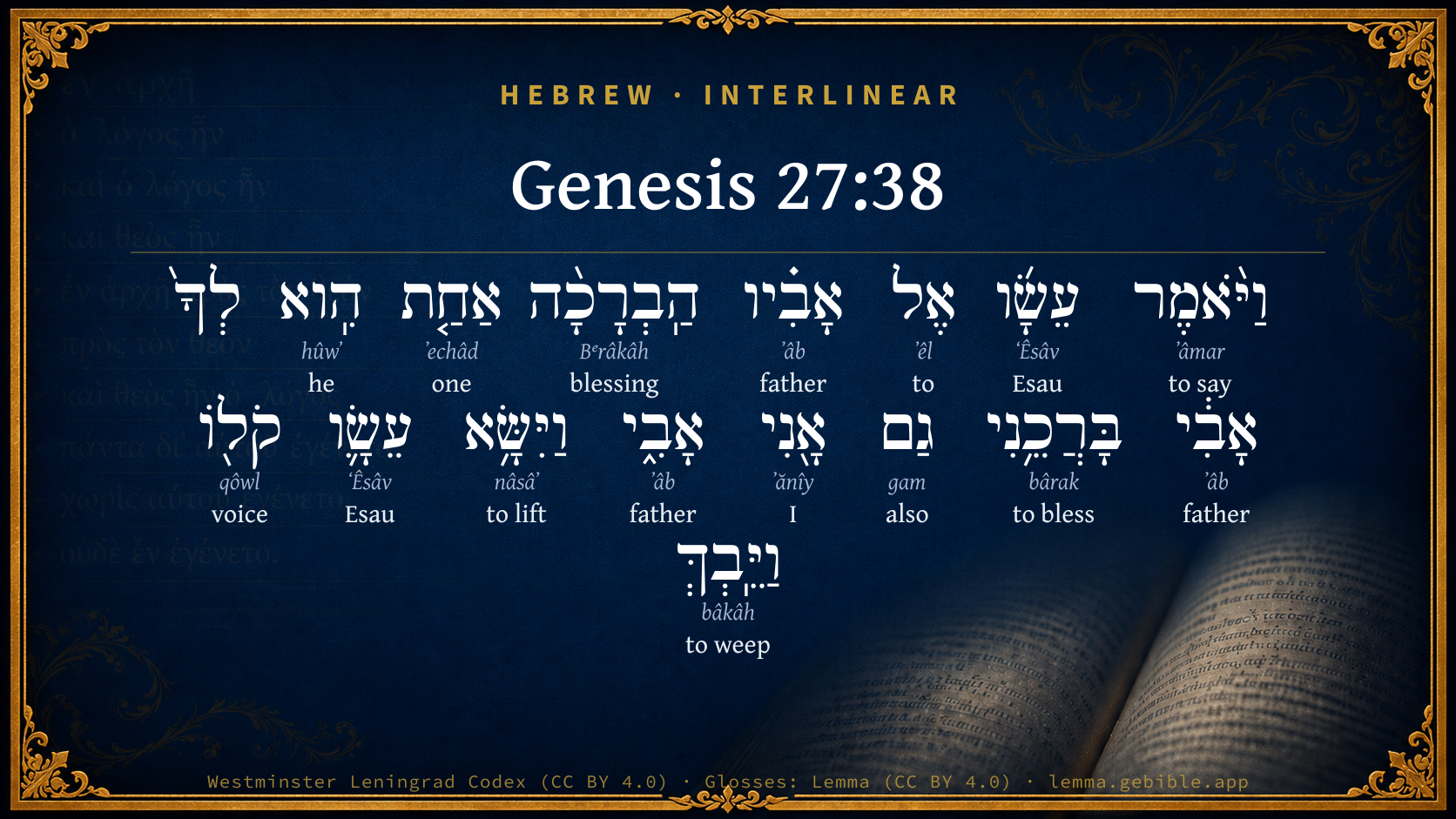
Genesis 27:38

Hebrew (Westminster Leningrad Codex) Genesis 27:38 appears in the Hebrew Old Testament. The text above is from the Westminster Leningrad Codex. Each word links to its Strong’s number, a concise gloss, and parsing drawn from the Open Scriptures Hebrew Bible morphology. Click any word for its full Brown-Driver-Briggs (BDB) entry.
Download image
Cite this verse

Genesis 27:38 (World English Bible). Public Domain. Lemma interlinear Bible study tool, https://lemma.gebible.app/v/genesis/27/38.

Show BibTeX & RIS
BibTeX
RIS
English Translation
Esau said to his father, "Have you but one blessing, my father? Bless me, even me also, my father." Esau lifted up his voice, and wept.
World English Bible · Public Domain
Download a study sheet

One document with this verse’s original text, its word-by-word gloss line, the meaning frame, cross-references with their text, attributed commentary, and full source and license credits — printable, and it pastes into notes with its structure intact.

This verse Autodidact and up

Study sheet (.html) Plain text (.txt)

A passage Seminary Student

Up to 50 verses in one chapter. A passage sheet keeps up to 6 commentary sources and 12 cross-references per verse, in the order this page ranks them, and says so on the sheet whenever that leaves anything out. Ask for a single verse and you get the Autodidact verse sheet above.

Everything on this page stays free to read, with no account — the sheet is a download of what is already on screen, not access to it.

Want to remove ads? Support Godless Engineer
Compare translations 3

The same verse in 3 English versions, stacked beneath the original-language interlinear above. Click any original word for its lexicon entry.

Each is an independent rendering of the whole verse — the interlinear is not word-aligned to these translations.

Highlighted words mark where these versions differ — a whole-verse word diff, not a word-by-word alignment.

  • World English Bible Public Domain
    Esau said to his father, "Have you but one blessing, my father? Bless me, even me also, my father." Esau lifted up his voice, and wept.
  • King James Version Public Domain
    And Esau said unto his father, Hast thou but one blessing, my father? bless me, even me also, O my father. And Esau lifted up his voice, and wept.
  • unfoldingWord Literal Text CC BY-SA 4.0
    But Esau said to his father, “Is there one blessing that you have, my father? Bless me, me too, my father!” Then Esau lifted his voice and sobbed.

unfoldingWord Literal Text — © unfoldingWord, licensed CC BY-SA 4.0. Word-aligned USFM3 via Door43 (git.door43.org/unfoldingWord/en_ult).

Versions to compare (up to 4)

3 of 4 selected

Show all 18 translations

Every available English version of this verse, each an independent rendering of the whole verse.

  • World English Bible Public Domain
    Esau said to his father, "Have you but one blessing, my father? Bless me, even me also, my father." Esau lifted up his voice, and wept.
  • Berean Standard Bible Public Domain
    Esau said to his father, “Do you have only one blessing, my father? Bless me too, O my father!” Then Esau wept aloud.
  • Majority Standard Bible Public Domain
    Esau said to his father, “Do you have only one blessing, my father? Bless me too, O my father!” Then Esau wept aloud.
  • King James Version Public Domain
    And Esau said unto his father, Hast thou but one blessing, my father? bless me, even me also, O my father. And Esau lifted up his voice, and wept.
  • American Standard Version (1901) Public Domain
    And Esau said unto his father, Hast thou but one blessing, my father? Bless me, even me also, O my father. And Esau lifted up his voice, and wept.
  • Revised Version (1885) Public Domain
    And Esau said unto his father, Hast thou but one blessing, my father? bless me, even me also, O my father. And Esau lifted up his voice, and wept.
  • Geneva Bible (1599) Public Domain
    Then Esau sayde vnto his father, Hast thou but one blessing my father? blesse mee, euen me also, my father: and Esau lifted vp his voyce, and wept.
  • Douay-Rheims (1899) Public Domain
    And Esac said to him: Hast thou only one blessing, father? I beseech thee bless me also. And when he wept with a loud cry,
  • Young's Literal Translation Public Domain
    And Esau saith unto his father, `One blessing hast thou my father? bless me, me also, O my father;' and Esau lifteth up his voice, and weepeth.
  • Literal Standard Version CC BY-SA 4.0
    And Esau says to his father, “One blessing have you my father? Bless me, me also, O my father”; and Esau lifts up his voice, and weeps.
  • Unlocked Literal Bible CC BY-SA 4.0
    Esau said to his father, “Have you not even one blessing for me, my father? Bless me, even me too, my father.” Esau wept loudly.
  • unfoldingWord Literal Text CC BY-SA 4.0
    But Esau said to his father, “Is there one blessing that you have, my father? Bless me, me too, my father!” Then Esau lifted his voice and sobbed.
  • Darby Bible Public Domain
    And Esau said to his father, Hast thou then but one blessing, my father? bless me -- me also, my father! And Esau lifted up his voice and wept.
  • World Messianic Bible Public Domain
    Esau said to his father, “Do you have just one blessing, my father? Bless me, even me also, my father.” Esau lifted up his voice, and wept.
  • Webster's Bible Public Domain
    And Esau said to his father, Hast thou but one blessing, my father? bless me, even me also, O my father. And Esau lifted up his voice, and wept.
  • Free Bible Version CC BY-SA 4.0
    “Do you only have one blessing, my father?” Esau asked. “Please bless me too!” Then Esau began to cry very loudly.
  • Bible in Basic English Public Domain
    And Esau said to his father, Is that the only blessing you have, my father? give a blessing to me, even me! And Esau was overcome with weeping.
  • JPS Tanakh (1917) Public Domain
    And Esau said unto his father: 'Hast thou but one blessing, my father? bless me, even me also, O my father.' And Esau lifted up his voice, and wept.

Literal Standard Version (2020), Covenant Press — licensed CC BY-SA 4.0. Text via the HelloAO Bible API (eBible.org). Unlocked Literal Bible (unfoldingWord) — licensed CC BY-SA 4.0. Text via the HelloAO Bible API (eBible.org). unfoldingWord Literal Text — © unfoldingWord, licensed CC BY-SA 4.0. Word-aligned USFM3 via Door43 (git.door43.org/unfoldingWord/en_ult). Free Bible Version, Dr. Jonathan Gallagher — licensed CC BY-SA 4.0. Text via the HelloAO Bible API (eBible.org).

Word by word

More ways to search: Search by grammar → Find every occurrence → Compare this word →

Practice this passage: Drill this verse → Learn its vocabulary →

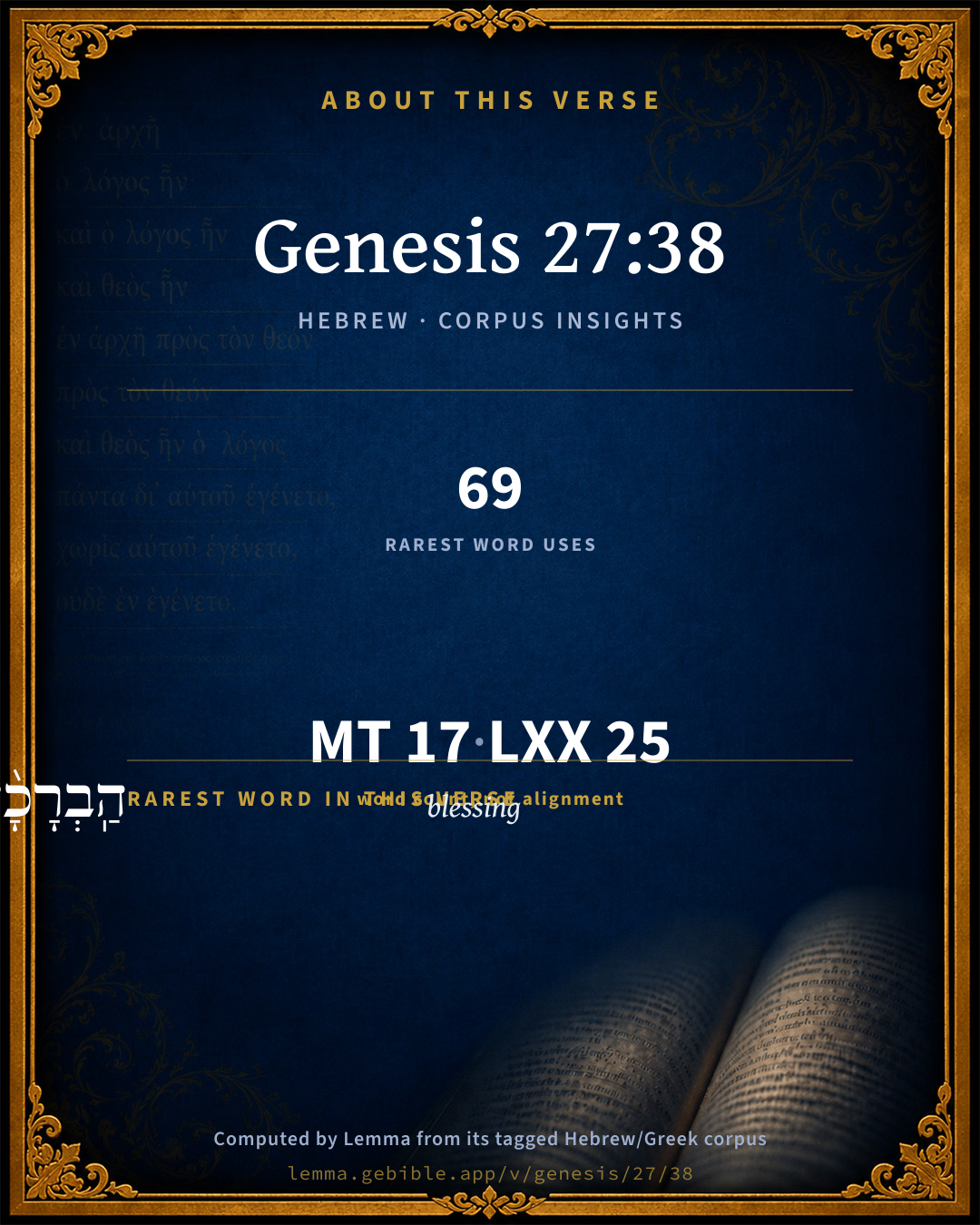
הַֽבְרָכָ֨ה
Bᵉrâkâh
H1293
“blessing”
Particle, Interrogative + Noun, Common, Feminine, Singular, Absolute
Part of Speech
Particle + Noun
Type
Common
Gender
Feminine
Number
Singular
State
Absolute
Full BDB Definition

Origin: from H1288

TWOT: None

blessing - (source of) blessing - blessing, prosperity - blessing, praise of God - a gift, present - treaty of peace
  1. וַיֹּ֨אמֶר ʼâmar H559 “and · to say” Conjunction + Verb, Qal, Sequential Imperfect, 3rd Person, Masculine, Singular
  2. עֵשָׂ֜ו ʻÊsâv H6215 “Esau” Noun, Proper
  3. אֶל ʼêl H413 “to” Preposition
  4. אָבִ֗יו ʼâb H1 “father · his” Noun, Common, Masculine, Singular, Construct + Suffix, Personal, 3rd Person, Masculine, Singular
  5. אַחַ֤ת ʼechâd H259 “one” Adjective, Cardinal number, Feminine, Singular, Absolute
  6. הִֽוא hûwʼ H1931 “he” Pronoun, Personal, 3rd Person, Feminine, Singular
  7. אָבִ֔י ʼâb H1 “father · my” Noun, Common, Masculine, Singular, Construct + Suffix, Personal, 1st Person, Common, Singular
  8. בָּרֲכֵ֥נִי bârak H1288 “bless · me” Verb, Piel, Imperative, 2nd Person, Masculine, Singular + Suffix, Personal, 1st Person, Common, Singular
  9. גַם gam H1571 “also” Adverb
  10. אָ֖נִי ʼănîy H589 “I” Pronoun, Personal, 1st Person, Common, Singular
  11. אָבִ֑י ʼâb H1 “father · my” Noun, Common, Masculine, Singular, Construct + Suffix, Personal, 1st Person, Common, Singular
  12. וַיִּשָּׂ֥א nâsâʼ H5375 “and · to lift” Conjunction + Verb, Qal, Sequential Imperfect, 3rd Person, Masculine, Singular
  13. עֵשָׂ֛ו ʻÊsâv H6215 “Esau” Noun, Proper
  14. קֹל֖וֹ qôwl H6963 “voice · his” Noun, Common, Masculine, Singular, Construct + Suffix, Personal, 3rd Person, Masculine, Singular
  15. וַיֵּֽבְךְּ bâkâh H1058 “and · to weep” Conjunction + Verb, Qal, Sequential Imperfect, 3rd Person, Masculine, Singular

About this verse

These counts appear in no published source. They are computed here, from the morphology-tagged text and Lemma’s own curated glosses. What Lemma adds →

17
words
13
distinct lemmas
Pentateuch
section

Grammatical profile

  • 4 verbs
  • 7 nouns
  • 1 adjective
  • 2 pronouns
  • 2 prepositions
  • 1 adverb

Verb forms

  • וַיֹּ֨אמֶר Qal · Sequential Imperfect
  • בָּרֲכֵ֥נִי Piel · Imperative
  • וַיִּשָּׂ֥א Qal · Sequential Imperfect
  • וַיֵּֽבְךְּ Qal · Sequential Imperfect

Repetition

Words recur within this verse — often emphatic in Hebrew:

  • אָבִ֗יו father H1 ×3
  • עֵשָׂ֜ו Esau H6215 ×2

Hebrew & Septuagint length

In English translation the verse runs 26 words from the Hebrew and 28 from the Septuagint (LXX English) — closely comparable.

A rough comparison of the two English renderings, which tokenize alike — not a word-level alignment.

Word counts can differ between the Hebrew and the Greek without any difference in meaning — e.g. the Hebrew direct-object marker אֵת has no separate Greek word, and Greek often adds the article ὁ.

In the original languages it is 17 Hebrew tokens and 25 Greek tokens — but the two are counted differently (Hebrew bundles its prefixes and suffixes into one token; the Greek is in lemma form), so that isn’t a like-for-like length.

Cross-references

7

Topical passages linked to Genesis 27:38 in the Treasury of Scripture Knowledge — connected by theme and wording, ordered by reader-vote popularity; previews shown in the World English Bible.

  • Hebrews 12:17 For you know that even when he afterward desired to inherit the blessing, he was rejected, for he found no place for a change of mind though he sought it diligently with tears.
  • Genesis 27:34 When Esau heard the words of his father, he cried with an exceeding great and bitter cry, and said to his father, "Bless me, even me also, my father."
  • Genesis 27:36 He said, "Isn't he rightly named Jacob? For he has supplanted me these two times. He took away my birthright. See, now he has taken away my blessing." He said, "Haven't you reserved a blessing for me?"
  • Genesis 49:28 All these are the twelve tribes of Israel, and this is what their father spoke to them and blessed them. He blessed everyone according to his blessing.
  • Proverbs 1:24–26 Because I have called, and you have refused; I have stretched out my hand, and no one has paid attention;
  • Isaiah 32:10–12 For days beyond a year shall you be troubled, you careless women; for the vintage shall fail, the harvest shall not come.
  • Isaiah 65:14 behold, my servants shall sing for joy of heart, but you shall cry for sorrow of heart, and shall wail for vexation of spirit.

Cross-references courtesy of OpenBible.info (CC BY 4.0).

Hebrew and Greek witnesses Masoretic Hebrew ↔ Greek Septuagint

The same verse in the two great witnesses to the Old Testament, shown verse-for-verse.

These are two independent witnesses, not word-aligned to each other, and the Septuagint is shown in lemma (dictionary) form.

Hebrew Genesis 27:38 Masoretic · Westminster Leningrad Codex

וַיֹּ֨אמֶר עֵשָׂ֜ו אֶל אָבִ֗יו הַֽבְרָכָ֨ה אַחַ֤ת הִֽוא לְךָ֙ אָבִ֔י בָּרֲכֵ֥נִי גַם אָ֖נִי אָבִ֑י וַיִּשָּׂ֥א עֵשָׂ֛ו קֹל֖וֹ וַיֵּֽבְךְּ

Esau said to his father, "Have you but one blessing, my father? Bless me, even me also, my father." Esau lifted up his voice, and wept.

World English Bible · Public Domain

Greek LXX Genesis 27:38 Septuagint · lemma form

εἶπον δέ ησαυ πρός ὁ πατήρ αὐτός μή εὐλογία εἷς σύ εἰμί πατήρ εὐλογέω δή καΐἐμός πατήρ κατανύττω δέ ισαακ ἀναβοάω φωνή ησαυ καί κλαίω

And Esau said to his father, Have you only one blessing, father? Bless, I pray you, me also, father. And Isaac being troubled, Esau cried aloud and wept.

LXX2012 (modern English Septuagint) · Public Domain

Hebrew: Westminster Leningrad Codex (CC BY 4.0). Greek: Septuagint (public domain); English from LXX2012 (modern English Septuagint) (Public Domain). How the Septuagint differs from the Hebrew →

Targum (Aramaic paraphrase)

2

The Targum is the ancient Jewish Aramaic paraphrase of the Hebrew Scriptures — an interpretive translation, not the Hebrew text itself. Onkelos (literal) and Pseudo-Jonathan (expansive) render the Torah, and Jonathan the Prophets. Coverage is partial: where no permissively-licensed English translation exists for a verse, only the Aramaic is shown. This is verse-level text, not a word-by-word alignment to the Hebrew.

  1. Targum Onkelos Torah (Genesis–Deuteronomy)
    וַאֲמַר עֵשָׂו לַאֲבוּהִי הֲבִרְכְּתָא חֲדָא הִיא לָךְ אַבָּא בָּרֵךְ לִי אַף אֲנָא אַבָּא וַאֲרֵים עֵשָׂו קָלֵהּ וּבְכָא

    (no public-domain English translation for this verse)

    Targum Onkelos — Aramaic: “Onkelos Genesis” (public domain); “Onkelos Exodus” (public domain); “Onkelos Leviticus” (public domain); “Onkelos Numbers” (public domain); “Onkelos Deuteronomy” (public domain). English: “Sefaria Community Translation” (CC0 1.0 (public-domain dedication)); “J.W. Etheridge. The Targums of Onkelos and Jonathan Ben Uzziel on the Pentateuch. London: Longmans, Green, 1862” (public domain). Text via Sefaria.

  2. Targum Pseudo-Jonathan Torah (Genesis–Deuteronomy)
    וַאֲמַר עֵשָו לְאָבוֹי הֲבִרְכָתָא חָדָא הוּא לָךְ אַבָּא בְּרֵיכְנִי אוּף לִי אַבָּא וְאָרֵים עֵשָו קָלֵיהּ וּבְכָא

    And Esau answered his father, Hast thou but one blessing, my father? Bless me, me also, my father. And Esau lifted up his voice and wept.

    Targum Pseudo-Jonathan — Aramaic: “Targum Jonathan on Genesis” (public domain); “Targum Jonathan on Exodus” (public domain); “Targum Jonathan on Leviticus” (public domain); “Targum Jonathan on Numbers” (public domain); “Targum Jonathan on Deuteronomy” (public domain). English: “The Targum of Jonathan ben Uzziel, trans. J. W. Etheridge, London, 1862” (public domain). Text via Sefaria.

Commentary

Notes on Genesis 27:38 from classic Christian and Jewish commentators (each source and its license shown beneath its notes). The classic Christian expositions comment on the surrounding passage and are grouped to its opening verse, so a note may address several verses; the Jewish commentaries on the Tanakh (Rashi and others) are per-verse, so they appear only where the commentator wrote on this verse.

Lemma curates 59 commentaries, every one of them public domain or Creative Commons licensed, each selected and text-cleaned for this edition rather than reprinted as found. About our sources →

Trapp's Complete Commentary

John Trapp

Gen 27:38 And Esau said unto his father, Hast thou but one blessing, my father? bless me, [even] me also, O my father. And Esau lifted up his voice, and wept.

Ver. 38. Esau lifted up his voice, and wept.] Yet, "found no place for repentance". {Heb 12:17} That is, he could not, by his tears, prevail with his father to reverse the blessing. See the fruit of God’s holy fear. Moses’ rod was not so famous for being turned into a serpent, for even the magicians did as much, as for devouring the magicians’ rods: so the true fear of God is most eminent and effectual when set in emulation or opposition to other fears or carnal aims and affections.

John Trapp, A Commentary or Exposition upon All the Books of the Old and New Testament (1647–1656) — public domain. Text from a community e-Sword module.

Geneva Bible (1599)

Geneva Bible translators

Or, I am also (thy son).

Geneva Bible (1599) marginal notes — public domain. Text via Bolls.life.

John Calvin's Commentaries

38. Hast thou but one blessing? Esau seems to take courage; but he neglects the care of his soul, and turns, like a swine, to the pampering of his flesh. He had heard that his father had nothing left to grant; because, truly, the full and entire grace of God so rested upon Jacob, that out of his family there was no happiness. Wherefore, if Esau sought his own welfare, he ought to have drawn from that fountain, and rather to have subjected himself to his brother, than to have cut himself off from a happy connection with him. He chose, however, rather to be deprived of spiritual grace, provided he might but possess something of his own, and apart from his brother, than to be his inferior at home. He could not be ignorant, that there was one sole benediction by which his brother Jacob had been constituted the heir of the divine covenant: for Isaac would be daily discoursing with them concerning the singular privilege which God had vouchsafed to Abraham and his seed. Esau would not previously have complained so bitterly, unless he had felt that he had been deprived of an incomparable benefit. Therefore, by departing from this one source of blessing, he indirectly renounces God, and cuts himself off from the body of the Church, caring for nothing but this transitory life. But it would have been better for him, miserably to perish through the want of all things in this world, and with difficulty to draw his languishing breath, than to slumber amidst temporal delights. What afterwards follows, — namely, that he wept with loud lamentations, — is a sign of fierce and proud indignation, rather than of penitence; for he remitted nothing of his ferocity, but raged like a cruel beast of prey. So the wicked, when punishment overtakes them, bewail the salvation they have lost; but, meanwhile, do not cease to delight themselves in their vices; and instead of heartily seeking after the righteousness of God, they rather desire that his deity should be extinct. Of a similar character is that gnashing of teeth and weeping in hell which, instead of stimulating the reprobate to seek after God, only consumes them with unknown torments

John Calvin's Commentaries (1540-1563) — public domain. Text from the Calvin Translation Society English edition (1840s-50s) via the Christian Classics Ethereal Library (ccel.org). Calvin's coverage is partial (roughly two-thirds of the Bible); uncommented books and verses are honest gaps, never fabricated. The 19th-century editor's footnotes and remarks are omitted so the notes are faithfully Calvin's own voice.

Ellicott's Commentary for English Readers

(38) Hast thou but one blessing?—Only one son could inherit the spiritual prerogatives of the birthright, and the temporal lordship which accompanied it. And even lower earthly blessings would avail little if Esau’s descendants were to be subject to the dominion of the other brother’s race. With some mitigation, then, of his lot Esau must now be content.

A Bible Commentary for English Readers, edited by Charles John Ellicott (1878–1897) — public domain. Text from a community e-Sword module.

The Cambridge Bible for Schools and Colleges

gen. ed. J. J. S. Perowne

38. but one blessing] Esau’s words shew the importance attached to the blessing invoked by the dying head of the family. Isaac’s words in the preceding verse, coupled with Esau’s exclamation, imply that there was only one blessing. Esau knows that the blessing once given cannot be recalled.

wept] Cf. Gen_21:16. “Those tears of Esau, the sensuous, wild, impulsive man,—almost like the cry of some ‘trapped creature,’ are among the most pathetic in the Bible” (Davidson, Hebrews, 242).

The Cambridge Bible for Schools and Colleges (gen. ed. J. J. S. Perowne; Cambridge University Press, 1878–1918) — public domain. Text from a community e-Sword module.

John Gill's Exposition

And Esau said unto his father, hast thou but one blessing, my father?.... He seems to speak diminutively of what had been given to Jacob, calling it one blessing: whereas there were many, and of different sorts, both temporal and spiritual; but it may be Esau had not so clear and comprehensive a view of what was contained in Jacob's blessing; or at least was willing to think and hope that there was not so much given, but there might be some behind for him, and that his father had a greater stock than to be drained of all at once:

bless me, even me also, O my father: with another blessing, with one equal to what has been given my brother:

and Esau lift up his voice, and wept; in order to move the affections of his father, and to prevail upon him to reverse the blessing he had bestowed on Jacob, and give it to him; but he could not bring his father to repentance, to change his mind, and revoke the blessing, and give it him, with all his crying and tears, as the apostle observes, Heb 12:17.

John Gill's Exposition of the Whole Bible (1746–1763) — public domain (CC PDM 1.0). Text via the HelloAO Bible API.

Matthew Poole's English Annotations

Hast thou but one? By these words Esau manifests his profane and worldly mind, that he esteemed this blessing but as one among many others equal to it, and did not apprehend the true and peculiar excellency and absolute necessity of it, and that it was impossible for him or his posterity to be happy without an interest in this covenant, and continuance in that church to which it was appropriated.

Matthew Poole's English Annotations on the Holy Bible (1683–1685) — public domain. Text from a community e-Sword/MySword module.

The Pulpit Commentary

And ESAU said unto his father, Hast thou but one blessing, my father? Not as desiring either the reversal of the patriarchal sentence upon Jacob, which he appears to have understood to be irrevocable, or an extension of its gracious provisions, so as to include him as well as Jacob; but as soliciting such a benediction as would place him, at least in respect of temporalities, on a level with the favorite of Rebekah, either because he did not recognize the spiritual character of the covenant blessing, or because, though recognizing it, he was willing to let it go.

Bless me, even me also, O my father. And Esau lifted up his voice, and wept (cf. Heb_12:17) "Those tear expressed, indeed, sorrow for his forfeiture, but not for the sinful levity by which it had been incurred. They were ineffectual (i.e. they did not lead to genuine repentance) because Esau was incapable of true repentance". (vide Delitzsch on Heb_12:17)

The Pulpit Commentary (1880–1919), ed. H.D.M. Spence-Jones & Joseph S. Exell — public domain. Text from a community e-Sword module.

Scofield Reference Notes

C. I. Scofield

and Esau

Esau wept because of a lost advantage, but "found no way to change his mind, though he sought it carefully with tears" Heb 12:17 so far may regret or remorse be from true repentance:

The Scofield Reference Bible (1917 edition), notes by C. I. Scofield — public domain. Text from a community e-Sword module.

unfoldingWord translationNotes

Door43 World Missions Community

Have you not even one blessing for me, my father

This can be stated in positive form. "My father, do you have one more blessing for me"

translationWords

bless

unfoldingWord translationNotes — © Distant Shores Media and the Door43 World Missions Community, licensed CC BY-SA 4.0. Source: git.door43.org/Door43/en_tn.

Rashi

Rabbi Shlomo Yitzchaki (Rashi)

הברכה אחת HAST THOU BUT ONE BLESSING? The ה in הברכה is the interrogative prefix, as in (Num. XIII. 19, 20) “whether in camps (הבמחנים)”, “whether it is fat (השמנה)", and (2 Sam. III. 33) “Should Abner die (הכמות) as a churl dieth”?

Rashi on the Tanakh — English translations: “The Judaica Press complete Tanach with Rashi, translated by A. J. Rosenberg” (CC BY 4.0); “Pentateuch with Rashi's commentary by M. Rosenbaum and A.M. Silbermann, 1929-1934” (public domain); “The Metsudah Tanach series, Lakewood, N.J” (CC BY 4.0); and “The Book of Joshua, Metsudah Publications, 1997” (CC BY 4.0). Text via Sefaria.

Radak

Rabbi David Kimhi (Radak)

ויאמר...אחת, can you not even grant me a blessing concerning any aspect of life which you have not given him?

Radak on the Tanakh — English translations: “Sefaria Community Translation” (CC0 1.0 (public-domain dedication)); “Eliyahu Munk, HaChut Hameshulash” (CC BY 4.0); “Rabbi Mike Feuer, Jerusalem Anthology” (CC BY 4.0); and “R. David Kimhi on the first book of Psalms, Translated by R.G. Finch, London, 1919” (public domain). Text via Sefaria.

Lesson kit

Teaching starters — assembled from the data on this page, not authored interpretation. Every prompt links to the verse data it draws on. Edit before teaching.

Genesis, in the Pentateuch, opens this verse with 17 words (13 distinct Hebrew lemmas). Its most distinctive word is Bᵉrâkâh (“blessing”). A historical commentator’s framing appears above. Read the whole chapter for the surrounding context.

Discussion questions

  1. How does “blessing” (Bᵉrâkâh) shape what this verse is saying?
  2. Hebrews 12:17 shares this passage’s theme. How do the two illuminate each other?
  3. “father” occurs 3× in this one verse. What is the effect of the repetition?
  4. These translations render this verse differently. What is at stake in choosing one wording over another?
  5. The verb «וַיֹּ֨אמֶר» is Qal Sequential Imperfect. How does its form color the action?
  6. Reading how Trapp's Complete Commentary and Geneva Bible (1599) read this verse, where do the two commentators agree and where do they part?

Things to notice

Reading settings

Reading text

Shown beneath each verse's original-language words.

Old Testament
Old Testament edition

Read the OT as the Masoretic Hebrew (MT) or the Greek Septuagint (LXX).

English shown for the Greek Septuagint (in the Hebrew ↔ Greek comparison).

Comparing translations? Open the Compare panel on any verse page to stack up to four side by side.