
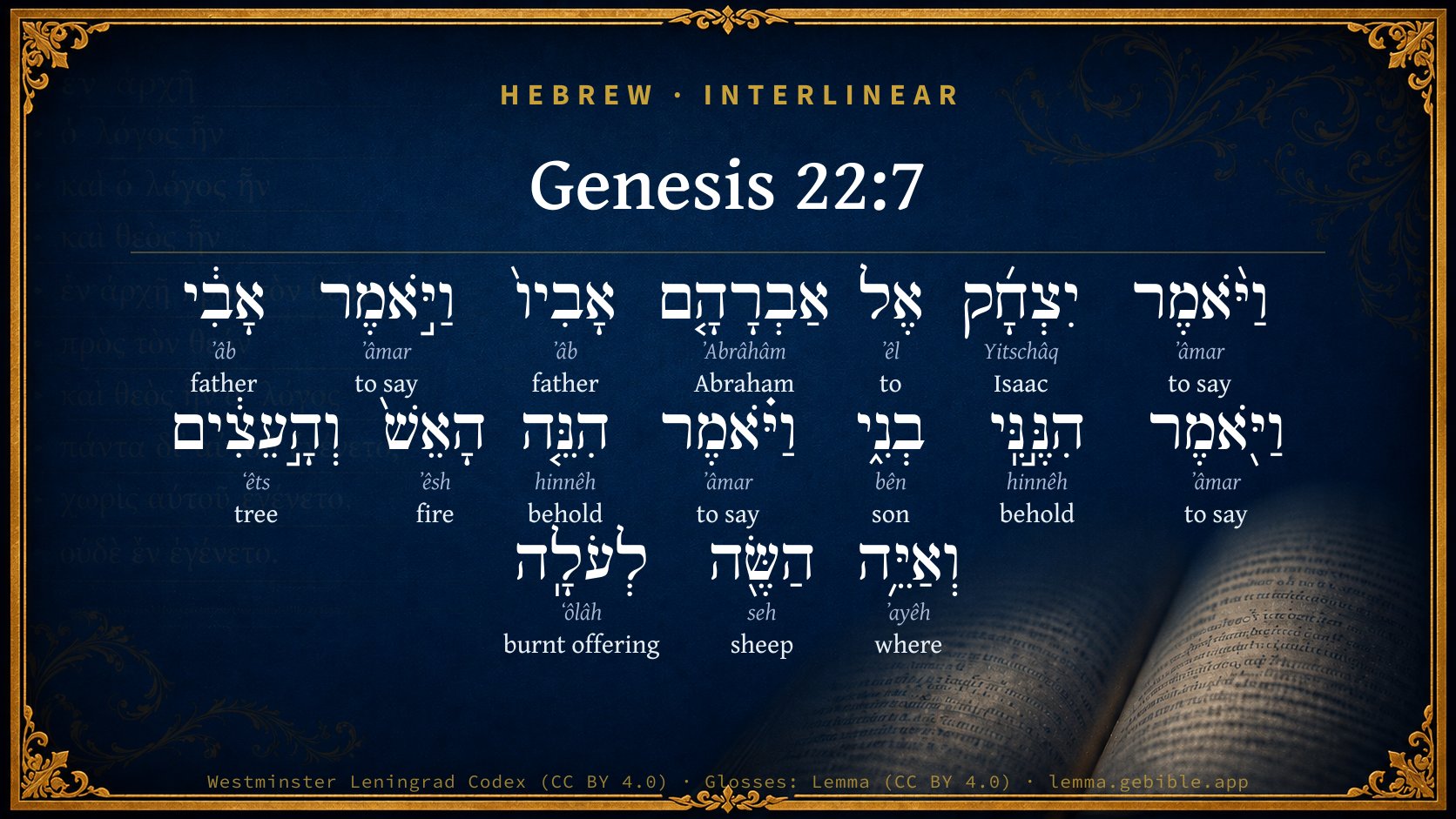
Genesis 22:7

Hebrew (Westminster Leningrad Codex) Genesis 22:7 appears in the Hebrew Old Testament. The text above is from the Westminster Leningrad Codex. Each word links to its Strong’s number, a concise gloss, and parsing drawn from the Open Scriptures Hebrew Bible morphology. Click any word for its full Brown-Driver-Briggs (BDB) entry.
Download image
Cite this verse

Genesis 22:7 (World English Bible). Public Domain. Lemma interlinear Bible study tool, https://lemma.gebible.app/v/genesis/22/7.

Show BibTeX & RIS
BibTeX
RIS
English Translation
Isaac spoke to Abraham his father, and said, "My father?" He said, "Here I am, my son." He said, "Here is the fire and the wood, but where is the lamb for a burnt offering?"
World English Bible · Public Domain
Highlights
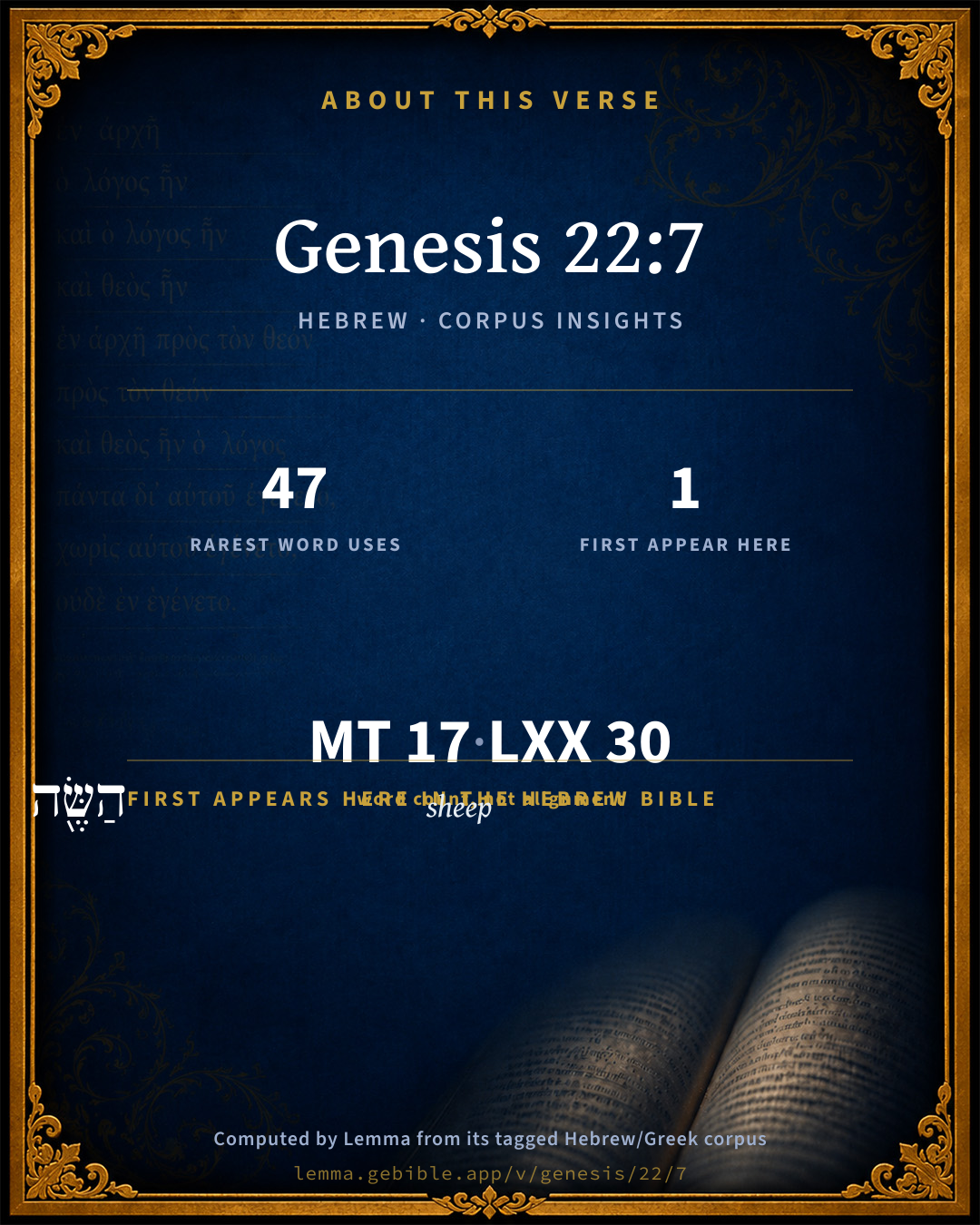
  • 1 first appearance in the Hebrew Bible
Full analysis ↓
Download a study sheet

One document with this verse’s original text, its word-by-word gloss line, the meaning frame, cross-references with their text, attributed commentary, and full source and license credits — printable, and it pastes into notes with its structure intact.

This verse Autodidact and up

Study sheet (.html) Plain text (.txt)

A passage Seminary Student

Up to 50 verses in one chapter. A passage sheet keeps up to 6 commentary sources and 12 cross-references per verse, in the order this page ranks them, and says so on the sheet whenever that leaves anything out. Ask for a single verse and you get the Autodidact verse sheet above.

Everything on this page stays free to read, with no account — the sheet is a download of what is already on screen, not access to it.

Want to remove ads? Support Godless Engineer
Compare translations 3

The same verse in 3 English versions, stacked beneath the original-language interlinear above. Click any original word for its lexicon entry.

Each is an independent rendering of the whole verse — the interlinear is not word-aligned to these translations.

Highlighted words mark where these versions differ — a whole-verse word diff, not a word-by-word alignment.

  • World English Bible Public Domain
    Isaac spoke to Abraham his father, and said, "My father?" He said, "Here I am, my son." He said, "Here is the fire and the wood, but where is the lamb for a burnt offering?"
  • King James Version Public Domain
    And Isaac spake unto Abraham his father, and said, My father: and he said, Here am I, my son. And he said, Behold the fire and the wood: but where is the lamb for a burnt offering?
  • unfoldingWord Literal Text CC BY-SA 4.0
    and Isaac spoke to Abraham his father and said, “My father?” And he said, “Behold me, my son.” Then he said, “Behold the fire and the wood, but where the lamb for the burnt offering?”

unfoldingWord Literal Text — © unfoldingWord, licensed CC BY-SA 4.0. Word-aligned USFM3 via Door43 (git.door43.org/unfoldingWord/en_ult).

Versions to compare (up to 4)

3 of 4 selected

Show all 18 translations

Every available English version of this verse, each an independent rendering of the whole verse.

  • World English Bible Public Domain
    Isaac spoke to Abraham his father, and said, "My father?" He said, "Here I am, my son." He said, "Here is the fire and the wood, but where is the lamb for a burnt offering?"
  • Berean Standard Bible Public Domain
    Then Isaac said to his father Abraham, “My father!” “Here I am, my son,” he replied. “The fire and the wood are here,” said Isaac, “but where is the lamb for the burnt offering?”
  • Majority Standard Bible Public Domain
    Then Isaac said to his father Abraham, “My father!” “Here I am, my son,” he replied. “The fire and the wood are here,” said Isaac, “but where is the lamb for the burnt offering?”
  • King James Version Public Domain
    And Isaac spake unto Abraham his father, and said, My father: and he said, Here am I, my son. And he said, Behold the fire and the wood: but where is the lamb for a burnt offering?
  • American Standard Version (1901) Public Domain
    And Isaac spake unto Abraham his father, and said, My father. And he said, Here am I, my son. And he said, Behold, the fire and the wood. But where is the lamb for a burnt-offering?
  • Revised Version (1885) Public Domain
    And Isaac spake unto Abraham his father, and said, My father: and he said, Here am I, my son. And he said, Behold, the fire and the wood: but where is the lamb for a burnt offering?
  • Geneva Bible (1599) Public Domain
    Then spake Izhak vnto Abraham his father, and said, My father. And he answered, Here am I, my sonne. And he said, Behold the fire and the wood, but where is the lambe for ye burnt offring?
  • Douay-Rheims (1899) Public Domain
    Isaac said to his father: My father. And he answered: What wilt thou, son? Behold, saith he, fire and wood: where is the victim for the holocaust?
  • Young's Literal Translation Public Domain
    And Isaac speaketh unto Abraham his father, and saith, `My father,' and he saith, `Here `am' I, my son.' And he saith, `Lo, the fire and the wood, and where the lamb for a burnt-offering?'
  • Literal Standard Version CC BY-SA 4.0
    And Isaac speaks to his father Abraham and says, “My father,” and he says, “Here I [am], my son.” And he says, “Behold, the fire and the wood, and where the lamb for a burnt-offering?”
  • Unlocked Literal Bible CC BY-SA 4.0
    Isaac spoke to Abraham his father and said, “My father,” and he said, “Here I am, my son.” He said, “See, here is the fire and the wood, but where is the lamb for the burnt offering?”
  • unfoldingWord Literal Text CC BY-SA 4.0
    and Isaac spoke to Abraham his father and said, “My father?” And he said, “Behold me, my son.” Then he said, “Behold the fire and the wood, but where the lamb for the burnt offering?”
  • Darby Bible Public Domain
    And Isaac spoke to Abraham his father, and said, My father! And he said, Here am I, my son. And he said, Behold the fire and the wood; but where is the sheep for a burnt-offering?
  • World Messianic Bible Public Domain
    Isaac spoke to Abraham his father, and said, “My father?” He said, “Here I am, my son.” He said, “Here is the fire and the wood, but where is the lamb for a burnt offering?”
  • Webster's Bible Public Domain
    And Isaac spoke to Abraham his father, and said, My father: and he said, here am I, my son. And he said, Behold the fire and the wood: but where is the lamb for a burnt-offering?
  • Free Bible Version CC BY-SA 4.0
    Isaac said to Abraham, “Father?” “Yes, my son?” Abraham replied. “Well, we have the fire and the wood, but where's the lamb for the burnt offering?” Isaac asked.
  • Bible in Basic English Public Domain
    Then Isaac said to Abraham, My father; and he said, Here am I, my son. And he said, We have wood and fire here, but where is the lamb for the burned offering?
  • JPS Tanakh (1917) Public Domain
    And Isaac spoke unto Abraham his father, and said: 'My father.' And he said: 'Here am I, my son.' And he said: 'Behold the fire and the wood; but where is the lamb for a burnt-offering?'

Literal Standard Version (2020), Covenant Press — licensed CC BY-SA 4.0. Text via the HelloAO Bible API (eBible.org). Unlocked Literal Bible (unfoldingWord) — licensed CC BY-SA 4.0. Text via the HelloAO Bible API (eBible.org). unfoldingWord Literal Text — © unfoldingWord, licensed CC BY-SA 4.0. Word-aligned USFM3 via Door43 (git.door43.org/unfoldingWord/en_ult). Free Bible Version, Dr. Jonathan Gallagher — licensed CC BY-SA 4.0. Text via the HelloAO Bible API (eBible.org).

Word by word

More ways to search: Search by grammar → Find every occurrence → Compare this word →

Practice this passage: Drill this verse → Learn its vocabulary →

וְאַיֵּ֥ה
ʼayêh
H346
“and · where”
Conjunction + Particle, Interrogative
Part of Speech
Conjunction + Particle
Type
Interrogative
Full BDB Definition

Origin: prolonged from H335

TWOT: 75a

where? - of persons, things - rhetorical
  1. וַיֹּ֨אמֶר ʼâmar H559 “and · to say” Conjunction + Verb, Qal, Sequential Imperfect, 3rd Person, Masculine, Singular
  2. יִצְחָ֜ק Yitschâq H3327 “Isaac” Noun, Proper
  3. אֶל ʼêl H413 “to” Preposition
  4. אַבְרָהָ֤ם ʼAbrâhâm H85 “Abraham” Noun, Proper
  5. אָבִיו֙ ʼâb H1 “father · his” Noun, Common, Masculine, Singular, Construct + Suffix, Personal, 3rd Person, Masculine, Singular
  6. וַיֹּ֣אמֶר ʼâmar H559 “and · to say” Conjunction + Verb, Qal, Sequential Imperfect, 3rd Person, Masculine, Singular
  7. אָבִ֔י ʼâb H1 “father · my” Noun, Common, Masculine, Singular, Construct + Suffix, Personal, 1st Person, Common, Singular
  8. וַיֹּ֖אמֶר ʼâmar H559 “and · to say” Conjunction + Verb, Qal, Sequential Imperfect, 3rd Person, Masculine, Singular
  9. הִנֶּ֣נִּֽי hinnêh H2009 “behold · me” Particle, Demonstrative + Suffix, Personal, 1st Person, Common, Singular
  10. בְנִ֑י bên H1121 “son · my” Noun, Common, Masculine, Singular, Construct + Suffix, Personal, 1st Person, Common, Singular
  11. וַיֹּ֗אמֶר ʼâmar H559 “and · to say” Conjunction + Verb, Qal, Sequential Imperfect, 3rd Person, Masculine, Singular
  12. הִנֵּ֤ה hinnêh H2009 “behold” Particle, Demonstrative
  13. הָאֵשׁ֙ ʼêsh H784 “the · fire” Particle, Definite Article + Noun, Common, Both, Singular, Absolute
  14. וְהָ֣עֵצִ֔ים ʻêts H6086 “and · the · trees” Conjunction + Particle, Definite Article + Noun, Common, Masculine, Plural, Absolute
  15. הַשֶּׂ֖ה seh H7716 “the · sheep” Particle, Definite Article + Noun, Common, Both, Singular, Absolute
  16. לְעֹלָֽה ʻôlâh H5930 “to/for · burnt offering” Preposition + Noun, Common, Feminine, Singular, Absolute

About this verse

These counts appear in no published source. They are computed here, from the morphology-tagged text and Lemma’s own curated glosses. What Lemma adds →

17
words
12
distinct lemmas
Pentateuch
section

First appearance in Scripture

This word makes its first canonical appearance in the Hebrew Bible here:

  • הַשֶּׂ֖ה sheep H7716

Shared distinctive vocabulary

וְאַיֵּ֥ה where H346 occurs in 40 verses of the Hebrew Bible. Also found in:

Grammatical profile

  • 4 verbs
  • 9 nouns
  • 1 preposition
  • 3 particles

Verb forms

  • וַיֹּ֨אמֶר Qal · Sequential Imperfect
  • וַיֹּ֣אמֶר Qal · Sequential Imperfect
  • וַיֹּ֖אמֶר Qal · Sequential Imperfect
  • וַיֹּ֗אמֶר Qal · Sequential Imperfect

Repetition

Words recur within this verse — often emphatic in Hebrew:

  • וַיֹּ֨אמֶר to say H559 ×4
  • אָבִיו֙ father H1 ×2
  • הִנֶּ֣נִּֽי behold H2009 ×2

Hebrew & Septuagint length

In English translation the verse runs 35 words from the Hebrew and 33 from the Septuagint (LXX English) — closely comparable.

A rough comparison of the two English renderings, which tokenize alike — not a word-level alignment.

Word counts can differ between the Hebrew and the Greek without any difference in meaning — e.g. the Hebrew direct-object marker אֵת has no separate Greek word, and Greek often adds the article ὁ.

In the original languages it is 17 Hebrew tokens and 30 Greek tokens — but the two are counted differently (Hebrew bundles its prefixes and suffixes into one token; the Greek is in lemma form), so that isn’t a like-for-like length.

Cross-references

7

Topical passages linked to Genesis 22:7 in the Treasury of Scripture Knowledge — connected by theme and wording, ordered by reader-vote popularity; previews shown in the World English Bible.

  • Romans 8:15 For you didn't receive the spirit of bondage again to fear, but you received the Spirit of adoption, by whom we cry, "Abba! Father!"
  • Genesis 4:2–4 Again she gave birth, to Cain's brother Abel. Abel was a keeper of sheep, but Cain was a tiller of the ground.
  • Genesis 8:20 Noah built an altar to Yahweh, and took of every clean animal, and of every clean bird, and offered burnt offerings on the altar.
  • Exodus 12:3 Speak to all the congregation of Israel, saying, 'On the tenth day of this month, they shall take to them every man a lamb, according to their fathers' houses, a lamb for a household;
  • Matthew 26:39 He went forward a little, fell on his face, and prayed, saying, "My Father, if it is possible, let this cup pass away from me; nevertheless, not what I desire, but what you desire."
  • Matthew 26:42 Again, a second time he went away, and prayed, saying, "My Father, if this cup can't pass away from me unless I drink it, your desire be done."
  • John 18:11 Jesus therefore said to Peter, "Put the sword into its sheath. The cup which the Father has given me, shall I not surely drink it?"

Cross-references courtesy of OpenBible.info (CC BY 4.0).

Hebrew and Greek witnesses Masoretic Hebrew ↔ Greek Septuagint

The same verse in the two great witnesses to the Old Testament, shown verse-for-verse.

These are two independent witnesses, not word-aligned to each other, and the Septuagint is shown in lemma (dictionary) form.

Hebrew Genesis 22:7 Masoretic · Westminster Leningrad Codex

וַיֹּ֨אמֶר יִצְחָ֜ק אֶל אַבְרָהָ֤ם אָבִיו֙ וַיֹּ֣אמֶר אָבִ֔י וַיֹּ֖אמֶר הִנֶּ֣נִּֽי בְנִ֑י וַיֹּ֗אמֶר הִנֵּ֤ה הָאֵשׁ֙ וְהָ֣עֵצִ֔ים וְאַיֵּ֥ה הַשֶּׂ֖ה לְעֹלָֽה

Isaac spoke to Abraham his father, and said, "My father?" He said, "Here I am, my son." He said, "Here is the fire and the wood, but where is the lamb for a burnt offering?"

World English Bible · Public Domain

Greek LXX Genesis 22:7 Septuagint · lemma form

εἶπον δέ ισαακ πρός αβρααμ ὁ πατήρ αὐτός εἶπον πατήρ ὁ δέ εἶπον τίς εἰμί τέκνον λέγω ἰδού ὁ πῦρ καί ὁ ξύλον ποῦ εἰμί ὁ πρόβατον ὁ εἰς ὁλοκάρπωσις

And Isaac said to Abraam his father, Father. And he said, What is it, son? And he said, Behold the fire and the wood, where is the sheep for a whole burnt offering?

LXX2012 (modern English Septuagint) · Public Domain

Hebrew: Westminster Leningrad Codex (CC BY 4.0). Greek: Septuagint (public domain); English from LXX2012 (modern English Septuagint) (Public Domain). How the Septuagint differs from the Hebrew →

Targum (Aramaic paraphrase)

2

The Targum is the ancient Jewish Aramaic paraphrase of the Hebrew Scriptures — an interpretive translation, not the Hebrew text itself. Onkelos (literal) and Pseudo-Jonathan (expansive) render the Torah, and Jonathan the Prophets. Coverage is partial: where no permissively-licensed English translation exists for a verse, only the Aramaic is shown. This is verse-level text, not a word-by-word alignment to the Hebrew.

  1. Targum Onkelos Torah (Genesis–Deuteronomy)
    וַאֲמַר יִצְחָק לְאַבְרָהָם אֲבוּהִי וַאֲמַר אַבָּא וַאֲמַר הָא אֲנָא בְרִי וַאֲמַר הָא אֶשָּׁתָא וְאָעַיָּא וְאָן אִימְרָא לַעֲלָתָא

    (no public-domain English translation for this verse)

    Targum Onkelos — Aramaic: “Onkelos Genesis” (public domain); “Onkelos Exodus” (public domain); “Onkelos Leviticus” (public domain); “Onkelos Numbers” (public domain); “Onkelos Deuteronomy” (public domain). English: “Sefaria Community Translation” (CC0 1.0 (public-domain dedication)); “J.W. Etheridge. The Targums of Onkelos and Jonathan Ben Uzziel on the Pentateuch. London: Longmans, Green, 1862” (public domain). Text via Sefaria.

  2. Targum Pseudo-Jonathan Torah (Genesis–Deuteronomy)
    וַאֲמַר יִצְחָק לְאַבְרָהָם אָבוֹי וַאֲמַר אַבָּא וַאֲמַר הָא נָא וְאָמַר אֶשְׁתָּא וְקִיסִין וְהָאן אִמְרָא לְעָלָתָא

    And Izhak spake to Abraham his father and said, My Father! And he said, I am. And he said, Behold the fire and the wood: where is the lamb for the offering?

    Targum Pseudo-Jonathan — Aramaic: “Targum Jonathan on Genesis” (public domain); “Targum Jonathan on Exodus” (public domain); “Targum Jonathan on Leviticus” (public domain); “Targum Jonathan on Numbers” (public domain); “Targum Jonathan on Deuteronomy” (public domain). English: “The Targum of Jonathan ben Uzziel, trans. J. W. Etheridge, London, 1862” (public domain). Text via Sefaria.

Commentary

Notes on Genesis 22:7 from classic Christian and Jewish commentators (each source and its license shown beneath its notes). The classic Christian expositions comment on the surrounding passage and are grouped to its opening verse, so a note may address several verses; the Jewish commentaries on the Tanakh (Rashi and others) are per-verse, so they appear only where the commentator wrote on this verse.

Lemma curates 59 commentaries, every one of them public domain or Creative Commons licensed, each selected and text-cleaned for this edition rather than reprinted as found. About our sources →

Trapp's Complete Commentary

John Trapp

Gen 22:7 And Isaac spake unto Abraham his father, and said, My father: and he said, Here [am] I, my son. And he said, Behold the fire and the wood: but where [is] the lamb for a burnt offering?

Ver. 7. Where is the lamb for a burnt offering.] Isaac was not to be told now what belonged to a sacrifice. He had been long since taught by his father what was to be done in the service of God. "When I was young, my father taught me," saith Solomon, {Pro 4:4} so did his mother also, {Pro 31:1-31} in her Lemuel’s lesson. Plantus tenellas frequentius adaquare proderit , saith Primasius. {a}

{a} Primas, in Philip. Greg. Moral., lib. xxvii cap. 14.

John Trapp, A Commentary or Exposition upon All the Books of the Old and New Testament (1647–1656) — public domain. Text from a community e-Sword module.

Joseph Benson's Commentary

Gen 22:7. Behold the fire and the wood: but where is the lamb? — This is,

1st, A trying question to Abraham; how could he endure to think that Isaac is himself the lamb? 2d, It is a teaching question to us all, that when we are going to worship God, we should seriously consider whether we have every thing ready, especially the “lamb for a burnt-offering.” Behold, the fire is ready, the Spirit’s assistance, and God’s acceptance: the wood is ready, the instituted ordinances, designed to kindle our affections, which indeed, without the Spirit, are but like wood without fire. All things are now ready, but where is the lamb? — Where is the heart? Is that ready to be offered up to God, to ascend to him as a burnt-offering?

Joseph Benson's Commentary on the Old and New Testaments (1811–1818) — public domain. Text from a community e-Sword module.

Tyndale Open Study Notes

Tyndale Open Resources

22:7-8 In response to Isaac’s question, Abraham again showed his faith in the Lord, saying God will provide, although he was not sure how. This theme is central to the entire narrative.

Tyndale Open Study Notes — © Tyndale Open Resources, licensed CC BY-SA 4.0. Text via the HelloAO Bible API.

Adam Clarke's Commentary

Verse 7. Behold the fire and the wood: but where is the lamb] Nothing can be conceived more tender, affectionate, and affecting, than the question of the son and the reply of the father on this occasion. A paraphrase would spoil it; nothing can be added without injuring those expressions of affectionate submission on the one hand, and dignified tenderness and simplicity on the other.

Adam Clarke's Commentary on the Bible (1810–1826) — public domain. Text from a community e-Sword/MySword module.

John Calvin's Commentaries

7. My father. God produces here a new instrument of torture, by which he may, more and more, torment the breast of Abraham, already pierced with so many wounds. And it is not to be doubted, that God designedly both framed the tongue of Isaac to this tender appellation, and directed it to this question, in order that nothing might be wanting to the extreme severity of Abraham’s grief. Yet the holy man sustains even this attack with invincible courage; and is so far from being disturbed in his proposed course, that he shows himself to be entirely devoted to God, hearkening to nothing which should either shake his confidence, or hinder his obedience. But it is important to notice the manner in which he unties this inextricable knot; namely, by taking refuge in Divine Providence, God will provide himself a lamb. This example is proposed for our imitation. Whenever the Lord gives a command, many things are perpetually occurring to enfeeble our purpose: means fail, we are destitute of counsel, all avenues seem closed. In such straits, the only remedy against despondency is, to leave the event to God, in order that he may open a way for us where there is none. For as we act unjustly towards God when we hope for nothing from him but what our senses can perceive, so we pay Him the highest honor, when, in affairs of perplexity, we nevertheless entirely acquiesce in his providence.

John Calvin's Commentaries (1540-1563) — public domain. Text from the Calvin Translation Society English edition (1840s-50s) via the Christian Classics Ethereal Library (ccel.org). Calvin's coverage is partial (roughly two-thirds of the Bible); uncommented books and verses are honest gaps, never fabricated. The 19th-century editor's footnotes and remarks are omitted so the notes are faithfully Calvin's own voice.

The Cambridge Bible for Schools and Colleges

gen. ed. J. J. S. Perowne

7. And Isaac spake] The pathos of the narrative reaches its climax in the simple expression of boyish curiosity, indicating a knowledge of his father’s regular usages of sacrifice.

“Here am I, my son?” is a little formal as a rendering. It is equivalent to a father’s reply: “Well, boy, what is it?”

The Cambridge Bible for Schools and Colleges (gen. ed. J. J. S. Perowne; Cambridge University Press, 1878–1918) — public domain. Text from a community e-Sword module.

John Gill's Exposition

And Isaac spake unto Abraham his father,.... As they were walking together:

and said, my father; a cutting word to Abraham, who knew what he was going to do with him, so contrary to the relation and affection of a parent:

and he said, here am I, my son; what hast thou to say to me? I am ready to answer thee; he owns the relation he stood in unto him, a sense of which he had not put off, and curbs his affections, which must be inwardly moving towards him, and showed great strength of faith to grapple with such a trying exercise:

and he said, behold the fire and the wood; the fire which his father had his hand, and the wood which was upon his own, shoulders:

but where is the lamb for a burnt offering? he perceived by the preparation made, by the fire and the wood, that it was to be a burnt offering which they were going to offer; but there being no creature provided for the sacrifice, he puts this question, by which it appears that as yet he was quite ignorant of the true design of this journey, and little thought that he was to be the sacrifice: however, from what he said, it plain he had been used to sacrifices, and had been trained up in them, and had seen them performed, and knew the nature of them, and what were requisite unto them.

John Gill's Exposition of the Whole Bible (1746–1763) — public domain (CC PDM 1.0). Text via the HelloAO Bible API.

Haydock's Catholic Bible Commentary

Holocaust. These were probably the only sacrifices yet in use. (Calmet) --- The conversation of Isaac could not fail to pierce the heart of his father. (Menochius)

George Leo Haydock (1774–1849), Haydock's Catholic Family Bible and Commentary, 1859 edition — public domain. Excludes Psalms (Douay-Rheims chapter numbering differs from Protestant) and Deuterocanonical books (Catholic canon only).

Matthew Poole's English Annotations

My father; a compellation which might both wound Abraham’s heart, and admonish him how unbecoming to a father that action was which he was going about.

Here am I, my son; which expression showed that he had not put off fatherly affection to him, and that his intention did not arise from any unnatural and barbarous disposition, nor from any decay of love to him, but from a higher cause, even the declared will of God.

Matthew Poole's English Annotations on the Holy Bible (1683–1685) — public domain. Text from a community e-Sword/MySword module.

Whedon's Commentary on the Bible

Daniel D. Whedon

7. My father — The narrative, in its life-like simplicity, evidences its own genuineness. It was probably often repeated by Isaac to his sons, and by them handed down, till it took this written form.

Where is the lamb — A most searching question, painful to Abraham’s heart, and prompting the prophetic utterance recorded in the next verse, where Abraham again speaks more wisely than he knew. Comp. Gen_22:5.

Daniel D. Whedon (gen. ed.), Commentary on the Old and New Testaments (1874–1909) — public domain. Text from a community e-Sword module.

The Pulpit Commentary

And Isaac spoke to Abraham his father, during the progress of the journey, after leaving the young men, solitude inviting him to give expression to thoughts which had been rising in his bosom, but which the presence of companions had constrained him to suppressand said, My father: a term of filial reverence and endearment that must have lacerated Abraham"s heart. As used by Isaac it signified a desire to interrogate his parentand he said, Here am I, my son (literally, Behold me, my son Well, my son, what is it? in colloquial English). And he said, Behold the fire and the wood: but where is the lamb for a burnt offering. Another hint that the sacrificial system did not originate with Moses.

The Pulpit Commentary (1880–1919), ed. H.D.M. Spence-Jones & Joseph S. Exell — public domain. Text from a community e-Sword module.

John Wesley's Explanatory Notes

Behold the fire and the wood, but where is the lamb? - This is,

1. A trying question to Abraham; how could he endure to think that Isaac is himself the lamb?

2. 'Tis a teaching question to us all, that when we are going to worship God, we should seriously consider whether we have every thing ready, especially the lamb for a burnt-offering. Behold, the fire is ready; that is, the Spirit's assistance, and God's acceptance: the wood is ready, the instituted ordinances designed to kindle our affections, which indeed, without the Spirit, are but like wood without fire, but the Spirit works by them. All things are now ready, but where is the lamb? Where is the heart? Is that ready to be offered up to God, to ascend to him as a burnt- offering?

John Wesley, Explanatory Notes Upon the Whole Bible (1754–1765) — public domain. Text via the GEBible commentary corpus.

unfoldingWord translationNotes

Door43 World Missions Community

My father

This is a loving way for a son to speak to his father.

Here I am

"Yes, I am listening" or "Yes, what is it?" See how you translated this in Genesis 22:1.

my son

This is a loving way for a father to speak to his son.

the fire

Here "fire" stands for a pan containing burning coals or a torch or lamp. See how you translated this in Genesis 22:6. (See: Synecdoche)

the lamb for the burnt offering

"the lamb that you will give as a burnt offering"

God himself

Here "himself" emphasizes that it is God who will provide the lamb. (See: Reflexive Pronouns)

will provide

"will give us"

translationWords

Isaac

Abraham

lamb

burnt offering

unfoldingWord translationNotes — © Distant Shores Media and the Door43 World Missions Community, licensed CC BY-SA 4.0. Source: git.door43.org/Door43/en_tn.

Radak

Rabbi David Kimhi (Radak)

הנני בני, with a dagesh also in the second letter נ.

Radak on the Tanakh — English translations: “Sefaria Community Translation” (CC0 1.0 (public-domain dedication)); “Eliyahu Munk, HaChut Hameshulash” (CC BY 4.0); “Rabbi Mike Feuer, Jerusalem Anthology” (CC BY 4.0); and “R. David Kimhi on the first book of Psalms, Translated by R.G. Finch, London, 1919” (public domain). Text via Sefaria.

Lesson kit

Teaching starters — assembled from the data on this page, not authored interpretation. Every prompt links to the verse data it draws on. Edit before teaching.

Genesis, in the Pentateuch, opens this verse with 17 words (12 distinct Hebrew lemmas). Its most distinctive word is ʼayêh (“where”). A historical commentator’s framing appears above. Read the whole chapter for the surrounding context.

Discussion questions

  1. The word ʼayêh carries the sense “where.” How does it shape the verse?
  2. This is the first place “sheep” appears in Scripture (first appears here). What does its debut here establish?
  3. How does Genesis 18:9, which shares the word «where», read alongside this verse?
  4. What does the repetition of “to say” (4× in this one verse) do in this verse?
  5. These translations render this verse differently; the difference is in the English rendering, not the original. What questions does that raise?
  6. «וַיֹּ֨אמֶר» is a Qal Sequential Imperfect verb. How does that grammatical form shape the action described?
  7. Compare how Trapp's Complete Commentary and Joseph Benson's Commentary read this verse. Where do they agree or differ?

Things to notice

Reading settings

Reading text

Shown beneath each verse's original-language words.

Old Testament
Old Testament edition

Read the OT as the Masoretic Hebrew (MT) or the Greek Septuagint (LXX).

English shown for the Greek Septuagint (in the Hebrew ↔ Greek comparison).

Comparing translations? Open the Compare panel on any verse page to stack up to four side by side.