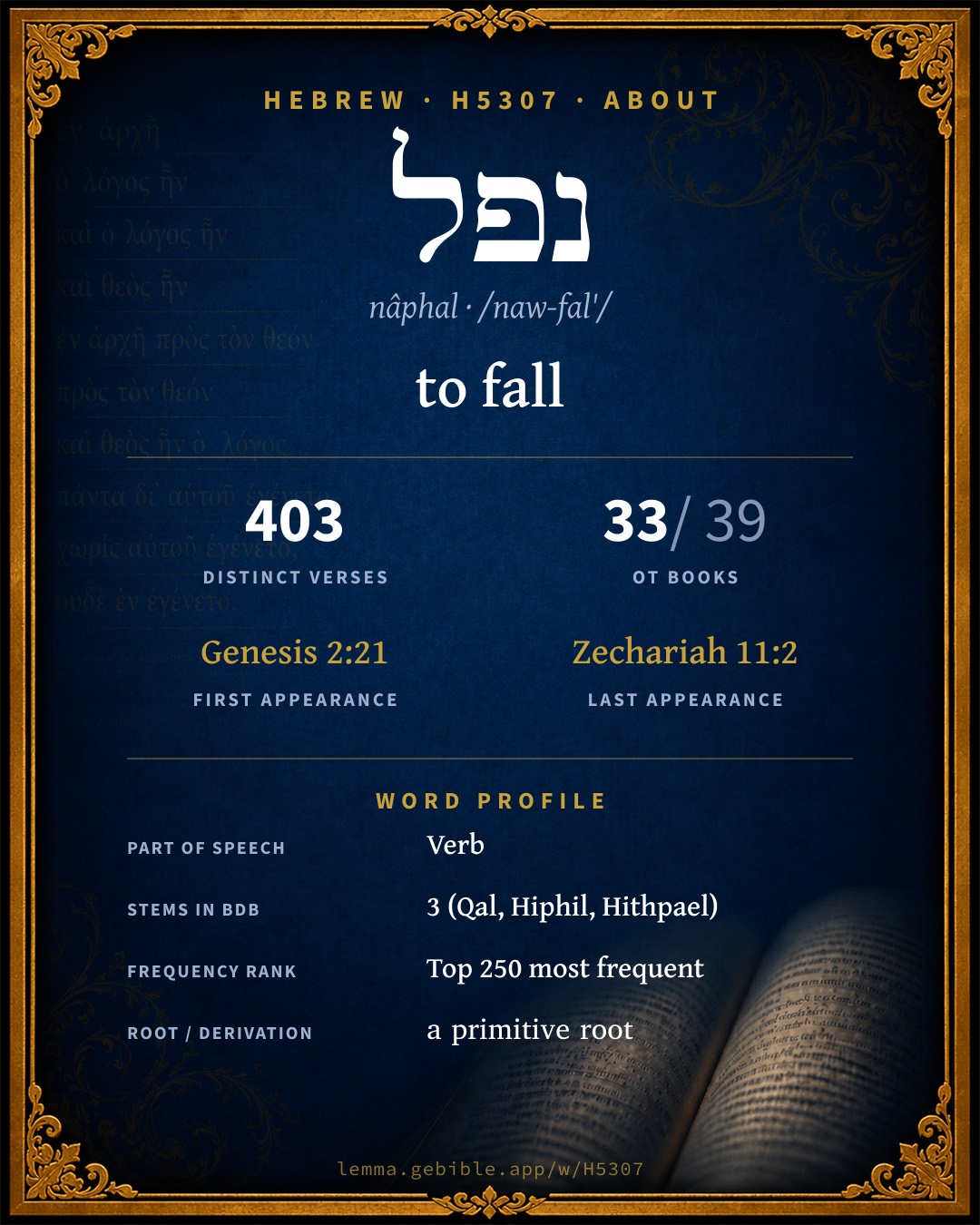
נָפַל
to fall
also: lie, be cast down, fail fuller range ↓
Full lexicon entry — Brown-Driver-Briggs (BDB)
From Brown-Driver-Briggs (BDB)
Where this word appears
See every Qal verb in the Hebrew Bible →
Grammar key — what these labels mean
Part of speech
- Verb
- An action or state-of-being word.
Stem
- Qal
- The basic, simple active stem — the plain form of the verb (“he wrote”). Here: ‘fall’
- Hiphil
- The causative active stem (“he caused / brought about”). Here: ‘cause to fall’
- Hithpael
- The reflexive or reciprocal stem (the subject acts on itself). Here: ‘throw’
- Pilpel
- A reduplicated intensive stem of two-letter or hollow roots.
Form
- Sequential Imperfect
- An imperfect with prefixed waw — the standard past-narrative form (waw-consecutive imperfect).
- Imperfect
- An incomplete, ongoing, or future action (“he will / would write”).
- Perfect
- A completed action or state — Hebrew marks aspect (completeness) more than strict tense (“he wrote”).
- Participle Active
- A verbal adjective expressing ongoing or characteristic action (“writing / one who writes”).
- Sequential Perfect
- A perfect with prefixed waw continuing a preceding imperfect or command (waw-consecutive perfect).
- Infinitive Construct
- A bound verbal noun, frequently with prepositions (“to write / in writing”).
- Cohortative
- A first-person volitional form expressing wish or resolve (“let me / let us write”).
- Jussive
- A third- or second-person volitional form expressing wish or command (“let him write”).
- Imperative
- A direct command (“write!”).
- Infinitive Absolute
- An unbound verbal noun, often intensifying or standing in for a finite verb.
State
- Absolute
- The independent form of a noun, not bound to a following word.
Person
- 3rd Person
- The one spoken about (“he / she / it / they”).
- 1st Person
- The speaker (“I / we”).
- 2nd Person
- The one addressed (“you”).
Gender
- Masculine
- Grammatically masculine.
- Common
- Either gender — not distinguished for this form.
- Feminine
- Grammatically feminine.
Number
- Singular
- One.
- Plural
- More than one (in Hebrew, generally three or more).
Grammatical forms 61 distinct
- Verb, Qal, Sequential Imperfect, 3rd Person, Masculine, Singular 44 times (10%)
- Verb, Qal, Imperfect, 3rd Person, Masculine, Singular 41 times (9%)
- Verb, Qal, Imperfect, 3rd Person, Masculine, Plural 35 times (8%)
- Verb, Qal, Perfect, 3rd Person, Common, Plural 32 times (7%)
- Verb, Qal, Sequential Imperfect, 3rd Person, Masculine, Plural 28 times (6%)
- Verb, Qal, Perfect, 3rd Person, Masculine, Singular 27 times (6%)
- Verb, Qal, Participle Active, Masculine, Singular, Absolute 18 times (4%)
- Verb, Qal, Participle Active, Masculine, Plural, Absolute 18 times (4%)
+53 more forms (192 occurrences)
Parsed forms decoded from the imported morphology (morphhb / Westminster Leningrad Codex — WLC text public domain, morphhb tagging CC BY 4.0), counted across 435 parsed occurrences — not distinct verses.
Page 1 of 3 — showing verses 1–200 of 403 distinct verses where H5307 appears, across 33 books. Click any verse to open its interlinear word-by-word view. Verse text shown in the World English Bible for context — . Each verse’s Hebrew form is shown with its reference; the English is not keyword-highlighted, since the data carries no word-level English alignment. Use “Compare translations” on any verse to read it across multiple English versions. This concordance covers the Hebrew Bible; Septuagint (Greek Old Testament) occurrences are not indexed here.
Genesis 17 verses
- Genesis 2:21 וַ/יַּפֵּל֩ conj + Hiphil wimpf 3ms Yahweh God caused a deep sleep to fall on the man, and he slept; and he took one of his ribs, and closed up the flesh in its place.
- Genesis 4:5 וַֽ/יִּפְּל֖וּ conj + Qal wimpf 3mp but he didn't respect Cain and his offering. Cain was very angry, and the expression on his face fell.
- Genesis 4:6 נָפְל֥וּ Qal pf 3cp Yahweh said to Cain, "Why are you angry? Why has the expression of your face fallen?
- Genesis 14:10 וַ/יִּפְּלוּ conj + Qal wimpf 3mp Now the valley of Siddim was full of tar pits; and the kings of Sodom and Gomorrah fled, and they fell there, and those who remained fled to the mountain.
- Genesis 15:12 נָפְלָ֣ה נֹפֶ֥לֶת Qal pf 3fs Qal ptcp.act fs When the sun was going down, a deep sleep fell on Abram. Now terror and great darkness fell on him.
- Genesis 17:3 וַ/יִּפֹּ֥ל conj + Qal wimpf 3ms Abram fell on his face. God talked with him, saying,
- Genesis 17:17 וַ/יִּפֹּ֧ל conj + Qal wimpf 3ms Then Abraham fell on his face, and laughed, and said in his heart, "Will a child be born to him who is one hundred years old? Will Sarah, who is ninety years old, give birth?"
- Genesis 24:64 וַ/תִּפֹּ֖ל conj + Qal wimpf 3fs Rebekah lifted up her eyes, and when she saw Isaac, she dismounted from the camel.
- Genesis 25:18 נָפָֽל Qal pf 3ms They lived from Havilah to Shur that is before Egypt, as you go toward Assyria. He lived opposite all his relatives.
- Genesis 33:4 וַ/יִּפֹּ֥ל conj + Qal wimpf 3ms Esau ran to meet him, embraced him, fell on his neck, kissed him, and they wept.
- Genesis 43:18 וּ/לְ/הִתְנַפֵּ֣ל conj + prep + Hithpael inf.cs The men were afraid, because they were brought to Joseph's house; and they said, "Because of the money that was returned in our sacks at the first time are we brought in; that he may seek occasion against us, and fall on us, and take us for bondservants, along with our donkeys."
- Genesis 44:14 וַ/יִּפְּל֥וּ conj + Qal wimpf 3mp Judah and his brothers came to Joseph's house, and he was still there. They fell on the ground before him.
- Genesis 45:14 וַ/יִּפֹּ֛ל conj + Qal wimpf 3ms He fell on his brother Benjamin's neck, and wept, and Benjamin wept on his neck.
- Genesis 46:29 וַ/יִּפֹּל֙ conj + Qal wimpf 3ms Joseph made ready his chariot, and went up to meet Israel, his father, in Goshen. He presented himself to him, and fell on his neck, and wept on his neck a good while.
- Genesis 49:17 וַ/יִּפֹּ֥ל conj + Qal wimpf 3ms Dan will be a serpent in the way, An adder in the path, That bites the horse's heels, So that his rider falls backward.
- Genesis 50:1 וַ/יִּפֹּ֥ל conj + Qal wimpf 3ms Joseph fell on his father's face, wept on him, and kissed him.
- Genesis 50:18 וַֽ/יִּפְּל֖וּ conj + Qal wimpf 3mp His brothers also went and fell down before his face; and they said, "Behold, we are your servants."
Exodus 6 verses
- Exodus 15:16 תִּפֹּ֨ל Qal impf 3fs Terror and dread falls on them. By the greatness of your arm they are as still as a stone; Until your people pass over, Yahweh, Until the people pass over who you have purchased.
- Exodus 19:21 וְ/נָפַ֥ל conj + Qal wpf 3ms Yahweh said to Moses, "Go down, charge the people, lest they break through to Yahweh to gaze, and many of them perish.
- Exodus 21:18 וְ/נָפַ֥ל conj + Qal wpf 3ms "If men quarrel and one strikes the other with a stone, or with his fist, and he doesn't die, but is confined to bed;
- Exodus 21:27 יַפִּ֑יל Hiphil impf 3ms If he strikes out his man-servant's tooth, or his maid-servant's tooth, he shall let him go free for his tooth's sake.
- Exodus 21:33 וְ/נָֽפַל conj + Qal pf 3ms "If a man opens a pit, or if a man digs a pit and doesn't cover it, and a bull or a donkey falls into it,
- Exodus 32:28 וַ/יִּפֹּ֤ל conj + Qal wimpf 3ms The sons of Levi did according to the word of Moses: and there fell of the people that day about three thousand men.
Leviticus 9 verses
- Leviticus 9:24 וַֽ/יִּפְּל֖וּ conj + Qal wimpf 3mp There came forth fire from before Yahweh, and consumed the burnt offering and the fat upon the altar: and when all the people saw it, they shouted, and fell on their faces.
- Leviticus 11:32 יִפֹּל Qal impf 3ms On whatever any of them falls when they are dead, it shall be unclean; whether it is any vessel of wood, or clothing, or skin, or sack, whatever vessel it is, with which any work is done, it must be put into water, and it shall be unclean until the evening; then it will be clean.
- Leviticus 11:33 יִפֹּ֥ל Qal impf 3ms Every earthen vessel, into which any of them falls, all that is in it shall be unclean, and you shall break it.
- Leviticus 11:35 יִפֹּ֨ל Qal impf 3ms Everything whereupon part of their carcass falls shall be unclean; whether oven, or range for pots, it shall be broken in pieces: they are unclean, and shall be unclean to you.
- Leviticus 11:37 יִפֹּל֙ Qal impf 3ms If part of their carcass falls on any sowing seed which is to be sown, it is clean.
- Leviticus 11:38 וְ/נָפַ֥ל conj + Qal wpf 3ms But if water is put on the seed, and part of their carcass falls on it, it is unclean to you.
- Leviticus 26:7 וְ/נָפְל֥וּ conj + Qal wpf 3cp You shall chase your enemies, and they shall fall before you by the sword.
- Leviticus 26:8 וְ/נָפְל֧וּ conj + Qal wpf 3cp Five of you shall chase a hundred, and a hundred of you shall chase ten thousand; and your enemies shall fall before you by the sword.
- Leviticus 26:36 וְ/נָפְל֖וּ conj + Qal wpf 3cp "'As for those of you who are left, I will send a faintness into their hearts in the lands of their enemies: and the sound of a driven leaf will put them to flight; and they shall flee, as one flees from the sword; and they will fall when no one pursues.
Numbers 17 verses
- Numbers 5:21 נֹפֶ֔לֶת Qal ptcp.act fs then the priest shall cause the woman to swear with the oath of cursing, and the priest shall tell the woman, 'Yahweh make you a curse and an oath among your people, when Yahweh allows your thigh to fall away, and your body to swell;
- Numbers 5:22 וְ/לַ/נְפִּ֣ל conj + prep + Hiphil inf.cs and this water that brings a curse will go into your bowels, and make your body swell, and your thigh fall away.' The woman shall say, 'Amen, Amen.'
- Numbers 5:27 וְ/נָפְלָ֖ה conj + Qal wpf 3fs When he has made her drink the water, then it shall happen, if she is defiled, and has committed a trespass against her husband, that the water that causes the curse will enter into her and become bitter, and her body will swell, and her thigh will fall away: and the woman will be a curse among her people.
- Numbers 6:12 יִפְּל֔וּ Qal impf 3mp He shall separate to Yahweh the days of his separation, and shall bring a male lamb a year old for a trespass offering; but the former days shall be void, because his separation was defiled.
- Numbers 14:3 לִ/נְפֹּ֣ל prep + Qal inf.cs Why does Yahweh bring us to this land, to fall by the sword? Our wives and our little ones will be a prey: wouldn't it be better for us to return into Egypt?
- Numbers 14:5 וַ/יִּפֹּ֥ל conj + Qal wimpf 3ms Then Moses and Aaron fell on their faces before all the assembly of the congregation of the children of Israel.
- Numbers 14:29 יִפְּל֨וּ Qal impf 3mp your dead bodies shall fall in this wilderness; and all who were numbered of you, according to your whole number, from twenty years old and upward, who have murmured against me,
- Numbers 14:32 יִפְּל֖וּ Qal impf 3mp But as for you, your dead bodies shall fall in this wilderness.
- Numbers 14:43 וּ/נְפַלְתֶּ֖ם conj + Qal wpf 2mp For there the Amalekite and the Canaanite are before you, and you shall fall by the sword: because you are turned back from following Yahweh, therefore Yahweh will not be with you.
- Numbers 16:4 וַ/יִּפֹּ֖ל conj + Qal wimpf 3ms When Moses heard it, he fell on his face:
- Numbers 16:22 וַ/יִּפְּל֤וּ conj + Qal wimpf 3mp They fell on their faces, and said, God, the God of the spirits of all flesh, shall one man sin, and will you be angry with all the congregation?
- Numbers 16:45 וַֽ/יִּפְּל֖וּ conj + Qal wimpf 3mp Get away from among this congregation, that I may consume them in a moment. They fell on their faces.
- Numbers 20:6 וַֽ/יִּפְּל֖וּ conj + Qal wimpf 3mp Moses and Aaron went from the presence of the assembly to the door of the tent of meeting, and fell on their faces: and the glory of Yahweh appeared to them.
- Numbers 24:4 נֹפֵ֖ל Qal ptcp.act ms He says, who hears the words of God, Who sees the vision of the Almighty, Falling down, and having his eyes open:
- Numbers 24:16 נֹפֵ֖ל Qal ptcp.act ms He says, who hears the words of God, Knows the knowledge of the Most High, Who sees the vision of the Almighty, Falling down, and having his eyes open:
- Numbers 34:2 תִּפֹּ֤ל Qal impf 3fs Command the children of Israel, and tell them, When you come into the land of Canaan (this is the land that shall fall to you for an inheritance, even the land of Canaan according to the borders of it),
- Numbers 35:23 וַ/יַּפֵּ֥ל conj + Hiphil wimpf 3ms or with any stone, by which a man may die, not seeing him, and cast it on him, so that he died, and he was not his enemy, neither sought his harm;
Deuteronomy 6 verses
- Deuteronomy 9:18 וָֽ/אֶתְנַפַּל֩ conj + Hithpael wimpf 1cs I fell down before Yahweh, as at the first, forty days and forty nights; I did neither eat bread nor drink water; because of all your sin which you sinned, in doing that which was evil in the sight of Yahweh, to provoke him to anger.
- Deuteronomy 9:25 וָֽ/אֶתְנַפַּ֞ל הִתְנַפָּ֑לְתִּי conj + Hithpael wimpf 1cs Hithpael pf 1cs So I fell down before Yahweh the forty days and forty nights that I fell down, because Yahweh had said he would destroy you.
- Deuteronomy 21:1 נֹפֵ֖ל Qal ptcp.act ms If one be found slain in the land which Yahweh your God gives you to possess it, lying in the field, and it isn't known who has struck him;
- Deuteronomy 22:4 נֹפְלִ֣ים Qal ptcp.act mp You shall not see your brother's donkey or his ox fallen down by the way, and hide yourself from them: you shall surely help him to lift them up again.
- Deuteronomy 22:8 יִפֹּ֥ל הַ/נֹּפֵ֖ל Qal impf 3ms ptcl def.art + Qal ptcp.act ms When you build a new house, then you shall make a battlement for your roof, that you don't bring blood on your house, if any man fall from there.
- Deuteronomy 25:2 וְ/הִפִּיל֤/וֹ conj + Hiphil wpf 3ms + sfx pers 3ms and it shall be, if the wicked man be worthy to be beaten, that the judge shall cause him to lie down, and to be beaten before his face, according to his wickedness, by number.
Joshua 14 verses
- Joshua 2:9 נָפְלָ֤ה Qal pf 3fs and she said to the men, I know that Yahweh has given you the land, and that the fear of you is fallen on us, and that all the inhabitants of the land melt away before you.
- Joshua 5:14 וַ/יִּפֹּל֩ conj + Qal wimpf 3ms He said, No; but [as] prince of the host of Yahweh am I now come. Joshua fell on his face to the earth, and did worship, and said to him, What says my lord to his servant?
- Joshua 6:5 וְ/נָ֨פְלָ֜ה conj + Qal wpf 3fs It shall be that when they make a long blast with the ram's horn, and when you hear the sound of the trumpet, all the people shall shout with a great shout; and the wall of the city shall fall down flat, and the people shall go up every man straight before him.
- Joshua 6:20 וַ/תִּפֹּ֨ל conj + Qal wimpf 3fs So the people shouted, and [the priests] blew the trumpets; and it happened, when the people heard the sound of the trumpet, that the people shouted with a great shout, and the wall fell down flat, so that the people went up into the city, every man straight before him, and they took the city.
- Joshua 7:6 וַ/יִּפֹּל֩ conj + Qal wimpf 3ms Joshua tore his clothes, and fell to the earth on his face before the ark of Yahweh until the evening, he and the elders of Israel; and they put dust on their heads.
- Joshua 7:10 נֹפֵ֥ל Qal ptcp.act ms Yahweh said to Joshua, Get you up; why are you thus fallen on your face?
- Joshua 8:24 וַֽ/יִּפְּל֥וּ conj + Qal wimpf 3mp It happened, when Israel had made an end of killing all the inhabitants of Ai in the field, in the wilderness in which they pursued them, and they were all fallen by the edge of the sword, until they were consumed, that all Israel returned to Ai, and struck it with the edge of the sword.
- Joshua 8:25 הַ/נֹּ֨פְלִ֜ים ptcl def.art + Qal ptcp.act mp All that fell that day, both of men and women, were twelve thousand, even all the men of Ai.
- Joshua 11:7 וַֽ/יִּפְּל֖וּ conj + Qal wimpf 3mp So Joshua came, and all the people of war with him, against them by the waters of Merom suddenly, and fell on them.
- Joshua 13:6 הַפִּלֶ֤/הָ Hiphil impv 2ms + sfx pers 3fs all the inhabitants of the hill-country from Lebanon to Misrephoth Maim, even all the Sidonians; them will I drive out from before the children of Israel: only allot you it to Israel for an inheritance, as I have commanded you.
- Joshua 17:5 וַ/יִּפְּל֥וּ conj + Qal wimpf 3mp There fell ten parts to Manasseh, besides the land of Gilead and Bashan, which is beyond the Jordan;
- Joshua 21:45 נָפַ֣ל Qal pf 3ms There failed not anything of any good thing which Yahweh had spoken to the house of Israel; all came to pass.
- Joshua 23:4 הִפַּ֨לְתִּי Hiphil pf 1cs Behold, I have allotted to you these nations that remain, to be an inheritance for your tribes, from the Jordan, with all the nations that I have cut off, even to the great sea toward the going down of the sun.
- Joshua 23:14 נָפַל֩ נָפַ֥ל Qal pf 3ms Qal pf 3ms Behold, this day I am going the way of all the earth: and you know in all your hearts and in all your souls, that not one thing has failed of all the good things which Yahweh your God spoke concerning you; all are happen to you, not one thing has failed of it.
Judges 18 verses
- Judges 2:19 הִפִּ֨ילוּ֙ Hiphil pf 3cp But it happened, when the judge was dead, that they turned back, and dealt more corruptly than their fathers, in following other gods to serve them, and to bow down to them; they didn't cease from their doings, nor from their stubborn way.
- Judges 3:25 נֹפֵ֥ל Qal ptcp.act ms They waited until they were ashamed; and, behold, he didn't open the doors of the upper room: therefore they took the key, and opened [them], and, behold, their lord was fallen down dead on the earth.
- Judges 4:16 וַ/יִּפֹּ֞ל conj + Qal wimpf 3ms But Barak pursued after the chariots, and after the host, to Harosheth of the Gentiles: and all the host of Sisera fell by the edge of the sword; there was not a man left.
- Judges 4:22 נֹפֵ֣ל Qal ptcp.act ms Behold, as Barak pursued Sisera, Jael came out to meet him, and said to him, Come, and I will show you the man whom you seek. He came to her; and, behold, Sisera lay dead, and the tent-pin was in his temples.
- Judges 5:27 נָפַ֖ל נָפָ֔ל נָפַ֥ל Qal pf 3ms Qal pf 3ms Qal pf 3ms At her feet he bowed, he fell, he lay; At her feet he bowed, he fell; Where he bowed, there he fell down dead.
- Judges 7:12 נֹפְלִ֣ים Qal ptcp.act mp The Midianites and the Amalekites and all the children of the east lay along in the valley like locusts for multitude; and their camels were without number, as the sand which is on the sea-shore for multitude.
- Judges 7:13 וַ/יִּפֹּ֛ל וְ/נָפַ֥ל conj + Qal wimpf 3ms conj + Qal pf 3ms When Gideon had come, behold, there was a man telling a dream to his fellow; and he said, Behold, I dreamed a dream; and, behold, a cake of barley bread tumbled into the camp of Midian, and came to the tent, and struck it so that it fell, and turned it upside down, so that the tent lay flat.
- Judges 8:10 וְ/הַ/נֹּ֣פְלִ֔ים conj + ptcl def.art + Qal ptcp.act mp Now Zebah and Zalmunna were in Karkor, and their hosts with them, about fifteen thousand men, all who were left of all the host of the children of the east; for there fell one hundred twenty thousand men who drew sword.
- Judges 9:40 וַֽ/יִּפְּל֛וּ conj + Qal wimpf 3mp Abimelech chased him, and he fled before him, and there fell many wounded, even to the entrance of the gate.
- Judges 12:6 וַ/יִּפֹּ֞ל conj + Qal wimpf 3ms then said they to him, Say now Shibboleth; and he said Sibboleth; for he couldn't manage to pronounce it right: then they laid hold on him, and killed him at the fords of the Jordan. There fell at that time of Ephraim forty-two thousand.
- Judges 13:20 וַ/יִּפְּל֥וּ conj + Qal wimpf 3mp For it happened, when the flame went up toward the sky from off the altar, that the angel of Yahweh ascended in the flame of the altar: and Manoah and his wife looked on; and they fell on their faces to the ground.
- Judges 15:18 וְ/נָפַלְתִּ֖י conj + Qal pf 1cs He was very thirsty, and called on Yahweh, and said, You have given this great deliverance by the hand of your servant; and now shall I die for thirst, and fall into the hand of the uncircumcised.
- Judges 16:30 וַ/יִּפֹּ֤ל conj + Qal wimpf 3ms Samson said, Let me die with the Philistines. He bowed himself with all his might; and the house fell on the lords, and on all the people who were therein. So the dead that he killed at his death were more than those who he killed in his life.
- Judges 18:1 נָ֨פְלָה Qal pf 3fs In those days there was no king in Israel: and in those days the tribe of the Danites sought them an inheritance to dwell in; for to that day [their] inheritance had not fallen to them among the tribes of Israel.
- Judges 19:26 וַ/תִּפֹּ֞ל conj + Qal wimpf 3fs Then came the woman in the dawning of the day, and fell down at the door of the man's house where her lord was, until it was light.
- Judges 19:27 נֹפֶ֨לֶת֙ Qal ptcp.act fs Her lord rose up in the morning, and opened the doors of the house, and went out to go his way; and, behold, the woman his concubine was fallen down at the door of the house, with her hands on the threshold.
- Judges 20:44 וַֽ/יִּפְּלוּ֙ conj + Qal wimpf 3mp There fell of Benjamin eighteen thousand men; all these [were] men of valor.
- Judges 20:46 הַ/נֹּ֨פְלִ֜ים ptcl def.art + Qal ptcp.act mp So that all who fell that day of Benjamin were twenty-five thousand men who drew the sword; all these [were] men of valor.
Ruth 2 verses
- Ruth 2:10 וַ/תִּפֹּל֙ conj + Qal wimpf 3fs Then she fell on her face, and bowed herself to the ground, and said to him, Why have I found favor in your sight, that you should take knowledge of me, seeing I am a foreigner?
- Ruth 3:18 יִפֹּ֣ל Qal impf 3ms Then said she, "Sit still, my daughter, until you know how the matter will fall; for the man will not rest, until he has finished the thing this day."
1 Samuel 25 verses
- 1 Samuel 3:19 הִפִּ֥יל Hiphil pf 3ms Samuel grew, and Yahweh was with him, and did let none of his words fall to the ground.
- 1 Samuel 4:10 וַ/יִּפֹּל֙ conj + Qal wimpf 3ms The Philistines fought, and Israel was struck, and they fled every man to his tent: and there was a very great slaughter; for there fell of Israel thirty thousand footmen.
- 1 Samuel 4:18 וַ/יִּפֹּ֣ל conj + Qal wimpf 3ms It happened, when he made mention of the ark of God, that [Eli] fell from off his seat backward by the side of the gate; and his neck broke, and he died: for he was an old man, and heavy. He had judged Israel forty years.
- 1 Samuel 5:3 נֹפֵ֤ל Qal ptcp.act ms When they of Ashdod arose early on the next day, behold, Dagon was fallen on his face to the ground before the ark of Yahweh. They took Dagon, and set him in his place again.
- 1 Samuel 5:4 נֹפֵ֤ל Qal ptcp.act ms When they arose early on the next day morning, behold, Dagon was fallen on his face to the ground before the ark of Yahweh; and the head of Dagon and both the palms of his hands [lay] cut off on the threshold; only [the stump of] Dagon was left to him.
- 1 Samuel 11:7 וַ/יִּפֹּ֤ל conj + Qal wimpf 3ms He took a yoke of oxen, and cut them in pieces, and sent them throughout all the borders of Israel by the hand of messengers, saying, Whoever doesn't come forth after Saul and after Samuel, so shall it be done to his oxen. The dread of Yahweh fell on the people, and they came out as one man.
- 1 Samuel 14:13 וַֽ/יִּפְּלוּ֙ conj + Qal wimpf 3mp Jonathan climbed up on his hands and on his feet, and his armor bearer after him: and they fell before Jonathan; and his armor bearer killed them after him.
- 1 Samuel 14:42 הַפִּ֕ילוּ Hiphil impv 2mp Saul said, Cast [lots] between me and Jonathan my son. Jonathan was taken.
- 1 Samuel 14:45 יִפֹּ֞ל Qal impf 3ms The people said to Saul, Shall Jonathan die, who has worked this great salvation in Israel? Far from it: as Yahweh lives, there shall not one hair of his head fall to the ground; for he has worked with God this day. So the people rescued Jonathan, that he didn't die.
- 1 Samuel 17:32 יִפֹּ֥ל Qal juss 3ms David said to Saul, Let no man's heart fail because of him; your servant will go and fight with this Philistine.
- 1 Samuel 17:49 וַ/יִּפֹּ֥ל conj + Qal wimpf 3ms David put his hand in his bag, and took there a stone, and slang it, and struck the Philistine in his forehead; and the stone sank into his forehead, and he fell on his face to the earth.
- 1 Samuel 17:52 וַֽ/יִּפְּל֞וּ conj + Qal wimpf 3mp The men of Israel and of Judah arose, and shouted, and pursued the Philistines, until you come to Gai, and to the gates of Ekron. The wounded of the Philistines fell down by the way to Shaaraim, even to Gath, and to Ekron.
- 1 Samuel 18:25 לְ/הַפִּ֥יל prep + Hiphil inf.cs Saul said, Thus shall you tell David, The king desires no dowry except one hundred foreskins of the Philistines, to be avenged of the king's enemies. Now Saul thought to make David fall by the hand of the Philistines.
- 1 Samuel 19:24 וַ/יִּפֹּ֣ל conj + Qal wimpf 3ms He also stripped off his clothes, and he also prophesied before Samuel, and lay down naked all that day and all that night. Therefore they say, "Is Saul also among the prophets?"
- 1 Samuel 20:41 וַ/יִּפֹּ֨ל conj + Qal wimpf 3ms As soon as the boy was gone, David arose out of [a place] toward the South, and fell on his face to the ground, and bowed himself three times: and they kissed one another, and wept one with another, until David exceeded.
- 1 Samuel 25:23 וַ/תִּפֹּ֞ל conj + Qal wimpf 3fs When Abigail saw David, she hurried, and alighted from her donkey, and fell before David on her face, and bowed herself to the ground.
- 1 Samuel 25:24 וַ/תִּפֹּל֙ conj + Qal wimpf 3fs She fell at his feet, and said, On me, my lord, on me be the iniquity; and please let your handmaid speak in your ears. Hear the words of your handmaid.
- 1 Samuel 26:12 נָפְלָ֖ה Qal pf 3fs So David took the spear and the jar of water from Saul's head; and they got them away: and no man saw it, nor knew it, neither did any awake; for they were all asleep, because a deep sleep from Yahweh was fallen on them.
- 1 Samuel 26:20 יִפֹּ֤ל Qal juss 3ms Now therefore, don't let my blood fall to the earth away from the presence of Yahweh: for the king of Israel is come out to seek a flea, as when one does hunt a partridge in the mountains.
- 1 Samuel 28:20 וַ/יִּפֹּ֤ל conj + Qal wimpf 3ms Then Saul fell immediately his full length on the earth, and was sore afraid, because of the words of Samuel: and there was no strength in him; for he had eaten no bread all the day, nor all the night.
- 1 Samuel 29:3 נָפְל֖/וֹ Qal inf.cs + sfx pers 3ms Then said the princes of the Philistines, What [do] these Hebrews [here]? Achish said to the princes of the Philistines, Isn't this David, the servant of Saul the king of Israel, who has been with me these days, or [rather] these years, and I have found no fault in him since he fell away [to me] to this day?
- 1 Samuel 31:1 וַ/יִּפְּל֥וּ conj + Qal wimpf 3mp Now the Philistines fought against Israel: and the men of Israel fled from before the Philistines, and fell down slain on Mount Gilboa.
- 1 Samuel 31:4 וַ/יִּפֹּ֖ל conj + Qal wimpf 3ms Then said Saul to his armor bearer, Draw your sword, and thrust me through therewith, lest these uncircumcised come and thrust me through, and abuse me. But his armor bearer would not; for he was sore afraid. Therefore Saul took his sword, and fell on it.
- 1 Samuel 31:5 וַ/יִּפֹּ֥ל conj + Qal wimpf 3ms When his armor bearer saw that Saul was dead, he likewise fell on his sword, and died with him.
- 1 Samuel 31:8 נֹפְלִ֖ים Qal ptcp.act mp It happened on the next day, when the Philistines came to strip the slain, that they found Saul and his three sons fallen on Mount Gilboa.
2 Samuel 27 verses
- 2 Samuel 1:2 וַ/יִּפֹּ֥ל conj + Qal wimpf 3ms it happened on the third day, that behold, a man came out of the camp from Saul, with his clothes torn, and earth on his head: and so it was, when he came to David, that he fell to the earth, and did obeisance.
- 2 Samuel 1:4 נָפַ֤ל Qal pf 3ms David said to him, How went the matter? Please tell me. He answered, The people are fled from the battle, and many of the people also are fallen and dead; and Saul and Jonathan his son are dead also.
- 2 Samuel 1:10 נִפְל֑/וֹ Qal inf.cs + sfx pers 3ms So I stood beside him, and killed him, because I was sure that he could not live after that he was fallen: and I took the crown that was on his head, and the bracelet that was on his arm, and have brought them here to my lord.
- 2 Samuel 1:12 נָפְל֖וּ Qal pf 3cp and they mourned, and wept, and fasted until even, for Saul, and for Jonathan his son, and for the people of Yahweh, and for the house of Israel; because they were fallen by the sword.
- 2 Samuel 1:19 נָפְל֥וּ Qal pf 3cp Your glory, Israel, is slain on your high places! How are the mighty fallen!
- 2 Samuel 1:25 נָפְל֣וּ Qal pf 3cp How are the mighty fallen in the midst of the battle! Jonathan is slain on your high places.
- 2 Samuel 1:27 נָפְל֣וּ Qal pf 3cp How are the mighty fallen, The weapons of war perished!
- 2 Samuel 2:16 וַֽ/יִּפְּל֖וּ conj + Qal wimpf 3mp They caught everyone his fellow by the head, and [thrust] his sword in his fellow's side; so they fell down together: therefore that place was called Helkath Hazzurim, which is in Gibeon.
- 2 Samuel 2:23 וַ/יִּפָּל נָ֨פַל conj + Qal wimpf 3ms Qal pf 3ms However he refused to turn aside: therefore Abner with the hinder end of the spear struck him in the body, so that the spear came out behind him; and he fell down there, and died in the same place: and it happened, that as many as came to the place where Asahel fell down and died stood still.
- 2 Samuel 3:29 וְ/נֹפֵ֥ל conj + Qal ptcp.act ms let it fall on the head of Joab, and on all his father's house; and let there not fail from the house of Joab one who has an issue, or who is a leper, or who leans on a staff, or who falls by the sword, or who lacks bread.
- 2 Samuel 3:34 כִּ/נְפ֛וֹל נָפָ֑לְתָּ prep + Qal inf.cs Qal pf 2ms Your hands were not bound, nor your feet put into fetters: As a man falls before the children of iniquity, so did you fall. All the people wept again over him.
- 2 Samuel 3:38 נָפַ֛ל Qal pf 3ms The king said to his servants, "Don't you know that there a prince and a great man has fallen this day in Israel?
- 2 Samuel 4:4 וַ/יִּפֹּ֥ל conj + Qal wimpf 3ms Now Jonathan, Saul's son, had a son who was lame of his feet. He was five years old when the news came of Saul and Jonathan out of Jezreel; and his nurse took him up, and fled: and it happened, as she made haste to flee, that he fell, and became lame. His name was Mephibosheth.
- 2 Samuel 9:6 וַ/יִּפֹּ֥ל conj + Qal wimpf 3ms Mephibosheth, the son of Jonathan, the son of Saul, came to David, and fell on his face, and did obeisance. David said, Mephibosheth. He answered, Behold, your servant!
- 2 Samuel 11:17 וַ/יִּפֹּ֥ל conj + Qal wimpf 3ms The men of the city went out, and fought with Joab: and there fell some of the people, even of the servants of David; and Uriah the Hittite died also.
- 2 Samuel 14:4 וַ/תִּפֹּ֧ל conj + Qal wimpf 3fs When the woman of Tekoa spoke to the king, she fell on her face to the ground, and did obeisance, and said, Help, O king.
- 2 Samuel 14:11 יִפֹּ֛ל Qal impf 3ms Then said she, Please let the king remember Yahweh your God, that the avenger of blood destroy not any more, lest they destroy my son. He said, As Yahweh lives, there shall not one hair of your son fall to the earth.
- 2 Samuel 14:22 וַ/יִּפֹּל֩ conj + Qal wimpf 3ms Joab fell to the ground on his face, and did obeisance, and blessed the king: and Joab said, Today your servant knows that I have found favor in your sight, my lord, king, in that the king has performed the request of his servant.
- 2 Samuel 17:9 כִּ/נְפֹ֤ל prep + Qal inf.cs Behold, he is hid now in some pit, or in some [other] place: and it will happen, when some of them are fallen at the first, that whoever hears it will say, There is a slaughter among the people who follow Absalom.
- 2 Samuel 17:12 יִפֹּ֥ל Qal impf 3ms So shall we come on him in some place where he shall be found, and we will light on him as the dew falls on the ground; and of him and of all the men who are with him we will not leave so much as one.
- 2 Samuel 19:18 נָפַל֙ Qal pf 3ms There went over a ferry-boat to bring over the king's household, and to do what he thought good. Shimei the son of Gera fell down before the king, when he was come over the Jordan.
- 2 Samuel 20:8 וַ/תִּפֹּֽל conj + Qal wimpf 3fs When they were at the great stone which is in Gibeon, Amasa came to meet them. Joab was girded with his apparel of war that he had put on, and thereon was a sash with a sword fastened on his loins in the sheath of it; and as he went forth it fell out.
- 2 Samuel 20:15 לְ/הַפִּ֥יל prep + Hiphil inf.cs They came and besieged him in Abel of Beth Maacah, and they cast up a mound against the city, and it stood against the rampart; and all the people who were with Joab battered the wall, to throw it down.
- 2 Samuel 21:9 וַ/יִּפְּל֥וּ conj + Qal wimpf 3mp He delivered them into the hands of the Gibeonites, and they hanged them in the mountain before Yahweh, and they fell [all] seven together. They were put to death in the days of harvest, in the first days, at the beginning of barley harvest.
- 2 Samuel 21:22 וַ/יִּפְּל֥וּ conj + Qal wimpf 3mp These four were born to the giant in Gath; and they fell by the hand of David, and by the hand of his servants.
- 2 Samuel 22:39 וַֽ/יִּפְּל֖וּ conj + Qal wimpf 3mp I have consumed them, and struck them through, so that they can't arise: Yes, they are fallen under my feet.
- 2 Samuel 24:14 נִפְּלָה אֶפֹּֽלָה Qal coh 1cp Qal coh 1cs David said to Gad, I am in a great strait: let us fall now into the hand of Yahweh; for his mercies are great; and let me not fall into the hand of man.
1 Kings 8 verses
- 1 Kings 1:52 יִפֹּ֥ל Qal impf 3ms Solomon said, If he shall show himself a worthy man, there shall not a hair of him fall to the earth; but if wickedness be found in him, he shall die.
- 1 Kings 8:56 נָפַ֞ל Qal pf 3ms Blessed be Yahweh, who has given rest to his people Israel, according to all that he promised: there has not failed one word of all his good promise, which he promised by Moses his servant.
- 1 Kings 18:7 וַ/יִּפֹּ֣ל conj + Qal wimpf 3ms As Obadiah was in the way, behold, Elijah met him: and he knew him, and fell on his face, and said, Is it you, my lord Elijah?
- 1 Kings 18:38 וַ/תִּפֹּ֣ל conj + Qal wimpf 3fs Then the fire of Yahweh fell, and consumed the burnt offering, and the wood, and the stones, and the dust, and licked up the water that was in the trench.
- 1 Kings 18:39 וַֽ/יִּפְּל֖וּ conj + Qal wimpf 3mp When all the people saw it, they fell on their faces: and they said, Yahweh, he is God; Yahweh, he is God.
- 1 Kings 20:25 הַ/נֹּפֵ֨ל ptcl def.art + Qal ptcp.act ms and number you an army, like the army that you have lost, horse for horse, and chariot for chariot; and we will fight against them in the plain, and surely we shall be stronger than they. He listened to their voice, and did so.
- 1 Kings 20:30 וַ/תִּפֹּל֙ conj + Qal wimpf 3fs But the rest fled to Aphek, into the city; and the wall fell on twenty-seven thousand men who were left. Ben Hadad fled, and came into the city, into an inner chamber.
- 1 Kings 22:20 וְ/יִפֹּ֖ל conj + Qal juss 3ms Yahweh said, Who shall entice Ahab, that he may go up and fall at Ramoth-gilead? One said on this manner; and another said on that manner.
2 Kings 14 verses
- 2 Kings 1:2 וַ/יִּפֹּ֨ל conj + Qal wimpf 3ms Ahaziah fell down through the lattice in his upper chamber that was in Samaria, and was sick: and he sent messengers, and said to them, Go, inquire of Baal Zebub, the god of Ekron, whether I shall recover of this sickness.
- 2 Kings 2:13 נָפְלָ֖ה Qal pf 3fs He took up also the mantle of Elijah that fell from him, and went back, and stood by the bank of the Jordan.
- 2 Kings 2:14 נָפְלָ֤ה Qal pf 3fs He took the mantle of Elijah that fell from him, and struck the waters, and said, Where is Yahweh, the God of Elijah? and when he also had struck the waters, they were divided here and there; and Elisha went over.
- 2 Kings 3:19 תַּפִּ֔ילוּ Hiphil impf 2mp You shall strike every fortified city, and every choice city, and shall fell every good tree, and stop all springs of water, and mar every good piece of land with stones.
- 2 Kings 3:25 יַפִּ֔ילוּ Hiphil impf 3mp They beat down the cities; and on every good piece of land they cast every man his stone, and filled it; and they stopped all the springs of water, and felled all the good trees, until in Kir Hareseth [only] they left the stones of it; however the men armed with slings went about it, and struck it.
- 2 Kings 4:37 וַ/תִּפֹּ֣ל conj + Qal wimpf 3fs Then she went in, and fell at his feet, and bowed herself to the ground; and she took up her son, and went out.
- 2 Kings 5:21 וַ/יִּפֹּ֞ל conj + Qal wimpf 3ms So Gehazi followed after Naaman. When Naaman saw one running after him, he alighted from the chariot to meet him, and said, Is all well?
- 2 Kings 6:5 מַפִּ֣יל נָפַ֣ל Hiphil ptcp.act ms Qal pf 3ms But as one was felling a beam, the axe head fell into the water; and he cried, and said, Alas, my master! for it was borrowed.
- 2 Kings 6:6 נָפָ֑ל Qal pf 3ms The man of God said, Where fell it? He shown him the place. He cut down a stick, and cast it in there, and made the iron to swim.
- 2 Kings 7:4 וְ/נִפְּלָה֙ conj + Qal coh 1cp If we say, We will enter into the city, then the famine is in the city, and we shall die there; and if we sit still here, we die also. Now therefore come, and let us fall to the host of the Syrians: if they save us alive, we shall live; and if they kill us, we shall but die.
- 2 Kings 10:10 יִפֹּ֜ל Qal impf 3ms Know now that there shall fall to the earth nothing of the word of Yahweh, which Yahweh spoke concerning the house of Ahab: for Yahweh has done that which he spoke by his servant Elijah.
- 2 Kings 14:10 וְ/נָ֣פַלְתָּ֔ה conj + Qal wpf 2ms You have indeed struck Edom, and your heart has lifted you up: glory of it, and abide at home; for why should you meddle to [your] hurt, that you should fall, even you, and Judah with you?
- 2 Kings 19:7 וְ/הִפַּלְתִּ֥י/ו conj + Hiphil wpf 1cs + sfx pers 3ms Behold, I will put a spirit in him, and he shall hear news, and shall return to his own land; and I will cause him to fall by the sword in his own land.
- 2 Kings 25:11 הַ/נֹּֽפְלִים֙ נָפְלוּ֙ ptcl def.art + Qal ptcp.act mp Qal pf 3cp The residue of the people who were left in the city, and those who fell away, who fell to the king of Babylon, and the residue of the multitude, did Nebuzaradan the captain of the guard carry away captive.
1 Chronicles 16 verses
- 1 Chronicles 5:10 וַֽ/יִּפְּל֖וּ conj + Qal wimpf 3mp In the days of Saul, they made war with the Hagrites, who fell by their hand; and they lived in their tents throughout all the [land] east of Gilead.
- 1 Chronicles 5:22 נָפָ֔לוּ Qal pf 3cp For there fell many slain, because the war was of God. They lived in their place until the captivity.
- 1 Chronicles 10:1 וַ/יִּפְּל֥וּ conj + Qal wimpf 3mp Now the Philistines fought against Israel: and the men of Israel fled from before the Philistines, and fell down slain on Mount Gilboa.
- 1 Chronicles 10:4 וַ/יִּפֹּ֖ל conj + Qal wimpf 3ms Then said Saul to his armor-bearer, Draw your sword, and thrust me through therewith, lest these uncircumcised come and abuse me. But his armor-bearer would not; for he was sore afraid. Therefore Saul took his sword, and fell on it.
- 1 Chronicles 10:5 וַ/יִּפֹּ֥ל conj + Qal wimpf 3ms When his armor-bearer saw that Saul was dead, he likewise fell on his sword, and died.
- 1 Chronicles 10:8 נֹפְלִ֖ים Qal ptcp.act mp It happened on the next day, when the Philistines came to strip the slain, that they found Saul and his sons fallen on Mount Gilboa.
- 1 Chronicles 12:19 נָפְל֣וּ יִפּ֖וֹל Qal pf 3cp Qal impf 3ms Of Manasseh also there fell away some to David, when he came with the Philistines against Saul to battle: but they didn't help them; for the lords of the Philistines sent him away after consultation, saying, He will fall away to his master Saul to the jeopardy of our heads.
- 1 Chronicles 12:20 נָפְל֣וּ Qal pf 3cp As he went to Ziklag, there fell to him of Manasseh, Adnah, and Jozabad, and Jediael, and Michael, and Jozabad, and Elihu, and Zillethai, captains of thousands who were of Manasseh.
- 1 Chronicles 20:8 וַ/יִּפְּל֥וּ conj + Qal wimpf 3mp These were born to the giant in Gath; and they fell by the hand of David, and by the hand of his servants.
- 1 Chronicles 21:13 אֶפְּלָה אֶפֹּֽל Qal coh 1cs Qal coh 1cs David said to Gad, I am in a great strait: let me fall, I pray, into the hand of Yahweh; for very great are his mercies: and let me not fall into the hand of man.
- 1 Chronicles 21:14 וַ/יִּפֹּל֙ conj + Qal wimpf 3ms So Yahweh sent a pestilence on Israel; and there fell of Israel seventy thousand men.
- 1 Chronicles 21:16 וַ/יִּפֹּ֨ל conj + Qal wimpf 3ms David lifted up his eyes, and saw the angel of Yahweh standing between earth and the sky, having a drawn sword in his hand stretched out over Jerusalem. Then David and the elders, clothed in sackcloth, fell on their faces.
- 1 Chronicles 24:31 וַ/יַּפִּילוּ֩ conj + Hiphil wimpf 3mp These likewise cast lots even as their brothers the sons of Aaron in the presence of David the king, and Zadok, and Ahimelech, and the heads of the fathers' [houses] of the priests and of the Levites; the fathers' [houses] of the chief even as those of his younger brother.
- 1 Chronicles 25:8 וַ/יַּפִּ֜ילוּ conj + Hiphil wimpf 3mp They cast lots for their offices, all alike, as well the small as the great, the teacher as the scholar.
- 1 Chronicles 26:13 וַ/יַּפִּ֨ילוּ conj + Hiphil wimpf 3mp They cast lots, the small as well as the great, according to their fathers' houses, for every gate.
- 1 Chronicles 26:14 וַ/יִּפֹּ֧ל הִפִּ֨ילוּ֙ conj + Qal wimpf 3ms Hiphil pf 3cp The lot eastward fell to Shelemiah. Then for Zechariah his son, a wise counselor, they cast lots; and his lot came out northward.
2 Chronicles 9 verses
- 2 Chronicles 13:17 וַ/יִּפְּל֤וּ conj + Qal wimpf 3mp Abijah and his people killed them with a great slaughter: so there fell down slain of Israel five hundred thousand chosen men.
- 2 Chronicles 14:13 וַ/יִּפֹּ֤ל conj + Qal wimpf 3ms Asa and the people who were with him pursued them to Gerar: and there fell of the Ethiopians so many that they could not recover themselves; for they were destroyed before Yahweh, and before his host; and they carried away very much booty.
- 2 Chronicles 15:9 נָפְל֨וּ Qal pf 3cp He gathered all Judah and Benjamin, and those who sojourned with them out of Ephraim and Manasseh, and out of Simeon: for they fell to him out of Israel in abundance, when they saw that Yahweh his God was with him.
- 2 Chronicles 18:19 וְ/יִפֹּ֖ל conj + Qal impf 3ms Yahweh said, Who shall entice Ahab king of Israel, that he may go up and fall at Ramoth-gilead? One spoke saying after this manner, and another saying after that manner.
- 2 Chronicles 20:18 נָֽפְלוּ֙ Qal pf 3cp Jehoshaphat bowed his head with his face to the ground; and all Judah and the inhabitants of Jerusalem fell down before Yahweh, worshipping Yahweh.
- 2 Chronicles 20:24 נֹפְלִ֥ים Qal ptcp.act mp When Judah came to the watch-tower of the wilderness, they looked at the multitude; and, behold, they were dead bodies fallen to the earth, and there were none who escaped.
- 2 Chronicles 25:19 וְ/נָ֣פַלְתָּ֔ conj + Qal wpf 2ms You say, Behold, you have struck Edom; and your heart lifts you up to boast: abide now at home; why should you meddle to [your] hurt, that you should fall, even you, and Judah with you?
- 2 Chronicles 29:9 נָפְל֥וּ Qal pf 3cp For, behold, our fathers have fallen by the sword, and our sons and our daughters and our wives are in captivity for this.
- 2 Chronicles 32:21 הִפִּילֻ֥/הוּ Hiphil pf 3cp + sfx pers 3ms Yahweh sent an angel, who cut off all the mighty men of valor, and the leaders and captains, in the camp of the king of Assyria. So he returned with shame of face to his own land. When he was come into the house of his god, those who came forth from his own bowels killed him there with the sword.
Ezra 1 verse
Nehemiah 3 verses
- Nehemiah 6:16 וַ/יִּפְּל֥וּ conj + Qal wimpf 3mp It happened, when all our enemies heard [of it], that all the nations that were about us feared, and were much cast down in their own eyes; for they perceived that this work was worked of our God.
- Nehemiah 10:34 הִפַּ֜לְנוּ Hiphil pf 1cp We cast lots, the priests, the Levites, and the people, for the wood-offering, to bring it into the house of our God, according to our fathers' houses, at times appointed, year by year, to burn on the altar of Yahweh our God, as it is written in the law;
- Nehemiah 11:1 הִפִּ֨ילוּ Hiphil pf 3cp The princes of the people lived in Jerusalem: the rest of the people also cast lots, to bring one of ten to dwell in Jerusalem the holy city, and nine parts in the [other] cities.
Esther 9 verses
- Esther 3:7 הִפִּ֣יל Hiphil pf 3ms In the first month, which is the month Nisan, in the twelfth year of king Ahasuerus, they cast Pur, that is, the lot, before Haman from day to day, and from month to month, [to] the twelfth [month], which is the month Adar.
- Esther 6:10 תַּפֵּ֣ל Hiphil juss 2ms Then the king said to Haman, Make haste, and take the clothing and the horse, as you have said, and do even so to Mordecai the Jew, who sits at the king's gate: let nothing fail of all that you have spoken.
- Esther 6:13 לִ/נְפֹּ֤ל נָפ֥וֹל תִּפּ֖וֹל prep + Qal inf.cs Qal inf.abs Qal impf 2ms Haman recounted to Zeresh his wife and all his friends everything that had happened to him. Then his wise men and Zeresh his wife said to him, If Mordecai, before whom you have begun to fall, be of the seed of the Jews, you shall not prevail against him, but shall surely fall before him.
- Esther 7:8 נֹפֵ֔ל Qal ptcp.act ms Then the king returned out of the palace garden into the place of the banquet of wine; and Haman was fallen on the couch whereon Esther was. Then said the king, Will he even force the queen before me in the house? As the word went out of the king's mouth, they covered Haman's face.
- Esther 8:3 וַ/תִּפֹּ֖ל conj + Qal wimpf 3fs Esther spoke yet again before the king, and fell down at his feet, and begged him with tears to put away the mischief of Haman the Agagite, and his device that he had devised against the Jews.
- Esther 8:17 נָפַ֥ל Qal pf 3ms In every province, and in every city, wherever the king's commandment and his decree came, the Jews had gladness and joy, a feast and a good day. Many from among the peoples of the land became Jews; for the fear of the Jews was fallen on them.
- Esther 9:2 נָפַ֥ל Qal pf 3ms the Jews gathered themselves together in their cities throughout all the provinces of the king Ahasuerus, to lay hand on such as sought their hurt: and no man could withstand them; for the fear of them was fallen on all the peoples.
- Esther 9:3 נָפַ֥ל Qal pf 3ms All the princes of the provinces, and the satraps, and the governors, and those who did the king's business, helped the Jews; because the fear of Mordecai was fallen on them.
About this entry
At a glance — auto-summarized from this page’s data, not written by a person. Every figure links to its source below. This summary describes the numbers; it doesn’t interpret them.
The Hebrew verb נפל centers on the idea of “to fall.” Its earliest occurrence is Genesis 2:21. It appears 403 verses across 33 books of the Hebrew Bible, among its common vocabulary. Across 3 stems, its meaning turns on the binyan (Qal, Hiphil). It clusters with מפל, מפלה and מפלת under a shared root. Dig into 403-verse concordance and the renderings breakdown below.
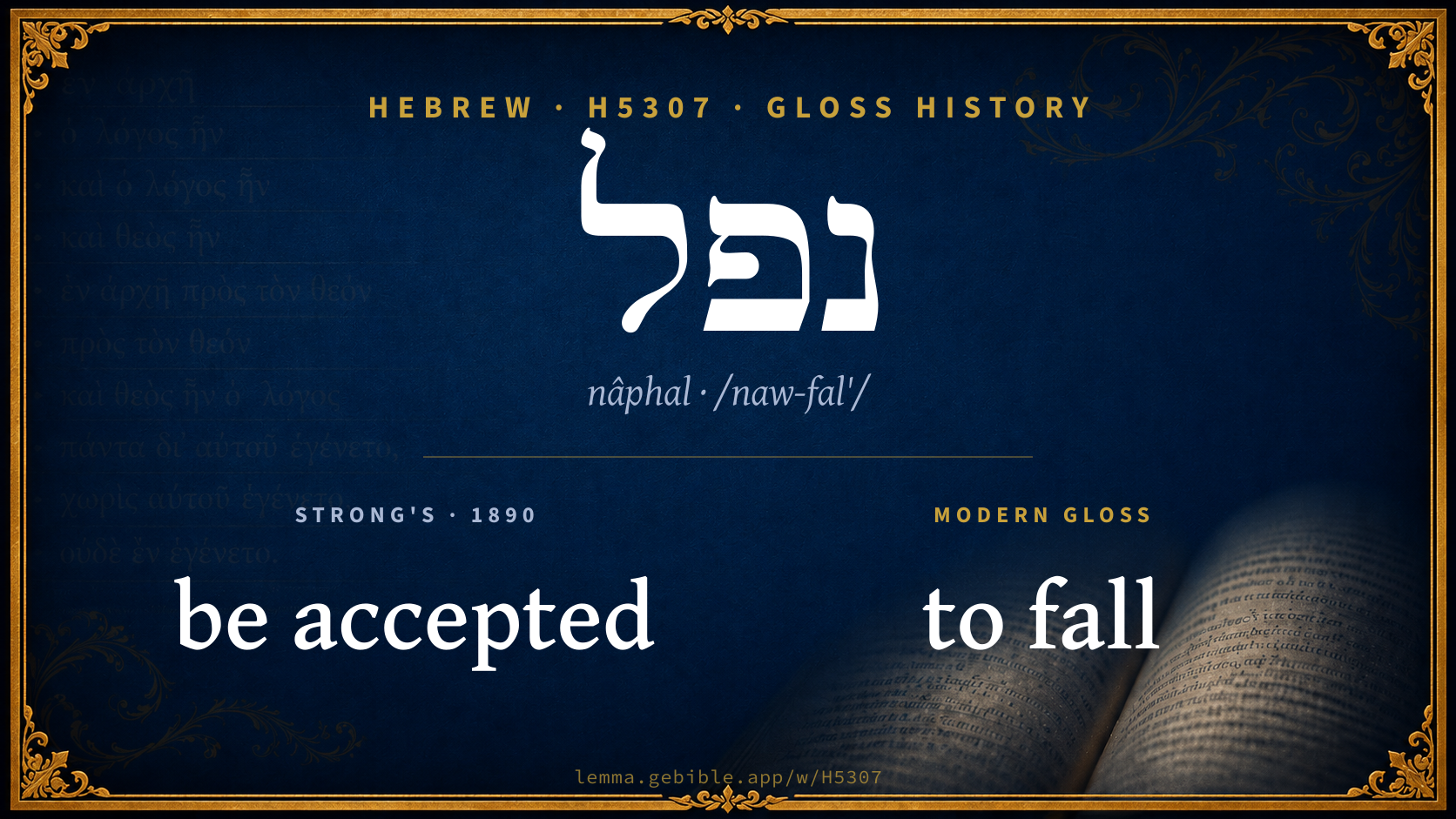
Gloss history
Strong's 1890 vs modern scholarship
About this word
Strong's H5307 catalogs a Hebrew word from the Hebrew Old Testament.
These counts are not copied from any lexicon or concordance. They are computed here, from the morphology-tagged Hebrew Old Testament. What Lemma adds →
- 403
- distinct verses
- The word appears in 403 distinct verses.
- 33 / 39
- OT books
- The word appears in 33 of 39 Old Testament books.
- #112
- by frequency
- Top 250 most frequent Hebrew words (rank 112 of 8,640 Hebrew words by occurrence).
View all 403 occurrences in the concordance →
By section of the Old Testament
By traditional corpus
Conventional, traditional groupings — biblical authorship is debated, so this is a traditional corpus grouping, not an authorship claim. Each share is this word’s portion of its verses in that division of the Hebrew canon. Each figure is a share of the word’s 403 distinct verses.
- Prophets (Nevi'im) 236 verses · 59%
- Writings (Ketuvim) 112 verses · 28%
- Torah (Pentateuch) 55 verses · 14%
How translations render this word
Counts come from each version’s own published word-to-Strong’s tagging or interlinear alignment — an approximate guide to how each version renders this word, not a word-level alignment the data otherwise carries. Because each total is that version’s own tagged count, the per-version totals vary from one another and need not match the appearance or distinct-verse counts above. These counts may also differ from a printed concordance because Lemma counts each distinctly tagged rendering and does not collapse phrase taggings into a single head-word total. This is a fixed set of word-tagged versions (KJV, ASV, BSB, ULT) and does not change with the reading translation you choose elsewhere. Each version’s license is shown beside its name below (and on Sources).
- King James Version: Fell 65×, Shall fall 47×, Fall 46×
- American Standard Version: Fell 51×, Shall fall 40×, Fall 32×
- Berean Standard Bible: Fell 52×, Will fall 41×, Fall 29×
- unfoldingWord Literal Text: Fell 57×, Fall 52×, Will fall 45×
King James Version Public Domain
Renders H5307 across 435 tagged occurrences — most commonly:
Plus other, less common renderings. Plus 116 renderings that appear only once — usually multi-word phrases or single function words the recovered tagging swept in, not distinct renderings.
American Standard Version Public Domain
Renders H5307 across 432 tagged occurrences — most commonly:
Plus other, less common renderings. Plus 147 renderings that appear only once — usually multi-word phrases or single function words the recovered tagging swept in, not distinct renderings.
Berean Standard Bible Public Domain
Renders H5307 across 431 tagged occurrences — most commonly:
Plus other, less common renderings. Plus 150 renderings that appear only once — usually multi-word phrases or single function words the recovered tagging swept in, not distinct renderings. Not rendered by a distinct English word in 3 further occurrences.
unfoldingWord Literal Text CC BY-SA 4.0
Renders H5307 across 502 tagged occurrences — most commonly:
Plus other, less common renderings. Plus 88 renderings that appear only once — usually multi-word phrases or single function words the recovered tagging swept in, not distinct renderings.
32 senses and sub-senses in the full BDB
Hebrew verbs can shift meaning by stem (binyan): Qal is the basic action, Niphal is often passive or reflexive, Piel often intensifies or makes it factitive, and Hiphil is typically causative. The senses below are grouped under the stem BDB assigns to each. This entry also uses Hithpael (reflexive or reciprocal).
What do BDB’s symbols mean?
BDB uses these scholarly abbreviations:
| Symbol | Meaning |
|---|---|
| 𝔊 | the Septuagint (the ancient Greek translation, LXX) |
| 𝔙 | the Vulgate (the Latin translation) |
| 𝔖 | the Syriac version (the Peshitta) |
| 𝔗 | the Targum (the Aramaic translation) |
| ψ | the Psalms |
| √ | root (the underlying root or stem) |
| ‖ | parallel passage (a synonymous or contrasted parallel) |
| † | the dagger: every passage where the word occurs is cited |
The 32 senses and sub-senses the full Brown-Driver-Briggs lexicon distinguishes for this word, in lexicon order (not ranked by frequency), with BDB’s own verbatim wording and sub-sense lettering. Shown in Hebrew script with BDB’s own scholarly abbreviations. The condensed entry is in the Lexicon Entry tab. See also the Forms in the corpus table below.
Qal
- Pf. נ׳ Ju 5:27 +, 3 fs. נָֽפְלָה Gn 15:12 +, etc.; Impf. יִפֹּל 1 S 14:45 +, וַיִּפֹּל Ju 4:16 +; 1 s. אֶפֹּל 1 Ch 21:13 (needless change from 1 pl. נִפְּלָה ‖ 2 S 24:14 We Dr); 3 mpl. יִפְּלוּ Ho 7:16 +, יִפֹּ֑לוּ Is 3:25 +, 3 fpl. תִּפֹּ֫לְנָה Ez 13:11; 30:25, etc.; Imv. mpl. נִפְלוּ Ho 10:8; Je 25:27; Inf. abs. נָפוֹל Est 6:13; cstr. נְפֹל Is 30:25 +; לִנְפֹּל Je 51:49 +; sf. נָפְלוֹ 1 S 29:3, נִפְלוֹ 2 S 1:10, נִפְלָם Je 49:21 (on these forms cf. Ba NB 104); Pt. נֹפֵל Ju 4:22 +; f. נֹפֶ֫לֶת Gn 15:12 +; pl. נֹפְלִים Jos 8:25 + (ins. also 1 S 28:19 b 𝔊 Th We Dr Kit Bu HPS; Klo כֹּרְעִים), etc.;— e.g. Judges 5:27
- 1. fall, by accident, וְנ׳־שָׁ֫מָּה Ex 21:33 (E) and there fall into it (a pit) an ox or an ass, cf. Dt 22:4 (בַּדֶּרֶךְ, on the way), bird עַל־פַּח Am 3:5; subj. pers., 1 S 4:18 (from seat, מֵעַל), Dt 22:8(×2) (from roof, מִן); often into (ב) pit (usually fig.) Pr 26:27; 28:10, also (abs.), 22:14, Ec 10:8 ψ 7:16; 57:7 (בְּתוֹךְ), cf. 35:8; 141:10 (net), also, c. אֶל, Is 24:18 = Je 48:44; fall בְּלֵב יַמִּים Ez 27:27 (of Tyrian people); abs. 2 S 4:4 Gn 14:10; Je 25:27; opp. קוּם Je 8:4 cf. Ec 4:10(×2); c. אָחוֹר fall backward Gn 49:17 (poem); c. בְּעַד through 2 K 1:2 cf. (of locusts) Jo 2:8; †נ׳ עַל־חֶרֶב causing death 1 S 31:4, 5 = 1 Ch 10:4, 5; †נ׳ עַל־פָּנָיו אַ֫רְצָה 1 S 17:49 (Goliath); subj. rei, 2 K 2:13, 14 (מֵעַל), 6:5 (אֶל־ into water); v 6 (abs.); c. עַל Lv 11:32, 35, 37, 38, אֶל־ v 33; abs. of tent Ju 7:13 + v 13 (gloss, GFM, Bu); of wall Jos 6:5 (JE), Je 51:44, fig. Ez 13:11 (del. 𝔊 𝔖 Sm Co Berthol), v 12, 14, לְאֶרֶץ Ez 38:20; + תַּחְתֶּיהָ i.e. flat Jos 6:20; נ׳ of bricks Is 9:9 (in fig.), פֶּרֶץ 30:13, towers v 25, foundations Je 50:15; wall fell upon (על) 1 K 20:30, so of house Ju 16:30; Jb 1:19, mts. Ho 10:8; mt. also abs. Jb 14:18 (cf. נָבֵל), height Ez 38:20; tree Ec 11:3(×2) (ב loc.), cf. Is 10:34 (בְ instr., in fig.), Zc 11:2 (abs.); branches Ez 31:12 (fig.); a grain Am 9:9 (אֶרֶץ = to earth); of dew 2 S 17:12 (c. על), hailstones Ez 13:11; blood (אַ֫רְצָה) 1 S 26:20; †hair of head (ארצה) 1 S 14:45 2 S 14:11; 1 K 1:52; horns of altar Am 3:14 (לָאָרֶץ); peg Is 22:25; fruit עַל־פֶּה Na 3:12; crown La 5:16; arm from (מִן) shoulder Jb 31:22; of sword (appar.) 2 S 20:8 (but on text v. Comm.); †fire from heaven, abs. 1 K 18:38 c. מִן Jb 1:16†; †hand of י׳ Ez 8:1 (c. עַל־; but read וַתְּהִי 𝔊 Co Berthol); spirit of י׳ Ez 11:5 (עַל־); of lot (גּוֹרָל) Ez 24:6; Jon 1:7 (both c. עַל), 1 Ch 26:14 (c. לְ; ‖ יָצָא), + Est 3:7 𝔊 Ry Wild (עַל); cf. Hiph. 3; hence (of share, inheritance) fall, be allotted, to (לְ) Ju 18:1 (ב = as: בְּ I 7 c; so Nu 34:2; Ez 47:14), ψ 16:6, abs. Jos 17:5.—On Ez 47:22 b v. Hiph. 3. e.g. Exodus 21:33
- 2.
- a. Especially of violent death (c. 96 times), Ju 5:27(×3) (+ שָׁדוּד), 1 S 4:10; 14:13 2 S 11:17; 21:9, 1 K 22:20 = 2 Ch 18:9, etc.; + וַיָּמָת, etc., 2 S 1:4; 2:23(×2); נ׳ חָלָל fall pierced (fatally) Ju 9:40 1 S 17:52; 31:1 = 1 Ch 10:1 +; חַלְלֵי חֶרֶב Ez 35:8; cf. בְּתוֹךְ חֲלָלִים 32:20; נ׳ תַּחַת הֲרוּגִים Is 10:4; נ׳ פְּגָרִים corpses fall Je 9:21; Nu 14:29 (P), v 32 (JE); by the sword, בַּחֶרֶב Am 7:17; Ho 7:16; 14:1; Is 3:25 2 S 1:12; Ez 5:12; 6:11; Nu 14:3, 43 (JE), (+ בָּרָעָב, בַּדֶּבֶר), etc.; נ׳ לְפִי חֶרֶב †Jos 8:24 (JE), Ju 4:16†; בְּיַד by the hand of †2 S 21:22; 24:14(×2) = 1 Ch 21:13(×2), 1 Ch 5:10; 20:8†; נ׳ תַּחַת רגלי fall under my feet 2 S 22:39 = ψ 18:39. e.g. Judges 5:27
- b. fig. = go to ruin, perish, etc. (c. 30 times); Am 5:2; 8:14 +; often ‖ כָּשַׁל Is 3:8; 8:15 (+ other words), 31:3; Je 8:12; 46:12; 50:32 ψ 5:11; 27:2; Pr 24:17; ‖ כָּרַע ψ 20:9; fig. of earth Is 24:20 (opp. קוּם); Haman falls before (לִפְנֵי) Mordecai Est 6:13(×2); cf. Is 14:12 (abs.); peculiar to Pr are נ׳ בְּרִשְׁעָה Pr 11:5, בְּרַע 13:17, בְּרָעָה 17:20; 28:14. e.g. Amos 5:2
- c. fig. = experience calamity Mi 7:8 (opp. קוּם), ψ 37:34; 145:14; Pr 24:16. e.g. Micah 7:8
- d. fall, of a city Je 51:8 (‖ וַתִּשָּׁבֵר). e.g. Jeremiah 51:8
- 3.
- a. Fall prostrate, Ju 19:26; 27, + אַ֫רְצָה Jb 1:20; fall at full length (in a faint) וַיִּפֹּל מְלֹא־קוֹמָתוֹ 1 S 28:20; sink down Nu 24:4, 16 (JE; supernat. influence); of arms of Pharaoh Ez 30:25 (opp. חָזַק). e.g. Judges 19:26
- b. fall = prostrate oneself before (לִפְנֵי) man Gn 50:18 (E), 2 S 19:19; Gn 44:14 (J; + אַ֫רְצָה); before י׳ 2 Ch 20:18; נ׳ אֶל־פָּנָיו אַ֫רְצָה before י׳ or his representative Jos 5:14; 7:6 (both JE); also (ארצה om.) Ez 43:3; 44:4; before man 2 S 14:22; more often נ׳ עַל־פָּנָיו, before man 2 S 9:6; 1 K 18:7, 39; Ru 2:10, before י׳ Gn 17:3, 17 + 6 times P, Ez 3:23; 9:8; 11:13; 1 Ch 21:16; Dn 8:17; + אַ֫רְצָה, before man 2 S 14:4, before י׳ Ju 13:20; לְאַפָּיו אַ֫רְצָה 1 S 20:41, לְאַפֵּי דָוִד עַל־פָּנֶיהָ 1 S 25:23, נ׳ ארצה 2 S 1:2 (all before man); נ׳ עַל־רַגְלָיו fall at one’s feet 1 S 25:24; 2 K 4:37, לִפְנֵי ר׳ Est 8:3. Vid. syn. sub קדד. e.g. Genesis 50:18
- c. fall upon (עַל) one’s neck, in embrace Gn 33:4; 46:29 (both J), 45:14 (E), עַל־פְּנֵי אָבִיו 50:1 (J). e.g. Genesis 33:4
- 4.
- a. Fall upon (עַל) = attack Je 48:32 (fig.), cf. Is 16:9; c. בְּ Jos 11:7 (D), abs. Jb 1:15; נ׳ אִישׁ אֶל־רֵעֵהוּ Je 46:16. e.g. Jeremiah 48:32
- b. †desert or fall away to, go over to, c. עַל־ 2 K 25:11(×2) = Je 52:15(×2), Je 21:9; 37:14; 39:9; 1 Ch 12:20, 21(×2) (van d. H. v 19, 20(×2)), 2 Ch 15:9, c. אֶל־ 2 K 7:4; Je 37:13; 38:19, abs. 1 S 29:3; Je 39:9. e.g. 2 Kings 25:11
- c. נ׳ בְּיַד fall into the hand (power) of Ju 15:18 La 1:7:—cf. also 2. a. supr. e.g. Judges 15:18
- 5. †Fig., of deep sleep, c. עַל Gn 15:12 (J), 1 S 26:12; Jb 4:13; 33:15; face, countenance (in displeasure) Gn 4:5, 6 (J); נ׳ לֵב אָדָם עָלָיו 1 S 17:32 (of sinking heart); וַיִּפְּלוּ בְעֵינֵיהֶם Ne 6:16 and they were cast down in their (own) eyes (cf. Be-Ry, Ryle); †of calamity sq. עַל־ Is 47:11; Ec 9:12; terror, etc., sq. עַל־ Gn 15:12 (J), Jos 2:9 (JE), Ex 15:16 (song), 1 S 11:7; Jb 13:11 ψ 55:5; 105:38; Est 8:17; 9:2, 3; Dn 10:7; reproach, sq. עַל־ ψ 69:10; † = fail to be accomplished Jos 21:45; 23:14(×2) (all D), 1 K 8:56; 2 K 10:10 (+ אַ֫רְצָה); = not to be reckoned Nu 6:12 (P); †of word (דָּבָר) falling into (ב) Isr. Is 9:7; † = fall out, turn out, result Ru 3:18 (subj. דָּבָר). e.g. Genesis 15:12
- 6. Other idiomatic uses are: נ׳ לְמִשְׁכָּב take to one’s bed Ex 21:18 (E); settle Gn 25:18 (J); = alight quickly, מֵעַל הַגָּמָל Gn 24:64 (J), מֵעַל הַמֶּרְכָּבָה 2 K 5:21; waste away Nu 5:21, 22, 27; = be born Is 26:18 (cf. Hiph. v 19); = be offered, of supplication (לִפְנֵי י׳) Je 36:7; 37:20; 42:2 (cf. Hiph. 6); c. מִן = be inferior to Jb 12:3; 13:2. e.g. Exodus 21:18
- 7. = lie, of Midianites, etc. (like locusts; ב loc.) Ju 7:12; = lie prostrate, 1 S 19:24; usually pt. Jos 7:10 (JE; עַל־פָּנֶיךָ), 1 S 5:3, 4 (לְפָנָיו), Am 9:11, עַל־הַמִּטָּה Est 7:8; of the dead 1 S 31:8 = 1 Ch 10:8; Dt 21:1; Ez 32:27 (Co conj. נְפִילִים [cf. Gn 6:4], v. also Berthol Toy Hpt); נֹפֵל אַ֫רְצָה מֵת Ju 3:25 cf. 4:22 (om. ארצה); פְּגָרִים נ׳ אַ֫רְצָה 2 Ch 20:24; cf. also Ez 32:22, 23, 24 (del. in v 22 Hi Co Berthol, in v 23 ToyHpt). e.g. Judges 7:12
Hiphil
- Pf. הִפִּיל 1 S 3:19 +; 2 ms. sf. הִפַּלְתָּם ψ 73:18; 3 pl. הִפִּילוּ Ju 2:19 +; 1 pl. הִפַּלְנוּ Ne 10:35, etc.; Impf. יַפִּיל Ex 21:27, וַיַּפֵּל Gn 2:21 +, sf. יַפִּלֵם ψ 140:11; 3 mpl. יַפִּילוּ 2 K 3:25 ψ 22:19, יַפִּיל֑וּן Jb 29:24, etc.; Imv. ms. sf. הַפִּלֶהָ Jos 13:6; mpl. הַפִּילוּ 1 S 14:42; Inf. cstr. לְהַפִּיל 1 S 18:25 +; לַנְפִּל Nu 5:22 read לִנְפֹּל (Di Ol§ 78 c Sta§ 114 a, 2 Kö i. 309 Ges§ 66, 2 R 1); Pt. מַפִּיל 2 K 6:5 + 2 times, pl. מַפִּילִים Dn 9:18;— e.g. 1 Samuel 3:19
- 1. cause to fall, c. acc., lit.:
- a. fell tree 2 K 3:19, 25 cf. 6:5. e.g. 2 Kings 3:19
- b. throw down wall 2 S 20:15. e.g. 2 Samuel 20:15
- c. knock out tooth Ex 21:27 (E). e.g. Exodus 21:27
- d. lay prostrate Dt 25:2 (for bastinado). e.g. Deuteronomy 25:2
- e. cast (cedar pillars) into (עַל־) fire Je 22:7; so (c. ב), wicked men ψ 140:11. e.g. Jeremiah 22:7
- f. make sword drop from (מִן) hand Ez 30:22 (fig.), cf. 39:3. e.g. Ezekiel 30:22
- g. cause stone to fall עַל Nu 35:23, flesh ψ 78:28 (בְּקֶרֶב), stars Dn 8:10 (in vision). e.g. Numbers 35:23
- 2. Of causing death בַּחֶרֶב 2 K 19:7 = Is 37:7, Je 19:7; Ez 32:12 (all י׳ subj.), 2 Ch 32:21 (human subj.); בְּיַד 1 S 18:25; + חֲלָלִים Ez 6:4; Pr 7:26; also ψ 106:26; Dn 11:12 = overthrow, bring to destruction, ψ 37:14; 73:18 (c. ל), 106:27. e.g. 2 Kings 19:7
- 3. Especially of casting lot (גּוֹרָל), Is 34:17 (c. לְ for), Ne 10:35 (c. עַל + inf.), 11:1 (c. inf.), 1 Ch 26:14 (c. לְ; so read Kit Hpt cf. 𝔊𝔙 Be Öt), ψ 22:19 (c. עַל), Est 9:24 (c. inf.); abs. Jon 1:7(×2) 1 Ch 24:31; 25:8; 26:13; Est 3:7; + בְּתוֹכֵנוּ Pr 1:14 (i.e. share with us); om. גּוֹרָל 1 S 14:42 (c. בֵּין), Jb 6:27 (c. עַל); hence הִפּ׳ = assign, apportion, by lot, usually c. לְ pers., Jos 13:6; 23:4 (both D), Ez 45:1; 47:22 a + v 22 b (read יַּפִּילוּ 𝔙 𝔗 Hi-Sm Co Berthol), 48:29 (read בְנַחֲלָה for מנ׳, 𝔊 𝔙 Hi-Sm, etc.), ψ 78:55 (cf. Qal 1 end; and בְּ I 7 c). e.g. Isaiah 34:17
- 4. Fig., let drop, cause to fail (cf. Qal 5), Ju 2:19; Est 6:10, + אַ֫רְצָה 1 S 3:19. e.g. Judges 2:19
- 5. Cause deep sleep to fall (עַל־) Gn 2:21 (J), Pr 19:15 (abs.), make countenance fall, look displeased at (ב), Je 3:12, cf. Jb 29:24 (obj. אוֹר פָּנַי); cause terror, etc., to fall (עַל־) Je 15:8. e.g. Genesis 2:21
- 6. Other idioms are: bring to life (proposes drop young) Is 26:19 (fig.); present supplication Je 38:26; 42:9; Dn 9:18, 20 (all c. לִפְנֵי);—on both cf. Qal 6. e.g. Isaiah 26:19
Hithpael
- throw, or prostrate oneself,
- 1. Inf. cstr. הִתְנַפֵּל throw himself upon (על) Gn 43:18 (J; i.e. attack). e.g. Genesis 43:18
- 2. Pf. 1 s. הִתְנַפָּ֑לְתִּי Dt 9:25; Impf. 1 s. וָאֶתְנַפַּל Dt 9:18, 25; Pt. מִתְנַפֵּל Ezr 10:1;—prostrate oneself and lie prostrate, לִפְנֵי י׳.—Piʿlēl. וְנִפְלַּל Ez 28:23, read וְנָפַל Hi-Sm Co Berthol. e.g. Deuteronomy 9:25
Senses from the full Brown-Driver-Briggs lexicon (Brown, Driver, Briggs; Oxford 1906 — public domain), digitized via Sefaria, supplemented by the OpenScriptures HebrewLexicon (CC BY 4.0). Full attribution on Sources.
Word origin
vb. fall, lie (NH = BH, 𝔗 נְפַל, Syriac ܢܦܰܠ; cf. also Arabic نَفَلَ dedit praedam (NöZMG xl (1886), 725 Frä 153 f.), Min. נפל remove Hom Südar. Chrest. 128);—
— Brown-Driver-Briggs (Oxford 1906, public domain), digitized via Sefaria, supplemented by the OpenScriptures HebrewLexicon (CC BY 4.0). See Sources.
Origin: a primitive root
Jastrow Dictionary
A second Hebrew/Aramaic lexicon for comparison, covering Aramaic and post-biblical (Talmudic, Targumic, Midrashic) usage that the biblical-Hebrew BDB does not. Matched by lemma rather than by Strong’s number, so a lemma may carry more than one Jastrow headword (shown separately below), and the entries cover usage well beyond the Bible.
נָפַל
- (b. h.) to fall, lie down; to be dropped; to occur. Sabb. XVI, 2 נָפְלָה דליקה if a conflagration takes place. Pes. II, 3, v. מַפּוֹלֶת. Y. Sot. VII, 21ᵈ top (ref. to יקים, Deut. XXVII, 26) וכי יש תורה נוֹפֶלֶת is there a falling law (to need erection)? Ned. 65ᵇ כל הנוֹפֵל אינו נופל לידי וכ׳ he who falls (becomes poor) does not immediately fall into the hands of (become dependent on) the charities (but his friends support him for a time). B. Kam. IX, 11, a. fr. יִפְּלוּ דמיו לנדבה its equivalent must be surrendered as a donation to the Temple. B. Bath. IX, 4 האחין … שנ׳ אחד מהן לאומנות נ׳ לאמצע if one of two partner brothers (heirs) has been summoned to public service, his salary goes into the common fund. Y. Shek. V, 49ᵇ top בשביל ששמעתי שנפלה לך ירושה וכ׳ since I heard that an inheritance has fallen to thy share at a distant place, take (this as a loan) &c.; a. v. fr.—Imperat. פּוֹל. Tosef. Dem. VI, 4 ופול תחתיי וכ׳ (Var. טול, some ed. עול) and surrender thyself to public service in my place (v. supra). e.g. Deuteronomy 27:26
- to cause to fall; to throw down. Gen. R. s. 26, v. נָפִיל. B. Kam. III, 10 ה׳ את שינו struck out his tooth; Tosef. ib. IX, 23; a. fr.—Esp. to miscarry. Nidd. III, 1 המַפֶּלֶת וכ׳ if a woman loses a lump-shaped embryo; a. fr.
- to prostrate one’s self. Deut. R. s. 2, v. נִיפּוּל.
- (denom. of נִיפּוּל) to fall apart, be spoiled. Tosef. Sabb. VI (VII), 14 שלא תִינָּפֵל הפת, v. צָוַוח.
נְפַל
- Targ. II Sam. I, 4. Targ. Koh. XI, 3 למִנְפַּל; a. v. fr.—Imperat. פִּיל. Targ. Is. L, 11.—Part. נָפֵיל, part. pass. נְפִיל. Targ. Prov. XI, 5 (ed. Wil. נְפַל). Targ. Ps. CXLV, 14; a. e.—Ḥull. 51ᵃ אי נְפוּל לארעא if they were thrown down (violently). Ib.ᵇ, v. נְגִיחוּתָא. Ned. 65ᵇ כל דמעני לאו עלי נפיל not every one that becomes poor, falls on me (for support). B. Mets. 105ᵃ בזרא דנ׳ נ׳ a seed (of weeds) once fallen, has fallen (cannot be destroyed by the plough). Meg. 15ᵇ נַפְלָה ליה מילתא בדעתיה something (a suspicion) had entered his mind; a. fr.
- , as preced. Hif. Targ. Ps. LXXVIII, 28. Targ. Y. Ex. XXI, 22; a. fr.—Ḥull. 42ᵃ top אַפּוּלֵי אפיל (read אַפְּלָא) she may have miscarried. Snh. 109ᵇ ומַפְּלָא ליה and she miscarried through his fault; a. fr.
- to be upset, fall in. M. Kat. 2ᵃ דאתי לאִינְּפוּלֵי a caving in (of the ground through which the water makes a road) might occur; ib.ᵇ; a. e.
נָפִל
- , v. נָפִיל
נֵפֶל
- (preced. wds.)
- 1. capacity for seed, v. נְפִילָה.
- 2. (b. h.) abortion; premature, not viable birth. Tosef. Ohol. XVI, 13; Pes. 9ᵃ, a. e.—Y. Yeb. XI, end, 12ᵇ אינו נ׳ is not considered a non-viable birth (for legal purposes); a. v. fr.—Pl. נְפָלִים. Gen. R. s. 26 (play on הַנְּפִלִים, Gen. VI, 4) שמלאו את העולם נ׳ וכ׳ they filled the world with abortions by their lascivious life. Tosef. l. c.; a. fr. e.g. Genesis 6:4
A Dictionary of the Targumim, the Talmud Babli and Yerushalmi, and the Midrashic Literature (Marcus Jastrow; London, Luzac, 1903) — Public Domain. Digitized via Sefaria. Digitized via Sefaria. Full attribution on Sources.
Forms in the corpus
The 257 distinct written forms H5307 takes in the Hebrew Bible, most frequent first — each parse links to that stem’s occurrences in the concordance. Hebrew forms include their vowel points and cantillation, so a single lemma takes many written forms.
The 60 most common forms are shown; 197 rarer forms follow in the full concordance.
Same root — word family
Other BDB entries built from the same root as H5307, grouped by Strong’s listed origin. These share a root / origin per the lexicon — not necessarily a shared meaning. Each links to that word’s own entry.
Derived from this word
- מפל mappâl H4651 refuse
- מפלה mappâlâh H4654 ruin
- מפלת mappeleth H4658 carcass
- נפיל nᵉphîyl H5303 giants
- נפל nᵉphal H5308 to fall
- נפל nephel H5309 miscarriage
Compare all same-root words → Showing 4 of 7 — not the complete family. They share a root, not necessarily a meaning.
Septuagint verse parallels
This word appears in 369 verses that also exist in the Greek Old Testament (Septuagint), out of the 403 Hebrew verses it occurs in. You can read those verses in Greek by switching the Old Testament edition to the Septuagint.
Read these verses in the Septuagint
- Genesis 2:21
- Exodus 15:16
- Leviticus 9:24
- Numbers 5:21
- Deuteronomy 9:18
- Joshua 2:9
- Judges 2:19
- Ruth 2:10
- 1 Samuel 3:19
- 2 Samuel 1:2
- 1 Kings 1:52
- 2 Kings 1:2
This is a verse-level parallel only — the same verses exist in both the Hebrew and Greek Old Testaments. No word-level Hebrew↔Greek correspondence is claimed: the data carries no such alignment, so no Greek word is shown as this Hebrew word’s translation. Coverage is not total — the Septuagint omits the deuterocanon and renumbers the Psalms, so some Hebrew verses have no direct Greek parallel.