
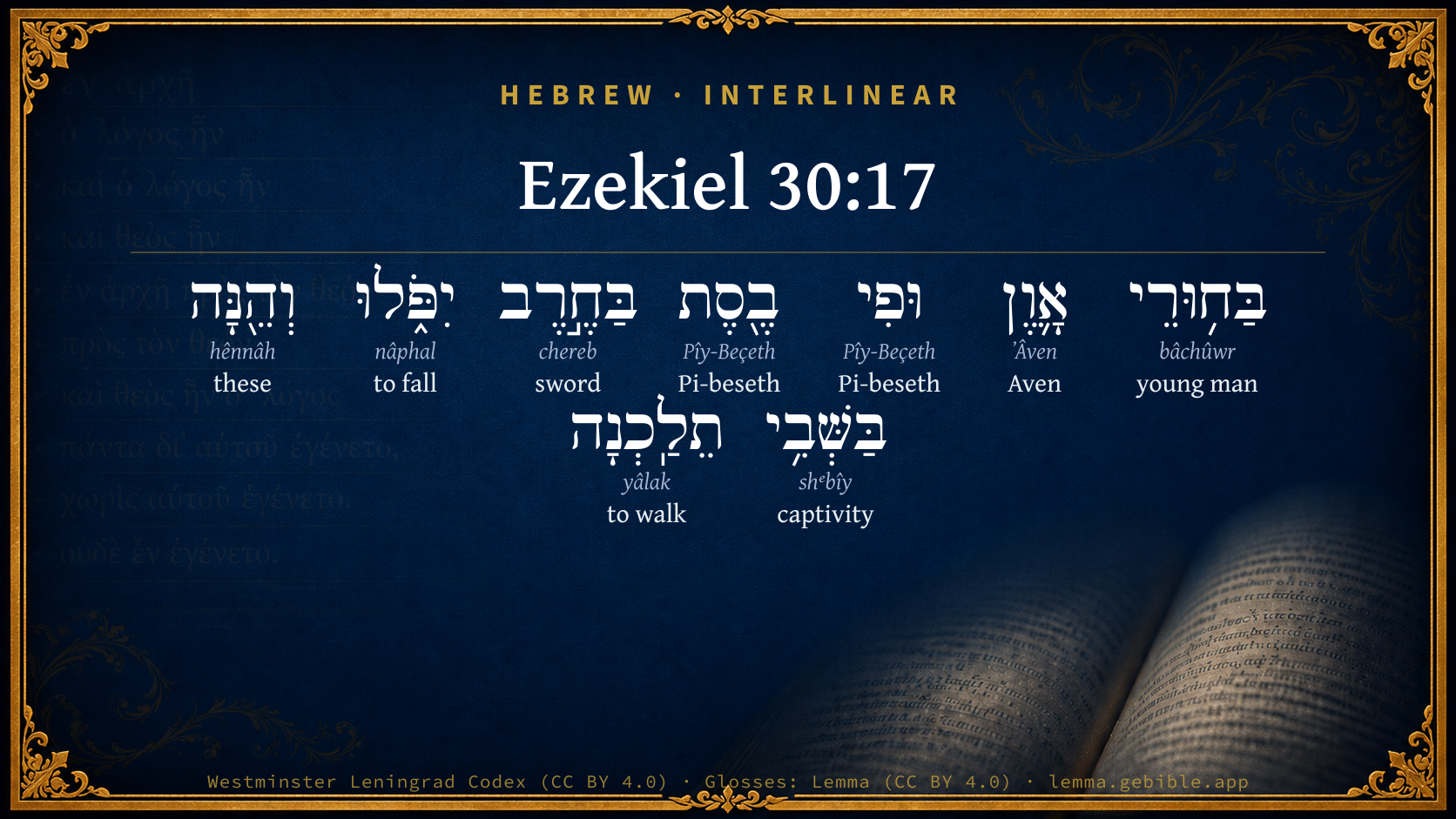
Ezekiel 30:17

Hebrew (Westminster Leningrad Codex) Ezekiel 30:17 appears in the Hebrew Old Testament. The text above is from the Westminster Leningrad Codex. Each word links to its Strong’s number, a concise gloss, and parsing drawn from the Open Scriptures Hebrew Bible morphology. Click any word for its full Brown-Driver-Briggs (BDB) entry.
Download image
Cite this verse

Ezekiel 30:17 (World English Bible). Public Domain. Lemma interlinear Bible study tool, https://lemma.gebible.app/v/ezekiel/30/17.

Show BibTeX & RIS
BibTeX
RIS
English Translation
The young men of Aven and of Pibeseth shall fall by the sword; and these [cities] shall go into captivity.
World English Bible · Public Domain
Highlights
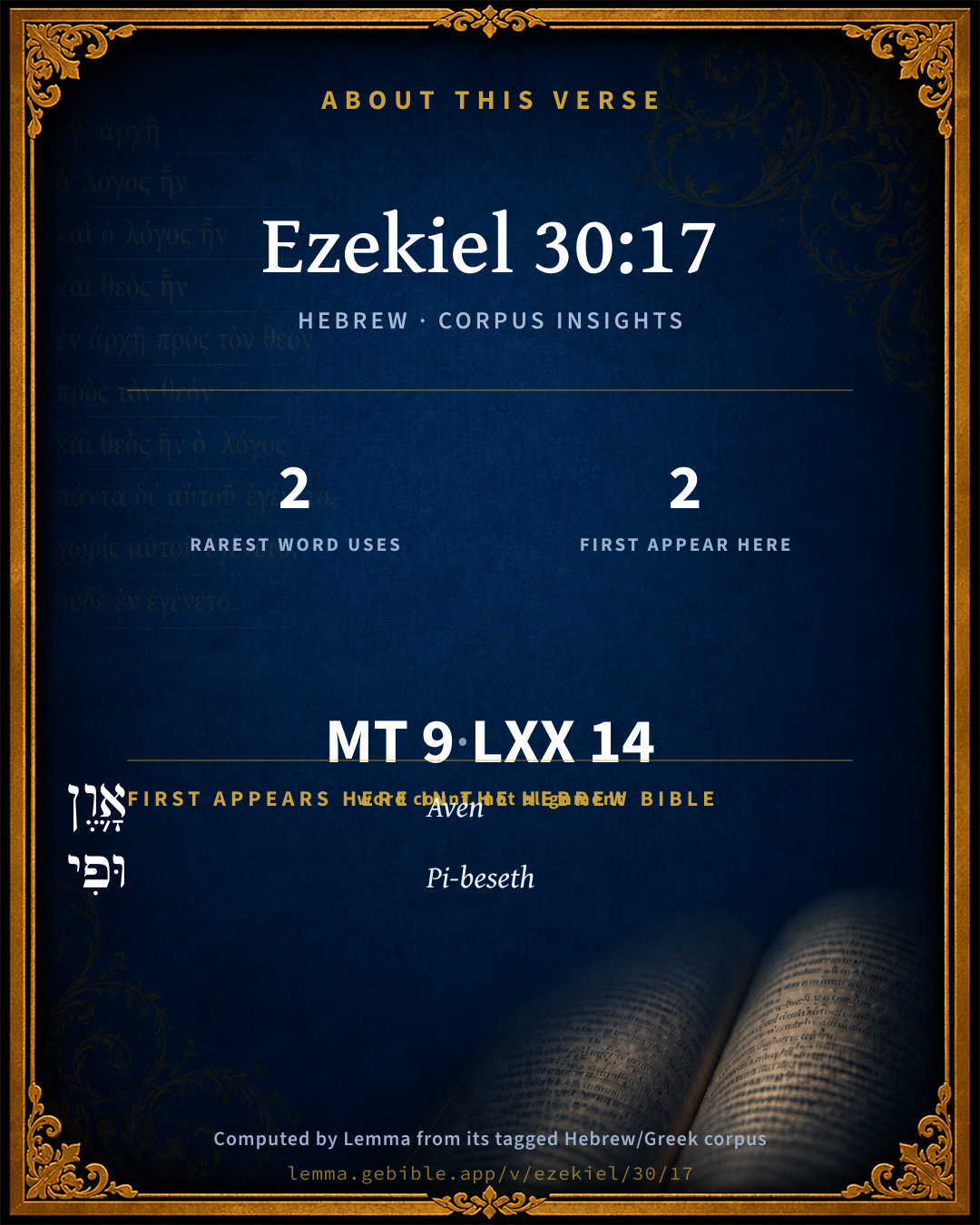
  • 2 first appearances in the Hebrew Bible
Full analysis ↓
Download a study sheet

One document with this verse’s original text, its word-by-word gloss line, the meaning frame, cross-references with their text, attributed commentary, and full source and license credits — printable, and it pastes into notes with its structure intact.

This verse Autodidact and up

Study sheet (.html) Plain text (.txt)

A passage Seminary Student

Up to 50 verses in one chapter. A passage sheet keeps up to 6 commentary sources and 12 cross-references per verse, in the order this page ranks them, and says so on the sheet whenever that leaves anything out. Ask for a single verse and you get the Autodidact verse sheet above.

Everything on this page stays free to read, with no account — the sheet is a download of what is already on screen, not access to it.

Want to remove ads? Support Godless Engineer
Compare translations 3

The same verse in 3 English versions, stacked beneath the original-language interlinear above. Click any original word for its lexicon entry.

Each is an independent rendering of the whole verse — the interlinear is not word-aligned to these translations.

Highlighted words mark where these versions differ — a whole-verse word diff, not a word-by-word alignment.

  • World English Bible Public Domain
    The young men of Aven and of Pibeseth shall fall by the sword; and these [cities] shall go into captivity.
  • King James Version Public Domain
    The young men of Aven and of Pibeseth shall fall by the sword: and these cities shall go into captivity.
  • unfoldingWord Literal Text CC BY-SA 4.0
    The young men in Heliopolis and Bubastis will fall by the sword, and their cities will go into captivity.

unfoldingWord Literal Text — © unfoldingWord, licensed CC BY-SA 4.0. Word-aligned USFM3 via Door43 (git.door43.org/unfoldingWord/en_ult).

Versions to compare (up to 4)

3 of 4 selected

Show all 18 translations

Every available English version of this verse, each an independent rendering of the whole verse.

  • World English Bible Public Domain
    The young men of Aven and of Pibeseth shall fall by the sword; and these [cities] shall go into captivity.
  • Berean Standard Bible Public Domain
    The young men of On and Pi-beseth will fall by the sword, and those cities will go into captivity.
  • Majority Standard Bible Public Domain
    The young men of On and Pi-beseth will fall by the sword, and those cities will go into captivity.
  • King James Version Public Domain
    The young men of Aven and of Pibeseth shall fall by the sword: and these cities shall go into captivity.
  • American Standard Version (1901) Public Domain
    The young men of Aven and of Pibeseth shall fall by the sword; and these `cities' shall go into captivity.
  • Revised Version (1885) Public Domain
    The young men of Aven and of Pi-beseth shall fall by the sword: and these cities shall go into captivity.
  • Geneva Bible (1599) Public Domain
    The yong men of Auen, and of Phibeseth shall fall by the sworde: and these cities shall goe into captiuitie.
  • Douay-Rheims (1899) Public Domain
    The young men of Heliopolis, and of Bubastus shall fall by the sword, and they themselves shall go into captivity.
  • Young's Literal Translation Public Domain
    The youths of Aven and Pi-Beseth by sword do fall, And these into captivity do go.
  • Literal Standard Version CC BY-SA 4.0
    The youths of Aven and Pi-Beseth fall by sword, || And these go into captivity.
  • Unlocked Literal Bible CC BY-SA 4.0
    The young men in Heliopolis and Bubastis will fall by the sword, and their cities will go into captivity.
  • unfoldingWord Literal Text CC BY-SA 4.0
    The young men in Heliopolis and Bubastis will fall by the sword, and their cities will go into captivity.
  • Darby Bible Public Domain
    The young men of Aven and of Pibeseth shall fall by the sword; and these shall go into captivity.
  • World Messianic Bible Public Domain
    The young men of Aven and of Pibeseth will fall by the sword. They will go into captivity.
  • Webster's Bible Public Domain
    The young men of Aven and of Pibeseth shall fall by the sword: and these cities shall go into captivity.
  • Free Bible Version CC BY-SA 4.0
    The young soldiers of Heliopolis and Bubastis will fall by the sword, and the people from those towns will be taken captive.
  • Bible in Basic English Public Domain
    The young men of On and Pi-beseth will be put to the sword: and these towns will be taken away prisoners.
  • JPS Tanakh (1917) Public Domain
    The young men of Aven and of Pi-beseth shall fall by the sword; and these cities shall go into captivity.

Literal Standard Version (2020), Covenant Press — licensed CC BY-SA 4.0. Text via the HelloAO Bible API (eBible.org). Unlocked Literal Bible (unfoldingWord) — licensed CC BY-SA 4.0. Text via the HelloAO Bible API (eBible.org). unfoldingWord Literal Text — © unfoldingWord, licensed CC BY-SA 4.0. Word-aligned USFM3 via Door43 (git.door43.org/unfoldingWord/en_ult). Free Bible Version, Dr. Jonathan Gallagher — licensed CC BY-SA 4.0. Text via the HelloAO Bible API (eBible.org).

Word by word

More ways to search: Search by grammar → Find every occurrence → Compare this word →

Practice this passage: Drill this verse → Learn its vocabulary →

About this verse

These counts appear in no published source. They are computed here, from the morphology-tagged text and Lemma’s own curated glosses. What Lemma adds →

9
words
8
distinct lemmas
Prophets
section

Notable vocabulary

The rarest word here is אָ֛וֶן Aven H206 — appearing just 2 times in the whole Hebrew Bible.

First appearance in Scripture

These words make their first canonical appearance in the Hebrew Bible here:

  • אָ֛וֶן Aven H206
  • וּפִי Pi-beseth H6364

Shared distinctive vocabulary

אָ֛וֶן Aven H206 occurs in 2 verses of the Hebrew Bible. Also found in:

Grammatical profile

  • 2 verbs
  • 6 nouns
  • 1 pronoun

Verb forms

  • יִפֹּ֑לוּ Qal · Imperfect
  • תֵלַֽכְנָה Qal · Imperfect

Repetition

A word recurs within this verse — often emphatic in Hebrew:

  • וּפִי Pi-beseth H6364 ×2

Hebrew & Septuagint length

In English translation the verse runs 20 words from the Hebrew and 18 from the Septuagint (LXX English) — closely comparable.

A rough comparison of the two English renderings, which tokenize alike — not a word-level alignment.

Word counts can differ between the Hebrew and the Greek without any difference in meaning — e.g. the Hebrew direct-object marker אֵת has no separate Greek word, and Greek often adds the article ὁ.

In the original languages it is 9 Hebrew tokens and 14 Greek tokens — but the two are counted differently (Hebrew bundles its prefixes and suffixes into one token; the Greek is in lemma form), so that isn’t a like-for-like length.

Cross-references

1

Topical passages linked to Ezekiel 30:17 in the Treasury of Scripture Knowledge — connected by theme and wording, ordered by reader-vote popularity; previews shown in the World English Bible.

  • Genesis 41:45 Pharaoh called Joseph's name Zaphenath-paneah; and he gave him Asenath, the daughter of Potiphera priest of On as a wife. Joseph went out over the land of Egypt.

Cross-references courtesy of OpenBible.info (CC BY 4.0).

Hebrew and Greek witnesses Masoretic Hebrew ↔ Greek Septuagint

The same verse in the two great witnesses to the Old Testament, shown verse-for-verse.

These are two independent witnesses, not word-aligned to each other, and the Septuagint is shown in lemma (dictionary) form.

Hebrew Ezekiel 30:17 Masoretic · Westminster Leningrad Codex

בַּח֥וּרֵי אָ֛וֶן וּפִי בֶ֖סֶת בַּחֶ֣רֶב יִפֹּ֑לוּ וְהֵ֖נָּה בַּשְּׁבִ֥י תֵלַֽכְנָה

The young men of Aven and of Pibeseth shall fall by the sword; and these [cities] shall go into captivity.

World English Bible · Public Domain

Greek LXX Ezekiel 30:17 Septuagint · lemma form

νεανίσκος ἥλιος πόλις καί βούβαστος ἐν μάχαιρα πίπτω καί ὁ γυνή ἐν αἰχμαλωσία πορεύομαι

The youths of Heliopolis and Bubastum shall fall by the sword, and the women shall go into captivity.

LXX2012 (modern English Septuagint) · Public Domain

On this verse, Joseph Benson's Commentary discusses the Septuagint’s reading. Read the note in Commentary ↓

Hebrew: Westminster Leningrad Codex (CC BY 4.0). Greek: Septuagint (public domain); English from LXX2012 (modern English Septuagint) (Public Domain). How the Septuagint differs from the Hebrew →

Targum (Aramaic paraphrase)

1

The Targum is the ancient Jewish Aramaic paraphrase of the Hebrew Scriptures — an interpretive translation, not the Hebrew text itself. Onkelos (literal) and Pseudo-Jonathan (expansive) render the Torah, and Jonathan the Prophets. Coverage is partial: where no permissively-licensed English translation exists for a verse, only the Aramaic is shown. This is verse-level text, not a word-by-word alignment to the Hebrew.

  1. Targum Jonathan Prophets (Joshua–Malachi)
    עוּלֵימֵי אָוֶן וּפִיבֶסֶת בְּחַרְבָּא יִתְקַטְלוּן וּפָלְחֵיהוֹן בְּשִׁבְיָא יָהֲכוּן:

    (no public-domain English translation for this verse)

    Targum Jonathan — Aramaic: “Mikraot Gedolot” (public domain). English: “Sefaria Community Translation” (CC0 1.0 (public-domain dedication)); “London "Chaldee Paraphrase," 1871” (public domain). Text via Sefaria.

Commentary

Notes on Ezekiel 30:17 from classic Christian and Jewish commentators (each source and its license shown beneath its notes). The classic Christian expositions comment on the surrounding passage and are grouped to its opening verse, so a note may address several verses; the Jewish commentaries on the Tanakh (Rashi and others) are per-verse, so they appear only where the commentator wrote on this verse.

Lemma curates 59 commentaries, every one of them public domain or Creative Commons licensed, each selected and text-cleaned for this edition rather than reprinted as found. About our sources →

Trapp's Complete Commentary

John Trapp

Eze 30:17 The young men of Aven and of Pibeseth shall fall by the sword: and these [cities] shall go into captivity.

Ver. 17. Aven.] Called also Heliopolis, and Thebe.

Phibeseth.] Or Bubastis, called by Ptolemy, Heroum civitas.

John Trapp, A Commentary or Exposition upon All the Books of the Old and New Testament (1647–1656) — public domain. Text from a community e-Sword module.

Joseph Benson's Commentary

Eze 30:17-18. The young men of Aven, &c. — Aven is the same with On, mentioned Gen 41:45, in aftertimes called Heliopolis, as the margin here explains it, because of a temple or image there dedicated to the sun: see notes on Isa 19:18; Jer 43:13. The word is so translated both here and Gen 41:45, by the LXX., who were very well acquainted with Egypt and all the principal places of it. And they translate Phibeseth, Bubastum. At Tehaphnehes — Elsewhere written Tahpanhes, supposed to be the same place which was afterward called Daphnæ Pelusiacæ; the day shall be darkened — By this expression is signified its being involved in great calamity; for the day, or light, in the Scripture language, is put for prosperity: therefore the day being darkened signifies a state of adversity.

Joseph Benson's Commentary on the Old and New Testaments (1811–1818) — public domain. Text from a community e-Sword module.

Tyndale Open Study Notes

Tyndale Open Resources

30:17 of Heliopolis and Bubastis: These cities were located in the Nile delta.

Tyndale Open Study Notes — © Tyndale Open Resources, licensed CC BY-SA 4.0. Text via the HelloAO Bible API.

Geneva Bible (1599)

Geneva Bible translators

Or, Heliopolis.

Or, Pubastum.

Geneva Bible (1599) marginal notes — public domain. Text via Bolls.life.

Jamieson, Fausset & Brown

Robert Jamieson, A. R. Fausset & David Brown

Aven--meaning "vanity" or "iniquity": applied, by a slight change of the Hebrew name, to On or Heliopolis, in allusion to its idolatry. Here stood the temple of the sun, whence it was called in Hebrew, Beth-shemesh (Jer 43:13). The Egyptian hieroglyphics call it, Re Athom, the sun, the father of the gods, being impersonate in Athom or Adam, the father of mankind.

Pi-beseth--that is, Bubastis, in Lower Egypt, near the Pelusiac branch of the Nile: notorious for the worship of the goddess of the same name (Coptic, Pasht), the granite stones of whose temple still attest its former magnificence.

these cities--rather, as the Septuagint, "the women," namely, of Aven and Pi-beseth, in antithesis to "the young men." So in Eze 30:18, "daughters shall go into captivity" [MAURER].

Jamieson, Fausset & Brown — Commentary Critical and Explanatory on the Whole Bible (1871) — public domain (CC PDM 1.0). Text via the HelloAO Bible API.

Adam Clarke's Commentary

Verse 17. Aven] Or On, the famous Heliopolis, or city of the sun.

Pibeseth] Bubastum or Bubaste, by a slight alteration of the letters. It is situated on the eastern branch of the Nile, towards Arabia.

Adam Clarke's Commentary on the Bible (1810–1826) — public domain. Text from a community e-Sword/MySword module.

Ellicott's Commentary for English Readers

(17) Of Aven and of Pi-beseth.—Aven is the same as On of Gen_41:45; Gen_41:50, and as Bethshemesh (House of the Sun) of Jer_43:13, the Heliopolis of the Greeks, so called because from the remotest times a chief seat of the worship of the sun. The vowel points are slightly changed from On to make Aven, nothingness, often used of idols. Pi-beseth, on the monuments Pi-Pasht—so called from the cat-headed goddess there worshipped—is Bubastis, situated on the canal leading from the Pelusiac branch of the Nile towards Suez.

A Bible Commentary for English Readers, edited by Charles John Ellicott (1878–1897) — public domain. Text from a community e-Sword module.

The Cambridge Bible for Schools and Colleges

gen. ed. J. J. S. Perowne

17. young men of Aven] i.e. On or Heliopolis, “city of the sun,” Jer_43:13; cf. Gen_41:45. The obelisk known as Cleopatra’s Needle belonged to the sun temple in On; and in the vicinity of the ruins near the village Matariyeh stands the sycamore under which tradition affirms that the Holy Family rested in their flight to Egypt. The modern name is Ain Shems (sun-fountain) a few miles N.-E. of Cairo.

Phi-beseth shall fall] i.e. Bubastos or Bubastis, Egyptian Pa Bast, house of Bast or Pasht, the goddess to whom the cat was sacred, and who herself was represented under the aspect of the cat. The cat mummies were here preserved. The place lay on the Pelusiac arm of the Nile; the ruins, bearing the name Tell Basta, are not far from the modern Zagazig. Herod. mentions that at a yearly festival held here as many as 700,000 people would assemble.

The Cambridge Bible for Schools and Colleges (gen. ed. J. J. S. Perowne; Cambridge University Press, 1878–1918) — public domain. Text from a community e-Sword module.

John Gill's Exposition

The young men of Aven and of Phibeseth shall fall by the sword,.... Aven is the same with On, of which Potipherah was priest in Joseph's time and whose daughter he married, Gen 41:45, the same with Heliopolis, or Bethshemesh, the city of the sun, see Jer 43:13; see Gill on Jer 43:13; where was the temple of the sun, and where it was worshipped; and so it is rendered by the Septuagint, Vulgate Latin, and Arabic versions. It is called here "Aven", or "vanity", because of the vain and idolatrous worship here performed. Phibeseth is the Bubastis of Herodotus, and called by other writers Bubastus; hence there was a nome or province in Egypt called the Bubastic nome, mentioned by Ptolemy (c), and others. In this was a temple built to the honour of Diana, where she was worshipped and Herodotus (d) says, that Bubastis, in the Greek tongue, is Diana; here she was worshipped in the form of a cat; and Stephanus (e) observes, that the Egyptians call a cat Bubastus; and it is also said that dead cats salted were buried in this city, as being sacred: according to Diodorus Siculus (f), it was built for the sake of Isis; and Hillerus (g) says, that in the Abyssine language it was called "Phy' mly' sith"; that is, the portion of the wife, namely of Isis married to Osiris, by whom this city was built to the honour of her; as appears by the pillar of Isis, on which these words are inscribed,

"for me the city of Bubastia is built; be glad, be glad, O Egypt, which brought me up.''

This place is now called Bishbesh, according to Dr. Shaw (h): now the young men of both these places, though they might exert themselves in the defence of them, yet should fail therein, and fall by the sword of the Chaldeans:

and these cities shall go into captivity; the rest of the inhabitants of the cities of Aven and Pibeseth, that shall not fall by the sword, shall be carried captive into other lands. Joseph Kimchi supplies "women" instead of "cities"; and thinks, that as the males are mentioned before, the females are understood here. The Targum is,

"they that served them shall go into captivity;''

that served the idols worshipped in these cities.

(c) Geograph. l. 4. c. 5. (d) Euterpe, sive l. 2. c. 59, 138, 156. (e) De Urbibus. (f) Bibliothec l. 1. p. 24. (g) Onomastic. Sacr. p. 672. (h) Travels, p. 306. Ed. 2.

John Gill's Exposition of the Whole Bible (1746–1763) — public domain (CC PDM 1.0). Text via the HelloAO Bible API.

Albert Barnes' Notes on the Bible

Aven - The same as “On” Gen 41:45, or “Heliopolis.” The word “Aven” means also “transgression” (compare Hos 10:8). Some have thought that here too Ezekiel substituted the word “Aven” for “On” to mark the “sin” of idolatry there in full vogue.

Pi-beseth - The Bubastis of Herodotus. The hieroglyphic name is “Pe-bast,” the house of Bast (the Egyptian Artemis, the cat-headed goddess). Bubastis was situated on the easternmost, the Pelusian, branch of the Delta. The road from Pelusium to Memphis lay through Bubastis and On. In the days of Herodotus Bubastis was the seat of one of the chief annual festivals of the Egyptians. The Persians took the town and razed the walls. The ruins bear the modern name Tel-Basta.

Albert Barnes' Notes on the Bible (1834–1885) — public domain. Text from a community e-Sword/MySword module.

Matthew Poole's English Annotations

The young men: it is probable these might be a select army of valiant youths in one body, collected out of these two cities, that resolved to break the Chaldean army, or fall in the enterprise; or else that they did to the utmost defend the walls, and were put to the sword when the city was taken by assault.

Aven; Bethshemesh and Heliopolis, an idolatrous city, that worshipped the sun, and in which was a stately temple built to the sun. Its size was one hundred and fifty furlongs, six miles and three quarters, in compass, a very vain and sinful city, as its name Aven intimates.

Pi-beseth; Bubastus, and sometimes called Haephestus, no inconsiderable place, and I believe not far from Avon. It should seem to be some convenient pass, as I conjecture.

These cities; the citizens, cities put for citizens.

Go into captivity; some of the first, it may be the very first; which put Memphis, at report of it, into a sick fit, with great pain; this being the first-fruits of the sad coming harvest.

Matthew Poole's English Annotations on the Holy Bible (1683–1685) — public domain. Text from a community e-Sword/MySword module.

Whedon's Commentary on the Bible

Daniel D. Whedon

17. Aven and of Pi-beseth — The Greek, Latin, and Coptic correctly translate “on [Heliopolis] and Bubastis.” Heliopolis (“city of the sun,” Jer_43:13) was one of the most renowned and holy cities of ancient Egypt. There the king “washed his face” before the sun-god centuries before Joseph married the daughter of the priest (Gen_41:45). The spot is still called “sun fountain,” but even the rains of this celebrated city have disappeared, with the single exception of one lonely obelisk. Pi-beseth (Egyptian, Pi-beset, “house of Beset”) was undoubtedly Bubastis (now Tel Bast). There is probably a word play here between Beseth and the familiar Bo-sheth (shame) which was the Hebrew nickname for Baal (Jer_11:13; 2Sa_11:21). The worship of Bast greatly resembled that of Baal. The city was the “key to the Delta,” protecting as it did the road used by all Syrian invaders. It was a magnificent city, one of the eight selected for mention by Pomponius Mela among twenty thousand said to have existed in the days of King Amasis — who was a contemporary of Ezekiel. The great temple which Herodotus described at length is now a mere heap of bricks. Naville has thoroughly explored the ruins. (See Egyptian Exploration Fund, Eighth Memoir.)

Daniel D. Whedon (gen. ed.), Commentary on the Old and New Testaments (1874–1909) — public domain. Text from a community e-Sword module.

The Pulpit Commentary

The young men of Aven; the "On" of Gen_12:4-5, the "house of the sun" of Jer_43:13, the Heliopolis of the LXX and Vulgate. The form Avert (Hebrews for "a vain thing!" as in (Hos_4:15 Hos_10:5) was perhaps chosen as a word of scorn pointing to the idolatry of the city. Pibeseth; LXX, Bubastos. The city situated on the Suez Canal, begun by Necho and finished under Ptolemy II (Herod., 2:59). It derived its name from the eat-headed goddess Pasht, and was the chief seat of the home which was named after it. It was destroyed by the Persians (Diod. Sic., 15:51), but the name lingers in Tebbastat, a heap of ruins about seven hours journey from the Nile.

The Pulpit Commentary (1880–1919), ed. H.D.M. Spence-Jones & Joseph S. Exell — public domain. Text from a community e-Sword module.

John Wesley's Explanatory Notes

Young men - 'Tis probable these might be a body of valiant youths, collected out of these ten cities. Aven - Bethshemesh, or Heliopolis, an idolatrous city, in which was a stately temple of the sun: an hundred and fifty furlongs, that is six miles and three quarters in compass. Phibeseth - Bubastus, sometimes called Hoephestus, not far from Aven.

John Wesley, Explanatory Notes Upon the Whole Bible (1754–1765) — public domain. Text via the GEBible commentary corpus.

unfoldingWord translationNotes

Door43 World Missions Community

General Information:

These are Yahweh's words about Egypt.

Heliopolis and Bubastis

These were cities in northern Egypt. (See: How to Translate Names)

will fall by the sword

The word "sword" is used here to refer to a battle or war. AT: "will die in battle" or "will die in the war" (See: Metonymy)

their cities will go into captivity

Here "cities" represents the people of the cities. The abstract noun "captivity" can be expressed with the more concrete noun "captive" or the verb "capture" AT: "the people of their cities will become captives" or "their enemies will capture their people and take them away" (See: Metonymy)

Tahpanhes

This was an important city in northern Egypt.

the day will hold back its light

The day is spoken of as if it were able to keep its own light from shining. AT: "the day will be dark" (See: Personification)

when I break the yoke of Egypt there

The word "yoke" here refers to Egypt's power to oppress people. AT: "when I stop Egypt from oppressing people" or "when I end Egypt's power to cruelly control other nations" (See: Metaphor)

the pride of her strength will be finished

This represents Egypt no longer being proud of their strength. The reason that they will not be proud is that they will no longer be strong. AT: "Egypt will no longer be proud about being strong" or "Egypt will no longer have the strength that they were so proud of" (See:Metaphor and Assumed Knowledge and Implicit Information)

There will be a cloud covering her

Possible meanings are 1) the dark cloud represents how sad the people of Egypt will feel. AT: "It will be as if there is a cloud over Egypt" or 2) there will be a cloud of dust over Egypt from everything that is destroyed. AT: "A cloud of dust will be over Egypt" (See: Metaphor)

her daughters

Possible meanings are 1) the people of the Egyptian towns or 2) the daughters of the Egyptian people

I will execute acts of judgment in Egypt

The phrase "acts of judgment" refers to punishment. AT: "I will punish Egypt in many ways" (See: Abstract Nouns)

so they

"so the Egyptians"

translationWords

captive

yoke

judge

unfoldingWord translationNotes — © Distant Shores Media and the Door43 World Missions Community, licensed CC BY-SA 4.0. Source: git.door43.org/Door43/en_tn.

Rashi

Rabbi Shlomo Yitzchaki (Rashi)

and they will go into captivity both of them, the provinces of Aven and Pi beseth.

Rashi on the Tanakh — English translations: “The Judaica Press complete Tanach with Rashi, translated by A. J. Rosenberg” (CC BY 4.0); “Pentateuch with Rashi's commentary by M. Rosenbaum and A.M. Silbermann, 1929-1934” (public domain); “The Metsudah Tanach series, Lakewood, N.J” (CC BY 4.0); and “The Book of Joshua, Metsudah Publications, 1997” (CC BY 4.0). Text via Sefaria.

Lesson kit

Teaching starters — assembled from the data on this page, not authored interpretation. Every prompt links to the verse data it draws on. Edit before teaching.

Ezekiel, in the Prophets, opens this verse with 9 words (8 distinct Hebrew lemmas). Its most distinctive word is ʼÂven (“Aven”). A historical commentator’s framing appears above. Read the whole chapter for the surrounding context.

Discussion questions

  1. What does “Aven” (ʼÂven) contribute to the verse as a whole?
  2. 2 words here appear for the first time in Scripture. What is being introduced at this debut?
  3. Amos 1:5 shares the word «Aven» with this verse. How do the two illuminate each other?
  4. “Pi-beseth” occurs 2× in this one verse. What is the effect of the repetition?
  5. These translations render this verse differently. What is at stake in choosing one wording over another?
  6. The verb «יִפֹּ֑לוּ» is Qal Imperfect. How does its form color the action?
  7. Reading how Trapp's Complete Commentary and Joseph Benson's Commentary read this verse, where do the two commentators agree and where do they part?

Things to notice

Reading settings

Reading text

Shown beneath each verse's original-language words.

Old Testament
Old Testament edition

Read the OT as the Masoretic Hebrew (MT) or the Greek Septuagint (LXX).

English shown for the Greek Septuagint (in the Hebrew ↔ Greek comparison).

Comparing translations? Open the Compare panel on any verse page to stack up to four side by side.