
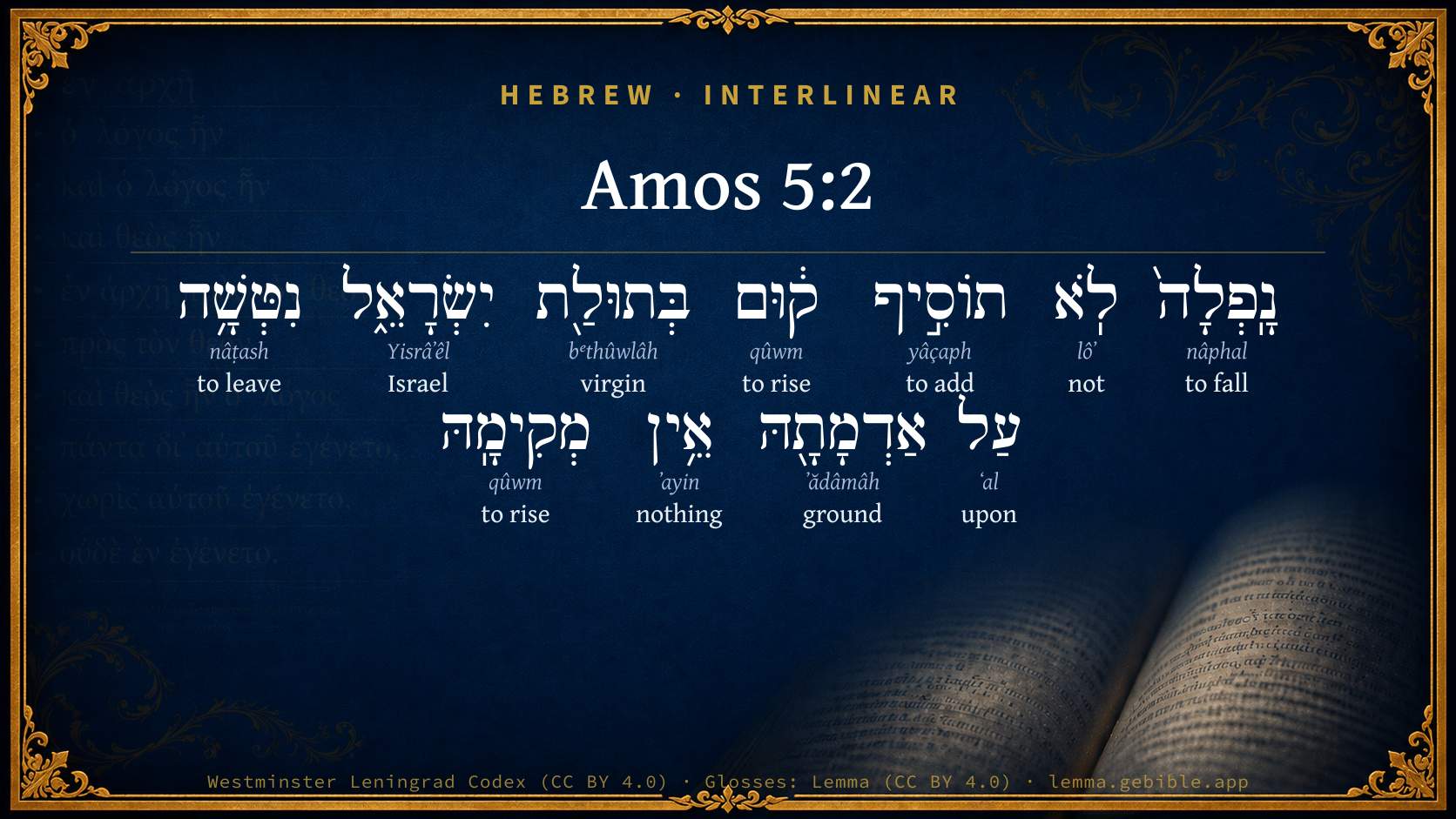
Amos 5:2

Hebrew (Westminster Leningrad Codex) Amos 5:2 appears in the Hebrew Old Testament. The text above is from the Westminster Leningrad Codex. Each word links to its Strong’s number, a concise gloss, and parsing drawn from the Open Scriptures Hebrew Bible morphology. Click any word for its full Brown-Driver-Briggs (BDB) entry.
Download image
Cite this verse

Amos 5:2 (World English Bible). Public Domain. Lemma interlinear Bible study tool, https://lemma.gebible.app/v/amos/5/2.

Show BibTeX & RIS
BibTeX
RIS
English Translation
"The virgin of Israel has fallen; She shall rise no more. She is cast down on her land; There is no one to raise her up."
World English Bible · Public Domain
Download a study sheet

One document with this verse’s original text, its word-by-word gloss line, the meaning frame, cross-references with their text, attributed commentary, and full source and license credits — printable, and it pastes into notes with its structure intact.

This verse Autodidact and up

Study sheet (.html) Plain text (.txt)

A passage Seminary Student

Up to 50 verses in one chapter. A passage sheet keeps up to 6 commentary sources and 12 cross-references per verse, in the order this page ranks them, and says so on the sheet whenever that leaves anything out. Ask for a single verse and you get the Autodidact verse sheet above.

Everything on this page stays free to read, with no account — the sheet is a download of what is already on screen, not access to it.

Want to remove ads? Support Godless Engineer
Compare translations 3

The same verse in 3 English versions, stacked beneath the original-language interlinear above. Click any original word for its lexicon entry.

Each is an independent rendering of the whole verse — the interlinear is not word-aligned to these translations.

Highlighted words mark where these versions differ — a whole-verse word diff, not a word-by-word alignment.

  • World English Bible Public Domain
    "The virgin of Israel has fallen; She shall rise no more. She is cast down on her land; There is no one to raise her up."
  • King James Version Public Domain
    The virgin of Israel is fallen; she shall no more rise: she is forsaken upon her land; there is none to raise her up.
  • unfoldingWord Literal Text CC BY-SA 4.0
    The virgin Israel has fallen; she will rise no more; she is forsaken on her land; there is no one to raise her up.

unfoldingWord Literal Text — © unfoldingWord, licensed CC BY-SA 4.0. Word-aligned USFM3 via Door43 (git.door43.org/unfoldingWord/en_ult).

Versions to compare (up to 4)

3 of 4 selected

Show all 18 translations

Every available English version of this verse, each an independent rendering of the whole verse.

  • World English Bible Public Domain
    "The virgin of Israel has fallen; She shall rise no more. She is cast down on her land; There is no one to raise her up."
  • Berean Standard Bible Public Domain
    “Fallen is Virgin Israel, never to rise again. She lies abandoned on her land, with no one to raise her up.”
  • Majority Standard Bible Public Domain
    “Fallen is Virgin Israel, never to rise again. She lies abandoned on her land, with no one to raise her up.”
  • King James Version Public Domain
    The virgin of Israel is fallen; she shall no more rise: she is forsaken upon her land; there is none to raise her up.
  • American Standard Version (1901) Public Domain
    The virgin of Israel is fallen; she shall no more rise: she is cast down upon her land; there is none to raise her up.
  • Revised Version (1885) Public Domain
    The virgin of Israel is fallen; she shall no more rise: she is cast down upon her land; there is none to raise her up.
  • Geneva Bible (1599) Public Domain
    The virgine Israel is fallen, and shall no more rise: shee is left vpon her lande, and there is none to raise her vp.
  • Douay-Rheims (1899) Public Domain
    The virgin of Israel is cast down upon her land, there is none to raise her up.
  • Young's Literal Translation Public Domain
    `Fallen, not again to rise, hath the virgin of Israel, Left on her land -- she hath no raiser up.'
  • Literal Standard Version CC BY-SA 4.0
    “Fallen, not to rise again, has the virgin of Israel, || Left on her land—she has none [to] raise [her] up.”
  • Unlocked Literal Bible CC BY-SA 4.0
    The virgin Israel has fallen; she will rise no more; she is forsaken on her land; there is no one to raise her up.
  • unfoldingWord Literal Text CC BY-SA 4.0
    The virgin Israel has fallen; she will rise no more; she is forsaken on her land; there is no one to raise her up.
  • Darby Bible Public Domain
    The virgin of Israel is fallen; she shall no more arise: she is cast down upon her land; there is none to raise her up.
  • World Messianic Bible Public Domain
    “The virgin of Israel has fallen; She shall rise no more. She is cast down on her land; there is no one to raise her up.”
  • Webster's Bible Public Domain
    The virgin of Israel is fallen; she shall no more rise! she is forsaken upon her land; there is none to raise her up.
  • Free Bible Version CC BY-SA 4.0
    Virgin Israel has fallen, and will never rise again! She lies abandoned on the ground, and there is no one to help her up.
  • Bible in Basic English Public Domain
    The virgin of Israel has been made low, never again to be lifted up: she is stretched out by herself on her land; there is no one to put her on her feet again.
  • JPS Tanakh (1917) Public Domain
    The virgin of Israel is fallen, she shall no more rise; she is cast down upon her land, there is none to raise her up.

Literal Standard Version (2020), Covenant Press — licensed CC BY-SA 4.0. Text via the HelloAO Bible API (eBible.org). Unlocked Literal Bible (unfoldingWord) — licensed CC BY-SA 4.0. Text via the HelloAO Bible API (eBible.org). unfoldingWord Literal Text — © unfoldingWord, licensed CC BY-SA 4.0. Word-aligned USFM3 via Door43 (git.door43.org/unfoldingWord/en_ult). Free Bible Version, Dr. Jonathan Gallagher — licensed CC BY-SA 4.0. Text via the HelloAO Bible API (eBible.org).

Word by word

More ways to search: Search by grammar → Find every occurrence → Compare this word →

Practice this passage: Drill this verse → Learn its vocabulary →

נִטְּשָׁ֥ה
nâṭash
H5203
“to leave”
Verb, Niphal, Perfect, 3rd Person, Feminine, Singular
Part of Speech
Verb
Stem
Niphal
Form
Perfect
Person
3rd Person
Gender
Feminine
Number
Singular
Full BDB Definition

Origin: a primitive root

TWOT: 1357

to leave, permit, forsake, cast off or away, reject, suffer, join, spread out or abroad, be loosed, cease, abandon, quit, hang loose, cast down, make a raid, lie fallow, let fall, forgo, draw - (Qal) - to leave, let alone, lie fallow, entrust to - to forsake, abandon - to permit - (Niphal) - to be forsaken - to be loosened, be loose - to be let go, spread abroad - (Pual) to be abandoned, be deserted
  1. נָֽפְלָה֙ nâphal H5307 “to fall” Verb, Qal, Perfect, 3rd Person, Feminine, Singular
  2. לֹֽא lôʼ H3808 “not” Particle, Negative
  3. תוֹסִ֣יף yâçaph H3254 “to add” Verb, Hiphil, Imperfect, 3rd Person, Feminine, Singular
  4. ק֔וּם qûwm H6965 “to rise” Verb, Qal, Infinitive Construct
  5. בְּתוּלַ֖ת bᵉthûwlâh H1330 “virgin of” Noun, Common, Feminine, Singular, Construct
  6. יִשְׂרָאֵ֑ל Yisrâʼêl H3478 “Israel” Noun, Proper
  7. עַל ʻal H5921 “upon” Preposition
  8. אַדְמָתָ֖הּ ʼădâmâh H127 “ground · her” Noun, Common, Feminine, Singular, Construct + Suffix, Personal, 3rd Person, Feminine, Singular
  9. אֵ֥ין ʼayin H369 “nothing” Particle, Negative
  10. מְקִימָֽהּ qûwm H6965 “rising · her” Verb, Hiphil, Participle Active, Masculine, Singular, Construct + Suffix, Personal, 3rd Person, Feminine, Singular

About this verse

These counts appear in no published source. They are computed here, from the morphology-tagged text and Lemma’s own curated glosses. What Lemma adds →

11
words
10
distinct lemmas
Prophets
section

Shared distinctive vocabulary

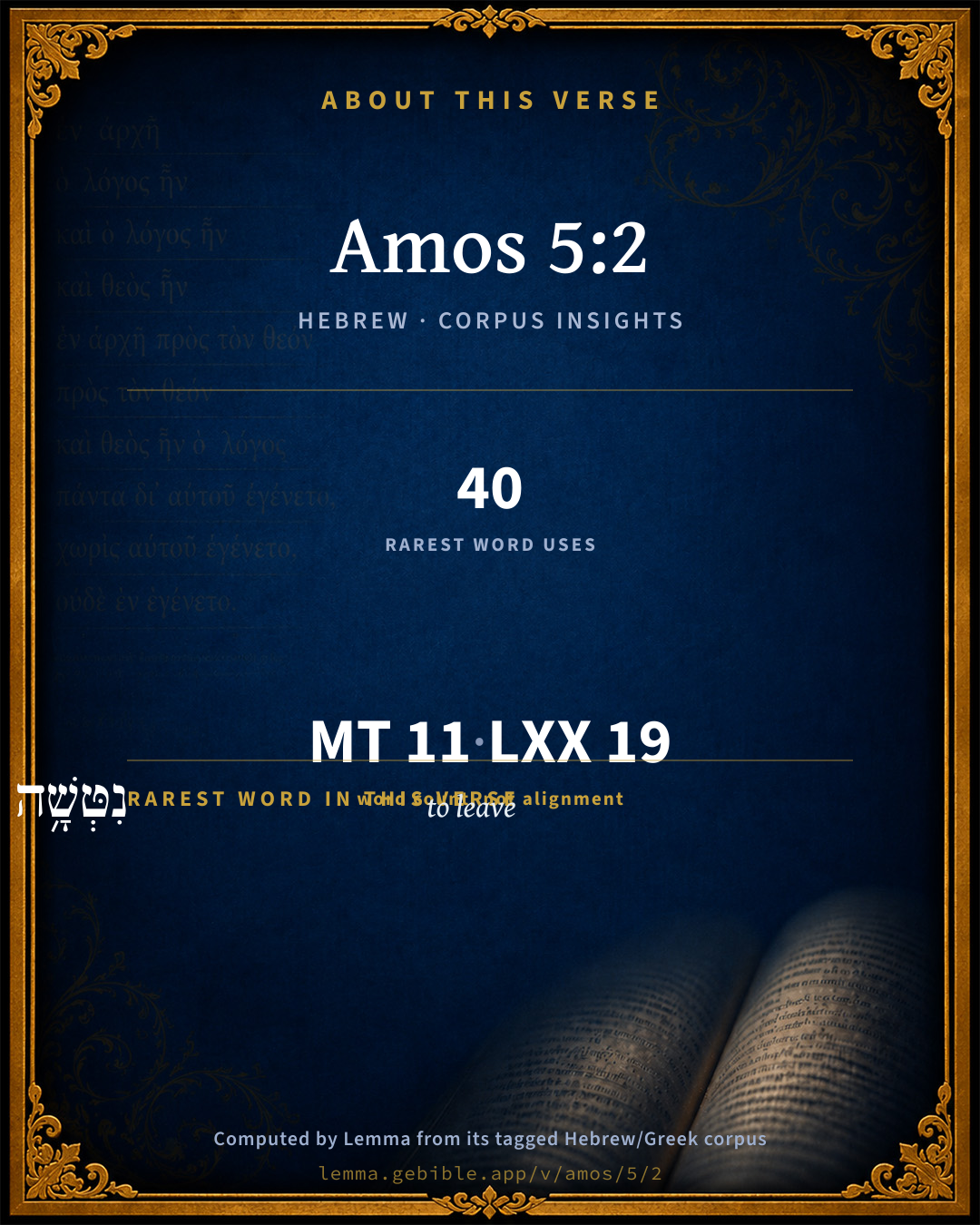
נִטְּשָׁ֥ה to leave H5203 occurs in 39 verses of the Hebrew Bible. Also found in:

Grammatical profile

  • 5 verbs
  • 3 nouns
  • 1 preposition
  • 2 particles

Verb forms

  • נָֽפְלָה֙ Qal · Perfect
  • תוֹסִ֣יף Hiphil · Imperfect
  • ק֔וּם Qal · Infinitive Construct
  • נִטְּשָׁ֥ה Niphal · Perfect
  • מְקִימָֽהּ Hiphil · Participle Active

Repetition

A word recurs within this verse — often emphatic in Hebrew:

  • ק֔וּם to rise H6965 ×2

Hebrew & Septuagint length

In English translation the verse runs 26 words from the Hebrew and 17 from the Septuagint (LXX English) — the Septuagint runs noticeably shorter here. See the side-by-side →

A rough comparison of the two English renderings, which tokenize alike — not a word-level alignment.

Word counts can differ between the Hebrew and the Greek without any difference in meaning — e.g. the Hebrew direct-object marker אֵת has no separate Greek word, and Greek often adds the article ὁ.

In the original languages it is 11 Hebrew tokens and 19 Greek tokens — but the two are counted differently (Hebrew bundles its prefixes and suffixes into one token; the Greek is in lemma form), so that isn’t a like-for-like length.

Cross-references

24

Topical passages linked to Amos 5:2 in the Treasury of Scripture Knowledge — connected by theme and wording, ordered by reader-vote popularity; previews shown in the World English Bible.

  • Jeremiah 14:17 You shall say this word to them, Let my eyes run down with tears night and day, and let them not cease; for the virgin daughter of my people is broken with a great breach, with a very grievous wound.
  • 2 Kings 15:29 In the days of Pekah king of Israel came Tiglath Pileser king of Assyria, and took Ijon, and Abel Beth Maacah, and Janoah, and Kedesh, and Hazor, and Gilead, and Galilee, all the land of Naphtali; and he carried them captive to Assyria.
  • 2 Kings 17:16 They forsook all the commandments of Yahweh their God, and made them molten images, even two calves, and made an Asherah, and worshiped all the host of the sky, and served Baal.
  • Isaiah 3:8 For Jerusalem is ruined, and Judah is fallen; Because their tongue and their doings are against Yahweh, To provoke the eyes of his glory.
  • Isaiah 14:21 Prepare slaughter for his children for the iniquity of their fathers, that they not rise up, and possess the earth, and fill the surface of the world with cities.
  • Isaiah 24:20 The earth shall stagger like a drunken man, and shall sway back and forth like a hammock; and the disobedience of it shall be heavy on it, and it shall fall, and not rise again.
  • Isaiah 37:22 this is the word which Yahweh has spoken concerning him: The virgin daughter of Zion has despised you and ridiculed you; the daughter of Jerusalem has shaken her head at you.
  • Isaiah 43:17 who brings forth the chariot and horse, the army and the mighty man (they lie down together, they shall not rise; they are extinct, they are quenched as a wick):
  • Isaiah 51:17–18 Awake, awake, stand up, Jerusalem, that have drunk at the hand of Yahweh the cup of his wrath; you have drunken the bowl of the cup of staggering, and drained it.
  • Jeremiah 2:27 who tell a stock, You are my father; and to a stone, You have brought me forth: for they have turned their back to me, and not their face; but in the time of their trouble they will say, Arise, and save us.
  • Jeremiah 4:20 Destruction on destruction is cried; for the whole land is laid waste: suddenly are my tents destroyed, [and] my curtains in a moment.
  • Jeremiah 18:13 Therefore thus says Yahweh: Ask you now among the nations, who has heard such things; the virgin of Israel has done a very horrible thing.
  • Jeremiah 30:12–14 For thus says Yahweh, Your hurt is incurable, and your wound grievous.
  • Jeremiah 31:4 Again will I build you, and you shall be built, O virgin of Israel: again shall you be adorned with your tambourines, and shall go forth in the dances of those who make merry.
  • Jeremiah 50:32 The proud one shall stumble and fall, and none shall raise him up; and I will kindle a fire in his cities, and it shall devour all who are round about him.
  • Jeremiah 51:64 and you shall say, Thus shall Babylon sink, and shall not rise again because of the evil that I will bring on her; and they shall be weary. Thus far are the words of Jeremiah.
  • Lamentations 1:16–19 For these things I weep; my eye, my eye runs down with water; Because the comforter who should refresh my soul is far from me: My children are desolate, because the enemy has prevailed.
  • Lamentations 2:13 What shall I testify to you? what shall I liken to you, daughter of Jerusalem? What shall I compare to you, that I may comfort you, virgin daughter of Zion? For your breach is great like the sea: who can heal you?
  • Ezekiel 16:36–37 Thus says the Lord Yahweh, Because your filthiness was poured out, and your nakedness uncovered through your prostitution with your lovers; and because of all the idols of your abominations, and for the blood of your children, that you gave to them;
  • Hosea 6:2 After two days will he revive us. On the third day he will raise us up, And we will live before him.
  • Hosea 14:1 Israel, return to Yahweh your God; For you have fallen because of your sin.
  • Amos 7:2–5 It happened that, when they made an end of eating the grass of the land, then I said, "Lord Yahweh, forgive, I beg you! How could Jacob stand? For he is small."
  • Amos 8:14 Those who swear by the sin of Samaria, And say, 'As your god, Dan, lives;' And, 'As the way of Beersheba lives;' They will fall, and never rise up again."
  • Amos 9:11 In that day I will raise up the tent of David who is fallen, and close up its breaches, and I will raise up its ruins, and I will build it as in the days of old;

Cross-references courtesy of OpenBible.info (CC BY 4.0).

Hebrew and Greek witnesses Masoretic Hebrew ↔ Greek Septuagint

The same verse in the two great witnesses to the Old Testament, shown verse-for-verse.

Here the Septuagint runs noticeably shorter than the Hebrew — LXX2012 (modern English Septuagint) 17 words vs World English Bible 26. A rough length comparison of the two English translations, not a word-level alignment — read both below.

These are two independent witnesses, not word-aligned to each other, and the Septuagint is shown in lemma (dictionary) form.

Hebrew Amos 5:2 Masoretic · Westminster Leningrad Codex

נָֽפְלָה֙ לֹֽא תוֹסִ֣יף ק֔וּם בְּתוּלַ֖ת יִשְׂרָאֵ֑ל נִטְּשָׁ֥ה עַל אַדְמָתָ֖הּ אֵ֥ין מְקִימָֽהּ

"The virgin of Israel has fallen; She shall rise no more. She is cast down on her land; There is no one to raise her up."

World English Bible · Public Domain

Greek LXX Amos 5:2 Septuagint · lemma form

πίπτω οὐκέτι μή προςτίθημι ὁ ἀναἵστημι παρθένος ὁ ἰσραήλ σφάλλω ἐπί ὁ γῆ αὐτός οὐ εἰμί ὁ ἀναἵστημι αὐτός

The virgin of Israel has fallen upon his land; there is none that shall raise her up.

LXX2012 (modern English Septuagint) · Public Domain

Hebrew: Westminster Leningrad Codex (CC BY 4.0). Greek: Septuagint (public domain); English from LXX2012 (modern English Septuagint) (Public Domain). How the Septuagint differs from the Hebrew →

Targum (Aramaic paraphrase)

1

The Targum is the ancient Jewish Aramaic paraphrase of the Hebrew Scriptures — an interpretive translation, not the Hebrew text itself. Onkelos (literal) and Pseudo-Jonathan (expansive) render the Torah, and Jonathan the Prophets. Coverage is partial: where no permissively-licensed English translation exists for a verse, only the Aramaic is shown. This is verse-level text, not a word-by-word alignment to the Hebrew.

  1. Targum Jonathan Prophets (Joshua–Malachi)
    נָפְלָת לָא תוֹסִיף לְמֵיקָם שַׁתָּא הָדָא כְּנִשְׁתָּא דְיִשְׂרָאֵל אִתְרְטִישַׁת עַל אַרְעָא לֵית דִיקַיְמִינָהּ:

    (no public-domain English translation for this verse)

    Targum Jonathan — Aramaic: “Mikraot Gedolot” (public domain). English: “Sefaria Community Translation” (CC0 1.0 (public-domain dedication)); “London "Chaldee Paraphrase," 1871” (public domain). Text via Sefaria.

Commentary

Notes on Amos 5:2 from classic Christian and Jewish commentators (each source and its license shown beneath its notes). The classic Christian expositions comment on the surrounding passage and are grouped to its opening verse, so a note may address several verses; the Jewish commentaries on the Tanakh (Rashi and others) are per-verse, so they appear only where the commentator wrote on this verse.

Lemma curates 59 commentaries, every one of them public domain or Creative Commons licensed, each selected and text-cleaned for this edition rather than reprinted as found. About our sources →

Trapp's Complete Commentary

John Trapp

Amo 5:2 The virgin of Israel is fallen; she shall no more rise: she is forsaken upon her land; [there is] none to raise her up.

Ver. 2. The virgin of Israel is fallen] i.e. Though of the spouse of God she be become the devil’s adulteress, Jer 3:1 Hos 1:2, yet she will needs be counted and called a virgin still; as Sardis, she hath a name to live, but is dead, Rev 3:1; as the Romish crew cry themselves up the only Church Catholic, and therein (like oyster wives) do much outcry us. But what saith the Lord by his prophet Jeremiah, Jer 18:13? "Ask ve now among the heathen; who hath heard such things?" And "the virgin of Israel hath done a very horrible thing." And the virgin of Rome may well say, as Quartilla the strumpet in Petronius doth, Iunonem meam iratam habeam, si unquam me meminerim virginem fuisse: I can hardly remember myself a maid. Israel may also be called a virgin, because she yet subsisted and flourished in her first liberty and splendour, till taken and defloured, as it were, by the Assyrian. And in this sense we read of the virgin of Babylon, Isa 47:1; of Egypt, Jer 46:12; of Zidon, Isa 23:12; and now of Venice, whose motto is, Intacta maneo, I am still a maid; as having never yet fallen into the enemies’ power. Tournay, a town in France, was ever counted so invincible, that this sentence was engraven over one of the gates, Iannes ton me perdu ton pucellage, Thou hast never lost thy maidenhead. Yet was it yielded up to our King Henry VIII, with 10,000 pounds sterling, for the the citizens’ redemption. The virgin of Israel sped not so well.

She is fallen] That is, she shall fall, surely, suddenly, utterly.

She shall no more rise] i.e. Return out of captivity, and be restored to her pristine splendour; yet some think otherwise.

She is forsaken upon her land] Proiecta est, prostrata iacet, she is thrown hard upon her ground, and as it were dashed against it, like an earthen pot against a rock; and all this, because she had left off righteousness in the earth, Amo 5:7. Those that forsake God shall be forsaken of him, 2Ch 15:2.

There is none to raise her up] God will not; and then, man cannot. "Behold," saith Bildad, "God will not cast away a perfect man, neither will he take the ungodly by the hand," Job 8:20, and he will bring them into trouble, and there leave them, Eze 22:20; Eze 29:5. His own he will not leave; or if he do, yet forsake them he will not, Heb 13:5; and if men do, he will relieve them the rather. "Because they called thee an outcast, saying, This is Zion, whom no man seeketh after; therefore I will restore health unto thee, and I will heal thee of thy wounds, saith the Lord," Jer 30:17.

John Trapp, A Commentary or Exposition upon All the Books of the Old and New Testament (1647–1656) — public domain. Text from a community e-Sword module.

Tyndale Open Study Notes

Tyndale Open Resources

5:2 When used to describe political powers, virgin refers to a state of being unconquered by a foreign power (e.g., Babylon, Isa 47:1; Jerusalem, Lam 2:13; cp. Lam 1:1).

Tyndale Open Study Notes — © Tyndale Open Resources, licensed CC BY-SA 4.0. Text via the HelloAO Bible API.

Geneva Bible (1599)

Geneva Bible translators

He so calleth them, because they so boasted of themselves or because they were given to wantonness and daintiness.

Geneva Bible (1599) marginal notes — public domain. Text via Bolls.life.

Jamieson, Fausset & Brown

Robert Jamieson, A. R. Fausset & David Brown

virgin of Israel--the Israelite state heretofore unsubdued by foreigners. Compare Isa 23:12; Jer 18:13; Jer 31:4, Jer 31:21; Lam 2:13; may be interpreted, Thou who wast once the "virgin daughter of Zion." Rather, "virgin" as applied to a state implies its beauty, and the delights on which it prides itself, its luxuries, power, and wealth [CALVIN].

no more rise--in the existing order of things: in the Messianic dispensation it is to rise again, according to many prophecies. Compare Kg2 6:23; Kg2 24:7, for the restricted sense of "no more."

forsaken upon her land--or, "prostrated upon," &c. (compare Eze 29:5; Eze 32:4) [MAURER].

Jamieson, Fausset & Brown — Commentary Critical and Explanatory on the Whole Bible (1871) — public domain (CC PDM 1.0). Text via the HelloAO Bible API.

Adam Clarke's Commentary

Verse 2. The virgin of Israel] The kingdom of Israel, or the ten tribes, which were carried into captivity; and are now totally lost in the nations of the earth.

Adam Clarke's Commentary on the Bible (1810–1826) — public domain. Text from a community e-Sword/MySword module.

John Calvin's Commentaries

This was substantially the vengeance which was now nigh the Israelites, though they rested securely, and even scorned all the threatening of God. The virgin of Israel, he says, has fallen Expounders have too refinedly explained the word virgin; for they think that the people of Israel are here called a virgin, because God had espoused them to himself, and that though they ought to have observed spiritual chastity towards God, they yet abandoned themselves to all kinds of pollutions: but a virgin, we know, is a title given for the most part by the Prophets to this or that people on account of their delicacies; for Babylon, no less than Samaria or the people of Israel, is called a virgin. Certainly this refined interpretation cannot be applied to Babylon, to Egypt, to Tyre, and to other places. I have therefore no doubt but the Prophet here arraigns the Israelites, because they, relying on their strength, indulged themselves. They were quiet in their own retreats, and when all kinds of blessings abounded, they lived daintily and sumptuously. As then they were indulging themselves in such pleasures he calls them a virgin. The virgin of Israel then has fallen, and shall no more rise again.

A condition may be here included, as an exhortation to repentance immediately follows: we may then fitly regard this as being understood, “except they timely repent:” otherwise the Israelites must have fallen without hope of restoration. But we may also refer this to the body of the people: fallen then had the virgin of Israel, not so however that they were all destroyed, as we shall hereafter see; for the Prophet says that the tenth part would remain: but this is rightly said of the people generally; for we know that the kingdom had so fallen, that it never afterwards did rise. A remnant of the tribe of Judah did indeed return to Jerusalem; but the Israelites are at this day dispersed though various parts of the world; yea, they are hid either in the mountains of Armenia, or in other regions of the East. Since then what the Prophet here denounces has been really fulfilled as to the whole kingdom, we may take the place without supposing any thing understood, “Fallen has the virgin of Israel.” For as God showed mercy when the people as a body were destroyed, that some remained, is what does not militate with the prophecy, that the whole body had fallen. Fallen then has the virgin of Israel, nor will she any more rise again; that is, the kingdom shall not by way of recovery be restored; and this, we know, has never taken place.

Forsaken is she, he says, on her own land, and there is none to raise her up; which means, that she will continue fallen: though she may remain in her own place, she will not yet recover what she had lost. We now understand the Prophet’s meaning; and, at the same time, we see that that people had so fallen, as never to rise again, as it has been stated, into a kingdom. Let us now proceed —

John Calvin's Commentaries (1540-1563) — public domain. Text from the Calvin Translation Society English edition (1840s-50s) via the Christian Classics Ethereal Library (ccel.org). Calvin's coverage is partial (roughly two-thirds of the Bible); uncommented books and verses are honest gaps, never fabricated. The 19th-century editor's footnotes and remarks are omitted so the notes are faithfully Calvin's own voice.

Ellicott's Commentary for English Readers

(2) Forsaken.—Or rather dashed to the earth. “Virgin” is a feminine designation of Israel poetically expressive of grace and beauty. Comp. the epithet “daughter of Zion,” nations and cities being represented by a feminine personification. She is not annihilated, but obliterated as a nation.

A Bible Commentary for English Readers, edited by Charles John Ellicott (1878–1897) — public domain. Text from a community e-Sword module.

The Cambridge Bible for Schools and Colleges

gen. ed. J. J. S. Perowne

2. The virgin of Israel is fallen, | she shall no more rise;

She is cast down upon her land, | there is none to raise her up.

This is the ‘ḳînâh,’ written in a peculiar rhythm, which has been shewn (by Prof. K. Budde, now of Strassburg) to be that regularly used for Hebrew elegy. As a rule, in Hebrew poetry, the second of two parallel members balances the first, being approximately similar in length and structure, and presenting a thought either synonymous with it, or antithetic to it; but in the Hebrew elegy, the second member is shorter than the first, and instead of balancing and re-enforcing it, echoes it imperfectly, producing a plaintive, melancholy cadence. This rhythmical form prevails throughout most of the Book of ‘Lamentations,’ for instance, Amo_1:1 :—

How doth the city sit solitary, | she that was full of people!

She is become as a widow, | she that was great among the nations;

The princess among the provinces, | she is become tributary.

It is also observable elsewhere, where a ‘ḳînâh’ is announced, as Jer_9:10 b–11:—

From the fowl of heaven even unto cattle, | they are fled, they are gone:

And I will make Jerusalem to be heaps, | an habitation of jackals;

And the cities of Judah will I make a desolation, | without inhabitant.

In the verses here quoted, each line, it will be observed, consists of two unequal parts, the second halting after the first, and being (in the Hebrew) appreciably shorter. For other examples of the “ḳînâh,” or dirge, see 2Sa_1:17 ff; 2Sa_3:33-34, Eze_19:1-14; Eze_26:17-18; Eze_32:2-16[156]. (In A.V., R.V., the subst. and corresponding verbs are rendered lamentation, lament; but these are suited better to express nĕhî, nâhâh: see on Amo_5:16.)

[156] See further the writer’s Introduction, p. 429 f.

the virgin of Israel] The nation is personified, being pictured as a maiden, no longer erect and blithefully going her way, but wounded and prostrate on the ground, unable to rise by her own efforts (having none to assist her (cf. Isa_1:17 f. of Jerusalem). This is the earliest extant example of the personification of a nation, or community, as a woman,—a maiden or a mother, as the case may be: but it becomes common afterwards in Hebrew poetry, the figure being adopted especially with effect when it is desired to represent some keen or strong emotion, and being employed sometimes with great dramatic force. See, for example, with virgin, Jer_18:13; Jer_31:4; Jer_31:21; with virgin daughter, Isa_37:22 (“the virgin daughter of Zion hath despised thee, and laughed thee to scorn; the daughter of Jerusalem hath shaken her head after thee”), Isa_47:1, Jer_14:17; Jer_46:11; with daughter (alone) Isa_1:8; Isa_10:30; Isa_10:32; Isa_22:4; Isa_47:5, Jer_6:26; Jer_9:1, Mic_4:10; Mic_4:13, Zep_3:14, Zec_9:9 (“Rejoice greatly, O daughter of Zion; shout, O daughter of Jerusalem”); and with the feminine indicated (in the Hebrew) by the termination, Isa_12:6 (see R.V. marg.), Isa_49:17 f., Isa_51:17-20, Jer_10:17 (see R.V. marg.), Jer_22:23 (see ib.).

is fallen] The tense is the prophetic past, describing the future as the prophet in imagination sees it, already accomplished. Cf. Amo_8:14.

is forsaken] Rather, is cast down (R.V.), or lieth forsaken (R.V. marg.), i.e. is abandoned, left to die where she had fallen: cf. Eze_29:5 (R.V. “leave thee (thrown) into the wilderness”), Eze_32:4 (“And I will leave thee forsaken upon the land, I will throw thee forth upon the face of the field”). Such an announcement as this, made in the height of the prosperity secured by Jeroboam II, would naturally be a startling one to those who heard it.

The Cambridge Bible for Schools and Colleges (gen. ed. J. J. S. Perowne; Cambridge University Press, 1878–1918) — public domain. Text from a community e-Sword module.

John Gill's Exposition

The virgin of Israel is fallen,.... The kingdom of Israel, so called, because it had never been subdued, or become subject to a foreign power, since it was a kingdom; or because, considered in its ecclesiastic state, it had been espoused to the Lord as a chaste virgin; and perhaps this may be ironically spoken, and refers to its present adulterate and degenerated state worshipping the calves at Dan and Bethel; or else because of its wealth and riches and the splendour and gaiety in which it appeared; but now, as it had fallen into sin and iniquity, it should quickly fall by it, and on account of it, into ruin and misery; and because of the certainty of it it is represented as if it was already fallen:

she shall no more rise; and become a kingdom again, as it never has as yet, since the ten tribes were carried away captive by Shalmaneser king of Assyria, to which calamity this prophecy refers, The Targum is,

"shall not rise again this year;''

very impertinently; better Kimchi and Ben Melech, for a long time; since as they think, and many others, that the ten tribes shall return again, as may seem when all Israel shall be converted and saved, and repossess their own land; see Hos 1:10. Abendana produces a passage out of Zohar, in which these words are interpreted, that the virgin of Israel should not rise again of herself, she not having power to prevail over her enemies; but God will raise her up out of the dust, when he shall raise up the tabernacle of David that is fallen, who shall reign in future time over all the tribes together, as it is said in Amo 9:11;

she is forsaken upon her land; by her people, her princes, and her God; or prostrate on the ground, as the Targum; she was cast upon the ground, and dashed to pieces by the enemy as an earthen vessel, and there left, her ruin being irrecoverable; so whatever is cast and scattered, or dashed to pieces on the ground, and left, is expressed by the word here used, as Jarchi observes:

there is none to raise her up: her princes and people are either slain by the sword, famine, and pestilence, or carried captive, and so can yield her no assistance; her idols whom she worshipped cannot, and her God she forsook will not.

John Gill's Exposition of the Whole Bible (1746–1763) — public domain (CC PDM 1.0). Text via the HelloAO Bible API.

Albert Barnes' Notes on the Bible

She hath fallen, she shall rise no more, the virgin of Israel; she hath been dashed down upon her land, there is none to raise her up - Such is the dirge, a dirge like that of David over Saul and Jonathan, over what once was lovely and mighty, but which had perished. He speaks of all as past, and that, irremediably. Israel is one of the things which had been, and which would never again be. He calls her tenderly, “the virgin of Israel,” not as having retained her purity or her fealty to God; still less, with human boastfulness, as though she had as yet been unsubdued by man. For she had been faithless to God, and had been many times conquered by man. Nor does it even seem that God so calls her, because He once espoused her to Himself For isaiah so calls Babylon. But Scripture seems to speak of cities, as women, because in women tenderness is most seen; they are most tenderly guarded; they, when pure, are most lovely; they, when corrupted, are most debased.

Hence , “God says on the one hand, “I remember thee, the love of thine espousals” Jer 2:2; on the other, “Hear, thou harlot, the word of the Lord” Eze 16:35. When He claims her faithfulness He calls her, betrothed.” Again , “when He willeth to signify that a city or nation has been as tenderly loved and anxiously guarded, whether by Himsclf or by others, He calleth it “virgin,” or when lie would indicate its beauty and lovely array. Isaiah saith, ‘come down and sit in the dust, virgin daughter of Babylon’ Isa 47:1, that is, thou who livedest before in all delicacies, like a virgin under the shelter of her home. For it follows, ‘for thou shalt no more be called tender and delicate.’” More pitiable, for their tenderness and delicacy, is the distress of women. And so he pictures her as already fallen, “dashed” (the word imitates the sound) to the earth “upon her own ground.” An army may be lost, and the nation recover. She was “dashed down upon her own ground.” In the abode of her strength, in the midst of her resources, in her innermost retreat, she should fall. In herself, she fell powerless. And he adds, she has “no one to raise her up;” none to have ruth upon her; image of the judgment on a lost soul, when the terrible sentence is spoken and none can intercede! “She shall not rise again.” As she fell, she did not again rise. The prophet beholds beyond the eighty-five years which separated the prosperity under Jeroboam II from her captivity. As a people, he says, she should be restored no more; nor was she.

Albert Barnes' Notes on the Bible (1834–1885) — public domain. Text from a community e-Sword/MySword module.

Matthew Poole's English Annotations

The virgin: this name is given to her not for her purity and integrity, for she was an adulteress, but either ironically, or because her present riches, glory, and beauty seemed to be that of a virgin that had her portion, strength, and honour untouched; or else by a figure as properly may it be applied to Israel, as to Babylon, Isa 47:1, or to Egypt, Jer 46:11, to Zidon, Isa 23:12.

Is fallen; or shall ere long fall, the thing put as done already because of the certainty of it. Or rather, is already falling by civil wars and conspiracies, which prepared way for the final ruin of Israel: it is possible this sermon of the prophet might be about the time that Shallum or Menahem usurped the throne. Or else it may refer to the times of Jehoahaz, when that of the third verse will appear to have been fulfilled; this seems most probable.

She shall no more rise; though they might by repentance have risen again, yet the prophet, considering their obstinacy, speaks of it as a thing that should never be, as eventually it proved also, for Israel never recovered the fall by Shalmaneser.

She is forsaken upon her land; broken to pieces upon her own land, and so left as a broken vessel; or she shall be by home divisions first broken, and afterwards carried captive.

There is none to raise her up; none at home among all her princes, counsellors, and rulers, nor any friend among her allies; all leave her to sink.

Matthew Poole's English Annotations on the Holy Bible (1683–1685) — public domain. Text from a community e-Sword/MySword module.

The Pulpit Commentary

The virgin of Israel; i.e. the virgin Israel; so called, not as having been pure and faithful to God, but as tenderly treated and guarded from enemies. (comp. Isa_23:12 Isa_47:1; Jer_14:17) Is fallen; (2Sa_1:19) she shall no more rise. This is apparently a contradiction to the promise of restoration elsewhere expressed, but is to be explained either as referring exclusively to the ten tribes, very few of whom returned from exile, and to the kingdom of Israel which was never reestablished; or, as Pseudo-Rufinus says, "Ita debemus accipere quod lugentis affectu cumulatius aetimavit illata discrimina sicque funditus appellasse deletos, quos ex majore videret parte contritos." Forsaken upon her land; better, she shall be dashed upon her own land; her own soil shall witness her ruin that soil which was "virgin," unconquered, and her own possession.

The Pulpit Commentary (1880–1919), ed. H.D.M. Spence-Jones & Joseph S. Exell — public domain. Text from a community e-Sword module.

John Wesley's Explanatory Notes

The virgin - So she was, when first espoused to God. Upon her land - Broken to pieces upon her own land, and so left as a broken vessel.

John Wesley, Explanatory Notes Upon the Whole Bible (1754–1765) — public domain. Text via the GEBible commentary corpus.

Rashi

Rabbi Shlomo Yitzchaki (Rashi)

The virgin of Israel—When they are exiled in the days of Hoshea son of Elah (II Kings 17:1-6), a king will never again rise from the ten tribes.

she is spread out on her soil Heb. נִטְּשָׁה. Anything that is cast, lying, and spread out upon the field is called נְטִישָה.

Rashi on the Tanakh — English translations: “The Judaica Press complete Tanach with Rashi, translated by A. J. Rosenberg” (CC BY 4.0); “Pentateuch with Rashi's commentary by M. Rosenbaum and A.M. Silbermann, 1929-1934” (public domain); “The Metsudah Tanach series, Lakewood, N.J” (CC BY 4.0); and “The Book of Joshua, Metsudah Publications, 1997” (CC BY 4.0). Text via Sefaria.

Lesson kit

Teaching starters — assembled from the data on this page, not authored interpretation. Every prompt links to the verse data it draws on. Edit before teaching.

Amos, in the Prophets, opens this verse with 11 words (10 distinct Hebrew lemmas). Its most distinctive word is nâṭash (“to leave”). The Greek Septuagint runs shorter here. A historical commentator’s framing appears above. Read the whole chapter for the surrounding context.

Discussion questions

  1. How does “to leave” (nâṭash) shape what this verse is saying?
  2. How does Genesis 31:28, which shares the word «to leave», read alongside this verse?
  3. What does the repetition of “to rise” (2× in this one verse) do in this verse?
  4. The Septuagint runs shorter here than the Hebrew. What might account for the difference?
  5. These translations render this verse differently; the difference is in the English rendering, not the original. What questions does that raise?
  6. «נָֽפְלָה֙» is a Qal Perfect verb. How does that grammatical form shape the action described?
  7. Compare how Trapp's Complete Commentary and Tyndale Open Study Notes read this verse. Where do they agree or differ?

Things to notice

Reading settings

Reading text

Shown beneath each verse's original-language words.

Old Testament
Old Testament edition

Read the OT as the Masoretic Hebrew (MT) or the Greek Septuagint (LXX).

English shown for the Greek Septuagint (in the Hebrew ↔ Greek comparison).

Comparing translations? Open the Compare panel on any verse page to stack up to four side by side.