
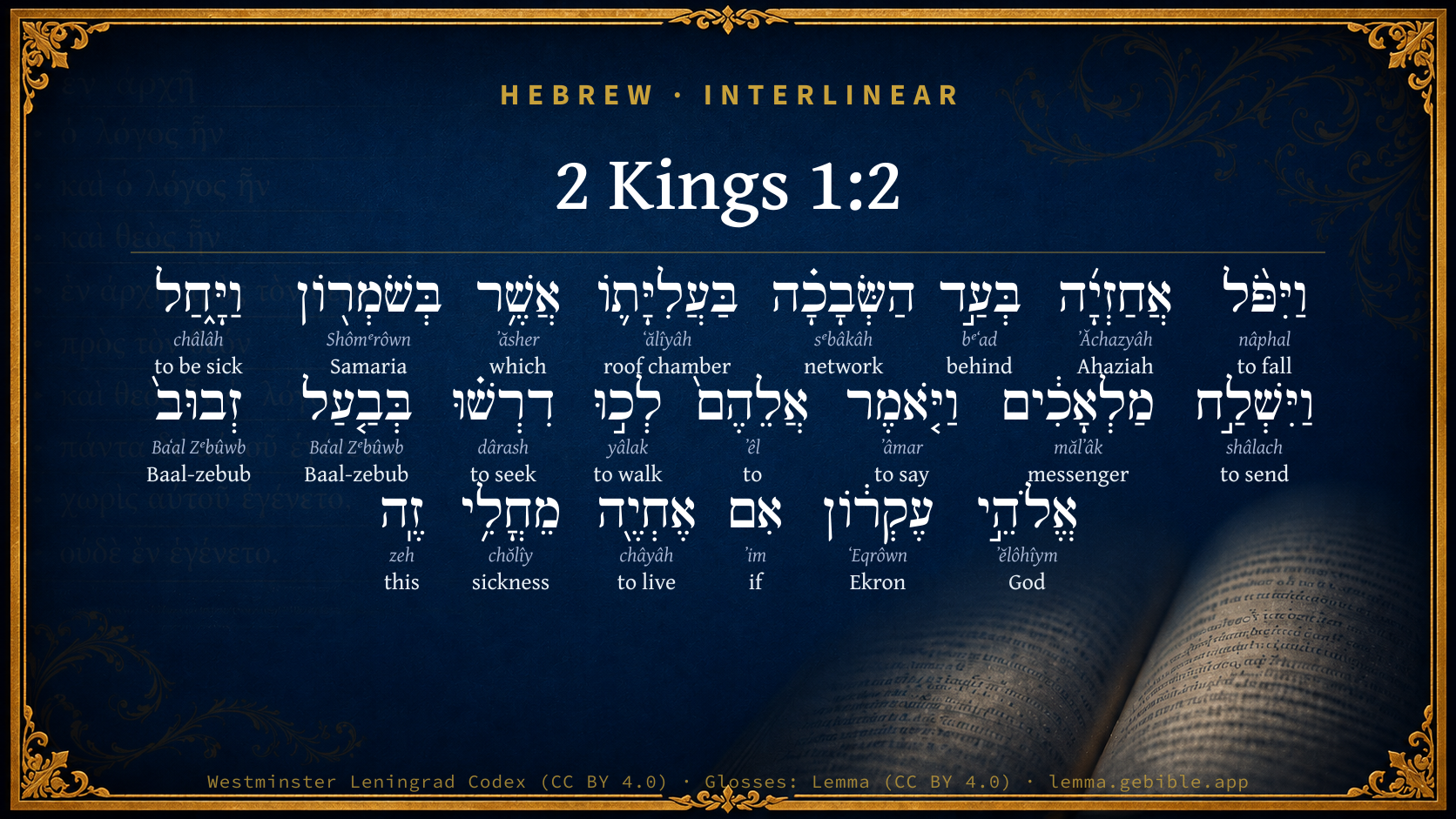
2 Kings 1:2

Hebrew (Westminster Leningrad Codex) 2 Kings 1:2 appears in the Hebrew Old Testament. The text above is from the Westminster Leningrad Codex. Each word links to its Strong’s number, a concise gloss, and parsing drawn from the Open Scriptures Hebrew Bible morphology. Click any word for its full Brown-Driver-Briggs (BDB) entry.
Download image
Cite this verse

2 Kings 1:2 (World English Bible). Public Domain. Lemma interlinear Bible study tool, https://lemma.gebible.app/v/2-kings/1/2.

Show BibTeX & RIS
BibTeX
RIS
English Translation
Ahaziah fell down through the lattice in his upper chamber that was in Samaria, and was sick: and he sent messengers, and said to them, Go, inquire of Baal Zebub, the god of Ekron, whether I shall recover of this sickness.
World English Bible · Public Domain
Highlights
  • 1 first appearance in the Hebrew Bible
Full analysis ↓
Download a study sheet

One document with this verse’s original text, its word-by-word gloss line, the meaning frame, cross-references with their text, attributed commentary, and full source and license credits — printable, and it pastes into notes with its structure intact.

This verse Autodidact and up

Study sheet (.html) Plain text (.txt)

A passage Seminary Student

Up to 50 verses in one chapter. A passage sheet keeps up to 6 commentary sources and 12 cross-references per verse, in the order this page ranks them, and says so on the sheet whenever that leaves anything out. Ask for a single verse and you get the Autodidact verse sheet above.

Everything on this page stays free to read, with no account — the sheet is a download of what is already on screen, not access to it.

Want to remove ads? Support Godless Engineer
Compare translations 3

The same verse in 3 English versions, stacked beneath the original-language interlinear above. Click any original word for its lexicon entry.

Each is an independent rendering of the whole verse — the interlinear is not word-aligned to these translations.

Highlighted words mark where these versions differ — a whole-verse word diff, not a word-by-word alignment.

  • World English Bible Public Domain
    Ahaziah fell down through the lattice in his upper chamber that was in Samaria, and was sick: and he sent messengers, and said to them, Go, inquire of Baal Zebub, the god of Ekron, whether I shall recover of this sickness.
  • King James Version Public Domain
    And Ahaziah fell down through a lattice in his upper chamber that was in Samaria, and was sick: and he sent messengers, and said unto them, Go, enquire of Baalzebub the god of Ekron whether I shall recover of this disease.
  • unfoldingWord Literal Text CC BY-SA 4.0
    And Ahaziah fell through the lattice in his upper chamber that in Samaria, and he injured. And he sent messengers, and he said to them, “Go, inquire of Baal Zebub, the god of Ekron, if I will live from this injury.”

unfoldingWord Literal Text — © unfoldingWord, licensed CC BY-SA 4.0. Word-aligned USFM3 via Door43 (git.door43.org/unfoldingWord/en_ult).

Versions to compare (up to 4)

3 of 4 selected

Show all 18 translations

Every available English version of this verse, each an independent rendering of the whole verse.

  • World English Bible Public Domain
    Ahaziah fell down through the lattice in his upper chamber that was in Samaria, and was sick: and he sent messengers, and said to them, Go, inquire of Baal Zebub, the god of Ekron, whether I shall recover of this sickness.
  • Berean Standard Bible Public Domain
    Now Ahaziah had fallen through the lattice of his upper room in Samaria and injured himself. So he sent messengers and instructed them: “Go inquire of Baal-zebub, the god of Ekron, whether I will recover from this injury.”
  • Majority Standard Bible Public Domain
    Now Ahaziah had fallen through the lattice of his upper room in Samaria and injured himself. So he sent messengers and instructed them: “Go inquire of Baal-zebub, the god of Ekron, whether I will recover from this injury.”
  • King James Version Public Domain
    And Ahaziah fell down through a lattice in his upper chamber that was in Samaria, and was sick: and he sent messengers, and said unto them, Go, enquire of Baalzebub the god of Ekron whether I shall recover of this disease.
  • American Standard Version (1901) Public Domain
    And Ahaziah fell down through the lattice in his upper chamber that was in Samaria, and was sick: and he sent messengers, and said unto them, Go, inquire of Baal-zebub, the god of Ekron, whether I shall recover of this sickness.
  • Revised Version (1885) Public Domain
    And Ahaziah fell down through the lattice in his upper chamber that was in Samaria, and was sick: and he sent messengers, and said unto them, Go, inquire of Baal-zebub the god of Ekron whether I shall recover of this sickness.
  • Geneva Bible (1599) Public Domain
    And Ahaziah fell thorow the lattesse windowe in his vpper chamber which was in Samaria: so he was sicke: then he sent messengers, to whome he saide, Goe, and enquire of Baal-zebub the God of Ekron, if I shall recouer of this my disease.
  • Douay-Rheims (1899) Public Domain
    And Ochozias fell through the lattices of his upper chamber which he had in Samaria, and was sick: and he sent messengers, saying to them: Go, consult Beelzebub, the god of Accaron, whether I shall recover of this my illness.
  • Young's Literal Translation Public Domain
    and Ahaziah falleth through the lattice in his upper chamber that `is' in Samaria, and is sick, and sendeth messengers, and saith unto them, `Go ye, inquire of Baal-Zebub god of Ekron if I recover from this sickness.'
  • Literal Standard Version CC BY-SA 4.0
    and Ahaziah falls through the lattice in his upper chamber that [is] in Samaria, and is sick, and sends messengers, and says to them, “Go, inquire of Ba‘al-Zebub god of Ekron if I recover from this sickness.”
  • Unlocked Literal Bible CC BY-SA 4.0
    Then Ahaziah fell down through the lattice in his upper chamber in Samaria, and was injured. So he sent for messengers and said to them, “Go, ask Baal-Zebub, the god of Ekron, whether I will recover from this injury.”
  • unfoldingWord Literal Text CC BY-SA 4.0
    And Ahaziah fell through the lattice in his upper chamber that in Samaria, and he injured. And he sent messengers, and he said to them, “Go, inquire of Baal Zebub, the god of Ekron, if I will live from this injury.”
  • Darby Bible Public Domain
    And Ahaziah fell down through the lattice in his upper chamber which was in Samaria, and was sick; and he sent messengers and said to them, Go, inquire of Baal-zebub the god of Ekron, whether I shall recover from this disease.
  • World Messianic Bible Public Domain
    Ahaziah fell down through the lattice in his upper room that was in Samaria, and was sick. So he sent messengers, and said to them, “Go, inquire of Baal Zebub, the god of Ekron, whether I will recover of this sickness.”
  • Webster's Bible Public Domain
    And Ahaziah fell down through a lattice in his upper chamber that was in Samaria, and was sick: and he sent messengers, and said to them, Go, inquire of Baal-zebub the god of Ekron, whether I shall recover from this disease.
  • Free Bible Version CC BY-SA 4.0
    Ahaziah had fallen through the lattice-work of his upper room in Samaria and had hurt himself badly. So he sent out messengers, telling them: “Go and ask Baal-zebub, the god of Ekron, whether I will get better from this injury.”
  • Bible in Basic English Public Domain
    Now Ahaziah had a fall from the window of his room in Samaria, and was ill. And he sent men, and said to them, Put a question to Baal-zebub, the god of Ekron, about the outcome of my disease, to see if I will get well or not.
  • JPS Tanakh (1917) Public Domain
    And Ahaziah fell down through the lattice in his upper chamber that was in Samaria, and was sick; and he sent messengers, and said unto them: 'Go, inquire of Baal-zebub the god of Ekron whether I shall recover of this sickness.'

Literal Standard Version (2020), Covenant Press — licensed CC BY-SA 4.0. Text via the HelloAO Bible API (eBible.org). Unlocked Literal Bible (unfoldingWord) — licensed CC BY-SA 4.0. Text via the HelloAO Bible API (eBible.org). unfoldingWord Literal Text — © unfoldingWord, licensed CC BY-SA 4.0. Word-aligned USFM3 via Door43 (git.door43.org/unfoldingWord/en_ult). Free Bible Version, Dr. Jonathan Gallagher — licensed CC BY-SA 4.0. Text via the HelloAO Bible API (eBible.org).

Word by word

More ways to search: Search by grammar → Find every occurrence → Compare this word →

Practice this passage: Drill this verse → Learn its vocabulary →

בְּבַ֤עַל
Baʻal Zᵉbûwb
H1176
“in/at · Baal-zebub”
Preposition + Noun, Proper
Part of Speech
Preposition + Noun
Type
Proper
Full BDB Definition

Origin: from H1168 and H2070

TWOT: None

Baal-zebub = "lord of the fly" - a Philistine deity worshipped at Ekron
  1. וַיִּפֹּ֨ל nâphal H5307 “and · to fall” Conjunction + Verb, Qal, Sequential Imperfect, 3rd Person, Masculine, Singular
  2. אֲחַזְיָ֜ה ʼĂchazyâh H274 “Ahaziah” Noun, Proper
  3. בְּעַ֣ד bᵉʻad H1157 “behind” Preposition
  4. הַשְּׂבָכָ֗ה sᵉbâkâh H7639 “the · network” Particle, Definite Article + Noun, Common, Feminine, Singular, Absolute
  5. בַּעֲלִיָּת֛וֹ ʻălîyâh H5944 “in/at · roof chamber · his” Preposition + Noun, Common, Feminine, Singular, Construct + Suffix, Personal, 3rd Person, Masculine, Singular
  6. אֲשֶׁ֥ר ʼăsher H834 “which” Particle, Relative
  7. בְּשֹׁמְר֖וֹן Shômᵉrôwn H8111 “in/at · Samaria” Preposition + Noun, Proper
  8. וַיָּ֑חַל châlâh H2470 “and · to be sick” Conjunction + Verb, Qal, Sequential Imperfect, 3rd Person, Masculine, Singular
  9. וַיִּשְׁלַ֣ח shâlach H7971 “and · to send” Conjunction + Verb, Qal, Sequential Imperfect, 3rd Person, Masculine, Singular
  10. מַלְאָכִ֔ים mălʼâk H4397 “messengers” Noun, Common, Masculine, Plural, Absolute
  11. וַיֹּ֤אמֶר ʼâmar H559 “and · to say” Conjunction + Verb, Qal, Sequential Imperfect, 3rd Person, Masculine, Singular
  12. אֲלֵהֶם֙ ʼêl H413 “to · them” Preposition + Suffix, Personal, 3rd Person, Masculine, Plural
  13. לְכ֣וּ yâlak H3212 “walk” Verb, Qal, Imperative, 2nd Person, Masculine, Plural
  14. דִרְשׁ֗וּ dârash H1875 “seek” Verb, Qal, Imperative, 2nd Person, Masculine, Plural
  15. זְבוּב֙ Baʻal Zᵉbûwb H1176 “Baal-zebub” Noun, Proper
  16. אֱלֹהֵ֣י ʼĕlôhîym H430 “God(s) of” Noun, Common, Masculine, Plural, Construct
  17. עֶקְר֔וֹן ʻEqrôwn H6138 “Ekron” Noun, Proper
  18. אִם ʼim H518 “if” Conjunction
  19. אֶחְיֶ֖ה châyâh H2421 “to live” Verb, Qal, Imperfect, 1st Person, Common, Singular
  20. מֵחֳלִ֥י chŏlîy H2483 “from · sickness” Preposition + Noun, Common, Masculine, Singular, Absolute
  21. זֶֽה zeh H2088 “this” Pronoun, Demonstrative, Masculine, Singular

About this verse

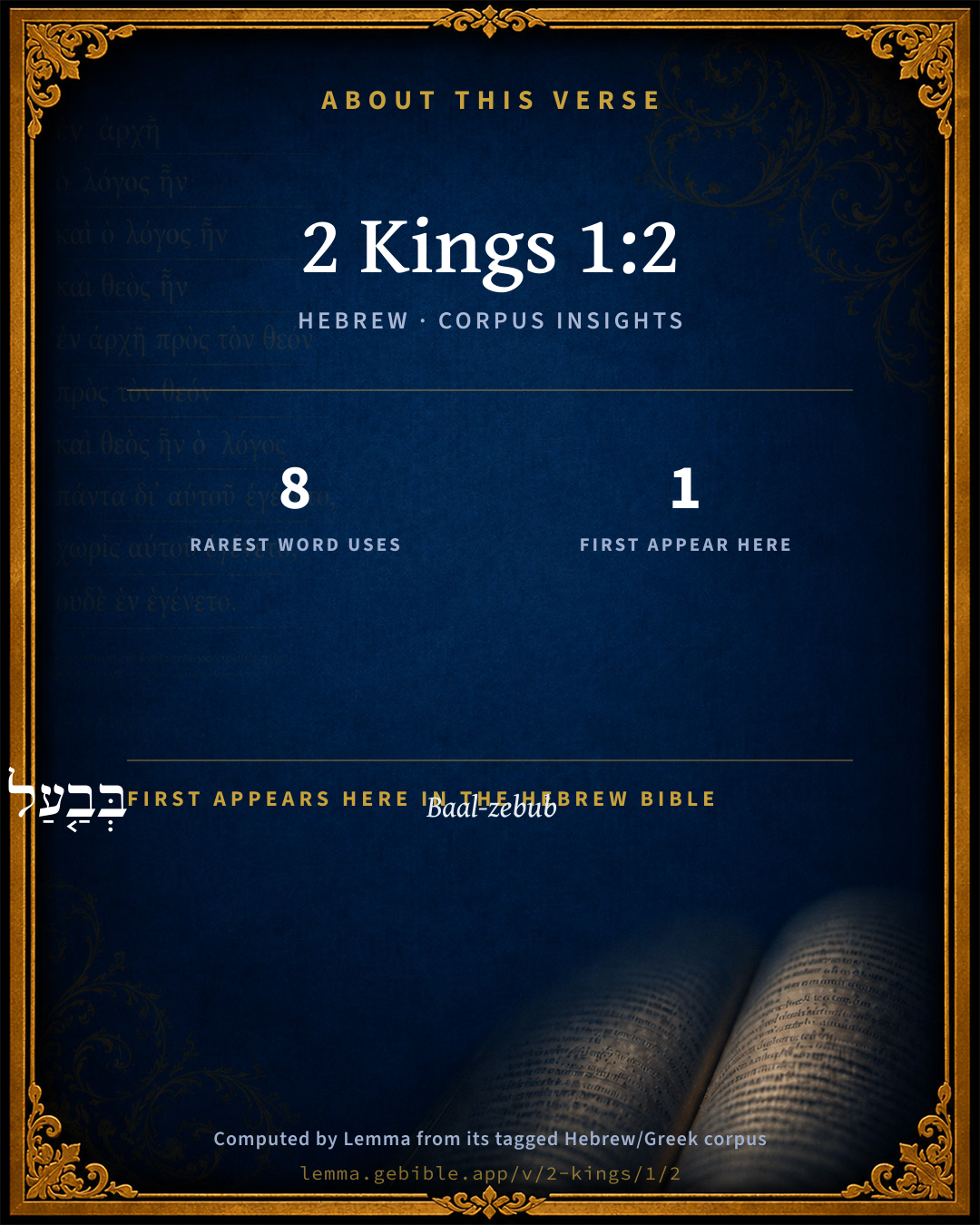
These counts appear in no published source. They are computed here, from the morphology-tagged text and Lemma’s own curated glosses. What Lemma adds →

22
words
21
distinct lemmas
Historical
section

Notable vocabulary

The rarest word here is בְּבַ֤עַל Baal-zebub H1176 — appearing just 8 times in the whole Hebrew Bible.

First appearance in Scripture

This word makes its first canonical appearance in the Hebrew Bible here:

  • בְּבַ֤עַל Baal-zebub H1176

Shared distinctive vocabulary

בְּבַ֤עַל Baal-zebub H1176 occurs in 4 verses of the Hebrew Bible. Also found in:

Grammatical profile

  • 7 verbs
  • 10 nouns
  • 1 pronoun
  • 2 prepositions
  • 1 conjunction
  • 1 particle

Verb forms

  • וַיִּפֹּ֨ל Qal · Sequential Imperfect
  • וַיָּ֑חַל Qal · Sequential Imperfect
  • וַיִּשְׁלַ֣ח Qal · Sequential Imperfect
  • וַיֹּ֤אמֶר Qal · Sequential Imperfect
  • לְכ֣וּ Qal · Imperative
  • דִרְשׁ֗וּ Qal · Imperative
  • אֶחְיֶ֖ה Qal · Imperfect

Repetition

A word recurs within this verse — often emphatic in Hebrew:

  • בְּבַ֤עַל Baal-zebub H1176 ×2

Hebrew & Septuagint length

In English translation the verse runs 41 words from the Hebrew and 50 from the Septuagint (LXX English) — closely comparable.

A rough comparison of the two English renderings, which tokenize alike — not a word-level alignment.

Word counts can differ between the Hebrew and the Greek without any difference in meaning — e.g. the Hebrew direct-object marker אֵת has no separate Greek word, and Greek often adds the article ὁ.

Cross-references

20

Topical passages linked to 2 Kings 1:2 in the Treasury of Scripture Knowledge — connected by theme and wording, ordered by reader-vote popularity; previews shown in the World English Bible.

  • 2 Kings 1:16 He said to him, Thus says Yahweh, Because you have sent messengers to inquire of Baal Zebub, the god of Ekron, is it because there is no God in Israel to inquire of his word? therefore you shall not come down from the bed where you are gone up, but shall surely die.
  • 2 Kings 8:7–10 Elisha came to Damascus; and Benhadad the king of Syria was sick; and it was told him, saying, The man of God is come here.
  • Matthew 10:25 It is enough for the disciple that he be like his teacher, and the servant like his lord. If they have called the master of the house Beelzebul, how much more those of his household!
  • Mark 3:22 The scribes who came down from Jerusalem said, "He has Beelzebul," and, "By the prince of the demons he casts out the demons."
  • Isaiah 37:19 and have cast their gods into the fire: for they were no gods, but the work of men's hands, wood and stone; therefore they have destroyed them.
  • 1 Kings 11:33 because that they have forsaken me, and have worshiped Ashtoreth the goddess of the Sidonians, Chemosh the god of Moab, and Milcom the god of the children of Ammon; and they have not walked in my ways, to do that which is right in my eyes, and [to keep] my statutes and my ordinances, as did David his father.
  • 2 Kings 1:3 But the angel of Yahweh said to Elijah the Tishbite, Arise, go up to meet the messengers of the king of Samaria, and tell them, Is it because there is no God in Israel, that you go to inquire of Baal Zebub, the god of Ekron?
  • 2 Kings 1:6 They said to him, There came up a man to meet us, and said to us, Go, turn again to the king who sent you, and tell him, Thus says Yahweh, Is it because there is no God in Israel, that you send to inquire of Baal Zebub, the god of Ekron? therefore you shall not come down from the bed where you are gone up, but shall surely die.
  • Isaiah 37:12 Have the gods of the nations delivered them, which my fathers have destroyed, Gozan, and Haran, and Rezeph, and the children of Eden who were in Telassar?
  • Luke 11:15 But some of them said, "He casts out demons by Beelzebul, the prince of the demons."
  • Judges 5:28 Through the window she looked forth, and cried, The mother of Sisera [cried] through the lattice, Why is his chariot so long in coming? Why do the wheels of his chariots wait?
  • Judges 11:24 Won't you possess that which Chemosh your god gives you to possess? So whoever Yahweh our God has dispossessed from before us, them will we possess.
  • 1 Samuel 5:10 So they sent the ark of God to Ekron. It happened, as the ark of God came to Ekron, that the Ekronites cried out, saying, They have brought about the ark of the God of Israel to us, to kill us and our people.
  • 1 Kings 14:3 Take with you ten loaves, and cakes, and a jar of honey, and go to him: he will tell you what shall become of the child.
  • 1 Kings 22:34 A certain man drew his bow at a venture, and struck the king of Israel between the joints of the armor: therefore he said to the driver of his chariot, Turn your hand, and carry me out of the host; for I am severely wounded.
  • 2 Chronicles 21:14–15 behold, Yahweh will strike with a great plague your people, and your children, and your wives, and all your substance;
  • Job 31:3 Is it not calamity to the unrighteous, And disaster to the workers of iniquity?
  • Song of Solomon 2:9 My beloved is like a roe or a young hart. Behold, he stands behind our wall! He looks in at the windows. He glances through the lattice.
  • Matthew 12:24–27 But when the Pharisees heard it, they said, "This man does not cast out demons, except by Beelzebul, the prince of the demons."
  • Acts 20:9 A certain young man named Eutychus sat in the window, weighed down with deep sleep. As Paul spoke still longer, being weighed down by his sleep, he fell down from the third story, and was taken up dead.

Cross-references courtesy of OpenBible.info (CC BY 4.0).

Hebrew and Greek witnesses Masoretic Hebrew ↔ Greek Septuagint

The same verse in the two great witnesses to the Old Testament, shown verse-for-verse.

These are two independent witnesses, not word-aligned to each other, and the Septuagint is shown in lemma (dictionary) form.

Hebrew 2 Kings 1:2 Masoretic · Westminster Leningrad Codex

וַיִּפֹּ֨ל אֲחַזְיָ֜ה בְּעַ֣ד הַשְּׂבָכָ֗ה בַּעֲלִיָּת֛וֹ אֲשֶׁ֥ר בְּשֹׁמְר֖וֹן וַיָּ֑חַל וַיִּשְׁלַ֣ח מַלְאָכִ֔ים וַיֹּ֤אמֶר אֲלֵהֶם֙ לְכ֣וּ דִרְשׁ֗וּ בְּבַ֤עַל זְבוּב֙ אֱלֹהֵ֣י עֶקְר֔וֹן אִם אֶחְיֶ֖ה מֵחֳלִ֥י זֶֽה

Ahaziah fell down through the lattice in his upper chamber that was in Samaria, and was sick: and he sent messengers, and said to them, Go, inquire of Baal Zebub, the god of Ekron, whether I shall recover of this sickness.

World English Bible · Public Domain

Greek LXX 2 Kings 1:2 Septuagint · lemma form

καί πίπτω οχοζιας διά ὁ δικτυωτός ὁ ἐν ὁ ὑπερῷον αὐτός ὁ ἐν σαμαρεία καί ἀρρωστέω καί ἀποστέλλω ἄγγελος καί εἶπον πρός αὐτός δεῦτε καί ἐπιζητέω ἐν ὁ βααλ μυῖα θεός ακκαρων εἰ ζάω ἐκ ὁ ἀρρωστία ἐγώ οὗτος καί πορεύομαι ἐπιἐρωτάω διά αὐτός

And Ochozias fell through the lattice that was in his upper chamber in Samaria and was sick; and he sent messengers, and said to them, Go and enquire of Baal fly, the god of Accaron, whether I shall recover of this my sickness. And they went to enquire of him.

LXX2012 (modern English Septuagint) · Public Domain

On this verse, Adam Clarke's Commentary discusses the Septuagint’s reading. Read the note in Commentary ↓

Hebrew: Westminster Leningrad Codex (CC BY 4.0). Greek: Septuagint (public domain); English from LXX2012 (modern English Septuagint) (Public Domain). How the Septuagint differs from the Hebrew →

Targum (Aramaic paraphrase)

1

The Targum is the ancient Jewish Aramaic paraphrase of the Hebrew Scriptures — an interpretive translation, not the Hebrew text itself. Onkelos (literal) and Pseudo-Jonathan (expansive) render the Torah, and Jonathan the Prophets. Coverage is partial: where no permissively-licensed English translation exists for a verse, only the Aramaic is shown. This is verse-level text, not a word-by-word alignment to the Hebrew.

  1. Targum Jonathan Prophets (Joshua–Malachi)
    וּנְפַל אֲחַזְיָה מִן סְרַגְתָּא בְּעִילִיתֵיהּ דִי בְּשֹׁמְרוֹן וְאִתְמְרַע וּשְׁלַח אִזְגַדִין וַאֲמַר לְהוֹן אֱזִילוּ תְּבַעוּ בְּבַעַל זְבוּב טַעֲוַת עֶקְרוֹן אִם אֱחֵי מִמַרְעֵי דֵין:

    (no public-domain English translation for this verse)

    Targum Jonathan — Aramaic: “Mikraot Gedolot” (public domain). English: “Sefaria Community Translation” (CC0 1.0 (public-domain dedication)); “London "Chaldee Paraphrase," 1871” (public domain). Text via Sefaria.

Commentary

Notes on 2 Kings 1:2 from classic Christian and Jewish commentators (each source and its license shown beneath its notes). The classic Christian expositions comment on the surrounding passage and are grouped to its opening verse, so a note may address several verses; the Jewish commentaries on the Tanakh (Rashi and others) are per-verse, so they appear only where the commentator wrote on this verse.

Lemma curates 59 commentaries, every one of them public domain or Creative Commons licensed, each selected and text-cleaned for this edition rather than reprinted as found. About our sources →

Jamieson, Fausset & Brown

Robert Jamieson, A. R. Fausset & David Brown

AHAZIAH'S JUDGMENT BY ELIJAH. (Kg2 1:2-8)

Ahaziah fell down through a lattice in his upper chamber--This lattice was either a part of the wooden parapet, or fence, which surrounds the flat roofs of houses, and over which the king was carelessly leaning when it gave way; or it might be an opening like a skylight in the roof itself, done over with lattice-work, which, being slender or rotten, the king stepped on and slipped through. This latter supposition is most probably the true one, as Ahaziah did not fall either into the street or the court, but "in his upper chamber."

inquire of Baalzebub--Anxious to learn whether he should recover from the effects of this severe fall, he sent to consult Baalzebub, that is, the god of flies, who was considered the patron deity of medicine. A temple to that idol was erected at Ekron, which was resorted to far and wide, though it afterwards led to the destruction of the place (Zac 9:5; Amo 1:8; Zep 2:4). "After visiting Ekron, 'the god of flies' is a name that gives me no surprise. The flies there swarmed, in fact so innumerably, that I could hardly get any food without these troublesome insects getting into it" [VAN DE VELDE].

Jamieson, Fausset & Brown — Commentary Critical and Explanatory on the Whole Bible (1871) — public domain (CC PDM 1.0). Text via the HelloAO Bible API.

Trapp's Complete Commentary

John Trapp

2Ki 1:2 And Ahaziah fell down through a lattice in his upper chamber that [was] in Samaria, and was sick: and he sent messengers, and said unto them, Go, enquire of Baalzebub the god of Ekron whether I shall recover of this disease.

Ver. 2. And Ahaziah fell down through a lattice.] So the Suffragan of Dover broke his neck, falling down a pair of stairs in Cardinal Peele’s lodgings at Greenwich, presently after he had received the cardinal’s blessing. {a} The fall of Blackfriars slew about a hundred massmongers, bruised and lamed many more. By such mischances, besides diseases, men may be taken as a bird with a bolt, while he gazeth at the bow; which made Augustine say, that he would not for the gain of a million of worlds be an atheist for one half-hour, lest in that time death should seize him.

And was sick.] And so disabled to attempt anything against Moab.

Inquire of Baalzebub.] Which signifieth a fly lord. The Greeks called him Myiodes and Jupiter απομυιος, as driving away the flies that annoyed them {b} The Gentiles worshipped many strange gods, as Febris, Cloacina, Pavor and Pallor, &c. {c} These were devils, saith St Paul; and Beelzebub is called "the prince of devils." At Ekron he was chiefly worshipped; hence Acheron is taken for hell.

“ Flectere si nequeo superos, Acheronta movebo. ” - Virg.

Whether I shall recover.] Answers to such questions these idolaters had sometimes from Aesculapius and other like devils, that they might be further deceived, as Martyr observeth.

{a} Act. and Mon., 1902.

{b} Pausan., lib. v. Plin., lib. xxix. cap. 6.

{c} Aug., De Civ. Dei.

John Trapp, A Commentary or Exposition upon All the Books of the Old and New Testament (1647–1656) — public domain. Text from a community e-Sword module.

Joseph Benson's Commentary

2Ki 1:2. Ahaziah fell through a lattice in his upper chamber — Houbigant renders it, Through the lattice into his upper chamber. He thinks that as Ahaziah was walking upon the top of the house, the wooden lattice gave way, and he fell through. Go and inquire of Baal-zebub, the god of Ekron — The word Baal-zebub, properly means the god of flies. This idol was so called, because it was supposed to deliver the Ekronites from flies, with which they were much pestered, being situated on a moist and hot soil, near the sea. Jupiter and Hercules were called by a like name among the Greeks; and it is evident, both from sacred and profane histories, that the idol-gods, or, rather, Satan by them, did sometimes give answers, through God’s permission, though these answers were generally observed, even by the heathen themselves, to be dark and doubtful.

Joseph Benson's Commentary on the Old and New Testaments (1811–1818) — public domain. Text from a community e-Sword module.

Tyndale Open Study Notes

Tyndale Open Resources

1:2 An upper room or balcony enclosed with latticework was common; it allowed for the free flow of air and a degree of privacy, but latticework was easily broken. • Baal-zebub (lord of flies) may be a parody of a Canaanite deity named Baal-zebul (Baal is prince). The name of this deity was later used for Satan (see study note on Matt 10:25). Ahaziah followed his father Ahab in worshiping Baal.

Tyndale Open Study Notes — © Tyndale Open Resources, licensed CC BY-SA 4.0. Text via the HelloAO Bible API.

Geneva Bible (1599)

Geneva Bible translators

So that he was punished for his idolatry after two sorts: for the Moabites which were wont to pay him tribute, rebelled, and he fell down at a grate which was upon his house to give light beneath.

The Philistines which dwelt at Ekron, worshipped this idol, which figureth the god of flies, thinking that he could preserve them from the biting of flies: or else he was so called, because flies were engendered in great abundance of the blood of the sacrifices that were offered to that idol.

Geneva Bible (1599) marginal notes — public domain. Text via Bolls.life.

Adam Clarke's Commentary

Verse 2. Fell down through a lattice] Perhaps either through the flat root of his house, or over or through the balustrades with which the roof was surrounded.

Go, inquire of Baal-zebub] Literally, the fly-god, or master of flies. The Septuagint has βααλμυιαν, Baal the fly. He was the tutelary god of Ekron, and probably was used at first as a kind of telesm, to drive away flies. He became afterwards a very respectable devil, and was supposed to have great power and influence. In the New Testament Beelzebub is a common name for Satan himself, or the prince of devils. See Clarke on Mt 10:25.

Adam Clarke's Commentary on the Bible (1810–1826) — public domain. Text from a community e-Sword/MySword module.

Ellicott's Commentary for English Readers

(2) Through a lattice.—Rather, the lattice, i.e., the latticed window of the chamber on the palace roof, looking into the court below. The word rendered “through” (bĕ‘ad) implies that Ahaziah was leaning out over the window-sill. (Comp. 2Ki_9:30; Psa_14:2.) He perhaps fell into a gallery underneath, as the palace would be several storeys high, and he was not killed by his fall. The word sĕbâkhâh means “net” in Job_18:8, and decorative “network” in metal in 1Ki_7:18; 2Ch_4:12. The Rabbis explain it here as a sort of skylight to the chamber beneath the upper chamber, or a spiral stairway; both improbable.

He sent messengers.—By Jezebes advice. (S Ephrem.)

Baal-zebub.—Here only in the Old Testament. “Lord of Flies” is generally compared with the Greek Ζϵὺς ὰπομυῖος, or μυίαγρος, the “fly-averting Zeus” of the Eleans (Paus., viii. 26, 4), and it is no doubt true that flies are an extraordinary pest in the East. But when we remember that “myiomancy,” or divination by watching the movements of flies, is an ancient Babylonian practice, we can hardly doubt that this is the true significance of the title “Baal-zebub.” In the Assyrian deluge tablet the gods are said to have gathered over Izdubar’s sacrifice “like flies” (kîma zumbie). The later Jewish spelling (Βεελζεβοὺλ) probably contains an allusive reference to the Talmudic woras zébel (“dung”), zibbûl (“dunging”).

Ekron.—Akir (Jos_13:3). Of the five Philistine cities it lay farthest north, and so nearest to Samaria.

Recover.—Literally, live from, or after.

Disease.—Sickness, viz., that occasioned by his fall. The LXX. adds, “and they went to inquire of him.”

A Bible Commentary for English Readers, edited by Charles John Ellicott (1878–1897) — public domain. Text from a community e-Sword module.

The Cambridge Bible for Schools and Colleges

gen. ed. J. J. S. Perowne

2. And Ahaziah fell down through a [R.V. the] lattice] From the use of the word rendered ‘lattice’ elsewhere (cf. Job_18:8), it must mean some kind of net or trellis-work put in front of an open space, a window or a balcony. As it is said the king fell through it, we may most probably conclude that an Oriental window space with its trellis-work is intended. The description of it as ‘in his upper chamber’ shews that it cannot have been a palisade round the flat roof of the house, as some have thought, which broke away as he was leaning on it, and let him fall down. Josephus (Ant. IX. 2. 1) represents the king as having fallen as he was coming down from the housetop.

and was sick] The verb is employed, as here, of sickness caused by wounds, and also of ordinary disease (cf. 2Ki_13:14) as in the case of Elisha. It is also used metaphorically (cf. Son_2:5; Son_5:8).

inquire of Baal-zebub the god of Ekron] The son of Jezebel follows his mother’s example in his adherence to false gods. It was probably because Ekron was the nearest shrine of such a divinity that Ahaziah was sending thither. Ekron was the most northern of the five great Philistine cities, and so most easily within reach from Samaria. It is not possible to say, from the form of the two Hebrew words which make up the name Baal-zebub, whether they are in construction or in apposition. The latter word signifies ‘a fly’, and the LXX. taking them as in apposition rendered ‘Baal, the fly’, as though the image of the god had been in that form, just as Dagon’s image, in the neighbouring Ashdod, was in part at least like a fish. But it seems more natural to regard the words as in construction, so that ‘the Baal (or lord) of flies’ would be an epithet implying that the god was supposed to be an averter of flies, these insects being, especially in hot countries, a very serious pest. Such among the Greeks was Ζεὺς ἀπόμυιος (Paus. v. 14. 2), and among the Romans a deity supposed to possess this fly-dispelling power was named ‘Myiagrus’ and ‘Myiodes’ = the fly catcher. (Plin. x. 28. 40; xxix. 6. 34.)

whether I shall recover of this disease] R.V. sickness. The noun is from the same root as the verb rendered ‘was sick’, just before. There must have been some oracle at Ekron, for it was an answer that Ahaziah sought. He did not send his messengers to make supplication for his recovery. The LXX. adds at the close of this verse ‘and they went to inquire concerning him’.

The Cambridge Bible for Schools and Colleges (gen. ed. J. J. S. Perowne; Cambridge University Press, 1878–1918) — public domain. Text from a community e-Sword module.

Albert Barnes' Notes on the Bible

A lattice - The “upper chamber” had probably a single latticed window, through which Ahaziah fell. Windows in the East are to this day generally closed by lattices of interlaced wood, which open outward; so that, if the fastening is not properly secured, one who leans against them may easily fall out.

Baal-zebub - literally, “Lord (i. e., averter) of flies.” Flies in the East constitute one of the most terrible of plages Psa 105:31; Exo 8:24; and Orientals would be as likely to have a “god of flies” as a god of storm fand thunder. To inquire 2Ki 1:3 of Baal-zebub was practically to deny Yahweh. Ahaziah cast aside the last remnant of respect for the old religion, and consulted a foreign oracle, as if the voice of God were wholly silent in his own country.

For Ekron see the marginal reference.

Albert Barnes' Notes on the Bible (1834–1885) — public domain. Text from a community e-Sword/MySword module.

Haydock's Catholic Bible Commentary

Lattices, by a skylight, (Haydock) or trap-door, designed to give light to the room below, into which the king fell. The roofs are generally flat in the East, and covered with earth mixed with straw, with the light at the top, to prevent the excessive heats. --- Of. Hebrew, &c., "into." (Calmet) --- If the lattices be understood to mean the rails, which were ordered to be placed round the roof, (Deuteronomy xxii. 8.) Ochozias might fall into the street. (Menochius) --- Josephus thinks he fell from the staircase. At any rate, he was much hurt, (Haydock) and thus was made to feel the indignation of God. (Tirinus) --- God. Septuagint, "Baal, the god-fly;" (Calmet) the Jupiter of the Greeks, or their chief god; and the prince of devils, Matthew xii. --- Accaron. Hence Pliny ([Natural History?] viii. 29.) styles the god Achor, (Tirinus) and Myiodis, (B. xxxvi.) which is the name given to him by Josephus, ix. 2. (Haydock) --- He was supposed to free the people of the country from being infested with flies; or the many victims offered up to him, drew those insects together. (Vatable) --- Grotius supposes that the Phœnicians styled their god, Beelsemen, (Balssomin) "God of heaven;" and that the Hebrews called him, Balzobub, "god of flies," out of contempt. But perhaps his is too favourable to the idolaters. (Du Hamel) --- Selden is convinced that Ochozias gives the idol its real name. Scaliger rather thinks that Balzobeim, "the lord of victims," was the original title. (Haydock)

George Leo Haydock (1774–1849), Haydock's Catholic Family Bible and Commentary, 1859 edition — public domain. Excludes Psalms (Douay-Rheims chapter numbering differs from Protestant) and Deuterocanonical books (Catholic canon only).

Matthew Poole's English Annotations

In his upper chamber; in which the lattice might be left to convey light into the lower room; which if it now seem to be absurd in a king’s palace, we must not think it was so then, when the world was not arrived to that height of curiosity and art in which now it is. But the words may be, and are by some, rendered, through the battlements (or through the lattice in the battlements) of the roof of the house; where being first walking, after the manner, and then standing and looking through, and leaning upon this lattice, which was grown infirm, it broke, and he fell into the court or garden belonging to the house.

Baal-zebub; properly, the god of flies; an idol so called, because it was falsely supposed to deliver those people from flies, which were both vexatious and hurtful to them; as Jupiter and Hercules were called by a like name among the Grecians for thee same reason. And it is evident, both from sacred and profane histories, that the idol gods, being consulted by the heathens, did sometimes through God’s permission and just judgment give them answers, though they were generally observed, even by the heathens themselves to be dark and doubtful.

Matthew Poole's English Annotations on the Holy Bible (1683–1685) — public domain. Text from a community e-Sword/MySword module.

Whedon's Commentary on the Bible

Daniel D. Whedon

2. A lattice in his upper chamber — That is, the latticed window of an upper room. Compare Son_2:9. The windows of ancient Eastern houses had no glass. “They were only latticed, and thus gave free passage to the air and admitted light, while birds and bats were excluded. In winter the cold air was kept out by vails over the windows, or by shutters, with openings in them sufficient to admit light.” — Kitto.

And was sick — The consequence of his fall is thus told, but the particulars of his fall are not stated, and conjecture is here useless.

Baal-zebub the god of Ekron — The Fly-god was worshipped by the Philistines at Ekron, and the plague of flies in hot climates serves to account for the worship of a deity of this name. The word Baal in the composition of this idol’s name, taken in connexion with the fact that the king of Israel, who had adopted the Baal worship of Tyre, sends to Ekron to inquire, shows that there was a close relationship between the idolatry of Phenicia and Philistia; and on a silver coin of the Phenician town Aradus (Eze_27:8, Arvad) is engraved the figure of a fly — a device having, probably, some reference to this same idol Baal-zebub. 1Sa_6:5, shows how the Philistines of Ekron hastened, in time of suffering, to make images of the things that plagued them. On Ekron, see at 1 Samuel 5:20. It was the chief seat of the worship of this god. The probable reason of Ahaziah’s sending to inquire of the god of Ekron was because of some special fame of this oracle.

Daniel D. Whedon (gen. ed.), Commentary on the Old and New Testaments (1874–1909) — public domain. Text from a community e-Sword module.

The Pulpit Commentary

Ahaziah fell down through a lattice; rather, through the lattice. It is implied that the upper chamber had a single window, which was closed by a single lattice, or shutter of interlaced woodwork. The shutter may have been insufficiently secured; or the woodwork may have been too weak to bear his weight, Compare the fall of Eutychus, (Act_20:9) where, however, there is no mention of a "lattice." Was sick; i.e. "was so injured that he had to take to his bed." Inquire of Baal-zebub the god of Ekron. As a worshipper of Baal, bent on walking in the evil way of his father and of his mother, (1Ki_22:52) Ahaziah would naturally inquire of some form of the Baal divinity. Why he chose "Baal-zebub the god of Ekron," it is impossible to say. Perhaps Baal-zebub had at the time a special reputation for giving oracular responses. Perhaps the Ekron temple was, of all the ancient sites of the Baal-worship, the one with which he could most readily communicate. Philistia lay nearer to Samaria than Phoenicia did, and of the Philistine towns Ekron (now Akir) was the most northern, and so the nearest. "Baal-zebub" has been thought by some to be equivalent to "Beel-samen," "the lord of heaven a divine title well known to the Phoenicians; but this view is etymologically unsound, since zebub cannot possibly mean "heaven." "Baal-zebub" is "the lord of flies either the god who sends them as a plague on any nation that offends him (Exo_8:21-31) or the god who averts them from his votaries and favorites, an equivalent of the Greek Zeumuiov, or the Roman "Jupiter Myiagrus," flies being in the East not infrequently a terrible plague. The Septuagint translation, Baal muian, though inaccurate, shows an appreciation of the true etymology. Of this disease; rather, of this illness (ejk thv ajrrwstiav mou tauthv, LXX).

The Pulpit Commentary (1880–1919), ed. H.D.M. Spence-Jones & Joseph S. Exell — public domain. Text from a community e-Sword module.

John Wesley's Explanatory Notes

Chamber - In which, the lattess might be left to convey light into the lower room. But the words may be rendered, through the battlements (or through the lattess in the battlements) of the roof of the house. Where, standing and looking through, and leaning upon this lattess, it broke, and he fell down into the court or garden. Baal-zebub - Properly, the God of flies; an idol so called, because it was supposed to deliver those people from flies; Jupiter and Hercules were called by a like name among the Grecians. And it is evident, both from sacred and prophane histories, That the idol-gods, did sometimes through God's permission, give the answers; though they were generally observed, even by the Heathens themselves, to be dark and doubtful.

John Wesley, Explanatory Notes Upon the Whole Bible (1754–1765) — public domain. Text via the GEBible commentary corpus.

Rashi

Rabbi Shlomo Yitzchaki (Rashi)

Through the lattice. Gradil, in Latin. I say that they were accustomed to weave it as a warp and a woof with long and short boards, which is called (lates) cantineli, in Latin, and it was made full of holes like sort of a net, and it is called prodne, in O.F. But I heard that שְׂבָכָה is wiz, in O.F., and in German, schwindel steg, as I explained [in], “and by a winding stairway they went up.”

And he became ill. An expression of sickness.

Rashi on the Tanakh — English translations: “The Judaica Press complete Tanach with Rashi, translated by A. J. Rosenberg” (CC BY 4.0); “Pentateuch with Rashi's commentary by M. Rosenbaum and A.M. Silbermann, 1929-1934” (public domain); “The Metsudah Tanach series, Lakewood, N.J” (CC BY 4.0); and “The Book of Joshua, Metsudah Publications, 1997” (CC BY 4.0). Text via Sefaria.

Lesson kit

Teaching starters — assembled from the data on this page, not authored interpretation. Every prompt links to the verse data it draws on. Edit before teaching.

2 Kings, in the Historical, opens this verse with 22 words (21 distinct Hebrew lemmas). Its most distinctive word is Baʻal Zᵉbûwb (“Baal-zebub”). A historical commentator’s framing appears above. Read the whole chapter for the surrounding context.

Discussion questions

  1. The word Baʻal Zᵉbûwb carries the sense “Baal-zebub.” How does it shape the verse?
  2. This is the first place “Baal-zebub” appears in Scripture (first appears here). What does its debut here establish?
  3. How does 2 Kings 1:3, which shares the word «Baal-zebub», read alongside this verse?
  4. What does the repetition of “Baal-zebub” (2× in this one verse) do in this verse?
  5. These translations render this verse differently; the difference is in the English rendering, not the original. What questions does that raise?
  6. «וַיִּפֹּ֨ל» is a Qal Sequential Imperfect verb. How does that grammatical form shape the action described?
  7. Compare how Jamieson, Fausset & Brown and Trapp's Complete Commentary read this verse. Where do they agree or differ?

Things to notice

  • 1 word makes its first canonical appearance in Scripture here.
  • These translations choose different wording for 16 words in this verse.
  • “Baal-zebub” occurs 2× in this single verse.
  • 21 distinct Hebrew lemmas span 22 words in this verse.

Reading settings

Reading text

Shown beneath each verse's original-language words.

Old Testament
Old Testament edition

Read the OT as the Masoretic Hebrew (MT) or the Greek Septuagint (LXX).

English shown for the Greek Septuagint (in the Hebrew ↔ Greek comparison).

Comparing translations? Open the Compare panel on any verse page to stack up to four side by side.