
1 Chronicles 21:13

Hebrew (Westminster Leningrad Codex) 1 Chronicles 21:13 appears in the Hebrew Old Testament. The text above is from the Westminster Leningrad Codex. Each word links to its Strong’s number, a concise gloss, and parsing drawn from the Open Scriptures Hebrew Bible morphology. Click any word for its full Brown-Driver-Briggs (BDB) entry.
Download image
Cite this verse

1 Chronicles 21:13 (World English Bible). Public Domain. Lemma interlinear Bible study tool, https://lemma.gebible.app/v/1-chronicles/21/13.

Show BibTeX & RIS
BibTeX
RIS
English Translation
David said to Gad, I am in a great strait: let me fall, I pray, into the hand of Yahweh; for very great are his mercies: and let me not fall into the hand of man.
World English Bible · Public Domain
Download a study sheet

One document with this verse’s original text, its word-by-word gloss line, the meaning frame, cross-references with their text, attributed commentary, and full source and license credits — printable, and it pastes into notes with its structure intact.

This verse Autodidact and up

Study sheet (.html) Plain text (.txt)

A passage Seminary Student

Up to 50 verses in one chapter. A passage sheet keeps up to 6 commentary sources and 12 cross-references per verse, in the order this page ranks them, and says so on the sheet whenever that leaves anything out. Ask for a single verse and you get the Autodidact verse sheet above.

Everything on this page stays free to read, with no account — the sheet is a download of what is already on screen, not access to it.

Want to remove ads? Support Godless Engineer
Compare translations 3

The same verse in 3 English versions, stacked beneath the original-language interlinear above. Click any original word for its lexicon entry.

Each is an independent rendering of the whole verse — the interlinear is not word-aligned to these translations.

Highlighted words mark where these versions differ — a whole-verse word diff, not a word-by-word alignment.

  • World English Bible Public Domain
    David said to Gad, I am in a great strait: let me fall, I pray, into the hand of Yahweh; for very great are his mercies: and let me not fall into the hand of man.
  • King James Version Public Domain
    And David said unto Gad, I am in a great strait: let me fall now into the hand of the LORD; for very great are his mercies: but let me not fall into the hand of man.
  • unfoldingWord Literal Text CC BY-SA 4.0
    And David said to Gad, “It is narrow to me greatly! Let me fall, please, into the hand of Yahweh, for his mercies very many, but into the hand of man, let me not fall.”

unfoldingWord Literal Text — © unfoldingWord, licensed CC BY-SA 4.0. Word-aligned USFM3 via Door43 (git.door43.org/unfoldingWord/en_ult).

Versions to compare (up to 4)

3 of 4 selected

Show all 18 translations

Every available English version of this verse, each an independent rendering of the whole verse.

  • World English Bible Public Domain
    David said to Gad, I am in a great strait: let me fall, I pray, into the hand of Yahweh; for very great are his mercies: and let me not fall into the hand of man.
  • Berean Standard Bible Public Domain
    David answered Gad, “I am deeply distressed. Please, let me fall into the hand of the LORD, for His mercies are very great; but do not let me fall into the hands of men.”
  • Majority Standard Bible Public Domain
    David answered Gad, “I am deeply distressed. Please, let me fall into the hand of the LORD, for His mercies are very great; but do not let me fall into the hands of men.”
  • King James Version Public Domain
    And David said unto Gad, I am in a great strait: let me fall now into the hand of the LORD; for very great are his mercies: but let me not fall into the hand of man.
  • American Standard Version (1901) Public Domain
    And David said unto Gad, I am in a great strait: let me fall, I pray, into the hand of Jehovah; for very great are his mercies: and let me not fall into the hand of man.
  • Revised Version (1885) Public Domain
    And David said unto Gad, I am in a great strait: let me fall now into the hand of the LORD; for very great are his mercies: and let me not fall into the hand of man.
  • Geneva Bible (1599) Public Domain
    And Dauid said vnto Gad, I am in a wonderfull strait. let me nowe fall into the hande of the Lord: for his mercies are exceeding great, and let me not fall into the hande of man.
  • Douay-Rheims (1899) Public Domain
    Either three years' famine: or three months to flee from thy enemies, and not to be able to escape their sword: or three days to have the sword of the Lord, and pestilence in the land, and the angel of the Lord destroying in all the coasts of Israel: now therefore see what I shall answer him who sent me.
  • Young's Literal Translation Public Domain
    And David saith unto Gad, `I am greatly distressed, let me fall, I pray thee, into the hand of Jehovah, for very many `are' His mercies, and into the hand of man let me not fall.'
  • Literal Standard Version CC BY-SA 4.0
    And David says to Gad, “I am greatly distressed, please let me fall into the hand of YHWH, for His mercies [are] very many, and do not let me fall into the hand of man.”
  • Unlocked Literal Bible CC BY-SA 4.0
    Then David said to Gad, “I am in great distress! Let me fall into the hand of Yahweh rather than into the hand of man, for his merciful actions are very great.”
  • unfoldingWord Literal Text CC BY-SA 4.0
    And David said to Gad, “It is narrow to me greatly! Let me fall, please, into the hand of Yahweh, for his mercies very many, but into the hand of man, let me not fall.”
  • Darby Bible Public Domain
    And David said to Gad, I am in a great strait: let me fall, I pray thee, into the hand of Jehovah, for his mercies are very great; but let me not fall into the hand of man.
  • World Messianic Bible Public Domain
    David said to Gad, “I am in distress. Let me fall, I pray, into the LORD’s hand, for his mercies are very great. Don’t let me fall into man’s hand.”
  • Webster's Bible Public Domain
    And David said to Gad, I am in a great strait: let me fall now into the hand of the LORD; for very great are his mercies: but let me not fall into the hand of man.
  • Free Bible Version CC BY-SA 4.0
    David replied to Gad, “This is an awful situation for me! Please, let the Lord decide my punishment, for he is so merciful. Don't let me be punished by people.”
  • Bible in Basic English Public Domain
    And David said to Gad, This is a hard decision for me to make: let me come into the hands of the Lord, for great are his mercies: let me not come into the hands of men.
  • JPS Tanakh (1917) Public Domain
    And David said unto Gad: 'I am in a great strait; let me fall now into the hand of the LORD, for very great are His mercies; and let me not fall into the hand of man.'

Literal Standard Version (2020), Covenant Press — licensed CC BY-SA 4.0. Text via the HelloAO Bible API (eBible.org). Unlocked Literal Bible (unfoldingWord) — licensed CC BY-SA 4.0. Text via the HelloAO Bible API (eBible.org). unfoldingWord Literal Text — © unfoldingWord, licensed CC BY-SA 4.0. Word-aligned USFM3 via Door43 (git.door43.org/unfoldingWord/en_ult). Free Bible Version, Dr. Jonathan Gallagher — licensed CC BY-SA 4.0. Text via the HelloAO Bible API (eBible.org).

Word by word

More ways to search: Search by grammar → Find every occurrence → Compare this word →

Practice this passage: Drill this verse → Learn its vocabulary →

רַחֲמָיו֙
racham
H7356
“compassion · his”
Noun, Common, Masculine, Plural, Construct + Suffix, Personal, 3rd Person, Masculine, Singular
Part of Speech
Noun
Type
Common
Gender
Masculine
Number
Plural
State
Construct
Full BDB Definition

Origin: from H7355

TWOT: 2146a

womb (noun masculine) - compassion (noun masculine absolute plural intensive)
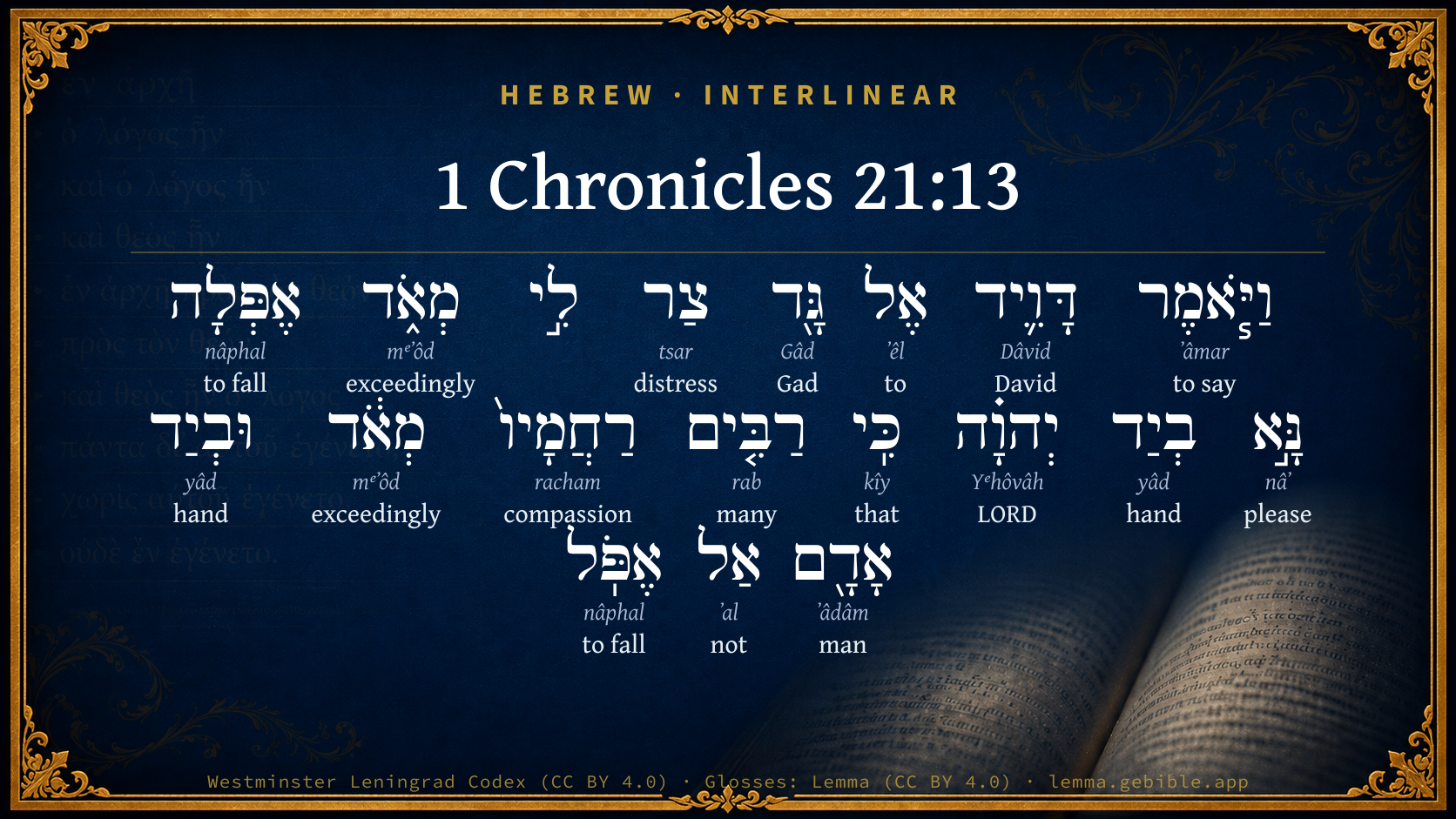
  1. וַיֹּ֧אמֶר ʼâmar H559 “and · to say” Conjunction + Verb, Qal, Sequential Imperfect, 3rd Person, Masculine, Singular
  2. דָּוִ֛יד Dâvid H1732 “David” Noun, Proper
  3. אֶל ʼêl H413 “to” Preposition
  4. גָּ֖ד Gâd H1410 “Gad” Noun, Proper
  5. צַר tsar H6862 “distress” Verb, Qal, Perfect, 3rd Person, Masculine, Singular
  6. מְאֹ֑ד mᵉʼôd H3966 “exceedingly” Adverb
  7. אֶפְּלָה nâphal H5307 “to fall” Verb, Qal, Cohortative, 1st Person, Common, Singular
  8. נָּ֣א nâʼ H4994 “please” Particle, Interjection
  9. בְיַד yâd H3027 “in/at · hand of” Preposition + Noun, Common, Both, Singular, Construct
  10. יְהוָ֗ה Yᵉhôvâh H3068 “LORD” Noun, Proper
  11. כִּֽי kîy H3588 “that” Conjunction
  12. רַבִּ֤ים rab H7227 “many” Adjective, Adjective, Masculine, Plural, Absolute
  13. מְאֹ֔ד mᵉʼôd H3966 “exceedingly” Adverb
  14. וּבְיַד yâd H3027 “and · in/at · hand of” Conjunction + Preposition + Noun, Common, Both, Singular, Construct
  15. אָדָ֖ם ʼâdâm H120 “man” Noun, Common, Masculine, Singular, Absolute
  16. אַל ʼal H408 “not” Particle, Negative
  17. אֶפֹּֽל nâphal H5307 “to fall” Verb, Qal, Cohortative, 1st Person, Common, Singular

About this verse

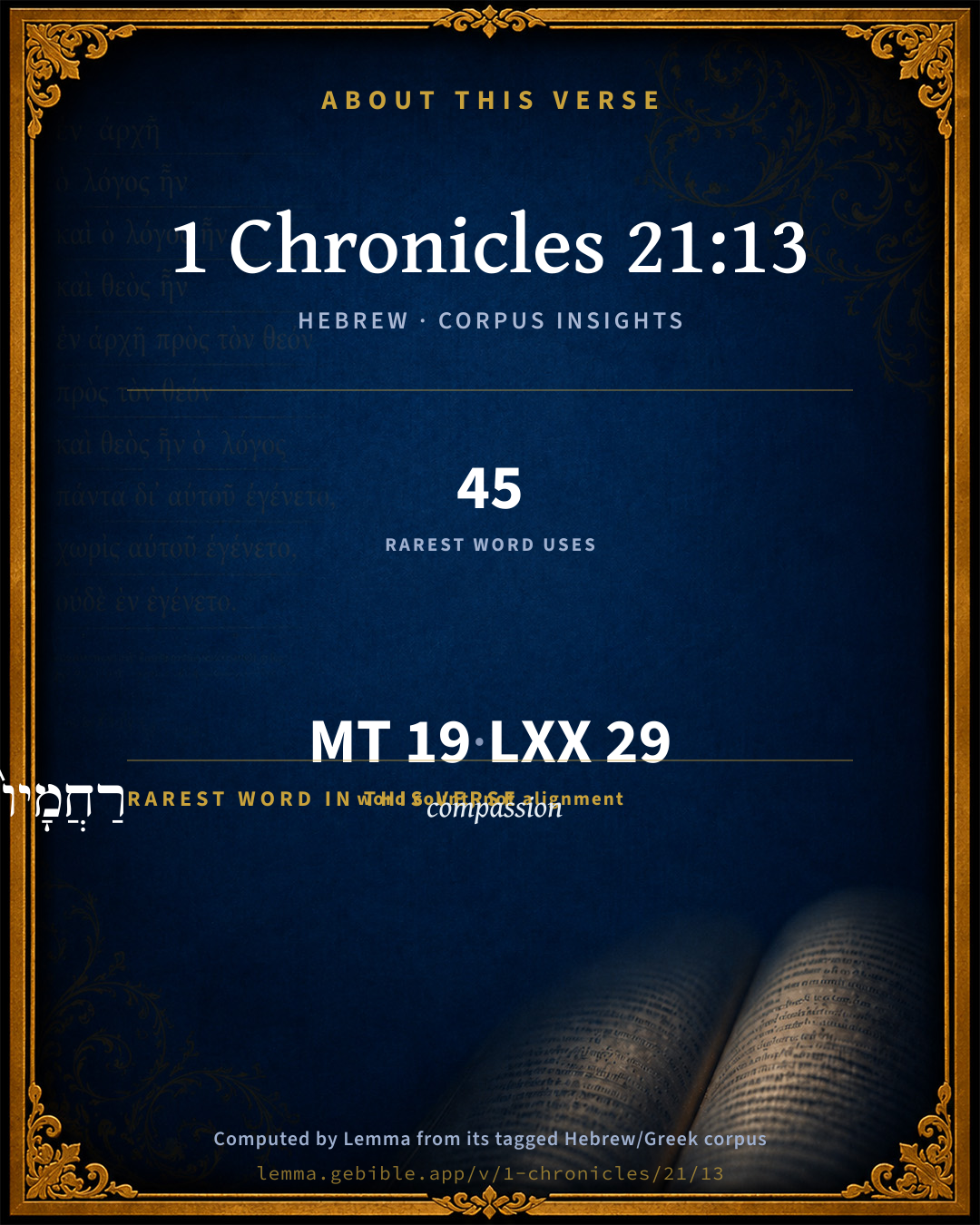
These counts appear in no published source. They are computed here, from the morphology-tagged text and Lemma’s own curated glosses. What Lemma adds →

19
words
15
distinct lemmas
Historical
section

Shared distinctive vocabulary

רַחֲמָיו֙ compassion H7356 occurs in 44 verses of the Hebrew Bible. Also found in:

Grammatical profile

  • 4 verbs
  • 7 nouns
  • 1 adjective
  • 2 prepositions
  • 1 conjunction
  • 2 adverbs
  • 2 particles

Verb forms

  • וַיֹּ֧אמֶר Qal · Sequential Imperfect
  • צַר Qal · Perfect
  • אֶפְּלָה Qal · Cohortative
  • אֶפֹּֽל Qal · Cohortative

Repetition

Words recur within this verse — often emphatic in Hebrew:

  • מְאֹ֑ד exceedingly H3966 ×2
  • אֶפְּלָה to fall H5307 ×2
  • בְיַד hand H3027 ×2

Hebrew & Septuagint length

In English translation the verse runs 36 words from the Hebrew and 44 from the Septuagint (LXX English) — closely comparable.

A rough comparison of the two English renderings, which tokenize alike — not a word-level alignment.

Word counts can differ between the Hebrew and the Greek without any difference in meaning — e.g. the Hebrew direct-object marker אֵת has no separate Greek word, and Greek often adds the article ὁ.

In the original languages it is 19 Hebrew tokens and 29 Greek tokens — but the two are counted differently (Hebrew bundles its prefixes and suffixes into one token; the Greek is in lemma form), so that isn’t a like-for-like length.

Cross-references

30

Topical passages linked to 1 Chronicles 21:13 in the Treasury of Scripture Knowledge — connected by theme and wording, ordered by reader-vote popularity; previews shown in the World English Bible.

  • Psalms 130:7 Israel, hope in Yahweh, For with Yahweh there is loving kindness. With him is abundant redemption.
  • Philippians 1:23 But I am in a dilemma between the two, having the desire to depart and be with Christ, which is far better.
  • Isaiah 55:7 let the wicked forsake his way, and the unrighteous man his thoughts; and let him return to Yahweh, and he will have mercy on him; and to our God, for he will abundantly pardon.
  • Hebrews 10:31 It is a fearful thing to fall into the hands of the living God.
  • John 12:27 "Now my soul is troubled. What shall I say? 'Father, save me from this time?' But for this cause I came to this time.
  • Exodus 34:6–7 Yahweh passed by before him, and proclaimed, "Yahweh! Yahweh, a merciful and gracious God, slow to anger, and abundant in loving kindness and truth,
  • 2 Kings 6:15 When the servant of the man of God was risen early, and gone forth, behold, a host with horses and chariots was round about the city. His servant said to him, Alas, my master! how shall we do?
  • 2 Kings 7:4 If we say, We will enter into the city, then the famine is in the city, and we shall die there; and if we sit still here, we die also. Now therefore come, and let us fall to the host of the Syrians: if they save us alive, we shall live; and if they kill us, we shall but die.
  • 2 Chronicles 28:9 But a prophet of Yahweh was there, whose name was Oded: and he went out to meet the host that came to Samaria, and said to them, Behold, because Yahweh, the God of your fathers, was angry with Judah, he has delivered them into your hand, and you have slain them in a rage which has reached up to heaven.
  • Esther 4:11 All the king's servants, and the people of the king's provinces, do know, that whoever, whether man or woman, shall come to the king into the inner court, who is not called, there is one law for him, that he be put to death, except those to whom the king shall hold out the golden scepter, that he may live: but I have not been called to come in to the king these thirty days.
  • Esther 4:16 Go, gather together all the Jews who are present in Shushan, and fast you for me, and neither eat nor drink three days, night or day: I also and my maidens will fast in like manner; and so will I go in to the king, which is not according to the law: and if I perish, I perish.
  • Psalms 5:7 But as for me, in the abundance of your loving kindness I will come into your house: I will bow toward your holy temple in reverence of you.
  • Psalms 51:1–2 Have mercy on me, God, according to your loving kindness. According to the multitude of your tender mercies, blot out my transgressions.
  • Psalms 69:13 But as for me, my prayer is to you, Yahweh, in an acceptable time. God, in the abundance of your loving kindness, answer me in the truth of your salvation.
  • Psalms 69:16 Answer me, Yahweh, for your loving kindness is good. According to the multitude of your tender mercies, turn to me.
  • Psalms 86:5 For you, Lord, are good, and ready to forgive; Abundant in loving kindness to all those who call on you.
  • Psalms 86:15 But you, Lord, are a merciful and gracious God, Slow to anger, and abundant in loving kindness and truth.
  • Psalms 103:8 Yahweh is merciful and gracious, Slow to anger, and abundant in loving kindness.
  • Psalms 106:7 Our fathers didn't understand your wonders in Egypt. They didn't remember the multitude of your loving kindnesses, But were rebellious at the sea, even at the Red Sea.
  • Psalms 130:4 But there is forgiveness with you, Therefore you are feared.
  • Proverbs 12:10 A righteous man regards the life of his animal, But the tender mercies of the wicked are cruel.
  • Isaiah 46:7 They bear it on the shoulder, they carry it, and set it in its place, and it stands, from its place it shall not move: yes, one may cry to it, yet it can not answer, nor save him out of his trouble.
  • Isaiah 47:6 I was angry with my people, I profaned my inheritance, and gave them into your hand: you did show them no mercy; on the aged have you very heavily laid your yoke.
  • Isaiah 63:7 I will make mention of the loving kindnesses of Yahweh, [and] the praises of Yahweh, according to all that Yahweh has bestowed on us, and the great goodness toward the house of Israel, which he has bestowed on them according to his mercies, and according to the multitude of his loving kindnesses.
  • Isaiah 63:15 Look down from heaven, and see from the habitation of your holiness and of your glory: where are your zeal and your mighty acts? the yearning of your heart and your compassion is restrained toward me.
  • Lamentations 3:32 For though he cause grief, yet will he have compassion according to the multitude of his loving kindnesses.
  • Jonah 3:9 Who knows whether God will not turn and repent, and turn away from his fierce anger, so that we might not perish?"
  • Jonah 4:2 He prayed to Yahweh, and said, "Please, Yahweh, wasn't this what I said when I was still in my own country? Therefore I hurried to flee to Tarshish, for I knew that you are a gracious God, and merciful, slow to anger, and abundant in loving kindness, and you repent of the evil.
  • Micah 7:18 Who is a God like you, who pardons iniquity, And passes over the disobedience of the remnant of his heritage? He doesn't retain his anger forever, Because he delights in loving kindness.
  • Habakkuk 3:2 Yahweh, I have heard of your fame. I stand in awe of your deeds, Yahweh. Renew your work in the midst of the years. In the midst of the years make it known. In wrath, you remember mercy.

Cross-references courtesy of OpenBible.info (CC BY 4.0).

Hebrew and Greek witnesses Masoretic Hebrew ↔ Greek Septuagint

The same verse in the two great witnesses to the Old Testament, shown verse-for-verse.

These are two independent witnesses, not word-aligned to each other, and the Septuagint is shown in lemma (dictionary) form.

Hebrew 1 Chronicles 21:13 Masoretic · Westminster Leningrad Codex

וַיֹּ֧אמֶר דָּוִ֛יד אֶל גָּ֖ד צַר לִ֣י מְאֹ֑ד אֶפְּלָה נָּ֣א בְיַד יְהוָ֗ה כִּֽי רַבִּ֤ים רַחֲמָיו֙ מְאֹ֔ד וּבְיַד אָדָ֖ם אַל אֶפֹּֽל

David said to Gad, I am in a great strait: let me fall, I pray, into the hand of Yahweh; for very great are his mercies: and let me not fall into the hand of man.

World English Bible · Public Domain

Greek LXX 1 Chronicles 21:13 Septuagint · lemma form

καί εἶπον δαυίδ πρός γαδ στενός ἐγώ καί ὁ τρεῖς σφόδρα ἐνπίπτω δή εἰς χείρ κύριος ὅτι πολύς ὁ οἰκτιρμός αὐτός σφόδρα καί εἰς χείρ ἄνθρωπος οὐ μή ἐνπίπτω

And David said to Gad, They are very hard for me, even all the three: let me fall now into the hands of the Lord, for his mercies are very abundant, and let me not fall by any means into the hands of man.

LXX2012 (modern English Septuagint) · Public Domain

Hebrew: Westminster Leningrad Codex (CC BY 4.0). Greek: Septuagint (public domain); English from LXX2012 (modern English Septuagint) (Public Domain). How the Septuagint differs from the Hebrew →

Commentary

Notes on 1 Chronicles 21:13 from classic Christian and Jewish commentators (each source and its license shown beneath its notes). The classic Christian expositions comment on the surrounding passage and are grouped to its opening verse, so a note may address several verses; the Jewish commentaries on the Tanakh (Rashi and others) are per-verse, so they appear only where the commentator wrote on this verse.

Lemma curates 59 commentaries, every one of them public domain or Creative Commons licensed, each selected and text-cleaned for this edition rather than reprinted as found. About our sources →

Jamieson, Fausset & Brown

Robert Jamieson, A. R. Fausset & David Brown

let me fall now into the hand of the Lord . . . let me not fall into the hand of man--Experience had taught him that human passion and vengeance had no bounds, whereas our wise and gracious Father in heaven knows the kind, and regulates the extent, of chastisement which every one needs.

Jamieson, Fausset & Brown — Commentary Critical and Explanatory on the Whole Bible (1871) — public domain (CC PDM 1.0). Text via the HelloAO Bible API.

Adam Clarke's Commentary

Verse 13. David said - I am in a great strait] The Targum reasons thus: "And David said to Gad, If I choose famine, the Israelites may say, The granaries of David are full of corn; neither doth he care should the people of Israel die with hunger. And if I choose war, and fly before an enemy, the Israelites may say, David is a strong and warlike man, and he cares not though the people of Israel should fall by the sword. I am brought into a great strait; I will deliver myself now into the HAND of the WORD of the LORD, ביד מימרא דיי beyad meymera dayai, for his mercies are many; but into the hands of the children of men I will not deliver myself."

Adam Clarke's Commentary on the Bible (1810–1826) — public domain. Text from a community e-Sword/MySword module.

Ellicott's Commentary for English Readers

(13) And David said.—Almost identical with Samuel. “Let me fall” looks like an improvement of Samuel, “Let us fall.” The word “very” (not in Sam.) is perhaps an accidental repetition from the Hebrew of I am in a great strait.

Let me not fall.—Samuel has a precative form of the same verb (’eppôlâh; here ’eppôl).

David confesses inability to choose. So much only is clear to him, that it is better to be dependent on the compassion of God than of man; and thus, by implication he decides against the second alternative, leaving the rest to God. Famine, sword, and pestilence were each regarded as Divine visitations, but the last especially so, because of the apparent suddenness of its outbreak and the mysterious nature of its operation.

A Bible Commentary for English Readers, edited by Charles John Ellicott (1878–1897) — public domain. Text from a community e-Sword module.

The Cambridge Bible for Schools and Colleges

gen. ed. J. J. S. Perowne

13. into the hand of the Lord] David deprecates war, and prefers famine or pestilence.

The Cambridge Bible for Schools and Colleges (gen. ed. J. J. S. Perowne; Cambridge University Press, 1878–1918) — public domain. Text from a community e-Sword module.

Haydock's Catholic Bible Commentary

Men. Susanna spoke on a different supposition, (Daniel xiii. 23., and Ecclesiasticus ii. 22.) of eternal punishment, in consequence of sin. David prefers to be punished by the hand of a tender father, rather than that of an enemy; (Tirinus; Estius) and he does not wish to screen himself from suffering in this world, but offers himself to share in the chastisement of his subjects. (Haydock)

George Leo Haydock (1774–1849), Haydock's Catholic Family Bible and Commentary, 1859 edition — public domain. Excludes Psalms (Douay-Rheims chapter numbering differs from Protestant) and Deuterocanonical books (Catholic canon only).

The Pulpit Commentary

It is in such answers as these answers of equal piety and practical wisdom, that the difference is often visible between the man radically bad, and the man good at heart and the child of grace, even when fallen into the deepest depth of sin.

Falling into the hand of the Lord.

There is something very simple and touching in this expression. "The hand of the Lord" is, for the most part, mentioned in Scripture as the emblem of God"s protecting, upholding, preserving power. Here it indicates chastisement. How truly submissive and filial was the spirit which was manifested in this petition! Whether God"s hand was raised to deliver or to smite, his servant was content so that it was God"s.

I THE LORD SOMETIMES CHASTENS EVEN REPENTING OFFENDERS. Some unthinking persons may wonder why, if the sinner be penitent and the sin forgiven, there should be any necessity for punishment at all. But facts cannot be explained away. The great Lord and Judge of all does Sometimes, as in the instance before us, permit the sinner to endure temporal consequences of sin, although his anger is turned away from the repentant heart. God thus avenges his own Law, upholds his own authority, shows himself a righteous Sovereign and Ruler.

II THERE ARE REASONS FOR MEEKLY SUBMITTING TO DIVINE CHASTISEMENT. An alternative of punishment is not God"s usual offer to repenting sinners. There is much to commend in the choice which David made when Gad, at the Lord"s command, permitted the king to elect one form of penalty rather than another. David referred the matter wholly into "the band" of a wise and merciful God. There are many reasons why we should thus submit when the Lord chastens.

1. God is the All-merciful. For this reason his people may well be content to "fall into his hand." "Very great are his mercies." He is "merciful and gracious, forgiving iniquity, transgression, and sin." His character, his promises, and especially his "unspeakable gift," should encourage us to lay aside all rebellion, murmuring, and fear, and to submit with patience, and "endure chastening." It is, no doubt, in his power to punish with far greater severity than any human enemy is capable of doing. But whilst "the tender mercies of the wicked are cruel," the mercy of God is boundless as his nature.

2. God knows, not only the sin, but the repentance by which it it followed. He reads the heart, and hears the sighs, and marks the tears of every contrite penitent. He sees when a deep impression of the sinfulness of sin has been produced. He knew that though David was a great sinner, he was a sincere, submissive, and lowly penitent. He makes a distinction between the punishment which is a mark of his righteous displeasure with the sin, and that which is needed to bring the offender to a just sense of his ill desert.

3. God tempers his chastisements with Divine consolations and support. He does not desert his children, even in their deserved distresses. He is with them in the furnace. When they are ready to sink beneath their merited sorrows, lo! his everlasting arms are found to be underneath them.

4 . God designs, by all his chastening, to secure his peoples spiritual good. He afflicts, not for his pleasure, but for our profit. His purpose is that we may "bring forth the peaceable fruits of righteousness." Men may wreak malicious vengeance; God"s discipline is that of a holy and compassionate Father. T.

Tolerable and intolerable troubles.

These are not only

I THE LESSER AND THE LARGER TRIALS OF OUR LIFE. Those, on the one hand, which cause temporary inconvenience, or slight annoyance, or little regret; and those, on the other hand, Which upset all our plans, or remove that which nothing can restore, or cut to the quick our lacerated and bleeding hearts, Not only these: as thus regarded, but also

II THOSE WHICH ARE UNATTENDED AND THOSE WHICH ARE ACCOMPANIED WITH REMORSE.

1. When our troubles come upon us as the consequence of our fidelity anddevotion, the source of them is a positive alleviation of our pain of mind.

2. When they arrive as the consequence of forces with which we havenothing to do, our mental pain is neither soothed nor aggravated by their source.

3. When we have to reproach ourselves as the authors of our own miseries,our souls smart with a keenness of suffering which makes us feel that "our punishment is greater than we can bear." But our troubles are divided into the tolerable and the intolerable (or the less tolerable) when, as suggested by the text, we view them as

III THOSE WHICH ARE OF DIVINE AND THOSE WHICH ARE OF HUMAN INFLICTION. David uttered a sentiment which is common to every pious heart when he said, "Let me fall now into the hand of the Lord; but let me not fall into the hand of men." When the evils which are oppressing us, when the sorrows which are saddening us, are embittered by the feeling that they are due to the heedlessness and heartlessness of men, especially when due to the inconsiderateness of those whose relation to ourselves calls for peculiar thoughtfulness and attention and still more, when they are inflicted on us by the positive malignity of our fellows, who find a cruel and horrible satisfaction in our losses and griefs, then our trouble is at its very heaviest, and seems to us quite intolerable. But when, as in unaccountable sickness, or in unavoidable loss, or in inevitable bereavement, we can feel that the hand of God is upon us, that we have "fallen into the hand of the Lord, and not into the hand of man," then we are not tempted to add the bitterness of resentment to the heaviness of disappointment or to the poignancy of grief. It is well for us to remember:

1. That even those troubles which seem to be wholly of human origin areyet to be borne as evils permitted of God. If David had chosen defeat in war, that would have had the Divine as well as the human in its origin and infliction. In our very worst distress, in the most cruel aggravations we can experience, we should "be in subjection to the Father of spirits, and live." He allows them to come; he would have us be patient and docile under them; he will bring us out from under them; he will overrule them for good in his own time and way.

1. That we have reason to be thankful when the trouble that comes to us issuch as we can readily ascribe to the Father"s hand. We must all pass through tribulation on our way to the heavenly kingdom: only by the waters of chastisement can we hope to be cleansed from some sins which beset us. It is well for us when the sorrow through which the Divine Father makes us t,o pass is of such a kind that we have no difficulty in referring it to his wisdom and love, and when, feeling that we have "fallen into the hands of God," we can

1. breathe freely the spirit of resignation,

2. learn readily the lessons of affliction. C.

The Pulpit Commentary (1880–1919), ed. H.D.M. Spence-Jones & Joseph S. Exell — public domain. Text from a community e-Sword module.

unfoldingWord translationNotes

Door43 World Missions Community

Let me fall into the hand of Yahweh rather than into the hand of man

Here "hand" represents power to harm or punish Israel. AT: "Let me be punished by Yahweh, rather than be punished by people" (See: Metonymy)

Let me fall

The people of Israel are the ones who would die from the plague, but David is personalizing this judgment as if he himself was being killed.

hand of man

Here "man" is used in the generic sense of "people."

his merciful actions are very great

"Yahweh is very merciful"

on Israel

Here Israel is a metonym that represents the people of Israel. (See: Metonymy)

seventy thousand people died

"70,000 people died" (See: Numbers)

changed his mind about the harm

Here "mind" represents his decision. AT: "decided not to destroy Jerusalem" (See: Metonymy)

Enough!

This exclamation means "You have killed enough people!" (See: Exclamations)

draw back your hand

This is an idiom that means to stop doing something. AT: "do not kill attack the people of Jerusalem" (See: Idiom)

Ornan

This is the name of a man. (See: How to Translate Names)

translationWords

David

Yahweh

hand

mercy

Israel

die

angel

Jerusalem

thresh

Jebus

unfoldingWord translationNotes — © Distant Shores Media and the Door43 World Missions Community, licensed CC BY-SA 4.0. Source: git.door43.org/Door43/en_tn.

Rashi

Rabbi Shlomo Yitzchaki (Rashi)

I am greatly oppressed You tell me, “Choose the mildest of them. It is hard for me, and I am greatly oppressed about it.” This can be compared to a [sick] person, to whom people said, “Behold you are going to die. Now in which grave do you wish to be buried? Beside your father or beside your mother?” Woe to the ears that hear such a thing!

let me fall now into the hand of the Lord with the pestilence, in which all are equal, both rich and poor.

for His mercies are great Perhaps He will have compassion, but our enemies will not have compassion on us.

Rashi on the Tanakh — English translations: “The Judaica Press complete Tanach with Rashi, translated by A. J. Rosenberg” (CC BY 4.0); “Pentateuch with Rashi's commentary by M. Rosenbaum and A.M. Silbermann, 1929-1934” (public domain); “The Metsudah Tanach series, Lakewood, N.J” (CC BY 4.0); and “The Book of Joshua, Metsudah Publications, 1997” (CC BY 4.0). Text via Sefaria.

Lesson kit

Teaching starters — assembled from the data on this page, not authored interpretation. Every prompt links to the verse data it draws on. Edit before teaching.

1 Chronicles, in the Historical, opens this verse with 19 words (15 distinct Hebrew lemmas). Its most distinctive word is racham (“compassion”). A historical commentator’s framing appears above. Read the whole chapter for the surrounding context.

Discussion questions

  1. The word racham carries the sense “compassion.” How does it shape the verse?
  2. Genesis 43:14 shares the word «compassion» with this verse. How do the two illuminate each other?
  3. “exceedingly” occurs 2× in this one verse. What is the effect of the repetition?
  4. The translations on this page render this verse differently — a whole-verse word diff, not a word-by-word alignment. What might account for the different wordings?
  5. The verb «וַיֹּ֧אמֶר» is Qal Sequential Imperfect. How does its form color the action?
  6. Reading how Jamieson, Fausset & Brown and Adam Clarke's Commentary read this verse, where do the two commentators agree and where do they part?

Things to notice

Reading settings

Reading text

Shown beneath each verse's original-language words.

Old Testament
Old Testament edition

Read the OT as the Masoretic Hebrew (MT) or the Greek Septuagint (LXX).

English shown for the Greek Septuagint (in the Hebrew ↔ Greek comparison).

Comparing translations? Open the Compare panel on any verse page to stack up to four side by side.