
Esther 6:13

Hebrew (Westminster Leningrad Codex) Esther 6:13 appears in the Hebrew Old Testament. The text above is from the Westminster Leningrad Codex. Each word links to its Strong’s number, a concise gloss, and parsing drawn from the Open Scriptures Hebrew Bible morphology. Click any word for its full Brown-Driver-Briggs (BDB) entry.
Download image
Cite this verse

Esther 6:13 (World English Bible). Public Domain. Lemma interlinear Bible study tool, https://lemma.gebible.app/v/esther/6/13.

Show BibTeX & RIS
BibTeX
RIS
English Translation
Haman recounted to Zeresh his wife and all his friends everything that had happened to him. Then his wise men and Zeresh his wife said to him, If Mordecai, before whom you have begun to fall, be of the seed of the Jews, you shall not prevail against him, but shall surely fall before him.
World English Bible · Public Domain
Download a study sheet

One document with this verse’s original text, its word-by-word gloss line, the meaning frame, cross-references with their text, attributed commentary, and full source and license credits — printable, and it pastes into notes with its structure intact.

This verse Autodidact and up

Study sheet (.html) Plain text (.txt)

A passage Seminary Student

Up to 50 verses in one chapter. A passage sheet keeps up to 6 commentary sources and 12 cross-references per verse, in the order this page ranks them, and says so on the sheet whenever that leaves anything out. Ask for a single verse and you get the Autodidact verse sheet above.

Everything on this page stays free to read, with no account — the sheet is a download of what is already on screen, not access to it.

Want to remove ads? Support Godless Engineer
Compare translations 3

The same verse in 3 English versions, stacked beneath the original-language interlinear above. Click any original word for its lexicon entry.

Each is an independent rendering of the whole verse — the interlinear is not word-aligned to these translations.

Highlighted words mark where these versions differ — a whole-verse word diff, not a word-by-word alignment.

  • World English Bible Public Domain
    Haman recounted to Zeresh his wife and all his friends everything that had happened to him. Then his wise men and Zeresh his wife said to him, If Mordecai, before whom you have begun to fall, be of the seed of the Jews, you shall not prevail against him, but shall surely fall before him.
  • King James Version Public Domain
    And Haman told Zeresh his wife and all his friends every thing that had befallen him. Then said his wise men and Zeresh his wife unto him, If Mordecai be of the seed of the Jews, before whom thou hast begun to fall, thou shalt not prevail against him, but shalt surely fall before him.
  • unfoldingWord Literal Text CC BY-SA 4.0
    And Haman recounted to Zeresh his wife and to all his friends everything that had happened to him. Then his wise men and Zeresh his wife said to him, “If Mordecai, before whose face you have begun to fall, is from the seed of the Jews, then you will not prevail against him, but you will surely fall before his face.”

unfoldingWord Literal Text — © unfoldingWord, licensed CC BY-SA 4.0. Word-aligned USFM3 via Door43 (git.door43.org/unfoldingWord/en_ult).

Versions to compare (up to 4)

3 of 4 selected

Show all 18 translations

Every available English version of this verse, each an independent rendering of the whole verse.

  • World English Bible Public Domain
    Haman recounted to Zeresh his wife and all his friends everything that had happened to him. Then his wise men and Zeresh his wife said to him, If Mordecai, before whom you have begun to fall, be of the seed of the Jews, you shall not prevail against him, but shall surely fall before him.
  • Berean Standard Bible Public Domain
    Haman told his wife Zeresh and all his friends everything that had happened. His advisers and his wife Zeresh said to him, “Since Mordecai, before whom your downfall has begun, is Jewish, you will not prevail against him—for surely you will fall before him.”
  • Majority Standard Bible Public Domain
    Haman told his wife Zeresh and all his friends everything that had happened. His advisers and his wife Zeresh said to him, “Since Mordecai, before whom your downfall has begun, is Jewish, you will not prevail against him—for surely you will fall before him.”
  • King James Version Public Domain
    And Haman told Zeresh his wife and all his friends every thing that had befallen him. Then said his wise men and Zeresh his wife unto him, If Mordecai be of the seed of the Jews, before whom thou hast begun to fall, thou shalt not prevail against him, but shalt surely fall before him.
  • American Standard Version (1901) Public Domain
    And Haman recounted unto Zeresh his wife and all his friends everything that had befallen him. Then said his wise men and Zeresh his wife unto him, If Mordecai, before whom thou hast begun to fall, be of the seed of the Jews, thou shalt not prevail against him, but shalt surely fall before him.
  • Revised Version (1885) Public Domain
    And Haman recounted unto Zeresh his wife and all his friends every thing that had befallen him. Then said his wise men and Zeresh his wife unto him, If Mordecai, before whom thou hast begun to fall, be of the seed of the Jews, thou shalt not prevail against him, but shalt surely fall before him.
  • Geneva Bible (1599) Public Domain
    And Haman tolde Zeresh his wife, and all his friends all that had befallen him. Then sayd his wise men, and Zeresh his wife vnto him, If Mordecai be of the seede of the Iewes, before whom thou hast begunne to fall; thou shalt not preuaile against him, but shalt surely fall before him.
  • Douay-Rheims (1899) Public Domain
    And he told Zares his wife, and his friends, all that had befallen him. And the wise men whom he had in counsel, and his wife answered him: If Mardochai be of the seed of the Jews, before whom thou hast begun to fall, thou canst not resist him, but thou shalt fall in his sight.
  • Young's Literal Translation Public Domain
    and Haman recounteth to Zeresh his wife, and to all his friends, all that hath met him, and his wise men say to him, and Zeresh his wife, `If Mordecai `is' of the seed of the Jews, before whom thou hast begun to fall, thou art not able for him, but dost certainly fall before him.'
  • Literal Standard Version CC BY-SA 4.0
    and Haman recounts to his wife Zeresh, and to all his friends, all that has met him, and his wise men and his wife Zeresh say to him, “If Mordecai [is] of the seed of the Jews, before whom you have begun to fall, you are not able for him, but certainly fall before him.”
  • Unlocked Literal Bible CC BY-SA 4.0
    Haman told Zeresh his wife and all his friends everything that happened to him. Then his men who were known for their wisdom, and Zeresh his wife, said to him, “If Mordecai, before whom you have begun to fall, is Jewish, you will not overcome him, but you will certainly fall before him.”
  • unfoldingWord Literal Text CC BY-SA 4.0
    And Haman recounted to Zeresh his wife and to all his friends everything that had happened to him. Then his wise men and Zeresh his wife said to him, “If Mordecai, before whose face you have begun to fall, is from the seed of the Jews, then you will not prevail against him, but you will surely fall before his face.”
  • Darby Bible Public Domain
    And Haman recounted to Zeresh his wife and to all his friends all that had befallen him. Then said his wise men and Zeresh his wife to him, If Mordecai be of the seed of the Jews, before whom thou hast begun to fall, thou shalt not prevail against him, but wilt certainly fall before him.
  • World Messianic Bible Public Domain
    Haman recounted to Zeresh his wife and all his friends everything that had happened to him. Then his wise men and Zeresh his wife said to him, “If Mordecai, before whom you have begun to fall, is of Jewish descent, you will not prevail against him, but you will surely fall before him.”
  • Webster's Bible Public Domain
    And Haman told Zeresh his wife and all his friends every thing that had befallen him. Then said his wise men and Zeresh his wife to him, If Mordecai is of the seed of the Jews, before whom thou hast begun to fall, thou wilt not prevail against him, but wilt surely fall before him.
  • Free Bible Version CC BY-SA 4.0
    Haman explained to his wife Zeresh and all his friends what had happened to him. These wise friends and his wife Zeresh told him, “If Mordecai is one of the Jewish people, and you have already begun to lose status before him—you won't be able to beat him! You're going to lose to him, you're going to fall!”
  • Bible in Basic English Public Domain
    And Haman gave his wife Zeresh and all his friends an account of what had taken place. Then his wise men and his wife Zeresh said to him, If Mordecai, who is starting to get the better of you, is of the seed of the Jews, you will not be able to do anything against him, but you will certainly go down before him.
  • JPS Tanakh (1917) Public Domain
    And Haman recounted unto Zeresh his wife and all his friends every thing that had befallen him. Then said his wise men and Zeresh his wife unto him: 'If Mordecai, before whom thou hast begun to fall, be of the seed of the Jews, thou shalt not prevail against him, but shalt surely fall before him.'

Literal Standard Version (2020), Covenant Press — licensed CC BY-SA 4.0. Text via the HelloAO Bible API (eBible.org). Unlocked Literal Bible (unfoldingWord) — licensed CC BY-SA 4.0. Text via the HelloAO Bible API (eBible.org). unfoldingWord Literal Text — © unfoldingWord, licensed CC BY-SA 4.0. Word-aligned USFM3 via Door43 (git.door43.org/unfoldingWord/en_ult). Free Bible Version, Dr. Jonathan Gallagher — licensed CC BY-SA 4.0. Text via the HelloAO Bible API (eBible.org).

Word by word

More ways to search: Search by grammar → Find every occurrence → Compare this word →

Practice this passage: Drill this verse → Learn its vocabulary →

לְזֶ֤רֶשׁ
Zeresh
H2238
“to/for · Zeresh”
Preposition + Noun, Proper
Part of Speech
Preposition + Noun
Type
Proper
Full BDB Definition

Origin: of Persian origin

TWOT: None

Zeresh = "gold" - the wife of Haman, the Agagite
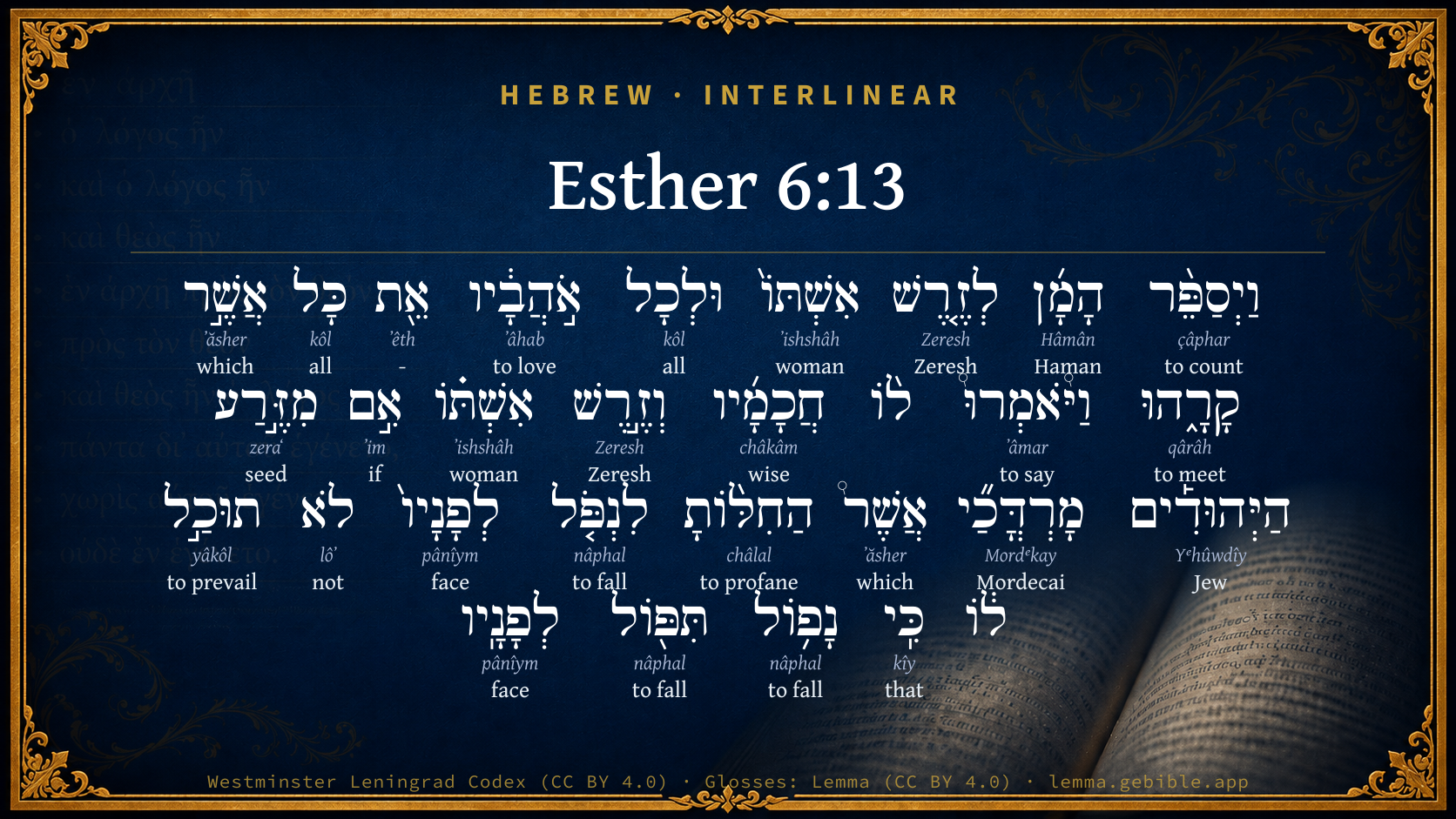
  1. וַיְסַפֵּ֨ר çâphar H5608 “and · to count” Conjunction + Verb, Piel, Sequential Imperfect, 3rd Person, Masculine, Singular
  2. הָמָ֜ן Hâmân H2001 “Haman” Noun, Proper
  3. אִשְׁתּוֹ֙ ʼishshâh H802 “woman · his” Noun, Common, Feminine, Singular, Construct + Suffix, Personal, 3rd Person, Masculine, Singular
  4. וּלְכָל kôl H3605 “and · to/for · all of” Conjunction + Preposition + Noun, Common, Masculine, Singular, Construct
  5. אֹ֣הֲבָ֔יו ʼâhab H157 “loving · him” Verb, Qal, Participle Active, Masculine, Plural, Construct + Suffix, Personal, 3rd Person, Masculine, Singular
  6. אֵ֖ת ʼêth H853 “-” Particle, Direct Object
  7. כָּל kôl H3605 “all of” Noun, Common, Masculine, Singular, Construct
  8. אֲשֶׁ֣ר ʼăsher H834 “which” Particle, Relative
  9. קָרָ֑הוּ qârâh H7136 “to meet · him” Verb, Qal, Perfect, 3rd Person, Masculine, Singular + Suffix, Personal, 3rd Person, Masculine, Singular
  10. וַיֹּ֩אמְרוּ֩ ʼâmar H559 “and · to say” Conjunction + Verb, Qal, Sequential Imperfect, 3rd Person, Masculine, Plural
  11. חֲכָמָ֜יו châkâm H2450 “wise · his” Adjective, Adjective, Masculine, Plural, Construct + Suffix, Personal, 3rd Person, Masculine, Singular
  12. וְזֶ֣רֶשׁ Zeresh H2238 “and · Zeresh” Conjunction + Noun, Proper
  13. אִשְׁתּ֗וֹ ʼishshâh H802 “woman · his” Noun, Common, Feminine, Singular, Construct + Suffix, Personal, 3rd Person, Masculine, Singular
  14. אִ֣ם ʼim H518 “if” Conjunction
  15. מִזֶּ֣רַע zeraʻ H2233 “from · seed of” Preposition + Noun, Common, Masculine, Singular, Construct
  16. הַיְּהוּדִ֡ים Yᵉhûwdîy H3064 “the · Jews” Particle, Definite Article + Noun, Gentilic, Masculine, Plural, Absolute
  17. מָרְדֳּכַ֞י Mordᵉkay H4782 “Mordecai” Noun, Proper
  18. אֲשֶׁר֩ ʼăsher H834 “which” Particle, Relative
  19. הַחִלּ֨וֹתָ châlal H2490 “to profane” Verb, Hiphil, Perfect, 2nd Person, Masculine, Singular
  20. לִנְפֹּ֤ל nâphal H5307 “to fall” Preposition + Verb, Qal, Infinitive Construct
  21. לְפָנָיו֙ pânîym H6440 “to/for · face(s) · his” Preposition + Noun, Common, Both, Plural, Construct + Suffix, Personal, 3rd Person, Masculine, Singular
  22. לֹא lôʼ H3808 “not” Particle, Negative
  23. תוּכַ֣ל yâkôl H3201 “to prevail” Verb, Qal, Imperfect, 2nd Person, Masculine, Singular
  24. כִּֽי kîy H3588 “that” Conjunction
  25. נָפ֥וֹל nâphal H5307 “to fall” Verb, Qal, Infinitive Absolute
  26. תִּפּ֖וֹל nâphal H5307 “to fall” Verb, Qal, Imperfect, 2nd Person, Masculine, Singular
  27. לְפָנָֽיו pânîym H6440 “to/for · face(s) · his” Preposition + Noun, Common, Both, Plural, Construct + Suffix, Personal, 3rd Person, Masculine, Singular

About this verse

These counts appear in no published source. They are computed here, from the morphology-tagged text and Lemma’s own curated glosses. What Lemma adds →

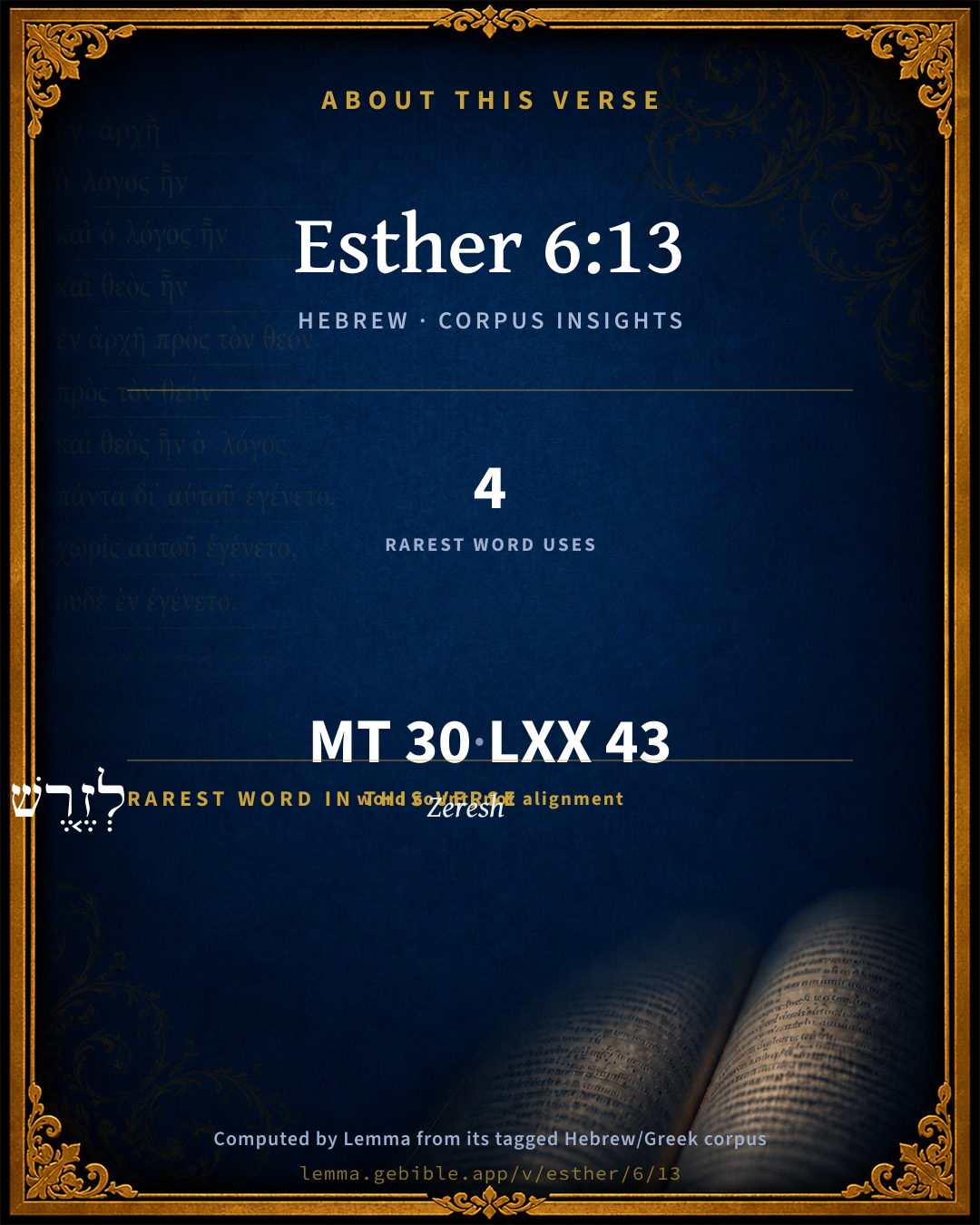
30
words
21
distinct lemmas
Historical
section

Notable vocabulary

The rarest word here is לְזֶ֤רֶשׁ Zeresh H2238 — appearing just 4 times in the whole Hebrew Bible.

Shared distinctive vocabulary

לְזֶ֤רֶשׁ Zeresh H2238 occurs in 3 verses of the Hebrew Bible. Also found in:

Grammatical profile

  • 9 verbs
  • 12 nouns
  • 1 adjective
  • 2 prepositions
  • 2 conjunctions
  • 4 particles

Verb forms

  • וַיְסַפֵּ֨ר Piel · Sequential Imperfect
  • אֹ֣הֲבָ֔יו Qal · Participle Active
  • קָרָ֑הוּ Qal · Perfect
  • וַיֹּ֩אמְרוּ֩ Qal · Sequential Imperfect
  • הַחִלּ֨וֹתָ Hiphil · Perfect
  • לִנְפֹּ֤ל Qal · Infinitive Construct
  • תוּכַ֣ל Qal · Imperfect
  • נָפ֥וֹל Qal · Infinitive Absolute
  • תִּפּ֖וֹל Qal · Imperfect

Repetition

Words recur within this verse — often emphatic in Hebrew:

  • לִנְפֹּ֤ל to fall H5307 ×3
  • לְזֶ֤רֶשׁ Zeresh H2238 ×2
  • אִשְׁתּוֹ֙ woman H802 ×2
  • וּלְכָל all H3605 ×2
  • לְפָנָיו֙ face H6440 ×2
  • אֲשֶׁ֣ר which H834 ×2

Hebrew & Septuagint length

In English translation the verse runs 55 words from the Hebrew and 64 from the Septuagint (LXX English) — closely comparable.

A rough comparison of the two English renderings, which tokenize alike — not a word-level alignment.

Word counts can differ between the Hebrew and the Greek without any difference in meaning — e.g. the Hebrew direct-object marker אֵת has no separate Greek word, and Greek often adds the article ὁ.

In the original languages it is 30 Hebrew tokens and 43 Greek tokens — but the two are counted differently (Hebrew bundles its prefixes and suffixes into one token; the Greek is in lemma form), so that isn’t a like-for-like length.

Cross-references

11

Topical passages linked to Esther 6:13 in the Treasury of Scripture Knowledge — connected by theme and wording, ordered by reader-vote popularity; previews shown in the World English Bible.

  • Proverbs 28:18 Whoever walks blamelessly is kept safe; But one with perverse ways will fall suddenly.
  • Hosea 14:9 Who is wise, that he may understand these things? Who is prudent, that he may know them? For the ways of Yahweh are right, And the righteous walk in them; But the rebellious stumble in them.
  • Genesis 40:19 Within three more days, Pharaoh will lift up your head from off you, and will hang you on a tree; and the birds will eat your flesh from off you."
  • Genesis 41:8 It happened in the morning that his spirit was troubled, and he sent and called for all the magicians of Egypt, and all the wise men of it. Pharaoh told them his dream, but there was no one who could interpret them to Pharaoh.
  • Daniel 2:12 For this cause the king was angry and very furious, and commanded to destroy all the wise men of Babylon.
  • Daniel 5:26–28 This is the interpretation of the thing: MENE; God has numbered your kingdom, and brought it to an end;
  • 1 Samuel 28:19–20 Moreover Yahweh will deliver Israel also with you into the hand of the Philistines; and tomorrow shall you and your sons be with me: Yahweh will deliver the host of Israel also into the hand of the Philistines.
  • Esther 5:10–14 Nevertheless Haman refrained himself, and went home; and he sent and fetched his friends and Zeresh his wife.
  • Job 16:2 "I have heard many such things. Miserable comforters are you all!
  • Job 15:24 Distress and anguish make him afraid; They prevail against him, as a king ready to the battle.
  • Zechariah 12:2–3 "Behold, I will make Jerusalem a cup of reeling to all the surrounding peoples, and on Judah also will it be in the siege against Jerusalem.

Cross-references courtesy of OpenBible.info (CC BY 4.0).

Hebrew and Greek witnesses Masoretic Hebrew ↔ Greek Septuagint

The same verse in the two great witnesses to the Old Testament, shown verse-for-verse.

These are two independent witnesses, not word-aligned to each other, and the Septuagint is shown in lemma (dictionary) form.

Hebrew Esther 6:13 Masoretic · Westminster Leningrad Codex

וַיְסַפֵּ֨ר הָמָ֜ן לְזֶ֤רֶשׁ אִשְׁתּוֹ֙ וּלְכָל אֹ֣הֲבָ֔יו אֵ֖ת כָּל אֲשֶׁ֣ר קָרָ֑הוּ וַיֹּ֩אמְרוּ֩ ל֨וֹ חֲכָמָ֜יו וְזֶ֣רֶשׁ אִשְׁתּ֗וֹ אִ֣ם מִזֶּ֣רַע הַיְּהוּדִ֡ים מָרְדֳּכַ֞י אֲשֶׁר֩ הַחִלּ֨וֹתָ לִנְפֹּ֤ל לְפָנָיו֙ לֹא תוּכַ֣ל ל֔וֹ כִּֽי נָפ֥וֹל תִּפּ֖וֹל לְפָנָֽיו

Haman recounted to Zeresh his wife and all his friends everything that had happened to him. Then his wise men and Zeresh his wife said to him, If Mordecai, before whom you have begun to fall, be of the seed of the Jews, you shall not prevail against him, but shall surely fall before him.

World English Bible · Public Domain

Greek LXX Esther 6:13 Septuagint · lemma form

καί διαἡγέομαι αμαν ὁ συνβαίνω αὐτός ζωσαρα ὁ γυνή αὐτός καί ὁ φίλος καί εἶπον πρός αὐτός ὁ φίλος καί ὁ γυνή εἰ ἐκ γένος ἰουδαῖος μαρδοχαῖος ἄρχω ταπεινόω ἐνώπιον αὐτός πίπτω πίπτω οὐ μή δύναμαι αὐτός ἀμύνω ὅτι θεός ζάω μετά αὐτός

And Aman related the events that had befallen him to Zosara his wife, and to his friends: and his friends and his wife said to him, If Mardochaeus be of the race of the Jews, and you have begun to be humbled before him, you will assuredly fall, and you will not be able to withstand him, for the living God is with him.

LXX2012 (modern English Septuagint) · Public Domain

On this verse, Adam Clarke's Commentary discusses the Septuagint’s reading. Read the note in Commentary ↓

Hebrew: Westminster Leningrad Codex (CC BY 4.0). Greek: Septuagint (public domain); English from LXX2012 (modern English Septuagint) (Public Domain). How the Septuagint differs from the Hebrew →

Commentary

Notes on Esther 6:13 from classic Christian and Jewish commentators (each source and its license shown beneath its notes). The classic Christian expositions comment on the surrounding passage and are grouped to its opening verse, so a note may address several verses; the Jewish commentaries on the Tanakh (Rashi and others) are per-verse, so they appear only where the commentator wrote on this verse.

Lemma curates 59 commentaries, every one of them public domain or Creative Commons licensed, each selected and text-cleaned for this edition rather than reprinted as found. About our sources →

Trapp's Complete Commentary

John Trapp

Est 6:13 And Haman told Zeresh his wife and all his friends every [thing] that had befallen him. Then said his wise men and Zeresh his wife unto him, If Mordecai [be] of the seed of the Jews, before whom thou hast begun to fall, thou shalt not prevail against him, but shalt surely fall before him.

Ver. 13. And Haman told Zeresh his wife, and all his friends] Expecting comfort and counsel from them; but they read him his destiny, and add to his grief and desperation; letting him know, that his state was such as that there was neither hope for better nor place for worse; a just hand of God upon such a hard-hearted wretch, that had plotted the ruin of so many innocents. And his wife and friends, had they done well should have reminded him of, and stirred him up to repent of his wickedness against God, the cause of his present wretchedness, to be reconciled to Mordecai, whom he and they plainly saw to be God’s favourite, and now the king’s also, to take down that ugly gallows, that there were no further notice taken of it, the evidence and ensign of his insufferable pride, and their unsavoury counsel, to get the decree for the Jews’ massacre reversed or countermanded, &c. But not a word find we of anything this way tending. Graceless people neither have God in their heads, Psa 10:4, nor hearts, Psa 14:1, nor words, Psa 12:4, nor ways, Tit 1:16, but stand in a posture of distance, nay, defiance, walking contrary to him; and therefore he also, to cry quittance, walketh contrary to them, Lev 16:1-34, showing himself as froward as they for the hearts of them, Psa 18:26.

Everything that had befallen him] The sad accidents of that day. Nothing now (as once, Est 5:11) boasteth he to them of the glory of his riches and multitude of his children, and how the king had advanced him above all his other courtiers. Haman’s crowing was now turned into crying, &c.

Then said his wise men] Wizards haply, such as he made use of when he cast Pur for a lucky day, and into whose mouths the devil might put this answer. It is his use to bring his imps into the briars, and there to leave them, as he did Saul (whose funeral sermon he preached), and Judas, Julian, Valens, and others.

And Zeresh his wife said unto him] She is noted for a prudent woman, but here she proves as cold a comforter as before she had been an evil counsellor.

If Mordecai be of the seed of the Jews] A nation noted as dear to God, often delivered by him, and that had also the faculty for gaining the good will of princes, by their excellent virtues, as it had been seen in Daniel and his companions, in Jechoniah, Zerubbabel, Ezra, Nehemiah, and the whole nation, so graciously licensed by Cyrus to return into their own country. It is a good note that one gives here, A Jew may fall before a Persian, and get up and prevail; but if a Persian, or whosoever of the Gentiles, begin, to fall before a Jew, he can neither stay nor rise, &c.

Thou shalt mot prevail against him] But why did they not tell him this before, since they knew, as well as Haman, that Mordecai was of the seed of the Jews, and therefore advised him to prepare such a huge gallows? Surely, he that had so flattered himself deserved to be so flattered and undone by others; he that had given so evil counsel to the king against the Jews deserved by such evil counsellors to be cast into straits, and have no hand to help him out; they lead him to his bane, and there leave him, as familiars do their witches, when they have once brought them into fetters.

But shalt surely fall before him] Thus is Haman judged of all, condemned by all, and this with so great assurance of such an event, as if they had seen it. Utique coram eo concides Thou shalt surely fall before him, and that irrecoverably; as Eli fell, and as those idolaters are threatened, Amo 8:14. The Hebrew is, falling thou shalt fall, viz. to the lowest and utmost ebb of disgrace and misery, προν τ αιχεσιν αλγεα πειση.

John Trapp, A Commentary or Exposition upon All the Books of the Old and New Testament (1647–1656) — public domain. Text from a community e-Sword module.

The Biblical Illustrator

Joseph S. Exell

Est_6:13

Before whom thou hast begun to fall.

Descent easy

The ascent to honour and greatness is steep, and those who aspire after them must climb it slowly, and with difficulty; but the descent is easy, and so precipitous, that when they lose their footing they fall in minutes what they rose in years. (T. McCrie, D. D.)

.

The Biblical Illustrator, edited by Joseph S. Exell (c. 1880s–1900s) — public domain. Text from a community e-Sword module.

Joseph Benson's Commentary

Est 6:13. Then said his wise men — The magicians, whom, after the Persian manner, he had called together, to consult upon this strange emergency. If Mordecai be of the seed of the Jews — Which they were told, and it was generally supposed he was, but of which they were not infallibly sure; before whom thou hast begun to fall — Though but in a point of honour; thou shalt not prevail against him — They had observed, it is probable, how the Jews had been wonderfully raised from under great oppressions, since the time of Cyrus, and in how many remarkable instances God had appeared for them, and against their enemies, in this very court and kingdom, and thence concluded there was a particular providence that took care of them. Or perhaps they only formed their judgment from the omen, in Haman having been obliged to pay such honours himself to one of that nation which he had purposed, and even got the king’s edict, entirely to destroy. But shalt surely fall before him — This they concluded, either, 1st, By rules of policy, because Haman’s reputation and interest were sinking, and Mordecai, whom they understood to be a man of great wisdom and courage, had now got into the king’s favour, and therefore was likely to gain an opportunity of moving him to a dislike, if not revocation, of his own bloody decree, and consequently to a detestation of that person who had procured it. Or, 2d, By an instinct or impression from God upon their minds, who might suggest this to them, as he did other things to other wicked men, for his own great glory, and the good of his people.

Joseph Benson's Commentary on the Old and New Testaments (1811–1818) — public domain. Text from a community e-Sword module.

Tyndale Open Study Notes

Tyndale Open Resources

6:13 Since Mordecai—this man who has humiliated you—is of Jewish birth, you will never succeed in your plans: Haman’s wife and friends could see that this was more than just a series of coincidences. The text does not explain why Zeresh and the advisers felt that the fact of Mordecai’s Jewish heritage would necessarily mean that Haman’s plans would not succeed.

Tyndale Open Study Notes — © Tyndale Open Resources, licensed CC BY-SA 4.0. Text via the HelloAO Bible API.

Geneva Bible (1599)

Geneva Bible translators

Thus God sometimes putteth in the mouth of the very wicked, to speak that thing which he hath decreed shall come to pass.

Geneva Bible (1599) marginal notes — public domain. Text via Bolls.life.

Adam Clarke's Commentary

Verse 13. But shalt surely fall before him.] The Septuagint adds, ὁτι ὁ Θεος ὁ ζων μετ' αυτου, for the living God is with him. But this is a sentiment that could scarcely be expected to proceed from the mouth of heathens, such as these were.

Adam Clarke's Commentary on the Bible (1810–1826) — public domain. Text from a community e-Sword/MySword module.

Ellicott's Commentary for English Readers

(13) Told.—The same word as on a former occasion. Est_5:11. Then the tale was one of boastful pride in what he had, and no less boastful pride in what he hoped to be; now it is of bitter disappointment and bitter anticipation, not brightened by any of the thoughts which blunt the keenness of many a sorrow, as when men have nobly done their duty, though it is not God’s will that their efforts should succeed for the time, and when the hope could be cherished that a brighter time must dawn before long. Nothing of this comfort could be Hainan’s. He had’ not failed in an honest discharge of his duty, but in a cruel and unjust scheme (not that the king can be called a whit better in this matter); he knew the usages of his country far too well to suppose for a moment that, after having made such an attempt, and having failed, he would be allowed to try a second time.

If Mordecai . . . before whom thou hast begun . . .—Poor comfort does the unfortunate schemer get from his household; he knew too well already that he had begun to fall, his heart must have told him all too truly that it was but the beginning: what then could he expect from this communication to his family? Had he been the representative of a fallen cause, fallen but not discredited, despairing even of his cause, yet not ashamed of the course that had resulted thus, he might have been helped with counsel and cheering and sympathy. Contrast Zeresh’s perhaps last words to her husband with those, for example, of the wife of good John Rogers, or of Rowland Taylor, on their way. to the stake, in the days of the Marian persecution.

A Bible Commentary for English Readers, edited by Charles John Ellicott (1878–1897) — public domain. Text from a community e-Sword module.

The Cambridge Bible for Schools and Colleges

gen. ed. J. J. S. Perowne

13. recounted] The Heb. word indicates a more detailed account than the ‘told’ of the A.V.

his wise men] See on Est_1:13. By these are probably meant the same as those who cast lots in Est_3:7.

Mordecai, before whom] the relative pronoun refers to the individual foe, and not, as in the A.V., to the Jewish nation generally.

thou shalt not prevail against him] If we are to consider Haman as a descendant of Agag (see on Est_3:1), the writer is probably referring to the passages which indicate that Amalek’s fate is, when confronted with Israel, to be worsted in the conflict. See Exo_17:16; Num_24:20; Deu_25:17-19; 1 Samuel 15; 2Sa_1:8 ff.

The Cambridge Bible for Schools and Colleges (gen. ed. J. J. S. Perowne; Cambridge University Press, 1878–1918) — public domain. Text from a community e-Sword module.

John Gill's Exposition

And while they were yet talking with him,.... About these things, and giving their opinion of the issue of them, upon the present appearance of them:

came the king's chamberlains, and hasted to bring Haman unto the banquet that Esther had prepared; the time appointed for it being very near, or quite up, and Haman being backward and dilatory, having no stomach to go to it, and perhaps fearing worse things were coming upon him he should hear of there.

Next: Esther Chapter 7

John Gill's Exposition of the Whole Bible (1746–1763) — public domain (CC PDM 1.0). Text via the HelloAO Bible API.

Haydock's Catholic Bible Commentary

Wise men. Probably the magi, who concluded, from the first miscarriage, that he undertaking would prove abortive, (Calmet) as they were also informed of God’s protection given repeatedly to the Jews. Septuagint, "because the living God is with him." (Chaldean) They might have heard of the fate of Sennacherib and of Holofernes, (Calmet) or of God’s promises, (Genesis xiii., and xv.) unless they were guided by human prudence. (Worthington)

George Leo Haydock (1774–1849), Haydock's Catholic Family Bible and Commentary, 1859 edition — public domain. Excludes Psalms (Douay-Rheims chapter numbering differs from Protestant) and Deuterocanonical books (Catholic canon only).

Matthew Poole's English Annotations

His wise men; the magicians, whom after the Persian manner he had called together to consult with upon this great and strange emergency.

If Mordecai be of the seed of the Jews; which they were told, and was generally supposed; but they were not infallibly sure of it. Thou shalt not prevail against him, but shalt surely fall before him: this they concluded, either,

1. By rules of policy, because Haman’s reputation and interest was hereby sinking, and Mordecai (whom they understood to be a man of great wisdom, and courage, and government of himself) was now got into the king’s favour, and thereby was likely to gain an opportunity of making his addresses to the king, who being of a mild disposition, might easily be moved to a dislike (if not revocation) of his own bloody decree, and consequently to a detestation of that person who had procured it. Or,

2. By former experience, and the observation of God’s extraordinary actions on the behalf of the Jews, and against their enemies, in this very court and kingdom. Or,

3. By instinct and inspiration to their minds, either from God, who might suggest this to them, as he did other things to other wicked men, Balaam, Caiaphas, &c., for his own greater glory, and the good of his people; or from the devil, who, by God’s permission, might know this, and reveal it to them, who sought to him in their superstitious and idolatrous methods.

Matthew Poole's English Annotations on the Holy Bible (1683–1685) — public domain. Text from a community e-Sword/MySword module.

Whedon's Commentary on the Bible

Daniel D. Whedon

13. His wise men — His counsellors and advisers, among whom were the diviners who cast lots before him. Est_3:7. These were the same as his friends. See note on Est_5:10.

Thou shalt not prevail against him — His diviners now hesitate not to predict his fall. If his enemy is of the seed of the Jews — a new and startling fact that seems suddenly to have impressed these wise men — then it is certain that the Providence which has ever been such a wondrous power in the Jewish nation, and which has now so strangely elevated Mordecai at the very moment when Haman thought to have slain him, will cause the Jew to triumph.

Daniel D. Whedon (gen. ed.), Commentary on the Old and New Testaments (1874–1909) — public domain. Text from a community e-Sword module.

The Pulpit Commentary

His wise men. Magians, perhaps, whom he was in the habit of consulting concerning the future. On the supposed prophetic powers of the Magians see Herod., 1:107, 120; 7:19; Duris, Fr. 7, etc. If Mordecai be of the seed of the Jews. It is difficult to understand how this could any longer be regarded as doubtful. His fellow servants knew it; (Est_3:4) Haman knew it (ibid. ver. 6); Ahasuerus knew it (supra, ver. 10). The "wise men" profess to regard it as uncertain, perhaps to give their words a more oracular character. Thou shalt surely fall. Rather, "thou shalt utterly fall.

Forebodings of ruin.

Bad counsellors are poor comforters. Haman had recourse to his wife, the wise men, and his friends, only yesterday; and they advised that a gallows should be reared, and that the king should be petitioned that Mordecai might there be hanged. To-day Haman comes to the same circle of his intimates, tells what has befallen, and unfolds his fears. They do but predict his speedy ruin. He might well have used the language of Job comforters are ye all!" They foretell

I THE GOOD FORTUNE OF MORDECAI, CONTRASTING WITH HAMAN"S ILL FORTUNE. "Thou shalt not prevail against him, but shalt surely fall before him." The rise and fall of favourites at court was a familiar spectacle. That Mordecai should displace Haman in royal favour seemed, after the events of the day, probable enough.

II THE FAILURE OF HAMAN"S PROJECT, CONTRASTING WITH THE ADVANCEMENT AND SECURITY OF THE JEWS. The plot and decree against the captive Hebrews were well known; and it was well known that Haman was the origin of these nefarious designs. Now those who had aided and abetted the unprincipled favourite foresee that he will be disgraced, and that his devices will all be brought to nothing. Application:

1. Let persecutors tremble. All things are not in their power. When theyrage and imagine a vain thing, he that sitteth in the heavens shall laugh. The day of their downfall and defeat is near at hand.

2. Let the persecuted take heart. "The Lord knoweth how to deliver thegodly out of temptation." The enemies of the righteous man shall "surely fall before him.

God on his saints looks watchful down, His ear attends their cry. The wicked sink beneath his frown, Their very name shall die; But he, at length, the just will crown With victory and joy!

HOMILIES BY F. HASTINGS

Ver. 13.

Conjugal confidences.

Haman told Zeresh his wife." The first indication of Haman"s falling from power was when he was commanded by the king to array Mordecai in the royal robes and lead him through the city. His mortification was great. Directly he could escape from his hateful duty he hastened home and told his wife.

I THERE SHOULD BE NO SECRETS BETWEEN HUSBAND AND WIFE. Where there are secrets there is always a danger of an outbreak of passion or jealousy. Happiness is endangered.

II HAMAN TOLD OF HIS CHECKS AS WELL AS HIS ADVANCES; HIS DISAPPOINTMENTS AS WELL AS HONOURS. Sometimes men tell their good fortune and hide the bad; and, on the other hand, some husbands make their wives miserable from fear of approaching disaster.

III HUMAN HAD A FAITHFUL WARNING, BUT LITTLE CONSOLATION, IN HIS CONJUGAL CONFIDENCE. Zeresh told him that "if Mordecai be of the seed of the Jews, before whom thou hast begun to fall, thou shalt not prevail against him," etc. She was a candid friend and a true prophet. Wives should, however, seek to comfort the bread-winner under his trials.

IV HAMAN HAD TO INVOLVE HIS WIFE IN HIS OVERTHROW, AND RIGHTLY LETS HER KNOW ALL THAT BEFALLS HIM. No man can suffer alone. As Achan "perished not alone in his iniquity," so Haman. His bitterest regrets must have been that he had to involve wife and family in ruin. H.

The Pulpit Commentary (1880–1919), ed. H.D.M. Spence-Jones & Joseph S. Exell — public domain. Text from a community e-Sword module.

John Wesley's Explanatory Notes

Wise men - The magicians, whom after the Persian manner he had called together to consult upon this strange emergency.

John Wesley, Explanatory Notes Upon the Whole Bible (1754–1765) — public domain. Text via the GEBible commentary corpus.

Rashi

Rabbi Shlomo Yitzchaki (Rashi)

before whom you have begun to fall, etc. She said, “This nation has been compared to the stars and to the dust. When they descend, they descend to the dust, and when they ascend, they ascend to the sky and the stars.”

Rashi on the Tanakh — English translations: “The Judaica Press complete Tanach with Rashi, translated by A. J. Rosenberg” (CC BY 4.0); “Pentateuch with Rashi's commentary by M. Rosenbaum and A.M. Silbermann, 1929-1934” (public domain); “The Metsudah Tanach series, Lakewood, N.J” (CC BY 4.0); and “The Book of Joshua, Metsudah Publications, 1997” (CC BY 4.0). Text via Sefaria.

Lesson kit

Teaching starters — assembled from the data on this page, not authored interpretation. Every prompt links to the verse data it draws on. Edit before teaching.

Esther, in the Historical, opens this verse with 30 words (21 distinct Hebrew lemmas). Its most distinctive word is Zeresh (“Zeresh”). A historical commentator’s framing appears above. Read the whole chapter for the surrounding context.

Discussion questions

  1. The word Zeresh carries the sense “Zeresh.” How does it shape the verse?
  2. How does Esther 5:10, which shares the word «Zeresh», read alongside this verse?
  3. What does the repetition of “to fall” (3× in this one verse) do in this verse?
  4. The translations on this page render this verse differently — a whole-verse word diff, not a word-by-word alignment. What might account for the different wordings?
  5. «וַיְסַפֵּ֨ר» is a Piel Sequential Imperfect verb. How does that grammatical form shape the action described?
  6. Compare how Trapp's Complete Commentary and The Biblical Illustrator read this verse. Where do they agree or differ?

Things to notice

Reading settings

Reading text

Shown beneath each verse's original-language words.

Old Testament
Old Testament edition

Read the OT as the Masoretic Hebrew (MT) or the Greek Septuagint (LXX).

English shown for the Greek Septuagint (in the Hebrew ↔ Greek comparison).

Comparing translations? Open the Compare panel on any verse page to stack up to four side by side.