2 Kings 5:21

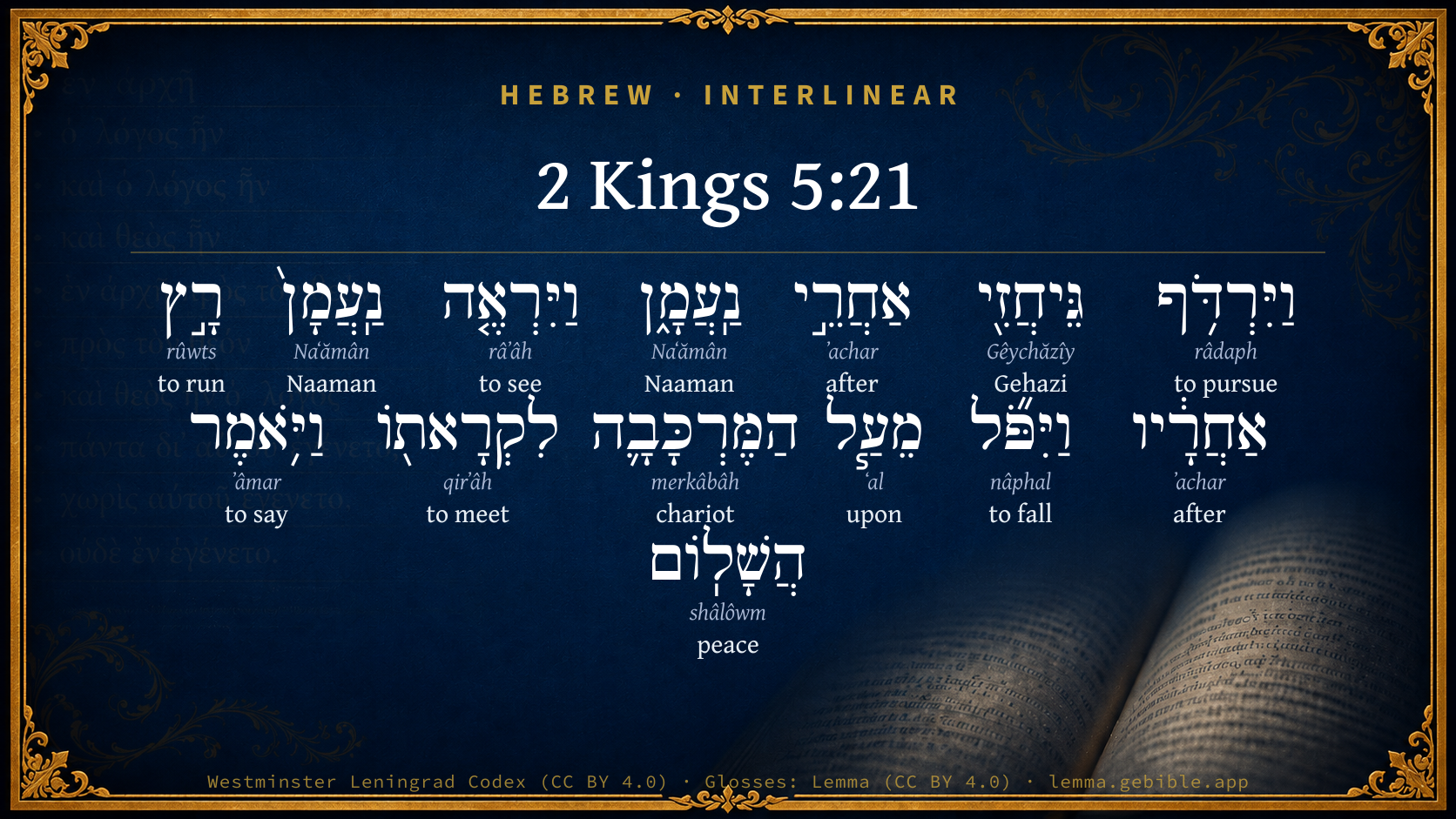
Hebrew (Westminster Leningrad Codex) 2 Kings 5:21 appears in the Hebrew Old Testament. The text above is from the Westminster Leningrad Codex. Each word links to its Strong’s number, a concise gloss, and parsing drawn from the Open Scriptures Hebrew Bible morphology. Click any word for its full Brown-Driver-Briggs (BDB) entry.
Download image
Cite this verse

2 Kings 5:21 (World English Bible). Public Domain. Lemma interlinear Bible study tool, https://lemma.gebible.app/v/2-kings/5/21.

Show BibTeX & RIS
BibTeX
RIS
English Translation
So Gehazi followed after Naaman. When Naaman saw one running after him, he alighted from the chariot to meet him, and said, Is all well?
World English Bible · Public Domain
Download a study sheet

One document with this verse’s original text, its word-by-word gloss line, the meaning frame, cross-references with their text, attributed commentary, and full source and license credits — printable, and it pastes into notes with its structure intact.

This verse Autodidact and up

Study sheet (.html) Plain text (.txt)

A passage Seminary Student

Up to 50 verses in one chapter. A passage sheet keeps up to 6 commentary sources and 12 cross-references per verse, in the order this page ranks them, and says so on the sheet whenever that leaves anything out. Ask for a single verse and you get the Autodidact verse sheet above.

Everything on this page stays free to read, with no account — the sheet is a download of what is already on screen, not access to it.

Want to remove ads? Support Godless Engineer
Compare translations 3

The same verse in 3 English versions, stacked beneath the original-language interlinear above. Click any original word for its lexicon entry.

Each is an independent rendering of the whole verse — the interlinear is not word-aligned to these translations.

Highlighted words mark where these versions differ — a whole-verse word diff, not a word-by-word alignment.

  • World English Bible Public Domain
    So Gehazi followed after Naaman. When Naaman saw one running after him, he alighted from the chariot to meet him, and said, Is all well?
  • King James Version Public Domain
    So Gehazi followed after Naaman. And when Naaman saw him running after him, he lighted down from the chariot to meet him, and said, Is all well?
  • unfoldingWord Literal Text CC BY-SA 4.0
    So Gehazi pursued after Naaman. And Naaman saw one running after him, and he got down from upon the chariot to meet him. And he said, “Peace?”

unfoldingWord Literal Text — © unfoldingWord, licensed CC BY-SA 4.0. Word-aligned USFM3 via Door43 (git.door43.org/unfoldingWord/en_ult).

Versions to compare (up to 4)

3 of 4 selected

Show all 18 translations

Every available English version of this verse, each an independent rendering of the whole verse.

  • World English Bible Public Domain
    So Gehazi followed after Naaman. When Naaman saw one running after him, he alighted from the chariot to meet him, and said, Is all well?
  • Berean Standard Bible Public Domain
    So Gehazi pursued Naaman. And when Naaman saw him running toward him, he got down from the chariot to meet him and asked, “Is everything all right?”
  • Majority Standard Bible Public Domain
    So Gehazi pursued Naaman. And when Naaman saw him running toward him, he got down from the chariot to meet him and asked, “Is everything all right?”
  • King James Version Public Domain
    So Gehazi followed after Naaman. And when Naaman saw him running after him, he lighted down from the chariot to meet him, and said, Is all well?
  • American Standard Version (1901) Public Domain
    So Gehazi followed after Naaman. And when Naaman saw one running after him, he alighted from the chariot to meet him, and said, Is all well?
  • Revised Version (1885) Public Domain
    So Gehazi followed after Naaman. And when Naaman saw one running after him, he lighted down from the chariot to meet him, and said, Is all well?
  • Geneva Bible (1599) Public Domain
    So Gehazi followed speedily after Naaman. And when Naaman sawe him running after him, he light downe from the charet to meete him, and said, Is all well?
  • Douay-Rheims (1899) Public Domain
    ,21And Giezi followed after Naaman: and when he saw him running after him, he leapt down from his chariot to meet him, and said: Is all well?
  • Young's Literal Translation Public Domain
    And Gehazi pursueth after Naaman, and Naaman seeth one running after him, and alighteth from off the chariot to meet him, and saith, `Is there peace?'
  • Literal Standard Version CC BY-SA 4.0
    And Gehazi pursues after Naaman, and Naaman sees one running after him, and comes down off the chariot to meet him, and says, “Is there peace?”
  • Unlocked Literal Bible CC BY-SA 4.0
    So Gehazi followed after Naaman. When Naaman saw someone running after him, he jumped down from his chariot to meet him and said, “Is everything alright?”
  • unfoldingWord Literal Text CC BY-SA 4.0
    So Gehazi pursued after Naaman. And Naaman saw one running after him, and he got down from upon the chariot to meet him. And he said, “Peace?”
  • Darby Bible Public Domain
    And Gehazi followed after Naaman. And when Naaman saw him running after him, he sprang down from the chariot to meet him, and said, Is all well?
  • World Messianic Bible Public Domain
    So Gehazi followed after Naaman. When Naaman saw one running after him, he came down from the chariot to meet him, and said, “Is all well?”
  • Webster's Bible Public Domain
    So Gehazi followed after Naaman. And when Naaman saw him running after him, he lighted down from the chariot to meet him, and said, Is all well?
  • Free Bible Version CC BY-SA 4.0
    So Gehazi chased after Naaman. When Naaman saw him running after him, he jumped down from the chariot to meet him and asked, “Is everything all right?”
  • Bible in Basic English Public Domain
    So Gehazi went after Naaman. And when Naaman saw him running after him, he got down from his carriage and went back to him and said, Is all well?
  • JPS Tanakh (1917) Public Domain
    So Gehazi followed after Naaman. And when Naaman saw one running after him, he alighted from the chariot to meet him, and said: 'Is all well?'

Literal Standard Version (2020), Covenant Press — licensed CC BY-SA 4.0. Text via the HelloAO Bible API (eBible.org). Unlocked Literal Bible (unfoldingWord) — licensed CC BY-SA 4.0. Text via the HelloAO Bible API (eBible.org). unfoldingWord Literal Text — © unfoldingWord, licensed CC BY-SA 4.0. Word-aligned USFM3 via Door43 (git.door43.org/unfoldingWord/en_ult). Free Bible Version, Dr. Jonathan Gallagher — licensed CC BY-SA 4.0. Text via the HelloAO Bible API (eBible.org).

Word by word

More ways to search: Search by grammar → Find every occurrence → Compare this word →

Practice this passage: Drill this verse → Learn its vocabulary →

גֵּיחֲזִ֖י
Gêychăzîy
H1522
“Gehazi”
Noun, Proper
Part of Speech
Noun
Type
Proper
Full BDB Definition

Origin: apparently from H1516 and H2372

TWOT: None

Gehazi = "valley of vision" - the servant of Elisha
  1. וַיִּרְדֹּ֥ף râdaph H7291 “and · to pursue” Conjunction + Verb, Qal, Sequential Imperfect, 3rd Person, Masculine, Singular
  2. אַחֲרֵ֣י ʼachar H310 “after” Preposition
  3. נַֽעֲמָ֑ן Naʻămân H5283 “Naaman” Noun, Proper
  4. וַיִּרְאֶ֤ה râʼâh H7200 “and · to see” Conjunction + Verb, Qal, Sequential Imperfect, 3rd Person, Masculine, Singular
  5. נַֽעֲמָן֙ Naʻămân H5283 “Naaman” Noun, Proper
  6. רָ֣ץ rûwts H7323 “running” Verb, Qal, Participle Active, Masculine, Singular, Absolute
  7. אַחֲרָ֔יו ʼachar H310 “after · him” Preposition + Suffix, Personal, 3rd Person, Masculine, Singular
  8. וַיִּפֹּ֞ל nâphal H5307 “and · to fall” Conjunction + Verb, Qal, Sequential Imperfect, 3rd Person, Masculine, Singular
  9. מֵעַ֧ל ʻal H5921 “from · upon” Preposition + Preposition
  10. הַמֶּרְכָּבָ֛ה merkâbâh H4818 “the · chariot” Particle, Definite Article + Noun, Common, Feminine, Singular, Absolute
  11. לִקְרָאת֖וֹ qirʼâh H7125 “to meet · him” Preposition + Verb, Qal, Infinitive Construct + Suffix, Personal, 3rd Person, Masculine, Singular
  12. וַיֹּ֥אמֶר ʼâmar H559 “and · to say” Conjunction + Verb, Qal, Sequential Imperfect, 3rd Person, Masculine, Singular
  13. הֲשָׁלֽוֹם shâlôwm H7965 “peace” Particle, Interrogative + Noun, Common, Masculine, Singular, Absolute

About this verse

These counts appear in no published source. They are computed here, from the morphology-tagged text and Lemma’s own curated glosses. What Lemma adds →

14
words
12
distinct lemmas
Historical
section

Notable vocabulary

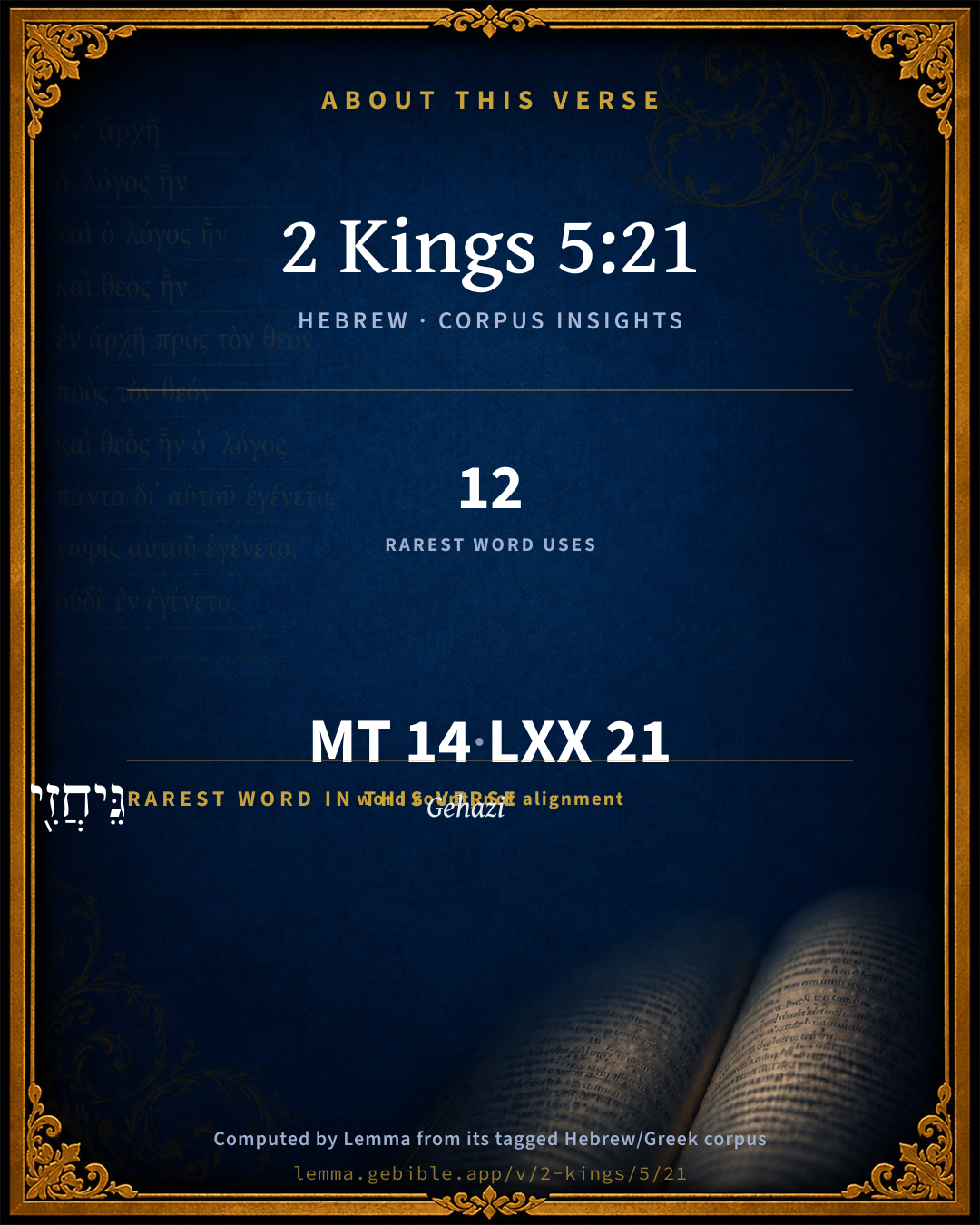
The rarest word here is גֵּיחֲזִ֖י Gehazi H1522 — appearing just 12 times in the whole Hebrew Bible.

Shared distinctive vocabulary

גֵּיחֲזִ֖י Gehazi H1522 occurs in 12 verses of the Hebrew Bible. Also found in:

Grammatical profile

  • 6 verbs
  • 5 nouns
  • 3 prepositions

Verb forms

  • וַיִּרְדֹּ֥ף Qal · Sequential Imperfect
  • וַיִּרְאֶ֤ה Qal · Sequential Imperfect
  • רָ֣ץ Qal · Participle Active
  • וַיִּפֹּ֞ל Qal · Sequential Imperfect
  • לִקְרָאת֖וֹ Qal · Infinitive Construct
  • וַיֹּ֥אמֶר Qal · Sequential Imperfect

Repetition

Words recur within this verse — often emphatic in Hebrew:

  • אַחֲרֵ֣י after H310 ×2
  • נַֽעֲמָ֑ן Naaman H5283 ×2

Hebrew & Septuagint length

In English translation the verse runs 25 words from the Hebrew and 21 from the Septuagint (LXX English) — closely comparable.

A rough comparison of the two English renderings, which tokenize alike — not a word-level alignment.

Word counts can differ between the Hebrew and the Greek without any difference in meaning — e.g. the Hebrew direct-object marker אֵת has no separate Greek word, and Greek often adds the article ὁ.

In the original languages it is 14 Hebrew tokens and 21 Greek tokens — but the two are counted differently (Hebrew bundles its prefixes and suffixes into one token; the Greek is in lemma form), so that isn’t a like-for-like length.

Cross-references

5

Topical passages linked to 2 Kings 5:21 in the Treasury of Scripture Knowledge — connected by theme and wording, ordered by reader-vote popularity; previews shown in the World English Bible.

  • 2 Kings 4:26 please run now to meet her, and ask her, Is it well with you? is it well with your husband? is it well with the child? She answered, It is well.
  • 2 Kings 9:17–22 Now the watchman was standing on the tower in Jezreel, and he spied the company of Jehu as he came, and said, I see a company. Joram said, Take a horseman, and send to meet them, and let him say, Is it peace?
  • Luke 7:6–7 Jesus went with them. When he was now not far from the house, the centurion sent friends to him, saying to him, "Lord, don't trouble yourself, for I am not worthy for you to come under my roof.
  • Acts 8:31 He said, "How can I, unless someone explains it to me?" He begged Philip to come up and sit with him.
  • Acts 10:25–26 When it happened that Peter entered, Cornelius met him, fell down at his feet, and worshiped him.

Cross-references courtesy of OpenBible.info (CC BY 4.0).

Hebrew and Greek witnesses Masoretic Hebrew ↔ Greek Septuagint

The same verse in the two great witnesses to the Old Testament, shown verse-for-verse.

These are two independent witnesses, not word-aligned to each other, and the Septuagint is shown in lemma (dictionary) form.

Hebrew 2 Kings 5:21 Masoretic · Westminster Leningrad Codex

וַיִּרְדֹּ֥ף גֵּיחֲזִ֖י אַחֲרֵ֣י נַֽעֲמָ֑ן וַיִּרְאֶ֤ה נַֽעֲמָן֙ רָ֣ץ אַחֲרָ֔יו וַיִּפֹּ֞ל מֵעַ֧ל הַמֶּרְכָּבָ֛ה לִקְרָאת֖וֹ וַיֹּ֥אמֶר הֲשָׁלֽוֹם

So Gehazi followed after Naaman. When Naaman saw one running after him, he alighted from the chariot to meet him, and said, Is all well?

World English Bible · Public Domain

Greek LXX 2 Kings 5:21 Septuagint · lemma form

καί διώκω γιεζι ὀπίσω ὁ ναιμαν καί ὁράω αὐτός ναιμαν τρέχω ὀπίσω αὐτός καί ἐπιστρέφω ἀπό ὁ ἅρμα εἰς ἀπαντή αὐτός

So Giezi followed after Naiman: and Naiman saw him running after him, and turned back from his chariot to meet him.

LXX2012 (modern English Septuagint) · Public Domain

On this verse, Ellicott's Commentary for English Readers discusses the Septuagint’s reading. Read the note in Commentary ↓

Hebrew: Westminster Leningrad Codex (CC BY 4.0). Greek: Septuagint (public domain); English from LXX2012 (modern English Septuagint) (Public Domain). How the Septuagint differs from the Hebrew →

Targum (Aramaic paraphrase)

1

The Targum is the ancient Jewish Aramaic paraphrase of the Hebrew Scriptures — an interpretive translation, not the Hebrew text itself. Onkelos (literal) and Pseudo-Jonathan (expansive) render the Torah, and Jonathan the Prophets. Coverage is partial: where no permissively-licensed English translation exists for a verse, only the Aramaic is shown. This is verse-level text, not a word-by-word alignment to the Hebrew.

  1. Targum Jonathan Prophets (Joshua–Malachi)
    וּרְדַף גֵיחֲזִי בָּתַר נַעֲמָן וַחֲזָא נַעֲמָן גַבְרָא רְהִיט בַּתְרוֹהִי וְאִתְרְכִין מִן רְתִיכָא לָקֳדָמוּתֵיהּ וַאֲמַר הַשְׁלָם:

    (no public-domain English translation for this verse)

    Targum Jonathan — Aramaic: “Mikraot Gedolot” (public domain). English: “Sefaria Community Translation” (CC0 1.0 (public-domain dedication)); “London "Chaldee Paraphrase," 1871” (public domain). Text via Sefaria.

Commentary

Notes on 2 Kings 5:21 from classic Christian and Jewish commentators (each source and its license shown beneath its notes). The classic Christian expositions comment on the surrounding passage and are grouped to its opening verse, so a note may address several verses; the Jewish commentaries on the Tanakh (Rashi and others) are per-verse, so they appear only where the commentator wrote on this verse.

Lemma curates 59 commentaries, every one of them public domain or Creative Commons licensed, each selected and text-cleaned for this edition rather than reprinted as found. About our sources →

Trapp's Complete Commentary

John Trapp

2Ki 5:21 So Gehazi followed after Naaman. And when Naaman saw [him] running after him, he lighted down from the chariot to meet him, and said, [Is] all well?

Ver. 2l. So Gehazi followed.] Being acted and agitated by the devil of discontent, Judas-like.

John Trapp, A Commentary or Exposition upon All the Books of the Old and New Testament (1647–1656) — public domain. Text from a community e-Sword module.

Joseph Benson's Commentary

2Ki 5:21-23. He lighted down from his chariot to meet him — Thereby testifying his great respect to the prophet his master, He said — My master hath sent me, &c. — This story of Gehazi was a very unlikely one: Naaman, however, was not willing to question it, but glad of the opportunity of showing his gratitude to the prophet. And he — Naaman, urged him — Who at first refused it upon a pretence of modesty and obedience to his master’s command.

Joseph Benson's Commentary on the Old and New Testaments (1811–1818) — public domain. Text from a community e-Sword module.

Geneva Bible (1599)

Geneva Bible translators

Declaring thereby, what honor and affection he bare to the Prophet his master.

Geneva Bible (1599) marginal notes — public domain. Text via Bolls.life.

Adam Clarke's Commentary

Verse 21. He lighted down from the chariot] He treats even the prophet's servant with the profoundest respect, alights from his chariot, and goes to meet him.

Is all well?] השלום hashalom; Is it peace, or prosperity?

Adam Clarke's Commentary on the Bible (1810–1826) — public domain. Text from a community e-Sword/MySword module.

Ellicott's Commentary for English Readers

(21) He lighted down from the chariot to meet him.—An Oriental mark of respect. Literally, fell from off the chariot: an expression denoting haste (Gen_24:64). The LXX. has “he turned,” which implies an ellipsis of “and descended.”

Is all well?—Naaman feared something might have befallen the prophet. The LXX. omits this.

A Bible Commentary for English Readers, edited by Charles John Ellicott (1878–1897) — public domain. Text from a community e-Sword module.

The Cambridge Bible for Schools and Colleges

gen. ed. J. J. S. Perowne

21. And when Naaman saw him [R.V. one] running after him] On an Eastern road the travellers were not numerous, and any one in hot pursuit would at once be noticed, and it would be felt that he was anxious that the travellers in front should halt.

he lighted down from the chariot to meet him] As Gehazi approached, Naaman would recognise him; for Gehazi may have been the messenger first sent to bid the Syrian go and wash in Jordan, and he had clearly been by his master’s side during the subsequent interview. Anxious therefore to shew his gratitude, the superior lights down from his chariot. This was an act of much condescension, and is an index of Naaman’s feeling.

The Cambridge Bible for Schools and Colleges (gen. ed. J. J. S. Perowne; Cambridge University Press, 1878–1918) — public domain. Text from a community e-Sword module.

John Gill's Exposition

So Gehazi followed after Naaman,.... As fast as he could:

and when Naaman saw him running after him; which he might observe, looking back, or be informed of by some of his servants:

he lighted down from the chariot to meet him; in honour to the prophet, whose servant he was:

and said, is all well? fearing something ill had befallen Elisha; or he himself had done something wrong, which occasioned the servant to run after him.

John Gill's Exposition of the Whole Bible (1746–1763) — public domain (CC PDM 1.0). Text via the HelloAO Bible API.

Albert Barnes' Notes on the Bible

He lighted down from the chariot - This was an act of quite uncalled-for courtesy. It indicates eagerness to honor the master in the person of his servant.

Albert Barnes' Notes on the Bible (1834–1885) — public domain. Text from a community e-Sword/MySword module.

Matthew Poole's English Annotations

He lighted down from the chariot to meet him thereby testifying his great respect to the prophet his master.

Matthew Poole's English Annotations on the Holy Bible (1683–1685) — public domain. Text from a community e-Sword/MySword module.

The Pulpit Commentary

So Gehazi followed after Naaman. A company of travelers in the East, even though it consist of the retinue of a single great man, will always contain footmen, as well as those who ride on horses or in chariots, and will not travel at a faster pace than about three miles an hour. Thus Gehazi, if he went at his best speed, could expect to overtake, and did actually overtake, the cavalcade of Naaman. He probably overtook them at a very short distance from Samaria. And when Naaman saw him running after him. Gehazi was pressed for time. He could not start at once, lest he should make it too plain that he was going m pursuit of Naaman; and he could not absent himself from the house too long, lest his master should call for him. He had, therefore, at whatever loss of dignity, to hurry himself, and actually "run after" the Syrian. Naaman, either accidentally looking back, or warned by some of his train, sees him, recognizes him, and is only too glad to respond to his wishes. He lighted down from the chariot to meet him. An act of great condescension. As Bahr notes, "Descent from a vehicle is, in the East, a sign of respect from the inferior to the superior;" and Naaman, in lighting down from his chariot, must have intended to "honor the prophet in his servant" ("Commentary on Kings," vol. 2. p. 55). But such honor is not commonly paid, and thus the act of Naaman was abnormal. And said, Is all well? The words admit of no better translation. Seeing Gehazi"s haste and anxious looks, Naaman suspects that all is not well, that something has happened since he left the prophet"s house, and accordingly puts his question, Rectene sunt omnia? (Vulgate).

The Pulpit Commentary (1880–1919), ed. H.D.M. Spence-Jones & Joseph S. Exell — public domain. Text from a community e-Sword module.

Rashi

Rabbi Shlomo Yitzchaki (Rashi)

And he jumped off. [Targum Yonoson renders,] “and he leaned over.”

Rashi on the Tanakh — English translations: “The Judaica Press complete Tanach with Rashi, translated by A. J. Rosenberg” (CC BY 4.0); “Pentateuch with Rashi's commentary by M. Rosenbaum and A.M. Silbermann, 1929-1934” (public domain); “The Metsudah Tanach series, Lakewood, N.J” (CC BY 4.0); and “The Book of Joshua, Metsudah Publications, 1997” (CC BY 4.0). Text via Sefaria.

Lesson kit

Teaching starters — assembled from the data on this page, not authored interpretation. Every prompt links to the verse data it draws on. Edit before teaching.

2 Kings, in the Historical, opens this verse with 14 words (12 distinct Hebrew lemmas). Its most distinctive word is Gêychăzîy (“Gehazi”). A historical commentator’s framing appears above. Read the whole chapter for the surrounding context.

Discussion questions

  1. How does “Gehazi” (Gêychăzîy) shape what this verse is saying?
  2. 2 Kings 4:12 shares the word «Gehazi» with this verse. How do the two illuminate each other?
  3. “after” occurs 2× in this one verse. What is the effect of the repetition?
  4. These translations render this verse differently; the difference is in the English rendering, not the original. What questions does that raise?
  5. The verb «וַיִּרְדֹּ֥ף» is Qal Sequential Imperfect. How does its form color the action?
  6. Reading how Trapp's Complete Commentary and Joseph Benson's Commentary read this verse, where do the two commentators agree and where do they part?

Things to notice

Reading settings

Reading text

Shown beneath each verse's original-language words.

Old Testament
Old Testament edition

Read the OT as the Masoretic Hebrew (MT) or the Greek Septuagint (LXX).

English shown for the Greek Septuagint (in the Hebrew ↔ Greek comparison).

Comparing translations? Open the Compare panel on any verse page to stack up to four side by side.