
1 Samuel 5:3

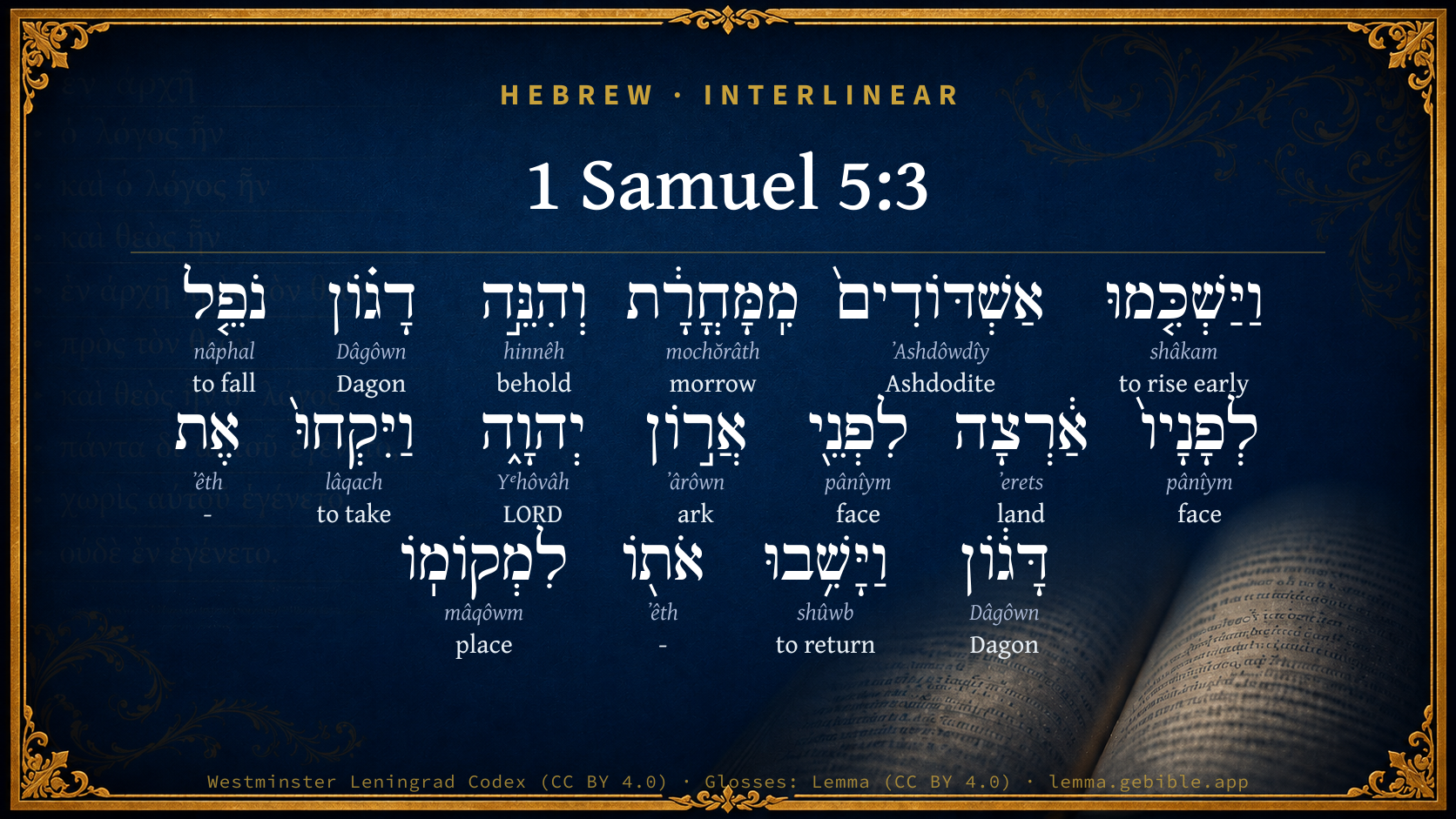
Hebrew (Westminster Leningrad Codex) 1 Samuel 5:3 appears in the Hebrew Old Testament. The text above is from the Westminster Leningrad Codex. Each word links to its Strong’s number, a concise gloss, and parsing drawn from the Open Scriptures Hebrew Bible morphology. Click any word for its full Brown-Driver-Briggs (BDB) entry.
Download image
Cite this verse

1 Samuel 5:3 (World English Bible). Public Domain. Lemma interlinear Bible study tool, https://lemma.gebible.app/v/1-samuel/5/3.

Show BibTeX & RIS
BibTeX
RIS
English Translation
When they of Ashdod arose early on the next day, behold, Dagon was fallen on his face to the ground before the ark of Yahweh. They took Dagon, and set him in his place again.
World English Bible · Public Domain
Download a study sheet

One document with this verse’s original text, its word-by-word gloss line, the meaning frame, cross-references with their text, attributed commentary, and full source and license credits — printable, and it pastes into notes with its structure intact.

This verse Autodidact and up

Study sheet (.html) Plain text (.txt)

A passage Seminary Student

Up to 50 verses in one chapter. A passage sheet keeps up to 6 commentary sources and 12 cross-references per verse, in the order this page ranks them, and says so on the sheet whenever that leaves anything out. Ask for a single verse and you get the Autodidact verse sheet above.

Everything on this page stays free to read, with no account — the sheet is a download of what is already on screen, not access to it.

Want to remove ads? Support Godless Engineer
Compare translations 3

The same verse in 3 English versions, stacked beneath the original-language interlinear above. Click any original word for its lexicon entry.

Each is an independent rendering of the whole verse — the interlinear is not word-aligned to these translations.

Highlighted words mark where these versions differ — a whole-verse word diff, not a word-by-word alignment.

  • World English Bible Public Domain
    When they of Ashdod arose early on the next day, behold, Dagon was fallen on his face to the ground before the ark of Yahweh. They took Dagon, and set him in his place again.
  • King James Version Public Domain
    And when they of Ashdod arose early on the morrow, behold, Dagon was fallen upon his face to the earth before the ark of the LORD. And they took Dagon, and set him in his place again.
  • unfoldingWord Literal Text CC BY-SA 4.0
    And the Ashdodites arose early on the next day, and behold, Dagon was fallen on his face to the ground to the face of the Box of Yahweh. And they took Dagon and returned him to his place.

unfoldingWord Literal Text — © unfoldingWord, licensed CC BY-SA 4.0. Word-aligned USFM3 via Door43 (git.door43.org/unfoldingWord/en_ult).

Versions to compare (up to 4)

3 of 4 selected

Show all 18 translations

Every available English version of this verse, each an independent rendering of the whole verse.

  • World English Bible Public Domain
    When they of Ashdod arose early on the next day, behold, Dagon was fallen on his face to the ground before the ark of Yahweh. They took Dagon, and set him in his place again.
  • Berean Standard Bible Public Domain
    When the people of Ashdod got up early the next morning, there was Dagon, fallen on his face before the ark of the LORD. So they took Dagon and returned him to his place.
  • Majority Standard Bible Public Domain
    When the people of Ashdod got up early the next morning, there was Dagon, fallen on his face before the ark of the LORD. So they took Dagon and returned him to his place.
  • King James Version Public Domain
    And when they of Ashdod arose early on the morrow, behold, Dagon was fallen upon his face to the earth before the ark of the LORD. And they took Dagon, and set him in his place again.
  • American Standard Version (1901) Public Domain
    And when they of Ashdod arose early on the morrow, behold, Dagon was fallen upon his face to the ground before the ark of Jehovah. And they took Dagon, and set him in his place again.
  • Revised Version (1885) Public Domain
    And when they of Ashdod arose early on the morrow, behold, Dagon was fallen upon his face to the ground before the ark of the LORD. And they took Dagon, and set him in his place again.
  • Geneva Bible (1599) Public Domain
    And when they of Ashdod rose the next day in the morning, beholde, Dagon was fallen vpon his face on the ground before the Arke of the Lord, and they tooke vp Dagon, and set him in his place againe.
  • Douay-Rheims (1899) Public Domain
    And when the Azotians arose early the next day, behold Dagon lay upon his face on the ground before the ark of the Lord: and they took Dagon, and set him again in his place.
  • Young's Literal Translation Public Domain
    And the Ashdodites rise early on the morrow, and lo, Dagon is fallen on its face to the earth, before the ark of Jehovah; and they take Dagon, and put it back to its place.
  • Literal Standard Version CC BY-SA 4.0
    And the Ashdodites rise early on the next day, and behold, Dagon is fallen on its face to the earth, before the Ark of YHWH; and they take Dagon, and put it back in its place.
  • Unlocked Literal Bible CC BY-SA 4.0
    When the people of Ashdod got up early the next day, behold, Dagon had fallen facedown on the ground before the ark of Yahweh. So they took Dagon and set him up in his place again.
  • unfoldingWord Literal Text CC BY-SA 4.0
    And the Ashdodites arose early on the next day, and behold, Dagon was fallen on his face to the ground to the face of the Box of Yahweh. And they took Dagon and returned him to his place.
  • Darby Bible Public Domain
    And when they of Ashdod arose early the next day, behold, Dagon had fallen on his face to the ground before the ark of Jehovah. And they took Dagon, and set him in his place again.
  • World Messianic Bible Public Domain
    When the people of Ashdod arose early on the next day, behold, Dagon had fallen on his face to the ground before the LORD’s ark. They took Dagon and set him in his place again.
  • Webster's Bible Public Domain
    And when they of Ashdod arose early on the morrow, behold, Dagon had fallen upon his face to the earth before the ark of the LORD. And they took Dagon, and set him in his place again.
  • Free Bible Version CC BY-SA 4.0
    When the people of Ashdod got up early the next day, they saw Dagon had fallen on his face in front of the Ark of the Lord. So they took Dagon and set him back up.
  • Bible in Basic English Public Domain
    And when the people of Ashdod got up early on the morning after, they saw that Dagon had come down to the earth on his face before the ark of the Lord. And they took Dagon up and put him in his place again.
  • JPS Tanakh (1917) Public Domain
    And when they of Ashdod arose early on the morrow, behold, Dagon was fallen upon his face to the ground before the ark of the LORD. And they took Dagon, and set him in his place again.

Literal Standard Version (2020), Covenant Press — licensed CC BY-SA 4.0. Text via the HelloAO Bible API (eBible.org). Unlocked Literal Bible (unfoldingWord) — licensed CC BY-SA 4.0. Text via the HelloAO Bible API (eBible.org). unfoldingWord Literal Text — © unfoldingWord, licensed CC BY-SA 4.0. Word-aligned USFM3 via Door43 (git.door43.org/unfoldingWord/en_ult). Free Bible Version, Dr. Jonathan Gallagher — licensed CC BY-SA 4.0. Text via the HelloAO Bible API (eBible.org).

Word by word

More ways to search: Search by grammar → Find every occurrence → Compare this word →

Practice this passage: Drill this verse → Learn its vocabulary →

אַשְׁדּוֹדִים֙
ʼAshdôwdîy
H796
“Ashdodites”
Noun, Gentilic, Masculine, Plural, Absolute
Part of Speech
Noun
Type
Gentilic
Gender
Masculine
Number
Plural
State
Absolute
Full BDB Definition

Origin: patrial from H795

TWOT: None

Ashdodites = "I will spoil" - an inhabitant of Ashdod
  1. וַיַּשְׁכִּ֤מוּ shâkam H7925 “and · to rise early” Conjunction + Verb, Hiphil, Sequential Imperfect, 3rd Person, Masculine, Plural
  2. מִֽמָּחֳרָ֔ת mochŏrâth H4283 “from · morrow” Preposition + Noun, Common, Feminine, Singular, Absolute
  3. וְהִנֵּ֣ה hinnêh H2009 “and · behold” Conjunction + Particle, Demonstrative
  4. דָג֗וֹן Dâgôwn H1712 “Dagon” Noun, Proper
  5. נֹפֵ֤ל nâphal H5307 “falling” Verb, Qal, Participle Active, Masculine, Singular, Absolute
  6. לְפָנָיו֙ pânîym H6440 “to/for · face(s) · his” Preposition + Noun, Common, Both, Plural, Construct + Suffix, Personal, 3rd Person, Masculine, Singular
  7. אַ֔רְצָה ʼerets H776 “land · toward” Noun, Common, Both, Singular, Absolute + Suffix, Demonstrative
  8. לִפְנֵ֖י pânîym H6440 “to/for · face(s) of” Preposition + Noun, Common, Both, Plural, Construct
  9. אֲר֣וֹן ʼârôwn H727 “ark of” Noun, Common, Both, Singular, Construct
  10. יְהוָ֑ה Yᵉhôvâh H3068 “LORD” Noun, Proper
  11. וַיִּקְחוּ֙ lâqach H3947 “and · to take” Conjunction + Verb, Qal, Sequential Imperfect, 3rd Person, Masculine, Plural
  12. אֶת ʼêth H853 “-” Particle, Direct Object
  13. דָּג֔וֹן Dâgôwn H1712 “Dagon” Noun, Proper
  14. וַיָּשִׁ֥בוּ shûwb H7725 “and · to return” Conjunction + Verb, Hiphil, Sequential Imperfect, 3rd Person, Masculine, Plural
  15. אֹת֖וֹ ʼêth H853 “- · him” Particle, Direct Object + Suffix, Personal, 3rd Person, Masculine, Singular
  16. לִמְקוֹמֽוֹ mâqôwm H4725 “to/for · place · his” Preposition + Noun, Common, Masculine, Singular, Construct + Suffix, Personal, 3rd Person, Masculine, Singular

About this verse

These counts appear in no published source. They are computed here, from the morphology-tagged text and Lemma’s own curated glosses. What Lemma adds →

17
words
14
distinct lemmas
Historical
section

Notable vocabulary

The rarest word here is אַשְׁדּוֹדִים֙ Ashdodite H796 — appearing just 6 times in the whole Hebrew Bible.

Shared distinctive vocabulary

אַשְׁדּוֹדִים֙ Ashdodite H796 occurs in 5 verses of the Hebrew Bible. Also found in:

Grammatical profile

  • 4 verbs
  • 10 nouns
  • 3 particles

Verb forms

  • וַיַּשְׁכִּ֤מוּ Hiphil · Sequential Imperfect
  • נֹפֵ֤ל Qal · Participle Active
  • וַיִּקְחוּ֙ Qal · Sequential Imperfect
  • וַיָּשִׁ֥בוּ Hiphil · Sequential Imperfect

Repetition

Words recur within this verse — often emphatic in Hebrew:

  • דָג֗וֹן Dagon H1712 ×2
  • לְפָנָיו֙ face H6440 ×2

Hebrew & Septuagint length

In English translation the verse runs 35 words from the Hebrew and 68 from the Septuagint (LXX English) — the Septuagint runs noticeably longer here. See the side-by-side →

A rough comparison of the two English renderings, which tokenize alike — not a word-level alignment.

Word counts can differ between the Hebrew and the Greek without any difference in meaning — e.g. the Hebrew direct-object marker אֵת has no separate Greek word, and Greek often adds the article ὁ.

Cross-references

13

Topical passages linked to 1 Samuel 5:3 in the Treasury of Scripture Knowledge — connected by theme and wording, ordered by reader-vote popularity; previews shown in the World English Bible.

  • Isaiah 19:1 The burden of Egypt. Behold, Yahweh rides on a swift cloud, and comes to Egypt: and the idols of Egypt shall tremble at his presence; and the heart of Egypt shall melt in the midst of it.
  • Isaiah 46:1–2 Bel bows down, Nebo stoops; their idols are on the animals, and on the cattle: the things that you carried about are made a load, a burden to the weary [animal].
  • Isaiah 46:7 They bear it on the shoulder, they carry it, and set it in its place, and it stands, from its place it shall not move: yes, one may cry to it, yet it can not answer, nor save him out of his trouble.
  • Mark 3:11 The unclean spirits, whenever they saw him, fell down before him, and cried, "You are the Son of God!"
  • Zephaniah 2:11 Yahweh will be awesome to them, for he will famish all the gods of the land. Men will worship him, everyone from his place, even all the shores of the nations.
  • Luke 10:18–20 He said to them, "I saw Satan having fallen like lightning from heaven.
  • Exodus 12:12 For I will go through the land of Egypt in that night, and will strike all the firstborn in the land of Egypt, both man and animal. Against all the gods of Egypt I will execute judgments: I am Yahweh.
  • Psalms 97:7 Let all them be shamed who serve engraved images, Who boast in their idols. Worship him, all you gods!
  • Isaiah 40:20 He who is too impoverished for [such] an offering chooses a tree that will not rot; he seeks to him a skillful workman to set up an engraved image, that shall not be moved.
  • Isaiah 41:7 So the carpenter encourages the goldsmith, [and] he who smoothes with the hammer him who strikes the anvil, saying of the soldering, It is good; and he fastens it with nails, that is should not be moved.
  • Isaiah 44:17–20 The residue of it he makes a god, even his engraved image; he falls down to it and worships, and prays to it, and says, Deliver me; for you are my god.
  • Jeremiah 10:8 But they are together brutish and foolish: the instruction of idols! it is but a stock.
  • 2 Corinthians 6:14–16 Don't be unequally yoked with unbelievers, for what fellowship have righteousness and iniquity? Or what communion has light with darkness?

Cross-references courtesy of OpenBible.info (CC BY 4.0).

Hebrew and Greek witnesses Masoretic Hebrew ↔ Greek Septuagint

The same verse in the two great witnesses to the Old Testament, shown verse-for-verse.

Here the Septuagint runs noticeably longer than the Hebrew — LXX2012 (modern English Septuagint) 68 words vs World English Bible 35. A rough length comparison of the two English translations, not a word-level alignment — read both below.

These are two independent witnesses, not word-aligned to each other, and the Septuagint is shown in lemma (dictionary) form.

Hebrew 1 Samuel 5:3 Masoretic · Westminster Leningrad Codex

וַיַּשְׁכִּ֤מוּ אַשְׁדּוֹדִים֙ מִֽמָּחֳרָ֔ת וְהִנֵּ֣ה דָג֗וֹן נֹפֵ֤ל לְפָנָיו֙ אַ֔רְצָה לִפְנֵ֖י אֲר֣וֹן יְהוָ֑ה וַיִּקְחוּ֙ אֶת דָּג֔וֹן וַיָּשִׁ֥בוּ אֹת֖וֹ לִמְקוֹמֽוֹ

When they of Ashdod arose early on the next day, behold, Dagon was fallen on his face to the ground before the ark of Yahweh. They took Dagon, and set him in his place again.

World English Bible · Public Domain

Greek LXX 1 Samuel 5:3 Septuagint · lemma form

καί ὀρθρίζω ὁ ἀζώτιος καί εἰςἔρχομαι εἰς οἶκος δαγων καί ὁράω καί ἰδού δαγων πίπτω ἐπί πρόσωπον αὐτός ἐνώπιον κιβωτός ὁ θεός καί ἀγείρω ὁ δαγων καί καταἵστημι εἰς ὁ τόπος αὐτός καί βαρύνω χείρ κύριος ἐπί ὁ ἀζώτιος καί βασανίζω αὐτός καί πατάσσω αὐτός εἰς ὁ ἕδρα αὐτός ὁ ἄζωτος καί ὁ ὅριον αὐτός

And the people of Azotus rose early, and entered into the house of Dagon; and looked, and behold, Dagon had fallen on his face before the ark of the Lord: and they lifted up Dagon, and set him in his place. And the hand of the Lord was heavy upon the Azotians, and he plagued them, and he struck them in their secret parts, Azotus and her coasts.

LXX2012 (modern English Septuagint) · Public Domain

Hebrew: Westminster Leningrad Codex (CC BY 4.0). Greek: Septuagint (public domain); English from LXX2012 (modern English Septuagint) (Public Domain). How the Septuagint differs from the Hebrew →

Targum (Aramaic paraphrase)

1

The Targum is the ancient Jewish Aramaic paraphrase of the Hebrew Scriptures — an interpretive translation, not the Hebrew text itself. Onkelos (literal) and Pseudo-Jonathan (expansive) render the Torah, and Jonathan the Prophets. Coverage is partial: where no permissively-licensed English translation exists for a verse, only the Aramaic is shown. This is verse-level text, not a word-by-word alignment to the Hebrew.

  1. Targum Jonathan Prophets (Joshua–Malachi)
    וְאַקְדִימוּ אֱנָשֵׁי אַשְׁדוֹד בְּיוֹמָא דְבַתְרוֹהִי וְהָא דָגוֹן רָמֵי עַל אַפּוֹהִי עַל אַרְעָא קֳדָם אֲרוֹנָא דַייָ וּנְסִיבוּ יַת דָגוֹן וַאֲתִיבוּ יָתֵיהּ לְאַתְרֵיהּ:

    (no public-domain English translation for this verse)

    Targum Jonathan — Aramaic: “Mikraot Gedolot” (public domain). English: “Sefaria Community Translation” (CC0 1.0 (public-domain dedication)); “London "Chaldee Paraphrase," 1871” (public domain). Text via Sefaria.

Commentary

Notes on 1 Samuel 5:3 from classic Christian and Jewish commentators (each source and its license shown beneath its notes). The classic Christian expositions comment on the surrounding passage and are grouped to its opening verse, so a note may address several verses; the Jewish commentaries on the Tanakh (Rashi and others) are per-verse, so they appear only where the commentator wrote on this verse.

Lemma curates 59 commentaries, every one of them public domain or Creative Commons licensed, each selected and text-cleaned for this edition rather than reprinted as found. About our sources →

Jamieson, Fausset & Brown

Robert Jamieson, A. R. Fausset & David Brown

DAGON FALLS DOWN. (Sa1 5:3-5)

they of Ashdod arose early--They were filled with consternation when they found the object of their stupid veneration prostrate before the symbol of the divine presence. Though set up, it fell again, and lay in a state of complete mutilation; its head and arms, severed from the trunk, were lying in distant and separate places, as if violently cast off, and only the fishy part remained. The degradation of their idol, though concealed by the priests on the former occasion, was now more manifest and infamous. It lay in the attitude of a vanquished enemy and a suppliant, and this picture of humiliation significantly declared the superiority of the God of Israel.

Jamieson, Fausset & Brown — Commentary Critical and Explanatory on the Whole Bible (1871) — public domain (CC PDM 1.0). Text via the HelloAO Bible API.

Trapp's Complete Commentary

John Trapp

1Sa 5:3 And when they of Ashdod arose early on the morrow, behold, Dagon [was] fallen upon his face to the earth before the ark of the LORD. And they took Dagon, and set him in his place again.

Ver. 3. And when they of Ashdod arose early on the morrow,] viz., To their devotions, the fittest time for which the heathens generally held to be the top of the morning: for they thought that the gods sat in their temples, and waited for their morning salutations.

Behold, Dagon was fallen upon his face to the earth.] Before the Lord, who seemed to be asleep all this while, as David elegantly speaketh in Psa 78:65-66, but now showeth his power, by beating Dagon upon his own dunghill, and smiting his worshippers on their hinder parts, paying their posteriors, as men use to deal by puny boys.

Before the ark of the Lord.] Who endureth not a co-rival. There is a tradition, that when the child Jesus came into Egypt, all the idols of that nation fell to the ground: according to that of the psalmist, "Worship him, all ye gods." Sure it is, that when Christ, of whom the ark was a type, came in the flesh and sent abroad the gospel, thereby "bringing life and immortality to light," the oracles of Apollo and other heathen idols ceased. Plutarch sweateth in giving some fond reasons of that sudden deep silence among their deities: but the truth is, Christ was "come a light into the world, that whosoever believed on him should not abide in darkness." {Joh 12:46}

John Trapp, A Commentary or Exposition upon All the Books of the Old and New Testament (1647–1656) — public domain. Text from a community e-Sword module.

Adam Clarke's Commentary

Verse 3. They of Ashdod arose early on the morrow] Probably to perform some act of their superstition in the temple of their idol.

Dagon was fallen upon his face] This was one proof, which they little expected, of the superiority of the God of Israel.

Set him in his place again.] Supposing his fall might have been merely accidental.

Adam Clarke's Commentary on the Bible (1810–1826) — public domain. Text from a community e-Sword/MySword module.

Ellicott's Commentary for English Readers

(3) Dagon was fallen upon his face.—This Dagon was one of the chief Philistine deities, and had temples not only in Ashdod and in Gaza, but in the cities of Philistia. (See St. Jerome on Isa_46:1.) The idol had a human head and hands, and the body of a fish. Philo derives the word Dagon from dagan, “corn,” and supposes the worship to have been connected with Nature worship. The true derivation, however, is from Dag, a fish, which represents the sea from which the Philistines drew their wealth and power. In one of the bas-reliefs discovered at Khorsabad, and which, Layard states, represents the war of an Assyrian king—probably Sargon—with the inhabitants of the coast of Syria, a figure is seen swimming in the sea, with the upper part of the body resembling a bearded man wearing the ordinary conical tiara of royalty, adorned with elephants’ tusks, and the lower part re sembling the body of a fish. It has the hand lifted up, as if in astonishment or fear, and is surrounded by fishes, crabs, and other marine animals.

“There can be hardly any doubt,” argues Keil, “that we have here a representation of the Philistine Dagon. This deity was a personification of the generative and vivifying principle of nature, for which the fish, with its innumerable multiplication, was specially adapted, and set forth the idea of the Giver of all earthly good.”

This strange image the men of Ashdod, on the morrow of their triumphal offering of the Ark of the Lord before the idol shrine, found prostrate on the temple floor, before the desecrated sacred coffer of the Israelites.

They at once assumed that this had taken place owing to some accident, and they raised again the image to its place.

A Bible Commentary for English Readers, edited by Charles John Ellicott (1878–1897) — public domain. Text from a community e-Sword module.

The Cambridge Bible for Schools and Colleges

gen. ed. J. J. S. Perowne

3. Dagon was fallen upon his face to the earth] In the attitude of homage to the ark. Jehovah does not leave the Philistines to fancy that their god has conquered Him. He will shew that He is “the living God.” “The idols shall be moved at his presence” (Isa_19:1).

The Cambridge Bible for Schools and Colleges (gen. ed. J. J. S. Perowne; Cambridge University Press, 1878–1918) — public domain. Text from a community e-Sword module.

John Gill's Exposition

And when they of Ashdod arose early on the morrow, Either the people, the inhabitants of the place, who came early to pay their devotions to their idol, before they went on their business; or the priests of the idol, who came to sacrifice in the morning:

and, behold, Dagon was fallen upon his face to the earth before the ark of the Lord; as if he was subject to it, and giving adoration to it, and owning it was above him, and had superior power over him:

and they took Dagon, and set him in his place again; having no notion that it was owing to the ark of God, or to the God of Israel, that he was fallen, but that it was a matter of chance.

John Gill's Exposition of the Whole Bible (1746–1763) — public domain (CC PDM 1.0). Text via the HelloAO Bible API.

Haydock's Catholic Bible Commentary

Lord, as if to acknowledge his superiority. (Calmet) --- No sooner was the gospel preached, than the power of the idols began to decrease. (Ven. Bede) (Worthington)

George Leo Haydock (1774–1849), Haydock's Catholic Family Bible and Commentary, 1859 edition — public domain. Excludes Psalms (Douay-Rheims chapter numbering differs from Protestant) and Deuterocanonical books (Catholic canon only).

Matthew Poole's English Annotations

They of Ashdod, i.e. the priests of Dagon.

Arose early on the morrow; either to worship Dagon according to their manner, or being curious and greedy to know whether the neighbourhood of the ark to Dagon had made any alteration in either of them, that if Dagon had received any damage, they might, if possibly they could, repair it, before it came to the people’s knowledge, as indeed they did, to prevent their contempt of that idol, by which the priests had all their reputation and advantage.

Set him in his place again; supposing or pretending that his fall was wholly casual.

Matthew Poole's English Annotations on the Holy Bible (1683–1685) — public domain. Text from a community e-Sword/MySword module.

Whedon's Commentary on the Bible

Daniel D. Whedon

3. Dagon… fallen upon his face… before the ark — Not only will Jehovah not give his glory to another, nor his praise to graven images, but he will make idols themselves fall before him, (comp. Isa_19:1; Isa_46:1-2,) and thereby proclaim that he alone is God.

Set him in his place again — Not knowing the cause of his fall, but perhaps supposing that it was by accident. How dim and low their notions of Deity!

Daniel D. Whedon (gen. ed.), Commentary on the Old and New Testaments (1874–1909) — public domain. Text from a community e-Sword module.

The Pulpit Commentary

Vers. 3, 4. On the morrow, behold, Dagon was fallen upon his face to the earth before the ark of Jehovah. Ie. he was in the attitude of adoration, and instead of triumphing over Jehovah, he was prostrate, as if compelled to worship. But his priests perhaps thought that it was an accident, and so they set the image in its place again. They also, we may be sure, took due precaution against any one entering his temple by stealth; but when early on the second morning they came with anxious minds to see whether any new prodigy had happened, they found their god not only prostrate, as before, but mutilated, and his head and both the palms of his hands were cut off not broken off by the fall of the image from its place, but severed with deliberate care, and placed contemptuously upon the threshold, i.e. upon the door sill, the place where all must tread. Only Dagon was left to him. We cannot in English render the full contemptuousness of this phrase, because Dagon is to us a mere proper name, with no significance. In the original it conveys the idea that the head, the emblem of reason, and the human hands, the emblems of intellectual activity, were no real parts of Dagon, but falsely assumed by him; and, deprived of them, he lay there in his true ugliness, a mere misshapen fish; for dag, as we have seen, means a fish, and Dagon is here a diminutive of contempt. In spite of his discomfiture the Philistines were tree to their allegiance to their god, because, believing as they did in "gods many," he was still their own national deity, even though he had been proved inferior to the God of Israel, and would probably be rendered more particular and exacting as regards the homage due to him from his own subjects by so humiliating a defeat. For the gods of the heathen were jealous, fickle, and very ill tempered if any slight was put upon them. After all, perhaps they thought, he had done his best, and though worsted in the personal conflict, he had managed so cleverly that they had gained in fair fight a great victory.

Ver. 3. (ASHDOD.)

The overthrow of idolatry.

Dagon was fallen upon his face to the earth before the ark of the Lord." Idolatry still prevails over by far the larger portion of the earth. It is an ancient, persistent, and enormous evil. And we, like Israel of old, are called to be witnesses to the heathen of the living and true God; not, indeed, by keeping outwardly separate from them, nor for that purpose, and the preservation of the truth intrusted to us, by contending against them with the sword; but by going into all the world, and preaching the gospel to every creature. Our only weapons are those of truth, righteousness, and love.

Nor do we need Beside the gospel other sword or shield To aid us in the warfare for the faith. (Dante. )

When the ark was defended with carnal weapons, it was carried away by the heathen, and placed in the temple of Dagon; but he whom the sacred symbol represented smote the idol to the ground (vers. 1-5). "Wherever he comes with the ark and the testimony, there he smites the idols to the ground. Idolatry must fall where the gospel finds a place." Concerning idolatry, notice

I THE NATURE OF THE EVIL.

1. False and unworthy conceptions of God. The instinct of worship was possessed by the Philistines; but their worship was rendered to a monstrous image, which was wholly destitute of, and opposed to, the perfections of the true God. It is the same with other idolatrous nations. Of the innumerable gods of India it has been said, "What a lie against his supreme majesty! Their number is a lie against his unity; their corporeal nature is a lie against his pure, invisible spirituality; their confined and local residence a lie against his omnipresence and immensity; their limited and subdivided departments of operation a lie against his universal proprietorship and dominion; their follies and weaknesses a lie against his infinite wisdom; their defects, vices, and crimes a lie against his unsullied purity and

2. perfection." "Having no hope, and without God in the world". (Eph_2:12)

3. Great corruption of life and manners; gross sensuality, incessant strife, oppression, cruelty, etc.. (Psa_74:20) "The land is defiled, and vomiteth out her inhabitants". (Lev_18:25)

4. A downward tendency towards still greater darkness, corruption, and misery. "The true evil of idolatry is this. There is one sole idea of God which corresponds adequately to his whole nature. Of this idea two things may be affirmed, the first being that it is the root of all absolute grandeur, of all truth, and all moral perfections; the second, that, natural and easy as it seems when once unfolded, it could only have been unfolded by revelation; and to all eternity he that started with a false conception of God could not through any effort of his own have exchanged it for the true one. All idolatries alike, though not all in equal degrees, by intercepting the idea of God through the prism of some representative creature that partially resembles God, refract, and splinter, and distort that idea. And all experience shows that the tendency of man, left to his own imaginations, is downwards. Many things cheek and disturb this tendency for a time; but finally, and under that intense civilisation to which man intellectually is always hurrying, under the eternal evolution of physical knowledge, such a degradation of God"s idea, ruinous to the moral capacities of man, would undoubtedly perfect itself, were it not for the kindling of a purer standard by revelation. Idolatry, therefore, is not an evil, and one utterly beyond the power of social institutions to redress; but, in fact, it is the fountain of all other evil that seriously menaces the destiny of the human race" (De Quincey, "Leaders in Lit.," p. 308).

II THE MEANS OF ITS OVERTHROW.

1. The proclamation of Divine truth, of which the ark may be accounted a symbol; the revelation of the righteous and merciful purposes of God toward men in his Son Jesus Christ.

2. The operations of Divine providence, by which heathen lands are rendered accessible, and their inhabitants disposed to pay attention to the truth; not only those which are afflictive, but also those which are benign (ver. 6).

3. The influences of the Divine Spirit, by which false systems are shaken as by a "mighty rushing wind," and consumed as with fire, and lost souls are enlightened, purified, and saved. "By my Spirit, saith the Lord of hosts". (Zec_4:6) He works in silence and secrecy; but the effects of his working become manifest to all. The light of the morning reveals them.

III THE CERTAINTY OF ITS DOOM; from

1. The adaptation of the means.

2. The work which has been already accomplished, and which is an earnest of and preparation for "greater things than these.

3. The predictions of the word (Num_14:21; Isa_2:18; Jer_10:11; Mal_2:11)

Conclusion:

1. Pity the heathen "in the compassion of Jesus Christ.

2. "Go ye." "Give ye." "Pray ye.

3. Do all in faith and hope. D.

HOMILIES BY D. FRASER Ver. 3.

Infatuation.

I OF THE HEATHEN. Samson, calling on the name of Jehovah God, pulled down the temple of Dagon at Gaza, and showed the weakness of the idol. When the Philistines got possession of the ark of Jehovah, they placed it in another temple of Dagon at Ashdod, in order to re-establish the credit of their god. Great must have been their chagrin when they found the god of the victors prostrate before a sacred symbol connected with the God of the vanquished. But it was no easy thing to break their confidence in their own god. They set the idol up again, trying to persuade themselves, perhaps, that the fall had been accidental. The restoration of Dagon, however, only prepared for him and his worshippers a greater discomfiture. As the Philistines would learn nothing from the humiliation of their god, they had to behold with horror his mutilation and destruction. A plague fell at the same time on the people of Ashdod, like the plague of boils that smote the Egyptians in the days of Moses. They were filled with dismay, yet they would not restore to its place in Shiloh that ark which, as they owned, had brought such distress upon them (ver. 7). They carried it from city to city, though in each place the Lord punished them. For some months they continued in this infatuated course. The lesson of the weakness of their own gods they learned very slowly, very reluctantly; indeed, they never turned from their idols. Dreading the judgments of Jehovah, they at last sent back the ark to the land of Israel; but their minds and hearts were not changed. All that they cared for was to be free of this terrible ark, that they might cleave undisturbed to their own gods and their own heathen usages.

II OF UNGODLY MEN IN ALL NATIONS. An evil habit is reproved, an error refuted, or a vain hope in religion exposed; yet men will not abandon it. They have some excuse for it, and after it has been thrown down they "set it up again in its place." The lesson is repeated with emphasis more than once, and yet it is not learned. Ungodly and self-willed men fall on one excuse after another, rather than give up errors which suit their minds and evils to which they are addicted. They have no objection to keep religion as a talisman; but rather than be called to account concerning it, or compelled to choose between it and their own devices, they will send it away. They prefer even a weak Dagon, who lets them sin, to the holy God, who requires his people to be holy too. The Philistines continued to be heathens, notwithstanding the reproof and humiliation inflicted upon them, just as the Egyptians remained in heathen blindness after all the proofs given to them of the power of Jehovah over their gods and their Pharaoh. Alas! many persons in Christendom have solemn reproofs from God and exposures of their helplessness when he rises up to judgment, yet never turn to him. In their infatuation they first treat the ark with disrespect, then send it away. They dismiss God from their thoughts, and are as mad as ever on their idols.

This chapter, with the following, strikingly illustrates the non-missionary character of the Old Dispensation. For centuries the Israelites were near neighbours of the Philistines, and yet the Philistines had no particular knowledge of the religion of the Israelites, and only a garbled and distorted account of their history. This religious isolation was, no doubt, a part of the Divine plan for the development of the theocratic kingdom; but if we look for the natural causes, we shall find one in the narrowness of ancient civilisation, when the absence of means of social and literary communication fostered mutual ignorance, and made sympathy almost impossible; and another in the national local nature of the religion of Israel, with its central sanctuary, and its whole system grounded in the past history of the nation, thus presenting great obstacles to a foreigner who wished to become a worshipper of Jehovah. Dr. Broadus. F.

The Pulpit Commentary (1880–1919), ed. H.D.M. Spence-Jones & Joseph S. Exell — public domain. Text from a community e-Sword module.

John Wesley's Explanatory Notes

They - The priests of Dagon. Set him - Supposing his fall was casual.

John Wesley, Explanatory Notes Upon the Whole Bible (1754–1765) — public domain. Text via the GEBible commentary corpus.

Keil & Delitzsch

C. F. Keil & F. Delitzsch

The next morning the Ashdodites found Dagon lying on his face upon the ground before the ark of Jehovah, and restored him to his place again, evidently supposing that the idol had fallen or been thrown down by some accident.

Keil & Delitzsch — Biblical Commentary on the Old Testament (1861–1891) — public domain (CC PDM 1.0). Text via the HelloAO Bible API. (Old Testament only.)

Lesson kit

Teaching starters — assembled from the data on this page, not authored interpretation. Every prompt links to the verse data it draws on. Edit before teaching.

1 Samuel, in the Historical, opens this verse with 17 words (14 distinct Hebrew lemmas). Its most distinctive word is ʼAshdôwdîy (“Ashdodite”). The Greek Septuagint runs longer here. A historical commentator’s framing appears above. Read the whole chapter for the surrounding context.

Discussion questions

  1. How does “Ashdodite” (ʼAshdôwdîy) shape what this verse is saying?
  2. Joshua 13:3 shares the word «Ashdodite» with this verse. How do the two illuminate each other?
  3. “Dagon” occurs 2× in this one verse. What is the effect of the repetition?
  4. Compared with the Hebrew, the Septuagint runs longer here. What questions does that raise?
  5. The translations on this page render this verse differently — a whole-verse word diff, not a word-by-word alignment. What might account for the different wordings?
  6. The verb «וַיַּשְׁכִּ֤מוּ» is Hiphil Sequential Imperfect. How does its form color the action?
  7. Reading how Jamieson, Fausset & Brown and Trapp's Complete Commentary read this verse, where do the two commentators agree and where do they part?

Things to notice

Reading settings

Reading text

Shown beneath each verse's original-language words.

Old Testament
Old Testament edition

Read the OT as the Masoretic Hebrew (MT) or the Greek Septuagint (LXX).

English shown for the Greek Septuagint (in the Hebrew ↔ Greek comparison).

Comparing translations? Open the Compare panel on any verse page to stack up to four side by side.