Ezekiel 13:12

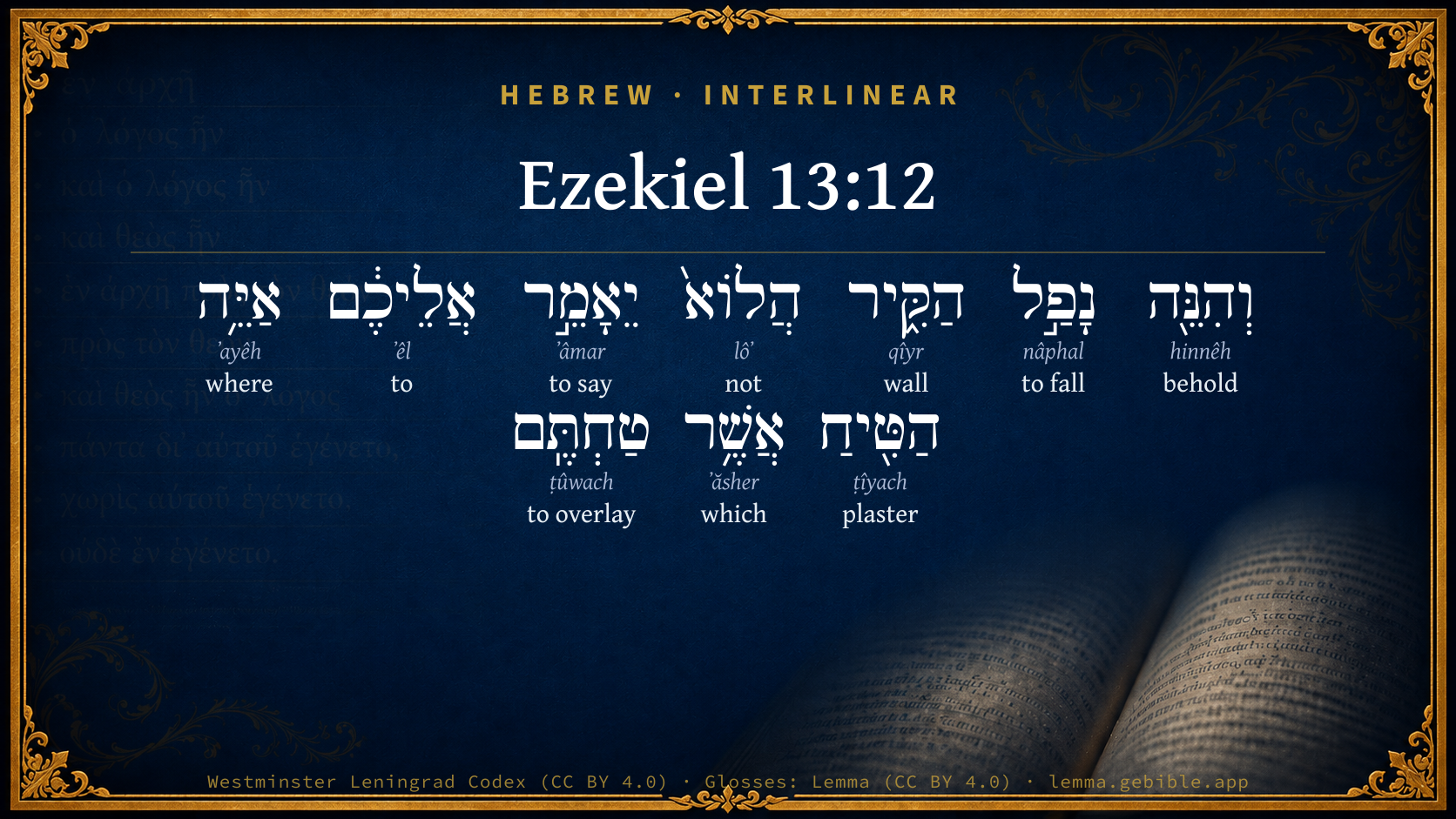
Hebrew (Westminster Leningrad Codex) Ezekiel 13:12 appears in the Hebrew Old Testament. The text above is from the Westminster Leningrad Codex. Each word links to its Strong’s number, a concise gloss, and parsing drawn from the Open Scriptures Hebrew Bible morphology. Click any word for its full Brown-Driver-Briggs (BDB) entry.
Download image
Cite this verse

Ezekiel 13:12 (World English Bible). Public Domain. Lemma interlinear Bible study tool, https://lemma.gebible.app/v/ezekiel/13/12.

Show BibTeX & RIS
BibTeX
RIS
English Translation
Behold, when the wall is fallen, shall it not be said to you, Where is the daubing with which you have daubed it?
World English Bible · Public Domain
Highlights
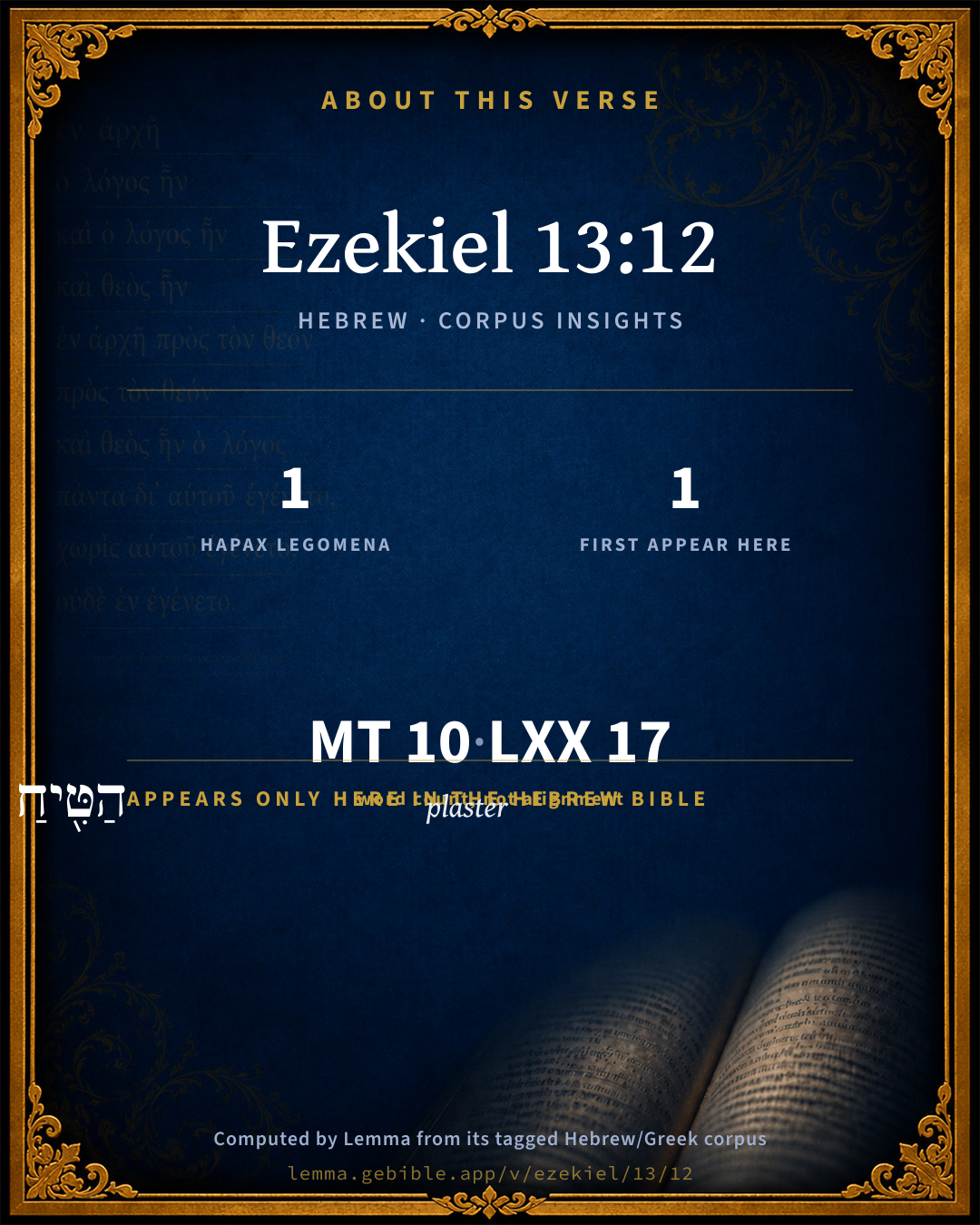
  • 1 hapax legomenon — only here in the Hebrew Bible
  • 1 first appearance in the Hebrew Bible
Full analysis ↓
Download a study sheet

One document with this verse’s original text, its word-by-word gloss line, the meaning frame, cross-references with their text, attributed commentary, and full source and license credits — printable, and it pastes into notes with its structure intact.

This verse Autodidact and up

Study sheet (.html) Plain text (.txt)

A passage Seminary Student

Up to 50 verses in one chapter. A passage sheet keeps up to 6 commentary sources and 12 cross-references per verse, in the order this page ranks them, and says so on the sheet whenever that leaves anything out. Ask for a single verse and you get the Autodidact verse sheet above.

Everything on this page stays free to read, with no account — the sheet is a download of what is already on screen, not access to it.

Want to remove ads? Support Godless Engineer
Compare translations 3

The same verse in 3 English versions, stacked beneath the original-language interlinear above. Click any original word for its lexicon entry.

Each is an independent rendering of the whole verse — the interlinear is not word-aligned to these translations.

Highlighted words mark where these versions differ — a whole-verse word diff, not a word-by-word alignment.

  • World English Bible Public Domain
    Behold, when the wall is fallen, shall it not be said to you, Where is the daubing with which you have daubed it?
  • King James Version Public Domain
    Lo, when the wall is fallen, shall it not be said unto you, Where is the daubing wherewith ye have daubed it?
  • unfoldingWord Literal Text CC BY-SA 4.0
    See, the wall will fall down. Have others not said to you, “Where is the whitewash that you put on it?”

unfoldingWord Literal Text — © unfoldingWord, licensed CC BY-SA 4.0. Word-aligned USFM3 via Door43 (git.door43.org/unfoldingWord/en_ult).

Versions to compare (up to 4)

3 of 4 selected

Show all 18 translations

Every available English version of this verse, each an independent rendering of the whole verse.

  • World English Bible Public Domain
    Behold, when the wall is fallen, shall it not be said to you, Where is the daubing with which you have daubed it?
  • Berean Standard Bible Public Domain
    Surely when the wall has fallen, you will not be asked, ‘Where is the whitewash with which you covered it?’
  • Majority Standard Bible Public Domain
    Surely when the wall has fallen, you will not be asked, ‘Where is the whitewash with which you covered it?’
  • King James Version Public Domain
    Lo, when the wall is fallen, shall it not be said unto you, Where is the daubing wherewith ye have daubed it?
  • American Standard Version (1901) Public Domain
    Lo, when the wall is fallen, shall it not be said unto you, Where is the daubing wherewith ye have daubed it?
  • Revised Version (1885) Public Domain
    Lo, when the wall is fallen, shall it not be said unto you, Where is the daubing wherewith ye have daubed it?
  • Geneva Bible (1599) Public Domain
    Lo, when the wall is fallen, shall it not bee sayd vnto you, Where is the daubing wherewith ye haue daubed it?
  • Douay-Rheims (1899) Public Domain
    Behold, when the wall is fallen: shall it not be said to you: Where is the daubing wherewith you have daubed it?
  • Young's Literal Translation Public Domain
    And lo, fallen hath the wall! Doth not one say unto you, Where `is' the daubing that ye daubed?
  • Literal Standard Version CC BY-SA 4.0
    And behold, the wall has fallen! Does one not say to you, Where [is] the coating that you coated?
  • Unlocked Literal Bible CC BY-SA 4.0
    See, the wall will fall down. Have others not said to you, “Where is the whitewash that you put on it?”
  • unfoldingWord Literal Text CC BY-SA 4.0
    See, the wall will fall down. Have others not said to you, “Where is the whitewash that you put on it?”
  • Darby Bible Public Domain
    And lo, when the wall is fallen, shall it not be said unto you, Where is the daubing with which ye have daubed [it]?
  • World Messianic Bible Public Domain
    Behold, when the wall has fallen, won’t it be said to you, “Where is the plaster with which you have plastered it?”
  • Webster's Bible Public Domain
    Lo, when the wall hath fallen, shall it not be said to you, Where is the daubing with which ye have daubed it?
  • Free Bible Version CC BY-SA 4.0
    Don't you think that when the wall collapses people are going to ask you, ‘What happened to the whitewash you painted it with?’
  • Bible in Basic English Public Domain
    And when the wall has come down, will they not say to you, Where is the whitewash which you put on it?
  • JPS Tanakh (1917) Public Domain
    and, lo, when the wall is fallen, shall it not be said unto you: Where is the daubing wherewith ye have daubed it?

Literal Standard Version (2020), Covenant Press — licensed CC BY-SA 4.0. Text via the HelloAO Bible API (eBible.org). Unlocked Literal Bible (unfoldingWord) — licensed CC BY-SA 4.0. Text via the HelloAO Bible API (eBible.org). unfoldingWord Literal Text — © unfoldingWord, licensed CC BY-SA 4.0. Word-aligned USFM3 via Door43 (git.door43.org/unfoldingWord/en_ult). Free Bible Version, Dr. Jonathan Gallagher — licensed CC BY-SA 4.0. Text via the HelloAO Bible API (eBible.org).

Word by word

More ways to search: Search by grammar → Find every occurrence → Compare this word →

Practice this passage: Drill this verse → Learn its vocabulary →

הַטִּ֖יחַ
ṭîyach
H2915
“the · plaster”
Particle, Definite Article + Noun, Common, Masculine, Singular, Absolute
Part of Speech
Particle + Noun
Type
Common
Gender
Masculine
Number
Singular
State
Absolute
Full BDB Definition

Origin: from (the equiv. of) H2902

TWOT: 795a

a coating, plaster
  1. וְהִנֵּ֖ה hinnêh H2009 “and · behold” Conjunction + Particle, Demonstrative
  2. נָפַ֣ל nâphal H5307 “to fall” Verb, Qal, Perfect, 3rd Person, Masculine, Singular
  3. הַקִּ֑יר qîyr H7023 “the · wall” Particle, Definite Article + Noun, Common, Masculine, Singular, Absolute
  4. הֲלוֹא֙ lôʼ H3808 “not” Particle, Interrogative + Particle, Negative
  5. יֵאָמֵ֣ר ʼâmar H559 “to say” Verb, Niphal, Imperfect, 3rd Person, Masculine, Singular
  6. אֲלֵיכֶ֔ם ʼêl H413 “to · you” Preposition + Suffix, Personal, 2nd Person, Masculine, Plural
  7. אַיֵּ֥ה ʼayêh H346 “where” Particle, Interrogative
  8. אֲשֶׁ֥ר ʼăsher H834 “which” Particle, Relative
  9. טַחְתֶּֽם ṭûwach H2902 “to overlay” Verb, Qal, Perfect, 2nd Person, Masculine, Plural

About this verse

These counts appear in no published source. They are computed here, from the morphology-tagged text and Lemma’s own curated glosses. What Lemma adds →

10
words
10
distinct lemmas
Prophets
section

Notable vocabulary

1 hapax legomenon — a word that appears only here in the entire Hebrew Bible:

  • הַטִּ֖יחַ plaster H2915

First appearance in Scripture

This word makes its first canonical appearance in the Hebrew Bible here:

  • הַטִּ֖יחַ plaster H2915

Shared distinctive vocabulary

טַחְתֶּֽם to overlay H2902 occurs in 11 verses of the Hebrew Bible. Also found in:

Grammatical profile

  • 3 verbs
  • 2 nouns
  • 1 preposition
  • 4 particles

Verb forms

  • נָפַ֣ל Qal · Perfect
  • יֵאָמֵ֣ר Niphal · Imperfect
  • טַחְתֶּֽם Qal · Perfect

Hebrew & Septuagint length

In English translation the verse runs 23 words from the Hebrew and 21 from the Septuagint (LXX English) — closely comparable.

A rough comparison of the two English renderings, which tokenize alike — not a word-level alignment.

Word counts can differ between the Hebrew and the Greek without any difference in meaning — e.g. the Hebrew direct-object marker אֵת has no separate Greek word, and Greek often adds the article ὁ.

In the original languages it is 10 Hebrew tokens and 17 Greek tokens — but the two are counted differently (Hebrew bundles its prefixes and suffixes into one token; the Greek is in lemma form), so that isn’t a like-for-like length.

Cross-references

8

Topical passages linked to Ezekiel 13:12 in the Treasury of Scripture Knowledge — connected by theme and wording, ordered by reader-vote popularity; previews shown in the World English Bible.

  • Deuteronomy 32:37 He will say, Where are their gods, The rock in which they took refuge;
  • Judges 9:38 Then said Zebul to him, Where is now your mouth, that you said, Who is Abimelech, that we should serve him? is not this the people that you have despised? go out now, I pray, and fight with them.
  • Judges 10:14 Go and cry to the gods which you have chosen; let them save you in the time of your distress.
  • 2 Kings 3:13 Elisha said to the king of Israel, What have I to do with you? get you to the prophets of your father, and to the prophets of your mother. The king of Israel said to him, No; for Yahweh has called these three kings together to deliver them into the hand of Moab.
  • Jeremiah 2:28 But where are your gods that you have made you? let them arise, if they can save you in the time of your trouble: for according to the number of your cities are your gods, Judah.
  • Jeremiah 29:31–32 Send to all them of the captivity, saying, Thus says Yahweh concerning Shemaiah the Nehelamite: Because Shemaiah has prophesied to you, and I didn't send him, and he has caused you to trust in a lie;
  • Jeremiah 37:19 Where now are your prophets who prophesied to you, saying, The king of Babylon shall not come against you, nor against this land?
  • Lamentations 2:14–15 Your prophets have seen for you false and foolish visions; They have not uncovered your iniquity, to bring back your captivity, But have seen for you false oracles and causes of banishment.

Cross-references courtesy of OpenBible.info (CC BY 4.0).

Hebrew and Greek witnesses Masoretic Hebrew ↔ Greek Septuagint

The same verse in the two great witnesses to the Old Testament, shown verse-for-verse.

These are two independent witnesses, not word-aligned to each other, and the Septuagint is shown in lemma (dictionary) form.

Hebrew Ezekiel 13:12 Masoretic · Westminster Leningrad Codex

וְהִנֵּ֖ה נָפַ֣ל הַקִּ֑יר הֲלוֹא֙ יֵאָמֵ֣ר אֲלֵיכֶ֔ם אַיֵּ֥ה הַטִּ֖יחַ אֲשֶׁ֥ר טַחְתֶּֽם

Behold, when the wall is fallen, shall it not be said to you, Where is the daubing with which you have daubed it?

World English Bible · Public Domain

Greek LXX Ezekiel 13:12 Septuagint · lemma form

καί ἰδού πίπτω ὁ τοῖχος καί οὐ εἶπον πρός σύ ποῦ εἰμί ὁ ἀλοιφή σύ ὅς ἀλείφω

And behold! the wall has fallen; and will they not say to you, Where is your plaster wherewith you⌃ plastered it?

LXX2012 (modern English Septuagint) · Public Domain

Hebrew: Westminster Leningrad Codex (CC BY 4.0). Greek: Septuagint (public domain); English from LXX2012 (modern English Septuagint) (Public Domain). How the Septuagint differs from the Hebrew →

Targum (Aramaic paraphrase)

1

The Targum is the ancient Jewish Aramaic paraphrase of the Hebrew Scriptures — an interpretive translation, not the Hebrew text itself. Onkelos (literal) and Pseudo-Jonathan (expansive) render the Torah, and Jonathan the Prophets. Coverage is partial: where no permissively-licensed English translation exists for a verse, only the Aramaic is shown. This is verse-level text, not a word-by-word alignment to the Hebrew.

  1. Targum Jonathan Prophets (Joshua–Malachi)
    וְהָא נְפַל כָּתְלָא הֲלָא יִתְאֲמַר לְכוֹן אָן שִׁיעָא דְשַׁעְתּוּן:

    (no public-domain English translation for this verse)

    Targum Jonathan — Aramaic: “Mikraot Gedolot” (public domain). English: “Sefaria Community Translation” (CC0 1.0 (public-domain dedication)); “London "Chaldee Paraphrase," 1871” (public domain). Text via Sefaria.

Commentary

Notes on Ezekiel 13:12 from classic Christian and Jewish commentators (each source and its license shown beneath its notes). The classic Christian expositions comment on the surrounding passage and are grouped to its opening verse, so a note may address several verses; the Jewish commentaries on the Tanakh (Rashi and others) are per-verse, so they appear only where the commentator wrote on this verse.

Lemma curates 59 commentaries, every one of them public domain or Creative Commons licensed, each selected and text-cleaned for this edition rather than reprinted as found. About our sources →

Trapp's Complete Commentary

John Trapp

Eze 13:12 Lo, when the wall is fallen, shall it not be said unto you, Where [is] the daubing wherewith ye have daubed [it]?

Ver. 12. Lo, when the wall is fallen.] As fall it will, and with a force, because made of ill mortar; and they that stand under it for shelter shall perish, as did sometimes seven and twenty thousand of Benhadad’s men in Aphek. Vocat autem eloquentiara secularem et rhetoricam inanem, lutum sine palea, &c., saith Oecolampadius here - i.e., by untempered mortar is meant worldly eloquence and empty rhetoric in sermons; this is as sand without lime, or as lime without litter, hair, chaff, or the like stuff to hold it together.

Where is the daubing?] What is your false doctrine come to? your work is lost, if not your souls. {1Co 3:15}

John Trapp, A Commentary or Exposition upon All the Books of the Old and New Testament (1647–1656) — public domain. Text from a community e-Sword module.

Jamieson, Fausset & Brown

Robert Jamieson, A. R. Fausset & David Brown

shall it not be said--Your vanity and folly shall be so manifested that it shall pass into a proverb, "Where is the daubing?"

Jamieson, Fausset & Brown — Commentary Critical and Explanatory on the Whole Bible (1871) — public domain (CC PDM 1.0). Text via the HelloAO Bible API.

John Calvin's Commentaries

He confirms the last sentence, namely, that the false prophets would be a laughing-stock to all when their prophecies and divinations came to nothing, for the event would show them to be liars. For when the city was taken it sufficiently appeared that they were the devil’s ministers of deceit, for they were trained in wickedness and boldness when they put forth the name of God. Now the Prophet teaches that a common proverb would arise when the wall fell; for by saying, shall it not be said to them, he signifies that their folly and vanity would be completely exposed, so that this proverb should be everywhere current — where is the daubing with which you daubed it? It follows —

John Calvin's Commentaries (1540-1563) — public domain. Text from the Calvin Translation Society English edition (1840s-50s) via the Christian Classics Ethereal Library (ccel.org). Calvin's coverage is partial (roughly two-thirds of the Bible); uncommented books and verses are honest gaps, never fabricated. The 19th-century editor's footnotes and remarks are omitted so the notes are faithfully Calvin's own voice.

Ellicott's Commentary for English Readers

(12) Where is the daubing?—The basis of all their false prophesying being destroyed by the coming judgments, the folly and falsehood of their words would be exposed to the eyes of all. As it is said in Eze_13:14, the wall itself being thrown down to its very foundation, they who have tried to make the people trust in it shall be overwhelmed in its ruin.

A Bible Commentary for English Readers, edited by Charles John Ellicott (1878–1897) — public domain. Text from a community e-Sword module.

The Cambridge Bible for Schools and Colleges

gen. ed. J. J. S. Perowne

12. Confusion of the false prophets.

The Cambridge Bible for Schools and Colleges (gen. ed. J. J. S. Perowne; Cambridge University Press, 1878–1918) — public domain. Text from a community e-Sword module.

John Gill's Exposition

So will I break down the wall that ye have daubed with untempered mortar,.... Which is repeated and expressed in these words, both for the sake of confirmation and explanation of what is before said:

and bring it down to the ground, so that the foundation thereof shall be discovered; meaning the city of Jerusalem, and by these phrases declaring the utter destruction of it; whereby also would be discovered the vain assurances and lying predictions of the false prophets, and which would appear to be entirely groundless: so the Targum,

"and I will destroy the city in which ye have prophesied false prophecies; and I will cause it to fall to the ground, and its foundations shall be discovered:''

and it shall fall, and ye shall be consumed in the midst of it; the false prophets perished in the destruction of Jerusalem, and not one of them escaped:

and ye shall know that I am the Lord; who is true to his word, and able to accomplish it, whether of punishment or of threatening.

John Gill's Exposition of the Whole Bible (1746–1763) — public domain (CC PDM 1.0). Text via the HelloAO Bible API.

Matthew Poole's English Annotations

Will not men thenceforth laugh you to scorn? you that built, you that daubed, you that applauded the wall, will they not upbraid you with your folly?

Matthew Poole's English Annotations on the Holy Bible (1683–1685) — public domain. Text from a community e-Sword/MySword module.

Whedon's Commentary on the Bible

Daniel D. Whedon

12. Where is the daubing — Without God and holiness the defenses of the city are rotten, and the prophet’s work is but the veneer which shall make the wreck more conspicuous. Many a weak place may be hidden from men’s eyes by the prophet’s brush, but when God blows against it with his mighty wind there is no daubing of cracks that can save it.

Daniel D. Whedon (gen. ed.), Commentary on the Old and New Testaments (1874–1909) — public domain. Text from a community e-Sword module.

Rashi

Rabbi Shlomo Yitzchaki (Rashi)

Where is the plaster When the calamity comes, such will be said to you: “Where is the peace that you promised?”

Rashi on the Tanakh — English translations: “The Judaica Press complete Tanach with Rashi, translated by A. J. Rosenberg” (CC BY 4.0); “Pentateuch with Rashi's commentary by M. Rosenbaum and A.M. Silbermann, 1929-1934” (public domain); “The Metsudah Tanach series, Lakewood, N.J” (CC BY 4.0); and “The Book of Joshua, Metsudah Publications, 1997” (CC BY 4.0). Text via Sefaria.

Lesson kit

Teaching starters — assembled from the data on this page, not authored interpretation. Every prompt links to the verse data it draws on. Edit before teaching.

Ezekiel, in the Prophets, opens this verse with 10 words (10 distinct Hebrew lemmas). Its most distinctive word is ṭîyach (“plaster”). A historical commentator’s framing appears above. Read the whole chapter for the surrounding context.

Discussion questions

  1. What does “plaster” (ṭîyach) contribute to the verse as a whole?
  2. This verse holds 1 word here found nowhere else in the Hebrew Bible. What might the rare word draw attention to?
  3. The word “plaster” first appears here in Scripture. What is being introduced at this debut?
  4. Leviticus 14:42 shares the word «to overlay» with this verse. How do the two illuminate each other?
  5. The translations on this page render this verse differently — a whole-verse word diff, not a word-by-word alignment. What might account for the different wordings?
  6. The verb «נָפַ֣ל» is Qal Perfect. How does its form color the action?
  7. Reading how Trapp's Complete Commentary and Jamieson, Fausset & Brown read this verse, where do the two commentators agree and where do they part?

Things to notice

Reading settings

Reading text

Shown beneath each verse's original-language words.

Old Testament
Old Testament edition

Read the OT as the Masoretic Hebrew (MT) or the Greek Septuagint (LXX).

English shown for the Greek Septuagint (in the Hebrew ↔ Greek comparison).

Comparing translations? Open the Compare panel on any verse page to stack up to four side by side.