Judges 9:40

Hebrew (Westminster Leningrad Codex) Judges 9:40 appears in the Hebrew Old Testament. The text above is from the Westminster Leningrad Codex. Each word links to its Strong’s number, a concise gloss, and parsing drawn from the Open Scriptures Hebrew Bible morphology. Click any word for its full Brown-Driver-Briggs (BDB) entry.
Download image
Cite this verse

Judges 9:40 (World English Bible). Public Domain. Lemma interlinear Bible study tool, https://lemma.gebible.app/v/judges/9/40.

Show BibTeX & RIS
BibTeX
RIS
English Translation
Abimelech chased him, and he fled before him, and there fell many wounded, even to the entrance of the gate.
World English Bible · Public Domain
Download a study sheet

One document with this verse’s original text, its word-by-word gloss line, the meaning frame, cross-references with their text, attributed commentary, and full source and license credits — printable, and it pastes into notes with its structure intact.

This verse Autodidact and up

Study sheet (.html) Plain text (.txt)

A passage Seminary Student

Up to 50 verses in one chapter. A passage sheet keeps up to 6 commentary sources and 12 cross-references per verse, in the order this page ranks them, and says so on the sheet whenever that leaves anything out. Ask for a single verse and you get the Autodidact verse sheet above.

Everything on this page stays free to read, with no account — the sheet is a download of what is already on screen, not access to it.

Want to remove ads? Support Godless Engineer
Compare translations 3

The same verse in 3 English versions, stacked beneath the original-language interlinear above. Click any original word for its lexicon entry.

Each is an independent rendering of the whole verse — the interlinear is not word-aligned to these translations.

Highlighted words mark where these versions differ — a whole-verse word diff, not a word-by-word alignment.

  • World English Bible Public Domain
    Abimelech chased him, and he fled before him, and there fell many wounded, even to the entrance of the gate.
  • King James Version Public Domain
    And Abimelech chased him, and he fled before him, and many were overthrown and wounded, even unto the entering of the gate.
  • unfoldingWord Literal Text CC BY-SA 4.0
    And Abimelech pursued him, and he fled from his face. And many wounded fell, up to the entrance of the gate.

unfoldingWord Literal Text — © unfoldingWord, licensed CC BY-SA 4.0. Word-aligned USFM3 via Door43 (git.door43.org/unfoldingWord/en_ult).

Versions to compare (up to 4)

3 of 4 selected

Show all 18 translations

Every available English version of this verse, each an independent rendering of the whole verse.

  • World English Bible Public Domain
    Abimelech chased him, and he fled before him, and there fell many wounded, even to the entrance of the gate.
  • Berean Standard Bible Public Domain
    but Abimelech pursued him, and Gaal fled before him. And many Shechemites fell wounded all the way to the entrance of the gate.
  • Majority Standard Bible Public Domain
    but Abimelech pursued him, and Gaal fled before him. And many Shechemites fell wounded all the way to the entrance of the gate.
  • King James Version Public Domain
    And Abimelech chased him, and he fled before him, and many were overthrown and wounded, even unto the entering of the gate.
  • American Standard Version (1901) Public Domain
    And Abimelech chased him, and he fled before him, and there fell many wounded, even unto the entrance of the gate.
  • Revised Version (1885) Public Domain
    And Abimelech chased him, and he fled before him, and there fell many wounded, even unto the entering of the gate.
  • Geneva Bible (1599) Public Domain
    But Abimelech pursued him, and he fledde before him, and many were ouerthrowen and wounded, euen vnto the entring of the gate.
  • Douay-Rheims (1899) Public Domain
    Who chased and put him to flight, and drove him to the city: and many were slain of his people, even to the gate of the city:
  • Young's Literal Translation Public Domain
    and Abimelech pursueth him, and he fleeth from his presence, and many fall wounded -- unto the opening of the gate.
  • Literal Standard Version CC BY-SA 4.0
    and Abimelech pursues him, and he flees from his presence, and many fall wounded—to the opening of the gate.
  • Unlocked Literal Bible CC BY-SA 4.0
    Abimelech chased him, and Gaal fled before him. Many fell with deadly wounds before the entrance to the city gate.
  • unfoldingWord Literal Text CC BY-SA 4.0
    And Abimelech pursued him, and he fled from his face. And many wounded fell, up to the entrance of the gate.
  • Darby Bible Public Domain
    And Abim'elech chased him, and he fled before him; and many fell wounded, up to the entrance of the gate.
  • World Messianic Bible Public Domain
    Abimelech chased him, and he fled before him, and many fell wounded, even to the entrance of the gate.
  • Webster's Bible Public Domain
    And Abimelech chased him, and he fled before him, and many were overthrown and wounded, even to the entrance of the gate.
  • Free Bible Version CC BY-SA 4.0
    Abimelech attacked, and chased him and his men as they ran away, killing many of them as they tried to get back to the town gate.
  • Bible in Basic English Public Domain
    And Abimelech went after him and he went in flight before him; and a great number were falling by the sword all the way up to the town.
  • JPS Tanakh (1917) Public Domain
    And Abimelech chased him, and he fled before him, and there fell many wounded, even unto the entrance of the gate.

Literal Standard Version (2020), Covenant Press — licensed CC BY-SA 4.0. Text via the HelloAO Bible API (eBible.org). Unlocked Literal Bible (unfoldingWord) — licensed CC BY-SA 4.0. Text via the HelloAO Bible API (eBible.org). unfoldingWord Literal Text — © unfoldingWord, licensed CC BY-SA 4.0. Word-aligned USFM3 via Door43 (git.door43.org/unfoldingWord/en_ult). Free Bible Version, Dr. Jonathan Gallagher — licensed CC BY-SA 4.0. Text via the HelloAO Bible API (eBible.org).

Word by word

More ways to search: Search by grammar → Find every occurrence → Compare this word →

Practice this passage: Drill this verse → Learn its vocabulary →

אֲבִימֶ֔לֶךְ
ʼĂbîymelek
H40
“Abimelech”
Noun, Proper
Part of Speech
Noun
Type
Proper
Full BDB Definition

Origin: from H1 and H4428

TWOT: None

Abimelech = "Melek is father" or " my father is king" - king of Gerar in Abraham's time - king of Gath in David's time; maybe title of Philistine kings - son of Gideon by a concubine - priest, son of Abiathar
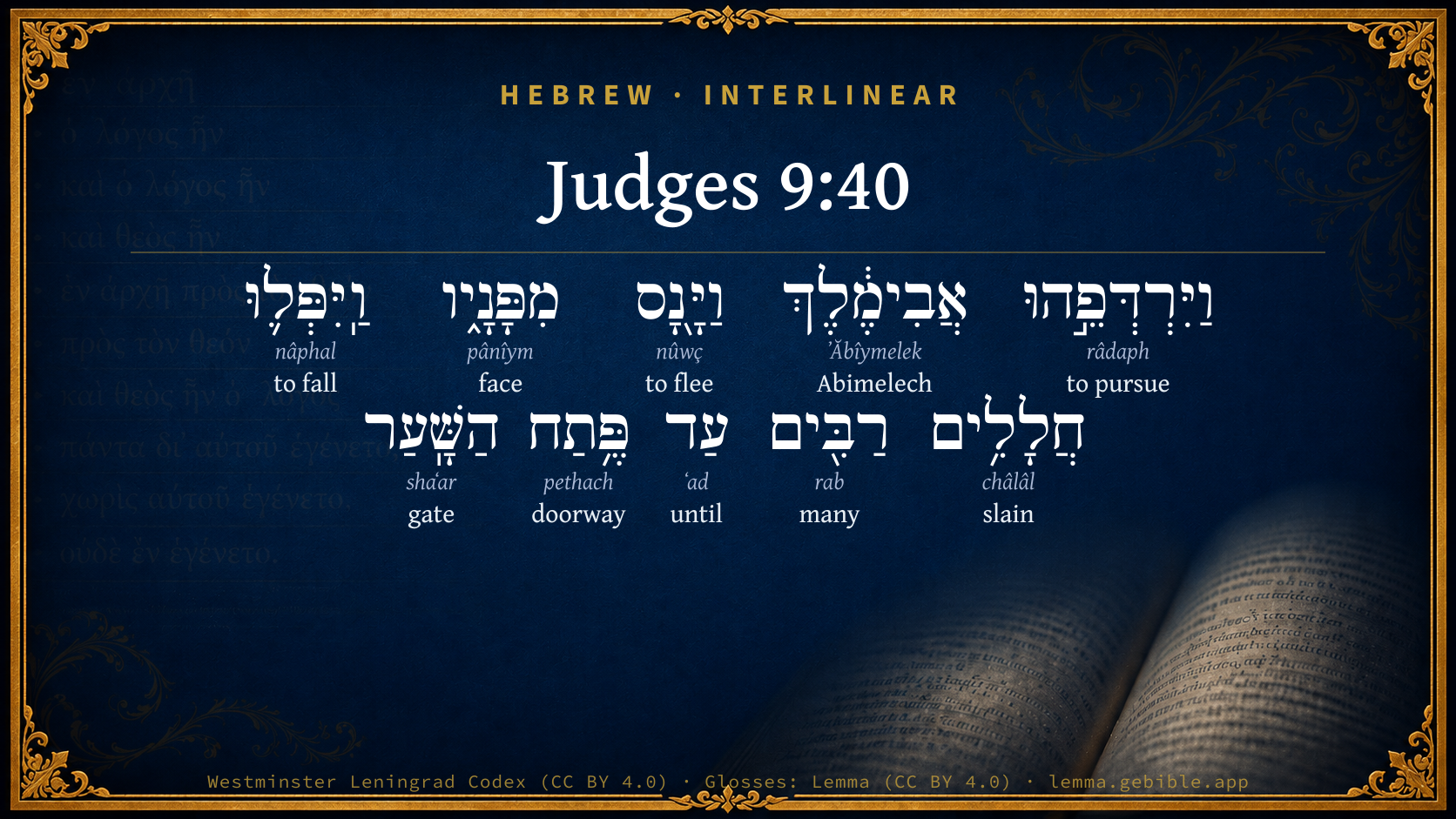
  1. וַיִּרְדְּפֵ֣הוּ râdaph H7291 “and · to pursue · him” Conjunction + Verb, Qal, Sequential Imperfect, 3rd Person, Masculine, Singular + Suffix, Personal, 3rd Person, Masculine, Singular
  2. וַיָּ֖נָס nûwç H5127 “and · to flee” Conjunction + Verb, Qal, Sequential Imperfect, 3rd Person, Masculine, Singular
  3. מִפָּנָ֑יו pânîym H6440 “from · face(s) · his” Preposition + Noun, Common, Both, Plural, Construct + Suffix, Personal, 3rd Person, Masculine, Singular
  4. וַֽיִּפְּל֛וּ nâphal H5307 “and · to fall” Conjunction + Verb, Qal, Sequential Imperfect, 3rd Person, Masculine, Plural
  5. חֲלָלִ֥ים châlâl H2491 “slain” Adjective, Adjective, Masculine, Plural, Absolute
  6. רַבִּ֖ים rab H7227 “many” Adjective, Adjective, Masculine, Plural, Absolute
  7. עַד ʻad H5704 “until” Preposition
  8. פֶּ֥תַח pethach H6607 “doorway of” Noun, Common, Masculine, Singular, Construct
  9. הַשָּֽׁעַר shaʻar H8179 “the · gate” Particle, Definite Article + Noun, Common, Masculine, Singular, Absolute

About this verse

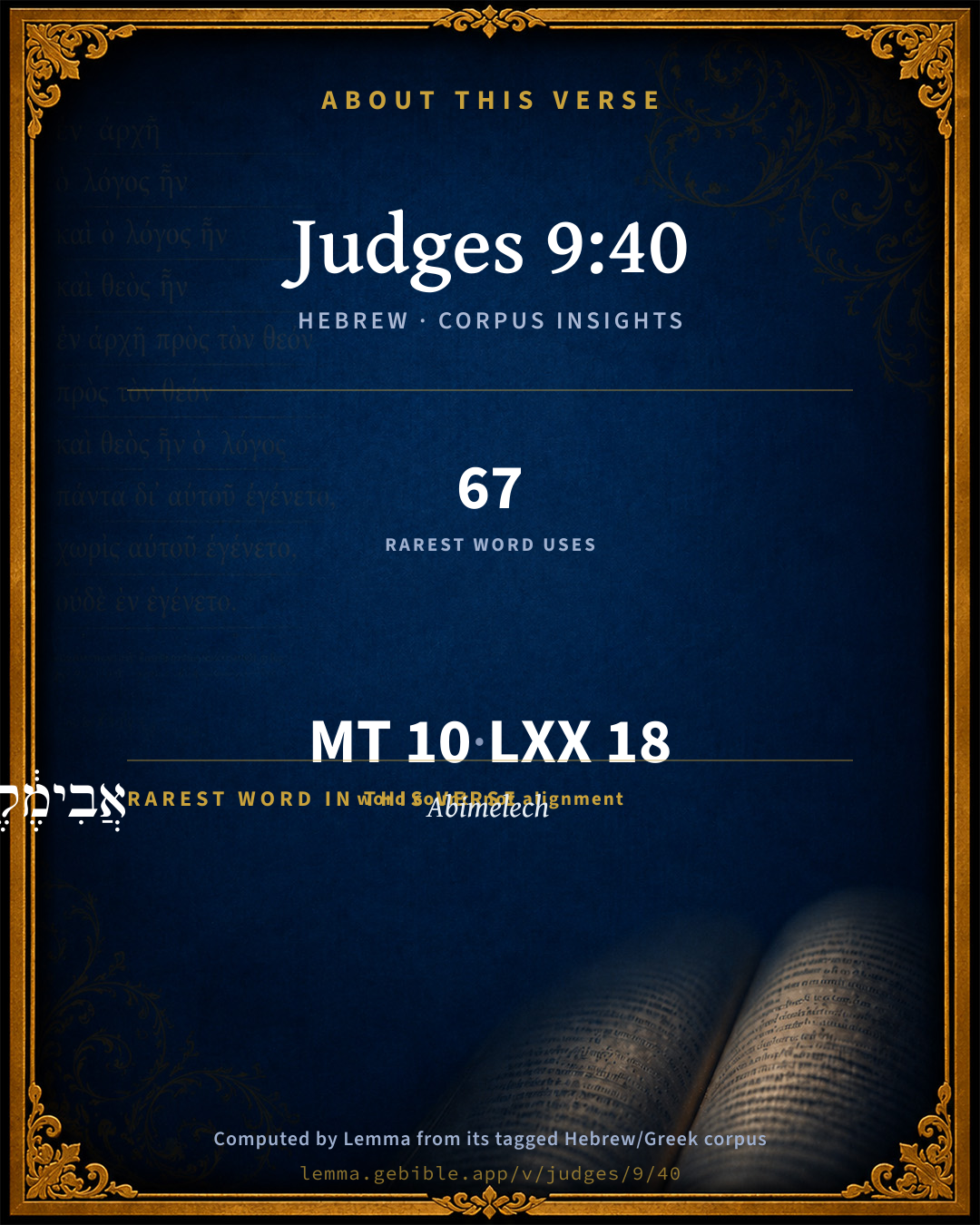
These counts appear in no published source. They are computed here, from the morphology-tagged text and Lemma’s own curated glosses. What Lemma adds →

10
words
10
distinct lemmas
Historical
section

Grammatical profile

  • 3 verbs
  • 4 nouns
  • 2 adjectives
  • 1 preposition

Verb forms

  • וַיִּרְדְּפֵ֣הוּ Qal · Sequential Imperfect
  • וַיָּ֖נָס Qal · Sequential Imperfect
  • וַֽיִּפְּל֛וּ Qal · Sequential Imperfect

Hebrew & Septuagint length

In English translation the verse runs 20 words from the Hebrew and 23 from the Septuagint (LXX English) — closely comparable.

A rough comparison of the two English renderings, which tokenize alike — not a word-level alignment.

Word counts can differ between the Hebrew and the Greek without any difference in meaning — e.g. the Hebrew direct-object marker אֵת has no separate Greek word, and Greek often adds the article ὁ.

In the original languages it is 10 Hebrew tokens and 18 Greek tokens — but the two are counted differently (Hebrew bundles its prefixes and suffixes into one token; the Greek is in lemma form), so that isn’t a like-for-like length.

Cross-references

2

Topical passages linked to Judges 9:40 in the Treasury of Scripture Knowledge — connected by theme and wording, ordered by reader-vote popularity; previews shown in the World English Bible.

  • 1 Kings 20:18–21 He said, Whether they are come out for peace, take them alive, or whether they are come out for war, taken them alive.
  • 1 Kings 20:30 But the rest fled to Aphek, into the city; and the wall fell on twenty-seven thousand men who were left. Ben Hadad fled, and came into the city, into an inner chamber.

Cross-references courtesy of OpenBible.info (CC BY 4.0).

Hebrew and Greek witnesses Masoretic Hebrew ↔ Greek Septuagint

The same verse in the two great witnesses to the Old Testament, shown verse-for-verse.

These are two independent witnesses, not word-aligned to each other, and the Septuagint is shown in lemma (dictionary) form.

Hebrew Judges 9:40 Masoretic · Westminster Leningrad Codex

וַיִּרְדְּפֵ֣הוּ אֲבִימֶ֔לֶךְ וַיָּ֖נָס מִפָּנָ֑יו וַֽיִּפְּל֛וּ חֲלָלִ֥ים רַבִּ֖ים עַד פֶּ֥תַח הַשָּֽׁעַר

Abimelech chased him, and he fled before him, and there fell many wounded, even to the entrance of the gate.

World English Bible · Public Domain

Greek LXX Judges 9:40 Septuagint · lemma form

καί διώκω αὐτός αβιμελεχ καί φεύγω ἀπό πρόσωπον αὐτός καί πίπτω τραυματίας πολύς ἕως ὁ θύρα ὁ πύλη

And Abimelech pursued him, and he fled from before him; and many fell down slain as far as the door of the gate.

LXX2012 (modern English Septuagint) · Public Domain

Hebrew: Westminster Leningrad Codex (CC BY 4.0). Greek: Septuagint (public domain); English from LXX2012 (modern English Septuagint) (Public Domain). How the Septuagint differs from the Hebrew →

Targum (Aramaic paraphrase)

1

The Targum is the ancient Jewish Aramaic paraphrase of the Hebrew Scriptures — an interpretive translation, not the Hebrew text itself. Onkelos (literal) and Pseudo-Jonathan (expansive) render the Torah, and Jonathan the Prophets. Coverage is partial: where no permissively-licensed English translation exists for a verse, only the Aramaic is shown. This is verse-level text, not a word-by-word alignment to the Hebrew.

  1. Targum Jonathan Prophets (Joshua–Malachi)
    וְרַדְפֵיהּ אֲבִימֶלֶךְ וְאַפַּךְ מִן קֳדָמוֹהִי וּנְפַלוּ קְטוֹלִין סַגִיאִין עַד מַעֲלָנָא דְתַרְעָא:

    (no public-domain English translation for this verse)

    Targum Jonathan — Aramaic: “Mikraot Gedolot” (public domain). English: “Sefaria Community Translation” (CC0 1.0 (public-domain dedication)); “London "Chaldee Paraphrase," 1871” (public domain). Text via Sefaria.

Commentary

Notes on Judges 9:40 from classic Christian and Jewish commentators (each source and its license shown beneath its notes). The classic Christian expositions comment on the surrounding passage and are grouped to its opening verse, so a note may address several verses; the Jewish commentaries on the Tanakh (Rashi and others) are per-verse, so they appear only where the commentator wrote on this verse.

Lemma curates 59 commentaries, every one of them public domain or Creative Commons licensed, each selected and text-cleaned for this edition rather than reprinted as found. About our sources →

Trapp's Complete Commentary

John Trapp

Jdg 9:40 And Abimelech chased him, and he fled before him, and many were overthrown [and] wounded, [even] unto the entering of the gate.

Ver. 40. And he fled before him.] Notwithstanding his great brags and insolent challenge. Those who vaunt most have oft the least courage: as those creatures which have the greatest hearts of flesh are the most timorous, as the stag, panther, hare, {a} &c.

{a} Diod.

John Trapp, A Commentary or Exposition upon All the Books of the Old and New Testament (1647–1656) — public domain. Text from a community e-Sword module.

Ellicott's Commentary for English Readers

(40) Abimelech chased him . . .—He won a complete victory; but Gaal and his forces were able to secure themselves in Shechem. They succeeded in closing the gates against Abimelech, but only at the cost of many lives.

A Bible Commentary for English Readers, edited by Charles John Ellicott (1878–1897) — public domain. Text from a community e-Sword module.

The Cambridge Bible for Schools and Colleges

gen. ed. J. J. S. Perowne

40. wounded] i.e. mortally, so slain, 1Sa_31:1, 1Ch_5:22, 2Ch_13:17; cf. Jdg_16:24.

the entering of the gate] Cf. Jdg_9:44. The city gateway (sha‘ar) was a large building and covered a considerable space, cf. Jos_20:4, 1Ki_22:10; it included a high entrance (péthaḥ) and a door (déleth), or doors, with posts and bars, Jdg_16:3. Abimelech did not enter the city, probably because he thought that the Shechemites had been punished enough. Zebul was now in a position to deal with Gaal and his following, Jdg_9:41.

The Cambridge Bible for Schools and Colleges (gen. ed. J. J. S. Perowne; Cambridge University Press, 1878–1918) — public domain. Text from a community e-Sword module.

John Gill's Exposition

And Abimelech dwelt at Arumah,.... Called also Aarima as Jerom (l) says, and in his time called Remphtis; it seems to be not far off from Shechem, he returned to the place where he was before, see Jdg 9:31 contenting himself with the advantage he had got, and waiting when another opportunity would offer, which quickly did, to be revenged on the Shechemites:

and Zebul thrust out Gaal and his brethren, that they should not dwell in Shechem; there seems to have been two parties in Shechem before, one that hated Abimelech, and another more friendly to his interest; by which means Zebul his officer kept his post, and Gaal could not get the government into his hand; and now by the loss in the late battle, who were Abimelech's sworn enemies, and the disgrace Gaal fell into by being beaten, Zebul was able, so far able to carry his point, as to drive Gaul and his brethren out of the city; though he had not strength to put him to death, or to seize him and deliver him into the hands of Abimelech.

(l) De loc. Heb. fol. 94. B.

John Gill's Exposition of the Whole Bible (1746–1763) — public domain (CC PDM 1.0). Text via the HelloAO Bible API.

Matthew Poole's English Annotations

He fled before him; being surprised by the unexpected coming of Abimelech, and possibly not fully prepared for the encounter.

Many were overthrown and wounded, being pursued and overtaken by Abimelech.

Matthew Poole's English Annotations on the Holy Bible (1683–1685) — public domain. Text from a community e-Sword/MySword module.

The Pulpit Commentary

Were overthrown and wounded. The simple translation of the Hebrew is, and there fell many slain even unto the entering of the gate, showing that Abimelech"s men pursued them to the very gate of the city.

The Pulpit Commentary (1880–1919), ed. H.D.M. Spence-Jones & Joseph S. Exell — public domain. Text from a community e-Sword module.

John Wesley's Explanatory Notes

He fled - Being surprised by the unexpected coming of Abimelech, and probably not fully prepared for the encounter.

John Wesley, Explanatory Notes Upon the Whole Bible (1754–1765) — public domain. Text via the GEBible commentary corpus.

Lesson kit

Teaching starters — assembled from the data on this page, not authored interpretation. Every prompt links to the verse data it draws on. Edit before teaching.

Judges, in the Historical, opens this verse with 10 words (10 distinct Hebrew lemmas). Its most distinctive word is ʼĂbîymelek (“Abimelech”). A historical commentator’s framing appears above. Read the whole chapter for the surrounding context.

Discussion questions

  1. The word ʼĂbîymelek carries the sense “Abimelech.” How does it shape the verse?
  2. How does 1 Kings 20:18–21, which shares this passage’s theme, read alongside this verse?
  3. These translations render this verse differently; the difference is in the English rendering, not the original. What questions does that raise?
  4. «וַיִּרְדְּפֵ֣הוּ» is a Qal Sequential Imperfect verb. How does that grammatical form shape the action described?
  5. Compare how Trapp's Complete Commentary and Ellicott's Commentary for English Readers read this verse. Where do they agree or differ?

Things to notice

Reading settings

Reading text

Shown beneath each verse's original-language words.

Old Testament
Old Testament edition

Read the OT as the Masoretic Hebrew (MT) or the Greek Septuagint (LXX).

English shown for the Greek Septuagint (in the Hebrew ↔ Greek comparison).

Comparing translations? Open the Compare panel on any verse page to stack up to four side by side.