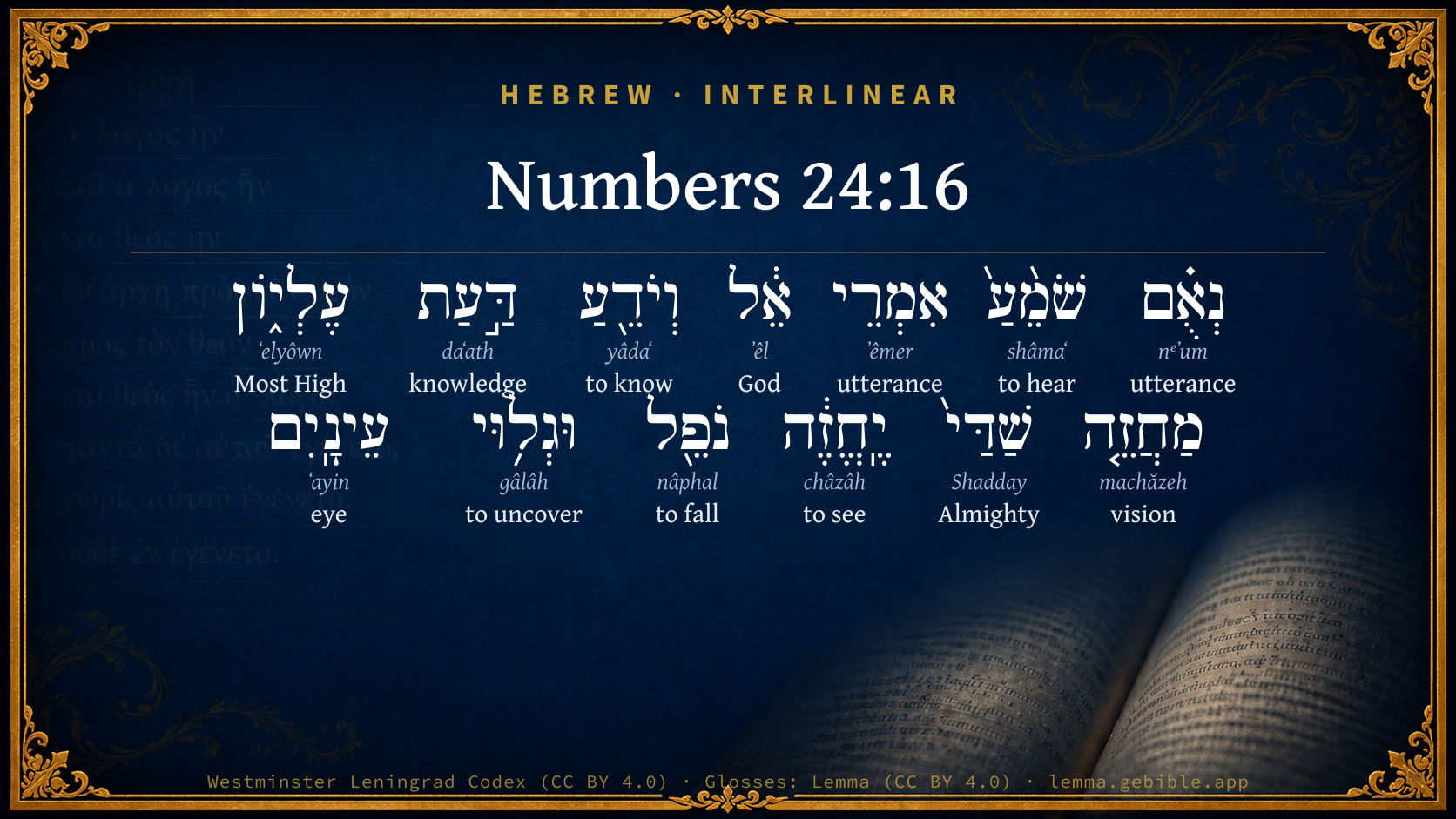
Numbers 24:16

Hebrew (Westminster Leningrad Codex) Numbers 24:16 appears in the Hebrew Old Testament. The text above is from the Westminster Leningrad Codex. Each word links to its Strong’s number, a concise gloss, and parsing drawn from the Open Scriptures Hebrew Bible morphology. Click any word for its full Brown-Driver-Briggs (BDB) entry.
Download image
Cite this verse

Numbers 24:16 (World English Bible). Public Domain. Lemma interlinear Bible study tool, https://lemma.gebible.app/v/numbers/24/16.

Show BibTeX & RIS
BibTeX
RIS
English Translation
He says, who hears the words of God, Knows the knowledge of the Most High, Who sees the vision of the Almighty, Falling down, and having his eyes open:
World English Bible · Public Domain
Download a study sheet

One document with this verse’s original text, its word-by-word gloss line, the meaning frame, cross-references with their text, attributed commentary, and full source and license credits — printable, and it pastes into notes with its structure intact.

This verse Autodidact and up

Study sheet (.html) Plain text (.txt)

A passage Seminary Student

Up to 50 verses in one chapter. A passage sheet keeps up to 6 commentary sources and 12 cross-references per verse, in the order this page ranks them, and says so on the sheet whenever that leaves anything out. Ask for a single verse and you get the Autodidact verse sheet above.

Everything on this page stays free to read, with no account — the sheet is a download of what is already on screen, not access to it.

Want to remove ads? Support Godless Engineer
Compare translations 3

The same verse in 3 English versions, stacked beneath the original-language interlinear above. Click any original word for its lexicon entry.

Each is an independent rendering of the whole verse — the interlinear is not word-aligned to these translations.

Highlighted words mark where these versions differ — a whole-verse word diff, not a word-by-word alignment.

  • World English Bible Public Domain
    He says, who hears the words of God, Knows the knowledge of the Most High, Who sees the vision of the Almighty, Falling down, and having his eyes open:
  • King James Version Public Domain
    He hath said, which heard the words of God, and knew the knowledge of the most High, which saw the vision of the Almighty, falling into a trance, but having his eyes open:
  • unfoldingWord Literal Text CC BY-SA 4.0
    the declaration of the hearer of the words of God, and the knower of the knowledge of the Most High, he sees the vision of the Almighty, falling down and opened of eyes:

unfoldingWord Literal Text — © unfoldingWord, licensed CC BY-SA 4.0. Word-aligned USFM3 via Door43 (git.door43.org/unfoldingWord/en_ult).

Versions to compare (up to 4)

3 of 4 selected

Show all 18 translations

Every available English version of this verse, each an independent rendering of the whole verse.

  • World English Bible Public Domain
    He says, who hears the words of God, Knows the knowledge of the Most High, Who sees the vision of the Almighty, Falling down, and having his eyes open:
  • Berean Standard Bible Public Domain
    the prophecy of one who hears the words of God, who has knowledge from the Most High, who sees a vision from the Almighty, who bows down with eyes wide open:
  • Majority Standard Bible Public Domain
    the prophecy of one who hears the words of God, who has knowledge from the Most High, who sees a vision from the Almighty, who bows down with eyes wide open:
  • King James Version Public Domain
    He hath said, which heard the words of God, and knew the knowledge of the most High, which saw the vision of the Almighty, falling into a trance, but having his eyes open:
  • American Standard Version (1901) Public Domain
    He saith, who heareth the words of God, And knoweth the knowledge of the Most High, Who seeth the vision of the Almighty, Falling down, and having his eyes open:
  • Revised Version (1885) Public Domain
    He saith, which heareth the words of God, And knoweth the knowledge of the Most High, Which seeth the vision of the Almighty, Falling down, and having his eyes open:
  • Geneva Bible (1599) Public Domain
    He hath said that heard the words of God, and hath the knowledge of the most High, and sawe the vision of the Almightie, and falling in a traunce had his eyes opened:
  • Douay-Rheims (1899) Public Domain
    The hearer of the words of God hath said, who knoweth the doctrine of the Highest, and seeth the visions of the Almighty, who falling hath his eyes opened:
  • Young's Literal Translation Public Domain
    An affirmation of him who is hearing sayings of God -- And knowing knowledge of the Most High; A vision of the Almighty he seeth, Falling -- and eyes uncovered:
  • Literal Standard Version CC BY-SA 4.0
    An affirmation of him who is hearing sayings of God, || And knowing knowledge of the Most High; He sees a vision of the Almighty, || Falling—and eyes uncovered:
  • Unlocked Literal Bible CC BY-SA 4.0
    This is a prophecy of someone who hears words from God, who has knowledge from the Most High, who has visions from the Almighty, Before whom he bows down with open eyes.
  • unfoldingWord Literal Text CC BY-SA 4.0
    the declaration of the hearer of the words of God, and the knower of the knowledge of the Most High, he sees the vision of the Almighty, falling down and opened of eyes:
  • Darby Bible Public Domain
    He saith, who heareth the words of ùGod, who knoweth the knowledge of the Most High, Who seeth the vision of the Almighty, who falleth down, and who hath his eyes open:
  • World Messianic Bible Public Domain
    he says, who hears the words of God, knows the knowledge of the Most High, and who sees the vision of the Almighty, falling down, and having his eyes open:
  • Webster's Bible Public Domain
    He hath said, who heard the words of God, and knew the knowledge of the Most High, who saw the vision of the Almighty, falling into a trance, but having his eyes open:
  • Free Bible Version CC BY-SA 4.0
    the prophecy of one who hears the words of God, who receives knowledge from the Most High, who sees the vision given by Almighty, who bows down in respect with open eyes.
  • Bible in Basic English Public Domain
    He says, whose ear is open to the words of God, who has knowledge of the Most High, who has seen the vision of the Ruler of all, falling down and having his eyes open:
  • JPS Tanakh (1917) Public Domain
    The saying of him who heareth the words of God, and knoweth the knowledge of the Most High, who seeth the vision of the Almighty, fallen down, yet with opened eyes:

Literal Standard Version (2020), Covenant Press — licensed CC BY-SA 4.0. Text via the HelloAO Bible API (eBible.org). Unlocked Literal Bible (unfoldingWord) — licensed CC BY-SA 4.0. Text via the HelloAO Bible API (eBible.org). unfoldingWord Literal Text — © unfoldingWord, licensed CC BY-SA 4.0. Word-aligned USFM3 via Door43 (git.door43.org/unfoldingWord/en_ult). Free Bible Version, Dr. Jonathan Gallagher — licensed CC BY-SA 4.0. Text via the HelloAO Bible API (eBible.org).

Word by word

More ways to search: Search by grammar → Find every occurrence → Compare this word →

Practice this passage: Drill this verse → Learn its vocabulary →

מַחֲזֵ֤ה
machăzeh
H4236
“vision of”
Noun, Common, Masculine, Singular, Construct
Part of Speech
Noun
Type
Common
Gender
Masculine
Number
Singular
State
Construct
Full BDB Definition

Origin: from H2372

TWOT: 633f

vision (in the ecstatic state)
  1. נְאֻ֗ם nᵉʼum H5002 “utterance of” Noun, Common, Masculine, Singular, Construct
  2. שֹׁמֵ֨עַ֙ shâmaʻ H8085 “hearing” Verb, Qal, Participle Active, Masculine, Singular, Absolute
  3. אִמְרֵי ʼêmer H561 “utterances of” Noun, Common, Masculine, Plural, Construct
  4. אֵ֔ל ʼêl H410 “God” Noun, Common, Masculine, Singular, Absolute
  5. וְיֹדֵ֖עַ yâdaʻ H3045 “and · knowing” Conjunction + Verb, Qal, Participle Active, Masculine, Singular, Absolute
  6. דַּ֣עַת daʻath H1847 “knowledge of” Noun, Common, Feminine, Singular, Construct
  7. עֶלְי֑וֹן ʻelyôwn H5945 “Most High” Adjective, Adjective, Masculine, Singular, Absolute
  8. שַׁדַּי֙ Shadday H7706 “Almighty” Noun, Proper
  9. יֶֽחֱזֶ֔ה châzâh H2372 “to see” Verb, Qal, Imperfect, 3rd Person, Masculine, Singular
  10. נֹפֵ֖ל nâphal H5307 “falling” Verb, Qal, Participle Active, Masculine, Singular, Absolute
  11. וּגְל֥וּי gâlâh H1540 “and · uncovered” Conjunction + Verb, Qal, Participle Passive, Masculine, Singular, Construct
  12. עֵינָֽיִם ʻayin H5869 “eyes” Noun, Common, Both, Dual, Absolute

About this verse

These counts appear in no published source. They are computed here, from the morphology-tagged text and Lemma’s own curated glosses. What Lemma adds →

13
words
13
distinct lemmas
Pentateuch
section

Notable vocabulary

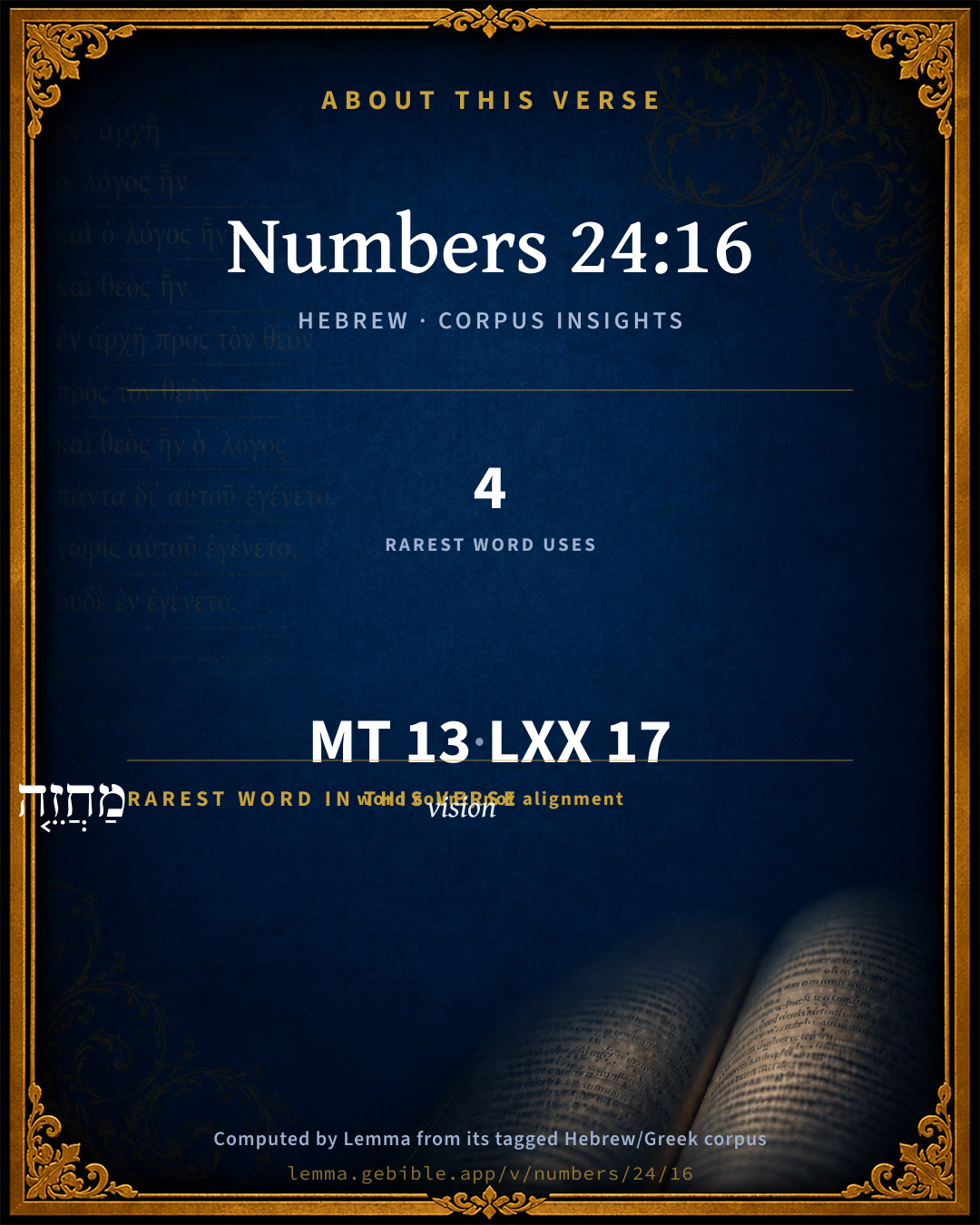
The rarest word here is מַחֲזֵ֤ה vision H4236 — appearing just 4 times in the whole Hebrew Bible.

Shared distinctive vocabulary

מַחֲזֵ֤ה vision H4236 occurs in 4 verses of the Hebrew Bible. Also found in:

Grammatical profile

  • 5 verbs
  • 7 nouns
  • 1 adjective

Verb forms

  • שֹׁמֵ֨עַ֙ Qal · Participle Active
  • וְיֹדֵ֖עַ Qal · Participle Active
  • יֶֽחֱזֶ֔ה Qal · Imperfect
  • נֹפֵ֖ל Qal · Participle Active
  • וּגְל֥וּי Qal · Participle Passive

Hebrew & Septuagint length

In English translation the verse runs 29 words from the Hebrew and 24 from the Septuagint (LXX English) — closely comparable.

A rough comparison of the two English renderings, which tokenize alike — not a word-level alignment.

Word counts can differ between the Hebrew and the Greek without any difference in meaning — e.g. the Hebrew direct-object marker אֵת has no separate Greek word, and Greek often adds the article ὁ.

In the original languages it is 13 Hebrew tokens and 17 Greek tokens — but the two are counted differently (Hebrew bundles its prefixes and suffixes into one token; the Greek is in lemma form), so that isn’t a like-for-like length.

Cross-references

4

Topical passages linked to Numbers 24:16 in the Treasury of Scripture Knowledge — connected by theme and wording, ordered by reader-vote popularity; previews shown in the World English Bible.

  • Numbers 24:4 He says, who hears the words of God, Who sees the vision of the Almighty, Falling down, and having his eyes open:
  • 2 Samuel 23:1–2 Now these are the last words of David. David the son of Jesse says, The man who was raised on high says, The anointed of the God of Jacob, The sweet psalmist of Israel:
  • 1 Corinthians 8:1 Now concerning things sacrificed to idols: We know that we all have knowledge. Knowledge puffs up, but love builds up.
  • 1 Corinthians 13:2 If I have the gift of prophecy, and know all mysteries and all knowledge; and if I have all faith, so as to remove mountains, but don't have love, I am nothing.

Cross-references courtesy of OpenBible.info (CC BY 4.0).

Hebrew and Greek witnesses Masoretic Hebrew ↔ Greek Septuagint

The same verse in the two great witnesses to the Old Testament, shown verse-for-verse.

These are two independent witnesses, not word-aligned to each other, and the Septuagint is shown in lemma (dictionary) form.

Hebrew Numbers 24:16 Masoretic · Westminster Leningrad Codex

נְאֻ֗ם שֹׁמֵ֨עַ֙ אִמְרֵי אֵ֔ל וְיֹדֵ֖עַ דַּ֣עַת עֶלְי֑וֹן מַחֲזֵ֤ה שַׁדַּי֙ יֶֽחֱזֶ֔ה נֹפֵ֖ל וּגְל֥וּי עֵינָֽיִם

He says, who hears the words of God, Knows the knowledge of the Most High, Who sees the vision of the Almighty, Falling down, and having his eyes open:

World English Bible · Public Domain

Greek LXX Numbers 24:16 Septuagint · lemma form

ἀκούω λόγιον θεός ἐπίσταμαι ἐπιστήμη παρά ὕψιστος καί ὅρασις θεός ὁράω ἐν ὕπνος ἀποκαλύπτω ὁ ὀφθαλμός αὐτός

hearing the oracles of God, receiving knowledge from the Most High, and having seen a vision of God in sleep; his eyes were opened.

LXX2012 (modern English Septuagint) · Public Domain

On this verse, The Pulpit Commentary discusses the Septuagint’s reading. Read the note in Commentary ↓

Hebrew: Westminster Leningrad Codex (CC BY 4.0). Greek: Septuagint (public domain); English from LXX2012 (modern English Septuagint) (Public Domain). How the Septuagint differs from the Hebrew →

Targum (Aramaic paraphrase)

2

The Targum is the ancient Jewish Aramaic paraphrase of the Hebrew Scriptures — an interpretive translation, not the Hebrew text itself. Onkelos (literal) and Pseudo-Jonathan (expansive) render the Torah, and Jonathan the Prophets. Coverage is partial: where no permissively-licensed English translation exists for a verse, only the Aramaic is shown. This is verse-level text, not a word-by-word alignment to the Hebrew.

  1. Targum Onkelos Torah (Genesis–Deuteronomy)
    אֵימַר דִשְׁמַע מֵימַר מִן קֳדָם אֵל וִידַע מַדַע מִן קֳדָם עִילָאָה חֵיזוּ מִן קֳדָם שַׁדַי חָזֵי שְׁכִיב וּמִתְגְלֵי לֵיהּ

    (no public-domain English translation for this verse)

    Targum Onkelos — Aramaic: “Onkelos Genesis” (public domain); “Onkelos Exodus” (public domain); “Onkelos Leviticus” (public domain); “Onkelos Numbers” (public domain); “Onkelos Deuteronomy” (public domain). English: “Sefaria Community Translation” (CC0 1.0 (public-domain dedication)); “J.W. Etheridge. The Targums of Onkelos and Jonathan Ben Uzziel on the Pentateuch. London: Longmans, Green, 1862” (public domain). Text via Sefaria.

  2. Targum Pseudo-Jonathan Torah (Genesis–Deuteronomy)
    אֵימַר דְשָׁמַע מֵימַר מִן קֳדָם אֱלָהָא וִידַע שַׁעְתָּא דְרָתַח בֵּיהּ אֱלָהָא עִלָאָה דְחֵיזוּ מִן קֳדָם שַׁדַי חָמֵי וְכַד הֲוָה בָּעֵי דְיִתְגְלֵי לֵיהּ הֲוָה מִשְׁתַּטַח וּנְפַל עַל אַפּוֹי וְרַזְיָא סְתִימַיָא מַה דְאִתְכַּסֵי מִן נְבִיָא הֲוָה מִתְגְלֵי לֵיהּ

    he speaketh who heard the Word from before the Lord, and who knoweth the hour when the Most High God will be wroth with him; (he speaketh) who saw the vision before the Almighty, seeking, prostrate on his face, that it should be revealed to him; the secret, concealed from the prophets, was disclosed unto him.

    Targum Pseudo-Jonathan — Aramaic: “Targum Jonathan on Genesis” (public domain); “Targum Jonathan on Exodus” (public domain); “Targum Jonathan on Leviticus” (public domain); “Targum Jonathan on Numbers” (public domain); “Targum Jonathan on Deuteronomy” (public domain). English: “The Targum of Jonathan ben Uzziel, trans. J. W. Etheridge, London, 1862” (public domain). Text via Sefaria.

Commentary

Notes on Numbers 24:16 from classic Christian and Jewish commentators (each source and its license shown beneath its notes). The classic Christian expositions comment on the surrounding passage and are grouped to its opening verse, so a note may address several verses; the Jewish commentaries on the Tanakh (Rashi and others) are per-verse, so they appear only where the commentator wrote on this verse.

Lemma curates 59 commentaries, every one of them public domain or Creative Commons licensed, each selected and text-cleaned for this edition rather than reprinted as found. About our sources →

Trapp's Complete Commentary

John Trapp

Num 24:16 He hath said, which heard the words of God, and knew the knowledge of the most High, [which] saw the vision of the Almighty, falling [into a trance], but having his eyes open:

Ver. 16. And knew the knowledge of the Most High.] The eye may be clear while the hand is palsied. Baalam’s great knowledge was but intuitiva, standing in speculation; it was not directiva vitae: he knew but by hearsay, as a blind man knows colours; his light served but to light him into utter darkness. Neronis Quantus artifex pereo, quadrabit in te peritum, et periturum.

John Trapp, A Commentary or Exposition upon All the Books of the Old and New Testament (1647–1656) — public domain. Text from a community e-Sword module.

Ellicott's Commentary for English Readers

(16) Which heard . . . and knew.—Better, which heareth . . . and knoweth.

Which saw.—Better, he seeth.

A Bible Commentary for English Readers, edited by Charles John Ellicott (1878–1897) — public domain. Text from a community e-Sword module.

Albert Barnes' Notes on the Bible

And knew, the knowledge of the Most High - With the addition of these words, which point to the greater importance and the more distinctly predictive character of what follows, the introduction to this last parable is the same as the introduction to the preceding parable.

Albert Barnes' Notes on the Bible (1834–1885) — public domain. Text from a community e-Sword/MySword module.

Haydock's Catholic Bible Commentary

Who knoweth. This is a new title, which he had not before assumed, ver. 4.

George Leo Haydock (1774–1849), Haydock's Catholic Family Bible and Commentary, 1859 edition — public domain. Excludes Psalms (Douay-Rheims chapter numbering differs from Protestant) and Deuterocanonical books (Catholic canon only).

The Pulpit Commentary

Knew the knowledge of the Most High. Septuagint, epistamenov episthmhn para Uqistou . This expression alone distinguishes this introduction of Balaam"s mashal from the former one (verses 3, 4), but it is difficult to say that it really adds anything to our understanding of his mental state. If we ask when Balaam had received the revelation which he now proceeds to communicate, it would seem most natural to reply that it was made known to him when "the Spirit of God came upon him," and that Balak"s anger had interrupted him in the midst of his mashal, or possibly he had kept it back, as too distasteful to his patron, until he saw that he had nothing more to expect from that quarter.

The Pulpit Commentary (1880–1919), ed. H.D.M. Spence-Jones & Joseph S. Exell — public domain. Text from a community e-Sword module.

Rashi

Rabbi Shlomo Yitzchaki (Rashi)

וידע דעת עליון WHO KNOWETH THE MIND OF THE MOST HIGH — i.e., who knoweth to determine the precise moment when He is angry. (The meaning of the text is: “who knoweth His state of mind”, not, ”who knoweth his thoughts”) (Sanhedrin 105b).

Rashi on the Tanakh — English translations: “The Judaica Press complete Tanach with Rashi, translated by A. J. Rosenberg” (CC BY 4.0); “Pentateuch with Rashi's commentary by M. Rosenbaum and A.M. Silbermann, 1929-1934” (public domain); “The Metsudah Tanach series, Lakewood, N.J” (CC BY 4.0); and “The Book of Joshua, Metsudah Publications, 1997” (CC BY 4.0). Text via Sefaria.

Lesson kit

Teaching starters — assembled from the data on this page, not authored interpretation. Every prompt links to the verse data it draws on. Edit before teaching.

Numbers, in the Pentateuch, opens this verse with 13 words (13 distinct Hebrew lemmas). Its most distinctive word is machăzeh (“vision”). A historical commentator’s framing appears above. Read the whole chapter for the surrounding context.

Discussion questions

  1. The word machăzeh carries the sense “vision.” How does it shape the verse?
  2. How does Genesis 15:1, which shares the word «vision», read alongside this verse?
  3. These translations render this verse differently; the difference is in the English rendering, not the original. What questions does that raise?
  4. «שֹׁמֵ֨עַ֙» is a Qal Participle Active verb. How does that grammatical form shape the action described?
  5. Compare how Trapp's Complete Commentary and Ellicott's Commentary for English Readers read this verse. Where do they agree or differ?

Things to notice

Reading settings

Reading text

Shown beneath each verse's original-language words.

Old Testament
Old Testament edition

Read the OT as the Masoretic Hebrew (MT) or the Greek Septuagint (LXX).

English shown for the Greek Septuagint (in the Hebrew ↔ Greek comparison).

Comparing translations? Open the Compare panel on any verse page to stack up to four side by side.