
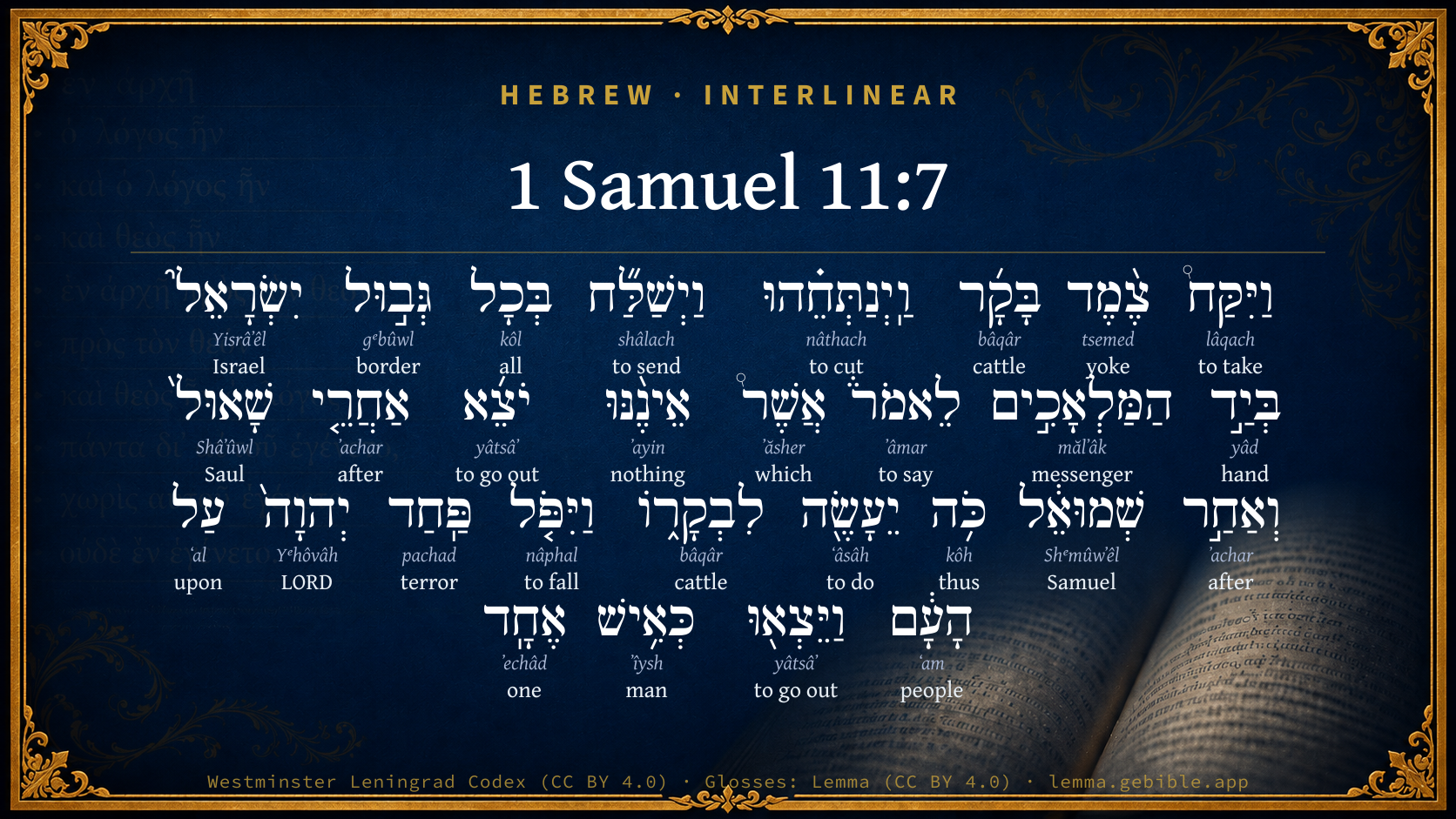
1 Samuel 11:7

Hebrew (Westminster Leningrad Codex) 1 Samuel 11:7 appears in the Hebrew Old Testament. The text above is from the Westminster Leningrad Codex. Each word links to its Strong’s number, a concise gloss, and parsing drawn from the Open Scriptures Hebrew Bible morphology. Click any word for its full Brown-Driver-Briggs (BDB) entry.
Download image
Cite this verse

1 Samuel 11:7 (World English Bible). Public Domain. Lemma interlinear Bible study tool, https://lemma.gebible.app/v/1-samuel/11/7.

Show BibTeX & RIS
BibTeX
RIS
English Translation
He took a yoke of oxen, and cut them in pieces, and sent them throughout all the borders of Israel by the hand of messengers, saying, Whoever doesn't come forth after Saul and after Samuel, so shall it be done to his oxen. The dread of Yahweh fell on the people, and they came out as one man.
World English Bible · Public Domain
Download a study sheet

One document with this verse’s original text, its word-by-word gloss line, the meaning frame, cross-references with their text, attributed commentary, and full source and license credits — printable, and it pastes into notes with its structure intact.

This verse Autodidact and up

Study sheet (.html) Plain text (.txt)

A passage Seminary Student

Up to 50 verses in one chapter. A passage sheet keeps up to 6 commentary sources and 12 cross-references per verse, in the order this page ranks them, and says so on the sheet whenever that leaves anything out. Ask for a single verse and you get the Autodidact verse sheet above.

Everything on this page stays free to read, with no account — the sheet is a download of what is already on screen, not access to it.

Want to remove ads? Support Godless Engineer
Compare translations 3

The same verse in 3 English versions, stacked beneath the original-language interlinear above. Click any original word for its lexicon entry.

Each is an independent rendering of the whole verse — the interlinear is not word-aligned to these translations.

Highlighted words mark where these versions differ — a whole-verse word diff, not a word-by-word alignment.

  • World English Bible Public Domain
    He took a yoke of oxen, and cut them in pieces, and sent them throughout all the borders of Israel by the hand of messengers, saying, Whoever doesn't come forth after Saul and after Samuel, so shall it be done to his oxen. The dread of Yahweh fell on the people, and they came out as one man.
  • King James Version Public Domain
    And he took a yoke of oxen, and hewed them in pieces, and sent them throughout all the coasts of Israel by the hands of messengers, saying, Whosoever cometh not forth after Saul and after Samuel, so shall it be done unto his oxen. And the fear of the LORD fell on the people, and they came out with one consent.
  • unfoldingWord Literal Text CC BY-SA 4.0
    And he took a pair of cattle and cut it into pieces, and he sent through all of the border of Israel by the hand of the messengers, saying, “Whoever is not going out behind Saul and behind Samuel, thus shall be done to his oxen.” And the fear of Yahweh fell on the people, and they went out as one man.

unfoldingWord Literal Text — © unfoldingWord, licensed CC BY-SA 4.0. Word-aligned USFM3 via Door43 (git.door43.org/unfoldingWord/en_ult).

Versions to compare (up to 4)

3 of 4 selected

Show all 18 translations

Every available English version of this verse, each an independent rendering of the whole verse.

  • World English Bible Public Domain
    He took a yoke of oxen, and cut them in pieces, and sent them throughout all the borders of Israel by the hand of messengers, saying, Whoever doesn't come forth after Saul and after Samuel, so shall it be done to his oxen. The dread of Yahweh fell on the people, and they came out as one man.
  • Berean Standard Bible Public Domain
    He took a pair of oxen, cut them into pieces, and sent them by messengers throughout the land of Israel, proclaiming, “This is what will be done to the oxen of anyone who does not march behind Saul and Samuel.” Then the terror of the LORD fell upon the people, and they turned out as one man.
  • Majority Standard Bible Public Domain
    He took a pair of oxen, cut them into pieces, and sent them by messengers throughout the land of Israel, proclaiming, “This is what will be done to the oxen of anyone who does not march behind Saul and Samuel.” Then the terror of the LORD fell upon the people, and they came out together as one man.
  • King James Version Public Domain
    And he took a yoke of oxen, and hewed them in pieces, and sent them throughout all the coasts of Israel by the hands of messengers, saying, Whosoever cometh not forth after Saul and after Samuel, so shall it be done unto his oxen. And the fear of the LORD fell on the people, and they came out with one consent.
  • American Standard Version (1901) Public Domain
    And he took a yoke of oxen, and cut them in pieces, and sent them throughout all the borders of Israel by the hand of messengers, saying, Whosoever cometh not forth after Saul and after Samuel, so shall it be done unto his oxen. And the dread of Jehovah fell on the people, and they came out as one man.
  • Revised Version (1885) Public Domain
    And he took a yoke of oxen, and cut them in pieces, and sent them throughout all the borders of Israel by the hand of messengers, saying, Whosoever cometh not forth after Saul and after Samuel, so shall it be done unto his oxen. And the dread of the LORD fell on the people, and they came out as one man.
  • Geneva Bible (1599) Public Domain
    And tooke a yoke of oxen, and hewed them in pieces, and sent them throughout all the coastes of Israel by the hands of messengers, saying, Whosoeuer commeth not foorth after Saul, and after Samuel, so shall his oxen be serued. And the feare of the Lord fell on the people, and they came out with one consent.
  • Douay-Rheims (1899) Public Domain
    And taking both the oxen, he cut them in pieces, and sent them into all the coasts of Israel by messengers, saying: Whosoever shall not come forth, and follow Saul and Samuel, so shall it be done to his oxen. And the fear of the Lord fell upon the people, and they went out as one man.
  • Young's Literal Translation Public Domain
    and he taketh a couple of oxen, and cutteth them in pieces, and sendeth through all the border of Israel, by the hand of the messengers, saying, `He who is not coming out after Saul and after Samuel -- thus it is done to his oxen;' and the fear of Jehovah falleth on the people, and they come out as one man.
  • Literal Standard Version CC BY-SA 4.0
    and he takes a couple of oxen, and cuts them in pieces, and sends [them] through all the border of Israel, by the hand of the messengers, saying, “He who is not coming out after Saul and after Samuel—thus it is done to his oxen”; and the fear of YHWH falls on the people, and they come out as one man.
  • Unlocked Literal Bible CC BY-SA 4.0
    He took a yoke of oxen, cut them into pieces, and sent them throughout all the territory of Israel with the messengers. He said, “Whoever does not come out after Saul and after Samuel, this is what will be done to his oxen.” Then the terror of Yahweh fell on the people, and they came out together as one man.
  • unfoldingWord Literal Text CC BY-SA 4.0
    And he took a pair of cattle and cut it into pieces, and he sent through all of the border of Israel by the hand of the messengers, saying, “Whoever is not going out behind Saul and behind Samuel, thus shall be done to his oxen.” And the fear of Yahweh fell on the people, and they went out as one man.
  • Darby Bible Public Domain
    And he took a yoke of oxen and cut them in pieces, and sent throughout the territory of Israel by the hand of messengers, saying, Whoever comes not forth after Saul and after Samuel, so shall it be done to his oxen! And the fear of Jehovah fell on the people, and they came out as one man.
  • World Messianic Bible Public Domain
    He took a yoke of oxen and cut them in pieces, then sent them throughout all the borders of Israel by the hand of messengers, saying, “Whoever doesn’t come out after Saul and after Samuel, so shall it be done to his oxen.” The dread of the LORD fell on the people, and they came out as one man.
  • Webster's Bible Public Domain
    And he took a yoke of oxen, and hewed them in pieces, and sent them throughout all the borders of Israel by the hands of messengers, saying, Whoever cometh not forth after Saul and after Samuel, so shall it be done to his oxen. And the fear of the LORD fell on the people, and they came out with one consent.
  • Free Bible Version CC BY-SA 4.0
    He took a pair of oxen and cut them into pieces. Then he sent them by messenger to every part of Israel with the message, “This is what will happen to the oxen of anyone who does not follow Saul and Samuel.” The Lord made the people anxious to do so, and they came out as one.
  • Bible in Basic English Public Domain
    And he took two oxen and, cutting them up, sent them through all the land of Israel by the hand of runners, saying, If any man does not come out after Saul and Samuel, this will be done to his oxen. And the fear of the Lord came on the people and they came out like one man.
  • JPS Tanakh (1917) Public Domain
    And he took a yoke of oxen, and cut them in pieces, and sent them throughout all the borders of Israel by the hand of messengers, saying: 'Whosoever cometh not forth after Saul and after Samuel, so shall it be done unto his oxen.' And the dread of the LORD fell on the people, and they came out as one man.

Literal Standard Version (2020), Covenant Press — licensed CC BY-SA 4.0. Text via the HelloAO Bible API (eBible.org). Unlocked Literal Bible (unfoldingWord) — licensed CC BY-SA 4.0. Text via the HelloAO Bible API (eBible.org). unfoldingWord Literal Text — © unfoldingWord, licensed CC BY-SA 4.0. Word-aligned USFM3 via Door43 (git.door43.org/unfoldingWord/en_ult). Free Bible Version, Dr. Jonathan Gallagher — licensed CC BY-SA 4.0. Text via the HelloAO Bible API (eBible.org).

Word by word

More ways to search: Search by grammar → Find every occurrence → Compare this word →

Practice this passage: Drill this verse → Learn its vocabulary →

וַֽיְנַתְּחֵ֗הוּ
nâthach
H5408
“and · to cut · him”
Conjunction + Verb, Piel, Sequential Imperfect, 3rd Person, Masculine, Singular + Suffix, Personal, 3rd Person, Masculine, Singular
Part of Speech
Conjunction + Verb
Stem
Piel
Form
Sequential Imperfect
Person
3rd Person
Gender
Masculine
Number
Singular
Full BDB Definition

Origin: a primitive root

TWOT: 1441

to cut, cut up, cut in pieces, divide - (Piel) to cut up, cut in pieces, divide by joints
  1. וַיִּקַּח֩ lâqach H3947 “and · to take” Conjunction + Verb, Qal, Sequential Imperfect, 3rd Person, Masculine, Singular
  2. צֶ֨מֶד tsemed H6776 “yoke of” Noun, Common, Masculine, Singular, Construct
  3. בָּקָ֜ר bâqâr H1241 “cattle” Noun, Common, Both, Singular, Absolute
  4. וַיְשַׁלַּ֞ח shâlach H7971 “and · to send” Conjunction + Verb, Piel, Sequential Imperfect, 3rd Person, Masculine, Singular
  5. בְּכָל kôl H3605 “in/at · all of” Preposition + Noun, Common, Masculine, Singular, Construct
  6. גְּב֣וּל gᵉbûwl H1366 “border of” Noun, Common, Masculine, Singular, Construct
  7. יִשְׂרָאֵל֮ Yisrâʼêl H3478 “Israel” Noun, Proper
  8. בְּיַ֣ד yâd H3027 “in/at · hand of” Preposition + Noun, Common, Both, Singular, Construct
  9. הַמַּלְאָכִ֣ים mălʼâk H4397 “the · messengers” Particle, Definite Article + Noun, Common, Masculine, Plural, Absolute
  10. לֵאמֹר֒ ʼâmar H559 “to say” Preposition + Verb, Qal, Infinitive Construct
  11. אֲשֶׁר֩ ʼăsher H834 “which” Particle, Relative
  12. אֵינֶ֨נּוּ ʼayin H369 “nothing · him” Particle, Negative + Suffix, Personal, 3rd Person, Masculine, Singular
  13. יֹצֵ֜א yâtsâʼ H3318 “going out” Verb, Qal, Participle Active, Masculine, Singular, Absolute
  14. אַחֲרֵ֤י ʼachar H310 “after” Preposition
  15. שָׁאוּל֙ Shâʼûwl H7586 “Saul” Noun, Proper
  16. וְאַחַ֣ר ʼachar H310 “and · after” Conjunction + Preposition
  17. שְׁמוּאֵ֔ל Shᵉmûwʼêl H8050 “Samuel” Noun, Proper
  18. כֹּ֥ה kôh H3541 “thus” Adverb
  19. יֵעָשֶׂ֖ה ʻâsâh H6213 “to do” Verb, Niphal, Imperfect, 3rd Person, Masculine, Singular
  20. לִבְקָר֑וֹ bâqâr H1241 “to/for · cattle · his” Preposition + Noun, Common, Both, Singular, Construct + Suffix, Personal, 3rd Person, Masculine, Singular
  21. וַיִּפֹּ֤ל nâphal H5307 “and · to fall” Conjunction + Verb, Qal, Sequential Imperfect, 3rd Person, Masculine, Singular
  22. פַּֽחַד pachad H6343 “terror of” Noun, Common, Masculine, Singular, Construct
  23. יְהוָה֙ Yᵉhôvâh H3068 “LORD” Noun, Proper
  24. עַל ʻal H5921 “upon” Preposition
  25. הָעָ֔ם ʻam H5971 “the · people” Particle, Definite Article + Noun, Common, Masculine, Singular, Absolute
  26. וַיֵּצְא֖וּ yâtsâʼ H3318 “and · to go out” Conjunction + Verb, Qal, Sequential Imperfect, 3rd Person, Masculine, Plural
  27. כְּאִ֥ישׁ ʼîysh H376 “like/as · man” Preposition + Noun, Common, Masculine, Singular, Absolute
  28. אֶחָֽד ʼechâd H259 “one” Adjective, Cardinal number, Masculine, Singular, Absolute

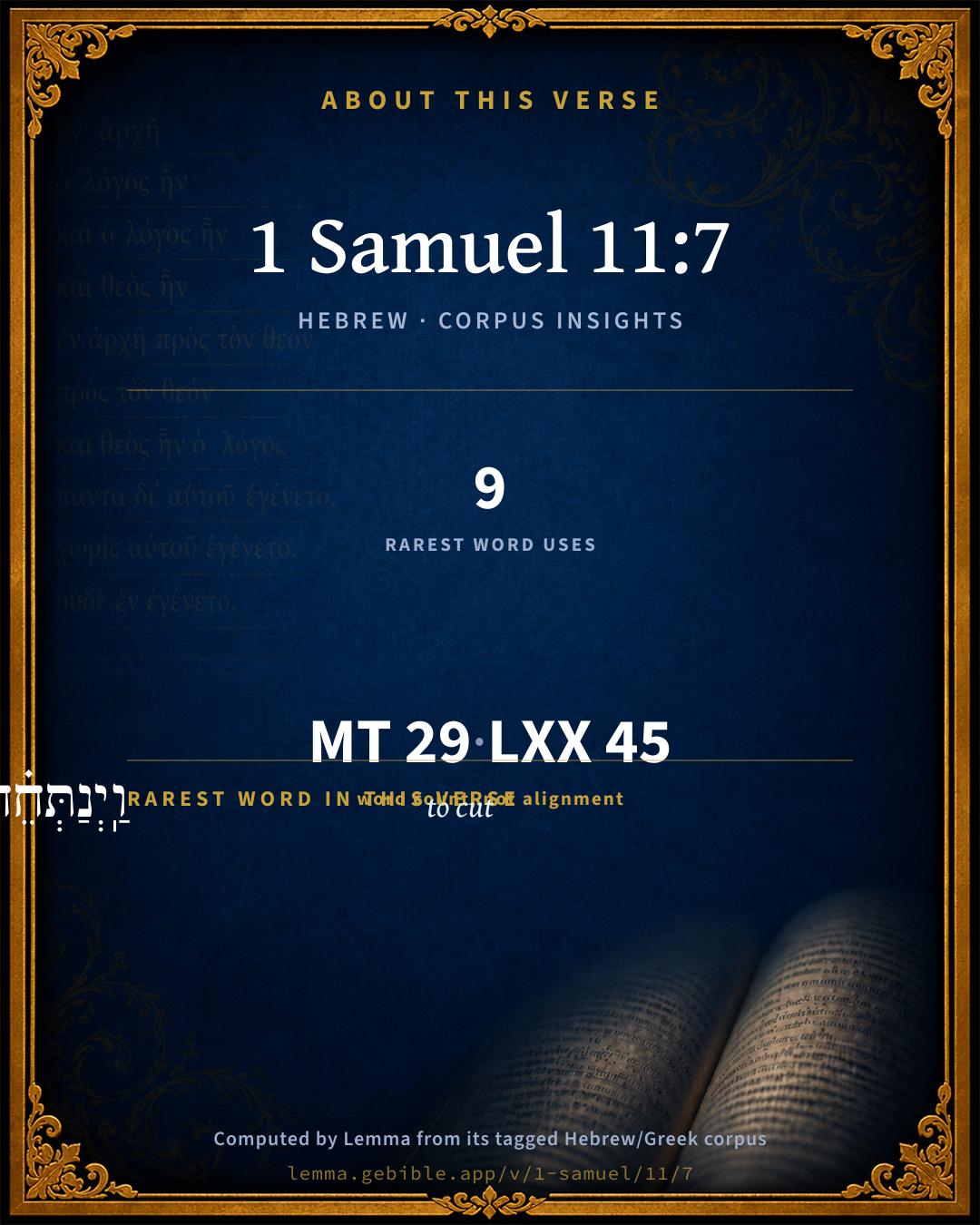
About this verse

These counts appear in no published source. They are computed here, from the morphology-tagged text and Lemma’s own curated glosses. What Lemma adds →

29
words
26
distinct lemmas
Historical
section

Notable vocabulary

The rarest word here is וַֽיְנַתְּחֵ֗הוּ to cut H5408 — appearing just 9 times in the whole Hebrew Bible.

Shared distinctive vocabulary

וַֽיְנַתְּחֵ֗הוּ to cut H5408 occurs in 9 verses of the Hebrew Bible. Also found in:

Grammatical profile

  • 8 verbs
  • 14 nouns
  • 1 adjective
  • 3 prepositions
  • 1 adverb
  • 2 particles

Verb forms

  • וַיִּקַּח֩ Qal · Sequential Imperfect
  • וַֽיְנַתְּחֵ֗הוּ Piel · Sequential Imperfect
  • וַיְשַׁלַּ֞ח Piel · Sequential Imperfect
  • לֵאמֹר֒ Qal · Infinitive Construct
  • יֹצֵ֜א Qal · Participle Active
  • יֵעָשֶׂ֖ה Niphal · Imperfect
  • וַיִּפֹּ֤ל Qal · Sequential Imperfect
  • וַיֵּצְא֖וּ Qal · Sequential Imperfect

Repetition

Words recur within this verse — often emphatic in Hebrew:

  • בָּקָ֜ר cattle H1241 ×2
  • יֹצֵ֜א to go out H3318 ×2
  • אַחֲרֵ֤י after H310 ×2

Hebrew & Septuagint length

In English translation the verse runs 58 words from the Hebrew and 62 from the Septuagint (LXX English) — closely comparable.

A rough comparison of the two English renderings, which tokenize alike — not a word-level alignment.

Word counts can differ between the Hebrew and the Greek without any difference in meaning — e.g. the Hebrew direct-object marker אֵת has no separate Greek word, and Greek often adds the article ὁ.

In the original languages it is 29 Hebrew tokens and 45 Greek tokens — but the two are counted differently (Hebrew bundles its prefixes and suffixes into one token; the Greek is in lemma form), so that isn’t a like-for-like length.

Cross-references

6

Topical passages linked to 1 Samuel 11:7 in the Treasury of Scripture Knowledge — connected by theme and wording, ordered by reader-vote popularity; previews shown in the World English Bible.

  • Judges 19:29 When he was come into his house, he took a knife, and laid hold on his concubine, and divided her, limb by limb, into twelve pieces, and sent her throughout all the borders of Israel.
  • Judges 20:1 Then all the children of Israel went out, and the congregation was assembled as one man, from Dan even to Beersheba, with the land of Gilead, to Yahweh at Mizpah.
  • Genesis 35:5 They traveled: and a terror of God was on the cities that were round about them, and they didn't pursue the sons of Jacob.
  • Judges 21:5–11 The children of Israel said, Who is there among all the tribes of Israel who didn't come up in the assembly to Yahweh? For they had made a great oath concerning him who didn't come up to Yahweh to Mizpah, saying, He shall surely be put to death.
  • 2 Chronicles 14:14 They struck all the cities round about Gerar; for the fear of Yahweh came on them: and they despoiled all the cities; for there was much spoil in them.
  • 2 Chronicles 17:10 The fear of Yahweh fell on all the kingdoms of the lands that were round about Judah, so that they made no war against Jehoshaphat.

Cross-references courtesy of OpenBible.info (CC BY 4.0).

Hebrew and Greek witnesses Masoretic Hebrew ↔ Greek Septuagint

The same verse in the two great witnesses to the Old Testament, shown verse-for-verse.

These are two independent witnesses, not word-aligned to each other, and the Septuagint is shown in lemma (dictionary) form.

Hebrew 1 Samuel 11:7 Masoretic · Westminster Leningrad Codex

וַיִּקַּח֩ צֶ֨מֶד בָּקָ֜ר וַֽיְנַתְּחֵ֗הוּ וַיְשַׁלַּ֞ח בְּכָל גְּב֣וּל יִשְׂרָאֵל֮ בְּיַ֣ד הַמַּלְאָכִ֣ים לֵאמֹר֒ אֲשֶׁר֩ אֵינֶ֨נּוּ יֹצֵ֜א אַחֲרֵ֤י שָׁאוּל֙ וְאַחַ֣ר שְׁמוּאֵ֔ל כֹּ֥ה יֵעָשֶׂ֖ה לִבְקָר֑וֹ וַיִּפֹּ֤ל פַּֽחַד יְהוָה֙ עַל הָעָ֔ם וַיֵּצְא֖וּ כְּאִ֥ישׁ אֶחָֽד

He took a yoke of oxen, and cut them in pieces, and sent them throughout all the borders of Israel by the hand of messengers, saying, Whoever doesn't come forth after Saul and after Samuel, so shall it be done to his oxen. The dread of Yahweh fell on the people, and they came out as one man.

World English Bible · Public Domain

Greek LXX 1 Samuel 11:7 Septuagint · lemma form

καί λαμβάνω δύο βοῦς καί μελίζω αὐτός καί ἀποστέλλω εἰς πᾶς ὅριον ἰσραήλ ἐν χείρ ἄγγελος λέγω ὅς οὐ εἰμί ἐκπορεύομαι ὀπίσω σαούλ καί ὀπίσω σαμουηλ κατά ὅδε ποιέω ὁ βοῦς αὐτός καί ἐπιἔρχομαι ἔκστασις κύριος ἐπί ὁ λαός ἰσραήλ καί βοάω ὡς ἀνήρ εἷς

And he took two cows, and cut them in pieces, and sent them into all the coasts of Israel by the hand of messengers, saying, Whoso comes not forth after Saul and after Samuel, so shall they do to his oxen: and a transport from the Lord came upon the people of Israel, and they came out to battle as one man.

LXX2012 (modern English Septuagint) · Public Domain

On this verse, John Gill's Exposition discusses the Septuagint’s reading. Read the note in Commentary ↓

Hebrew: Westminster Leningrad Codex (CC BY 4.0). Greek: Septuagint (public domain); English from LXX2012 (modern English Septuagint) (Public Domain). How the Septuagint differs from the Hebrew →

Targum (Aramaic paraphrase)

1

The Targum is the ancient Jewish Aramaic paraphrase of the Hebrew Scriptures — an interpretive translation, not the Hebrew text itself. Onkelos (literal) and Pseudo-Jonathan (expansive) render the Torah, and Jonathan the Prophets. Coverage is partial: where no permissively-licensed English translation exists for a verse, only the Aramaic is shown. This is verse-level text, not a word-by-word alignment to the Hebrew.

  1. Targum Jonathan Prophets (Joshua–Malachi)
    וּנְסִיב פַּדַן תּוֹרַיָא וְהַדְמֵיהּ וּשְׁלַח בְּכָל תְּחוּם יִשְׂרָאֵל בְּיַד אִזְגַדַיָא לְמֵימַר דְלֵיתוֹהִי נָפֵיק בָּתַר שָׁאוּל וּבָתַר שְׁמוּאֵל כְּדֵין יִתְעֲבֵיד לְתוֹרֵיהּ וּנְפַל זִיעָא מִן קֳדָם יְיָ עַל עַמָא וּנְפָקוּ כְּגַבְרָא חָד:

    (no public-domain English translation for this verse)

    Targum Jonathan — Aramaic: “Mikraot Gedolot” (public domain). English: “Sefaria Community Translation” (CC0 1.0 (public-domain dedication)); “London "Chaldee Paraphrase," 1871” (public domain). Text via Sefaria.

Commentary

Notes on 1 Samuel 11:7 from classic Christian and Jewish commentators (each source and its license shown beneath its notes). The classic Christian expositions comment on the surrounding passage and are grouped to its opening verse, so a note may address several verses; the Jewish commentaries on the Tanakh (Rashi and others) are per-verse, so they appear only where the commentator wrote on this verse.

Lemma curates 59 commentaries, every one of them public domain or Creative Commons licensed, each selected and text-cleaned for this edition rather than reprinted as found. About our sources →

Trapp's Complete Commentary

John Trapp

1Sa 11:7 And he took a yoke of oxen, and hewed them in pieces, and sent [them] throughout all the coasts of Israel by the hands of messengers, saying, Whosoever cometh not forth after Saul and after Samuel, so shall it be done unto his oxen. And the fear of the LORD fell on the people, and they came out with one consent.

Ver. 7. And he took a yoke of oxen.] His own, likely, which he was following from the field. {1Sa 11:5} These he slayeth and sendeth abroad, as that Levite did his dead concubine, {Jdg 19:29} and as the Scots do their fire cross, with proclamation that all men above sixteen years of age, and under sixty, shall come into the field, to oppose the common enemy. {a}

So shall it be done unto his oxen.] He knew that deeds would persuade more than words; and that fear of punishment prevaileth most with the many. He therefore taketh upon him like a king, which yet would have been to small purpose, but that -

The fear of the Lord fell on the people, and they came out with one consent.] Whereas otherwise the malcontents would have said, Minarum strepitus, Asini crepitus.

{a} Life of Edw. VI, by Sir Jo. Heywood, 20.

John Trapp, A Commentary or Exposition upon All the Books of the Old and New Testament (1647–1656) — public domain. Text from a community e-Sword module.

The Biblical Illustrator

Joseph S. Exell

1Sa_11:7-11

And he took a yoke of oxen.

Rallying to the Kings standard

Everything seems to point to this as the time when a decisive blow may be struck. If we are only equal to the situation, we may do something effectual in our time for the spread of the kingdom of God. I daresay you remember that scene in Scotts Lady of the Lake, where Roderick Dhu gathers the clan to war by sending through the land the cross dipped in blood. Wherever the symbol went there was a general uprising, and Norman left his new-made bride and took hold of the consecrated symbol, and rushed forth to rouse the land, and all the minor duties were absorbed in the one great and one all-absorbing duty to the cross. Oh, would that this spirit possessed all the clansmen of Jesus, and when He sends His Cross through the land let us not remain among our joys or sorrows or minor duties, but let us rally to His side and strike for victory. And into this missionary crusade we may enter with every assurance of success. (Hugh Brown.)

Enthusiastic leaders

Caesar might never have conquered Britain if his standard bearer had not aroused the soldiers by leaping into the water and rushing for the shore and many a splendid possibility is lost for lack of enthusiasm to lead off. We seem afraid of it; we put off our boots and dabble about the edge of it, but catch us tripping and taking a header! (Weekly Pulpit.)

The Biblical Illustrator, edited by Joseph S. Exell (c. 1880s–1900s) — public domain. Text from a community e-Sword module.

Joseph Benson's Commentary

1Sa 11:7. Sent them throughout all the coasts — Wisely considering that the sight of men’s eyes does much more affect their hearts than what they only hear with their ears. After Saul and after Samuel — He joins Samuel with himself, both because he was present with him, and that hereby he might gain the more authority. The fear of the Lord fell on the people — A fear was sent upon them by God, so that they did not dare to deny their help. The fear of God will make men good subjects, good soldiers and good friends to their country. They that fear God will make conscience of their duty to all men, particularly to their rulers. They will honour the king, and all that are in authority under him. They came out with one consent — God, who put courage into Saul, and now induced him to assert his royal authority over the people, influenced them with a fear of offending him, so that they readily came and joined him at his call.

Joseph Benson's Commentary on the Old and New Testaments (1811–1818) — public domain. Text from a community e-Sword module.

Tyndale Open Study Notes

Tyndale Open Resources

11:7 Not to participate would indicate rejection of the leadership of both Saul as king and Samuel as prophet.

Tyndale Open Study Notes — © Tyndale Open Resources, licensed CC BY-SA 4.0. Text via the HelloAO Bible API.

Geneva Bible (1599)

Geneva Bible translators

He addeth Samuel because Saul was not yet approved of all.

Hebrew, as one man.

Geneva Bible (1599) marginal notes — public domain. Text via Bolls.life.

Jamieson, Fausset & Brown

Robert Jamieson, A. R. Fausset & David Brown

THEY SEND TO SAUL, AND ARE DELIVERED. (Sa1 11:5-11)

he took a yoke of oxen, and hewed them in pieces--(see Jdg 19:29). This particular form of war-summons was suited to the character and habits of an agricultural and pastoral people. Solemn in itself, the denunciation that accompanied it carried a terrible threat to those that neglected to obey it. Saul conjoins the name of Samuel with his own, to lend the greater influence to the measure, and to strike greater terror unto all contemners of the order. The small contingent furnished by Judah suggests that the disaffection to Saul was strongest in that tribe.

Jamieson, Fausset & Brown — Commentary Critical and Explanatory on the Whole Bible (1871) — public domain (CC PDM 1.0). Text via the HelloAO Bible API.

Adam Clarke's Commentary

Verse 7. He took a yoke of open] The sending the pieces of the oxen was an act similar to that of the Levite, Jdg 19:29, where see the note. And both customs are similar to the sending about of the bloody cross, to call the clans to battle, practised by the ancient Highlanders of Scotland. See at the end of this chapter. 1Sa 11:15

Adam Clarke's Commentary on the Bible (1810–1826) — public domain. Text from a community e-Sword/MySword module.

Ellicott's Commentary for English Readers

(7) A yoke of oxen.—In a moment all the great powers of Saul, hitherto dormant, woke up, and he issued his swift commands in a way which at once showed Israel that they had got a hero-king who would brook no trifling. In that self-same hour, striking dead the oxen standing before his plough, he hews them in pieces, and handing a bloody strip to certain of the men standing around him, weeping for grief and shame and the wrong done to Israel, bade them swiftly bear these terrible war-signals throughout the length and breadth of the land, and by these means to rouse the nation to prompt action.

On this strange war-signal of king Saul, Ewald, in his History of Israel, Book II., section iii. 1 (note), remarks, “how in like manner it was formerly the custom in Norway to send on the war-arrow; and in Scotland a fire-brand, with both ends dipped in blood, was dispatched as a war-token.”

Not improbably Saul cut the oxen into eleven pieces, and sent one to each of the other tribes.

And the fear of the Lord fell on the people.—It was some such mighty awakening under the influence of the Spirit of the Eternal, as is here related of King Saul, which suggested to the poet Asaph the bold but splendid image of the seventy-eighth Psalm, when, after describing in moving language the degradation and bitter woe of fallen Israel, the singer, struck with a new inspiration, bursts forth with “Then the Lord awaked as one out of sleep, and like a mighty man that shouteth by reason of wine. And he smote his enemies,” &c. (Psa_78:65). “The people rose as one man” (see margin) against the enemies of their national freedom. It was the same Spirit of the Lord which inspired Saul to put himself at the head of the children of Israel which now laid hold of all the people, lifting them up, and giving them new strength and resistless courage, and the mighty feeling that God was with them.

It was owing to some influence of a similar nature that with scanty numbers, ill-armed and ill-trained, the Swiss won for their land centuries of freedom on memorable fields like Laupen and Morat, though the proudest chivalry of Europe was arrayed against them. it was the same Spirit which impelled the peace-loving traders of the marshes of Holland to rise as one man, and to drive out for ever from their loved strip of fen land the hitherto invincible armies of Spain. No oppressor, though backed by the wealth and power of an empire, has ever been able to resist the smallest people in whose heart has burned the flame of the Divine fire of the “fear of the Lord.”

A Bible Commentary for English Readers, edited by Charles John Ellicott (1878–1897) — public domain. Text from a community e-Sword module.

The Cambridge Bible for Schools and Colleges

gen. ed. J. J. S. Perowne

7. he took a yoke of oxen] Those doubtless with which he had just been ploughing (1Sa_11:5).

and sent them] ‘Them,’ i.e. the pieces, is rightly supplied. Symbolical acts are often more eloquent than any words. Cp. Jdg_19:29; 1Ki_11:30; 1Ki_22:11; 2Ki_13:18. We may compare the Fiery Cross which used to be sent round as the signal for the gathering of the Highland clans in Scotland. It was “scathed with flame,” and “quenched in blood” as an emblem of the fire and sword awaiting all who should neglect its summons. See The Lady of the Lake, Canto III., Stanzas 8–11.

by the hands of messengers] By the hand of the Messengers, viz. those who had come from Jabesh.

after Saul and after Samuel] Saul strengthens himself in his new office by an appeal to the time-honoured name and prophetic authority of Samuel.

the fear of the Lord &c.] Awe inspired by Jehovah supported the authority of His King and His Prophet; the people left their homes and came out to the rendezvous as one man.

The Cambridge Bible for Schools and Colleges (gen. ed. J. J. S. Perowne; Cambridge University Press, 1878–1918) — public domain. Text from a community e-Sword module.

John Gill's Exposition

And when he numbered them at Bezek,.... Which was the place appointed to meet at, the same with that in Jdg 1:4; see Gill on Jdg 1:4 though some take the word to be an appellative, and not, the proper name of a place, and render it, "with a stone"; with which he numbered, taking a stone from each, and laying them on a heap, and then telling them (u); so Bizakion signifies little stones (w) with the Greeks: or "with a fragment"; either of an earthen vessel, or of a stone, or of the branch of a tree they carried in their hands, and so the king's servants numbered not the men, but the branches (x):

and the children of Israel were three hundred thousand men; who came together on this occasion; these were of the eight tribes and a half on this side Jordan:

and the men of Judah thirty thousand; which tribe is mentioned distinctly, because a noble and warlike tribe, which usually first went up to battle; and though the number of them at this time assembled may seem comparatively small, yet this may easily be accounted for; because they bordered upon the Philistines, who watched every opportunity to take an advantage of them, and therefore could not leave their tribe destitute, but reserved a sufficient number to guard their coasts, and yet were desirous to testify their obedience to Saul, though chosen king out of another tribe, when they might have expected from prophecy that the dominion belonged to them. Josephus (y) has made a gross mistake in the numbers here, he makes the men of Israel to be 700,000, and the men of Judah 70,000, contrary to the text, the Targum, Syriac and Arabic versions; but the Septuagint comes pretty near him, which has 600,000 of the men of Israel, 70,000 of the men of Judah.

(u) Vid. T. Bab. Yoma, fol. 22. 2. & Gloss. in ib. (w) Suidas in voce (x) Vid. Sheringham. in Misn. Yoma, c. 2. sect. 1. p. 14. (y) Ut supra, (Antiqu. l. 6. c. 5.) sect. 3.

John Gill's Exposition of the Whole Bible (1746–1763) — public domain (CC PDM 1.0). Text via the HelloAO Bible API.

Albert Barnes' Notes on the Bible

Though not expressly stated, it is doubtless implied that he sent the portions by the messengers to the twelve tribes, after the analogy, and probably in imitation, of Jdg 19:29. He made use of the revered name of Samuel to strengthen his own weak authority. Samuel accompanied Saul in the expedition 1Sa 11:12.

Albert Barnes' Notes on the Bible (1834–1885) — public domain. Text from a community e-Sword/MySword module.

Haydock's Catholic Bible Commentary

Oxen, with which he had been ploughing. --- Pieces. Hebrew does not say that he sent them; and Josephus intimates, that he only "hamstrung them, and sent messengers," &c. (Haydock) --- But such actions are far more impressive than words. See Judges xix 29., and Acts xxi. 10., &c. (Calmet) --- Samuel. Saul adds the name of the prophet, as the people had still great confidence in him, and he always acted as God’s envoy. (Haydock) --- Oxen. He does not threaten capital punishment, but insinuates that both duty and interest require the presence of all. (Salien) --- Of the Lord; that is, a great fear: (Calmet) or, God moved the people to shew a ready obedience and reverence to their king’s commands.

George Leo Haydock (1774–1849), Haydock's Catholic Family Bible and Commentary, 1859 edition — public domain. Excludes Psalms (Douay-Rheims chapter numbering differs from Protestant) and Deuterocanonical books (Catholic canon only).

Matthew Poole's English Annotations

Sent them throughout all the coasts of Israel; wisely considering, that the sight of men’s eyes do much more affect their hearts than what they only hear with their ears. He joins Samuel with himself, both because he was present with him, as appears from 1Sa 11:12, and that hereby he might gain the more authority to his command, and strike the greater terror into all despisers of it.

The fear of the Lord; either,

1. A great fear; great things being oft thus expressed; as cedars of God, mountains of God, &c. Or,

2. A fear sent upon them by God, as Gen 35:5, that they should not dare to deny their help.

Matthew Poole's English Annotations on the Holy Bible (1683–1685) — public domain. Text from a community e-Sword/MySword module.

Whedon's Commentary on the Bible

Daniel D. Whedon

7. Took… oxen, and hewed them in pieces — Lucian says that among the ancient Scythians, when any great injury called for punishment, an individual who was deeply interested in the matter cut an ox in pieces and sent it round, whereupon all who would help avenge the wrong that had been done took a piece, and swore by it to do his utmost to punish the offender. The import of this symbolical act the words of the messengers explained. It was the king’s prerogative to call the people out to battle; this act showed that he was terribly in earnest. Saul’s conduct could not but remind the people of the similar act of the Levite of Mount Ephraim, (Jdg_19:29,) and also of the bitter vengeance wrought on the inhabitants of this same Jabesh-Gilead for their refusal to respond to that call. Jdg_21:10.

After Saul and after Samuel — He adds the name of Samuel to his own in order to strengthen the authority and influence of his command.

Fear of the Lord fell — A fear inspired by Jehovah. The people were made to feel that a most important movement for the honour of all Israel was at hand.

Daniel D. Whedon (gen. ed.), Commentary on the Old and New Testaments (1874–1909) — public domain. Text from a community e-Sword module.

The Pulpit Commentary

Acting then with Divine enthusiasm, Saul cut into pieces a yoke of oxen, and sent them throughout all the coasts of Israel by the hands of messengers. For a similar act see Jud_1:19:29. Probably Saul cut the oxen into twelve pieces, and sent one to each tribe, with the threat that in case of disobedience their oxen would be similarly treated. The threat was moderate in that it did not touch their persons, but severe as regards their property, the labouring ox being man"s faithful friend and servant. It is important also to notice that Saul speaks not only in his own name, but also in that of Samuel. It was as the man chosen of Jehovah to be king by the voice of his prophet that he acted, and so as one possessed of legitimate authority; and it seems also that Samuel went with him in person to the war (ver. 12). And the result answered to the energy with which Saul acted, for the fear of Jehovah or, rather, "a terror from Jehovahfell on the people, and they came out with one consent, or, as it is rendered far more correctly and forcibly in the margin, "as one man." United by the kingly power, it was a nation that rose to defend one of its injured members.

The Pulpit Commentary (1880–1919), ed. H.D.M. Spence-Jones & Joseph S. Exell — public domain. Text from a community e-Sword module.

John Wesley's Explanatory Notes

Sent them - Wisely considering, that the sight of mens eyes does much more affect their hearts, than what they only hear with their ears. Samuel - Whom he joins with himself, both because he was present with him; and that hereby he might gain the more authority. Fear - A fear sent upon them by God, that they should not dare to deny their help. The fear of God will make men good subjects, good soldiers, and good friends to their country. They that fear God will make conscience of their duty to all men, particularly to their rulers.

John Wesley, Explanatory Notes Upon the Whole Bible (1754–1765) — public domain. Text via the GEBible commentary corpus.

Rashi

Rabbi Shlomo Yitzchaki (Rashi)

To his cattle. To his animals.

Rashi on the Tanakh — English translations: “The Judaica Press complete Tanach with Rashi, translated by A. J. Rosenberg” (CC BY 4.0); “Pentateuch with Rashi's commentary by M. Rosenbaum and A.M. Silbermann, 1929-1934” (public domain); “The Metsudah Tanach series, Lakewood, N.J” (CC BY 4.0); and “The Book of Joshua, Metsudah Publications, 1997” (CC BY 4.0). Text via Sefaria.

Lesson kit

Teaching starters — assembled from the data on this page, not authored interpretation. Every prompt links to the verse data it draws on. Edit before teaching.

1 Samuel, in the Historical, opens this verse with 29 words (26 distinct Hebrew lemmas). Its most distinctive word is nâthach (“to cut”). A historical commentator’s framing appears above. Read the whole chapter for the surrounding context.

Discussion questions

  1. How does “to cut” (nâthach) shape what this verse is saying?
  2. How does Exodus 29:17, which shares the word «to cut», read alongside this verse?
  3. What does the repetition of “cattle” (2× in this one verse) do in this verse?
  4. These translations render this verse differently. What is at stake in choosing one wording over another?
  5. «וַיִּקַּח֩» is a Qal Sequential Imperfect verb. How does that grammatical form shape the action described?
  6. Compare how Trapp's Complete Commentary and The Biblical Illustrator read this verse. Where do they agree or differ?

Things to notice

Reading settings

Reading text

Shown beneath each verse's original-language words.

Old Testament
Old Testament edition

Read the OT as the Masoretic Hebrew (MT) or the Greek Septuagint (LXX).

English shown for the Greek Septuagint (in the Hebrew ↔ Greek comparison).

Comparing translations? Open the Compare panel on any verse page to stack up to four side by side.