
Genesis 14:10

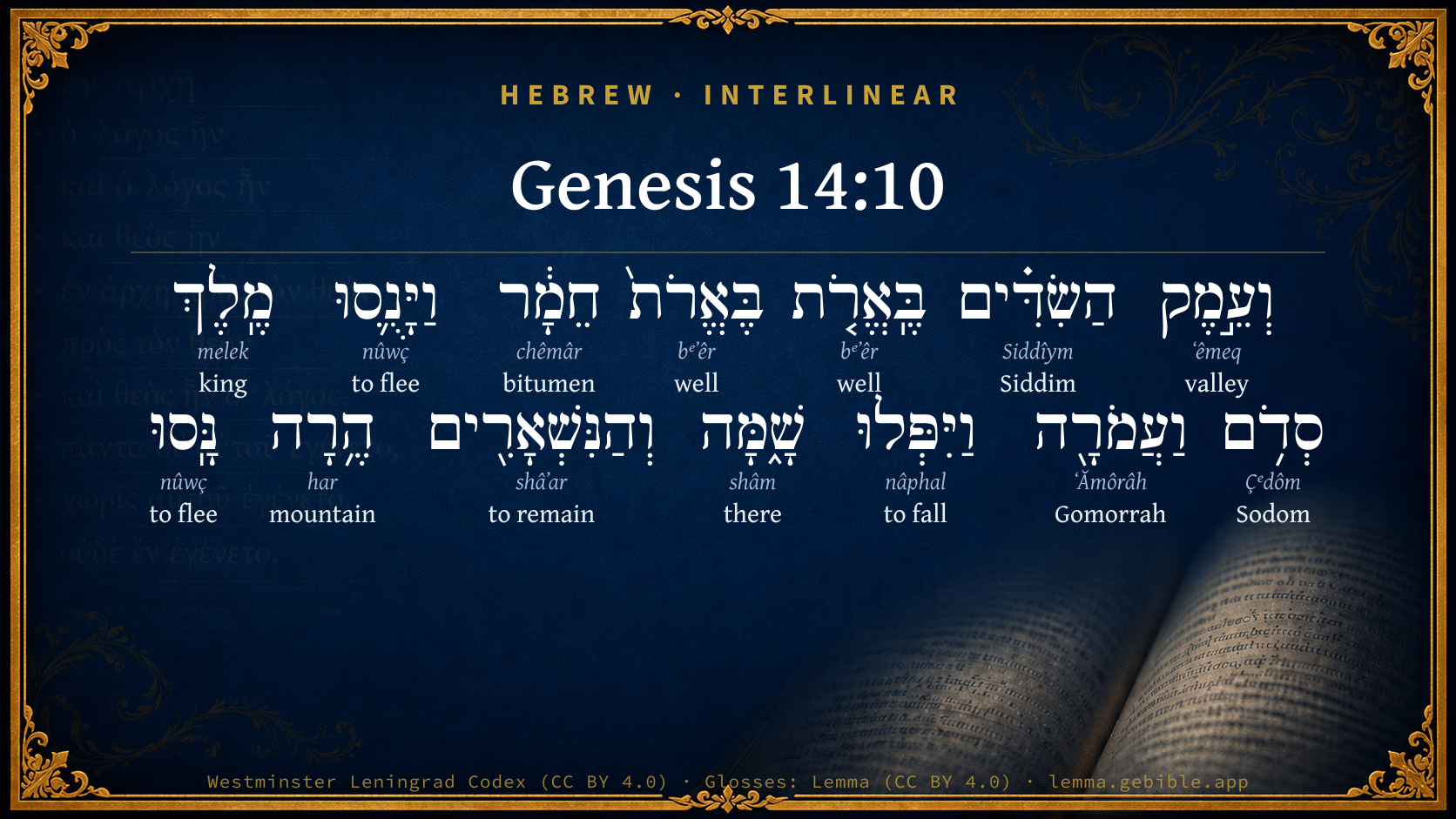
Hebrew (Westminster Leningrad Codex) Genesis 14:10 appears in the Hebrew Old Testament. The text above is from the Westminster Leningrad Codex. Each word links to its Strong’s number, a concise gloss, and parsing drawn from the Open Scriptures Hebrew Bible morphology. Click any word for its full Brown-Driver-Briggs (BDB) entry.
Download image
Cite this verse

Genesis 14:10 (World English Bible). Public Domain. Lemma interlinear Bible study tool, https://lemma.gebible.app/v/genesis/14/10.

Show BibTeX & RIS
BibTeX
RIS
English Translation
Now the valley of Siddim was full of tar pits; and the kings of Sodom and Gomorrah fled, and they fell there, and those who remained fled to the mountain.
World English Bible · Public Domain
Highlights
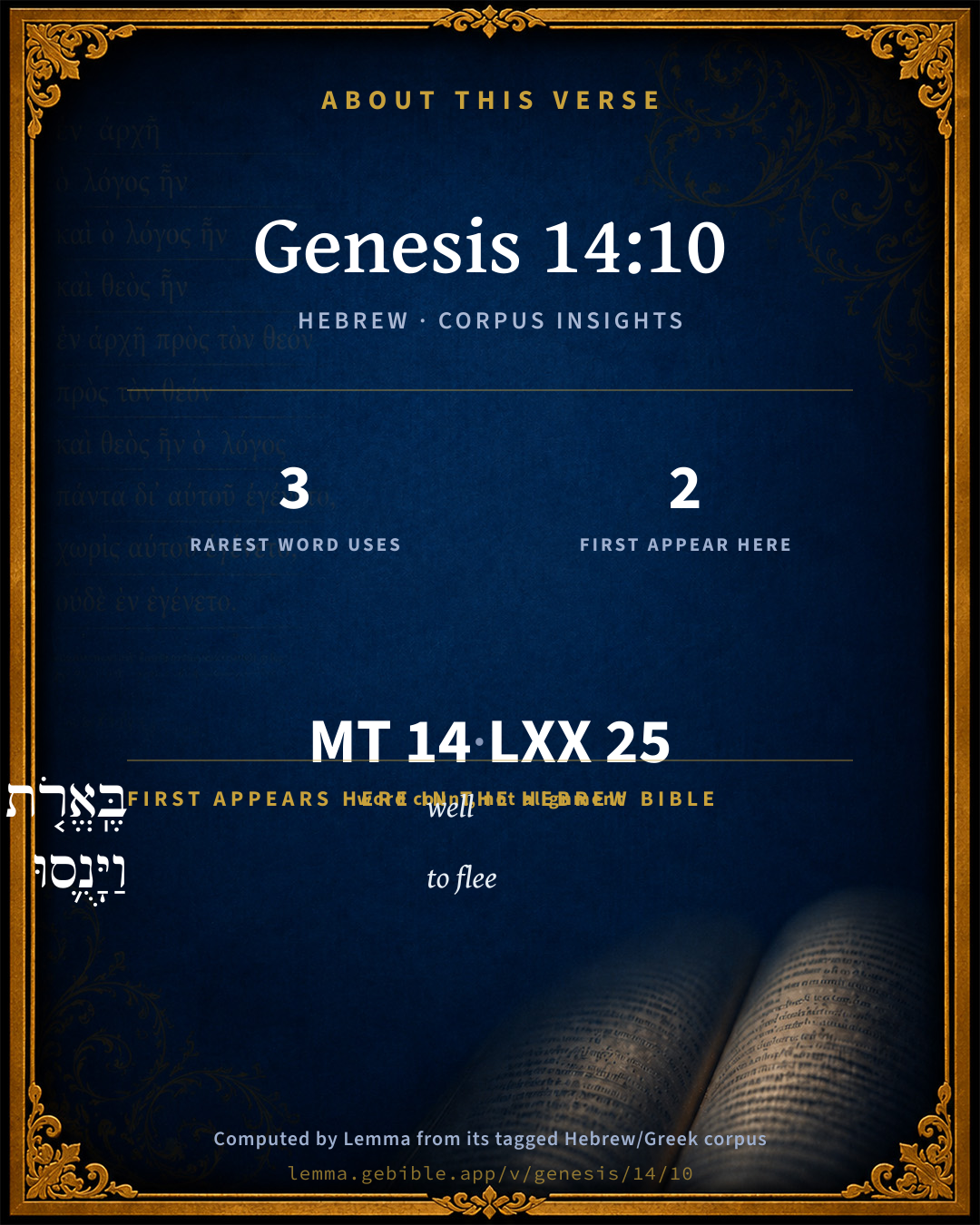
  • 2 first appearances in the Hebrew Bible
Full analysis ↓
Download a study sheet

One document with this verse’s original text, its word-by-word gloss line, the meaning frame, cross-references with their text, attributed commentary, and full source and license credits — printable, and it pastes into notes with its structure intact.

This verse Autodidact and up

Study sheet (.html) Plain text (.txt)

A passage Seminary Student

Up to 50 verses in one chapter. A passage sheet keeps up to 6 commentary sources and 12 cross-references per verse, in the order this page ranks them, and says so on the sheet whenever that leaves anything out. Ask for a single verse and you get the Autodidact verse sheet above.

Everything on this page stays free to read, with no account — the sheet is a download of what is already on screen, not access to it.

Want to remove ads? Support Godless Engineer
Compare translations 3

The same verse in 3 English versions, stacked beneath the original-language interlinear above. Click any original word for its lexicon entry.

Each is an independent rendering of the whole verse — the interlinear is not word-aligned to these translations.

Highlighted words mark where these versions differ — a whole-verse word diff, not a word-by-word alignment.

  • World English Bible Public Domain
    Now the valley of Siddim was full of tar pits; and the kings of Sodom and Gomorrah fled, and they fell there, and those who remained fled to the mountain.
  • King James Version Public Domain
    And the vale of Siddim was full of slime pits; and the kings of Sodom and Gomorrah fled, and fell there; and they that remained fled to the mountain.
  • unfoldingWord Literal Text CC BY-SA 4.0
    Now the Valley of Siddim many tar pits, and the kings of Sodom and Gomorrah fled, and they fell there. And those who remained fled to the hill country.

unfoldingWord Literal Text — © unfoldingWord, licensed CC BY-SA 4.0. Word-aligned USFM3 via Door43 (git.door43.org/unfoldingWord/en_ult).

Versions to compare (up to 4)

3 of 4 selected

Show all 18 translations

Every available English version of this verse, each an independent rendering of the whole verse.

  • World English Bible Public Domain
    Now the valley of Siddim was full of tar pits; and the kings of Sodom and Gomorrah fled, and they fell there, and those who remained fled to the mountain.
  • Berean Standard Bible Public Domain
    Now the Valley of Siddim was full of tar pits, and as the kings of Sodom and Gomorrah fled, some men fell into the pits, but the survivors fled to the hill country.
  • Majority Standard Bible Public Domain
    Now the Valley of Siddim was full of tar pits, and as the kings of Sodom and Gomorrah fled, some men fell into the pits, but the survivors fled to the hill country.
  • King James Version Public Domain
    And the vale of Siddim was full of slime pits; and the kings of Sodom and Gomorrah fled, and fell there; and they that remained fled to the mountain.
  • American Standard Version (1901) Public Domain
    Now the vale of Siddim was full of slime pits; and the kings of Sodom and Gomorrah fled, and they fell there, and they that remained fled to the mountain.
  • Revised Version (1885) Public Domain
    Now the vale of Siddim was full of slime pits; and the kings of Sodom and Gomorrah fled, and they fell there, and they that remained fled to the mountain.
  • Geneva Bible (1599) Public Domain
    Now the vale of Siddim was full of slime pits, and the Kings of Sodom and Gomorah fled and fell there: and ye residue fled to the mountaine.
  • Douay-Rheims (1899) Public Domain
    Now the woodland vale had many pits of slime. And the king of Sodom, and the king of Gomorrha turned their backs and were overthrown there: and they that remained fled to the mountain.
  • Young's Literal Translation Public Domain
    And the valley of Siddim `is' full of bitumen-pits; and the kings of Sodom and Gomorrah flee, and fall there, and those left have fled to the mountain.
  • Literal Standard Version CC BY-SA 4.0
    And the Valley of Siddim [is] full of bitumen-pits; and the kings of Sodom and Gomorrah flee, and fall there, and those left have fled to the mountain.
  • Unlocked Literal Bible CC BY-SA 4.0
    Now the Valley of Siddim was full of tar pits, and as the kings of Sodom and Gomorrah fled, they fell in there. Those who were left fled to the mountains.
  • unfoldingWord Literal Text CC BY-SA 4.0
    Now the Valley of Siddim many tar pits, and the kings of Sodom and Gomorrah fled, and they fell there. And those who remained fled to the hill country.
  • Darby Bible Public Domain
    And the vale of Siddim was full of pits of asphalt. And the kings of Sodom and Gomorrah fled, and fell there: and they that remained fled to the mountain.
  • World Messianic Bible Public Domain
    Now the valley of Siddim was full of tar pits; and the kings of Sodom and Gomorrah fled, and some fell there. Those who remained fled to the hills.
  • Webster's Bible Public Domain
    And the vale of Siddim was full of slime-pits; and the kings of Sodom and Gomorrah fled, and fell there: and they that remained fled to the mountain.
  • Free Bible Version CC BY-SA 4.0
    There were many tar pits in the Valley of Siddim, and as the defeated kings of Sodom and Gomorrah ran away, some of their men fell into them while the rest ran to the hills.
  • Bible in Basic English Public Domain
    Now the valley of Siddim was full of holes of sticky earth; and the kings of Sodom and Gomorrah were put to flight and came to their end there, but the rest got away to the mountain.
  • JPS Tanakh (1917) Public Domain
    Now the vale of Siddim was full of slime pits; and the kings of Sodom and Gomorrah fled, and they fell there, and they that remained fled to the mountain.

Literal Standard Version (2020), Covenant Press — licensed CC BY-SA 4.0. Text via the HelloAO Bible API (eBible.org). Unlocked Literal Bible (unfoldingWord) — licensed CC BY-SA 4.0. Text via the HelloAO Bible API (eBible.org). unfoldingWord Literal Text — © unfoldingWord, licensed CC BY-SA 4.0. Word-aligned USFM3 via Door43 (git.door43.org/unfoldingWord/en_ult). Free Bible Version, Dr. Jonathan Gallagher — licensed CC BY-SA 4.0. Text via the HelloAO Bible API (eBible.org).

Word by word

More ways to search: Search by grammar → Find every occurrence → Compare this word →

Practice this passage: Drill this verse → Learn its vocabulary →

הַשִׂדִּ֗ים
Siddîym
H7708
“the · Siddim”
Particle, Definite Article + Noun, Proper
Part of Speech
Particle + Noun
Type
Proper
Full BDB Definition

Origin: pl. from the same as H7704

TWOT: None

Siddim = "field" or " plain" - valley where the Dead Sea is located
  1. וְעֵ֣מֶק ʻêmeq H6010 “and · valley of” Conjunction + Noun, Common, Masculine, Singular, Construct
  2. בֶּֽאֱרֹ֤ת bᵉʼêr H875 “wells of” Noun, Common, Feminine, Plural, Construct
  3. בֶּאֱרֹת֙ bᵉʼêr H875 “wells of” Noun, Common, Feminine, Plural, Construct
  4. חֵמָ֔ר chêmâr H2564 “bitumen” Noun, Common, Masculine, Singular, Absolute
  5. וַיָּנֻ֛סוּ nûwç H5127 “and · to flee” Conjunction + Verb, Qal, Sequential Imperfect, 3rd Person, Masculine, Plural
  6. מֶֽלֶךְ melek H4428 “king of” Noun, Common, Masculine, Singular, Construct
  7. סְדֹ֥ם Çᵉdôm H5467 “Sodom” Noun, Proper
  8. וַעֲמֹרָ֖ה ʻĂmôrâh H6017 “and · Gomorrah” Conjunction + Noun, Proper
  9. וַיִּפְּלוּ nâphal H5307 “and · to fall” Conjunction + Verb, Qal, Sequential Imperfect, 3rd Person, Masculine, Plural
  10. שָׁ֑מָּה shâm H8033 “there · toward” Adverb + Suffix, Demonstrative
  11. וְהַנִּשְׁאָרִ֖ים shâʼar H7604 “and · the · remaining” Conjunction + Particle, Definite Article + Verb, Niphal, Participle Active, Masculine, Plural, Absolute
  12. הֶ֥רָה har H2022 “mountain · toward” Noun, Common, Masculine, Singular, Absolute + Suffix, Demonstrative
  13. נָּֽסוּ nûwç H5127 “to flee” Verb, Qal, Perfect, 3rd Person, Common, Plural

About this verse

These counts appear in no published source. They are computed here, from the morphology-tagged text and Lemma’s own curated glosses. What Lemma adds →

14
words
12
distinct lemmas
Pentateuch
section

Notable vocabulary

The rarest word here is הַשִׂדִּ֗ים Siddim H7708 — appearing just 3 times in the whole Hebrew Bible.

First appearance in Scripture

These words make their first canonical appearance in the Hebrew Bible here:

  • בֶּֽאֱרֹ֤ת well H875
  • וַיָּנֻ֛סוּ to flee H5127

Shared distinctive vocabulary

הַשִׂדִּ֗ים Siddim H7708 occurs in 3 verses of the Hebrew Bible. Also found in:

Grammatical profile

  • 4 verbs
  • 9 nouns
  • 1 adverb

Verb forms

  • וַיָּנֻ֛סוּ Qal · Sequential Imperfect
  • וַיִּפְּלוּ Qal · Sequential Imperfect
  • וְהַנִּשְׁאָרִ֖ים Niphal · Participle Active
  • נָּֽסוּ Qal · Perfect

Repetition

Words recur within this verse — often emphatic in Hebrew:

  • בֶּֽאֱרֹ֤ת well H875 ×2
  • וַיָּנֻ֛סוּ to flee H5127 ×2

Hebrew & Septuagint length

In English translation the verse runs 30 words from the Hebrew and 33 from the Septuagint (LXX English) — closely comparable.

A rough comparison of the two English renderings, which tokenize alike — not a word-level alignment.

Word counts can differ between the Hebrew and the Greek without any difference in meaning — e.g. the Hebrew direct-object marker אֵת has no separate Greek word, and Greek often adds the article ὁ.

In the original languages it is 14 Hebrew tokens and 25 Greek tokens — but the two are counted differently (Hebrew bundles its prefixes and suffixes into one token; the Greek is in lemma form), so that isn’t a like-for-like length.

Cross-references

7

Topical passages linked to Genesis 14:10 in the Treasury of Scripture Knowledge — connected by theme and wording, ordered by reader-vote popularity; previews shown in the World English Bible.

  • Genesis 19:17 It came to pass, when they had taken them out, that he said, "Escape for your life! Don't look behind you, neither stay anywhere in the plain. Escape to the mountain, lest you be consumed!"
  • Genesis 11:3 They said one to another, "Come, let's make brick, and burn them thoroughly." They had brick for stone, and they used tar for mortar.
  • Genesis 19:30 Lot went up out of Zoar, and lived in the mountain, and his two daughters with him; for he was afraid to live in Zoar. He lived in a cave with his two daughters.
  • Isaiah 24:18 It shall happen, that he who flees from the noise of the fear shall fall into the pit; and he who comes up out of the midst of the pit shall be taken in the snare: for the windows on high are opened, and the foundations of the earth tremble.
  • Jeremiah 48:44 He who flees from the fear shall fall into the pit; and he who gets up out of the pit shall be taken in the snare: for I will bring on him, even on Moab, the year of their visitation, says Yahweh.
  • Joshua 8:24 It happened, when Israel had made an end of killing all the inhabitants of Ai in the field, in the wilderness in which they pursued them, and they were all fallen by the edge of the sword, until they were consumed, that all Israel returned to Ai, and struck it with the edge of the sword.
  • Psalms 83:10 Who perished at Endor, Who became as dung for the earth.

Cross-references courtesy of OpenBible.info (CC BY 4.0).

Hebrew and Greek witnesses Masoretic Hebrew ↔ Greek Septuagint

The same verse in the two great witnesses to the Old Testament, shown verse-for-verse.

These are two independent witnesses, not word-aligned to each other, and the Septuagint is shown in lemma (dictionary) form.

Hebrew Genesis 14:10 Masoretic · Westminster Leningrad Codex

וְעֵ֣מֶק הַשִׂדִּ֗ים בֶּֽאֱרֹ֤ת בֶּאֱרֹת֙ חֵמָ֔ר וַיָּנֻ֛סוּ מֶֽלֶךְ סְדֹ֥ם וַעֲמֹרָ֖ה וַיִּפְּלוּ שָׁ֑מָּה וְהַנִּשְׁאָרִ֖ים הֶ֥רָה נָּֽסוּ

Now the valley of Siddim was full of tar pits; and the kings of Sodom and Gomorrah fled, and they fell there, and those who remained fled to the mountain.

World English Bible · Public Domain

Greek LXX Genesis 14:10 Septuagint · lemma form

ὁ δέ κοιλάς ὁ ἁλυκός φρέαρ φρέαρ ἄσφαλτος φεύγω δέ βασιλεύς σοδομα καί βασιλεύς γομορρα καί ἐνπίπτω ἐκεῖ ὁ δέ καταλείπω εἰς ὁ ὀρεινή φεύγω

Now the salt valley consists of slime-pits. And the king of Sodom fled and the king of Gomorrha, and they fell in there: and they that were left fled to the mountain country.

LXX2012 (modern English Septuagint) · Public Domain

Hebrew: Westminster Leningrad Codex (CC BY 4.0). Greek: Septuagint (public domain); English from LXX2012 (modern English Septuagint) (Public Domain). How the Septuagint differs from the Hebrew →

Targum (Aramaic paraphrase)

2

The Targum is the ancient Jewish Aramaic paraphrase of the Hebrew Scriptures — an interpretive translation, not the Hebrew text itself. Onkelos (literal) and Pseudo-Jonathan (expansive) render the Torah, and Jonathan the Prophets. Coverage is partial: where no permissively-licensed English translation exists for a verse, only the Aramaic is shown. This is verse-level text, not a word-by-word alignment to the Hebrew.

  1. Targum Onkelos Torah (Genesis–Deuteronomy)
    וּמֵישַׁר חַקְלַיָא בֵּירִין בֵּירִין מַסְקַן חֵימָרָא וַעֲרָקוּ מַלְכָּא דִסְדוֹם וַעֲמוֹרָה וּנְפָלוּ תַמָן וּדְאִשְׁתָּאֲרוּ לְטוּרָא עֲרָקוּ

    And the plain of the field had many pits, from which they raised asphalta; and the kings of Sedom and Amorah fled, and they fell there; and they who remained fled to the mountain.

    Targum Onkelos — Aramaic: “Onkelos Genesis” (public domain); “Onkelos Exodus” (public domain); “Onkelos Leviticus” (public domain); “Onkelos Numbers” (public domain); “Onkelos Deuteronomy” (public domain). English: “Sefaria Community Translation” (CC0 1.0 (public-domain dedication)); “J.W. Etheridge. The Targums of Onkelos and Jonathan Ben Uzziel on the Pentateuch. London: Longmans, Green, 1862” (public domain). Text via Sefaria.

  2. Targum Pseudo-Jonathan Torah (Genesis–Deuteronomy)
    וּמֵישַׁר פַרְדְסַיָא בֵּירִין בֵּירִין מַלְיָן חִימְרָן וַעֲרָקוּ מַלְכָּא דִסְדוֹם וַעֲמוֹרָה וּנְפָלוּ תַמָן וְדִשְׁתַּאֲרוּ לְטַוְורֵיהּ עָרָקוּ

    And the valley of the gardens had many pits filled with bitumen: and the kings of Sedom and Amora fled away, and fell there; and they who were left fled to the mountains.

    Targum Pseudo-Jonathan — Aramaic: “Targum Jonathan on Genesis” (public domain); “Targum Jonathan on Exodus” (public domain); “Targum Jonathan on Leviticus” (public domain); “Targum Jonathan on Numbers” (public domain); “Targum Jonathan on Deuteronomy” (public domain). English: “The Targum of Jonathan ben Uzziel, trans. J. W. Etheridge, London, 1862” (public domain). Text via Sefaria.

Commentary

Notes on Genesis 14:10 from classic Christian and Jewish commentators (each source and its license shown beneath its notes). The classic Christian expositions comment on the surrounding passage and are grouped to its opening verse, so a note may address several verses; the Jewish commentaries on the Tanakh (Rashi and others) are per-verse, so they appear only where the commentator wrote on this verse.

Lemma curates 59 commentaries, every one of them public domain or Creative Commons licensed, each selected and text-cleaned for this edition rather than reprinted as found. About our sources →

Trapp's Complete Commentary

John Trapp

Gen 14:10 And the vale of Siddim [was full of] slimepits; and the kings of Sodom and Gomorrah fled, and fell there; and they that remained fled to the mountain.

Ver. 10. And the vale of Siddim was full of slimepits.] Chosen therefore on purpose by the five kings, who fled and fell there; or (as some understand the text) made haste to fall down there; {a} skulking and scouting, {b} till their enemies should pursue them, and so perish in those pits. But their cunning failed them; for as they had travailed with iniquity and conceived mischief, so they brought forth a lie. They "made a pit and digged it, but fell into the ditch that themselves had made". {Psa 7:15} The way of this world, saith one, is like the vale of Siddim, slimy and slippery, full of slime pits and pitfalls, springs and stumbling-blocks, laid by Satan to maim or mischieve us, to procure our ruin or ruth. To defeat him therefore (as these four kings did the five), let us tread gingerly, step warily, lift not up one foot till we find sure footing for the other: let us look ere we leap. Alioqui saliens antequam videat, casurus est antequam debeat , as St Bernard hath it. {c}

{a} Celeriter se deiecerunt . - Piscat.

{b} Eo consilio ut hostes ignari locorum ,& c. - Idem.

{c} Bern. De Bon. Deser.

John Trapp, A Commentary or Exposition upon All the Books of the Old and New Testament (1647–1656) — public domain. Text from a community e-Sword module.

Geneva Bible (1599)

Geneva Bible translators

Or, were discomfited.

And afterward was overwhelmed with water, and so was called the salt sea.

Geneva Bible (1599) marginal notes — public domain. Text via Bolls.life.

Adam Clarke's Commentary

Verse 10. Slime-pits] Places where asphaltus or bitumen sprang out of the ground; this substance abounded in that country.

Fell there] It either signifies they were defeated on this spot, and many of them slain, or that multitudes of them had perished in the bitumen-pits which abounded there; that the place was full of pits we learn from the Hebrew, which reads here בארת בארת beeroth beeroth, pits, pits, i.e., multitudes of pits. A bad place to maintain a fight on, or to be obliged to run through in order to escape.

Adam Clarke's Commentary on the Bible (1810–1826) — public domain. Text from a community e-Sword/MySword module.

John Calvin's Commentaries

10. And the kings of Sodom and Gomorrah fled. Some expound that they had fallen into pits: but this is not probable, since they were by no means ignorant of the neighboring places: such an event would rather have happened to foreign enemies. Others say, that they went down into them for the sake of preserving their lives. I, however, understand them to have exchanged one kind of death for another, as is common in the moment of desperation; as if Moses had said, the swords of the enemy were so formidable to them, that, without hesitation, they threw themselves headlong into the pits. For he immediately afterwards subjoins, that they who escaped fled to the mountains. Whence we infer, that they who had rushed into the pits had perished. Only let us know, that they fell, not so much deceived through ignorance of the place, as disheartened by fear.

John Calvin's Commentaries (1540-1563) — public domain. Text from the Calvin Translation Society English edition (1840s-50s) via the Christian Classics Ethereal Library (ccel.org). Calvin's coverage is partial (roughly two-thirds of the Bible); uncommented books and verses are honest gaps, never fabricated. The 19th-century editor's footnotes and remarks are omitted so the notes are faithfully Calvin's own voice.

Ellicott's Commentary for English Readers

(10) The vale of Siddim was full of slimepits.—That is, of holes whence bitumen had been excavated. Layers of this natural asphalte, well known both to the Greeks and Romans as pia Judaica, Judean pitch, still exist on the western side of the Dead Sea; and the places whence it had been dug out, and which are often very deep, formed dangerous impediments in the way of the defeated side.

A Bible Commentary for English Readers, edited by Charles John Ellicott (1878–1897) — public domain. Text from a community e-Sword module.

The Cambridge Bible for Schools and Colleges

gen. ed. J. J. S. Perowne

10. full of slime pits] i.e. bitumen pits. Bitumen, or asphalt, is found in the neighbourhood of the Dead Sea. Josephus speaks of the bitumen floating upon the surface of its waters. Here we are to suppose that the bitumen came out of large holes or pits in the earth, into which the confederates fell in their flight.

“Full of slime pits.” The Hebrew idiom gives be’erôth be’erôth ḥêmar, “pits, pits of bitumen” = “all bitumen pits.” Cf. 2Ki_3:16, “trenches, trenches” = “nothing but trenches.”

The narrative is so fragmentary, or condensed, that only the rout is recorded.

they fell] Referring to the fugitive troops generally. The king of Sodom appears again in Gen_14:17. It is implied that those who fell into the pits were lost.

to the mountain] i.e. to the mountains of Moab, the chain of hills on the east side of the Dead Sea.

The Cambridge Bible for Schools and Colleges (gen. ed. J. J. S. Perowne; Cambridge University Press, 1878–1918) — public domain. Text from a community e-Sword module.

John Gill's Exposition

And the vale of Siddim was full of slimepits,.... Or "wells" or "fountains of slime" or bitumen (s); a liquid of a pitchy nature, cast out of fountains, and which was used for a cement in buildings; such fountains were near Babylon; see Gill on Gen 11:3; so that this place was naturally prepared for what it was designed to be, a bituminous lake; and hence, when turned into one, it was called the lake Asphaltites, from this slime or bitumen, called by the Greeks "asphaltos". Brocardus (t) says, these pits or wells of bitumen are at this day on the shore of the lake, each of them having pyramids erect, which he saw with his own eyes; and such pits casting out bitumen, as fountains do water, have been found in other countries, as in Greece (u). Now this vale being full of such pits, the kings of Sodom and Gomorrah chose it to fight in, and here drew up in a line of battle, hoping that the enemy, being ignorant of them, would fall into them and perish, and their ranks be broke and fall into confusion; but as it often is, that the pit men dig and contrive for others they fall into themselves, so it was in this case:

and the kings of Sodom and Gomorrah fled: the battle going hard against them, and they not able to stand before their enemies:

and fell there, or "into them" (w); the slimepits, or fountains of bitumen, into which they precipitately fell, and many perished; or of their own accord they threw themselves into them for their own safety, as some think; though the sense may be this, that there was a great slaughter of them made there, as the word is frequently used, see Sa1 4:10; this is to be understood not of the kings of Sodom and Gomorrah; for it is certain that they were preserved alive, at least the king of Sodom, for we hear of him afterwards, Gen 14:17; but of their soldiers:

and they that remained fled to the mountain: or mountains hard by, where Lot after went when Sodom was destroyed, Gen 19:30; hither such fled that escaped the sword of the enemy, or perished not in the slimepits, judging it more safe to be there, than to be in their cities, which would fall into the hands of their enemies, and be plundered by them, and where they would be in danger of losing their lives.

(s) "putei, putei bituminis", Vatablus, Piscator, Cartwright, Drusius, Schmidt; so Jarchi. (t) Apud Adricom. Theatrum Terrae Sanct. p. 44. (u) Aelian. Var. Hist. l. 13. c. 16. (w) "in eos", Cocceius.

John Gill's Exposition of the Whole Bible (1746–1763) — public domain (CC PDM 1.0). Text via the HelloAO Bible API.

Haydock's Catholic Bible Commentary

Of slime. Bituminis. This was a kind of pitch, which served for mortar in the building of Babel, Genesis xi. 3, and was used by Noe in pitching the ark. (Challoner) --- Moses does not make this remark without reason. This bitumen would easily take fire, and contribute to the conflagration of Sodom. (Calmet) --- Overthrown, not all slain, for the king of Sodom escaped, ver. 17.

George Leo Haydock (1774–1849), Haydock's Catholic Family Bible and Commentary, 1859 edition — public domain. Excludes Psalms (Douay-Rheims chapter numbering differs from Protestant) and Deuterocanonical books (Catholic canon only).

Matthew Poole's English Annotations

The vale of Siddim was chosen by those five kings for the place of battle, that their adversaries being ignorant of the place might unawares fall into those pits, which they by their knowledge of it thought to escape.

Kings of Sodom and Gomorrah, i.e. their armies; a figurative speech, frequent in Scripture and other authors; for their persons escaped: see Gen 14:17. They either,

1. Fell into the pits which they designed for others; or rather,

2. Were slain, as this word is oft used, as Jos 8:24-25; Jdg 8:10; 12:6; and here too; for those that fell are here opposed to those that remained.

Matthew Poole's English Annotations on the Holy Bible (1683–1685) — public domain. Text from a community e-Sword/MySword module.

Whedon's Commentary on the Bible

Daniel D. Whedon

10. Full of slimepits — Sept., φρεατα ασφαλτου, pits of asphaltum; Vulg., puteos multos bituminis, many pits of bitumen. The Hebrew may be rendered: The vale of Siddim was pits, pits of mineral pitch; that is, such bituminous pits abounded there; and this abundance of asphalt has given the Dead Sea the name Asphaltic Lake. These pits served as so many snares to the kings of Sodom and Gomorrah, who, with their forces, were defeated, and fled, and fell there. These two kings seem to have taken the lead in the battle, and so are mentioned as representing all the rest. From Gen_14:17; Gen_14:21 we infer that the king of Sodom himself escaped capture, probably by fleeing to the mountains.

They that remained — That is, those who were neither killed in battle nor taken prisoners.

Daniel D. Whedon (gen. ed.), Commentary on the Old and New Testaments (1874–1909) — public domain. Text from a community e-Sword module.

The Pulpit Commentary

And the vale of Siddim was full of slime-pits. Literally, was pits, pits (cf. 2Ki_3:16; Eze_42:12 for examples of repeated nouns) of slime, bitumen or asphalte, and therefore unfavorable for flight. "Some of the wells near the Dead Sea are 116 feet deep, with a stratum of bitumen fifteen feet in depth, and as black as jet" (Inglis). And the kings of Sodom and Gomorrah fled and fell there. Stumbled into the pits and perished (Keil, Lange, Murphy), though if the king of Sodom escaped (Ver. 17), the language may only mean that they were overthrown there (Knobel, Rosenm Bush, "Speaker"s Commentary"). And they that remained fled to the mountain, of Moab, with its numerous defiles.

The Pulpit Commentary (1880–1919), ed. H.D.M. Spence-Jones & Joseph S. Exell — public domain. Text from a community e-Sword module.

unfoldingWord translationNotes

Door43 World Missions Community

Now

This word introduces background information about the valley of Siddim. Your language may have another way of introducing background information. (See: Background Information)

was full of tar pits

"had many tar pits." These were holes in the ground that had tar in them.

tar

a thick, sticky, black liquid that comes up from the ground. See how this is translated in Genesis 11:3.

the kings of Sodom and Gomorrah

Here the kings represent themselves and their armies. AT: the kings of Sodom and Gomorrah and their armies" (See: Synecdoche)

they fell in there

Possible meanings are 1) some of their soldiers fell in the tar pits or 2) the kings themselves fell in the tar pits. Since Genesis 14:17 says that the king of Sodom went to meet Abram, the first meaning is more likely correct. (See: Metonymy)

Those who were left

"Those who did not die in battle and did not fall in the pits"

the goods of Sodom and Gomorrah

The words "Sodom" and "Gomorrah" are metonyms for the people who lived in those cities. AT: "the wealth of the people of Sodom and Gomorrah" or "the property of the people of Sodom and Gomorrah" (See: Metonymy)

their provisions

"their food and drink"

went their way

"they went away"

they also took Lot, Abram's brother's son, who was living in Sodom, along with all his possessions

The phrases "Abram's brother's son" and "who was living in Sodom" remind the reader of things that were written earlier about Lot. AT: "they also took Lot, along with all his possessions. Lot was Abram's brother's son and was living in Sodom at that time" (See: Distinguishing versus Informing or Reminding)

translationWords

king

Sodom

Gomorrah

Lot

Abraham

unfoldingWord translationNotes — © Distant Shores Media and the Door43 World Missions Community, licensed CC BY-SA 4.0. Source: git.door43.org/Door43/en_tn.

Rashi

Rabbi Shlomo Yitzchaki (Rashi)

בארת בארת חמר FULL OF BITUMEN PITS — There were many pits there from which they took earth as clay for building purposes. The Midrashic explanation is that the clay was closely kneaded together in them (was very sticky) so that it was only because a miracle was performed for the king of Sodom that he escaped from them. For amongst those nations there were some who did not believe that Abraham had been delivered from Ur-Kasdim — from the fiery furnace — but as soon as this one escaped from the slime they corrected their past disbelief regarding what had happened to Abraham (literally, they believed retrospectively in Abraham) (Genesis Rabbah 42:7).

הרה נסו means THEY FLED TO A MOUNTAIN. The word הרה is the same as לְהַר. When a word requires a ל as a prefix one may put instead a ה as a suffix. There is a difference between הֶרָה and הָהָרָה, for the ה at the end takes the place of a לְ (with Shewa) prefixed (another version has: for the ה at the end does not take the place of a prefixed ל with Patach which would mean to “the”) so that הֶרָה is equal to לְהַר or to אֶל הַר to “a” mountain, without explaining which mountain — so that the meaning here is that each person fled to the first mountain he came across. When, however, a ה is prefixed to a word having this ה suffix so that it reads e. g., הָהרה or הַמדברה, it is the same as אל הָהר or לְהָהר (to “the” mount) signifying that mount which is well-known and has been definitely mentioned in the passage.

Rashi on the Tanakh — English translations: “The Judaica Press complete Tanach with Rashi, translated by A. J. Rosenberg” (CC BY 4.0); “Pentateuch with Rashi's commentary by M. Rosenbaum and A.M. Silbermann, 1929-1934” (public domain); “The Metsudah Tanach series, Lakewood, N.J” (CC BY 4.0); and “The Book of Joshua, Metsudah Publications, 1997” (CC BY 4.0). Text via Sefaria.

Ramban (Nachmanides)

Rabbi Moshe ben Nachman (Ramban / Nachmanides)

‘BE’EROTH BE’EROTH CHEIMAR’ (FULL OF SLIME PITS). There were many pits there since they removed earth to be used as clay for building purposes. The Midrashic explanation is that the clay was closely kneaded together in them, [that is, it was very sticky], but a miracle happened to the king of Sodom and he escaped from there. This miracle occurred because there were some among the nations who did not believe that Abram had been delivered from the fiery furnace, but as soon as this one escaped from the slime, in retrospect they believed in Abram. Thus the language of Rashi.There is no doubt that the meaning of be’eroth cheimar is “pits containing mud and slime,” even as it is written, And in the pit there was no water, but mire, and Jeremiah sank in the mire, and it is further written, He brought me up out of the tumultuous pit, out of the miry clay. And it is possible that the king of Sodom went out from there naturally, without a miracle.And I wonder concerning the above Midrashic explanation, for those nations that did not believe that the Holy One, blessed be He, had performed a miracle for Abraham would not have their faith in the Holy One, blessed be He, augmented by witnessing the miracle which befell the king of Sodom. The king of Sodom was an idol worshipper, and his miracle would either strengthen the hands of the idol worshippers or it would cause them to believe that all miracles are done by witchcraft or are due to some remotely possible chance. His miracle would thus cast doubt into the hearts of those who believed in Abraham’s miracle! Perhaps [the Rabbis who authored this Midrashic explanation] will interpret the verse, And the king of Sodom went out to meet him, as implying that “he went out” from the pit when Abraham passed by for it was in honor of Abraham that a miracle was done to him so that he could go forth to meet him in order to honor and bless Abraham.And it is possible that Abraham, upon his return, looked into that pit for he wanted to save the kings and return their wealth to them, and then the miracle happened on his account. Now if a miracle was done to the king of Sodom in honor of Abraham, the nations could now believe all the more that a miracle would be done to Abraham himself in order to rescue him from death.We must further say that the king of Gomorrah had already died when Abraham passed him by or that he had fallen into another pit, as the word “there” The word “there” does not refer to the pit, in which case it would then imply that all five kings fell into one pit. Rather it refers to ‘the vale’ of Siddim. Thus the king of Gomorrah fell into a different pit, near which Abraham did not pass. refers to “the vale.”

Ramban (Nachmanides) on the Tanakh — English translation: “Commentary on the Torah by Ramban (Nachmanides). Translated and annotated by Charles B. Chavel. New York, Shilo Pub. House, 1971-1976” (CC BY 4.0). Text via Sefaria.

Radak

Rabbi David Kimhi (Radak)

ועמק השדים בארות בארות חמר, the vowel pattern of the construct mode of the word בארות in our verse is different from the ordinary plural mode of the same word in Genesis 26,18 where it also appears in the construct mode, i.e. בארות המים, “the wells of water.”

The word חמר is equivalent to what we know as טיט, (11,3) where it means mortar. It is unbaked clay, binding bricks together, loam.

וינסו מלך סדום ועמורה, the other kings fled toward the mountains, as we are told והנשארים הרה נסו. “those remaining fled towards the mountain.” The letter ה at the end of the word הרה is equivalent to the prefix ל.

Radak on the Tanakh — English translations: “Sefaria Community Translation” (CC0 1.0 (public-domain dedication)); “Eliyahu Munk, HaChut Hameshulash” (CC BY 4.0); “Rabbi Mike Feuer, Jerusalem Anthology” (CC BY 4.0); and “R. David Kimhi on the first book of Psalms, Translated by R.G. Finch, London, 1919” (public domain). Text via Sefaria.

Lesson kit

Teaching starters — assembled from the data on this page, not authored interpretation. Every prompt links to the verse data it draws on. Edit before teaching.

Genesis, in the Pentateuch, opens this verse with 14 words (12 distinct Hebrew lemmas). Its most distinctive word is Siddîym (“Siddim”). A historical commentator’s framing appears above. Read the whole chapter for the surrounding context.

Discussion questions

  1. How does “Siddim” (Siddîym) shape what this verse is saying?
  2. 2 words here appear for the first time in Scripture. What is being introduced at this debut?
  3. Genesis 14:3 shares the word «Siddim» with this verse. How do the two illuminate each other?
  4. “well” occurs 2× in this one verse. What is the effect of the repetition?
  5. The translations on this page render this verse differently — a whole-verse word diff, not a word-by-word alignment. What might account for the different wordings?
  6. The verb «וַיָּנֻ֛סוּ» is Qal Sequential Imperfect. How does its form color the action?
  7. Reading how Trapp's Complete Commentary and Geneva Bible (1599) read this verse, where do the two commentators agree and where do they part?

Things to notice

Reading settings

Reading text

Shown beneath each verse's original-language words.

Old Testament
Old Testament edition

Read the OT as the Masoretic Hebrew (MT) or the Greek Septuagint (LXX).

English shown for the Greek Septuagint (in the Hebrew ↔ Greek comparison).

Comparing translations? Open the Compare panel on any verse page to stack up to four side by side.