
Leviticus 11:32

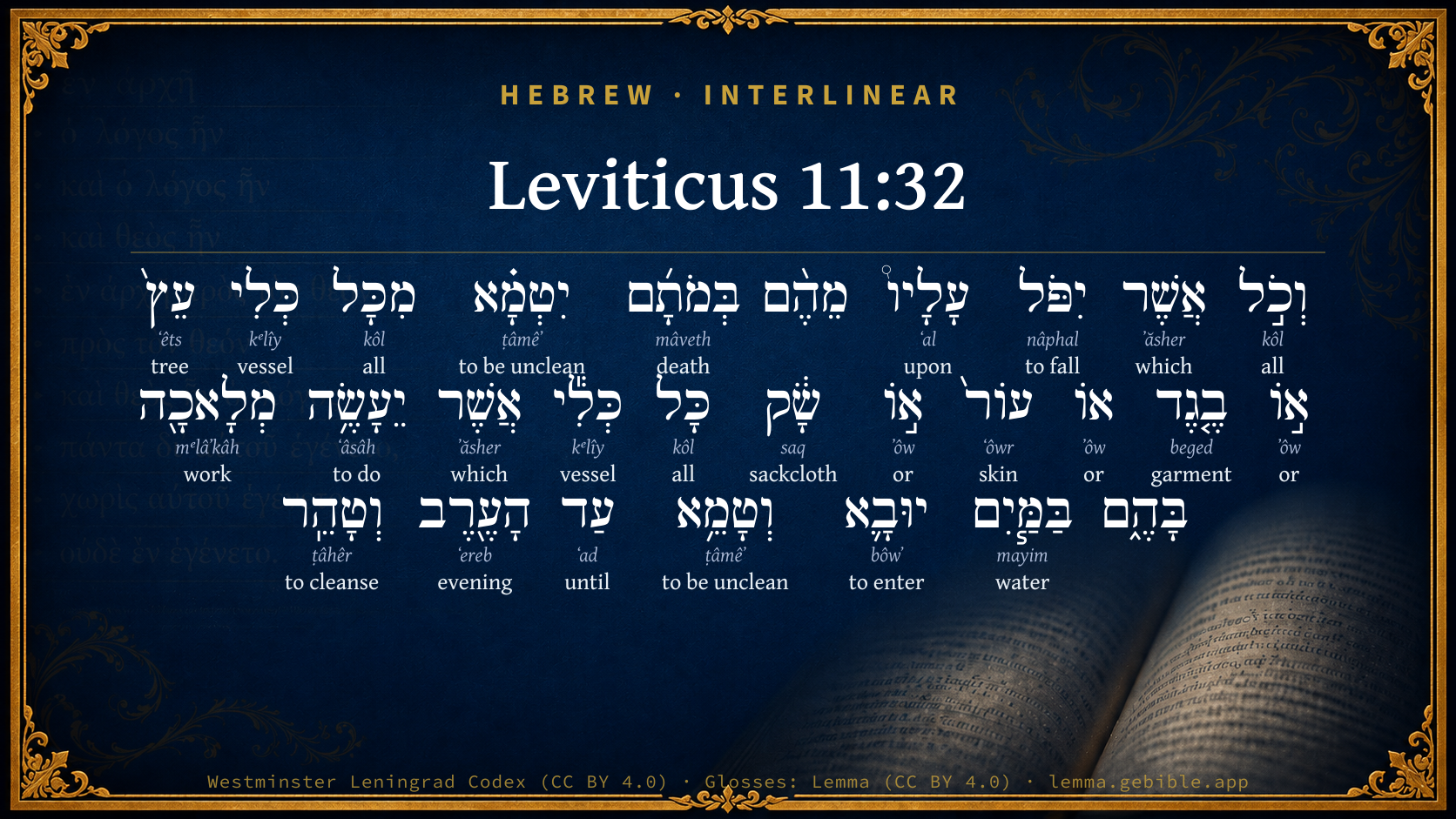
Hebrew (Westminster Leningrad Codex) Leviticus 11:32 appears in the Hebrew Old Testament. The text above is from the Westminster Leningrad Codex. Each word links to its Strong’s number, a concise gloss, and parsing drawn from the Open Scriptures Hebrew Bible morphology. Click any word for its full Brown-Driver-Briggs (BDB) entry.
Download image
Cite this verse

Leviticus 11:32 (World English Bible). Public Domain. Lemma interlinear Bible study tool, https://lemma.gebible.app/v/leviticus/11/32.

Show BibTeX & RIS
BibTeX
RIS
English Translation
On whatever any of them falls when they are dead, it shall be unclean; whether it is any vessel of wood, or clothing, or skin, or sack, whatever vessel it is, with which any work is done, it must be put into water, and it shall be unclean until the evening; then it will be clean.
World English Bible · Public Domain
Download a study sheet

One document with this verse’s original text, its word-by-word gloss line, the meaning frame, cross-references with their text, attributed commentary, and full source and license credits — printable, and it pastes into notes with its structure intact.

This verse Autodidact and up

Study sheet (.html) Plain text (.txt)

A passage Seminary Student

Up to 50 verses in one chapter. A passage sheet keeps up to 6 commentary sources and 12 cross-references per verse, in the order this page ranks them, and says so on the sheet whenever that leaves anything out. Ask for a single verse and you get the Autodidact verse sheet above.

Everything on this page stays free to read, with no account — the sheet is a download of what is already on screen, not access to it.

Want to remove ads? Support Godless Engineer
Compare translations 3

The same verse in 3 English versions, stacked beneath the original-language interlinear above. Click any original word for its lexicon entry.

Each is an independent rendering of the whole verse — the interlinear is not word-aligned to these translations.

Highlighted words mark where these versions differ — a whole-verse word diff, not a word-by-word alignment.

  • World English Bible Public Domain
    On whatever any of them falls when they are dead, it shall be unclean; whether it is any vessel of wood, or clothing, or skin, or sack, whatever vessel it is, with which any work is done, it must be put into water, and it shall be unclean until the evening; then it will be clean.
  • King James Version Public Domain
    And upon whatsoever any of them, when they are dead, doth fall, it shall be unclean; whether it be any vessel of wood, or raiment, or skin, or sack, whatsoever vessel it be, wherein any work is done, it must be put into water, and it shall be unclean until the even; so it shall be cleansed.
  • unfoldingWord Literal Text CC BY-SA 4.0
    And anything on which from them falls when they are dead will become unclean, from any vessel of wood or cloth or leather or sackcloth—any vessel that work is done with them shall be brought into the water, and it will be unclean until the evening. Then it will be clean.

unfoldingWord Literal Text — © unfoldingWord, licensed CC BY-SA 4.0. Word-aligned USFM3 via Door43 (git.door43.org/unfoldingWord/en_ult).

Versions to compare (up to 4)

3 of 4 selected

Show all 18 translations

Every available English version of this verse, each an independent rendering of the whole verse.

  • World English Bible Public Domain
    On whatever any of them falls when they are dead, it shall be unclean; whether it is any vessel of wood, or clothing, or skin, or sack, whatever vessel it is, with which any work is done, it must be put into water, and it shall be unclean until the evening; then it will be clean.
  • Berean Standard Bible Public Domain
    When one of them dies and falls on something, that article becomes unclean; any article of wood, clothing, leather, sackcloth, or any implement used for work must be rinsed with water and will remain unclean until evening; then it will be clean.
  • Majority Standard Bible Public Domain
    When one of them dies and falls on something, that article becomes unclean; any article of wood, clothing, leather, sackcloth, or any implement used for work must be rinsed with water and will remain unclean until evening; then it will be clean.
  • King James Version Public Domain
    And upon whatsoever any of them, when they are dead, doth fall, it shall be unclean; whether it be any vessel of wood, or raiment, or skin, or sack, whatsoever vessel it be, wherein any work is done, it must be put into water, and it shall be unclean until the even; so it shall be cleansed.
  • American Standard Version (1901) Public Domain
    And upon whatsoever any of them, when they are dead, doth fall, it shall be unclean; whether it be any vessel of wood, or raiment, or skin, or sack, whatsoever vessel it be, wherewith any work is done, it must be put into water, and it shall be unclean until the even; then shall it be clean.
  • Revised Version (1885) Public Domain
    And upon whatsoever any of them, when they are dead, doth fall, it shall be unclean; whether it be any vessel of wood, or raiment, or skin, or sack, whatsoever vessel it be, wherewith any work is done, it must be put into water, and it shall be unclean until the even; then shall it be clean.
  • Geneva Bible (1599) Public Domain
    Also whatsoeuer any of the dead carkeises of them doth fall vpon, shalbe vncleane, whether it be vessel of wood, or rayment, or skinne, or sacke: whatsoeuer vessel it be that is occupied, it shalbe put in the water as vncleane vntil the euen, and so be purified.
  • Douay-Rheims (1899) Public Domain
    And upon what thing soever any of their carcasses shall fall, it shall be defiled, whether it be a vessel of wood, or a garment, or skins or haircloths; or any thing in which work is done, they shall be dipped in water, and shall be unclean until the evening, and so afterwards shall be clean.
  • Young's Literal Translation Public Domain
    `And anything on which any one of them falleth, in their death, is unclean, of any vessel of wood or garment or skin or sack, any vessel in which work is done is brought into water, and hath been unclean till the evening, then it hath been clean;
  • Literal Standard Version CC BY-SA 4.0
    And anything on which anyone of them falls, in their death, is unclean, of any vessel of wood or garment or skin or sack, any vessel in which work is done is brought into water, and has been unclean until the evening, then it has been clean;
  • Unlocked Literal Bible CC BY-SA 4.0
    If any of them dies and falls on anything, that thing will be unclean, whether it is made of wood, cloth, leather, or sackcloth. Whatever it is and whatever it is used for, it must be put into water; it will be unclean until evening. Then it will be clean.
  • unfoldingWord Literal Text CC BY-SA 4.0
    And anything on which from them falls when they are dead will become unclean, from any vessel of wood or cloth or leather or sackcloth—any vessel that work is done with them shall be brought into the water, and it will be unclean until the evening. Then it will be clean.
  • Darby Bible Public Domain
    And on whatever any of them when they are dead doth fall, it shall be unclean; all vessels of wood, or garment, or skin, or sack, every vessel wherewith work is done -- it shall be put into water, and be unclean until the even; then shall it be clean.
  • World Messianic Bible Public Domain
    Anything they fall on when they are dead shall be unclean; whether it is any vessel of wood, or clothing, or skin, or sack, whatever vessel it is, with which any work is done, it must be put into water, and it shall be unclean until the evening. Then it will be clean.
  • Webster's Bible Public Domain
    And upon whatever any of them, when they are dead, doth fall, it shall be unclean; whether it is any vessel of wood, or raiment, or skin, or sack, whatever vessel it is, in which any work is done, it must be put into water, and it shall be unclean until the evening; so it shall be cleansed.
  • Free Bible Version CC BY-SA 4.0
    Anything that one of them dies and lands on becomes unclean. Whatever it is—something made of wood, clothing, leather, sackcloth, or any work tool—it must be washed with water and will be unclean until the evening. Then it will become clean.
  • Bible in Basic English Public Domain
    The dead body of any of these, falling on anything, will make that thing unclean; if it is any vessel of wood, or clothing, or skin, or bag, whatever it is, if it is used for any purpose, it will have to be put into water, and will be unclean till evening; after that it will be clean.
  • JPS Tanakh (1917) Public Domain
    And upon whatsoever any of them, when they are dead, doth fall, it shall be unclean; whether it be any vessel of wood, or raiment, or skin, or sack, whatsoever vessel it be, wherewith any work is done, it must be put into water, and it shall be unclean until the even; then shall it be clean.

Literal Standard Version (2020), Covenant Press — licensed CC BY-SA 4.0. Text via the HelloAO Bible API (eBible.org). Unlocked Literal Bible (unfoldingWord) — licensed CC BY-SA 4.0. Text via the HelloAO Bible API (eBible.org). unfoldingWord Literal Text — © unfoldingWord, licensed CC BY-SA 4.0. Word-aligned USFM3 via Door43 (git.door43.org/unfoldingWord/en_ult). Free Bible Version, Dr. Jonathan Gallagher — licensed CC BY-SA 4.0. Text via the HelloAO Bible API (eBible.org).

Word by word

More ways to search: Search by grammar → Find every occurrence → Compare this word →

Practice this passage: Drill this verse → Learn its vocabulary →

שָׂ֔ק
saq
H8242
“sackcloth”
Noun, Common, Masculine, Singular, Absolute
Part of Speech
Noun
Type
Common
Gender
Masculine
Number
Singular
State
Absolute
Full BDB Definition

Origin: from H8264

TWOT: 2282a

mesh, sackcloth, sack, sacking - sack (for grain) - sackcloth - worn in mourning or humiliation - same material spread out to lie on
  1. וְכֹ֣ל kôl H3605 “and · all” Conjunction + Noun, Common, Masculine, Singular, Absolute
  2. אֲשֶׁר ʼăsher H834 “which” Particle, Relative
  3. יִפֹּל nâphal H5307 “to fall” Verb, Qal, Imperfect, 3rd Person, Masculine, Singular
  4. עָלָיו֩ ʻal H5921 “upon · him” Preposition + Suffix, Personal, 3rd Person, Masculine, Singular
  5. בְּמֹתָ֜ם mâveth H4194 “in/at · death · their” Preposition + Noun, Common, Masculine, Singular, Construct + Suffix, Personal, 3rd Person, Masculine, Plural
  6. יִטְמָ֗א ṭâmêʼ H2930 “to be unclean” Verb, Qal, Imperfect, 3rd Person, Masculine, Singular
  7. מִכָּל kôl H3605 “from · all of” Preposition + Noun, Common, Masculine, Singular, Construct
  8. כְּלִי kᵉlîy H3627 “vessel of” Noun, Common, Masculine, Singular, Construct
  9. עֵץ֙ ʻêts H6086 “tree” Noun, Common, Masculine, Singular, Absolute
  10. א֣וֹ ʼôw H176 “or” Conjunction
  11. בֶ֤גֶד beged H899 “garment” Noun, Common, Masculine, Singular, Absolute
  12. אוֹ ʼôw H176 “or” Conjunction
  13. עוֹר֙ ʻôwr H5785 “skin” Noun, Common, Masculine, Singular, Absolute
  14. א֣וֹ ʼôw H176 “or” Conjunction
  15. כָּל kôl H3605 “all of” Noun, Common, Masculine, Singular, Construct
  16. כְּלִ֕י kᵉlîy H3627 “vessel” Noun, Common, Masculine, Singular, Absolute
  17. אֲשֶׁר ʼăsher H834 “which” Particle, Relative
  18. יֵעָשֶׂ֥ה ʻâsâh H6213 “to do” Verb, Niphal, Imperfect, 3rd Person, Masculine, Singular
  19. מְלָאכָ֖ה mᵉlâʼkâh H4399 “work” Noun, Common, Feminine, Singular, Absolute
  20. בַּמַּ֧יִם mayim H4325 “in/at the · water(s)” Preposition, Determined + Noun, Common, Masculine, Plural, Absolute
  21. יוּבָ֛א bôwʼ H935 “to enter” Verb, Hophal, Imperfect, 3rd Person, Masculine, Singular
  22. וְטָמֵ֥א ṭâmêʼ H2930 “and · to be unclean” Conjunction + Verb, Qal, Sequential Perfect, 3rd Person, Masculine, Singular
  23. עַד ʻad H5704 “until” Preposition
  24. הָעֶ֖רֶב ʻereb H6153 “the · evening” Particle, Definite Article + Noun, Common, Masculine, Singular, Absolute
  25. וְטָהֵֽר ṭâhêr H2891 “and · to cleanse” Conjunction + Verb, Qal, Sequential Perfect, 3rd Person, Masculine, Singular

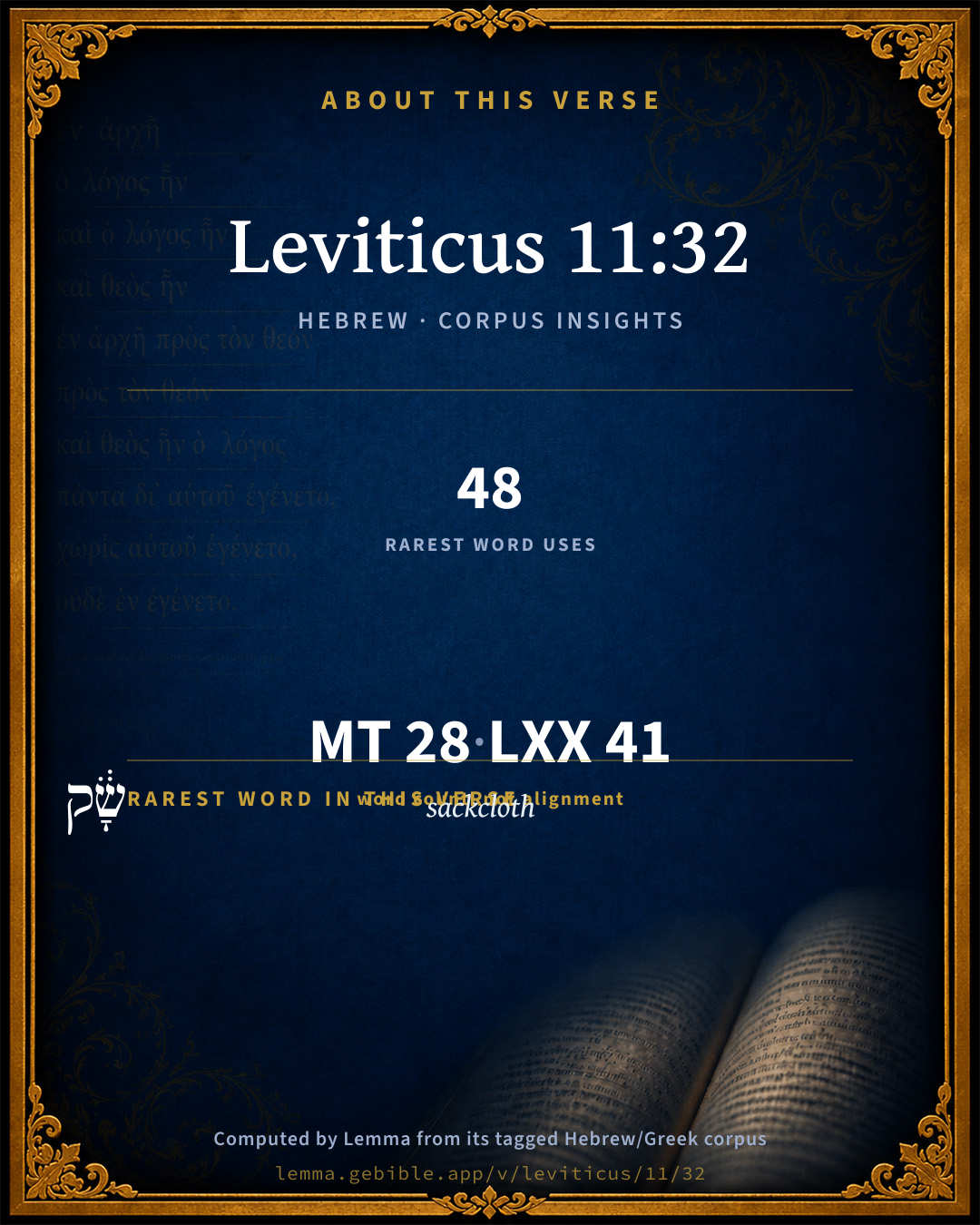
About this verse

These counts appear in no published source. They are computed here, from the morphology-tagged text and Lemma’s own curated glosses. What Lemma adds →

28
words
19
distinct lemmas
Pentateuch
section

Shared distinctive vocabulary

שָׂ֔ק sackcloth H8242 occurs in 46 verses of the Hebrew Bible. Also found in:

Grammatical profile

  • 6 verbs
  • 13 nouns
  • 4 prepositions
  • 3 conjunctions
  • 2 particles

Verb forms

  • יִפֹּל Qal · Imperfect
  • יִטְמָ֗א Qal · Imperfect
  • יֵעָשֶׂ֥ה Niphal · Imperfect
  • יוּבָ֛א Hophal · Imperfect
  • וְטָמֵ֥א Qal · Sequential Perfect
  • וְטָהֵֽר Qal · Sequential Perfect

Repetition

Words recur within this verse — often emphatic in Hebrew:

  • וְכֹ֣ל all H3605 ×3
  • יִטְמָ֗א to be unclean H2930 ×2
  • כְּלִי vessel H3627 ×2
  • א֣וֹ or H176 ×3
  • אֲשֶׁר which H834 ×2

Hebrew & Septuagint length

In English translation the verse runs 56 words from the Hebrew and 51 from the Septuagint (LXX English) — closely comparable.

A rough comparison of the two English renderings, which tokenize alike — not a word-level alignment.

Word counts can differ between the Hebrew and the Greek without any difference in meaning — e.g. the Hebrew direct-object marker אֵת has no separate Greek word, and Greek often adds the article ὁ.

In the original languages it is 28 Hebrew tokens and 41 Greek tokens — but the two are counted differently (Hebrew bundles its prefixes and suffixes into one token; the Greek is in lemma form), so that isn’t a like-for-like length.

Cross-references

4

Topical passages linked to Leviticus 11:32 in the Treasury of Scripture Knowledge — connected by theme and wording, ordered by reader-vote popularity; previews shown in the World English Bible.

  • Leviticus 15:12 "'The earthen vessel, which he who has the discharge touches, shall be broken; and every vessel of wood shall be rinsed in water.
  • Titus 3:5 not by works of righteousness, which we did ourselves, but according to his mercy, he saved us, through the washing of regeneration and renewing by the Holy Spirit,
  • Leviticus 6:28 But the earthen vessel in which it is boiled shall be broken; and if it is boiled in a brazen vessel, it shall be scoured, and rinsed in water.
  • Titus 2:14 who gave himself for us, that he might redeem us from all iniquity, and purify for himself a people for his own possession, zealous for good works.

Cross-references courtesy of OpenBible.info (CC BY 4.0).

Hebrew and Greek witnesses Masoretic Hebrew ↔ Greek Septuagint

The same verse in the two great witnesses to the Old Testament, shown verse-for-verse.

These are two independent witnesses, not word-aligned to each other, and the Septuagint is shown in lemma (dictionary) form.

Hebrew Leviticus 11:32 Masoretic · Westminster Leningrad Codex

וְכֹ֣ל אֲשֶׁר יִפֹּל עָלָיו֩ מֵהֶ֨ם בְּמֹתָ֜ם יִטְמָ֗א מִכָּל כְּלִי עֵץ֙ א֣וֹ בֶ֤גֶד אוֹ עוֹר֙ א֣וֹ שָׂ֔ק כָּל כְּלִ֕י אֲשֶׁר יֵעָשֶׂ֥ה מְלָאכָ֖ה בָּהֶ֑ם בַּמַּ֧יִם יוּבָ֛א וְטָמֵ֥א עַד הָעֶ֖רֶב וְטָהֵֽר

On whatever any of them falls when they are dead, it shall be unclean; whether it is any vessel of wood, or clothing, or skin, or sack, whatever vessel it is, with which any work is done, it must be put into water, and it shall be unclean until the evening; then it will be clean.

World English Bible · Public Domain

Greek LXX Leviticus 11:32 Septuagint · lemma form

καί πᾶς ἐπί ὅς ἄν ἐπιπίπτω ἀπό αὐτός θνήσκω αὐτός ἀκάθαρτος εἰμί ἀπό πᾶς σκεῦος ξύλινος ἤ ἱμάτιον ἤ δέρμα ἤ σάκκος πᾶς σκεῦος ὅς ἐάν ποιέω ἔργον ἐν αὐτός εἰς ὕδωρ βάπτω καί ἀκάθαρτος εἰμί ἕως ἑσπέρα καί καθαρός εἰμί

And on whatever one of their dead bodies shall fall it shall be unclean; whatever wooden vessel, or garment, or skin, or sack it may be, every vessel in which work should be done, shall be dipped in water, and shall be unclean till evening; and then it shall be clean.

LXX2012 (modern English Septuagint) · Public Domain

On this verse, John Gill's Exposition discusses the Septuagint’s reading. Read the note in Commentary ↓

Hebrew: Westminster Leningrad Codex (CC BY 4.0). Greek: Septuagint (public domain); English from LXX2012 (modern English Septuagint) (Public Domain). How the Septuagint differs from the Hebrew →

Targum (Aramaic paraphrase)

2

The Targum is the ancient Jewish Aramaic paraphrase of the Hebrew Scriptures — an interpretive translation, not the Hebrew text itself. Onkelos (literal) and Pseudo-Jonathan (expansive) render the Torah, and Jonathan the Prophets. Coverage is partial: where no permissively-licensed English translation exists for a verse, only the Aramaic is shown. This is verse-level text, not a word-by-word alignment to the Hebrew.

  1. Targum Onkelos Torah (Genesis–Deuteronomy)
    וְכָל דִי יִפֵּל עֲלוֹהִי מִנְהוֹן בְּמוֹתְהוֹן יְהֵי מְסָאָב מִכָּל מָאן דְעָא אוֹ לְבוּשׁ אוֹ מְשַׁךְ אוֹ שָׂק כָּל מָאן דִי תִתְעֲבֵד עִבִידָא בְּהוֹן בְּמַיָא יִתָּעַל וִיהֵי מְסָאָב עַד רַמְשָׁא וְיִדְכֵּי

    (no public-domain English translation for this verse)

    Targum Onkelos — Aramaic: “Onkelos Genesis” (public domain); “Onkelos Exodus” (public domain); “Onkelos Leviticus” (public domain); “Onkelos Numbers” (public domain); “Onkelos Deuteronomy” (public domain). English: “Sefaria Community Translation” (CC0 1.0 (public-domain dedication)); “J.W. Etheridge. The Targums of Onkelos and Jonathan Ben Uzziel on the Pentateuch. London: Longmans, Green, 1862” (public domain). Text via Sefaria.

  2. Targum Pseudo-Jonathan Torah (Genesis–Deuteronomy)
    וְכָל מִדַעַם דְיִפּוֹל עֲלוֹי מִנְהוֹן בְּמוֹתְהוֹן דְאֵיבָרַיָא דִידְהוֹן דְאִיתְפְּשַׁח מִנְהוֹן יְהֵי מְסָאָב כָּל מָאן דְקֵיסָא אוֹ לְבוּשׁ אוֹ צַלָא אוֹ שַק כָּל מָאן דְתִתְעֲבִיד בְּהוֹן עִיבִידְתָּא בְּאַרְבְּעִין סָאוִוין דְמוֹי יִתְעַל וִיהֵי מְסָאָב לְכָל צְרוֹךְ עַד רַמְשָׁא וְיִדְכֵּי

    And whatever upon which any part of their dead body may fall, as their members when separated from them, shall be unclean; every vessel of wood, or garment, or leather, or sack, anything in which work is done, in four measures of water it shall be dipped, and be unclean for use until evening, when it shall be purified.

    Targum Pseudo-Jonathan — Aramaic: “Targum Jonathan on Genesis” (public domain); “Targum Jonathan on Exodus” (public domain); “Targum Jonathan on Leviticus” (public domain); “Targum Jonathan on Numbers” (public domain); “Targum Jonathan on Deuteronomy” (public domain). English: “The Targum of Jonathan ben Uzziel, trans. J. W. Etheridge, London, 1862” (public domain). Text via Sefaria.

Commentary

Notes on Leviticus 11:32 from classic Christian and Jewish commentators (each source and its license shown beneath its notes). The classic Christian expositions comment on the surrounding passage and are grouped to its opening verse, so a note may address several verses; the Jewish commentaries on the Tanakh (Rashi and others) are per-verse, so they appear only where the commentator wrote on this verse.

Lemma curates 59 commentaries, every one of them public domain or Creative Commons licensed, each selected and text-cleaned for this edition rather than reprinted as found. About our sources →

Trapp's Complete Commentary

John Trapp

Lev 11:32 And upon whatsoever [any] of them, when they are dead, doth fall, it shall be unclean; whether [it be] any vessel of wood, or raiment, or skin, or sack, whatsoever vessel [it be], wherein [any] work is done, it must be put into water, and it shall be unclean until the even; so it shall be cleansed.

Ver. 32. It shall be unclean.] With a ceremonial uncleanness only, and not moral: howbeit, the disobedience, even in such a small matter, brought a guilt upon the soul, which did defile, while the prohibition was in force; as one well observeth.

John Trapp, A Commentary or Exposition upon All the Books of the Old and New Testament (1647–1656) — public domain. Text from a community e-Sword module.

Tyndale Open Study Notes

Tyndale Open Resources

11:32-40 Dead animals could make things and people unclean. Even a clean animal that died without having its blood drained was considered unclean (11:39-40). When a person became unclean from contact with an animal’s carcass, it lasted only until evening. Household articles that came into contact with a carcass had to be purified (11:25, 28, 32, 40) or destroyed (11:33, 35).

Tyndale Open Study Notes — © Tyndale Open Resources, licensed CC BY-SA 4.0. Text via the HelloAO Bible API.

Geneva Bible (1599)

Geneva Bible translators

As a bottle or bag.

Geneva Bible (1599) marginal notes — public domain. Text via Bolls.life.

Adam Clarke's Commentary

Verse 32. Any vessel of wood] Such as the wooden bowls still in use among the Arabs. Or raiment, or skin - any trunks or baskets covered with skins, another part of the furniture of an Arab tent; the goat-skins, in which they churn their milk, may be also intended. Or sack - any hair-cloth used for the purpose of transporting goods from place to place.

Adam Clarke's Commentary on the Bible (1810–1826) — public domain. Text from a community e-Sword/MySword module.

Ellicott's Commentary for English Readers

(32) And upon whatsoever any of them.—Better, and upon whatsoever aught of them, that is, not only if the whole carcase fell upon any of the specified vessels were the vessels in question defiled, but if a portion of the carcase came in contact with the utensils it made them unclean. (See Lev_11:25.) According to the law which obtained during the second Temple it was only when the portion of the carcase of an unclean animal had flesh on it that it defiled, but not otherwise. Hence the skins, hair, bones, horns, hoofs, sinews, &c. of all unclean creatures were exempted. These were made into different domestic utensils and implements. The use thus made of the parts in question also constituted one of the differences between the Pharisees and the Sadducees in the time of Christ. The Sadducees regarded every portion of every unclean animal in whatever state as defiling, and hence prohibited its being made up into any vessel.

Vessel of wood.—That is, vessels made of bulrushes (Isa_18:2), reeds, wicker, shells of nuts, barks of trees, or of anything which grew out of the earth like wood.

Or raiment.—That is, any garment made of a woven material, such as wool, flax, hemp, or anything which grows on the dry land. Hence cloth made of a material which grows in the sea was not defiled, according to the canons which obtained during the second Temple.

Or skin.—This also, according to the same authorities, only applied to the skins of land animals; skins of aquatic creatures received no defilement.

Or sack.—From the parallel passage in Num_31:20, we see that by this expression here is meant garments made of stuffs of goats’ hair, in contradistinction to the textures of which the garments were made, denoted by the expression beged, “raiment.” (See also Isa_20:2.) Skins which were not made into garments or vessels, or which exhibited unfinished vessels, received no pollution.

A Bible Commentary for English Readers, edited by Charles John Ellicott (1878–1897) — public domain. Text from a community e-Sword module.

The Cambridge Bible for Schools and Colleges

gen. ed. J. J. S. Perowne

32. The case of one of these small animals creeping into a pan or bag or garment, and being found dead, seems to be contemplated. In such a case the vessel is unclean for the rest of the day and (Lev_11:33) if earthen must be broken, cp. Lev_6:28.

The Cambridge Bible for Schools and Colleges (gen. ed. J. J. S. Perowne; Cambridge University Press, 1878–1918) — public domain. Text from a community e-Sword module.

John Gill's Exposition

And upon whatsoever any of them, when they are dead, doth fall, it shall be unclean,.... Any of the above eight creeping things, that is, of their flesh, for as for their bones, nails, nerves, and skin, as before observed, being separated from them and dry, they do not defile:

whether it be any vessel of wood, or raiment, or skin, or sack; every wooden vessel, as the Targum of Jonathan; and all sorts of clothes, of woollen, linen, or silk, and all sorts of skins, excepting skins of sea beasts; for these, according to the Jews (t), received no pollution; and also sacks or sackcloth, made of goats' hair, and the like:

whatsoever vessel it be, wherein any work is done; any tool or instrument made use of by any artificer in his trade, or any vessel wrought by him:

it must be put into water; dipped into it, even into forty seahs of water, according to the Targum of Jonathan; and which is to be understood, not of any working tool, or finished vessel only, but of any vessel of wood, raiment, skin, or sack, before mentioned:

it shall be unclean until the even; even though put into water and washed:

so it shall be cleansed; in the above manner, by being put or dipped into water; or "afterwards", as the Septuagint, when it has been dipped and the even is come, and not before. (t) Bartenora in Misn. Celaim, c. 17. sect. 13.

John Gill's Exposition of the Whole Bible (1746–1763) — public domain (CC PDM 1.0). Text via the HelloAO Bible API.

Whedon's Commentary on the Bible

Daniel D. Whedon

32. Vessel… must be put into water — This explains the baptism of cups, and pots, and brazen vessels, (Mar_7:4,) and “divers washings” mentioned in Heb_9:10, as characteristic of the Jews.

Daniel D. Whedon (gen. ed.), Commentary on the Old and New Testaments (1874–1909) — public domain. Text from a community e-Sword module.

Rashi

Rabbi Shlomo Yitzchaki (Rashi)

במים יובא IT MUST BE PUT INTO WATER — but even after it has been immersed, טמא IT IS UNCLEAN in respect to using it to hold the heave - offering,

עד הערב UNTIL THE EVENING, AND — afterwards — וטהר IT BECOMETH CLEAN at the setting of the sun (Yevamot 75a).

Rashi on the Tanakh — English translations: “The Judaica Press complete Tanach with Rashi, translated by A. J. Rosenberg” (CC BY 4.0); “Pentateuch with Rashi's commentary by M. Rosenbaum and A.M. Silbermann, 1929-1934” (public domain); “The Metsudah Tanach series, Lakewood, N.J” (CC BY 4.0); and “The Book of Joshua, Metsudah Publications, 1997” (CC BY 4.0). Text via Sefaria.

Ramban (Nachmanides)

Rabbi Moshe ben Nachman (Ramban / Nachmanides)

AND EVERY THING UPON WHICH ANY PART OF THEM, WHEN THEY ARE DEAD, DOTH FALL, SHALL BE UNCLEAN: WHETHER IT SHALL BE ANY VESSEL OF WOOD etc. It appears to me in the interpretation of this verse that most likely the expression any of them, when they are dead, alludes to all those mentioned above — impure animals, creeping things, and beasts. For why should He mention the law of impurity of vessels and garments only with reference to creeping things, when it applies also to carcasses? Similarly, all the rules that He mentions with reference to making food susceptible to impurity [conveyed by creeping things], apply equally to all [forms of] impurity, and Scripture speaks of the general concept of them. Do not find it difficult to accept that the expression touch them when they are dead in the first verse. applies to the creeping things, while the same expression any of them when they are dead [in Verse 32 before us] applies to all things that convey impurity, for such is the case in many places in Scripture [where similar words apply to different things].It is possible to say that Scripture waited until it had mentioned all impure things amongst cattle, beasts, and creeping things, and then at the end mentioned impurity of vessels with reference to one of them [namely, the creeping things], with which it had concluded this theme, in order that the law of all the others be derived from it, for the opinion of our Rabbis is that the expression any of them when they are dead [in Verse 32 before us] refers [only] to creeping things, and from that they learn that a creeping thing in [a minimal] size of a lentil conveys impurity., it shows that even though one has not touched the whole creeping thing but “any” part of it, he is rendered impure. “Now since the sand-lizard [one of the eight creeping things that convey impurity] when born is the size of a lentil,” therefore that amount of any of the eight creeping things when dead also conveys impurity (Chagiga ibid.). Thus according to the interpretation of the Rabbis, Verse 32 before us also speaks only of the impurity conveyed by creeping things, and not, as explained above, about all other impurities. Scripture dealt likewise with the subject of immersion, in mentioning at the end of all [the laws of] impurity, the impurity [conveyed by creeping things] to vessels and their purification by immersion, and from it we learn the law of man and vessels with reference to all the impurities mentioned above.

IT MUST BE PUT INTO WATER, AND IT SHALL BE UNCLEAN UNTIL THE EVEN; AND IT SHALL BE CLEAN. “Even after it has been immersed, it is still impure with regard to the heave-offering, until the setting of the sun, and afterwards at the setting of the sun it becomes pure.” This is Rashi’s language. And the interpretation in the Torath Kohanim is: 6:9. “And it shall be unclean until the even. I might think that [it shall be impure] for all [purposes]; Scripture therefore says, and it shall be clean. But if so, I might think that it is pure for all purposes; Scripture therefore says, and it shall be unclean until the even. How then can this be explained? It is pure with respect to ordinary food (the heave-offering) eaten by the priest. Thus if an Israelite who was impure immersed himself to be purified, he may straightaway eat of the Second Tithe, even though the sun has not yet set. But a priest who was impure and immersed himself before sunset, may not eat of the heave-offering until the sun has set and the stars have come forth. when it is still daytime [immediately after it was immersed to be purified], but regarding the heave-offering it is not held to be pure until it becomes dark.” The interpretation of the verse according to the explanation of the Torath Kohanim is thus: “it must be put into the water [before sundown] and it shall remain unclean till the evening.” But by way of the simple meaning of Scripture [the verse is to be transposed, thus]: “it must be put into water and it shall be clean, but it shall be unclean until the evening.”Now Scripture mentioned in all the sections [that the impurity is] “until the evening,” because it refers to the degree of purity required for the holy heave-offering, as He said, The soul that toucheth any such [unclean things] shall be unclean until the even, and shall not eat of the holy things, unless he bathe his flesh in water. And when the sun is down, he shall be clean; and afterward he may eat of the holy things, because it is his bread. (the heave-offering). But the purification required for ordinary food or the [Second] Tithe is attained after immersion alone, and it is not mentioned here because it is not mandatory upon an impure person to purify himself in order to eat ordinary food, for if he wants to, he may eat it in a state of impurity. purify himself, and wait till evening, whereas for ordinary food there is no requirement that it must be eaten in a state of purity, and thus no necessity to immerse oneself. If he does wish to eat it in a state of purity, however, he attains this immediately after immersion and even before sundown, as explained above in Ramban and in Note 246.

Ramban (Nachmanides) on the Tanakh — English translation: “Commentary on the Torah by Ramban (Nachmanides). Translated and annotated by Charles B. Chavel. New York, Shilo Pub. House, 1971-1976” (CC BY 4.0). Text via Sefaria.

Lesson kit

Teaching starters — assembled from the data on this page, not authored interpretation. Every prompt links to the verse data it draws on. Edit before teaching.

Leviticus, in the Pentateuch, opens this verse with 28 words (19 distinct Hebrew lemmas). Its most distinctive word is saq (“sackcloth”). A historical commentator’s framing appears above. Read the whole chapter for the surrounding context.

Discussion questions

  1. The word saq carries the sense “sackcloth.” How does it shape the verse?
  2. How does Genesis 37:34, which shares the word «sackcloth», read alongside this verse?
  3. What does the repetition of “all” (3× in this one verse) do in this verse?
  4. The translations on this page render this verse differently — a whole-verse word diff, not a word-by-word alignment. What might account for the different wordings?
  5. «יִפֹּל» is a Qal Imperfect verb. How does that grammatical form shape the action described?
  6. Compare how Trapp's Complete Commentary and Tyndale Open Study Notes read this verse. Where do they agree or differ?

Things to notice

Reading settings

Reading text

Shown beneath each verse's original-language words.

Old Testament
Old Testament edition

Read the OT as the Masoretic Hebrew (MT) or the Greek Septuagint (LXX).

English shown for the Greek Septuagint (in the Hebrew ↔ Greek comparison).

Comparing translations? Open the Compare panel on any verse page to stack up to four side by side.