
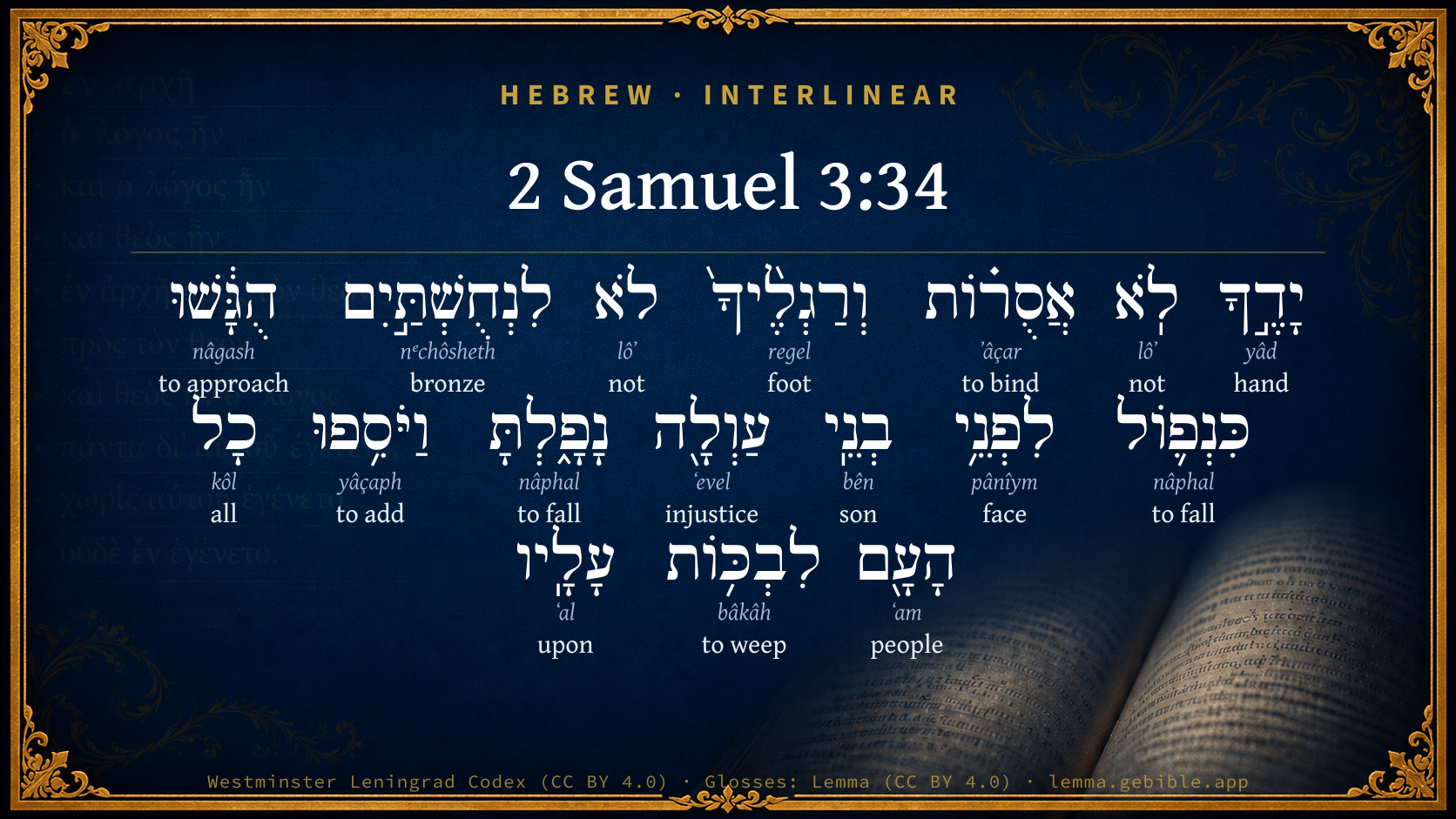
2 Samuel 3:34

Hebrew (Westminster Leningrad Codex) 2 Samuel 3:34 appears in the Hebrew Old Testament. The text above is from the Westminster Leningrad Codex. Each word links to its Strong’s number, a concise gloss, and parsing drawn from the Open Scriptures Hebrew Bible morphology. Click any word for its full Brown-Driver-Briggs (BDB) entry.
Download image
Cite this verse

2 Samuel 3:34 (World English Bible). Public Domain. Lemma interlinear Bible study tool, https://lemma.gebible.app/v/2-samuel/3/34.

Show BibTeX & RIS
BibTeX
RIS
English Translation
Your hands were not bound, nor your feet put into fetters: As a man falls before the children of iniquity, so did you fall. All the people wept again over him.
World English Bible · Public Domain
Download a study sheet

One document with this verse’s original text, its word-by-word gloss line, the meaning frame, cross-references with their text, attributed commentary, and full source and license credits — printable, and it pastes into notes with its structure intact.

This verse Autodidact and up

Study sheet (.html) Plain text (.txt)

A passage Seminary Student

Up to 50 verses in one chapter. A passage sheet keeps up to 6 commentary sources and 12 cross-references per verse, in the order this page ranks them, and says so on the sheet whenever that leaves anything out. Ask for a single verse and you get the Autodidact verse sheet above.

Everything on this page stays free to read, with no account — the sheet is a download of what is already on screen, not access to it.

Want to remove ads? Support Godless Engineer
Compare translations 3

The same verse in 3 English versions, stacked beneath the original-language interlinear above. Click any original word for its lexicon entry.

Each is an independent rendering of the whole verse — the interlinear is not word-aligned to these translations.

Highlighted words mark where these versions differ — a whole-verse word diff, not a word-by-word alignment.

  • World English Bible Public Domain
    Your hands were not bound, nor your feet put into fetters: As a man falls before the children of iniquity, so did you fall. All the people wept again over him.
  • King James Version Public Domain
    Thy hands were not bound, nor thy feet put into fetters: as a man falleth before wicked men, so fellest thou. And all the people wept again over him.
  • unfoldingWord Literal Text CC BY-SA 4.0
    Your hands were not bound, and your feet were not put in shackles. As falling to the face of sons of wickedness, you have fallen.” And all of the people added to weep for him.

unfoldingWord Literal Text — © unfoldingWord, licensed CC BY-SA 4.0. Word-aligned USFM3 via Door43 (git.door43.org/unfoldingWord/en_ult).

Versions to compare (up to 4)

3 of 4 selected

Show all 18 translations

Every available English version of this verse, each an independent rendering of the whole verse.

  • World English Bible Public Domain
    Your hands were not bound, nor your feet put into fetters: As a man falls before the children of iniquity, so did you fall. All the people wept again over him.
  • Berean Standard Bible Public Domain
    Your hands were not bound, your feet were not fettered. As a man falls before the wicked, so also you fell.” And all the people wept over him even more.
  • Majority Standard Bible Public Domain
    Your hands were not bound, your feet were not fettered. As a man falls before the wicked, so also you fell.” And all the people wept over him even more.
  • King James Version Public Domain
    Thy hands were not bound, nor thy feet put into fetters: as a man falleth before wicked men, so fellest thou. And all the people wept again over him.
  • American Standard Version (1901) Public Domain
    Thy hands were not bound, nor thy feet put into fetters: As a man falleth before the children of iniquity, so didst thou fall. And all the people wept again over him.
  • Revised Version (1885) Public Domain
    Thy hands were not bound, nor thy feet put into fetters: as a man falleth before the children of iniquity, so didst thou fall. And all the people wept again over him.
  • Geneva Bible (1599) Public Domain
    Thine handes were not bounde, nor thy feete tyed in fetters of brasse: but as a man falleth before wicked men, so diddest thou fall. And all the people wept againe for him.
  • Douay-Rheims (1899) Public Domain
    Thy hands were not bound, nor thy feet laden with fetters: but as men fall before the children of iniquity, so didst thou fall. And all the people repeating it wept over him.
  • Young's Literal Translation Public Domain
    Thy hands not bound, And thy feet to fetters not brought nigh! As one falling before sons of evil -- Thou hast fallen!' and all the people add to weep over him.
  • Literal Standard Version CC BY-SA 4.0
    Your hands not bound, || And your feet not brought near to chains! You have fallen as one falling before sons of evil!” And all the people add to weep over him.
  • Unlocked Literal Bible CC BY-SA 4.0
    Your hands were not bound. Your feet were not shackled. As a man falls before the sons of injustice, so you have fallen.” Once more all the people wept over him.
  • unfoldingWord Literal Text CC BY-SA 4.0
    Your hands were not bound, and your feet were not put in shackles. As falling to the face of sons of wickedness, you have fallen.” And all of the people added to weep for him.
  • Darby Bible Public Domain
    Thy hands were not bound, Nor thy feet put into fetters; As a man falleth before wicked men, Fellest thou! And all the people wept again over him.
  • World Messianic Bible Public Domain
    Your hands weren’t bound, and your feet weren’t put into fetters. As a man falls before the children of iniquity, so you fell.” All the people wept again over him.
  • Webster's Bible Public Domain
    Thy hands were not bound, nor thy feet put into fetters: as a man falleth before wicked men, so fellest thou. And all the people wept again over him.
  • Free Bible Version CC BY-SA 4.0
    Your hands were not tied together, your feet were not in shackles. But just like a murderer's victim, you too were killed.” All the people cried for him even more.
  • Bible in Basic English Public Domain
    Your hands were free, your feet were not chained: like the downfall of a man before evil men, so was your fall. And the weeping of the people over him went on again.
  • JPS Tanakh (1917) Public Domain
    Thy hands were not bound, nor thy feet put into fetters; as a man falleth before the children of iniquity, so didst thou fall. And all the people wept again over him.

Literal Standard Version (2020), Covenant Press — licensed CC BY-SA 4.0. Text via the HelloAO Bible API (eBible.org). Unlocked Literal Bible (unfoldingWord) — licensed CC BY-SA 4.0. Text via the HelloAO Bible API (eBible.org). unfoldingWord Literal Text — © unfoldingWord, licensed CC BY-SA 4.0. Word-aligned USFM3 via Door43 (git.door43.org/unfoldingWord/en_ult). Free Bible Version, Dr. Jonathan Gallagher — licensed CC BY-SA 4.0. Text via the HelloAO Bible API (eBible.org).

Word by word

More ways to search: Search by grammar → Find every occurrence → Compare this word →

Practice this passage: Drill this verse → Learn its vocabulary →

עַוְלָ֖ה
ʻevel
H5766
“injustice”
Noun, Common, Both, Singular, Absolute
Part of Speech
Noun
Type
Common
Gender
Both
Number
Singular
State
Absolute
Full BDB Definition

Origin: from H5765

TWOT: 1580a , 1580b

injustice, unrighteousness, wrong - violent deeds of injustice - injustice (of speech) - injustice (generally)
  1. יָדֶ֣ךָ yâd H3027 “hands · your” Noun, Common, Both, Dual, Construct + Suffix, Personal, 2nd Person, Masculine, Singular
  2. לֹֽא lôʼ H3808 “not” Particle, Negative
  3. אֲסֻר֗וֹת ʼâçar H631 “bound” Verb, Qal, Participle Passive, Feminine, Plural, Absolute
  4. וְרַגְלֶ֨יךָ֙ regel H7272 “and · feet · your” Conjunction + Noun, Common, Feminine, Dual, Construct + Suffix, Personal, 2nd Person, Masculine, Singular
  5. לֹא lôʼ H3808 “not” Particle, Negative
  6. לִנְחֻשְׁתַּ֣יִם nᵉchôsheth H5178 “to/for · bronze fetters” Preposition + Noun, Common, Feminine, Dual, Absolute
  7. הֻגָּ֔שׁוּ nâgash H5066 “to approach” Verb, Hophal, Perfect, 3rd Person, Common, Plural
  8. כִּנְפ֛וֹל nâphal H5307 “like/as · to fall” Preposition + Verb, Qal, Infinitive Construct
  9. לִפְנֵ֥י pânîym H6440 “to/for · face(s) of” Preposition + Noun, Common, Both, Plural, Construct
  10. בְנֵֽי bên H1121 “sons of” Noun, Common, Masculine, Plural, Construct
  11. נָפָ֑לְתָּ nâphal H5307 “to fall” Verb, Qal, Perfect, 2nd Person, Masculine, Singular
  12. וַיֹּסִ֥פוּ yâçaph H3254 “and · to add” Conjunction + Verb, Hiphil, Sequential Imperfect, 3rd Person, Masculine, Plural
  13. כָל kôl H3605 “all of” Noun, Common, Masculine, Singular, Construct
  14. הָעָ֖ם ʻam H5971 “the · people” Particle, Definite Article + Noun, Common, Masculine, Singular, Absolute
  15. לִבְכּ֥וֹת bâkâh H1058 “to weep” Preposition + Verb, Qal, Infinitive Construct
  16. עָלָֽיו ʻal H5921 “upon · him” Preposition + Suffix, Personal, 3rd Person, Masculine, Singular

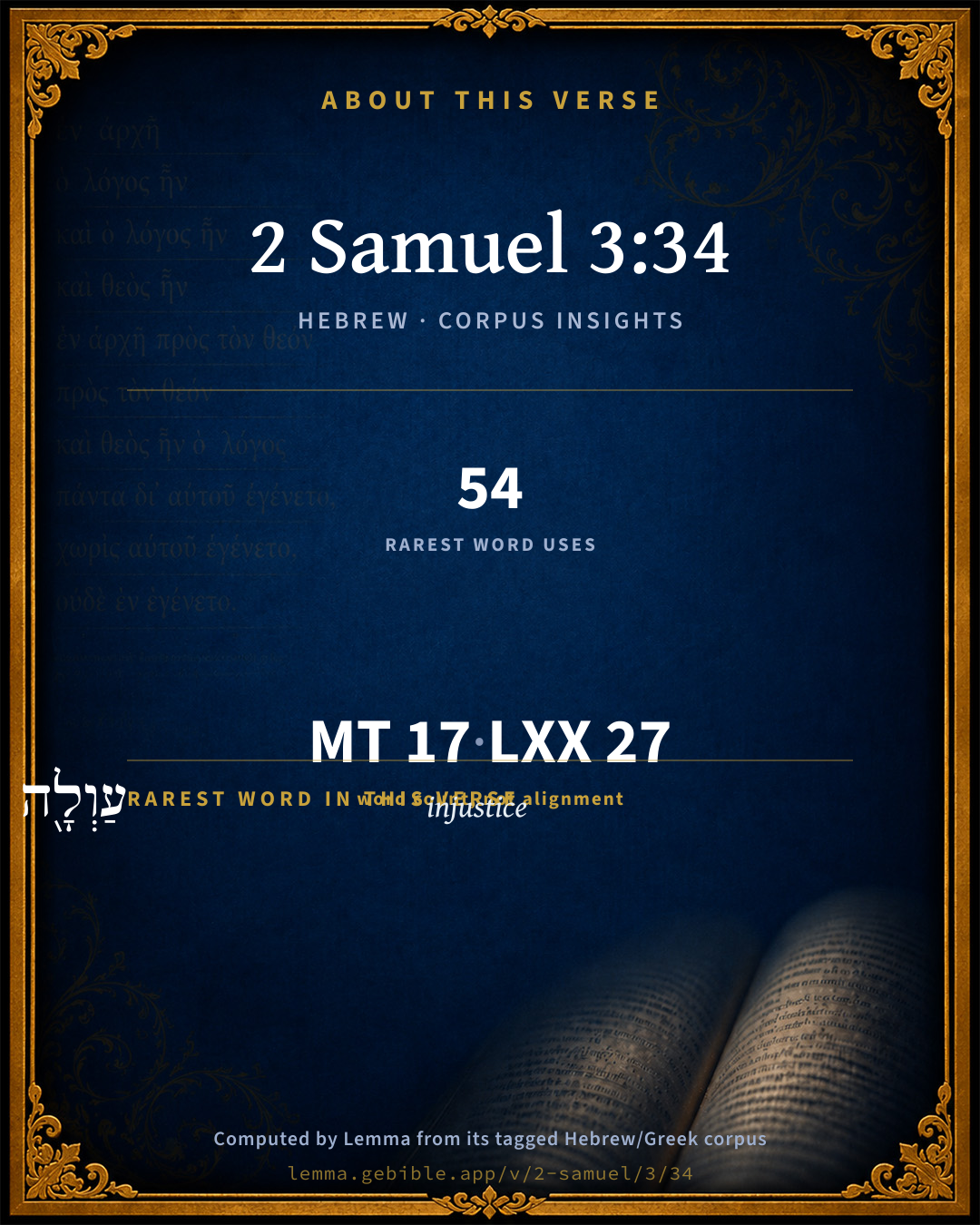
About this verse

These counts appear in no published source. They are computed here, from the morphology-tagged text and Lemma’s own curated glosses. What Lemma adds →

17
words
15
distinct lemmas
Historical
section

Shared distinctive vocabulary

עַוְלָ֖ה injustice H5766 occurs in 51 verses of the Hebrew Bible. Also found in:

Grammatical profile

  • 6 verbs
  • 8 nouns
  • 1 preposition
  • 2 particles

Verb forms

  • אֲסֻר֗וֹת Qal · Participle Passive
  • הֻגָּ֔שׁוּ Hophal · Perfect
  • כִּנְפ֛וֹל Qal · Infinitive Construct
  • נָפָ֑לְתָּ Qal · Perfect
  • וַיֹּסִ֥פוּ Hiphil · Sequential Imperfect
  • לִבְכּ֥וֹת Qal · Infinitive Construct

Repetition

Words recur within this verse — often emphatic in Hebrew:

  • כִּנְפ֛וֹל to fall H5307 ×2
  • לֹֽא not H3808 ×2

Hebrew & Septuagint length

In English translation the verse runs 31 words from the Hebrew and 27 from the Septuagint (LXX English) — closely comparable.

A rough comparison of the two English renderings, which tokenize alike — not a word-level alignment.

Word counts can differ between the Hebrew and the Greek without any difference in meaning — e.g. the Hebrew direct-object marker אֵת has no separate Greek word, and Greek often adds the article ὁ.

In the original languages it is 17 Hebrew tokens and 27 Greek tokens — but the two are counted differently (Hebrew bundles its prefixes and suffixes into one token; the Greek is in lemma form), so that isn’t a like-for-like length.

Cross-references

5

Topical passages linked to 2 Samuel 3:34 in the Treasury of Scripture Knowledge — connected by theme and wording, ordered by reader-vote popularity; previews shown in the World English Bible.

  • Judges 16:21 The Philistines laid hold on him, and put out his eyes; and they brought him down to Gaza, and bound him with fetters of brass; and he did grind in the prison-house.
  • 2 Samuel 1:12 and they mourned, and wept, and fasted until even, for Saul, and for Jonathan his son, and for the people of Yahweh, and for the house of Israel; because they were fallen by the sword.
  • Job 24:14 The murderer rises with the light. He kills the poor and needy. In the night he is like a thief.
  • Psalms 107:10–11 Some sat in darkness and in the shadow of death, Being bound in affliction and iron,
  • Hosea 6:9 As gangs of robbers wait to ambush a man, So the company of priests murder in the way toward Shechem, Committing shameful crimes.

Cross-references courtesy of OpenBible.info (CC BY 4.0).

Hebrew and Greek witnesses Masoretic Hebrew ↔ Greek Septuagint

The same verse in the two great witnesses to the Old Testament, shown verse-for-verse.

These are two independent witnesses, not word-aligned to each other, and the Septuagint is shown in lemma (dictionary) form.

Hebrew 2 Samuel 3:34 Masoretic · Westminster Leningrad Codex

יָדֶ֣ךָ לֹֽא אֲסֻר֗וֹת וְרַגְלֶ֨יךָ֙ לֹא לִנְחֻשְׁתַּ֣יִם הֻגָּ֔שׁוּ כִּנְפ֛וֹל לִפְנֵ֥י בְנֵֽי עַוְלָ֖ה נָפָ֑לְתָּ וַיֹּסִ֥פוּ כָל הָעָ֖ם לִבְכּ֥וֹת עָלָֽיו

Your hands were not bound, nor your feet put into fetters: As a man falls before the children of iniquity, so did you fall. All the people wept again over him.

World English Bible · Public Domain

Greek LXX 2 Samuel 3:34 Septuagint · lemma form

ὁ χείρ σύ οὐ δέω ὁ πούς σύ οὐ ἐν πέδη οὐ προςἄγω ὡς ναβαλ ἐνώπιον υἱός ἀδικία πίπτω καί συνἄγω πᾶς ὁ λαός ὁ κλαίω αὐτός

Your hands were not bound, and your feet were not put in fetters: one brought you not near as Nabal; you did fall before children of iniquity.

LXX2012 (modern English Septuagint) · Public Domain

Hebrew: Westminster Leningrad Codex (CC BY 4.0). Greek: Septuagint (public domain); English from LXX2012 (modern English Septuagint) (Public Domain). How the Septuagint differs from the Hebrew →

Targum (Aramaic paraphrase)

1

The Targum is the ancient Jewish Aramaic paraphrase of the Hebrew Scriptures — an interpretive translation, not the Hebrew text itself. Onkelos (literal) and Pseudo-Jonathan (expansive) render the Torah, and Jonathan the Prophets. Coverage is partial: where no permissively-licensed English translation exists for a verse, only the Aramaic is shown. This is verse-level text, not a word-by-word alignment to the Hebrew.

  1. Targum Jonathan Prophets (Joshua–Malachi)
    יְדָךְ לָא אֲסִירָן וְרַגְלָךְ לָא לְזִיקִין דִנְחַשׁ אִתְקְרָבוּ כְּמֵפַל קֳדָם גַבְרִין רַשִׁיעִין נְפַלְתָּא וְאוֹסִיפוּ כָל עַמָא לְמִבְכֵּי עֲלוֹהִי:

    (no public-domain English translation for this verse)

    Targum Jonathan — Aramaic: “Mikraot Gedolot” (public domain). English: “Sefaria Community Translation” (CC0 1.0 (public-domain dedication)); “London "Chaldee Paraphrase," 1871” (public domain). Text via Sefaria.

Commentary

Notes on 2 Samuel 3:34 from classic Christian and Jewish commentators (each source and its license shown beneath its notes). The classic Christian expositions comment on the surrounding passage and are grouped to its opening verse, so a note may address several verses; the Jewish commentaries on the Tanakh (Rashi and others) are per-verse, so they appear only where the commentator wrote on this verse.

Lemma curates 59 commentaries, every one of them public domain or Creative Commons licensed, each selected and text-cleaned for this edition rather than reprinted as found. About our sources →

Trapp's Complete Commentary

John Trapp

2Sa 3:34 Thy hands [were] not bound, nor thy feet put into fetters: as a man falleth before wicked men, [so] fellest thou. And all the people wept again over him.

Ver. 34. Thy hands were not bound.] As one either conquered or condemned. Hadst thou not been treacherously surprised and assassinated, manibus pedibusque obnixe omnia fecisses, thou wouldst have made thy party good with the stoutest he, and have stood with Joab in a trial of manhood.

So fellest thou.] Before this wicked Joab. And this perhaps was the elegy appointed to be sung at Abner’s funeral, to the reproach of Joab, whom David durst not as yet otherwise punish: but that he deferred it so long, when he had power in his hand, was an oversight.

John Trapp, A Commentary or Exposition upon All the Books of the Old and New Testament (1647–1656) — public domain. Text from a community e-Sword module.

The Biblical Illustrator

Joseph S. Exell

2Sa_3:34

Thy hands were not bound, nor thy feet put into fetters.

The moral of affliction

I. What there is in the text expressive of afflictive scenes.

1. Let us observe, that the text contains the speech, which was made at the grave of a very respectable person.

2. The next thing observable in the text, is the manner of describing a death, that was brought about by the most execrable villany.

3. The text concludes with assuring us, that the concern for such a death, of such a person, was deep and universal.

II. What useful lessons such a scene of affliction hath a more peculiar tendency to inculcate upon us.

1. It should more deeply convince us, that sin is the worst and greatest of all evils.

2. This scene of affliction may lead us to reflect on the vanity, which attends human life, even in its most prosperous state. Let Ira, on this occasion, thankfully acknowledge our obligations to Divine Providence, for the continuance of our lives and comforts. (B. Fawcett, M. A.)

The Biblical Illustrator, edited by Joseph S. Exell (c. 1880s–1900s) — public domain. Text from a community e-Sword module.

Tyndale Open Study Notes

Tyndale Open Resources

3:34 a wicked plot: Normal warfare could not defeat Abner, a seasoned warrior. Only treachery could.

Tyndale Open Study Notes — © Tyndale Open Resources, licensed CC BY-SA 4.0. Text via the HelloAO Bible API.

Ellicott's Commentary for English Readers

(34) Thy hands were not bound.—The people were moved greatly by the sight of David’s sorrow, but still more by this brief elegy over Abner. The whole circumstances are summed up in a few pregnant words: Abner, so valiant in war, with his hands free for defence, with his feet unfettered, unsuspicious of evil, fell by the treacherous act of a wicked man.

A Bible Commentary for English Readers, edited by Charles John Ellicott (1878–1897) — public domain. Text from a community e-Sword module.

The Cambridge Bible for Schools and Colleges

gen. ed. J. J. S. Perowne

34. Thy hands, &c.] Two explanations of these words seem possible; either (1) Thou hadst not committed any crime to deserve a malefactor’s punishment, but wast causelessly murdered by treacherous enemies: or (2) How was it that thou wast slain while thy hands were at liberty to defend thyself, thy feet free to escape by flight? It was because thou wast attacked unsuspectingly by treacherous enemies. In the first case “fool” in 2Sa_3:33 is equivalent to “miscreant.” It is a term which frequently in the O.T. implies moral worthlessness, wickedness. Cp. Psa_14:1. The Targum here renders it “the wicked.” In the second case it means “an ignoble churl who cannot defend himself.”

The Cambridge Bible for Schools and Colleges (gen. ed. J. J. S. Perowne; Cambridge University Press, 1878–1918) — public domain. Text from a community e-Sword module.

John Gill's Exposition

Thy hands were not bound, nor thy feet put into fetters,.... As malefactors are when they are taken up for any crime, and especially when proved upon them, and condemned for it, and brought forth to be executed. This was not his case, and had he been aware of the design against him, as his hands and feet were at liberty, he might have defended himself; or if he found he had too many to deal with, might have made use of his feet and fled:

as a man falleth before wicked men, so fellest thou; as a man being before bloodthirsty and deceitful men, falls before them, through treachery and deceit, privately and unawares, so fell Abner before Joab and Abishai; this David said in the presence of Joab, and before all the people, to declare the plain fact how it was, to express his detestation of it, and to show he had no hand in it; and Joab must be an hardened creature to stand at the grave of Abner, and hear all this, and not be affected with it:

and all the people wept again over him; over Abner, being laid in his grave; they had wept before, but hearing this funeral oration delivered by the king in such moving language, and in such a mournful tone, it drew tears afresh from them.

John Gill's Exposition of the Whole Bible (1746–1763) — public domain (CC PDM 1.0). Text via the HelloAO Bible API.

Albert Barnes' Notes on the Bible

Thy hands were not bound ... - This thought prepares the way for the solution; Abner had been treacherously murdered by wicked men.

Albert Barnes' Notes on the Bible (1834–1885) — public domain. Text from a community e-Sword/MySword module.

Haydock's Catholic Bible Commentary

Iniquity. David does not spare Joab, in this canticle, which was sung by all the people. (Calmet) --- He intimates, that if he had not used deceit, Abner would not have been so easily overcome. (Haydock)

George Leo Haydock (1774–1849), Haydock's Catholic Family Bible and Commentary, 1859 edition — public domain. Excludes Psalms (Douay-Rheims chapter numbering differs from Protestant) and Deuterocanonical books (Catholic canon only).

Matthew Poole's English Annotations

Thy hands were not bound, nor thy feet put into fetters; thou didst not tamely yield up thyself to Joab, as his prisoner, to be bound hand and foot, at his pleasure. Joab did not overcome thee generously and honourably in an equal combat, nor durst he attempt thee in that way, as a general or soldier of any worth would have done.

Before wicked men; or, before, i. e. in the presence or by the hands of froward, or perverse, or crooked men, by hypocrisy and perfidiousness, whereby the vilest coward may kill the most valiant person. Thus he reproached Joab to his very face, before all the people; which was a great evidence of his own innocency herein; because otherwise Joab, being so powerful, and proud, and petulant to his sovereign, would never have taken the shame and blame of it wholly to himself, as he did.

Matthew Poole's English Annotations on the Holy Bible (1683–1685) — public domain. Text from a community e-Sword/MySword module.

Whedon's Commentary on the Bible

Daniel D. Whedon

34. Thy hands… not bound — Thou wast not delivered up to death bound hand and foot, like a convicted malefactor, for thou wast guilty of no crime that called for such penalty. Some think that here is an allusion to a custom of delivering up, bound hand and foot, to the avenger of blood, the person who had fled for safety to one of the cities of refuge.

Num_35:6.

As a man falleth before wicked men — The victim of jealous and desperate passions.

Daniel D. Whedon (gen. ed.), Commentary on the Old and New Testaments (1874–1909) — public domain. Text from a community e-Sword module.

The Pulpit Commentary

Thy hands were not bound. Abner had been put to death by Joab for killing Asahel. But there had been no legal process. He had not been brought in fetters before a judge to be tried for the crime alleged, but murdered for private ends. And thus, "As a man falleth before the children of iniquity, so had he fallen," that is, by crime, and not by law. These words s re probably the refrain of the dirge, like those in 2Sa_1:19, 2Sa_1:25, 2Sa_1:27, and were followed by the celebration of Abner"s bravery, but they alone are recorded, because they contain the main point. Abner"s death was not, like the sentence upon Baanah and Rechab, an act of justice, but one of lawless revenge; and by this poem David proclaimed, not only his innocence, but also his abhorrence of the crime.

The Pulpit Commentary (1880–1919), ed. H.D.M. Spence-Jones & Joseph S. Exell — public domain. Text from a community e-Sword module.

John Wesley's Explanatory Notes

Not bound - Thou didst not tamely yield up thyself to Joab, to be bound hand and foot at his pleasure. Joab did not overcome thee in an equal combat, nor durst he attempt thee in that way, as a general or soldier of any worth would have done. Wicked men - By the hands of froward, or perverse, or crooked men, by hypocrisy and perfidiousness, whereby the vilest coward may kill the most valiant person.

John Wesley, Explanatory Notes Upon the Whole Bible (1754–1765) — public domain. Text via the GEBible commentary corpus.

Rashi

Rabbi Shlomo Yitzchaki (Rashi)

Your hands were not bound. How could a mighty soldier such as you fall before treacherous men.

Rashi on the Tanakh — English translations: “The Judaica Press complete Tanach with Rashi, translated by A. J. Rosenberg” (CC BY 4.0); “Pentateuch with Rashi's commentary by M. Rosenbaum and A.M. Silbermann, 1929-1934” (public domain); “The Metsudah Tanach series, Lakewood, N.J” (CC BY 4.0); and “The Book of Joshua, Metsudah Publications, 1997” (CC BY 4.0). Text via Sefaria.

Lesson kit

Teaching starters — assembled from the data on this page, not authored interpretation. Every prompt links to the verse data it draws on. Edit before teaching.

2 Samuel, in the Historical, opens this verse with 17 words (15 distinct Hebrew lemmas). Its most distinctive word is ʻevel (“injustice”). A historical commentator’s framing appears above. Read the whole chapter for the surrounding context.

Discussion questions

  1. The word ʻevel carries the sense “injustice.” How does it shape the verse?
  2. How does Leviticus 19:15, which shares the word «injustice», read alongside this verse?
  3. What does the repetition of “to fall” (2× in this one verse) do in this verse?
  4. The translations on this page render this verse differently — a whole-verse word diff, not a word-by-word alignment. What might account for the different wordings?
  5. «אֲסֻר֗וֹת» is a Qal Participle Passive verb. How does that grammatical form shape the action described?
  6. Compare how Trapp's Complete Commentary and The Biblical Illustrator read this verse. Where do they agree or differ?

Things to notice

Reading settings

Reading text

Shown beneath each verse's original-language words.

Old Testament
Old Testament edition

Read the OT as the Masoretic Hebrew (MT) or the Greek Septuagint (LXX).

English shown for the Greek Septuagint (in the Hebrew ↔ Greek comparison).

Comparing translations? Open the Compare panel on any verse page to stack up to four side by side.