
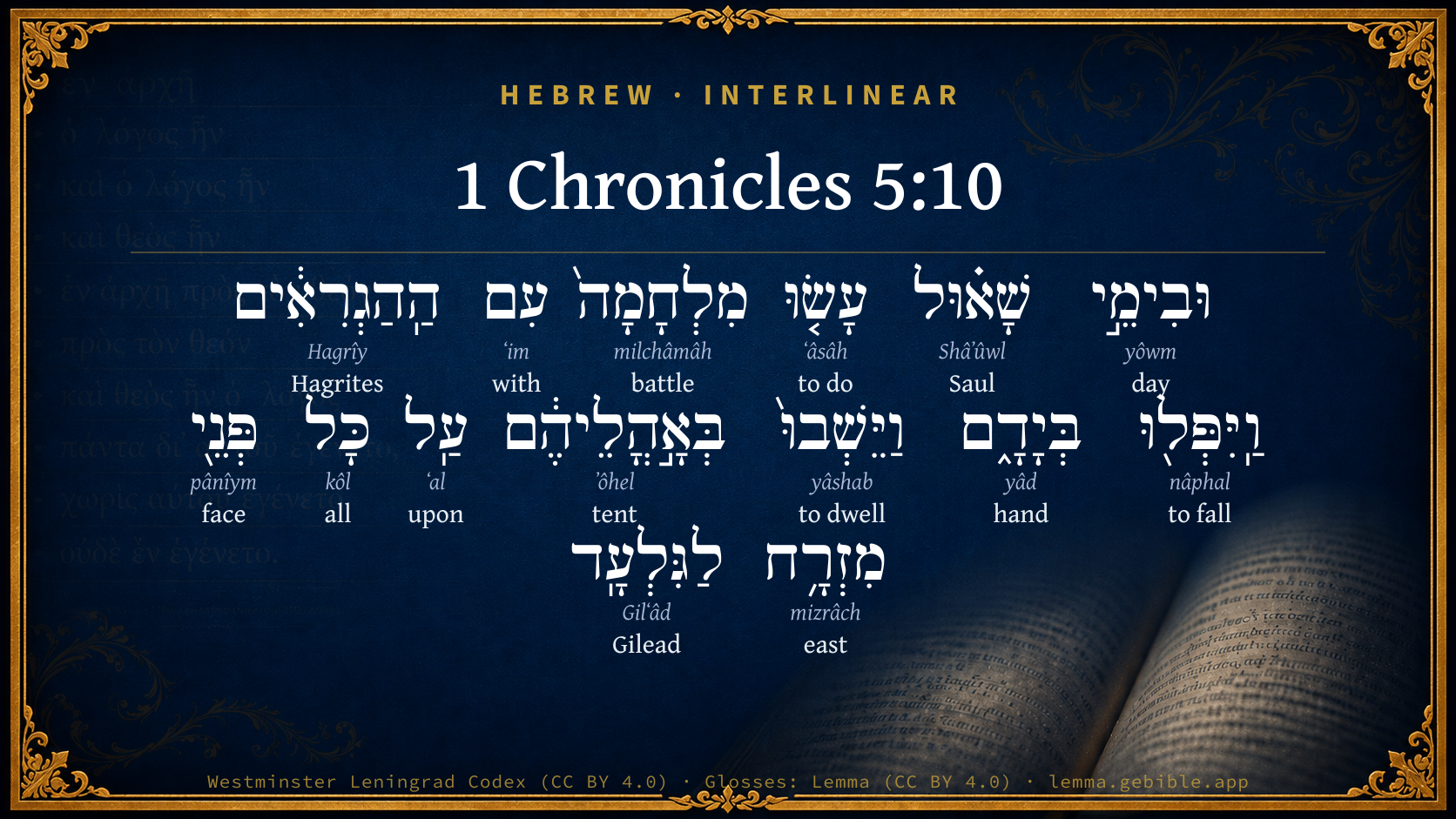
1 Chronicles 5:10

Hebrew (Westminster Leningrad Codex) 1 Chronicles 5:10 appears in the Hebrew Old Testament. The text above is from the Westminster Leningrad Codex. Each word links to its Strong’s number, a concise gloss, and parsing drawn from the Open Scriptures Hebrew Bible morphology. Click any word for its full Brown-Driver-Briggs (BDB) entry.
Download image
Cite this verse

1 Chronicles 5:10 (World English Bible). Public Domain. Lemma interlinear Bible study tool, https://lemma.gebible.app/v/1-chronicles/5/10.

Show BibTeX & RIS
BibTeX
RIS
English Translation
In the days of Saul, they made war with the Hagrites, who fell by their hand; and they lived in their tents throughout all the [land] east of Gilead.
World English Bible · Public Domain
Highlights
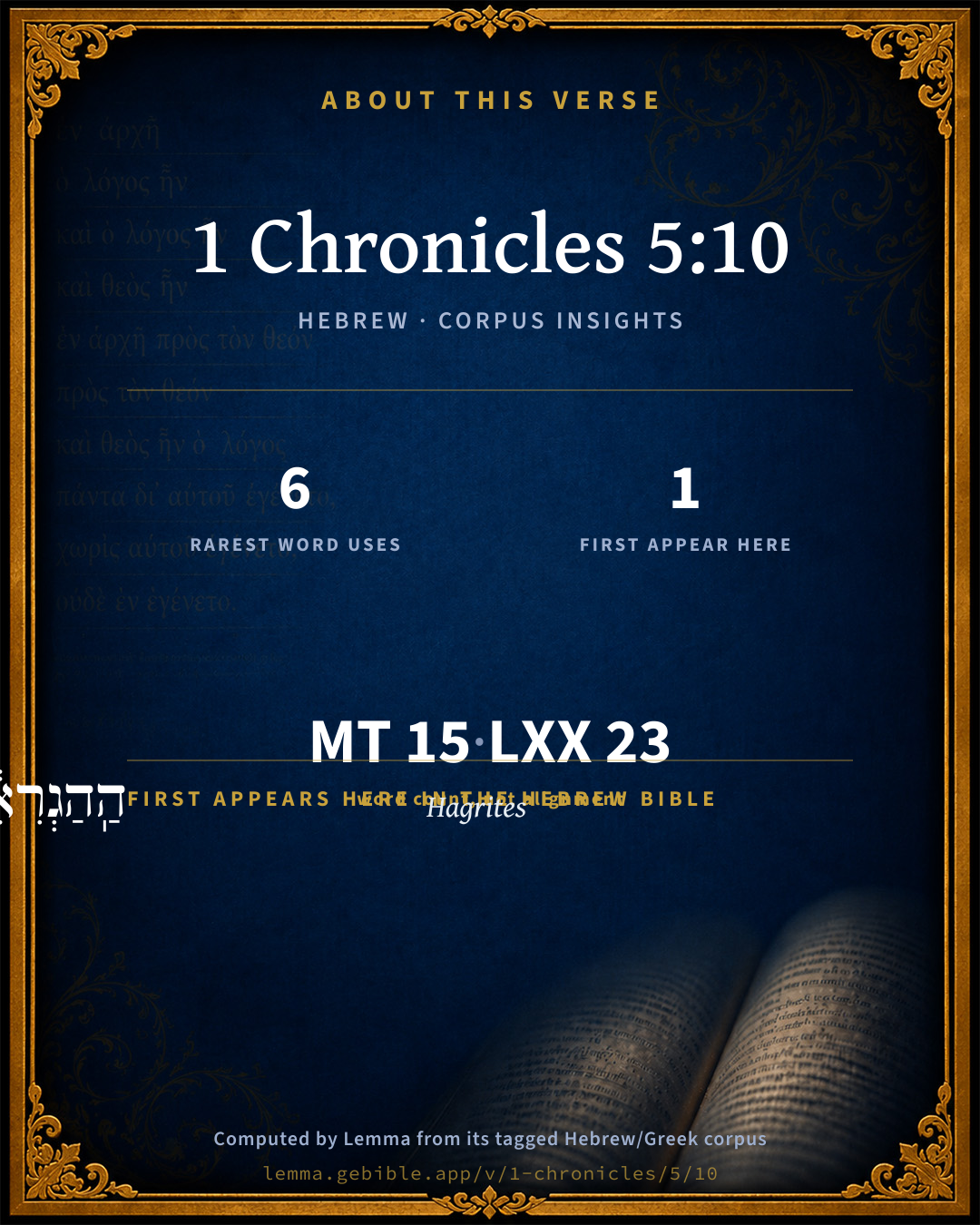
  • 1 first appearance in the Hebrew Bible
Full analysis ↓
Download a study sheet

One document with this verse’s original text, its word-by-word gloss line, the meaning frame, cross-references with their text, attributed commentary, and full source and license credits — printable, and it pastes into notes with its structure intact.

This verse Autodidact and up

Study sheet (.html) Plain text (.txt)

A passage Seminary Student

Up to 50 verses in one chapter. A passage sheet keeps up to 6 commentary sources and 12 cross-references per verse, in the order this page ranks them, and says so on the sheet whenever that leaves anything out. Ask for a single verse and you get the Autodidact verse sheet above.

Everything on this page stays free to read, with no account — the sheet is a download of what is already on screen, not access to it.

Want to remove ads? Support Godless Engineer
Compare translations 3

The same verse in 3 English versions, stacked beneath the original-language interlinear above. Click any original word for its lexicon entry.

Each is an independent rendering of the whole verse — the interlinear is not word-aligned to these translations.

Highlighted words mark where these versions differ — a whole-verse word diff, not a word-by-word alignment.

  • World English Bible Public Domain
    In the days of Saul, they made war with the Hagrites, who fell by their hand; and they lived in their tents throughout all the [land] east of Gilead.
  • King James Version Public Domain
    And in the days of Saul they made war with the Hagarites, who fell by their hand: and they dwelt in their tents throughout all the east land of Gilead.
  • unfoldingWord Literal Text CC BY-SA 4.0
    And in the days of Saul, they made war with the Hagrites, and they fell into their hand. And they dwelled in their tents upon all of the face of the east of Gilead.

unfoldingWord Literal Text — © unfoldingWord, licensed CC BY-SA 4.0. Word-aligned USFM3 via Door43 (git.door43.org/unfoldingWord/en_ult).

Versions to compare (up to 4)

3 of 4 selected

Show all 18 translations

Every available English version of this verse, each an independent rendering of the whole verse.

  • World English Bible Public Domain
    In the days of Saul, they made war with the Hagrites, who fell by their hand; and they lived in their tents throughout all the [land] east of Gilead.
  • Berean Standard Bible Public Domain
    During the days of Saul they waged war against the Hagrites, who were defeated at their hands, and they occupied the homes of the Hagrites throughout the region east of Gilead.
  • Majority Standard Bible Public Domain
    During the days of Saul they waged war against the Hagrites, who were defeated at their hands, and they occupied the dwellings of the Hagrites throughout the region east of Gilead.
  • King James Version Public Domain
    And in the days of Saul they made war with the Hagarites, who fell by their hand: and they dwelt in their tents throughout all the east land of Gilead.
  • American Standard Version (1901) Public Domain
    And in the days of Saul, they made war with the Hagrites, who fell by their hand; and they dwelt in their tents throughout all the `land' east of Gilead.
  • Revised Version (1885) Public Domain
    And in the days of Saul they made war with the Hagrites, who fell by their hand: and they dwelt in their tents throughout all the land east of Gilead.
  • Geneva Bible (1599) Public Domain
    And in the dayes of Saul they warred with the Hagarims, which fell by their hands: and they dwelt in their tentes in all the East partes of Gilead.
  • Douay-Rheims (1899) Public Domain
    And in the days of Saul they fought against the Agarites, and slew them, and dwelt in their tents in their stead, in all the country, that looketh to the east of Galaad.
  • Young's Literal Translation Public Domain
    And in the days of Saul they have made war with the Hagarites, who fall by their hand, and they dwell in their tents over all the face of the east of Gilead.
  • Literal Standard Version CC BY-SA 4.0
    And they have made war with the Hagarites in the days of Saul, who fall by their hand, and they dwell in their tents over all the face of the east of Gilead.
  • Unlocked Literal Bible CC BY-SA 4.0
    In the days of Saul, the tribe of Reuben attacked the Hagrites and defeated them. They lived in the Hagrites' tents throughout all the land east of Gilead.
  • unfoldingWord Literal Text CC BY-SA 4.0
    And in the days of Saul, they made war with the Hagrites, and they fell into their hand. And they dwelled in their tents upon all of the face of the east of Gilead.
  • Darby Bible Public Domain
    And in the days of Saul they made war with the Hagarites, who fell by their hand; and they dwelt in their tents throughout the east side of Gilead.
  • World Messianic Bible Public Domain
    In the days of Saul, they made war with the Hagrites, who fell by their hand; and they lived in their tents throughout all the land east of Gilead.
  • Webster's Bible Public Domain
    And in the days of Saul they made war with the Hagarites, who fell by their hand: and they dwelt in their tents throughout all the east land of Gilead.
  • Free Bible Version CC BY-SA 4.0
    In the time of Saul they went to war against the Hagrites, defeating them. They took over the places where the Hagrites had lived in all the regions east of Gilead.
  • Bible in Basic English Public Domain
    And in the days of Saul they made war on the Hagarites, and overcame them; and they put up their tents through all the land east of Gilead.
  • JPS Tanakh (1917) Public Domain
    And in the days of Saul they made war with the Hagrites, who fell by their hand; and they dwelt in their tents throughout all the land east of Gilead.

Literal Standard Version (2020), Covenant Press — licensed CC BY-SA 4.0. Text via the HelloAO Bible API (eBible.org). Unlocked Literal Bible (unfoldingWord) — licensed CC BY-SA 4.0. Text via the HelloAO Bible API (eBible.org). unfoldingWord Literal Text — © unfoldingWord, licensed CC BY-SA 4.0. Word-aligned USFM3 via Door43 (git.door43.org/unfoldingWord/en_ult). Free Bible Version, Dr. Jonathan Gallagher — licensed CC BY-SA 4.0. Text via the HelloAO Bible API (eBible.org).

Word by word

More ways to search: Search by grammar → Find every occurrence → Compare this word →

Practice this passage: Drill this verse → Learn its vocabulary →

הַֽהַגְרִאִ֔ים
Hagrîy
H1905
“the · Hagrites”
Particle, Definite Article + Noun, Gentilic, Masculine, Plural, Absolute
Part of Speech
Particle + Noun
Type
Gentilic
Gender
Masculine
Number
Plural
State
Absolute
Full BDB Definition

Origin: perhaps patronymically from H1904

TWOT: None

Haggeri = "wanderer" - a people dwelling to the east of Palestine, with whom the tribes of Reuben made war in the time of Saul (noun proper gentilic) - of one of David's servants (adjective patrial) - father of Mibhar and one of David's mighty warriors (noun proper masculine)
  1. וּבִימֵ֣י yôwm H3117 “and · in/at · days of” Conjunction + Preposition + Noun, Common, Masculine, Plural, Construct
  2. שָׁא֗וּל Shâʼûwl H7586 “Saul” Noun, Proper
  3. עָשׂ֤וּ ʻâsâh H6213 “to do” Verb, Qal, Perfect, 3rd Person, Common, Plural
  4. מִלְחָמָה֙ milchâmâh H4421 “battle” Noun, Common, Feminine, Singular, Absolute
  5. עִם ʻim H5973 “with” Preposition
  6. וַֽיִּפְּל֖וּ nâphal H5307 “and · to fall” Conjunction + Verb, Qal, Sequential Imperfect, 3rd Person, Masculine, Plural
  7. בְּיָדָ֑ם yâd H3027 “in/at · hand · their” Preposition + Noun, Common, Both, Singular, Construct + Suffix, Personal, 3rd Person, Masculine, Plural
  8. וַיֵּשְׁבוּ֙ yâshab H3427 “and · to dwell” Conjunction + Verb, Qal, Sequential Imperfect, 3rd Person, Masculine, Plural
  9. בְּאָ֣הֳלֵיהֶ֔ם ʼôhel H168 “in/at · tents · their” Preposition + Noun, Common, Masculine, Plural, Construct + Suffix, Personal, 3rd Person, Masculine, Plural
  10. עַֽל ʻal H5921 “upon” Preposition
  11. כָּל kôl H3605 “all of” Noun, Common, Masculine, Singular, Construct
  12. פְּנֵ֖י pânîym H6440 “face(s) of” Noun, Common, Both, Plural, Construct
  13. מִזְרָ֥ח mizrâch H4217 “east” Noun, Common, Masculine, Singular, Absolute
  14. לַגִּלְעָֽד Gilʻâd H1568 “to/for the · Gilead” Preposition, Determined + Noun, Proper

About this verse

These counts appear in no published source. They are computed here, from the morphology-tagged text and Lemma’s own curated glosses. What Lemma adds →

15
words
15
distinct lemmas
Historical
section

Notable vocabulary

The rarest word here is הַֽהַגְרִאִ֔ים Hagrites H1905 — appearing just 6 times in the whole Hebrew Bible.

First appearance in Scripture

This word makes its first canonical appearance in the Hebrew Bible here:

  • הַֽהַגְרִאִ֔ים Hagrites H1905

Shared distinctive vocabulary

הַֽהַגְרִאִ֔ים Hagrites H1905 occurs in 6 verses of the Hebrew Bible. Also found in:

Grammatical profile

  • 3 verbs
  • 10 nouns
  • 2 prepositions

Verb forms

  • עָשׂ֤וּ Qal · Perfect
  • וַֽיִּפְּל֖וּ Qal · Sequential Imperfect
  • וַיֵּשְׁבוּ֙ Qal · Sequential Imperfect

Hebrew & Septuagint length

In English translation the verse runs 29 words from the Hebrew and 31 from the Septuagint (LXX English) — closely comparable.

A rough comparison of the two English renderings, which tokenize alike — not a word-level alignment.

Word counts can differ between the Hebrew and the Greek without any difference in meaning — e.g. the Hebrew direct-object marker אֵת has no separate Greek word, and Greek often adds the article ὁ.

In the original languages it is 15 Hebrew tokens and 23 Greek tokens — but the two are counted differently (Hebrew bundles its prefixes and suffixes into one token; the Greek is in lemma form), so that isn’t a like-for-like length.

Cross-references

4

Topical passages linked to 1 Chronicles 5:10 in the Treasury of Scripture Knowledge — connected by theme and wording, ordered by reader-vote popularity; previews shown in the World English Bible.

  • Genesis 25:12 Now this is the history of the generations of Ishmael, Abraham's son, whom Hagar the Egyptian, Sarah's handmaid, bore to Abraham.
  • 1 Chronicles 5:18–21 The sons of Reuben, and the Gadites, and the half-tribe of Manasseh, of valiant men, men able to bear buckler and sword, and to shoot with bow, and skillful in war, were forty-four thousand seven hundred and sixty, that were able to go forth to war.
  • Psalms 83:6 The tents of Edom and the Ishmaelites; Moab, and the Hagrites;
  • Genesis 21:9 Sarah saw the son of Hagar the Egyptian, whom she had borne to Abraham, mocking.

Cross-references courtesy of OpenBible.info (CC BY 4.0).

Hebrew and Greek witnesses Masoretic Hebrew ↔ Greek Septuagint

The same verse in the two great witnesses to the Old Testament, shown verse-for-verse.

These are two independent witnesses, not word-aligned to each other, and the Septuagint is shown in lemma (dictionary) form.

Hebrew 1 Chronicles 5:10 Masoretic · Westminster Leningrad Codex

וּבִימֵ֣י שָׁא֗וּל עָשׂ֤וּ מִלְחָמָה֙ עִם הַֽהַגְרִאִ֔ים וַֽיִּפְּל֖וּ בְּיָדָ֑ם וַיֵּשְׁבוּ֙ בְּאָ֣הֳלֵיהֶ֔ם עַֽל כָּל פְּנֵ֖י מִזְרָ֥ח לַגִּלְעָֽד

In the days of Saul, they made war with the Hagrites, who fell by their hand; and they lived in their tents throughout all the [land] east of Gilead.

World English Bible · Public Domain

Greek LXX 1 Chronicles 5:10 Septuagint · lemma form

καί ἐν ἡμέρα σαούλ ποιέω πόλεμος πρός ὁ πάροικος καί πίπτω ἐν χείρ αὐτός καταοἰκέω ἐν σκηνή ἕως πᾶς κατά ἀνατολή ὁ γαλαάδ

And in the days of Saul they made war upon the sojourners in the land; and they fell into their hands, all of them dwelling in their tents eastward of Galaad.

LXX2012 (modern English Septuagint) · Public Domain

On this verse, Ellicott's Commentary for English Readers discusses the Septuagint’s reading. Read the note in Commentary ↓

Hebrew: Westminster Leningrad Codex (CC BY 4.0). Greek: Septuagint (public domain); English from LXX2012 (modern English Septuagint) (Public Domain). How the Septuagint differs from the Hebrew →

Commentary

Notes on 1 Chronicles 5:10 from classic Christian and Jewish commentators (each source and its license shown beneath its notes). The classic Christian expositions comment on the surrounding passage and are grouped to its opening verse, so a note may address several verses; the Jewish commentaries on the Tanakh (Rashi and others) are per-verse, so they appear only where the commentator wrote on this verse.

Lemma curates 59 commentaries, every one of them public domain or Creative Commons licensed, each selected and text-cleaned for this edition rather than reprinted as found. About our sources →

Trapp's Complete Commentary

John Trapp

1Ch 5:10 And in the days of Saul they made war with the Hagarites, who fell by their hand: and they dwelt in their tents throughout all the east [land] of Gilead.

Ver. 10. They made war with the Hagarites,] i.e., Ishmaelites inhabiting Arabia deserta. These, ashamed of their mother Hagar the handmaid, would afterwards need for honour’s sake be called Saracens, by the name of Sarah the mistress, as saith Sozomen. {a} This so pleased the rest of the Arabians, that they would all be called Saracens. Mohammed their general grew famous in the days of Heraclius the emperor, and subdued many countries. Now they are called Turks, &c.

And they dwelt in their tents.] Few countries but have changed their inhabitants: such is the vanity of all here below. The Athenians vaunted, but vainly, that they were αυτοχθονες, bred out of the land they lived upon, as so many mushrooms or grasshoppers.

{a} Lib. vii. cap. 38. Am. Marc.

John Trapp, A Commentary or Exposition upon All the Books of the Old and New Testament (1647–1656) — public domain. Text from a community e-Sword module.

Joseph Benson's Commentary

1Ch 5:10. In the days of Saul they made war — The Gadites and Manassites joining with them in the war, 1Ch 5:18-19. With the Hagarites — The Ishmaelites who dwelt in Arabia Deserta. They dwelt in their tents — The Israelites took possession of their lands, and tents or houses, which lay eastward from the land of Gilead. Thus God fulfilled his promise to his people: he cast out the enemy from before them by little and little, and gave them their land as they had occasion for it.

Joseph Benson's Commentary on the Old and New Testaments (1811–1818) — public domain. Text from a community e-Sword module.

Tyndale Open Study Notes

Tyndale Open Resources

5:10 The tribes of Transjordan, including the Reubenites, expanded their settlements to the north and east in conjunction with their war with the Hagrites in the days of Saul (see 5:18-22; Ps 83:6). Later, the Hagrites were among David’s men (see 1 Chr 11:38; 27:31).

Tyndale Open Study Notes — © Tyndale Open Resources, licensed CC BY-SA 4.0. Text via the HelloAO Bible API.

Geneva Bible (1599)

Geneva Bible translators

The Ishmaelites that came of Hagar Abraham’s concubine.

Geneva Bible (1599) marginal notes — public domain. Text via Bolls.life.

Adam Clarke's Commentary

Verse 10. And they dwelt in their tents] The Hagarites were tribes of Nomade, or Scenite, Arabs; people who lived in tents, without any fixed dwellings, and whose property consisted in cattle. The descendants of Reuben extirpated these Hagarites, seized on their property and their tents, and dwelt in their place.

Adam Clarke's Commentary on the Bible (1810–1826) — public domain. Text from a community e-Sword/MySword module.

Ellicott's Commentary for English Readers

(10) And in the days of Saul they made war with the Hagarites.—The great extension of the tribe in an easterly direction took place in the reign of Saul, the first king of Israel. Bela and his clan victoriously fought with the Hagarites (Heb., Hagri’im) or Hagarenes (see Psa_83:7, Hagrim), that is, the sons of Hagar, for possession of the pasture-grounds east of Gilead. This Arab nation is mentioned in the Assyrian inscriptions. (The LXX. has τοὺς παροίκους, i.e., haggârîm, u sojourners,” “nomads.”)

They dwelt in their tents.—This phrase first occurs in Gen_9:27. The Belaites occupied the territory of the Hagarites.

Throughout all the east land of Gilead.—Rather, on the whole eastern side or border of Gilead. This includes the new settlements of Bela beyond the border.

A Bible Commentary for English Readers, edited by Charles John Ellicott (1878–1897) — public domain. Text from a community e-Sword module.

The Cambridge Bible for Schools and Colleges

gen. ed. J. J. S. Perowne

10. in the days of Saul] Saul’s great victory over the Ammonites (1 Samuel 11) may have paved the way for the expansion of Israel east of Jordan.

the Hegarites] R.V. the Hagrites as Psa_83:6 (R.V. mg.). They were an Arab people. Details of the war are given 1Ch_5:18-22.

the east land of Gilead] R.V. the land east of Gilead, i.e. the land between Gilead and the Euphrates (cp. 1Ch_5:9).

The Cambridge Bible for Schools and Colleges (gen. ed. J. J. S. Perowne; Cambridge University Press, 1878–1918) — public domain. Text from a community e-Sword module.

John Gill's Exposition

And the children of Gad dwelt over against them,.... Or by them, the Reubenites; and one part of Gilead was given them between them, and the other to the half tribe of Manasseh:

in the land of Bashan, unto Salcah; for though all Bashan is said to be given to the half tribe of Manasseh, Deu 3:13 yet that is to be understood of the greater part of it; all of that which belonged to Og, but what did not, the Gadites, either from the first, or in later times, inhabited even as far as Salcah, which was one of the cities of Og, Deu 3:10 and which Benjamin of Tudela (w) makes mention of, being called by the same name in his days.

(w) Itinerar. p. 57.

John Gill's Exposition of the Whole Bible (1746–1763) — public domain (CC PDM 1.0). Text via the HelloAO Bible API.

Albert Barnes' Notes on the Bible

The “Hagarites” or “Hagarenes” are generally regarded as descendants of Hagar, and a distinct branch of the Ishmaelites 1Ch 27:30-31; Psa 83:6. They appear to have been one of the most wealthy 1Ch 5:21 and widely-spread tribes of the Syrian Desert, being found on the side of the Euphrates in contact with the Assyrians, and also in the Hauran, in the neighborhood of Palestine, in contact with the Moabites and Israelites. If identical with the Agraei of the Classical writers, their name may be considered as still surviving in that of the district called Hejer or Hejera in northeastern Arabia, on the borders of the Persian Gulf. A full account of the war is given in 1Ch 5:18-22.

Albert Barnes' Notes on the Bible (1834–1885) — public domain. Text from a community e-Sword/MySword module.

Matthew Poole's English Annotations

They made war; the Gadites and Manassites joining with them in the war, 1Ch 5:18,19.

With the Hagarites; the Ishmeelites, who dwelt in Arabia the Desert.

They dwelt in their tents; the Israelites took possession of their lands, and tents or houses.

Throughout all the east land of Gilead; which lay eastward from the land of Gilead.

Matthew Poole's English Annotations on the Holy Bible (1683–1685) — public domain. Text from a community e-Sword/MySword module.

Whedon's Commentary on the Bible

Daniel D. Whedon

10. The Hagarites — The same as the Ishmaelites, who were all descended from Hagar, Sarah’s Egyptian hand-maid, and were scattered over the vast deserts between Egypt and Assyria. See on Gen_25:12-18. In this Hagarite war, the Reubenites were assisted by the Gadites and the half tribe of Manasseh. See 1Ch_5:18-22.

Daniel D. Whedon (gen. ed.), Commentary on the Old and New Testaments (1874–1909) — public domain. Text from a community e-Sword module.

The Pulpit Commentary

Among such conflicts, one with a people descended presumably from Hagar or Ishmael (though 1Ch_27:30, 1Ch_27:31, and Psa 70:13:6 are somewhat needlessly interpreted to be opposed to this) is here alluded to. It takes us to the time of Saul, and from that time up to the time of "the Captivity" (ver. 22) the victorious Reubenites, Gadites, and people of the half-tribe Manasseh had the benefit of enlarged domain at their expense: "They dwelt in their steads," after seizing great spoil. It is exceedingly likely that we have the perpetuation of the name Hagarenes in the Agraeei (modern Hejer) of Strabo, 16:767; Pliny, "Hist. Nat.," 6:32; Dionysius, "Perieg.," 956; Pt. 5:2 (see art. "Hagarenes" in Smith"s "Bible Dictionary").

The Pulpit Commentary (1880–1919), ed. H.D.M. Spence-Jones & Joseph S. Exell — public domain. Text from a community e-Sword module.

John Wesley's Explanatory Notes

They made war - Thus God did for his people, as he promised them. He cast out the enemy from before them by little and little, and gave them their land as they had occasion for it.

John Wesley, Explanatory Notes Upon the Whole Bible (1754–1765) — public domain. Text via the GEBible commentary corpus.

Keil & Delitzsch

C. F. Keil & F. Delitzsch

And the children of Gad dwelt over against them,.... Or by them, the Reubenites; and one part of Gilead was given them between them, and the other to the half tribe of Manasseh:

in the land of Bashan, unto Salcah; for though all Bashan is said to be given to the half tribe of Manasseh, Deu 3:13 yet that is to be understood of the greater part of it; all of that which belonged to Og, but what did not, the Gadites, either from the first, or in later times, inhabited even as far as Salcah, which was one of the cities of Og, Deu 3:10 and which Benjamin of Tudela (w) makes mention of, being called by the same name in his days.

(w) Itinerar. p. 57.

Keil & Delitzsch — Biblical Commentary on the Old Testament (1861–1891) — public domain (CC PDM 1.0). Text via the HelloAO Bible API. (Old Testament only.)

unfoldingWord translationNotes

Door43 World Missions Community

the Hagrites

This is a name of a people group. (See: How to Translate Names)

lived in the Hagrites' tents

The tents are a synecdoche for the land and the buildings on the land. AT: "took over all the Hagrites' land and buildings" or "they lived in all the Hagrite territory" (See: Synecdoche)

translationWords

Saul (OT)

tent

unfoldingWord translationNotes — © Distant Shores Media and the Door43 World Missions Community, licensed CC BY-SA 4.0. Source: git.door43.org/Door43/en_tn.

Rashi

Rabbi Shlomo Yitzchaki (Rashi)

with the Hagarites with the Ishmaelites, and by their mother’s name he calls them Hagarites, because they were the sons of Hagar.

and they dwelt in their tents for it is the custom of the Arabs to dwell in tents.

Rashi on the Tanakh — English translations: “The Judaica Press complete Tanach with Rashi, translated by A. J. Rosenberg” (CC BY 4.0); “Pentateuch with Rashi's commentary by M. Rosenbaum and A.M. Silbermann, 1929-1934” (public domain); “The Metsudah Tanach series, Lakewood, N.J” (CC BY 4.0); and “The Book of Joshua, Metsudah Publications, 1997” (CC BY 4.0). Text via Sefaria.

Lesson kit

Teaching starters — assembled from the data on this page, not authored interpretation. Every prompt links to the verse data it draws on. Edit before teaching.

1 Chronicles, in the Historical, opens this verse with 15 words (15 distinct Hebrew lemmas). Its most distinctive word is Hagrîy (“Hagrites”). A historical commentator’s framing appears above. Read the whole chapter for the surrounding context.

Discussion questions

  1. How does “Hagrites” (Hagrîy) shape what this verse is saying?
  2. This is the first place “Hagrites” appears in Scripture (first appears here). What does its debut here establish?
  3. How does 1 Chronicles 5:19, which shares the word «Hagrites», read alongside this verse?
  4. These translations render this verse differently; the difference is in the English rendering, not the original. What questions does that raise?
  5. «עָשׂ֤וּ» is a Qal Perfect verb. How does that grammatical form shape the action described?
  6. Compare how Trapp's Complete Commentary and Joseph Benson's Commentary read this verse. Where do they agree or differ?

Things to notice

Reading settings

Reading text

Shown beneath each verse's original-language words.

Old Testament
Old Testament edition

Read the OT as the Masoretic Hebrew (MT) or the Greek Septuagint (LXX).

English shown for the Greek Septuagint (in the Hebrew ↔ Greek comparison).

Comparing translations? Open the Compare panel on any verse page to stack up to four side by side.