
Numbers 20:6

Hebrew (Westminster Leningrad Codex) Numbers 20:6 appears in the Hebrew Old Testament. The text above is from the Westminster Leningrad Codex. Each word links to its Strong’s number, a concise gloss, and parsing drawn from the Open Scriptures Hebrew Bible morphology. Click any word for its full Brown-Driver-Briggs (BDB) entry.
Download image
Cite this verse

Numbers 20:6 (World English Bible). Public Domain. Lemma interlinear Bible study tool, https://lemma.gebible.app/v/numbers/20/6.

Show BibTeX & RIS
BibTeX
RIS
English Translation
Moses and Aaron went from the presence of the assembly to the door of the tent of meeting, and fell on their faces: and the glory of Yahweh appeared to them.
World English Bible · Public Domain
Download a study sheet

One document with this verse’s original text, its word-by-word gloss line, the meaning frame, cross-references with their text, attributed commentary, and full source and license credits — printable, and it pastes into notes with its structure intact.

This verse Autodidact and up

Study sheet (.html) Plain text (.txt)

A passage Seminary Student

Up to 50 verses in one chapter. A passage sheet keeps up to 6 commentary sources and 12 cross-references per verse, in the order this page ranks them, and says so on the sheet whenever that leaves anything out. Ask for a single verse and you get the Autodidact verse sheet above.

Everything on this page stays free to read, with no account — the sheet is a download of what is already on screen, not access to it.

Want to remove ads? Support Godless Engineer
Compare translations 3

The same verse in 3 English versions, stacked beneath the original-language interlinear above. Click any original word for its lexicon entry.

Each is an independent rendering of the whole verse — the interlinear is not word-aligned to these translations.

Highlighted words mark where these versions differ — a whole-verse word diff, not a word-by-word alignment.

  • World English Bible Public Domain
    Moses and Aaron went from the presence of the assembly to the door of the tent of meeting, and fell on their faces: and the glory of Yahweh appeared to them.
  • King James Version Public Domain
    And Moses and Aaron went from the presence of the assembly unto the door of the tabernacle of the congregation, and they fell upon their faces: and the glory of the LORD appeared unto them.
  • unfoldingWord Literal Text CC BY-SA 4.0
    And Moses and Aaron went from the face of the assembly to the opening of the tent of meeting, and they fell on their faces. And the glory of Yahweh appeared to them.

unfoldingWord Literal Text — © unfoldingWord, licensed CC BY-SA 4.0. Word-aligned USFM3 via Door43 (git.door43.org/unfoldingWord/en_ult).

Versions to compare (up to 4)

3 of 4 selected

Show all 18 translations

Every available English version of this verse, each an independent rendering of the whole verse.

  • World English Bible Public Domain
    Moses and Aaron went from the presence of the assembly to the door of the tent of meeting, and fell on their faces: and the glory of Yahweh appeared to them.
  • Berean Standard Bible Public Domain
    Then Moses and Aaron went from the presence of the assembly to the entrance to the Tent of Meeting. They fell facedown, and the glory of the LORD appeared to them.
  • Majority Standard Bible Public Domain
    Then Moses and Aaron went from the presence of the assembly to the entrance to the Tent of Meeting. They fell facedown, and the glory of the LORD appeared to them.
  • King James Version Public Domain
    And Moses and Aaron went from the presence of the assembly unto the door of the tabernacle of the congregation, and they fell upon their faces: and the glory of the LORD appeared unto them.
  • American Standard Version (1901) Public Domain
    And Moses and Aaron went from the presence of the assembly unto the door of the tent of meeting, and fell upon their faces: and the glory of Jehovah appeared unto them.
  • Revised Version (1885) Public Domain
    And Moses and Aaron went from the presence of the assembly unto the door of the tent of meeting, and fell upon their faces: and the glory of the LORD appeared unto them.
  • Geneva Bible (1599) Public Domain
    Then Moses and Aaron went from the assemblie vnto the doore of the Tabernacle of the Congregation, and fell vpon their faces: and the glory of the Lord appeared vnto them.
  • Douay-Rheims (1899) Public Domain
    And Moses and Aaron leaving the multitude, went into the tabernacle of the covenant, and fell flat upon the ground, and cried to the Lord, and said: O Lord God, hear the cry of this people, and open to them thy treasure, a fountain of living water, that being satisfied, they may cease to murmur. And the glory of the Lord appeared over them.
  • Young's Literal Translation Public Domain
    And Moses and Aaron go in from the presence of the assembly unto the opening of the tent of meeting, and fall on their faces, and the honour of Jehovah is seen by them.
  • Literal Standard Version CC BY-SA 4.0
    And Moses and Aaron go in from the presence of the assembly to the opening of the Tent of Meeting and fall on their faces, and the glory of YHWH is seen by them.
  • Unlocked Literal Bible CC BY-SA 4.0
    So Moses and Aaron went away from in front of the assembly. They went to the entrance of the tent of meeting and lay facedown. There Yahweh's brilliant glory appeared to them.
  • unfoldingWord Literal Text CC BY-SA 4.0
    And Moses and Aaron went from the face of the assembly to the opening of the tent of meeting, and they fell on their faces. And the glory of Yahweh appeared to them.
  • Darby Bible Public Domain
    And Moses and Aaron went from before the congregation to the entrance of the tent of meeting, and fell upon their faces; and the glory of Jehovah appeared to them.
  • World Messianic Bible Public Domain
    Moses and Aaron went from the presence of the assembly to the door of the Tent of Meeting, and fell on their faces. The LORD’s glory appeared to them.
  • Webster's Bible Public Domain
    And Moses and Aaron went from the presence of the assembly to the door of the tabernacle of the congregation, and they fell upon their faces: and the glory of the LORD appeared to them.
  • Free Bible Version CC BY-SA 4.0
    Moses and Aaron left the people and went to the entrance of the Tent of Meeting. There they fell facedown on the ground, and the glory of the Lord appeared to them.
  • Bible in Basic English Public Domain
    Then Moses and Aaron went away from the people to the door of the Tent of meeting; and, falling on their faces there, they saw the glory of the Lord.
  • JPS Tanakh (1917) Public Domain
    And Moses and Aaron went from the presence of the assembly unto the door of the tent of meeting, and fell upon their faces; and the glory of the LORD appeared unto them.

Literal Standard Version (2020), Covenant Press — licensed CC BY-SA 4.0. Text via the HelloAO Bible API (eBible.org). Unlocked Literal Bible (unfoldingWord) — licensed CC BY-SA 4.0. Text via the HelloAO Bible API (eBible.org). unfoldingWord Literal Text — © unfoldingWord, licensed CC BY-SA 4.0. Word-aligned USFM3 via Door43 (git.door43.org/unfoldingWord/en_ult). Free Bible Version, Dr. Jonathan Gallagher — licensed CC BY-SA 4.0. Text via the HelloAO Bible API (eBible.org).

Word by word

More ways to search: Search by grammar → Find every occurrence → Compare this word →

Practice this passage: Drill this verse → Learn its vocabulary →

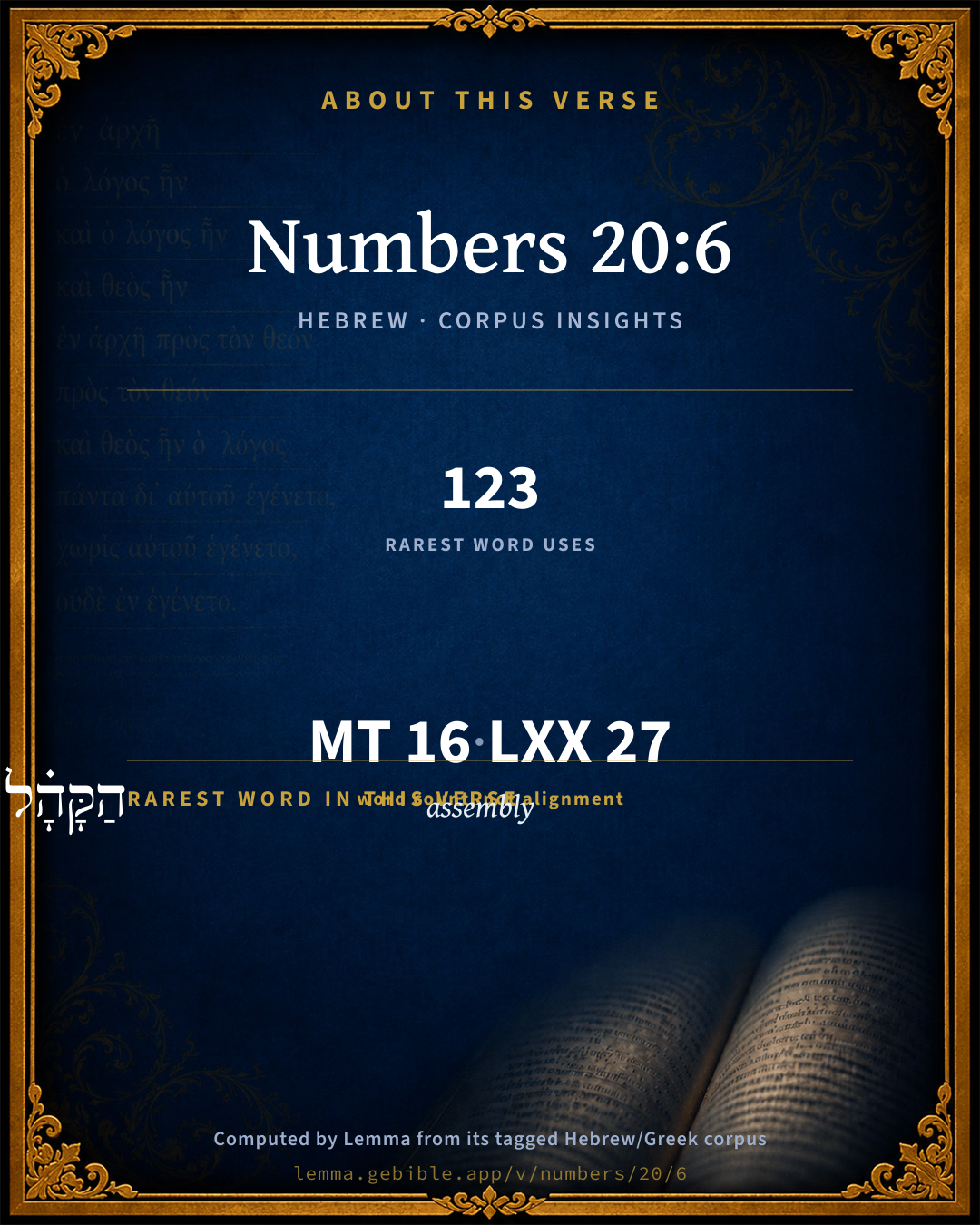
הַקָּהָ֗ל
qâhâl
H6951
“the · assembly”
Particle, Definite Article + Noun, Common, Masculine, Singular, Absolute
Part of Speech
Particle + Noun
Type
Common
Gender
Masculine
Number
Singular
State
Absolute
Full BDB Definition

Origin: from H6950

TWOT: 1991a

assembly, company, congregation, convocation - assembly - for evil counsel, war or invasion, religious purposes - company (of returning exiles) - congregation - as organised body
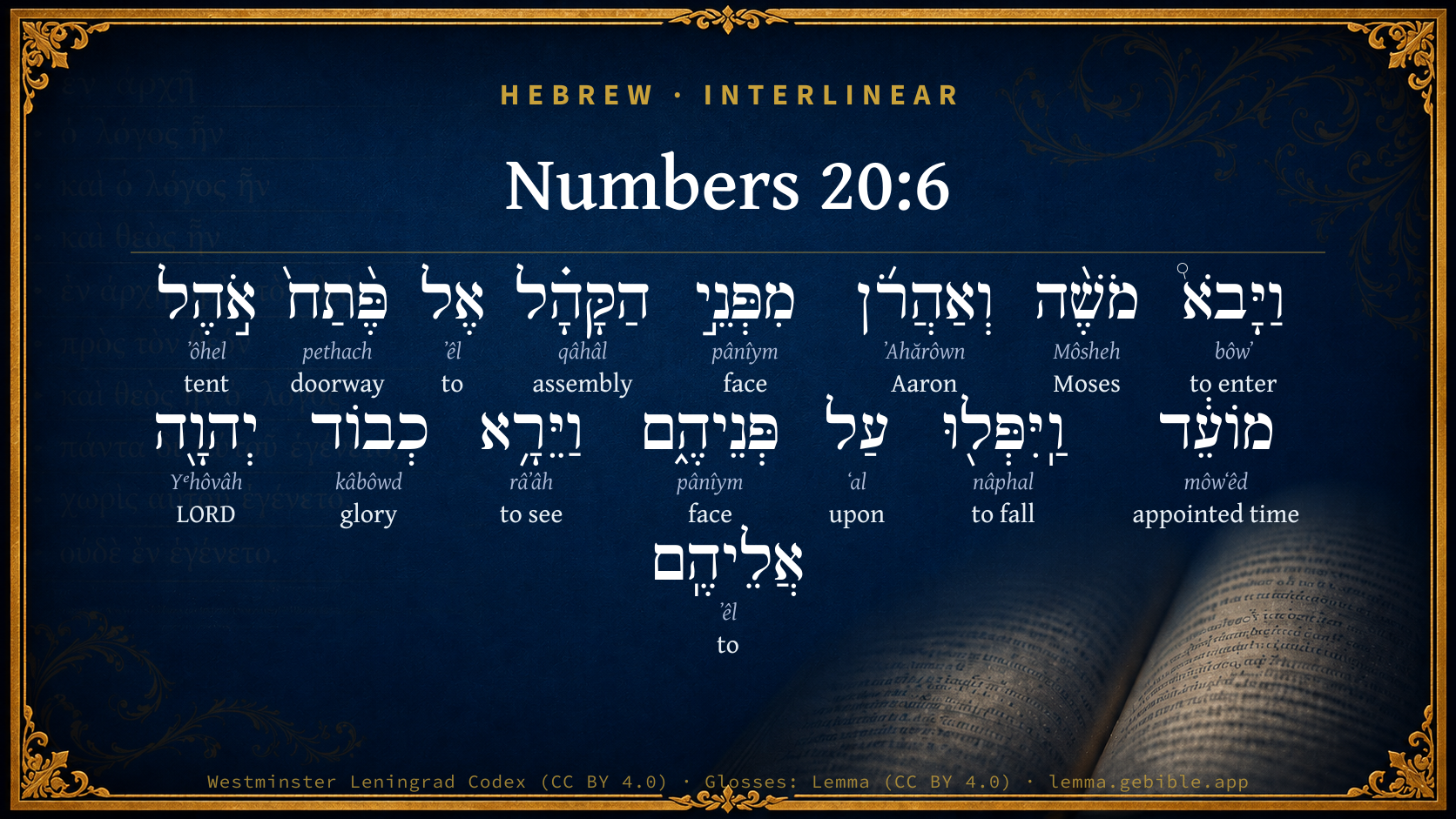
  1. וַיָּבֹא֩ bôwʼ H935 “and · to enter” Conjunction + Verb, Qal, Sequential Imperfect, 3rd Person, Masculine, Singular
  2. מֹשֶׁ֨ה Môsheh H4872 “Moses” Noun, Proper
  3. וְאַהֲרֹ֜ן ʼAhărôwn H175 “and · Aaron” Conjunction + Noun, Proper
  4. מִפְּנֵ֣י pânîym H6440 “from · face(s) of” Preposition + Noun, Common, Both, Plural, Construct
  5. אֶל ʼêl H413 “to” Preposition
  6. פֶּ֨תַח֙ pethach H6607 “doorway of” Noun, Common, Masculine, Singular, Construct
  7. אֹ֣הֶל ʼôhel H168 “tent” Noun, Common, Masculine, Singular, Absolute
  8. מוֹעֵ֔ד môwʻêd H4150 “appointed time” Noun, Common, Masculine, Singular, Absolute
  9. וַֽיִּפְּל֖וּ nâphal H5307 “and · to fall” Conjunction + Verb, Qal, Sequential Imperfect, 3rd Person, Masculine, Plural
  10. עַל ʻal H5921 “upon” Preposition
  11. פְּנֵיהֶ֑ם pânîym H6440 “face(s) · their” Noun, Common, Both, Plural, Construct + Suffix, Personal, 3rd Person, Masculine, Plural
  12. וַיֵּרָ֥א râʼâh H7200 “and · to see” Conjunction + Verb, Niphal, Sequential Imperfect, 3rd Person, Masculine, Singular
  13. כְבוֹד kâbôwd H3519 “glory of” Noun, Common, Both, Singular, Construct
  14. יְהוָ֖ה Yᵉhôvâh H3068 “LORD” Noun, Proper
  15. אֲלֵיהֶֽם ʼêl H413 “to · them” Preposition + Suffix, Personal, 3rd Person, Masculine, Plural

About this verse

These counts appear in no published source. They are computed here, from the morphology-tagged text and Lemma’s own curated glosses. What Lemma adds →

16
words
14
distinct lemmas
Pentateuch
section

Grammatical profile

  • 3 verbs
  • 10 nouns
  • 3 prepositions

Verb forms

  • וַיָּבֹא֩ Qal · Sequential Imperfect
  • וַֽיִּפְּל֖וּ Qal · Sequential Imperfect
  • וַיֵּרָ֥א Niphal · Sequential Imperfect

Repetition

Words recur within this verse — often emphatic in Hebrew:

  • מִפְּנֵ֣י face H6440 ×2
  • אֶל to H413 ×2

Hebrew & Septuagint length

In English translation the verse runs 31 words from the Hebrew and 32 from the Septuagint (LXX English) — closely comparable.

A rough comparison of the two English renderings, which tokenize alike — not a word-level alignment.

Word counts can differ between the Hebrew and the Greek without any difference in meaning — e.g. the Hebrew direct-object marker אֵת has no separate Greek word, and Greek often adds the article ὁ.

In the original languages it is 16 Hebrew tokens and 27 Greek tokens — but the two are counted differently (Hebrew bundles its prefixes and suffixes into one token; the Greek is in lemma form), so that isn’t a like-for-like length.

Cross-references

14

Topical passages linked to Numbers 20:6 in the Treasury of Scripture Knowledge — connected by theme and wording, ordered by reader-vote popularity; previews shown in the World English Bible.

  • Numbers 14:5 Then Moses and Aaron fell on their faces before all the assembly of the congregation of the children of Israel.
  • Numbers 16:4 When Moses heard it, he fell on his face:
  • Numbers 16:19 Korah assembled all the congregation against them to the door of the tent of meeting: and the glory of Yahweh appeared to all the congregation.
  • Numbers 16:22 They fell on their faces, and said, God, the God of the spirits of all flesh, shall one man sin, and will you be angry with all the congregation?
  • Numbers 16:45 Get away from among this congregation, that I may consume them in a moment. They fell on their faces.
  • Exodus 16:10 It happened, as Aaron spoke to the whole congregation of the children of Israel, that they looked toward the wilderness, and, behold, the glory of Yahweh appeared in the cloud.
  • Exodus 17:4 Moses cried to Yahweh, saying, "What shall I do with these people? They are almost ready to stone me."
  • Numbers 12:5 Yahweh came down in a pillar of cloud, and stood at the door of the Tent, and called Aaron and Miriam; and they both came forth.
  • Numbers 14:10 But all the congregation bade stone them with stones. The glory of Yahweh appeared in the tent of meeting to all the children of Israel.
  • Numbers 16:42 It happened, when the congregation was assembled against Moses and against Aaron, that they looked toward the tent of meeting: and, behold, the cloud covered it, and the glory of Yahweh appeared.
  • Joshua 7:6 Joshua tore his clothes, and fell to the earth on his face before the ark of Yahweh until the evening, he and the elders of Israel; and they put dust on their heads.
  • 1 Chronicles 21:16 David lifted up his eyes, and saw the angel of Yahweh standing between earth and the sky, having a drawn sword in his hand stretched out over Jerusalem. Then David and the elders, clothed in sackcloth, fell on their faces.
  • Psalms 109:3–4 They have also surrounded me with words of hatred, And fought against me without a cause.
  • Matthew 26:39 He went forward a little, fell on his face, and prayed, saying, "My Father, if it is possible, let this cup pass away from me; nevertheless, not what I desire, but what you desire."

Cross-references courtesy of OpenBible.info (CC BY 4.0).

Hebrew and Greek witnesses Masoretic Hebrew ↔ Greek Septuagint

The same verse in the two great witnesses to the Old Testament, shown verse-for-verse.

These are two independent witnesses, not word-aligned to each other, and the Septuagint is shown in lemma (dictionary) form.

Hebrew Numbers 20:6 Masoretic · Westminster Leningrad Codex

וַיָּבֹא֩ מֹשֶׁ֨ה וְאַהֲרֹ֜ן מִפְּנֵ֣י הַקָּהָ֗ל אֶל פֶּ֨תַח֙ אֹ֣הֶל מוֹעֵ֔ד וַֽיִּפְּל֖וּ עַל פְּנֵיהֶ֑ם וַיֵּרָ֥א כְבוֹד יְהוָ֖ה אֲלֵיהֶֽם

Moses and Aaron went from the presence of the assembly to the door of the tent of meeting, and fell on their faces: and the glory of Yahweh appeared to them.

World English Bible · Public Domain

Greek LXX Numbers 20:6 Septuagint · lemma form

καί ἔρχομαι μωυσῆς καί ἀαρών ἀπό πρόσωπον ὁ συναγωγή ἐπί ὁ θύρα ὁ σκηνή ὁ μαρτύριον καί πίπτω ἐπί πρόσωπον καί ὁράω ὁ δόξα κύριος πρός αὐτός

And Moses and Aaron went from before the assembly to the door of the tabernacle of witness, and they fell upon their faces; and the glory of the Lord appeared to them.

LXX2012 (modern English Septuagint) · Public Domain

On this verse, Haydock's Catholic Bible Commentary discusses the Septuagint’s reading. Read the note in Commentary ↓

Hebrew: Westminster Leningrad Codex (CC BY 4.0). Greek: Septuagint (public domain); English from LXX2012 (modern English Septuagint) (Public Domain). How the Septuagint differs from the Hebrew →

Targum (Aramaic paraphrase)

2

The Targum is the ancient Jewish Aramaic paraphrase of the Hebrew Scriptures — an interpretive translation, not the Hebrew text itself. Onkelos (literal) and Pseudo-Jonathan (expansive) render the Torah, and Jonathan the Prophets. Coverage is partial: where no permissively-licensed English translation exists for a verse, only the Aramaic is shown. This is verse-level text, not a word-by-word alignment to the Hebrew.

  1. Targum Onkelos Torah (Genesis–Deuteronomy)
    וְעַאל משֶׁה וְאַהֲרֹן מִן קֳדָם קְהָלָא לִתְרַע מַשְׁכַּן זִמְנָא וּנְפָלוּ עַל אַפֵּיהוֹן וְאִתְגְלֵי יְקָרָא דַיְיָ לְהוֹן

    (no public-domain English translation for this verse)

    Targum Onkelos — Aramaic: “Onkelos Genesis” (public domain); “Onkelos Exodus” (public domain); “Onkelos Leviticus” (public domain); “Onkelos Numbers” (public domain); “Onkelos Deuteronomy” (public domain). English: “Sefaria Community Translation” (CC0 1.0 (public-domain dedication)); “J.W. Etheridge. The Targums of Onkelos and Jonathan Ben Uzziel on the Pentateuch. London: Longmans, Green, 1862” (public domain). Text via Sefaria.

  2. Targum Pseudo-Jonathan Torah (Genesis–Deuteronomy)
    וְעָאל משֶׁה וְאַהֲרן מִן קֳדָם תּוּרְעֲמוּת קְהָלָא לִתְרַע מַשְׁכַּן זִמְנָא וְאִתְרְכִינוּ עַל אַפֵּיהוֹן וְאִתְגְלֵי אִיקַר שְׁכִינְתָּא דַיְיָ לְהוֹן

    And Mosheh and Aharon went from the face of the murmuring congregation to the door of the tabernacle of ordinance, and bowed upon their faces, and the Glory of the Lord's Shekinah was revealed to them.

    Targum Pseudo-Jonathan — Aramaic: “Targum Jonathan on Genesis” (public domain); “Targum Jonathan on Exodus” (public domain); “Targum Jonathan on Leviticus” (public domain); “Targum Jonathan on Numbers” (public domain); “Targum Jonathan on Deuteronomy” (public domain). English: “The Targum of Jonathan ben Uzziel, trans. J. W. Etheridge, London, 1862” (public domain). Text via Sefaria.

Commentary

Notes on Numbers 20:6 from classic Christian and Jewish commentators (each source and its license shown beneath its notes). The classic Christian expositions comment on the surrounding passage and are grouped to its opening verse, so a note may address several verses; the Jewish commentaries on the Tanakh (Rashi and others) are per-verse, so they appear only where the commentator wrote on this verse.

Lemma curates 59 commentaries, every one of them public domain or Creative Commons licensed, each selected and text-cleaned for this edition rather than reprinted as found. About our sources →

Tyndale Open Study Notes

Tyndale Open Resources

20:6 they fell face down on the ground: As in previous conflicts (14:5, 10; 16:4, 19, 22), they prostrated themselves and awaited the glorious presence of the Lord to resolve the crisis.

Tyndale Open Study Notes — © Tyndale Open Resources, licensed CC BY-SA 4.0. Text via the HelloAO Bible API.

Jamieson, Fausset & Brown

Robert Jamieson, A. R. Fausset & David Brown

Moses and Aaron went from the presence of the assembly--Here is a fresh ebullition of the untamed and discontented spirit of the people. The leaders fled to the precincts of the sanctuary, both as an asylum from the increasing fury of the highly excited rabble, and as their usual refuge in seasons of perplexity and danger, to implore the direction and aid of God.

Jamieson, Fausset & Brown — Commentary Critical and Explanatory on the Whole Bible (1871) — public domain (CC PDM 1.0). Text via the HelloAO Bible API.

John Gill's Exposition

And Moses and Aaron went from the presence of the assembly,.... Like fugitives, as Aben Ezra; they fled from them through fear, lest they should rise and fall upon them, and stone them, as their fathers were ready to do in a like case, Exo 17:4. It is very likely this assembly gathered about the tents of Moses and Aaron, who went from thence unto the door of the tabernacle of the congregation; where the Lord had promised to meet Moses, and speak unto him, Exo 29:42.

and they fell upon their faces; to pray, as Aben Ezra, that God would forgive the sin, of the people, and not break forth in his wrath against them, as he sometimes had done, and as their sin deserved, and that he would grant them what was needful for them. In the Vulgate Latin version the following words are added as their prayer,"and they cried unto the Lord, and said, Lord God, hear the cry of this people, and open to them thy treasure, the fountain of living water, that they being satiated, their murmuring may cease.''But they are not neither in the Hebrew text, nor in the Greek version, nor the Chaldee paraphrases:

and the glory of the Lord appeared unto them; either to Moses and Aaron, to encourage them to expect their prayers would be answered; or to the people, to terrify them, and silence their murmurings; see Num 16:19.

John Gill's Exposition of the Whole Bible (1746–1763) — public domain (CC PDM 1.0). Text via the HelloAO Bible API.

Haydock's Catholic Bible Commentary

And cried....to murmur. These words are not found in the Hebrew, Septuagint, &c., nor in the new edition of St. Jerome, though they occur in most of the Latin manuscripts. (Calmet) --- If it be an addition, it must be very ancient. (Mariana)

George Leo Haydock (1774–1849), Haydock's Catholic Family Bible and Commentary, 1859 edition — public domain. Excludes Psalms (Douay-Rheims chapter numbering differs from Protestant) and Deuterocanonical books (Catholic canon only).

Matthew Poole's English Annotations

Moses and Aaron went from the presence of the assembly; partly to avoid the growing rage of the people, for God’s singular protection of them did not exclude the use of ordinary means; and partly to go to God for relief and redress.

Matthew Poole's English Annotations on the Holy Bible (1683–1685) — public domain. Text from a community e-Sword/MySword module.

Whedon's Commentary on the Bible

Daniel D. Whedon

6. Unto the door of the tabernacle — Perhaps too much awed by the “glory” to attempt further entrance.

Upon their faces — See note on Num_14:5.

The glory of the Lord — See note on Num_14:10. This is the last occasion on which the glory of the Lord flashed out before Israel in the camp. But the cloud still continued visibly present over the tabernacle. The last mention of it is just before the death of Moses.

Deu_31:15. From this time we have no record of either the cloud, or the glory, or the voice from between the cherubim, till the dedication of Solomon’s temple. 1Ki_8:11. The glory appears in the New Testament to the shepherds. Luk_2:9. St. John (Joh_1:14) says of the Logos, “We beheld his glory.” St. Paul enumerates “the glory” as one of the peculiar blessings of the Hebrews. Rom_9:4. Its last terrific out-flashing in the eyes of men will be “when the Son of man cometh in his glory.”

Daniel D. Whedon (gen. ed.), Commentary on the Old and New Testaments (1874–1909) — public domain. Text from a community e-Sword module.

The Pulpit Commentary

They fell upon their faces. See note on Num_14:5.

The Pulpit Commentary (1880–1919), ed. H.D.M. Spence-Jones & Joseph S. Exell — public domain. Text from a community e-Sword module.

Keil & Delitzsch

C. F. Keil & F. Delitzsch

Moses and Aaron then turned to the tabernacle, to ask for the help of the Lord; and the glory of the Lord immediately appeared (see at Num 17:7 and Num 14:10).

Keil & Delitzsch — Biblical Commentary on the Old Testament (1861–1891) — public domain (CC PDM 1.0). Text via the HelloAO Bible API. (Old Testament only.)

unfoldingWord translationNotes

Door43 World Missions Community

lay facedown

This indicates that Moses and Aaron are humbling themselves before God. (See: Symbolic Action)

translationWords

assembly

tent of meeting

glory

unfoldingWord translationNotes — © Distant Shores Media and the Door43 World Missions Community, licensed CC BY-SA 4.0. Source: git.door43.org/Door43/en_tn.

Lesson kit

Teaching starters — assembled from the data on this page, not authored interpretation. Every prompt links to the verse data it draws on. Edit before teaching.

Numbers, in the Pentateuch, opens this verse with 16 words (14 distinct Hebrew lemmas). Its most distinctive word is qâhâl (“assembly”). A historical commentator’s framing appears above. Read the whole chapter for the surrounding context.

Discussion questions

  1. The word qâhâl carries the sense “assembly.” How does it shape the verse?
  2. Numbers 14:5 shares this passage’s theme. How do the two illuminate each other?
  3. “face” occurs 2× in this one verse. What is the effect of the repetition?
  4. These translations render this verse differently. What is at stake in choosing one wording over another?
  5. The verb «וַיָּבֹא֩» is Qal Sequential Imperfect. How does its form color the action?
  6. Reading how Tyndale Open Study Notes and Jamieson, Fausset & Brown read this verse, where do the two commentators agree and where do they part?

Things to notice

Reading settings

Reading text

Shown beneath each verse's original-language words.

Old Testament
Old Testament edition

Read the OT as the Masoretic Hebrew (MT) or the Greek Septuagint (LXX).

English shown for the Greek Septuagint (in the Hebrew ↔ Greek comparison).

Comparing translations? Open the Compare panel on any verse page to stack up to four side by side.