
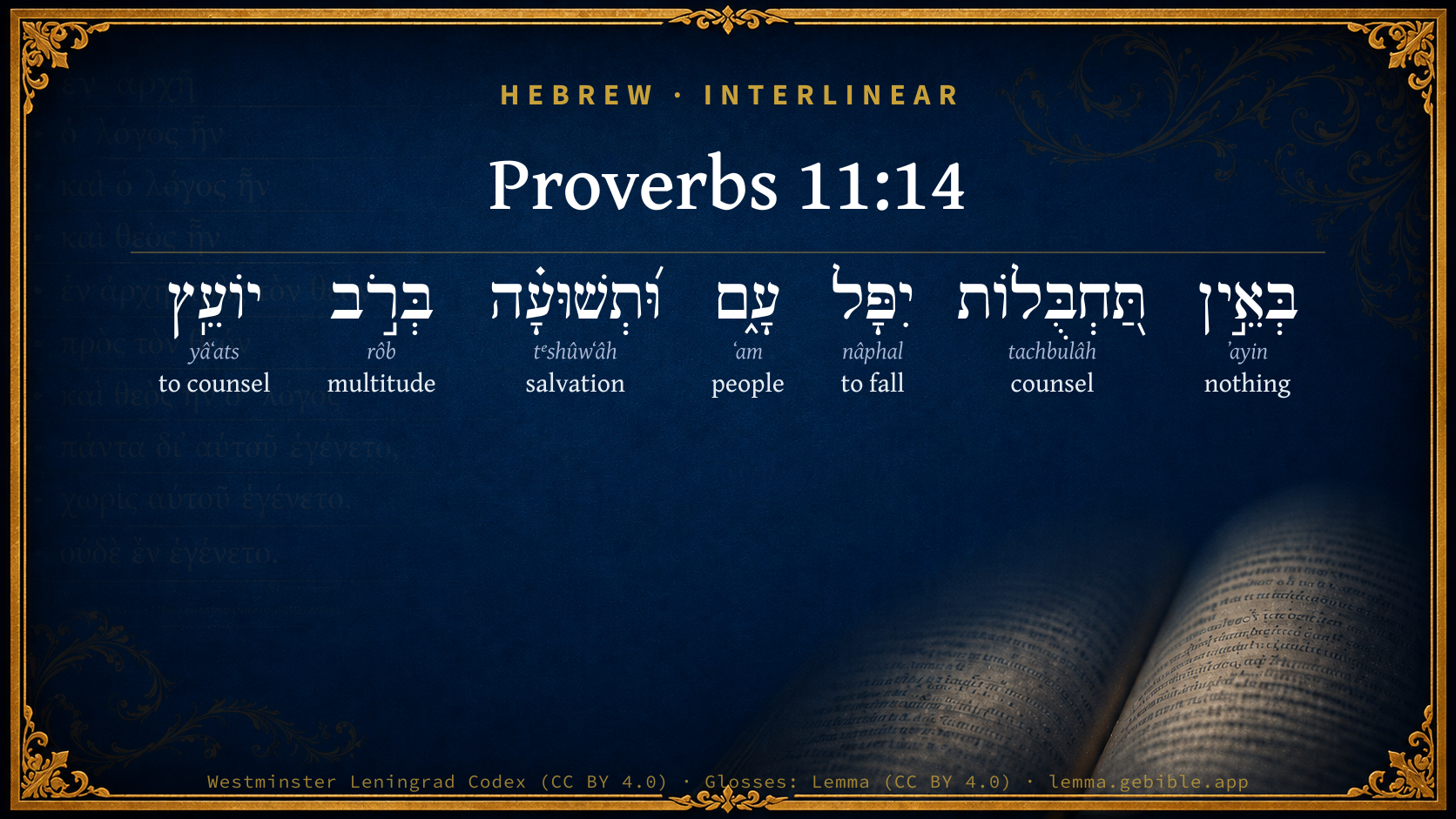
Proverbs 11:14

Hebrew (Westminster Leningrad Codex) Proverbs 11:14 appears in the Hebrew Old Testament. The text above is from the Westminster Leningrad Codex. Each word links to its Strong’s number, a concise gloss, and parsing drawn from the Open Scriptures Hebrew Bible morphology. Click any word for its full Brown-Driver-Briggs (BDB) entry.
Download image
Cite this verse

Proverbs 11:14 (World English Bible). Public Domain. Lemma interlinear Bible study tool, https://lemma.gebible.app/v/proverbs/11/14.

Show BibTeX & RIS
BibTeX
RIS
English Translation
Where there is no wise guidance, the nation falls, But in the multitude of counselors there is victory.
World English Bible · Public Domain
Download a study sheet

One document with this verse’s original text, its word-by-word gloss line, the meaning frame, cross-references with their text, attributed commentary, and full source and license credits — printable, and it pastes into notes with its structure intact.

This verse Autodidact and up

Study sheet (.html) Plain text (.txt)

A passage Seminary Student

Up to 50 verses in one chapter. A passage sheet keeps up to 6 commentary sources and 12 cross-references per verse, in the order this page ranks them, and says so on the sheet whenever that leaves anything out. Ask for a single verse and you get the Autodidact verse sheet above.

Everything on this page stays free to read, with no account — the sheet is a download of what is already on screen, not access to it.

Want to remove ads? Support Godless Engineer
Compare translations 3

The same verse in 3 English versions, stacked beneath the original-language interlinear above. Click any original word for its lexicon entry.

Each is an independent rendering of the whole verse — the interlinear is not word-aligned to these translations.

Highlighted words mark where these versions differ — a whole-verse word diff, not a word-by-word alignment.

  • World English Bible Public Domain
    Where there is no wise guidance, the nation falls, But in the multitude of counselors there is victory.
  • King James Version Public Domain
    Where no counsel is, the people fall: but in the multitude of counsellors there is safety.
  • unfoldingWord Literal Text CC BY-SA 4.0
    When there are no directions, a people falls, but salvation in an abundance of counsel.

unfoldingWord Literal Text — © unfoldingWord, licensed CC BY-SA 4.0. Word-aligned USFM3 via Door43 (git.door43.org/unfoldingWord/en_ult).

Versions to compare (up to 4)

3 of 4 selected

Show all 18 translations

Every available English version of this verse, each an independent rendering of the whole verse.

  • World English Bible Public Domain
    Where there is no wise guidance, the nation falls, But in the multitude of counselors there is victory.
  • Berean Standard Bible Public Domain
    For lack of guidance, a nation falls, but with many counselors comes deliverance.
  • Majority Standard Bible Public Domain
    For lack of guidance, a nation falls, but with many counselors comes deliverance.
  • King James Version Public Domain
    Where no counsel is, the people fall: but in the multitude of counsellors there is safety.
  • American Standard Version (1901) Public Domain
    Where no wise guidance is, the people falleth; But in the multitude of counsellors there is safety.
  • Revised Version (1885) Public Domain
    Where no wise guidance is, the people falleth: but in the multitude of counsellors there is safety.
  • Geneva Bible (1599) Public Domain
    Where no counsell is, the people fall: but where many counsellers are, there is health.
  • Douay-Rheims (1899) Public Domain
    Where there is no governor, the people shall fall: but there is safety where there is much counsel.
  • Young's Literal Translation Public Domain
    Without counsels do a people fall, And deliverance `is' in a multitude of counsellors.
  • Literal Standard Version CC BY-SA 4.0
    Without counsels a people falls, || And deliverance [is] in a multitude of counselors.
  • Unlocked Literal Bible CC BY-SA 4.0
    Where there is no wise direction, a nation falls, but victory comes by consulting many advisors.
  • unfoldingWord Literal Text CC BY-SA 4.0
    When there are no directions, a people falls, but salvation in an abundance of counsel.
  • Darby Bible Public Domain
    Where no advice is, the people fall; but in the multitude of counsellors there is safety.
  • World Messianic Bible Public Domain
    Where there is no wise guidance, the nation falls, but in the multitude of counselors there is victory.
  • Webster's Bible Public Domain
    Where no counsel is, the people fall: but in the multitude of counselors there is safety.
  • Free Bible Version CC BY-SA 4.0
    A nation falls without good guidance, but they are saved through much wise counsel.
  • Bible in Basic English Public Domain
    When there is no helping suggestion the people will have a fall, but with a number of wise guides they will be safe.
  • JPS Tanakh (1917) Public Domain
    Where no wise direction is, a people falleth; but in the multitude of counsellors there is safety.

Literal Standard Version (2020), Covenant Press — licensed CC BY-SA 4.0. Text via the HelloAO Bible API (eBible.org). Unlocked Literal Bible (unfoldingWord) — licensed CC BY-SA 4.0. Text via the HelloAO Bible API (eBible.org). unfoldingWord Literal Text — © unfoldingWord, licensed CC BY-SA 4.0. Word-aligned USFM3 via Door43 (git.door43.org/unfoldingWord/en_ult). Free Bible Version, Dr. Jonathan Gallagher — licensed CC BY-SA 4.0. Text via the HelloAO Bible API (eBible.org).

Word by word

More ways to search: Search by grammar → Find every occurrence → Compare this word →

Practice this passage: Drill this verse → Learn its vocabulary →

About this verse

These counts appear in no published source. They are computed here, from the morphology-tagged text and Lemma’s own curated glosses. What Lemma adds →

7
words
7
distinct lemmas
Wisdom
section

Notable vocabulary

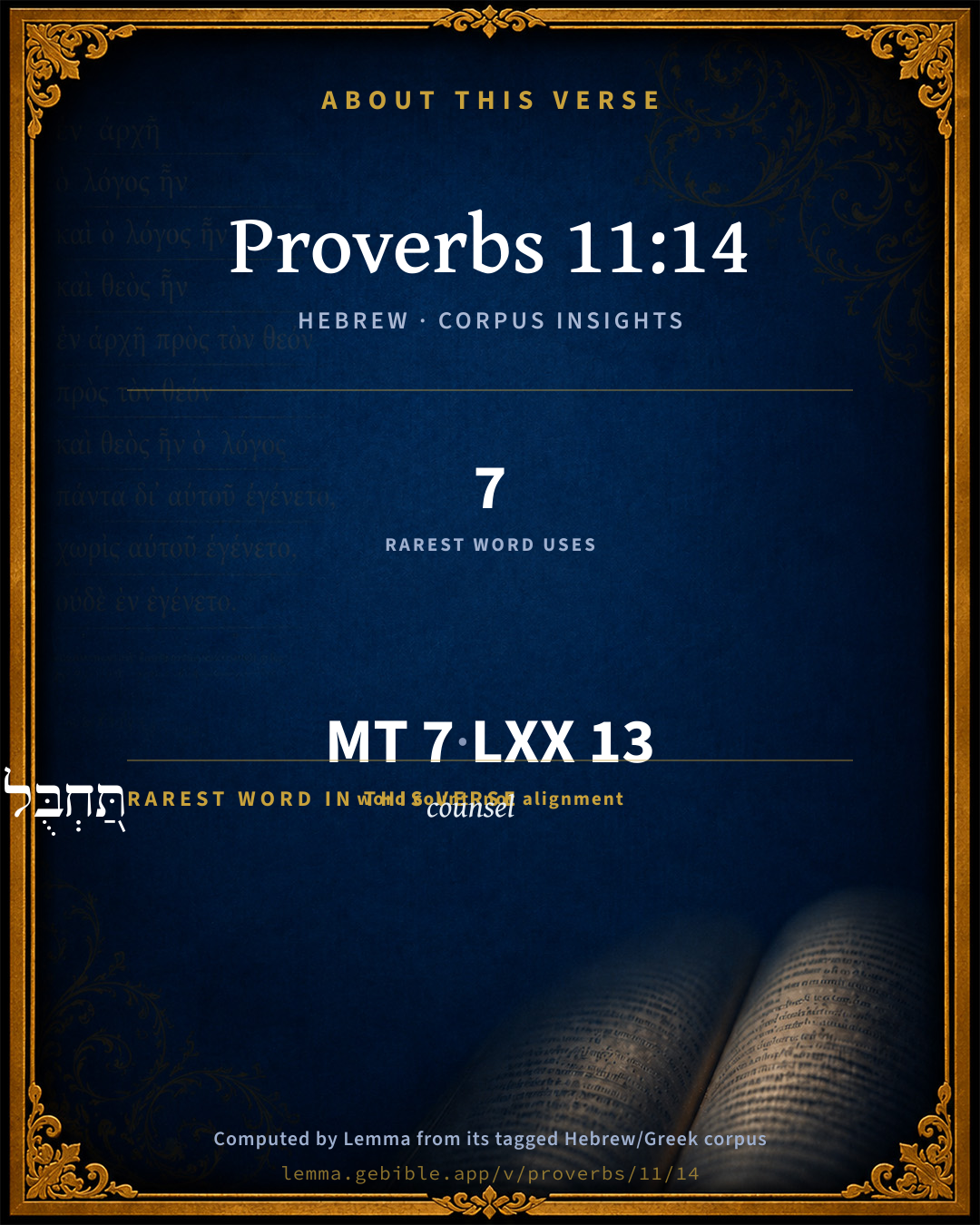
The rarest word here is תַּ֭חְבֻּלוֹת counsel H8458 — appearing just 7 times in the whole Hebrew Bible.

Shared distinctive vocabulary

תַּ֭חְבֻּלוֹת counsel H8458 occurs in 6 verses of the Hebrew Bible. Also found in:

Grammatical profile

  • 2 verbs
  • 4 nouns
  • 1 particle

Verb forms

  • יִפָּל Qal · Imperfect
  • יוֹעֵֽץ Qal · Participle Active

Hebrew & Septuagint length

In English translation the verse runs 18 words from the Hebrew and 15 from the Septuagint (LXX English) — closely comparable.

A rough comparison of the two English renderings, which tokenize alike — not a word-level alignment.

Word counts can differ between the Hebrew and the Greek without any difference in meaning — e.g. the Hebrew direct-object marker אֵת has no separate Greek word, and Greek often adds the article ὁ.

In the original languages it is 7 Hebrew tokens and 13 Greek tokens — but the two are counted differently (Hebrew bundles its prefixes and suffixes into one token; the Greek is in lemma form), so that isn’t a like-for-like length.

Cross-references

7

Topical passages linked to Proverbs 11:14 in the Treasury of Scripture Knowledge — connected by theme and wording, ordered by reader-vote popularity; previews shown in the World English Bible.

  • Proverbs 24:6 For by wise guidance you wage your war; And victory is in many advisors.
  • Proverbs 15:22 Where there is no counsel, plans fail; But in a multitude of counselors they are established.
  • Proverbs 20:18 Plans are established by advice; By wise guidance you wage war!
  • Proverbs 16:22 Understanding is a fountain of life to one who has it, But the punishment of fools is their folly.
  • 1 Kings 12:1–19 Rehoboam went to Shechem: for all Israel were come to Shechem to make him king.
  • Isaiah 19:11–14 The princes of Zoan are utterly foolish; the counsel of the wisest counselors of Pharaoh is become brutish: how do you say to Pharaoh, I am the son of the wise, the son of ancient kings?
  • Acts 15:6–21 The apostles and the elders were gathered together to see about this matter.

Cross-references courtesy of OpenBible.info (CC BY 4.0).

Hebrew and Greek witnesses Masoretic Hebrew ↔ Greek Septuagint

The same verse in the two great witnesses to the Old Testament, shown verse-for-verse.

These are two independent witnesses, not word-aligned to each other, and the Septuagint is shown in lemma (dictionary) form.

Hebrew Proverbs 11:14 Masoretic · Westminster Leningrad Codex

בְּאֵ֣ין תַּ֭חְבֻּלוֹת יִפָּל עָ֑ם וּ֝תְשׁוּעָ֗ה בְּרֹ֣ב יוֹעֵֽץ

Where there is no wise guidance, the nation falls, But in the multitude of counselors there is victory.

World English Bible · Public Domain

Greek LXX Proverbs 11:14 Septuagint · lemma form

ὅς μή ὑποἄρχω κυβέρνησις πίπτω ὥσπερ φύλλον σωτηρία δέ ὑποἄρχω ἐν πολύς βουλή

They that have no guidance fall like leaves: but in much counsel there is safety.

LXX2012 (modern English Septuagint) · Public Domain

On this verse, The Cambridge Bible for Schools and Colleges discusses the Septuagint’s reading. Read the note in Commentary ↓

Hebrew: Westminster Leningrad Codex (CC BY 4.0). Greek: Septuagint (public domain); English from LXX2012 (modern English Septuagint) (Public Domain). How the Septuagint differs from the Hebrew →

Commentary

Notes on Proverbs 11:14 from classic Christian and Jewish commentators (each source and its license shown beneath its notes). The classic Christian expositions comment on the surrounding passage and are grouped to its opening verse, so a note may address several verses; the Jewish commentaries on the Tanakh (Rashi and others) are per-verse, so they appear only where the commentator wrote on this verse.

Lemma curates 59 commentaries, every one of them public domain or Creative Commons licensed, each selected and text-cleaned for this edition rather than reprinted as found. About our sources →

Trapp's Complete Commentary

John Trapp

Pro 11:14 Where no counsel [is], the people fall: but in the multitude of counsellors [there is] safety.

Ver. 14. Where no counsel is, the people fall.] As where no pilot is, the ship miscarrieth. The Vulgate render it, Ubi non est gubernator, corruit populus. Tyranny is better than anarchy. And yet, "Woe also to thee, O land, whose king is a child"; that is, wilful and uncounsellable, as Rehoboam, who was a child at forty years old, whenas his father was a man at twenty. Age is no just measure of wisdom, and royalty without wisdom is but eminent dishonour. Solomon the wise chose him an excellent council of state, whom Rehoboam refused to hear, being as much more wilful than his father, as less wise - all head, no heart, losing those ten tribes with a churlish breath, and returning to Jerusalem lighter by a crown than he went forth. He and his green headed council was like Alcibiades and his army, where all would be leaders, none learners. Or it may be it was now in Israel as once it was in Persia, and as now it is in Turkey, when the great Turk stands at the dangerous door, where if any counsellor delivered anything contrary to the king’s mind, flagris caedebatur, he was chastised with rods. {a} Or as in Regno Cyclopico ubi, ουδεις ουδεν ουδενος ακουει, where no man cared for better counsel, but each one did what was good in his own eyes. {b} Such cannot long subsist.

But in the multitude of counsellors.] So they be good counsellors; better than Balaam was, better than Ahithophel, better than those of Aurelius, by whom the good emperor was even bought and sold. {c} One special thing the primitive Christians prayed for the emperor was, that God would send him Senatum fidelem, a faithful council. There were in Josiah’s days horrible abominations; and why? "The princes were as roaring lions, the judges wolves," &c. {Zep 3:3} Queen Elizabeth was happy in her council, by whom she was mostly ruled, and grew amiable to her friends, and formidable to her enemies, both at home and abroad. "Wisdom is better than strength," saith Solomon; and, Romani sedendo vincunt, The Romans conquer by being settled. {d} said they of old. The welfare of a state is procured and preserved, not so much by a multitude of worthy warriors as of wise counsellors; as Cleon, in Thucydides long since observed, {e} and as we have blessedly found in this present Parliamentum benedictum, more truly so styled than that was in the twenty-fifth of Edward III.

{a} Turk. Hist. Keckerm. Politic.

{b} Ulysses interrogat, quale regnum esset Cyclopicum? Respondet Silenus, Nουαδες ακουει ουδεις ουδενος.

{c} Tertul. Apol.

{d} Polybius.

{e} Thucyd., lib. iii.

John Trapp, A Commentary or Exposition upon All the Books of the Old and New Testament (1647–1656) — public domain. Text from a community e-Sword module.

The Biblical Illustrator

Joseph S. Exell

Pro_11:14

Where no counsel is, the people fall.

The value of advice

Kings and rulers stand in special need of counsel. When a ruler is surrounded by good counsellors he and his people are safe. We can trace this truth in the rise and fall of nations. Gods advice is one of our most valuable helps, and the text tells us not to neglect it. Man is apt to go astray. His judgment is sometimes misled; while his affections are corrupted, and his will is ungoverned.

I. Why do we need advice? The first reason is found in the peculiar nature of the evils to which we are exposed. Sin has a strangely deluding influence over those whom it tempts. Here there is scope of need for wise counsels, which may enforce the neglected voice of conscience. Advice is also necessary in consequence of special circumstances in which we are placed. We are involved in difficulties from which others are required to rescue us. Where no counsel is, the people fall.

II. Where are we to seek advice? We should not ask for it except when we really require it. To be ever at a loss what to do unless we are advised is a characteristic of a life that is usually spent to little purpose. The secret of a useful course through the world lies in a measure of self-reliance. At other times when advice is sought there is a foregone conclusion, and a man only wishes to have his own views confirmed. Out of its proper place advice, instead of being a help, is almost a hindrance to a right decision. It is not safe to go indiscriminately to all sorts of people with a statement of our difficulties, and entreaties for advice in dealing with them. This disposition is the evidence of a weak mind and an irresolute will. There is no real safety in the counsel sought in the confessional. Supreme wisdom comes to us with greatest force when it flows through the channel of hearts bound closely to our own.

III. How to take advice. The danger of resenting counsel, when it is unpleasant, is one with which we are all more or less familiar. Those who give advice should always be pure of their warrant to do so. But the more experience a man has the less disposed he will be to give advice unsought. Men are rarely careful enough in their way of giving disagreeable advice. There is a spirit and a manner in some counsels which it is not in human nature to bear. But we must take care lest we be displeased with others whose advice we get, simply because we dislike it. All are not good counsellors who try to lead, and we cannot too carefully test the words of advice which, on every hand, are spoken to us. When we are in doubt as to their value, we must weigh them in the balance of Gods sanctuary; and if they speak not according to His law, it is because there is no truth in them. The Great Adviser is always interested in us. Reliance on help from above is verified by the experience of all good men. (A. MacEwen, D.D.)

The Biblical Illustrator, edited by Joseph S. Exell (c. 1880s–1900s) — public domain. Text from a community e-Sword module.

Joseph Benson's Commentary

Pro 11:14. Where no counsel is, the people fall — “Where prudent counsellors are wanting a nation goes to wreck, as certainly as a ship doth without a pilot; but a country is safe when there are many wise men to govern affairs; that if one fail, there may enough still remain; or what one or two see not, others may be able to discern.”

Joseph Benson's Commentary on the Old and New Testaments (1811–1818) — public domain. Text from a community e-Sword module.

The Preacher's Complete Homiletical Commentary

Joseph S. Exell (gen. ed.)

CRITICAL NOTES.—

Pro_11:14. Counsel, literally, “pilotage,” “steermanship.”

Pro_11:15. Suretyship, literally “striking hands.” See Notes and Illustration on chap. Pro_6:1. Stuart translates this verse, “An evil man showeth himself as evil when he giveth pledge to a stranger,” i.e., by hastily pledging himself and then not redeeming his pledge.

MAIN HOMILETICS OF Pro_11:14

HELMSMANSHIP

I. The many (the people) are dependent upon the few for guidance. The word counsel is literally “pilotage,” “helmsmanship.” The many passengers in the vessel are dependent upon the few who guide it. The dependence of the many upon the few for guidance runs through every phase of human life. The dependence of the children upon their natural head is but prophetic of all the periods of after life, which very much consists in the dependence of the many upon the few. The child’s life at home and at school is a preparation for the rough handling of circumstance in this matter in the time of manhood. Although the man’s ability to guide his own life is far greater than that of the child, yet his need of counsel and guidance has increased with his years and responsibilities. This need of guidance springs from men’s unequal gifts. The physical, mental, and moral inequalities of men create and supply the demand for leaders—for counsellors for the many. This inequality is an ordination of the Divine Ruler of the universe—God is the Author of the inequalities. In nature we see that the strong gives shelter to the weak. The mighty oak protects the tiny plant at its roots. Counsellors are the giant trees which give shelter by giving guidance to those who are in some respects inferior to them. Men may be born free, but they are nowhere born equal in mental and physical qualities. Hence some must counsel, others must be counselled. Guidance is felt to be a necessity, and men make a virtue of the necessity. The passengers on board a vessel submit to the direction of the pilot because they feel that their safety depends upon submission, and so do the members of a nation—the citizens of a city. They know from experience that the way out of a difficulty is not found by those who follow, but by those who lead—that if they would enjoy the advantages of civil peace and safety, they must submit to guidance and direction.

II. That “no counsel” in a nation will end in there being no nation to counsel. “Where there is no counsel the people fall.” The passengers in a ship who have no one to steer the vessel will soon cease to have need of a helmsman. So the nation which has no head—no government—will cease to be a nation. Its national existence will be ruined by the anarchy that must follow.

III. Many men to give counsel are as a rule better than one. When the sea is heavy and breakers are ahead, one man at the wheel of a vessel would not be able to hold her on her course, many hands at once must be at work—the united strength of the many is indispensable. “In the multitude” there is “safety.” So it is generally in the case of the ship of the State. As a rule, there is more wisdom and ability in the union of many men than in one—there is likewise less danger of despotic rule. But there have been many exceptions to this rule. Joseph knew how to provide for the safety of Egypt when all the rest of Pharaoh’s counsellors were at their wits’ end. Before the battle of Plassy—which laid the foundation of British rule in India—Clive called a council of war to decide whether or not the battle should be fought. The majority pronounced against fighting. But it is now generally allowed that if the advice of that council had been followed the British would have never been in possession of India. Clive decided to act in opposition to the opinion of the majority, and the day was won for England. (See Macaulay’s Essay on Lord Clive.) Sometimes in the multitude of counsellors there has been national ruin. “All the council” of the Jews sought to put Jesus to death (Mat_26:59), and so brought about the destruction of their nation. But these are exceptions to a rule.

OUTLINES AND SUGGESTIVE COMMENTS

The case supposed, appears to be that of a self-willed, self-sufficient, headstrong ruler who glories in his power; who determines to wield the rod of that power in his own way, and who plays the hasty, jealous, resolute, sensitive and vindictive tyrant; who disdains to call in counsel, or who does it only for the pleasure of showing his superiority to it by setting it at nought. I conceive the phrase, “Where no counsel is,” to be intended to convey not a little of the character of him by whom it is declined or disregarded. We have an example of such a character in Solomon’s own successor Rehoboam. And yet, at the same time, in his case we are taught the necessity of understanding all such maxims as admitting of exceptions. Rehoboam did take counsel; and his counsellors were not few. Had they been fewer, there would in that instance been more safety. Had he stopped with the “old men who had stood before Solomon his father,” all would have been well.… How much better would it have been for Ahab, had he taken for his sole counsellor Micaiah the son of Imlah than it was when he preferred the four hundred prophets of Baal! The maxim, therefore, is general. It affirms the danger of solitary self-sufficiency, and the safety of deliberate and, in proportion to the complexity and difficulty of each case, and the nature and amount of its consequences, of extensive and diversified consultation.—Wardlaw.

It is a penalty inflicted by God on a sinful state to give it princes void of counsel (Isa_3:4; chap. Pro_15:22).—Fausset.

Care seems to be taken after a proverb lauding silence, always to put in a eulogy of speech. (See chap. Pro_10:20-21.) Secrets are not to be hid until the whole community is one covered over wickedness. The same faithfulness that conceals a secret, intrudes counsel, and grasps control, and saves the people by that leadership that the pious alone are intended to achieve. The word counsel or “helmsmanship” is from a root meaning a cord; hence the tacking of the helm; and, now, that princely guidance, which piety in the world (though the world does not think so) does actually bestow. “Safety”—or “salvation.” The inspired sentence-maker is always managing what the music men would call a crescendo, for the second clause. The first clause speaks of the people as falling, the second as not only “not falling,” but, though fallen, as actually raised.—Miller.

Tyranny is better than anarchy. And yet “Woe also to thee, O land, whose king is a child”; that is, wilful and uncounsellable.… One special thing the primitive Christians prayed for the emperor was, that God would send him a faithful council.—Trapp.

It is not said that in the multitude of counsellors there is safety, but in the largeness or muchness of a counsellor, that is, such a counsellor as is furnished with a variety of counsels, and can look many ways for direction. For such a one is instead of many, nay, often far better; because he can sooner resolve what is best, than many will or can. And therefore, though it be good to have many, and when they agree perhaps to follow them, yet it may be better to have one of many counsels, on whom to rely.—Jermin.

Probably one is more struck, on reflection and in reading, with the exceptions to the rule, than with confirmatory examples of it, that in the multitude of counsellors there is safety.… A modern historian finds in the unlicensed discretion reposed by the Roman Senate in the general, the most efficient aid to the extent of Rome’s early conquests, and he points by way of contrast, to the modern republics of Italy, as denying themselves scope for larger conquests by their extreme jealousy of their commanders. Anarchy in Antwerp is the heading of one of Mr. Morley’s graphic pages, and a lively picture it offers us of the confusion that ensued when the hydra heads of the multitudinous government were laid together. In Drake’s expedition of 1595, there were too many in command; and after losing time in debate which Sir Francis, if alone, would have spent in action, they were obliged to give up the attempt on the Canaries, with some loss. The otherwise unaccountable action of De Witt in 1671 is explained at once when the anarchical constitution of the Dutch republic is remembered—its want of a central authority, and the fact that, to raise money or troops, the consent of a number of petty councils was necessary, in the multitude of whose counsellors was anything but safety. “In the multitude of counsellors there may be safety,” says Alison, “it is in general safety to the counsellors, not to the counselled.” The quality of the counsel, and the ability of the counsellors, are elements of main import in the maxim of the king.—Jacox.

For Homiletics on Pro_11:15, see on chap. Pro_5:1-4.

ILLUSTRATION OF Pro_11:15

The melancholy instances of ruin, in consequence of becoming surety for others, are exceedingly numerous in the East. Against this they have many proverbs and fearful examples; but nothing seems to impart wisdom. Nearly all the Government monopolies, both among native and European rulers, are let to the highest bidders, and as the whole of the money cannot be advanced till a part of the produce be sold, sureties have to be accountable for the amount. But as men generally enter into these speculations in order to better a reduced fortune, an extravagant price is often paid, and ruin is the consequence both to the principal and his surety. This practice of suretyship, however, is also common in the most trifling affairs of life. “Sign your name,” is a request preferred by every one who is desirous of obtaining additional security to a petty agreement. In every legal court or magistrate’s office may be seen, now and then, a trio entering, thus to become responsible for the engagements of the other. The cause of all this is probably the bad faith which prevails amongst the heathen.—Roberts.

OUTLINES AND SUGGESTIVE COMMENTS

The traffic of ancient times was small, in comparison with the vast system of exchange which now compasses the whole world like network; but the same vices that we lament marred it, and the same righteousness that we desiderate would have healed its ailments. Neither the law of gravitation nor the law of righteousness has changed since the times of Solomon; both are as powerful as they then were, and as pervasive.… In those primitive times, it seems, as in our own, some men desired to get faster forward in the world than their circumstances legitimately permitted. They will throw for a fortune at another’s risk.… The warning does not of course discourage considerate kindness in bearing a deserving man over temporary pressure.… The Bible permits and requires more of kindness to our brother than we have ever done him yet; but it does not allow us to do a certain substantial evil, for the sake of a distant, shadowy good.—Arnot.

The heart and mind of every one is a stranger to every one except to God alone. He therefore that is a surety for another, is surety for a stranger.—Jermin.

… be not surety, if thou be a father,

Love is a personal debt. I cannot give

My children’s right, nor ought he to take it: rather

Both friends should die, than hinder them to live.

Fathers first enter bonds to nature’s ends;

And are her sureties, ere they are a friend’s.

—Herbert.

The Preacher's Complete Homiletical Commentary (gen. ed. Joseph S. Exell; Funk & Wagnalls, c. 1892) — public domain (pre-1929). A full-Bible homiletical/sermon-outline anthology covering 65 of 66 books (2 John is absent from the source module). Text from a community e-Sword module.

Tyndale Open Study Notes

Tyndale Open Resources

11:14 The future of an entire nation depends on wisdom.

Tyndale Open Study Notes — © Tyndale Open Resources, licensed CC BY-SA 4.0. Text via the HelloAO Bible API.

Geneva Bible (1599)

Geneva Bible translators

Where God giveth store of men of wisdom and counsel: whose conversation he knoweth not.

Geneva Bible (1599) marginal notes — public domain. Text via Bolls.life.

Matthew Henry's Commentary

Here is, 1. The bad omen of a kingdom's ruin: Where no counsel is, no consultation at all, but every thing done rashly, or no prudent consultation for the common good, but only caballing for parties and divided interests, the people fall, crumble into factions, fall to pieces, fall together by the ears, and fall an easy prey to their common enemies. Councils of war are necessary to the operations of war; two eyes see more than one; and mutual advice is in order to mutual assistance. 2. The good presage of a kingdom's prosperity: In the multitude of counsellors, that see their need one of another, and act in concert and with concern for the public welfare, there is safety; for what prudent methods one discerns not another may. In our private affairs we shall often find it to our advantage to advise with many; if they agree in their advice, our way will be the more clear; if they differ, we shall hear what is to be said on all sides, and be the better able to determine.

Matthew Henry's Commentary on the Whole Bible (1708–1710) — public domain (CC PDM 1.0). Text via the HelloAO Bible API.

Jamieson, Fausset & Brown

Robert Jamieson, A. R. Fausset & David Brown

counsel--the art of governing (Pro 1:5).

counsellors--literally, "one giving counsel"; the participle used as a collective.

Jamieson, Fausset & Brown — Commentary Critical and Explanatory on the Whole Bible (1871) — public domain (CC PDM 1.0). Text via the HelloAO Bible API.

Ellicott's Commentary for English Readers

(14) In the multitude of counsellors there is safety—i.e., where there are plenty to guide the state.

A Bible Commentary for English Readers, edited by Charles John Ellicott (1878–1897) — public domain. Text from a community e-Sword module.

The Cambridge Bible for Schools and Colleges

gen. ed. J. J. S. Perowne

14. counsel] See Pro_1:5 note. The same Heb. word is there rendered wise counsels, A.V. and sound counsels, R.V. Here R.V. renders wise guidance, with reference perhaps to the root-meaning of the word, steering a ship, κυβέρνησις, LXX. Comp. Pro_15:22.

The Cambridge Bible for Schools and Colleges (gen. ed. J. J. S. Perowne; Cambridge University Press, 1878–1918) — public domain. Text from a community e-Sword module.

John Gill's Exposition

Where no counsel is, the people fall,.... Where there is no wise and prudent, sound and good counsel, as the word signifies; where that is not, there had as good be none, or better; a people, a kingdom, a commonwealth, nation, or city, fall into ruin and destruction, or into schemes which bring them to it; they are like a ship without a pilot, or without a helm, or one to steer it: the Targum, Syriac, and Vulgate Latin versions, render it,

"where there is no governor;''

and the Arabic version,

"they that have no providence (or forecast) fall as a leaf falls;''

and so the Septuagint version,

"they that have no government fall as leaves,''

as leaves fall in autumn; and the word signifies the helm of government (o), in allusion to a ship;

but in the multitude of counsellors there is safety; because what one may miss another may hit upon; and, if they agree in their advice, it may be the more depended upon; and, if not, yet their different sentiments being compared together, and the reasons of them, a person may the better judge which is best to follow, and what is fit to be done: it may be rendered, "in the greatness" or "largeness of a counsellor" (p), for the word is in the singular number; that is, in the large capacity or endowments of a counsellor; in one that is abundantly qualified for a counsellor; whose abilities are not to be questioned; in the advice of such an one a man may safely confide; and who that answers to this character as Jesus Christ, the wonderful Counsellor? in whose counsel we may rest with the greatest safety; and which may be found in his word, in the Scriptures, which David says should be the men of his counsel, Psa 119:24; see Isa 9:6.

(o) "gubernationes", Schultens. (p) "in amplitudine consiliarii", Junius & Tremellius.

John Gill's Exposition of the Whole Bible (1746–1763) — public domain (CC PDM 1.0). Text via the HelloAO Bible API.

Albert Barnes' Notes on the Bible

Counsel - See Pro 1:5 note. This precept may well be thought of as coming with special force at the time of the organization of the monarchy of Israel. Compare 1Ki 12:6.

Albert Barnes' Notes on the Bible (1834–1885) — public domain. Text from a community e-Sword/MySword module.

Matthew Poole's English Annotations

No counsel; or, no wise counsel, as the word properly signifies, as Job 37:12; Pro 1:5.

In the multitude of counsellors, to wit, of wise and good counsellors, for such will employ and unite their counsels together for the public good.

Matthew Poole's English Annotations on the Holy Bible (1683–1685) — public domain. Text from a community e-Sword/MySword module.

Whedon's Commentary on the Bible

Daniel D. Whedon

14. Where no counsel is — No pilotage, guidance, or wise management. Miller renders helmsmanhip instead of “counsel.”

The people fall — Rather, a people or nation falls. It probably applies to States or entire communities.

In the multitude of counsellers — Or, in the greatness of the counsellor, is safety. If the word יועצ, (yo’hets,) which is singular, is to be understood as a collective noun, (counsellors,) it is implied that they are more or less capable; otherwise, the multiplicity of them might only confuse, weaken, and bring disaster. Too many and diverse counsellors are sometimes worse than none. One really capable man is worth a dozen such. Yo’hets, instead of being a participial noun, may be a participle proper.

Then the rendering would be, By much “counselling” — thoughtful planning — safety is secured. Comp. Pro_15:22; Pro_24:6; Ecc_9:15; 1Ki_12:1, seq.; Isa_3:4.

Daniel D. Whedon (gen. ed.), Commentary on the Old and New Testaments (1874–1909) — public domain. Text from a community e-Sword module.

The Pulpit Commentary

Where no counsel is. The word properly means "steersmanship," "pilotage". (Pro_1:5 Pro_12:5 Pro_24:6) So Vulgate, gubernator; Septuagint, kubernhsiv , "They who have no government fall like leaves," reading alim instead of am. In the multitude of counsellors. (Pro_15:22 Pro_20:18 Pro_24:6) This would go to prove the superiority of a popular government over the despotism of a single ruler. But the caution of our homely proverb is net inopportune, "Too many cooks spoil the broth."

The Pulpit Commentary (1880–1919), ed. H.D.M. Spence-Jones & Joseph S. Exell — public domain. Text from a community e-Sword module.

Keil & Delitzsch

C. F. Keil & F. Delitzsch

14 Where there is no direction a people fall

But where there is no want of counsellors there is safety.

Regarding תּחבּות, vid., at Pro 1:5. There it means rules of self-government; here, rules for the government of the people, or, since the pluralet. denotes a multiplicity in unity, circumspect κυβέρνησις. With 14b, Pro 24:6 (where direction in war, as here in peace, is spoken of, and the meaning of the word specializes itself accordingly) agrees; cf. also Pro 15:22. Hitzig criticises the proverb, remarking, "we who have the longest resorted to many counsellors, as a consequence of the superabundance have learned to say, 'Too many cooks spoil the broth,' and, 'He who asks long, errs.'" But the truth of the clause 14b is in modern times more fully illustrated in the region of ecclesiastical and political affairs; and in general it is found to be true that it is better with a people when they are governed according to the laws and conclusions which have resulted from the careful deliberation of many competent and authorized men, than when their fate is entrusted unconditionally to one or to a few. The proverb, it must be acknowledge, refers not to counsellors such as in Isa 3:3, but as in Isa 1:26.

Keil & Delitzsch — Biblical Commentary on the Old Testament (1861–1891) — public domain (CC PDM 1.0). Text via the HelloAO Bible API. (Old Testament only.)

Bridges on Proverbs

Charles Bridges

Even in private matters the value of wise counselors is generally admitted. The agreement of the multitude gives safety to our decision. And even their difference, by giving both sides of the question, enables us to ponder our path more safely. The nation, therefore, without counselors is like a ship in the midst of the rocks without a pilot, in imminent peril. God has given to some the gift of government — "wisdom that is profitable to direct." (Ecc 10:10 .) Where there is no counsel, the people fall. In the dark time of the Judges, the want of a king led to anarchy, and the people fell into the enemies’ hands. (Jdg 2:8-23 ; Jdg 21:25 .) Ten parts of the people fell when Rehoboam listened to evil counsel.†1 A fall again was there of the people, when the counsel of godly Jehoiada was removed! (2Ch 24:17-21 .) The good Lord deliver us from the deserved national judgment of weak and blinded counselors! (Ecc 10:16 . Isa 3:1-4 ; Isa 19:11-14 .)

David and Solomon, though themselves specially endowed with wisdom, governed their kingdoms prosperously by wise counselors. (Psa 119:98-100, with 2Sa 15:12 ; 2Sa 17:14, also 1Ki 12:6 .) The larger the multitude of such counselors (contrast Isa 47:13 ), the greater the safety. To one such, a heathen monarch owed the safety of his kingdom from desolating famine. (Gen 41:38-57 .)

Often has the Church been preserved by this blessing. (Act 15:6-31 . Compare Pro 15:22 ; Pro 24:6 .) Shall we not now plead for her safety in this day of her distress, that her people may not fall by the want of counsel (Eze 34:4-6 . Mat 15:14 ); that her ordained counselors may be largely filled with the "spirit of power, and of love, and of a sound mind" (2Ti 1:7 ), to establish her people more firmly in the pure faith of the gospel? (Act 16:4-5 .)

Footnotes:

†1 1Ki 12:16-19 . ’Fall like leaves.’ — LXX.

Charles Bridges, An Exposition of the Book of Proverbs (1846) — public domain. Text from a community e-Sword module.

Kretzmann's Popular Commentary

Paul E. Kretzmann

v. 14. Where no counsel is, no wise direction or leadership, the people fall, decay and ruin come upon the whole country; but in the multitude of counselors there is safety, that is, it is bound to serve for the benefit of a people if intelligent counselors are always available to the government.

Paul E. Kretzmann, Popular Commentary of the Bible (1921–1924) — public domain. Text from a community e-Sword module.

unfoldingWord translationNotes

Door43 World Missions Community

advisors

those who give recommendations as a guide to action; counselors

translationWords

wise

nation

advice

unfoldingWord translationNotes — © Distant Shores Media and the Door43 World Missions Community, licensed CC BY-SA 4.0. Source: git.door43.org/Door43/en_tn.

Rashi

Rabbi Shlomo Yitzchaki (Rashi)

Without strategy When trouble befalls Israel, and they do not put their heart to understand, to fast and to repent, the people will fall.

Rashi on the Tanakh — English translations: “The Judaica Press complete Tanach with Rashi, translated by A. J. Rosenberg” (CC BY 4.0); “Pentateuch with Rashi's commentary by M. Rosenbaum and A.M. Silbermann, 1929-1934” (public domain); “The Metsudah Tanach series, Lakewood, N.J” (CC BY 4.0); and “The Book of Joshua, Metsudah Publications, 1997” (CC BY 4.0). Text via Sefaria.

Lesson kit

Teaching starters — assembled from the data on this page, not authored interpretation. Every prompt links to the verse data it draws on. Edit before teaching.

Proverbs, in the Wisdom, opens this verse with 7 words (7 distinct Hebrew lemmas). Its most distinctive word is tachbulâh (“counsel”). A historical commentator’s framing appears above. Read the whole chapter for the surrounding context.

Discussion questions

  1. How does “counsel” (tachbulâh) shape what this verse is saying?
  2. Job 37:12 shares the word «counsel» with this verse. How do the two illuminate each other?
  3. These translations render this verse differently. What is at stake in choosing one wording over another?
  4. The verb «יִפָּל» is Qal Imperfect. How does its form color the action?
  5. Reading how Trapp's Complete Commentary and The Biblical Illustrator read this verse, where do the two commentators agree and where do they part?

Things to notice

Reading settings

Reading text

Shown beneath each verse's original-language words.

Old Testament
Old Testament edition

Read the OT as the Masoretic Hebrew (MT) or the Greek Septuagint (LXX).

English shown for the Greek Septuagint (in the Hebrew ↔ Greek comparison).

Comparing translations? Open the Compare panel on any verse page to stack up to four side by side.