
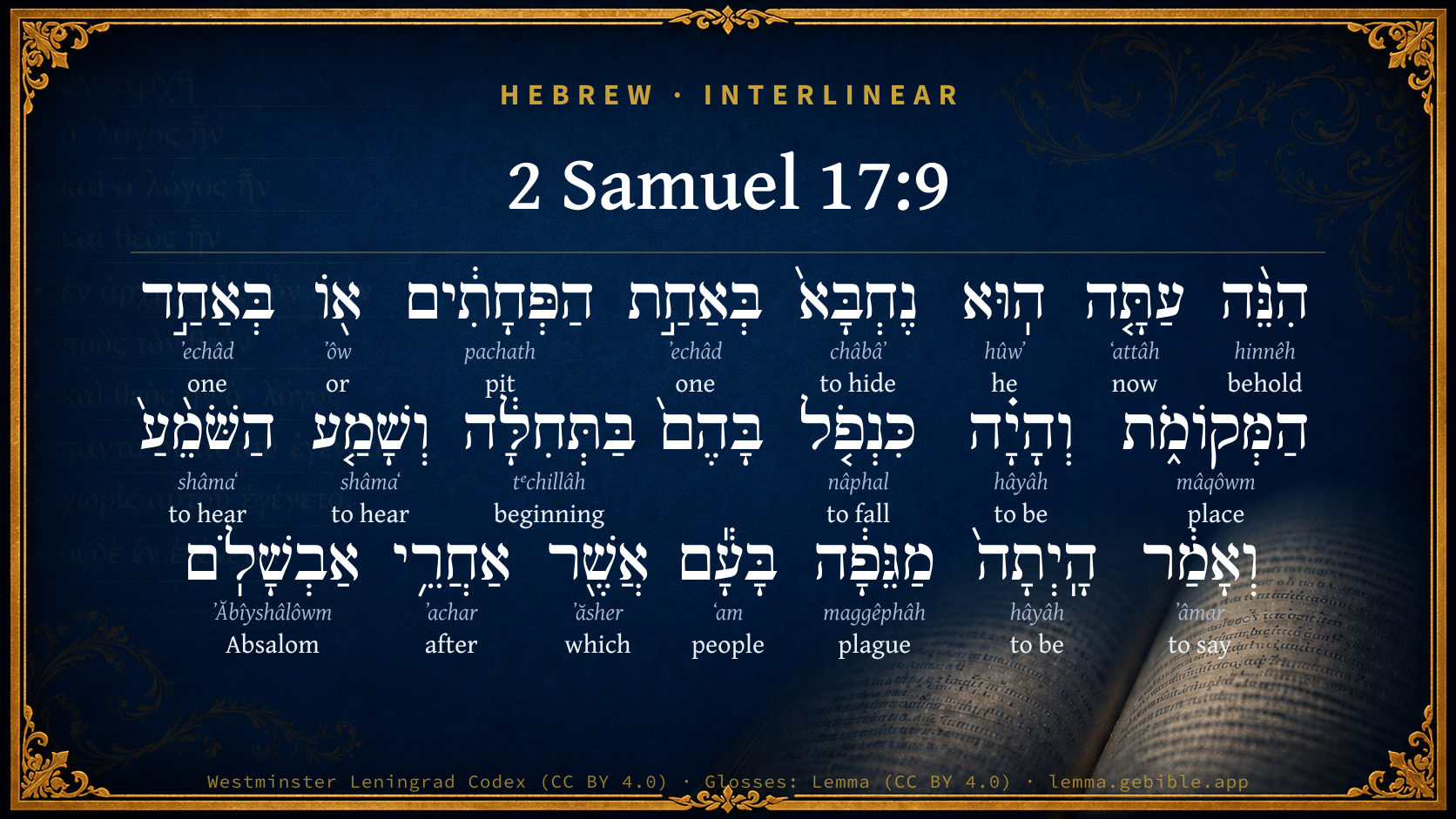
2 Samuel 17:9

Hebrew (Westminster Leningrad Codex) 2 Samuel 17:9 appears in the Hebrew Old Testament. The text above is from the Westminster Leningrad Codex. Each word links to its Strong’s number, a concise gloss, and parsing drawn from the Open Scriptures Hebrew Bible morphology. Click any word for its full Brown-Driver-Briggs (BDB) entry.
Download image
Cite this verse

2 Samuel 17:9 (World English Bible). Public Domain. Lemma interlinear Bible study tool, https://lemma.gebible.app/v/2-samuel/17/9.

Show BibTeX & RIS
BibTeX
RIS
English Translation
Behold, he is hid now in some pit, or in some [other] place: and it will happen, when some of them are fallen at the first, that whoever hears it will say, There is a slaughter among the people who follow Absalom.
World English Bible · Public Domain
Highlights
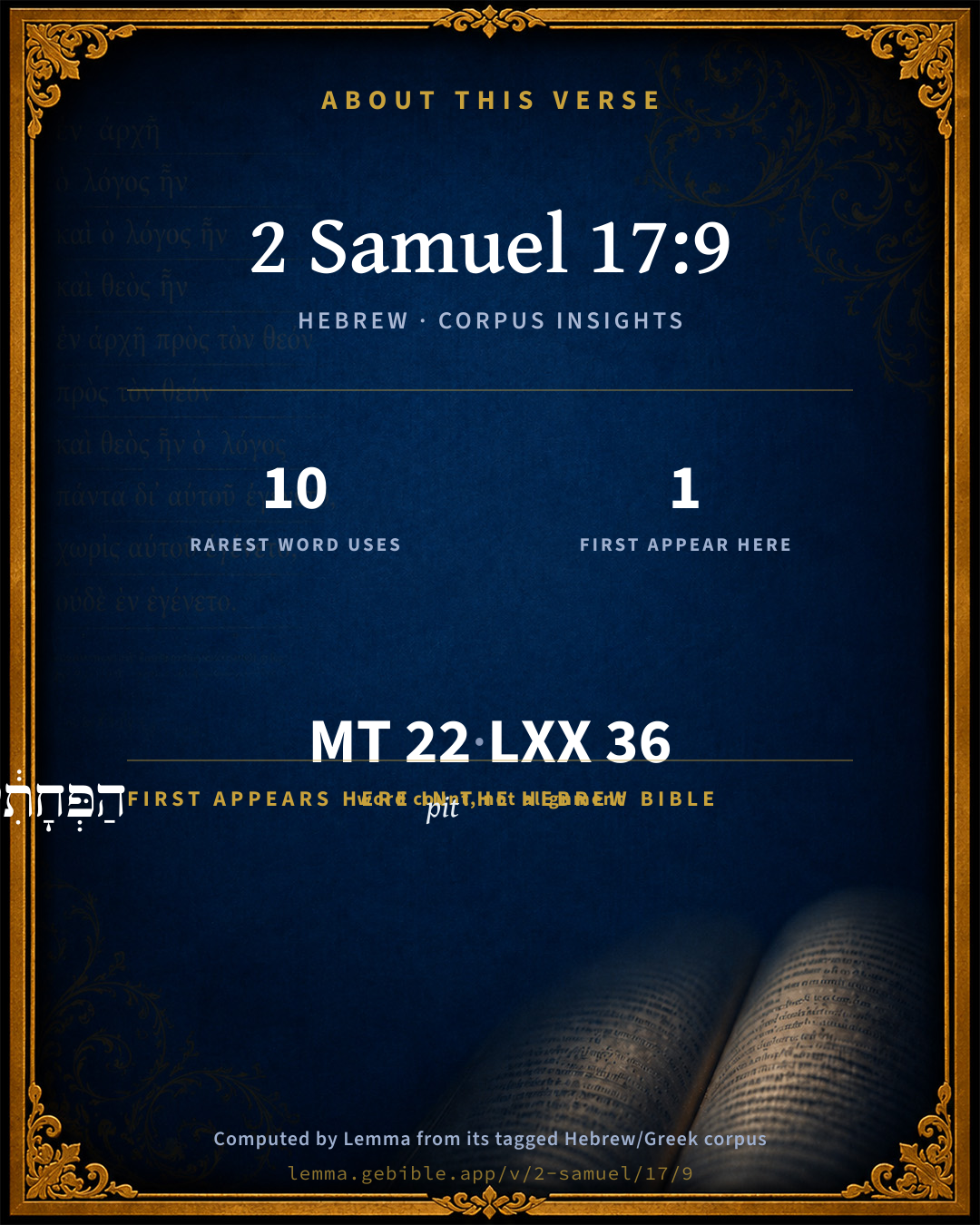
  • 1 first appearance in the Hebrew Bible
Full analysis ↓
Download a study sheet

One document with this verse’s original text, its word-by-word gloss line, the meaning frame, cross-references with their text, attributed commentary, and full source and license credits — printable, and it pastes into notes with its structure intact.

This verse Autodidact and up

Study sheet (.html) Plain text (.txt)

A passage Seminary Student

Up to 50 verses in one chapter. A passage sheet keeps up to 6 commentary sources and 12 cross-references per verse, in the order this page ranks them, and says so on the sheet whenever that leaves anything out. Ask for a single verse and you get the Autodidact verse sheet above.

Everything on this page stays free to read, with no account — the sheet is a download of what is already on screen, not access to it.

Want to remove ads? Support Godless Engineer
Compare translations 3

The same verse in 3 English versions, stacked beneath the original-language interlinear above. Click any original word for its lexicon entry.

Each is an independent rendering of the whole verse — the interlinear is not word-aligned to these translations.

Highlighted words mark where these versions differ — a whole-verse word diff, not a word-by-word alignment.

  • World English Bible Public Domain
    Behold, he is hid now in some pit, or in some [other] place: and it will happen, when some of them are fallen at the first, that whoever hears it will say, There is a slaughter among the people who follow Absalom.
  • King James Version Public Domain
    Behold, he is hid now in some pit, or in some other place: and it will come to pass, when some of them be overthrown at the first, that whosoever heareth it will say, There is a slaughter among the people that follow Absalom.
  • unfoldingWord Literal Text CC BY-SA 4.0
    Behold, he has now hidden himself in one of the pits or in one of the places. And it will be, when among them fall in the beginning, the hearer will hear and say, ‘A slaughter has happened among the people who behind Absalom.’

unfoldingWord Literal Text — © unfoldingWord, licensed CC BY-SA 4.0. Word-aligned USFM3 via Door43 (git.door43.org/unfoldingWord/en_ult).

Versions to compare (up to 4)

3 of 4 selected

Show all 18 translations

Every available English version of this verse, each an independent rendering of the whole verse.

  • World English Bible Public Domain
    Behold, he is hid now in some pit, or in some [other] place: and it will happen, when some of them are fallen at the first, that whoever hears it will say, There is a slaughter among the people who follow Absalom.
  • Berean Standard Bible Public Domain
    Surely by now he is hiding in a cave or some other location. If some of your troops fall first, whoever hears of it will say, ‘There has been a slaughter among the troops who follow Absalom.’
  • Majority Standard Bible Public Domain
    Surely by now he is hiding in a cave or some other location. If some of your troops fall first, whoever hears of it will say, ‘There has been a slaughter among the troops who follow Absalom.’
  • King James Version Public Domain
    Behold, he is hid now in some pit, or in some other place: and it will come to pass, when some of them be overthrown at the first, that whosoever heareth it will say, There is a slaughter among the people that follow Absalom.
  • American Standard Version (1901) Public Domain
    Behold, he is hid now in some pit, or in some `other' place: and it will come to pass, when some of them are fallen at the first, that whosoever heareth it will say, There is a slaughter among the people that follow Absalom.
  • Revised Version (1885) Public Domain
    Behold, he is hid now in some pit, or in some other place: and it will come to pass, when some of them be fallen at the first, that whosoever heareth it will say, There is a slaughter among the people that follow Absalom.
  • Geneva Bible (1599) Public Domain
    Behold, he is hid now in some caue, or in some place: and though some of them be ouerthrowen at the first, yet the people shall heare, and say, The people that follow Absalom, be ouerthrowen.
  • Douay-Rheims (1899) Public Domain
    Perhaps he now lieth hid in pits, or in some other place where he list: and when any one shall fall at the first, every one that heareth it shall say: There is a slaughter among the people that followed Absalom.
  • Young's Literal Translation Public Domain
    lo, now, he is hidden in one of the pits, or in one of the places, and it hath been, at the falling among them at the commencement, that the hearer hath heard, and said, There hath been a slaughter among the people who `are' after Absalom;
  • Literal Standard Version CC BY-SA 4.0
    behold, now, he is hidden in one of the pits, or in one of the places, and it has been at the falling among them at the commencement, that the hearer has heard and said, There has been a slaughter among the people who [are] after Absalom;
  • Unlocked Literal Bible CC BY-SA 4.0
    Look, right now he is probably hidden in some pit or in some other place. It will happen that when some of your men have been killed at the beginning of an attack, that whoever hears it will say, 'A slaughter has taken place among the soldiers who follow Absalom.'
  • unfoldingWord Literal Text CC BY-SA 4.0
    Behold, he has now hidden himself in one of the pits or in one of the places. And it will be, when among them fall in the beginning, the hearer will hear and say, ‘A slaughter has happened among the people who behind Absalom.’
  • Darby Bible Public Domain
    Behold, he is hid now in some pit, or some such place; and it will come to pass, when some of them fall at the first, whoever heareth it will say, There has been slaughter among the people that follow Absalom,
  • World Messianic Bible Public Domain
    Behold, he is now hidden in some pit, or in some other place. It will happen, when some of them have fallen at the first, that whoever hears it will say, ‘There is a slaughter among the people who follow Absalom!’
  • Webster's Bible Public Domain
    Behold, he is hid now in some pit, or in some other place: and it will come to pass, when some of them are overthrown at the first, that whosoever heareth it will say, There is a slaughter among the people that follow Absalom.
  • Free Bible Version CC BY-SA 4.0
    Right now he's holed up in a cave or some place like that. If he attacks first and some of your men are killed, people who hear about it will say, ‘Absalom's men are being slaughtered.’
  • Bible in Basic English Public Domain
    But he will certainly have taken cover now in some hole or secret place; and if some of our people, at the first attack, are overcome, then any hearing of it will say, There is destruction among the people who are on Absalom's side.
  • JPS Tanakh (1917) Public Domain
    Behold, he is hid now in some pit, or in some place; and it will come to pass, when they fall upon them at the first, and whosoever heareth it shall say: There is a slaughter among the people that follow Absalom;

Literal Standard Version (2020), Covenant Press — licensed CC BY-SA 4.0. Text via the HelloAO Bible API (eBible.org). Unlocked Literal Bible (unfoldingWord) — licensed CC BY-SA 4.0. Text via the HelloAO Bible API (eBible.org). unfoldingWord Literal Text — © unfoldingWord, licensed CC BY-SA 4.0. Word-aligned USFM3 via Door43 (git.door43.org/unfoldingWord/en_ult). Free Bible Version, Dr. Jonathan Gallagher — licensed CC BY-SA 4.0. Text via the HelloAO Bible API (eBible.org).

Word by word

More ways to search: Search by grammar → Find every occurrence → Compare this word →

Practice this passage: Drill this verse → Learn its vocabulary →

הַפְּחָתִ֔ים
pachath
H6354
“the · pits”
Particle, Definite Article + Noun, Common, Masculine, Plural, Absolute
Part of Speech
Particle + Noun
Type
Common
Gender
Masculine
Number
Plural
State
Absolute
Full BDB Definition

Origin: probably from an unused root apparently meaning to dig

TWOT: TWOT - 1761a

pit, hole
  1. הִנֵּ֨ה hinnêh H2009 “behold” Particle, Demonstrative
  2. עַתָּ֤ה ʻattâh H6258 “now” Adverb
  3. הֽוּא hûwʼ H1931 “he” Pronoun, Personal, 3rd Person, Masculine, Singular
  4. נֶחְבָּא֙ châbâʼ H2244 “hidden” Verb, Niphal, Participle Passive, Masculine, Singular, Absolute
  5. בְּאַחַ֣ת ʼechâd H259 “in/at · one” Preposition + Adjective, Cardinal number, Feminine, Singular, Construct
  6. א֖וֹ ʼôw H176 “or” Conjunction
  7. בְּאַחַ֣ד ʼechâd H259 “in/at · one” Preposition + Adjective, Cardinal number, Masculine, Singular, Construct
  8. הַמְּקוֹמֹ֑ת mâqôwm H4725 “the · places” Particle, Definite Article + Noun, Common, Masculine, Plural, Absolute
  9. וְהָיָ֗ה hâyâh H1961 “and · to be” Conjunction + Verb, Qal, Sequential Perfect, 3rd Person, Masculine, Singular
  10. כִּנְפֹ֤ל nâphal H5307 “like/as · to fall” Preposition + Verb, Qal, Infinitive Construct
  11. בַּתְּחִלָּ֔ה tᵉchillâh H8462 “in/at the · beginning” Preposition, Determined + Noun, Common, Feminine, Singular, Absolute
  12. וְשָׁמַ֤ע shâmaʻ H8085 “and · to hear” Conjunction + Verb, Qal, Sequential Perfect, 3rd Person, Masculine, Singular
  13. הַשֹּׁמֵ֨עַ֙ shâmaʻ H8085 “the · hearing” Particle, Definite Article + Verb, Qal, Participle Active, Masculine, Singular, Absolute
  14. וְאָמַ֔ר ʼâmar H559 “and · to say” Conjunction + Verb, Qal, Sequential Perfect, 3rd Person, Masculine, Singular
  15. הָֽיְתָה֙ hâyâh H1961 “to be” Verb, Qal, Perfect, 3rd Person, Feminine, Singular
  16. מַגֵּפָ֔ה maggêphâh H4046 “plague” Noun, Common, Feminine, Singular, Absolute
  17. בָּעָ֕ם ʻam H5971 “in/at the · people” Preposition, Determined + Noun, Common, Masculine, Singular, Absolute
  18. אֲשֶׁ֖ר ʼăsher H834 “which” Particle, Relative
  19. אַחֲרֵ֥י ʼachar H310 “after” Preposition
  20. אַבְשָׁלֹֽם ʼĂbîyshâlôwm H53 “Absalom” Noun, Proper

About this verse

These counts appear in no published source. They are computed here, from the morphology-tagged text and Lemma’s own curated glosses. What Lemma adds →

22
words
18
distinct lemmas
Historical
section

Notable vocabulary

The rarest word here is הַפְּחָתִ֔ים pit H6354 — appearing just 10 times in the whole Hebrew Bible.

First appearance in Scripture

This word makes its first canonical appearance in the Hebrew Bible here:

  • הַפְּחָתִ֔ים pit H6354

Shared distinctive vocabulary

הַפְּחָתִ֔ים pit H6354 occurs in 8 verses of the Hebrew Bible. Also found in:

Grammatical profile

  • 7 verbs
  • 6 nouns
  • 2 adjectives
  • 1 pronoun
  • 2 prepositions
  • 1 conjunction
  • 1 adverb
  • 2 particles

Verb forms

  • נֶחְבָּא֙ Niphal · Participle Passive
  • וְהָיָ֗ה Qal · Sequential Perfect
  • כִּנְפֹ֤ל Qal · Infinitive Construct
  • וְשָׁמַ֤ע Qal · Sequential Perfect
  • הַשֹּׁמֵ֨עַ֙ Qal · Participle Active
  • וְאָמַ֔ר Qal · Sequential Perfect
  • הָֽיְתָה֙ Qal · Perfect

Repetition

Words recur within this verse — often emphatic in Hebrew:

  • בְּאַחַ֣ת one H259 ×2
  • וְהָיָ֗ה to be H1961 ×2
  • וְשָׁמַ֤ע to hear H8085 ×2

Hebrew & Septuagint length

In English translation the verse runs 42 words from the Hebrew and 50 from the Septuagint (LXX English) — closely comparable.

A rough comparison of the two English renderings, which tokenize alike — not a word-level alignment.

Word counts can differ between the Hebrew and the Greek without any difference in meaning — e.g. the Hebrew direct-object marker אֵת has no separate Greek word, and Greek often adds the article ὁ.

In the original languages it is 22 Hebrew tokens and 36 Greek tokens — but the two are counted differently (Hebrew bundles its prefixes and suffixes into one token; the Greek is in lemma form), so that isn’t a like-for-like length.

Cross-references

6

Topical passages linked to 2 Samuel 17:9 in the Treasury of Scripture Knowledge — connected by theme and wording, ordered by reader-vote popularity; previews shown in the World English Bible.

  • Joshua 7:5 The men of Ai struck of them about thirty-six men; and they chased them [from] before the gate even to Shebarim, and struck them at the descent; and the hearts of the people melted, and became as water.
  • Joshua 8:6 and they will come out after us, until we have drawn them away from the city; for they will say, They flee before us, as at the first: so we will flee before them;
  • Judges 20:32–33 The children of Benjamin said, They are struck down before us, as at the first. But the children of Israel said, Let us flee, and draw them away from the city to the highways.
  • 1 Samuel 14:14–15 That first slaughter, which Jonathan and his armor bearer made, was about twenty men, within as it were half a furrow's length in an acre of land.
  • 1 Samuel 22:1 David therefore departed there, and escaped to the cave of Adullam: and when his brothers and all his father's house heard it, they went down there to him.
  • 1 Samuel 24:3 He came to the sheep pens by the way, where was a cave; and Saul went in to cover his feet. Now David and his men were abiding in the innermost parts of the cave.

Cross-references courtesy of OpenBible.info (CC BY 4.0).

Hebrew and Greek witnesses Masoretic Hebrew ↔ Greek Septuagint

The same verse in the two great witnesses to the Old Testament, shown verse-for-verse.

These are two independent witnesses, not word-aligned to each other, and the Septuagint is shown in lemma (dictionary) form.

Hebrew 2 Samuel 17:9 Masoretic · Westminster Leningrad Codex

הִנֵּ֨ה עַתָּ֤ה הֽוּא נֶחְבָּא֙ בְּאַחַ֣ת הַפְּחָתִ֔ים א֖וֹ בְּאַחַ֣ד הַמְּקוֹמֹ֑ת וְהָיָ֗ה כִּנְפֹ֤ל בָּהֶם֙ בַּתְּחִלָּ֔ה וְשָׁמַ֤ע הַשֹּׁמֵ֨עַ֙ וְאָמַ֔ר הָֽיְתָה֙ מַגֵּפָ֔ה בָּעָ֕ם אֲשֶׁ֖ר אַחֲרֵ֥י אַבְשָׁלֹֽם

Behold, he is hid now in some pit, or in some [other] place: and it will happen, when some of them are fallen at the first, that whoever hears it will say, There is a slaughter among the people who follow Absalom.

World English Bible · Public Domain

Greek LXX 2 Samuel 17:9 Septuagint · lemma form

ἰδού γάρ αὐτός νῦν κρύπτω ἐν εἷς ὁ βουνός ἤ ἐν εἷς ὁ τόπος καί εἰμί ἐν ὁ ἐπιπίπτω αὐτός ἐν ἀρχή καί ἀκούω ὁ ἀκούω καί εἶπον γίγνομαι θραῦσις ἐν ὁ λαός ὁ ὀπίσω αβεσσαλωμ

For, behold, he is now hidden in one of the hills or in some other place: and it shall come to pass when he falls upon them at the beginning, that some one will certainly hear, and say, There has been a slaughter among the people that follow after Abessalom.

LXX2012 (modern English Septuagint) · Public Domain

Hebrew: Westminster Leningrad Codex (CC BY 4.0). Greek: Septuagint (public domain); English from LXX2012 (modern English Septuagint) (Public Domain). How the Septuagint differs from the Hebrew →

Targum (Aramaic paraphrase)

1

The Targum is the ancient Jewish Aramaic paraphrase of the Hebrew Scriptures — an interpretive translation, not the Hebrew text itself. Onkelos (literal) and Pseudo-Jonathan (expansive) render the Torah, and Jonathan the Prophets. Coverage is partial: where no permissively-licensed English translation exists for a verse, only the Aramaic is shown. This is verse-level text, not a word-by-word alignment to the Hebrew.

  1. Targum Jonathan Prophets (Joshua–Malachi)
    הָא כְעַן הוּא טָמִיר בְּחַד מִן קוּמְצַיָא אוֹ בְּחַד מִן אַתְרַיָא וִיהֵי כְּמִיפֵל בְּהוֹן בְּקַדְמֵיתָא וְיִשְׁמַע דִי שְׁמַע וְיֵימַר הֲוַת מְחָתָא בְּעַמָא דְבָתַר אַבְשָׁלוֹם:

    (no public-domain English translation for this verse)

    Targum Jonathan — Aramaic: “Mikraot Gedolot” (public domain). English: “Sefaria Community Translation” (CC0 1.0 (public-domain dedication)); “London "Chaldee Paraphrase," 1871” (public domain). Text via Sefaria.

Commentary

Notes on 2 Samuel 17:9 from classic Christian and Jewish commentators (each source and its license shown beneath its notes). The classic Christian expositions comment on the surrounding passage and are grouped to its opening verse, so a note may address several verses; the Jewish commentaries on the Tanakh (Rashi and others) are per-verse, so they appear only where the commentator wrote on this verse.

Lemma curates 59 commentaries, every one of them public domain or Creative Commons licensed, each selected and text-cleaned for this edition rather than reprinted as found. About our sources →

Trapp's Complete Commentary

John Trapp

2Sa 17:9 Behold, he is hid now in some pit, or in some [other] place: and it will come to pass, when some of them be overthrown at the first, that whosoever heareth it will say, There is a slaughter among the people that follow Absalom.

Ver. 9. Behold, he is hid now in some pit.] Either to secure himself, or from thence to rush suddenly upon our forces as they march by him, and to give them a defeat, and that would be of very ill consequence: Nam prima pugna, qualiscunque fuerit, totius belli praeiudicium esse videtur; for the first conflict is much looked upon as a foretoken of the success of those that shall follow: therefore Ahithophel’s counsel hac vice is not good.

“ Quandoque bonus dormitat Homerus. ”

John Trapp, A Commentary or Exposition upon All the Books of the Old and New Testament (1647–1656) — public domain. Text from a community e-Sword module.

Joseph Benson's Commentary

2Sa 17:9-10. Behold, he is now hid in some pit — Having been often accustomed to that course, and well acquainted with all hiding-places from Saul’s time. In one of them, unknown to us, he will lurk with some of his chosen men, and lie in ambush for us; and when they see a fit opportunity, they will suddenly come forth and surprise some of our men, when they least expect it, and probably at first put them to flight. When some of them be overthrown — Namely, of Absalom’s men sent against David. At the first — Implying, that their good success at first would mightily animate David’s men to proceed vigorously in the fight, and intimidate Absalom’s army, and consequently would be both a presage and an occasion of their total defeat. Whosoever heareth it will say, &c. — They who first hear these ill tidings will propagate them, and strike terror with them into the rest of the army, whose fear will make them think the slaughter greater than it is. He also that is valiant shall utterly melt — For men, even the most valiant, are apt to form conjectures of the final issue by the beginning; and it is a great encouragement to men to fight, when they prosper at the first onset, and a great discouragement when they are worsted. All Israel knoweth that thy father is a valiant man, &c. — The known fame of the prodigious valour of thy father and his followers will easily gain credit to the report of their being victorious, and strike the stoutest of our men with dread, even Ahithophel himself, if he should go with them.

Joseph Benson's Commentary on the Old and New Testaments (1811–1818) — public domain. Text from a community e-Sword module.

Geneva Bible (1599)

Geneva Bible translators

Hebrew, have a breach of ruin.

Geneva Bible (1599) marginal notes — public domain. Text via Bolls.life.

The Cambridge Bible for Schools and Colleges

gen. ed. J. J. S. Perowne

9. in some pit, or in some other place] Omit other. By pit is meant a cave or natural hiding-place; by place an artificially strengthened position.

when some of them be overthrown] Or, when he (David) falleth upon them (his assailants).

The Cambridge Bible for Schools and Colleges (gen. ed. J. J. S. Perowne; Cambridge University Press, 1878–1918) — public domain. Text from a community e-Sword module.

John Gill's Exposition

And he also that is valiant, whose heart is as the heart of a lion, shall utterly melt,.... That is, whoever should hear of Absalom's forces, or a part of them, being routed, would be intimidated, though ever so courageous, or of such a lion-like temper and disposition; and even Ahithophel himself, notwithstanding all his boasted courage, his heart would fail, he would melt like water (h), Jos 7:5; should he meet with such a rebuff at first setting out. A lion is well known for its courage as well as strength, and has not only a fierce countenance, hence we read of lion-like men in their faces, Sa2 23:20; but has a courageous heart, and from thence it is thought to have its name Labi, from "leb", which signifies the heart; so Hercules is represented by the poet as having a lion's heart (i), and others also; though Leo Africanus (k) relates of some lions in Africa that are so naturally fearful that they will flee at the cry of children, particularly at a place called Agla; hence it became a proverb with the inhabitants of Fez to call blustering cowards the lions of Agla; and he speaks of great numbers of lions elsewhere (l), who are easily driven away with a small stick by the most timorous persons; but for the most part lions are very bold and daring, as well as strong, to which the allusion is here. Some apply this to David himself, who was a valiant man, and whose heart was like that of a lion, and so read the last clause with an interrogation: "shall he utterly melt?" no, he will not; he is not to be made afraid so easily as Ahithophel has intimated:

for all Israel knoweth that thy father is a mighty man, and they which be with him are valiant men: this is so universally known that it cannot be denied.

(h) , Moschi Idyll 2. ver. 45. (i) Homer. Iliad. 5. ver 639. Iliad. 7. ver. 228. Odyss. 11. ver. 279. Vid. Hesiod. Theogoniam prope finem. (k) Descriptio Africae, l. 3. p. 400. (l) Ib. p. 474.

John Gill's Exposition of the Whole Bible (1746–1763) — public domain (CC PDM 1.0). Text via the HelloAO Bible API.

Albert Barnes' Notes on the Bible

Some pit, or in some other place - The Hebrew has “in one of the pits,” or “in one of the places.” Hence, “place” must have some defined meaning. It probably is used here, as elsewhere, for a “dwelling-house” or “village,” which might in that district be fortified houses 2Sa 17:12; 1Sa 26:25.

Hushai’s argument is that there was no chance of seizing David by surprise as Ahithophel suggested. There was sure to be sharp fighting, and the terror of the names of David, Joab, Abishai, Ittai, and their companions, would magnify the first few blows received into a victory, and Absalom’s men would flee in panic. It is likely that Absalom was not a man of courage, and Hushai, knowing this, adroitly magnified the terror of the warlike prowess of David and his mighty men.

Albert Barnes' Notes on the Bible (1834–1885) — public domain. Text from a community e-Sword/MySword module.

Haydock's Catholic Bible Commentary

First. Hebrew, "If they attack them at first." (Calmet) --- Report will easily represent the engagement as unfavourable to Absalom; and this will be readily believed, as all are convinced of David’s valour. (Haydock) --- Nothing ought to be risked in such beginnings. (Calmet)

George Leo Haydock (1774–1849), Haydock's Catholic Family Bible and Commentary, 1859 edition — public domain. Excludes Psalms (Douay-Rheims chapter numbering differs from Protestant) and Deuterocanonical books (Catholic canon only).

Matthew Poole's English Annotations

He is hid now in some pit, or in some other place; having been oft accustomed to that course, and well acquainted with all hidingplaces from Saul’s time. In one of them, unknown to us, he will lurk with some of his chosen men, and lie in ambush for us; and when they see a fit opportunity, they will suddenly come forth and surprise some of our men when they least expect it, and fall upon them with great fury, and probably will at first put them to flight.

Some of them, to wit, of Absalom’s men sent against David.

Overthrown at the first; implying that their good success at first would mightily animate David’s men to proceed vigorously in the fight, and intimidate Absalom’s army, and consequently would be both a presage and an occasion of their total defeat.

Whosoever heareth it will say; they who first hear these ill tidings will propagate it, and strike terror with it into the rest of the army.

Matthew Poole's English Annotations on the Holy Bible (1683–1685) — public domain. Text from a community e-Sword/MySword module.

The Pulpit Commentary

When some of them be overthrown at the first; Hebrew, in the falling on them; that is, at the first onslaught of David"s champions.

Even though overpowered finally by force of numbers, they are sure to make a large slaughter at first, which may easily lead to a panic.

The Pulpit Commentary (1880–1919), ed. H.D.M. Spence-Jones & Joseph S. Exell — public domain. Text from a community e-Sword module.

John Wesley's Explanatory Notes

Pit - Having been often accustomed to that course, and well acquainted with in all hiding-places from Saul's time. In one of them, unknown to us, he will lurk with some of his chosen men, and lie in ambush for us; and, when they see a fit opportunity, they will suddenly come forth and surprize some of our men, when they least expect it, and probably at first put them to flight. Some - Namely, of Absalom's men sent against David. At the first - Implying, that their good success at first would mightily animate David's men to proceed vigourously in the fight, and intimidate Absalom's army, and consequently would be both a presage and an occasion of their total defeat.

John Wesley, Explanatory Notes Upon the Whole Bible (1754–1765) — public domain. Text via the GEBible commentary corpus.

Rashi

Rabbi Shlomo Yitzchaki (Rashi)

Now, he is hiding. When you reach the encampment of the people with him, he will not be there for us to kill.

When some of the men fall at the beginning [of their battles]. I told you that his men are strong and embittered souls and if they kill some of your people that will [mean] a defeat in this battle which is the first. A person will hear, [i.e., a person] from among all of Yisroel who come to join you, and will say, There was a disaster amongst Avsholom's people'.

Rashi on the Tanakh — English translations: “The Judaica Press complete Tanach with Rashi, translated by A. J. Rosenberg” (CC BY 4.0); “Pentateuch with Rashi's commentary by M. Rosenbaum and A.M. Silbermann, 1929-1934” (public domain); “The Metsudah Tanach series, Lakewood, N.J” (CC BY 4.0); and “The Book of Joshua, Metsudah Publications, 1997” (CC BY 4.0). Text via Sefaria.

Lesson kit

Teaching starters — assembled from the data on this page, not authored interpretation. Every prompt links to the verse data it draws on. Edit before teaching.

2 Samuel, in the Historical, opens this verse with 22 words (18 distinct Hebrew lemmas). Its most distinctive word is pachath (“pit”). A historical commentator’s framing appears above. Read the whole chapter for the surrounding context.

Discussion questions

  1. How does “pit” (pachath) shape what this verse is saying?
  2. The word “pit” first appears here in Scripture. What is being introduced at this debut?
  3. 2 Samuel 18:17 shares the word «pit» with this verse. How do the two illuminate each other?
  4. “one” occurs 2× in this one verse. What is the effect of the repetition?
  5. The translations on this page render this verse differently — a whole-verse word diff, not a word-by-word alignment. What might account for the different wordings?
  6. The verb «נֶחְבָּא֙» is Niphal Participle Passive. How does its form color the action?
  7. Reading how Trapp's Complete Commentary and Joseph Benson's Commentary read this verse, where do the two commentators agree and where do they part?

Things to notice

Reading settings

Reading text

Shown beneath each verse's original-language words.

Old Testament
Old Testament edition

Read the OT as the Masoretic Hebrew (MT) or the Greek Septuagint (LXX).

English shown for the Greek Septuagint (in the Hebrew ↔ Greek comparison).

Comparing translations? Open the Compare panel on any verse page to stack up to four side by side.