
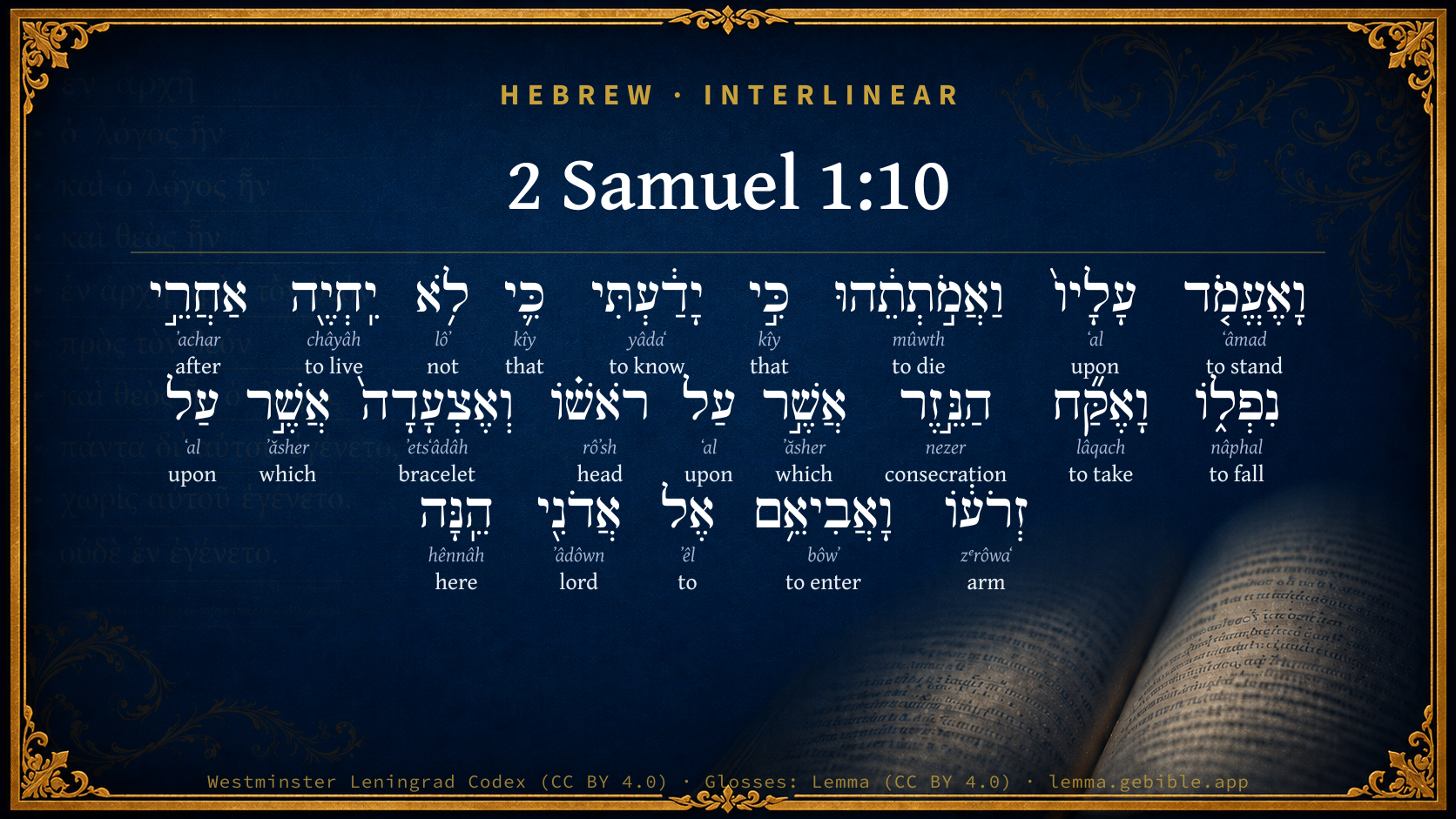
2 Samuel 1:10

Hebrew (Westminster Leningrad Codex) 2 Samuel 1:10 appears in the Hebrew Old Testament. The text above is from the Westminster Leningrad Codex. Each word links to its Strong’s number, a concise gloss, and parsing drawn from the Open Scriptures Hebrew Bible morphology. Click any word for its full Brown-Driver-Briggs (BDB) entry.
Download image
Cite this verse

2 Samuel 1:10 (World English Bible). Public Domain. Lemma interlinear Bible study tool, https://lemma.gebible.app/v/2-samuel/1/10.

Show BibTeX & RIS
BibTeX
RIS
English Translation
So I stood beside him, and killed him, because I was sure that he could not live after that he was fallen: and I took the crown that was on his head, and the bracelet that was on his arm, and have brought them here to my lord.
World English Bible · Public Domain
Download a study sheet

One document with this verse’s original text, its word-by-word gloss line, the meaning frame, cross-references with their text, attributed commentary, and full source and license credits — printable, and it pastes into notes with its structure intact.

This verse Autodidact and up

Study sheet (.html) Plain text (.txt)

A passage Seminary Student

Up to 50 verses in one chapter. A passage sheet keeps up to 6 commentary sources and 12 cross-references per verse, in the order this page ranks them, and says so on the sheet whenever that leaves anything out. Ask for a single verse and you get the Autodidact verse sheet above.

Everything on this page stays free to read, with no account — the sheet is a download of what is already on screen, not access to it.

Want to remove ads? Support Godless Engineer
Compare translations 3

The same verse in 3 English versions, stacked beneath the original-language interlinear above. Click any original word for its lexicon entry.

Each is an independent rendering of the whole verse — the interlinear is not word-aligned to these translations.

Highlighted words mark where these versions differ — a whole-verse word diff, not a word-by-word alignment.

  • World English Bible Public Domain
    So I stood beside him, and killed him, because I was sure that he could not live after that he was fallen: and I took the crown that was on his head, and the bracelet that was on his arm, and have brought them here to my lord.
  • King James Version Public Domain
    So I stood upon him, and slew him, because I was sure that he could not live after that he was fallen: and I took the crown that was upon his head, and the bracelet that was on his arm, and have brought them hither unto my lord.
  • unfoldingWord Literal Text CC BY-SA 4.0
    So I stood over him and killed him, for I knew that he would not live after his having fallen. And I took the crown that on his head and the band that on his arm, and I have brought them here to my lord.”

unfoldingWord Literal Text — © unfoldingWord, licensed CC BY-SA 4.0. Word-aligned USFM3 via Door43 (git.door43.org/unfoldingWord/en_ult).

Versions to compare (up to 4)

3 of 4 selected

Show all 18 translations

Every available English version of this verse, each an independent rendering of the whole verse.

  • World English Bible Public Domain
    So I stood beside him, and killed him, because I was sure that he could not live after that he was fallen: and I took the crown that was on his head, and the bracelet that was on his arm, and have brought them here to my lord.
  • Berean Standard Bible Public Domain
    So I stood over him and killed him, because I knew that after he had fallen he could not survive. And I took the crown that was on his head and the band that was on his arm, and I have brought them here to my lord.”
  • Majority Standard Bible Public Domain
    So I stood over him and killed him, because I knew that after he had fallen he could not survive. And I took the crown that was on his head and the band that was on his arm, and I have brought them here to my lord.”
  • King James Version Public Domain
    So I stood upon him, and slew him, because I was sure that he could not live after that he was fallen: and I took the crown that was upon his head, and the bracelet that was on his arm, and have brought them hither unto my lord.
  • American Standard Version (1901) Public Domain
    So I stood beside him, and slew him, because I was sure that he could not live after that he was fallen: and I took the crown that was upon his head, and the bracelet that was on his arm, and have brought them hither unto my lord.
  • Revised Version (1885) Public Domain
    So I stood beside him, and slew him, because I was sure that he could not live after that he was fallen: and I took the crown that was upon his head, and the bracelet that was on his arm, and have brought them hither unto my lord.
  • Geneva Bible (1599) Public Domain
    So I came vpon him, and slewe him, and because I was sure that hee coulde not liue, after that hee had fallen, I tooke the crowne that was vpon his head, and the bracelet that was on his arme, and brought them hither vnto my lord.
  • Douay-Rheims (1899) Public Domain
    So standing over him, I killed him: for I knew that he could not live after the fall: and I took the diadem that was on his head, and the bracelet that was on his arm and have brought them hither to thee, my lord.
  • Young's Literal Translation Public Domain
    And I stand over him, and put him to death, for I knew that he doth not live after his falling, and I take the crown which `is' on his head, and the bracelet which `is' on his arm, and bring them in unto my lord hither.'
  • Literal Standard Version CC BY-SA 4.0
    And I stand over him, and put him to death, for I knew that he does not live after his falling, and I take the crown which [is] on his head, and the bracelet which [is] on his arm, and bring them to my lord here.”
  • Unlocked Literal Bible CC BY-SA 4.0
    So I stood over him and killed him, because I knew that he would not live after he had fallen. Then I took the crown that was on his head and the band that was on his arm, and brought them here to you, my master.”
  • unfoldingWord Literal Text CC BY-SA 4.0
    So I stood over him and killed him, for I knew that he would not live after his having fallen. And I took the crown that on his head and the band that on his arm, and I have brought them here to my lord.”
  • Darby Bible Public Domain
    So I stood over him, and put him to death, for I knew that he would not live after his fall; and I took the crown that was upon his head, and the bracelet that was on his arm, and have brought them hither to my lord.
  • World Messianic Bible Public Domain
    So I stood beside him and killed him, because I was sure that he could not live after he had fallen. I took the crown that was on his head and the bracelet that was on his arm, and have brought them here to my lord.”
  • Webster's Bible Public Domain
    So I stood upon him, and slew him, because I was sure that he could not live after that he had fallen: and I took the crown that was upon his head, and the bracelet that was on his arm, and have brought them hither to my lord.
  • Free Bible Version CC BY-SA 4.0
    So I went over him and killed him, because I knew that wounded as he was he couldn't last long. I took the crown from his head and his bracelet from his arm, and I've brought them here to you, my lord.”
  • Bible in Basic English Public Domain
    So I put my foot on him and gave him his death-blow, because I was certain that he would not go on living after his fall: and I took the crown from his head and the band from his arm, and I have them here for my lord.
  • JPS Tanakh (1917) Public Domain
    So I stood beside him, and slew him, because I was sure that he could not live after that he was fallen; and I took the crown that was upon his head, and the bracelet that was on his arm, and have brought them hither unto my lord.'

Literal Standard Version (2020), Covenant Press — licensed CC BY-SA 4.0. Text via the HelloAO Bible API (eBible.org). Unlocked Literal Bible (unfoldingWord) — licensed CC BY-SA 4.0. Text via the HelloAO Bible API (eBible.org). unfoldingWord Literal Text — © unfoldingWord, licensed CC BY-SA 4.0. Word-aligned USFM3 via Door43 (git.door43.org/unfoldingWord/en_ult). Free Bible Version, Dr. Jonathan Gallagher — licensed CC BY-SA 4.0. Text via the HelloAO Bible API (eBible.org).

Word by word

More ways to search: Search by grammar → Find every occurrence → Compare this word →

Practice this passage: Drill this verse → Learn its vocabulary →

וְאֶצְעָדָה֙
ʼetsʻâdâh
H685
“and · bracelet”
Conjunction + Noun, Common, Feminine, Singular, Absolute
Part of Speech
Conjunction + Noun
Type
Common
Gender
Feminine
Number
Singular
State
Absolute
Full BDB Definition

Origin: a variation from H6807

TWOT: 1943e

armlet, bracelet, ankle chain
  1. וָאֶעֱמֹ֤ד ʻâmad H5975 “and · to stand” Conjunction + Verb, Qal, Sequential Imperfect, 1st Person, Common, Singular
  2. עָלָיו֙ ʻal H5921 “upon · him” Preposition + Suffix, Personal, 3rd Person, Masculine, Singular
  3. וַאֲמֹ֣תְתֵ֔הוּ mûwth H4191 “and · to die · him” Conjunction + Verb, Polel, Sequential Imperfect, 1st Person, Common, Singular + Suffix, Personal, 3rd Person, Masculine, Singular
  4. כִּ֣י kîy H3588 “that” Conjunction
  5. יָדַ֔עְתִּי yâdaʻ H3045 “to know” Verb, Qal, Perfect, 1st Person, Common, Singular
  6. כִּ֛י kîy H3588 “that” Conjunction
  7. לֹ֥א lôʼ H3808 “not” Particle, Negative
  8. יִֽחְיֶ֖ה châyâh H2421 “to live” Verb, Qal, Imperfect, 3rd Person, Masculine, Singular
  9. אַחֲרֵ֣י ʼachar H310 “after” Preposition
  10. נִפְל֑וֹ nâphal H5307 “to fall · him” Verb, Qal, Infinitive Construct + Suffix, Personal, 3rd Person, Masculine, Singular
  11. וָאֶקַּ֞ח lâqach H3947 “and · to take” Conjunction + Verb, Qal, Sequential Imperfect, 1st Person, Common, Singular
  12. הַנֵּ֣זֶר nezer H5145 “the · consecration” Particle, Definite Article + Noun, Common, Masculine, Singular, Absolute
  13. אֲשֶׁ֣ר ʼăsher H834 “which” Particle, Relative
  14. עַל ʻal H5921 “upon” Preposition
  15. רֹאשׁ֗וֹ rôʼsh H7218 “head · his” Noun, Common, Masculine, Singular, Construct + Suffix, Personal, 3rd Person, Masculine, Singular
  16. אֲשֶׁ֣ר ʼăsher H834 “which” Particle, Relative
  17. עַל ʻal H5921 “upon” Preposition
  18. זְרֹע֔וֹ zᵉrôwaʻ H2220 “arm · his” Noun, Common, Both, Singular, Construct + Suffix, Personal, 3rd Person, Masculine, Singular
  19. וָאֲבִיאֵ֥ם bôwʼ H935 “and · to enter · them” Conjunction + Verb, Hiphil, Sequential Imperfect, 1st Person, Common, Singular + Suffix, Personal, 3rd Person, Masculine, Plural
  20. אֶל ʼêl H413 “to” Preposition
  21. אֲדֹנִ֖י ʼâdôwn H113 “lord · my” Noun, Common, Masculine, Singular, Construct + Suffix, Personal, 1st Person, Common, Singular
  22. הֵֽנָּה hênnâh H2008 “here” Adverb

About this verse

These counts appear in no published source. They are computed here, from the morphology-tagged text and Lemma’s own curated glosses. What Lemma adds →

23
words
19
distinct lemmas
Historical
section

Notable vocabulary

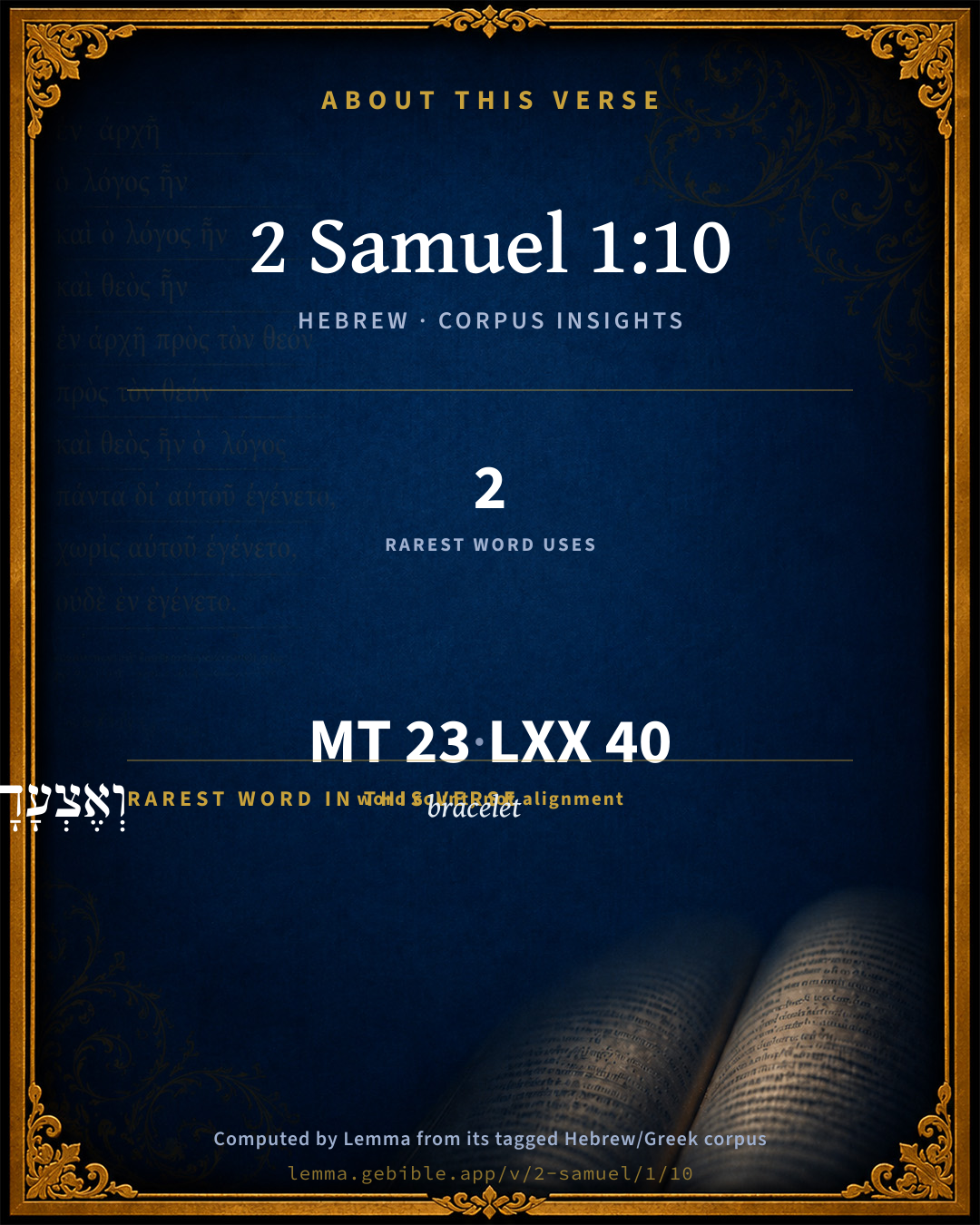
The rarest word here is וְאֶצְעָדָה֙ bracelet H685 — appearing just 2 times in the whole Hebrew Bible.

Shared distinctive vocabulary

וְאֶצְעָדָה֙ bracelet H685 occurs in 2 verses of the Hebrew Bible. Also found in:

Grammatical profile

  • 7 verbs
  • 5 nouns
  • 5 prepositions
  • 2 conjunctions
  • 1 adverb
  • 3 particles

Verb forms

  • וָאֶעֱמֹ֤ד Qal · Sequential Imperfect
  • וַאֲמֹ֣תְתֵ֔הוּ Polel · Sequential Imperfect
  • יָדַ֔עְתִּי Qal · Perfect
  • יִֽחְיֶ֖ה Qal · Imperfect
  • נִפְל֑וֹ Qal · Infinitive Construct
  • וָאֶקַּ֞ח Qal · Sequential Imperfect
  • וָאֲבִיאֵ֥ם Hiphil · Sequential Imperfect

Repetition

Words recur within this verse — often emphatic in Hebrew:

  • עָלָיו֙ upon H5921 ×3
  • כִּ֣י that H3588 ×2
  • אֲשֶׁ֣ר which H834 ×2

Hebrew & Septuagint length

In English translation the verse runs 48 words from the Hebrew and 46 from the Septuagint (LXX English) — closely comparable.

A rough comparison of the two English renderings, which tokenize alike — not a word-level alignment.

Word counts can differ between the Hebrew and the Greek without any difference in meaning — e.g. the Hebrew direct-object marker אֵת has no separate Greek word, and Greek often adds the article ὁ.

In the original languages it is 23 Hebrew tokens and 40 Greek tokens — but the two are counted differently (Hebrew bundles its prefixes and suffixes into one token; the Greek is in lemma form), so that isn’t a like-for-like length.

Cross-references

8

Topical passages linked to 2 Samuel 1:10 in the Treasury of Scripture Knowledge — connected by theme and wording, ordered by reader-vote popularity; previews shown in the World English Bible.

  • Judges 9:54 Then he called hastily to the young man his armor bearer, and said to him, Draw your sword, and kill me, that men not say of me, A woman killed him. His young man thrust him through, and he died.
  • Matthew 7:2 For with whatever judgment you judge, you will be judged; and with whatever measure you measure, it will be measured to you.
  • 2 Kings 11:12 Then he brought out the king's son, and put the crown on him, and [gave him] the testimony; and they made him king, and anointed him; and they clapped their hands, and said, [Long] live the king.
  • Judges 1:7 Adoni-bezek said, "Seventy kings, having their thumbs and their great toes cut off, gathered [their food] under my table: as I have done, so God has requited me." They brought him to Jerusalem, and he died there.
  • 1 Samuel 22:18 The king said to Doeg, Turn you, and fall on the priests. Doeg the Edomite turned, and he fell on the priests, and he killed on that day eighty-five persons who wore a linen ephod.
  • 1 Samuel 31:4–5 Then said Saul to his armor bearer, Draw your sword, and thrust me through therewith, lest these uncircumcised come and thrust me through, and abuse me. But his armor bearer would not; for he was sore afraid. Therefore Saul took his sword, and fell on it.
  • 2 Samuel 12:30 He took the crown of their king from off his head; and the weight of it was a talent of gold, and [in it were] precious stones; and it was set on David's head. He brought forth the spoil of the city, exceeding much.
  • Lamentations 5:16 The crown is fallen from our head: Woe to us! for we have sinned.

Cross-references courtesy of OpenBible.info (CC BY 4.0).

Hebrew and Greek witnesses Masoretic Hebrew ↔ Greek Septuagint

The same verse in the two great witnesses to the Old Testament, shown verse-for-verse.

These are two independent witnesses, not word-aligned to each other, and the Septuagint is shown in lemma (dictionary) form.

Hebrew 2 Samuel 1:10 Masoretic · Westminster Leningrad Codex

וָאֶעֱמֹ֤ד עָלָיו֙ וַאֲמֹ֣תְתֵ֔הוּ כִּ֣י יָדַ֔עְתִּי כִּ֛י לֹ֥א יִֽחְיֶ֖ה אַחֲרֵ֣י נִפְל֑וֹ וָאֶקַּ֞ח הַנֵּ֣זֶר אֲשֶׁ֣ר עַל רֹאשׁ֗וֹ וְאֶצְעָדָה֙ אֲשֶׁ֣ר עַל זְרֹע֔וֹ וָאֲבִיאֵ֥ם אֶל אֲדֹנִ֖י הֵֽנָּה

So I stood beside him, and killed him, because I was sure that he could not live after that he was fallen: and I took the crown that was on his head, and the bracelet that was on his arm, and have brought them here to my lord.

World English Bible · Public Domain

Greek LXX 2 Samuel 1:10 Septuagint · lemma form

καί ἐπιἵστημι ἐπί αὐτός καί θανατόω αὐτός ὅτι οἶδα ὅτι οὐ ζάω μετά ὁ πίπτω αὐτός καί λαμβάνω ὁ βασίλειον ὁ ἐπί ὁ κεφαλή αὐτός καί ὁ χλίδων ὁ ἐπί ὁ βραχίων αὐτός καί φέρω αὐτός ὁ κύριος ἐγώ ὧδε

So I stood over him and killed him, because I knew he would not live after he was fallen; and I took the crown that was upon his head, and the bracelet that was upon his arm, and I have brought them hither to my lord.

LXX2012 (modern English Septuagint) · Public Domain

Hebrew: Westminster Leningrad Codex (CC BY 4.0). Greek: Septuagint (public domain); English from LXX2012 (modern English Septuagint) (Public Domain). How the Septuagint differs from the Hebrew →

Targum (Aramaic paraphrase)

1

The Targum is the ancient Jewish Aramaic paraphrase of the Hebrew Scriptures — an interpretive translation, not the Hebrew text itself. Onkelos (literal) and Pseudo-Jonathan (expansive) render the Torah, and Jonathan the Prophets. Coverage is partial: where no permissively-licensed English translation exists for a verse, only the Aramaic is shown. This is verse-level text, not a word-by-word alignment to the Hebrew.

  1. Targum Jonathan Prophets (Joshua–Malachi)
    וְקָמִית עֲלוֹהִי וּקְטַלְתֵּיהּ אֲרֵי יָדַעְנָא אֲרֵי לָא יְחֵי בָתַר דִי נְפַל וּנְסֵיבִית כְּלִילָא דִי עַל רֵישֵׁיהּ וְטוֹטַפְתָּא דְעַל דַרְעֵיהּ וְאַיְתֵיתִינוּן לְוַת רִבּוֹנִי הַלְכָא:

    (no public-domain English translation for this verse)

    Targum Jonathan — Aramaic: “Mikraot Gedolot” (public domain). English: “Sefaria Community Translation” (CC0 1.0 (public-domain dedication)); “London "Chaldee Paraphrase," 1871” (public domain). Text via Sefaria.

Commentary

Notes on 2 Samuel 1:10 from classic Christian and Jewish commentators (each source and its license shown beneath its notes). The classic Christian expositions comment on the surrounding passage and are grouped to its opening verse, so a note may address several verses; the Jewish commentaries on the Tanakh (Rashi and others) are per-verse, so they appear only where the commentator wrote on this verse.

Lemma curates 59 commentaries, every one of them public domain or Creative Commons licensed, each selected and text-cleaned for this edition rather than reprinted as found. About our sources →

Trapp's Complete Commentary

John Trapp

2Sa 1:10 So I stood upon him, and slew him, because I was sure that he could not live after that he was fallen: and I took the crown that [was] upon his head, and the bracelet that [was] on his arm, and have brought them hither unto my lord.

Ver. 10. So I stood upon him, and slew him.] Lie and all: but this word was his death, David judging him out of his own mouth. Plutarch telleth us that Artaxerxes commanded three needles to be thrust through the tongue of a certain soldier, qui mentitus fuerat duos hostes se obtruncasse, who lyingly said that he had killed two of the enemy.

John Trapp, A Commentary or Exposition upon All the Books of the Old and New Testament (1647–1656) — public domain. Text from a community e-Sword module.

Joseph Benson's Commentary

2Sa 1:10. So I stood upon him and slew him — Saul, according to the true history, was afraid of being slain by the uncircumcised: and how was the matter mended by desiring to die by the hand of an Amalekite? And I took the crown that was upon his head — “Possibly the serious reader,” says Delaney, “may not think it an observation altogether unworthy of his regard, that an Amalekite now took the crown from Saul’s head, which he had forfeited by his disobedience in relation to Amalek.”

Joseph Benson's Commentary on the Old and New Testaments (1811–1818) — public domain. Text from a community e-Sword module.

Tyndale Open Study Notes

Tyndale Open Resources

1:10 The Amalekite apparently got to Saul’s corpse before the Philistines did, for they would not have left royal items such as his crown and his armband on his body. • Israel’s king wore a crown (Hebrew nezer, “consecration”) as a sign of his consecration to God and status as the Lord’s anointed (1:14).

Tyndale Open Study Notes — © Tyndale Open Resources, licensed CC BY-SA 4.0. Text via the HelloAO Bible API.

Geneva Bible (1599)

Geneva Bible translators

Hebrew, I stood upon him.

Geneva Bible (1599) marginal notes — public domain. Text via Bolls.life.

Jamieson, Fausset & Brown

Robert Jamieson, A. R. Fausset & David Brown

the crown--a small metallic cap or wreath, which encircled the temples, serving the purpose of a helmet, with a very small horn projecting in front, as the emblem of power.

the bracelet that was on his arm--the armlet worn above the elbow; an ancient mark of royal dignity. It is still worn by kings in some Eastern countries.

Jamieson, Fausset & Brown — Commentary Critical and Explanatory on the Whole Bible (1871) — public domain (CC PDM 1.0). Text via the HelloAO Bible API.

Adam Clarke's Commentary

Verse 10. The crown - and the bracelet] The crown was probably no more than a royal fillet or diadem, both being the ensigns of royalty. It is sometimes customary in the East for a sovereign prince to give a crown and bracelets, when investing others with dominion or authority over certain provinces. Had Saul these in token of his being God's vicegerent, and that he held the kingdom from him alone?

Adam Clarke's Commentary on the Bible (1810–1826) — public domain. Text from a community e-Sword/MySword module.

Ellicott's Commentary for English Readers

(10) Slew him.—This story is inconsistent with that given in 1Sa_31:4-5, and was evidently invented by the Amalekite to gain favour with David. At the same time, he is careful not to carry the story too far, and asserts that Saul was only put to death at his own request, and after being mortally wounded. However, he must have been one of the first to find the body of Saul after his death, since he brought his crown and bracelet to David—a primâ facie evidence of the truth of his whole story. The offering of these emblems of royalty shows that the Amalekite recognised David as the future king, a recognition which most of the tribes of Israel were unwilling to make for a long time.

A Bible Commentary for English Readers, edited by Charles John Ellicott (1878–1897) — public domain. Text from a community e-Sword module.

The Cambridge Bible for Schools and Colleges

gen. ed. J. J. S. Perowne

10. after that he was fallen] Not to be understood literally, of lying prostrate, but metaphorically, of defeat and disgrace. Cp.

“I am a poor fallen man, unworthy now

To be thy lord and master.”

Shakespeare, Hen. VIII. Act III. Sc. 2.

the crown] In all probability not the State-crown, but a light diadem, or fillet, worn round the helmet as the mark of royalty.

the bracelet] Armlets are still worn by Oriental sovereigns. Kings and distinguished warriors are represented on both Egyptian and Assyrian monuments as wearing highly ornamented bracelets or armlets. See Smith’s Dict. of the Bible, Art. Armlet, and Layard’s Nineveh and Babylon, II. 322.

The Cambridge Bible for Schools and Colleges (gen. ed. J. J. S. Perowne; Cambridge University Press, 1878–1918) — public domain. Text from a community e-Sword module.

John Gill's Exposition

So I stood upon him, and slew him,.... Pressed with all his weight upon his body, that so the spear might pierce through him, and slay him; thus he represents his death to be brought about:

because I was sure that he could not live after that he was fallen; this is not consistent with what he had said before, both that he was leaning on his spear, and not fallen to the ground, and that his life was whole in him:

and I took the crown that was upon his head; which made him conspicuous, and therefore the Philistines aimed at him, and pressed hard after him, Sa2 1:6; though some think that this was not on his head, but carried into the field of battle, ready to be put on if victory was on his side; and others say it was in the possession and care of Doeg, who at his death gave it to his son to carry to David, and thereby gain his favour:

and the bracelet that was on his arm; of gold no doubt, so Josephus (i); such as great personages used to wear, men as well as women, see Gen 38:18, especially military men (k). Jarchi takes them to be the "totaphot" or phylacteries on the arm, which is not probable:

and have brought them hither unto my lord; as ensigns of royalty, fit only for a king, Saul's successor, as this person, by calling him lord, owned him to be, and thought by bringing those to him to be highly he neared and rewarded.

(i) Ut supra. (Antiqu. l. 6. c. 14. sect. 7.) (k) Vid. Liv. Hist. Decad. 1. l. 10. c. 44.

John Gill's Exposition of the Whole Bible (1746–1763) — public domain (CC PDM 1.0). Text via the HelloAO Bible API.

Albert Barnes' Notes on the Bible

The Amalekite was one of those who came “to strip the slain” on “the morrow” after the battle 1Sa 31:8, and had the luck to find Saul and possess himself of his crown and bracelet. He probably started off immediately to seek David, and invented the above story, possibly having heard from some Israelite prisoner an account of what really did happen.

Albert Barnes' Notes on the Bible (1834–1885) — public domain. Text from a community e-Sword/MySword module.

Haydock's Catholic Bible Commentary

I killed him. This story of the young Amalecite was not true, as may easily be proved by comparing it with the last chapter of the foregoing book. (Challoner) --- Fall. This he says, apprehending that David would perhaps disapprove of what he had done. --- Diadem, or ribband, which was tied round his head, as a badge of his dignity. Hebrew, "the crown." But it was not of metal, though such were already common, Exodus xxviii. 36., and 1 Paralipomenon xx. 2. Some pretend that Doeg gave these insignia to this son, that he might ingratiate himself with the future king. But they were upon Saul, so that the enemy could easily distinguish him. --- Bracelet. The Hebrews took a great many from the Madianites, Numbers xxxi. 50. Such presents were made by the Romans to soldiers who had performed some feats of valour. (Pliny, [Natural History?] xxxiii. 2.) (Livy i. 10.)

George Leo Haydock (1774–1849), Haydock's Catholic Family Bible and Commentary, 1859 edition — public domain. Excludes Psalms (Douay-Rheims chapter numbering differs from Protestant) and Deuterocanonical books (Catholic canon only).

Matthew Poole's English Annotations

I stood upon him, and slew him: it is most probable this was a lie, devised to gain David’s favour, as he supposed. For, 1. Saul was not killed by a spear, as he pretends, but by his sword, 1Sa 31:4.

2. It is expressly said that Saul’s armour-bearer, being yet living, saw that Saul was dead, 1Sa 31:5; which doubtless he would very thoroughly examine and know, before he would kill himself upon that account, as he did.

3. Saul’s death is manifestly ascribed to his own action, even to his falling upon his sword, 1Sa 31:4,5.

I was sure that he could not live after that he was fallen: this he addeth by way of caution and excuse, that it might be thought all act of necessity and kindness, and not of choice or ill will, that he killed Saul. But here also he betrays himself; for how could this be true, when Saul’s life was whole within him, as he had now said, 2Sa 1:9?

The crown that was upon his head; not that he then wore it; which would have exposed him too much, and that unnecessarily, to the rage of the Philistines; but that he used to wear it. It is not likely that he found it now actually upon Saul’s head, but that he met with it in some part of the camp, whither Saul had brought it to wear it when he saw fit.

Unto my lord; unto thee, whom, now Saul is dead, I own for my lord and king.

Matthew Poole's English Annotations on the Holy Bible (1683–1685) — public domain. Text from a community e-Sword/MySword module.

Whedon's Commentary on the Bible

Daniel D. Whedon

10. I took the crown — By his disobedience in not smiting the Amalekites, Saul forfeited his crown and his kingdom, and now, behold, that crown is taken from his head by the hand of an Amalekite and transmitted to the man he hated and sought to destroy!

Bracelet — Or armlet, an ornament for the arm or wrist.

Daniel D. Whedon (gen. ed.), Commentary on the Old and New Testaments (1874–1909) — public domain. Text from a community e-Sword module.

The Pulpit Commentary

After that he was fallen; Hebrew, after his fall; that is, his defeat; for Saul was standing and supporting himself with his spear. The crown, probably, was a narrow band of gold encircling the royal helmet. Bracelet. We read of "bracelets" in Num_31:50, in the enumeration of the spoil taken from the Midianites, and there too apparently they were the ornaments of warriors. In the Assyrian monuments chiefs are generally represented with ornaments upon their wrists and arms (see Layard, "Nineveh," etc., pl. 18).

The Pulpit Commentary (1880–1919), ed. H.D.M. Spence-Jones & Joseph S. Exell — public domain. Text from a community e-Sword module.

Scofield Reference Notes

C. I. Scofield

stood

Cf. (See Scofield "1Sa 31:3").

The Scofield Reference Bible (1917 edition), notes by C. I. Scofield — public domain. Text from a community e-Sword module.

Rashi

Rabbi Shlomo Yitzchaki (Rashi)

And the bracelet that was on his arm. The tefilin that was on his arm.

Rashi on the Tanakh — English translations: “The Judaica Press complete Tanach with Rashi, translated by A. J. Rosenberg” (CC BY 4.0); “Pentateuch with Rashi's commentary by M. Rosenbaum and A.M. Silbermann, 1929-1934” (public domain); “The Metsudah Tanach series, Lakewood, N.J” (CC BY 4.0); and “The Book of Joshua, Metsudah Publications, 1997” (CC BY 4.0). Text via Sefaria.

Lesson kit

Teaching starters — assembled from the data on this page, not authored interpretation. Every prompt links to the verse data it draws on. Edit before teaching.

2 Samuel, in the Historical, opens this verse with 23 words (19 distinct Hebrew lemmas). Its most distinctive word is ʼetsʻâdâh (“bracelet”). A historical commentator’s framing appears above. Read the whole chapter for the surrounding context.

Discussion questions

  1. The word ʼetsʻâdâh carries the sense “bracelet.” How does it shape the verse?
  2. How does Numbers 31:50, which shares the word «bracelet», read alongside this verse?
  3. What does the repetition of “upon” (3× in this one verse) do in this verse?
  4. These translations render this verse differently; the difference is in the English rendering, not the original. What questions does that raise?
  5. «וָאֶעֱמֹ֤ד» is a Qal Sequential Imperfect verb. How does that grammatical form shape the action described?
  6. Compare how Trapp's Complete Commentary and Joseph Benson's Commentary read this verse. Where do they agree or differ?

Things to notice

Reading settings

Reading text

Shown beneath each verse's original-language words.

Old Testament
Old Testament edition

Read the OT as the Masoretic Hebrew (MT) or the Greek Septuagint (LXX).

English shown for the Greek Septuagint (in the Hebrew ↔ Greek comparison).

Comparing translations? Open the Compare panel on any verse page to stack up to four side by side.