Numbers 16:45

Hebrew (Westminster Leningrad Codex) Numbers 16:45 appears in the Hebrew Old Testament. The text above is from the Westminster Leningrad Codex. Each word links to its Strong’s number, a concise gloss, and parsing drawn from the Open Scriptures Hebrew Bible morphology. Click any word for its full Brown-Driver-Briggs (BDB) entry.
Download image
Cite this verse

Numbers 16:45 (World English Bible). Public Domain. Lemma interlinear Bible study tool, https://lemma.gebible.app/v/numbers/16/45.

Show BibTeX & RIS
BibTeX
RIS
English Translation
Get away from among this congregation, that I may consume them in a moment. They fell on their faces.
World English Bible · Public Domain
Highlights
  • 1 first appearance in the Hebrew Bible
Full analysis ↓
Download a study sheet

One document with this verse’s original text, its word-by-word gloss line, the meaning frame, cross-references with their text, attributed commentary, and full source and license credits — printable, and it pastes into notes with its structure intact.

This verse Autodidact and up

Study sheet (.html) Plain text (.txt)

A passage Seminary Student

Up to 50 verses in one chapter. A passage sheet keeps up to 6 commentary sources and 12 cross-references per verse, in the order this page ranks them, and says so on the sheet whenever that leaves anything out. Ask for a single verse and you get the Autodidact verse sheet above.

Everything on this page stays free to read, with no account — the sheet is a download of what is already on screen, not access to it.

Want to remove ads? Support Godless Engineer
Compare translations 3

The same verse in 3 English versions, stacked beneath the original-language interlinear above. Click any original word for its lexicon entry.

Each is an independent rendering of the whole verse — the interlinear is not word-aligned to these translations.

Highlighted words mark where these versions differ — a whole-verse word diff, not a word-by-word alignment.

  • World English Bible Public Domain
    Get away from among this congregation, that I may consume them in a moment. They fell on their faces.
  • King James Version Public Domain
    Get you up from among this congregation, that I may consume them as in a moment. And they fell upon their faces.
  • unfoldingWord Literal Text CC BY-SA 4.0
    “Lift yourselves up from the midst of this congregation, and I shall finish them according to a moment.” And they fell on their faces.

unfoldingWord Literal Text — © unfoldingWord, licensed CC BY-SA 4.0. Word-aligned USFM3 via Door43 (git.door43.org/unfoldingWord/en_ult).

Versions to compare (up to 4)

3 of 4 selected

Show all 18 translations

Every available English version of this verse, each an independent rendering of the whole verse.

  • World English Bible Public Domain
    Get away from among this congregation, that I may consume them in a moment. They fell on their faces.
  • Berean Standard Bible Public Domain
    “Get away from this congregation so that I may consume them in an instant.” And Moses and Aaron fell facedown.
  • Majority Standard Bible Public Domain
    “Get away from this congregation so that I may consume them in an instant.” And Moses and Aaron fell facedown.
  • King James Version Public Domain
    Get you up from among this congregation, that I may consume them as in a moment. And they fell upon their faces.
  • American Standard Version (1901) Public Domain
    Get you up from among this congregation, that I may consume them in a moment. And they fell upon their faces.
  • Revised Version (1885) Public Domain
    Get you up from among this congregation, that I may consume them in a moment. And they fell upon their faces.
  • Geneva Bible (1599) Public Domain
    Get you vp from among this Congregation: for I wil consume them quickly: then they fell vpon their faces.
  • Douay-Rheims (1899) Public Domain
    Get you out from the midst of this multitude, this moment will I destroy them. And as they were lying on the ground,
  • Young's Literal Translation Public Domain
    `Get you up from the midst of this company, and I consume them in a moment;' and they fall on their faces,
  • Literal Standard Version CC BY-SA 4.0
    “Get up from the midst of this congregation, and I consume them in a moment”; and they fall on their faces,
  • Unlocked Literal Bible CC BY-SA 4.0
    “Go away from in front of this community so that I may consume them immediately.” Then Moses and Aaron lay down with their faces to the ground.
  • unfoldingWord Literal Text CC BY-SA 4.0
    “Lift yourselves up from the midst of this congregation, and I shall finish them according to a moment.” And they fell on their faces.
  • Darby Bible Public Domain
    Get you up from the midst of this assembly, and I will consume them in a moment. And they fell on their faces.
  • World Messianic Bible Public Domain
    “Get away from among this congregation, that I may consume them in a moment!” They fell on their faces.
  • Webster's Bible Public Domain
    Remove from among this congregation, that I may consume them as in a moment. And they fell upon their faces.
  • Free Bible Version CC BY-SA 4.0
    “Get away from these people and I will finish them off immediately.” Moses and Aaron fell facedown on the ground.
  • Bible in Basic English Public Domain
    Come out from among this people, so that I may send sudden destruction on them. And they went down on their faces.
  • JPS Tanakh (1917) Public Domain
    (17-10) 'Get you up from among this congregation, that I may consume them in a moment.' And they fell upon their faces.

Literal Standard Version (2020), Covenant Press — licensed CC BY-SA 4.0. Text via the HelloAO Bible API (eBible.org). Unlocked Literal Bible (unfoldingWord) — licensed CC BY-SA 4.0. Text via the HelloAO Bible API (eBible.org). unfoldingWord Literal Text — © unfoldingWord, licensed CC BY-SA 4.0. Word-aligned USFM3 via Door43 (git.door43.org/unfoldingWord/en_ult). Free Bible Version, Dr. Jonathan Gallagher — licensed CC BY-SA 4.0. Text via the HelloAO Bible API (eBible.org).

Word by word

More ways to search: Search by grammar → Find every occurrence → Compare this word →

Practice this passage: Drill this verse → Learn its vocabulary →

הֵרֹ֗מּוּ
râmam
H7426
“be exalted”
Verb, Niphal, Imperative, 2nd Person, Masculine, Plural
Part of Speech
Verb
Stem
Niphal
Form
Imperative
Person
2nd Person
Gender
Masculine
Number
Plural
Full BDB Definition

Origin: a primitive root

TWOT: 2174

to be exalted, be lifted up - (Qal) to be exalted - (Niphal) to lift oneself
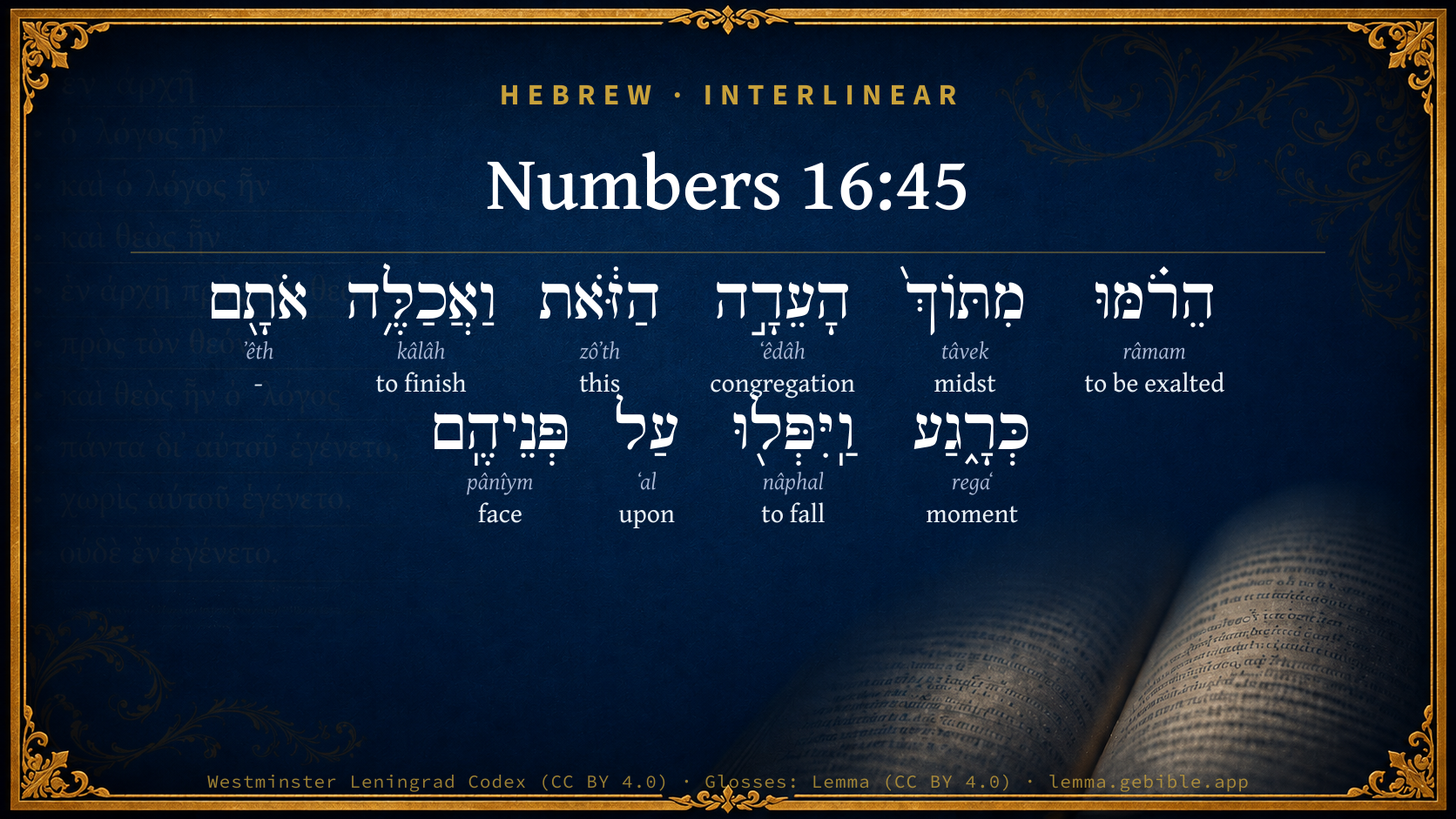
  1. מִתּוֹךְ֙ tâvek H8432 “from · midst of” Preposition + Noun, Common, Masculine, Singular, Construct
  2. הָעֵדָ֣ה ʻêdâh H5712 “the · congregation” Particle, Definite Article + Noun, Common, Feminine, Singular, Absolute
  3. הַזֹּ֔את zôʼth H2063 “the · this” Particle, Definite Article + Pronoun, Demonstrative, Feminine, Singular
  4. וַאֲכַלֶּ֥ה kâlâh H3615 “and · to finish” Conjunction + Verb, Piel, Imperfect, 1st Person, Common, Singular
  5. אֹתָ֖ם ʼêth H853 “- · them” Particle, Direct Object + Suffix, Personal, 3rd Person, Masculine, Plural
  6. כְּרָ֑גַע regaʻ H7281 “like/as · moment” Preposition + Noun, Common, Masculine, Singular, Absolute
  7. וַֽיִּפְּל֖וּ nâphal H5307 “and · to fall” Conjunction + Verb, Qal, Sequential Imperfect, 3rd Person, Masculine, Plural
  8. עַל ʻal H5921 “upon” Preposition
  9. פְּנֵיהֶֽם pânîym H6440 “face(s) · their” Noun, Common, Both, Plural, Construct + Suffix, Personal, 3rd Person, Masculine, Plural

About this verse

These counts appear in no published source. They are computed here, from the morphology-tagged text and Lemma’s own curated glosses. What Lemma adds →

10
words
10
distinct lemmas
Pentateuch
section

Notable vocabulary

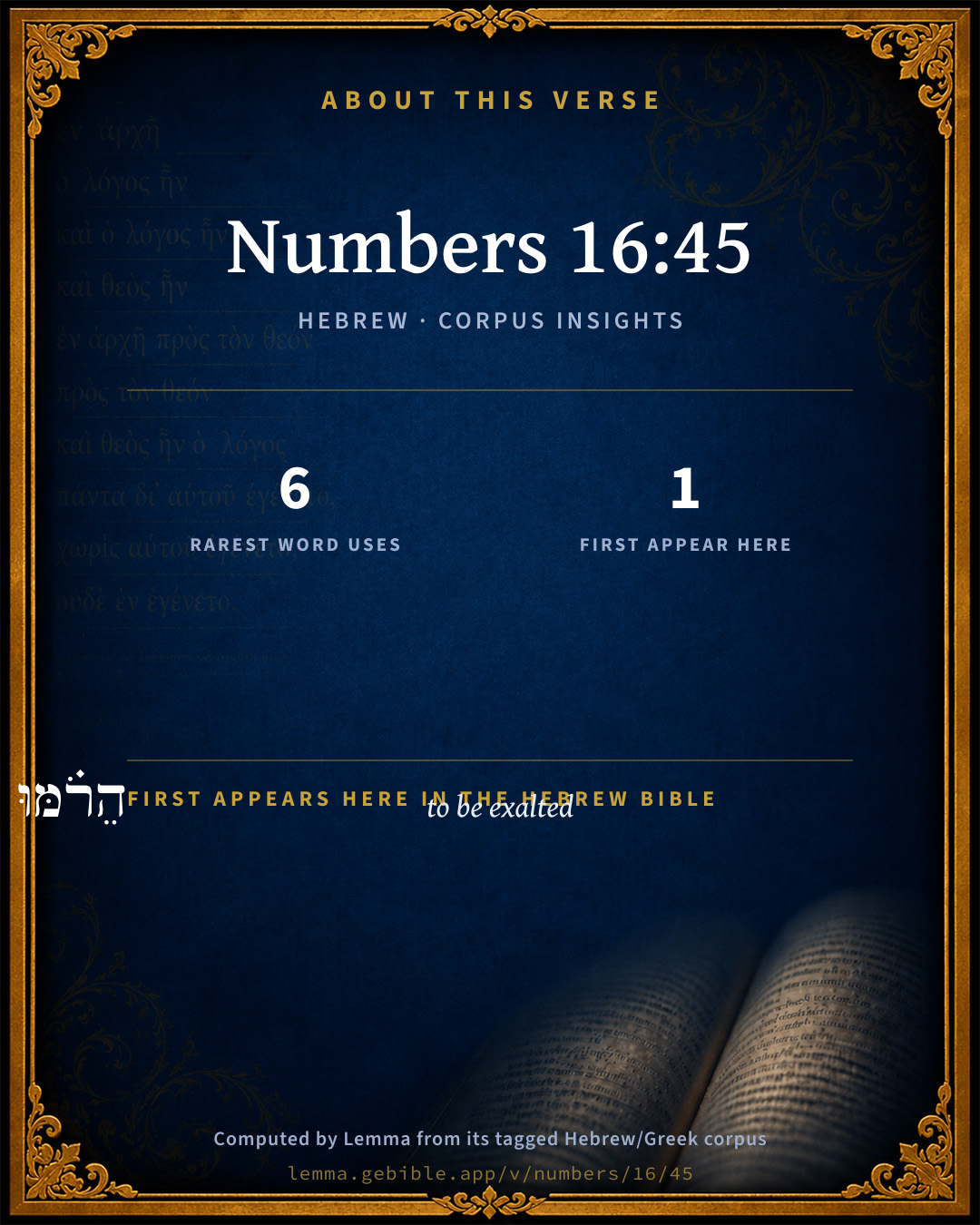
The rarest word here is הֵרֹ֗מּוּ to be exalted H7426 — appearing just 6 times in the whole Hebrew Bible.

First appearance in Scripture

This word makes its first canonical appearance in the Hebrew Bible here:

  • הֵרֹ֗מּוּ to be exalted H7426

Shared distinctive vocabulary

הֵרֹ֗מּוּ to be exalted H7426 occurs in 6 verses of the Hebrew Bible. Also found in:

Grammatical profile

  • 3 verbs
  • 4 nouns
  • 1 pronoun
  • 1 preposition
  • 1 particle

Verb forms

  • הֵרֹ֗מּוּ Niphal · Imperative
  • וַאֲכַלֶּ֥ה Piel · Imperfect
  • וַֽיִּפְּל֖וּ Qal · Sequential Imperfect

Hebrew & Septuagint length

In English translation the verse runs 19 words from the Hebrew and 21 from the Septuagint (LXX English) — closely comparable.

A rough comparison of the two English renderings, which tokenize alike — not a word-level alignment.

Word counts can differ between the Hebrew and the Greek without any difference in meaning — e.g. the Hebrew direct-object marker אֵת has no separate Greek word, and Greek often adds the article ὁ.

Cross-references

6

Topical passages linked to Numbers 16:45 in the Treasury of Scripture Knowledge — connected by theme and wording, ordered by reader-vote popularity; previews shown in the World English Bible.

  • Numbers 16:21–22 Separate yourselves from among this congregation, that I may consume them in a moment.
  • Numbers 16:24 Speak to the congregation, saying, Get away from around the tent of Korah, Dathan, and Abiram.
  • Numbers 16:26 He spoke to the congregation, saying, Depart, I pray you, from the tents of these wicked men, and touch nothing of theirs, lest you be consumed in all their sins.
  • Numbers 20:6 Moses and Aaron went from the presence of the assembly to the door of the tent of meeting, and fell on their faces: and the glory of Yahweh appeared to them.
  • 1 Chronicles 21:16 David lifted up his eyes, and saw the angel of Yahweh standing between earth and the sky, having a drawn sword in his hand stretched out over Jerusalem. Then David and the elders, clothed in sackcloth, fell on their faces.
  • Matthew 26:39 He went forward a little, fell on his face, and prayed, saying, "My Father, if it is possible, let this cup pass away from me; nevertheless, not what I desire, but what you desire."

Cross-references courtesy of OpenBible.info (CC BY 4.0).

Hebrew and Greek witnesses Masoretic Hebrew ↔ Greek Septuagint

The same verse in the two great witnesses to the Old Testament, shown verse-for-verse.

These are two independent witnesses, not word-aligned to each other, and the Septuagint is shown in lemma (dictionary) form.

Hebrew Numbers 16:45 Masoretic · Westminster Leningrad Codex

הֵרֹ֗מּוּ מִתּוֹךְ֙ הָעֵדָ֣ה הַזֹּ֔את וַאֲכַלֶּ֥ה אֹתָ֖ם כְּרָ֑גַע וַֽיִּפְּל֖וּ עַל פְּנֵיהֶֽם

Get away from among this congregation, that I may consume them in a moment. They fell on their faces.

World English Bible · Public Domain

Greek LXX Numbers 16:45 Septuagint · lemma form
Depart out of the midst of this congregation, and I will consume them at once: and they fell upon their faces.

LXX2012 (modern English Septuagint) · Public Domain

Hebrew: Westminster Leningrad Codex (CC BY 4.0). Greek: Septuagint (public domain); English from LXX2012 (modern English Septuagint) (Public Domain). How the Septuagint differs from the Hebrew →

Commentary

Notes on Numbers 16:45 from classic Christian and Jewish commentators (each source and its license shown beneath its notes). The classic Christian expositions comment on the surrounding passage and are grouped to its opening verse, so a note may address several verses; the Jewish commentaries on the Tanakh (Rashi and others) are per-verse, so they appear only where the commentator wrote on this verse.

Lemma curates 59 commentaries, every one of them public domain or Creative Commons licensed, each selected and text-cleaned for this edition rather than reprinted as found. About our sources →

Joseph Benson's Commentary

Num 16:45-46. They fell upon their faces — To beg mercy for the people; thus rendering good for evil. Put on incense — Which was a sign of intercession, and was to be accompanied with it. Go unto the congregation — He went with the incense to stir up the people to repentance and prayer, to prevent their utter ruin. This he might do upon this extraordinary occasion, having God’s command for his warrant, though ordinarily incense was to be offered only in the tabernacle.

Joseph Benson's Commentary on the Old and New Testaments (1811–1818) — public domain. Text from a community e-Sword module.

John Gill's Exposition

And Moses said unto Aaron, take a censer,.... Which lay in the tabernacle:

and put fire therein from off the altar; the altar of burnt offering, from whence fire only was to be taken for burning incense; and lest Aaron in his hurry should forget to take it from thence, but elsewhere, and offer strange fire as his sons had done, Moses expresses the place from whence he should take it:

and put on incense: upon the fire, in the censer, which he was to do when he came into the camp, and not as soon as he took the fire from the altar: the censer with fire in it he carried in one hand, and the incense in the other; and when he was in the midst of the congregation, he put the incense on the fire, and burnt it, as appears from Num 16:47, this was an emblem of prayer, and a figure of the intercession and mediation of Christ, Psa 141:2,

and go quickly unto the congregation; the case required haste:

and make an atonement for them; which was usually done by the sacrifice of a sin or trespass offering, but now there was no time for that, and therefore incense, which was of quicker dispatch, was used for that purpose instead of it:

for there is wrath gone out from the Lord; some token of it, some disease was inflicted, which Moses had information of from the Lord, and therefore expressly says:

the plague is begun; a pestilence was sent among the people.

John Gill's Exposition of the Whole Bible (1746–1763) — public domain (CC PDM 1.0). Text via the HelloAO Bible API.

Albert Barnes' Notes on the Bible

They fell upon their faces - In intercession for the people; compare Num 16:22; Num 14:5.

Albert Barnes' Notes on the Bible (1834–1885) — public domain. Text from a community e-Sword/MySword module.

Haydock's Catholic Bible Commentary

Get ye out. Moses and Aaron complied with the spirit, though not with the letter of this injunction. They lay prostrate on their faces, with all humility and earnestness, begging that the Lord would preserve them, and at the same time take pity on the frailty of the multitude, who had been deluded, and had, in words at least, approved the conduct of the rebels. (Haydock) --- God encourages them inwardly to persevere in prayer, in the same manner as when he said to Moses, (Exodus xxxii. 20,) Let me alone, that my wrath may be enkindled, &c.

George Leo Haydock (1774–1849), Haydock's Catholic Family Bible and Commentary, 1859 edition — public domain. Excludes Psalms (Douay-Rheims chapter numbering differs from Protestant) and Deuterocanonical books (Catholic canon only).

Matthew Poole's English Annotations

To beg pardon and mercy for the people, as they oft did; thus rendering good to them for evil, which the people requited with evil for their kindness.

Matthew Poole's English Annotations on the Holy Bible (1683–1685) — public domain. Text from a community e-Sword/MySword module.

Whedon's Commentary on the Bible

Daniel D. Whedon

45. They fell upon their faces — This was an act of heroic self-sacrifice equal to any in history. Only yesterday, after a similar command to the people to stand aloof from the tents of the chief rebels lest they perish with them, the yawning earth devoured the guilty. But now, in the face of a similar order, Moses and Aaron remain among the doomed people, in the attitude of most earnest intercession, determined to avert consuming wrath or perish in the attempt.

Daniel D. Whedon (gen. ed.), Commentary on the Old and New Testaments (1874–1909) — public domain. Text from a community e-Sword module.

The Pulpit Commentary

Get you up. WMrohe, from The command is substantially the same as that in verse 21. Since it was not obeyed, we must conclude (as before) that it was not intended to be obeyed. They fell on their faces.

In horror and dismay. No doubt they would have interceded (as in verse 22), but that Moses perceived through some Divine intimation that wrath had gone forth, and that some more prevailing form of mediation than mere words must be sought.

The Pulpit Commentary (1880–1919), ed. H.D.M. Spence-Jones & Joseph S. Exell — public domain. Text from a community e-Sword module.

John Wesley's Explanatory Notes

They fell upon their faces - To beg mercy for the people; thus rendering Good for Evil.

John Wesley, Explanatory Notes Upon the Whole Bible (1754–1765) — public domain. Text via the GEBible commentary corpus.

Lesson kit

Teaching starters — assembled from the data on this page, not authored interpretation. Every prompt links to the verse data it draws on. Edit before teaching.

Numbers, in the Pentateuch, opens this verse with 10 words (10 distinct Hebrew lemmas). Its most distinctive word is râmam (“to be exalted”). A historical commentator’s framing appears above. Read the whole chapter for the surrounding context.

Discussion questions

  1. The word râmam carries the sense “to be exalted.” How does it shape the verse?
  2. The word “to be exalted” first appears here in Scripture. What is being introduced at this debut?
  3. Job 24:24 shares the word «to be exalted» with this verse. How do the two illuminate each other?
  4. These translations render this verse differently; the difference is in the English rendering, not the original. What questions does that raise?
  5. The verb «הֵרֹ֗מּוּ» is Niphal Imperative. How does its form color the action?
  6. Reading how Joseph Benson's Commentary and John Gill's Exposition read this verse, where do the two commentators agree and where do they part?

Things to notice

Reading settings

Reading text

Shown beneath each verse's original-language words.

Old Testament
Old Testament edition

Read the OT as the Masoretic Hebrew (MT) or the Greek Septuagint (LXX).

English shown for the Greek Septuagint (in the Hebrew ↔ Greek comparison).

Comparing translations? Open the Compare panel on any verse page to stack up to four side by side.