
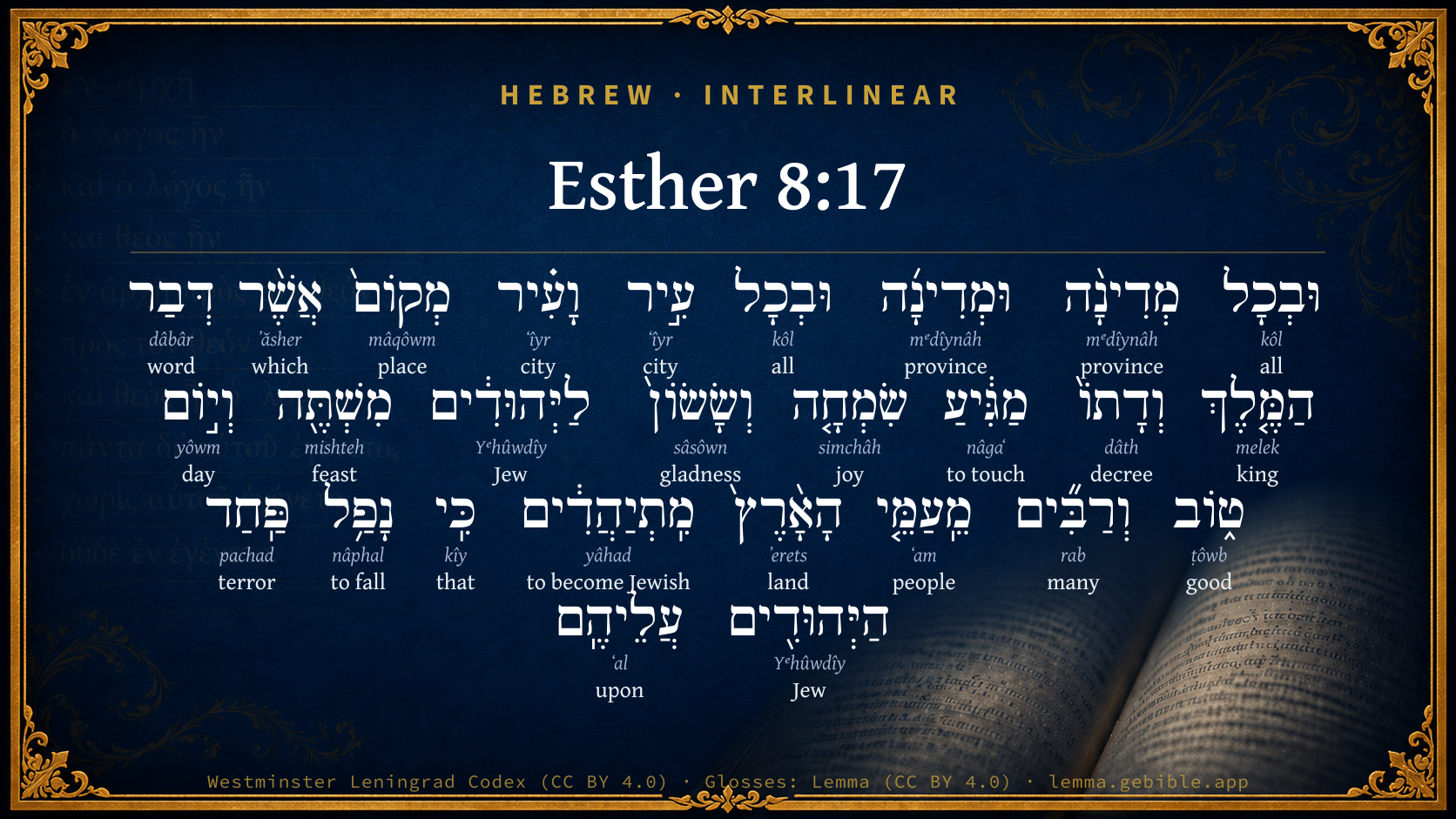
Esther 8:17

Hebrew (Westminster Leningrad Codex) Esther 8:17 appears in the Hebrew Old Testament. The text above is from the Westminster Leningrad Codex. Each word links to its Strong’s number, a concise gloss, and parsing drawn from the Open Scriptures Hebrew Bible morphology. Click any word for its full Brown-Driver-Briggs (BDB) entry.
Download image
Cite this verse

Esther 8:17 (World English Bible). Public Domain. Lemma interlinear Bible study tool, https://lemma.gebible.app/v/esther/8/17.

Show BibTeX & RIS
BibTeX
RIS
English Translation
In every province, and in every city, wherever the king's commandment and his decree came, the Jews had gladness and joy, a feast and a good day. Many from among the peoples of the land became Jews; for the fear of the Jews was fallen on them.
World English Bible · Public Domain
Highlights
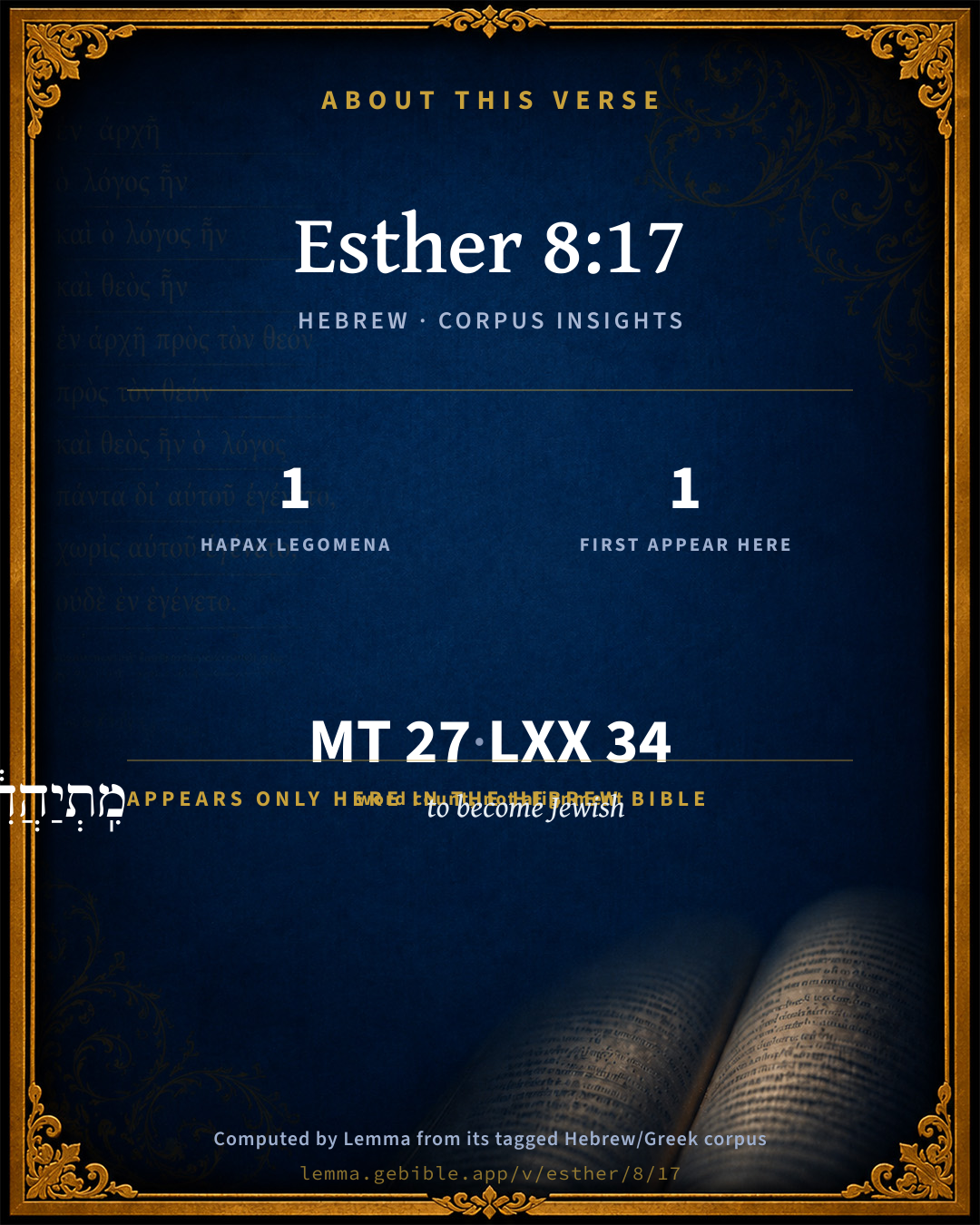
  • 1 hapax legomenon — only here in the Hebrew Bible
  • 1 first appearance in the Hebrew Bible
Full analysis ↓
Download a study sheet

One document with this verse’s original text, its word-by-word gloss line, the meaning frame, cross-references with their text, attributed commentary, and full source and license credits — printable, and it pastes into notes with its structure intact.

This verse Autodidact and up

Study sheet (.html) Plain text (.txt)

A passage Seminary Student

Up to 50 verses in one chapter. A passage sheet keeps up to 6 commentary sources and 12 cross-references per verse, in the order this page ranks them, and says so on the sheet whenever that leaves anything out. Ask for a single verse and you get the Autodidact verse sheet above.

Everything on this page stays free to read, with no account — the sheet is a download of what is already on screen, not access to it.

Want to remove ads? Support Godless Engineer
Compare translations 3

The same verse in 3 English versions, stacked beneath the original-language interlinear above. Click any original word for its lexicon entry.

Each is an independent rendering of the whole verse — the interlinear is not word-aligned to these translations.

Highlighted words mark where these versions differ — a whole-verse word diff, not a word-by-word alignment.

  • World English Bible Public Domain
    In every province, and in every city, wherever the king's commandment and his decree came, the Jews had gladness and joy, a feast and a good day. Many from among the peoples of the land became Jews; for the fear of the Jews was fallen on them.
  • King James Version Public Domain
    And in every province, and in every city, whithersoever the king's commandment and his decree came, the Jews had joy and gladness, a feast and a good day. And many of the people of the land became Jews; for the fear of the Jews fell upon them.
  • unfoldingWord Literal Text CC BY-SA 4.0
    In every province by province and in every city by city, any place where the word of the king and his law came, there was joy and rejoicing for the Jews, a feast and a good day. And many from the peoples of the land became Jews because dread of the Jews had fallen upon them.

unfoldingWord Literal Text — © unfoldingWord, licensed CC BY-SA 4.0. Word-aligned USFM3 via Door43 (git.door43.org/unfoldingWord/en_ult).

Versions to compare (up to 4)

3 of 4 selected

Show all 18 translations

Every available English version of this verse, each an independent rendering of the whole verse.

  • World English Bible Public Domain
    In every province, and in every city, wherever the king's commandment and his decree came, the Jews had gladness and joy, a feast and a good day. Many from among the peoples of the land became Jews; for the fear of the Jews was fallen on them.
  • Berean Standard Bible Public Domain
    In every province and every city, wherever the king’s edict and decree reached, there was joy and gladness among the Jews, with feasting and celebrating. And many of the people of the land themselves became Jews, because the fear of the Jews had fallen upon them.
  • Majority Standard Bible Public Domain
    In every province and every city, wherever the king’s edict and decree reached, there was joy and gladness among the Jews, with feasting and celebrating. And many of the people of the land themselves became Jews, because the fear of the Jews had fallen upon them.
  • King James Version Public Domain
    And in every province, and in every city, whithersoever the king's commandment and his decree came, the Jews had joy and gladness, a feast and a good day. And many of the people of the land became Jews; for the fear of the Jews fell upon them.
  • American Standard Version (1901) Public Domain
    And in every province, and in every city, whithersoever the king's commandment and his decree came, the Jews had gladness and joy, a feast and a good day. And many from among the peoples of the land became Jews; for the fear of the Jews was fallen upon them.
  • Revised Version (1885) Public Domain
    And in every province, and in every city, whithersoever the king’s commandment and his decree came, the Jews had gladness and joy, a feast and a good day. And many from among the peoples of the land became Jews; for the fear of the Jews was fallen upon them.
  • Geneva Bible (1599) Public Domain
    Also in all and euery prouince, and in al and euery citie and place, where the Kings commandement and his decree came, there was ioy and gladnes to the Iewes, a feast and good day, and many of the people of the land became Iewes: for the feare of the Iewes fell vpon them.
  • Douay-Rheims (1899) Public Domain
    And in all peoples, cities, and provinces, whithersoever the king's commandments came, there was wonderful rejoicing, feasts and banquets, and keeping holy day: insomuch that many of other nations and religion, joined themselves to their worship and ceremonies. For a great dread of the name of the Jews had fallen upon all.
  • Young's Literal Translation Public Domain
    and in every province and province, and in every city and city, the place where the word of the king, even his law, is coming, gladness and joy `are' to the Jews, a banquet, and a good day; and many of the peoples of the land are becoming Jews, for a fear of the Jews hath fallen upon them.
  • Literal Standard Version CC BY-SA 4.0
    and in each and every province, and in each and every city, the place where the word of the king, even his law, is coming, gladness and joy [are] to the Jews, a banquet, and a good day; and many of the peoples of the land are becoming Jews, for a fear of the Jews has fallen on them.
  • Unlocked Literal Bible CC BY-SA 4.0
    In every province and in every city, wherever the king's decree reached, there was gladness and joy among the Jews, a feast and a holiday. Many from among the variety of peoples of the land became Jews, because the fear of the Jews had fallen on them.
  • unfoldingWord Literal Text CC BY-SA 4.0
    In every province by province and in every city by city, any place where the word of the king and his law came, there was joy and rejoicing for the Jews, a feast and a good day. And many from the peoples of the land became Jews because dread of the Jews had fallen upon them.
  • Darby Bible Public Domain
    And in every province, and in every city, wherever the king's commandment and his decree came, the Jews had joy and gladness, a feast and a good day. And many among the peoples of the land became Jews; for the fear of the Jews had fallen upon them.
  • World Messianic Bible Public Domain
    In every province and in every city, wherever the king’s commandment and his decree came, the Jews had gladness, joy, a feast and a holiday. Many from among the peoples of the land became Jews, for the fear of the Jews had fallen on them.
  • Webster's Bible Public Domain
    And in every province, and in every city, whithersoever the king's commandment and his decree came, the Jews had joy and gladness, a feast and a good day. And many of the people of the land became Jews; for the fear of the Jews fell upon them.
  • Free Bible Version CC BY-SA 4.0
    In every province and in every city, wherever the king's order and decree had reached, the Jews were joyful and happy—they feasted and celebrated. Many people became Jews, because they had become afraid of them.
  • Bible in Basic English Public Domain
    And in every part of the kingdom and in every town, wherever the king's letter and his order came, the Jews were glad with great joy, and had a feast and a good day. And a great number of the people of the land became Jews: for the fear of the Jews had come on them.
  • JPS Tanakh (1917) Public Domain
    And in every province, and in every city, whithersoever the king's commandment and his decree came, the Jews had gladness and joy, a feast and a good day. And many from among the peoples of the land became Jews; for the fear of the Jews was fallen upon them.

Literal Standard Version (2020), Covenant Press — licensed CC BY-SA 4.0. Text via the HelloAO Bible API (eBible.org). Unlocked Literal Bible (unfoldingWord) — licensed CC BY-SA 4.0. Text via the HelloAO Bible API (eBible.org). unfoldingWord Literal Text — © unfoldingWord, licensed CC BY-SA 4.0. Word-aligned USFM3 via Door43 (git.door43.org/unfoldingWord/en_ult). Free Bible Version, Dr. Jonathan Gallagher — licensed CC BY-SA 4.0. Text via the HelloAO Bible API (eBible.org).

Word by word

More ways to search: Search by grammar → Find every occurrence → Compare this word →

Practice this passage: Drill this verse → Learn its vocabulary →

מִֽתְיַהֲדִ֔ים
yâhad
H3054
“becoming Jewish”
Verb, Hithpael, Participle Active, Masculine, Plural, Absolute
Part of Speech
Verb
Stem
Hithpael
Form
Participle Active
Gender
Masculine
Number
Plural
State
Absolute
Full BDB Definition

Origin: denominative from a form corresponding to H3061

TWOT: 850

(Hithpael) to become a Jew (in fact or in fraud), become Judaised
  1. וּבְכָל kôl H3605 “and · in/at · all of” Conjunction + Preposition + Noun, Common, Masculine, Singular, Construct
  2. מְדִינָ֨ה mᵉdîynâh H4082 “province” Noun, Common, Feminine, Singular, Absolute
  3. וּמְדִינָ֜ה mᵉdîynâh H4082 “and · province” Conjunction + Noun, Common, Feminine, Singular, Absolute
  4. וּבְכָל kôl H3605 “and · in/at · all of” Conjunction + Preposition + Noun, Common, Masculine, Singular, Construct
  5. עִ֣יר ʻîyr H5892 “city” Noun, Common, Feminine, Singular, Absolute
  6. וָעִ֗יר ʻîyr H5892 “and · city” Conjunction + Noun, Common, Feminine, Singular, Absolute
  7. מְקוֹם֙ mâqôwm H4725 “place of” Noun, Common, Masculine, Singular, Construct
  8. אֲשֶׁ֨ר ʼăsher H834 “which” Particle, Relative
  9. דְּבַר dâbâr H1697 “word of” Noun, Common, Masculine, Singular, Construct
  10. הַמֶּ֤לֶךְ melek H4428 “the · king” Particle, Definite Article + Noun, Common, Masculine, Singular, Absolute
  11. וְדָתוֹ֙ dâth H1881 “and · decree · his” Conjunction + Noun, Common, Feminine, Singular, Construct + Suffix, Personal, 3rd Person, Masculine, Singular
  12. מַגִּ֔יעַ nâgaʻ H5060 “touching” Verb, Hiphil, Participle Active, Masculine, Singular, Absolute
  13. שִׂמְחָ֤ה simchâh H8057 “joy” Noun, Common, Feminine, Singular, Absolute
  14. וְשָׂשׂוֹן֙ sâsôwn H8342 “and · gladness” Conjunction + Noun, Common, Masculine, Singular, Absolute
  15. לַיְּהוּדִ֔ים Yᵉhûwdîy H3064 “to/for the · Jews” Preposition, Determined + Noun, Gentilic, Masculine, Plural, Absolute
  16. מִשְׁתֶּ֖ה mishteh H4960 “feast” Noun, Common, Masculine, Singular, Absolute
  17. וְי֣וֹם yôwm H3117 “and · day” Conjunction + Noun, Common, Masculine, Singular, Absolute
  18. ט֑וֹב ṭôwb H2896 “good” Adjective, Adjective, Masculine, Singular, Absolute
  19. וְרַבִּ֞ים rab H7227 “and · many” Conjunction + Adjective, Adjective, Masculine, Plural, Absolute
  20. מֵֽעַמֵּ֤י ʻam H5971 “from · peoples of” Preposition + Noun, Common, Masculine, Plural, Construct
  21. הָאָ֨רֶץ֙ ʼerets H776 “the · land” Particle, Definite Article + Noun, Common, Both, Singular, Absolute
  22. כִּֽי kîy H3588 “that” Conjunction
  23. נָפַ֥ל nâphal H5307 “to fall” Verb, Qal, Perfect, 3rd Person, Masculine, Singular
  24. פַּֽחַד pachad H6343 “terror of” Noun, Common, Masculine, Singular, Construct
  25. הַיְּהוּדִ֖ים Yᵉhûwdîy H3064 “the · Jews” Particle, Definite Article + Noun, Gentilic, Masculine, Plural, Absolute
  26. עֲלֵיהֶֽם ʻal H5921 “upon · them” Preposition + Suffix, Personal, 3rd Person, Masculine, Plural

About this verse

These counts appear in no published source. They are computed here, from the morphology-tagged text and Lemma’s own curated glosses. What Lemma adds →

27
words
23
distinct lemmas
Historical
section

Notable vocabulary

1 hapax legomenon — a word that appears only here in the entire Hebrew Bible:

  • מִֽתְיַהֲדִ֔ים to become Jewish H3054

First appearance in Scripture

This word makes its first canonical appearance in the Hebrew Bible here:

  • מִֽתְיַהֲדִ֔ים to become Jewish H3054

Shared distinctive vocabulary

וְדָתוֹ֙ decree H1881 occurs in 21 verses of the Hebrew Bible. Also found in:

Grammatical profile

  • 3 verbs
  • 19 nouns
  • 2 adjectives
  • 1 preposition
  • 1 conjunction
  • 1 particle

Verb forms

  • מַגִּ֔יעַ Hiphil · Participle Active
  • מִֽתְיַהֲדִ֔ים Hithpael · Participle Active
  • נָפַ֥ל Qal · Perfect

Repetition

Words recur within this verse — often emphatic in Hebrew:

  • וּבְכָל all H3605 ×2
  • מְדִינָ֨ה province H4082 ×2
  • עִ֣יר city H5892 ×2
  • לַיְּהוּדִ֔ים Jew H3064 ×2

Hebrew & Septuagint length

In English translation the verse runs 47 words from the Hebrew and 39 from the Septuagint (LXX English) — closely comparable.

A rough comparison of the two English renderings, which tokenize alike — not a word-level alignment.

Word counts can differ between the Hebrew and the Greek without any difference in meaning — e.g. the Hebrew direct-object marker אֵת has no separate Greek word, and Greek often adds the article ὁ.

In the original languages it is 27 Hebrew tokens and 34 Greek tokens — but the two are counted differently (Hebrew bundles its prefixes and suffixes into one token; the Greek is in lemma form), so that isn’t a like-for-like length.

Cross-references

13

Topical passages linked to Esther 8:17 in the Treasury of Scripture Knowledge — connected by theme and wording, ordered by reader-vote popularity; previews shown in the World English Bible.

  • Deuteronomy 11:25 There shall no man be able to stand before you: Yahweh your God shall lay the fear of you and the dread of you on all the land that you shall tread on, as he has spoken to you.
  • Esther 9:19 Therefore do the Jews of the villages, who dwell in the unwalled towns, make the fourteenth day of the month Adar [a day of] gladness and feasting, and a good day, and of sending portions one to another.
  • 1 Samuel 25:8 Ask your young men, and they will tell you: therefore let the young men find favor in your eyes; for we come in a good day. Please give whatever comes to your hand, to your servants, and to your son David.
  • Esther 9:2 the Jews gathered themselves together in their cities throughout all the provinces of the king Ahasuerus, to lay hand on such as sought their hurt: and no man could withstand them; for the fear of them was fallen on all the peoples.
  • Psalms 18:43 You have delivered me from the strivings of the people. You have made me the head of the nations. A people whom I have not known shall serve me.
  • Zechariah 8:20–23 Thus says Yahweh of Hosts: "Many peoples, and the inhabitants of many cities will yet come;
  • Genesis 35:5 They traveled: and a terror of God was on the cities that were round about them, and they didn't pursue the sons of Jacob.
  • Exodus 15:16 Terror and dread falls on them. By the greatness of your arm they are as still as a stone; Until your people pass over, Yahweh, Until the people pass over who you have purchased.
  • Deuteronomy 2:25 This day will I begin to put the dread of you and the fear of you on the peoples who are under the whole sky, who shall hear the report of you, and shall tremble, and be in anguish because of you.
  • Esther 9:22 as the days in which the Jews had rest from their enemies, and the month which was turned to them from sorrow to gladness, and from mourning into a good day; that they should make them days of feasting and gladness, and of sending portions one to another, and gifts to the needy.
  • Esther 9:27 the Jews ordained, and took on them, and on their seed, and on all such as joined themselves to them, so that it should not fail, that they would keep these two days according to the writing of it, and according to the appointed time of it, every year;
  • Nehemiah 8:10 Then he said to them, Go your way, eat the fat, and drink the sweet, and send portions to him for whom nothing is prepared; for this day is holy to our Lord: neither be you grieved; for the joy of Yahweh is your strength.
  • Esther 9:17 [This was done] on the thirteenth day of the month Adar; and on the fourteenth day of the same they rested, and made it a day of feasting and gladness.

Cross-references courtesy of OpenBible.info (CC BY 4.0).

Hebrew and Greek witnesses Masoretic Hebrew ↔ Greek Septuagint

The same verse in the two great witnesses to the Old Testament, shown verse-for-verse.

These are two independent witnesses, not word-aligned to each other, and the Septuagint is shown in lemma (dictionary) form.

Hebrew Esther 8:17 Masoretic · Westminster Leningrad Codex

וּבְכָל מְדִינָ֨ה וּמְדִינָ֜ה וּבְכָל עִ֣יר וָעִ֗יר מְקוֹם֙ אֲשֶׁ֨ר דְּבַר הַמֶּ֤לֶךְ וְדָתוֹ֙ מַגִּ֔יעַ שִׂמְחָ֤ה וְשָׂשׂוֹן֙ לַיְּהוּדִ֔ים מִשְׁתֶּ֖ה וְי֣וֹם ט֑וֹב וְרַבִּ֞ים מֵֽעַמֵּ֤י הָאָ֨רֶץ֙ מִֽתְיַהֲדִ֔ים כִּֽי נָפַ֥ל פַּֽחַד הַיְּהוּדִ֖ים עֲלֵיהֶֽם

In every province, and in every city, wherever the king's commandment and his decree came, the Jews had gladness and joy, a feast and a good day. Many from among the peoples of the land became Jews; for the fear of the Jews was fallen on them.

World English Bible · Public Domain

Greek LXX Esther 8:17 Septuagint · lemma form

κατά πόλις καί χώρα οὗ ἄν ἐκτίθημι ὁ πρόσταγμα οὗ ἄν ἐκτίθημι ὁ ἔκθεμα χαρά καί εὐφροσύνη ὁ ἰουδαῖος κώθων καί εὐφροσύνη καί πολύς ὁ ἔθνος περιτέμνω καί ἰουδαίζω διά ὁ φόβος ὁ ἰουδαῖος

in every city and province wherever the ordinance was published: wherever the proclamation took place, the Jews had joy and gladness, feasting and mirth: and many of the Gentiles were circumcised, and became Jews, for fear of the Jews.

LXX2012 (modern English Septuagint) · Public Domain

On this verse, The Cambridge Bible for Schools and Colleges discusses the Septuagint’s reading. Read the note in Commentary ↓

Hebrew: Westminster Leningrad Codex (CC BY 4.0). Greek: Septuagint (public domain); English from LXX2012 (modern English Septuagint) (Public Domain). How the Septuagint differs from the Hebrew →

Commentary

Notes on Esther 8:17 from classic Christian and Jewish commentators (each source and its license shown beneath its notes). The classic Christian expositions comment on the surrounding passage and are grouped to its opening verse, so a note may address several verses; the Jewish commentaries on the Tanakh (Rashi and others) are per-verse, so they appear only where the commentator wrote on this verse.

Lemma curates 59 commentaries, every one of them public domain or Creative Commons licensed, each selected and text-cleaned for this edition rather than reprinted as found. About our sources →

Trapp's Complete Commentary

John Trapp

Est 8:17 And in every province, and in every city, whithersoever the king’s commandment and his decree came, the Jews had joy and gladness, a feast and a good day. And many of the people of the land became Jews; for the fear of the Jews fell upon them.

Ver. 17. And in every province, and in every city] Not at Shushan only, where it began, but throughout the whole empire there was a general joy among the Jews. For albeit the worst was not yet past with them, but the thirteenth of Adar is meant still by Haman’s abettors to be a bloody day (and this the Jews knew well enough, and therefore prepared for the encounter, so that they could not be without their fears and anxieties), yet the joy of the Lord was their strength. "Their hopes and prayers were like those of David," Psa 138:8, "The Lord will perfect that which concerneth us: thy mercy, O Lord, endureth for ever: forsake not the work of thine own hands."

The Jews had joy and gladness] Gaudium in re, gaudinm in spe; gaudium de possessione gaudium de promissione; gaudium de praesenti exhibitione, gaudium de futura expectatione joy in matter, joy in hope, joy about the possession, joy about promise, joy in outworking of the present, joy about the future providence. (Bern.). The Persians might revel, but the Jews only rejoiced; {See Trapp on "Est 8:16"}

A feast and a good day] Convivium et hilaria, a compotation and a merry meeting, such as the saints have here, in their foretastes of eternal life, those sweetmeats of the feast of a good conscience (so Mr Latimer called the assurance of heaven), which they have here, before they come to that full feast above. This feast and good day here mentioned was but a preparation unto that in the following chapter, when the warfare was accomplished, and all fears removed, and God said, Comfort ye, comfort ye my people, &c.

And many of the people of the land became Jews] That is, they were proselyted, professing the Jewish religion, and siding with them; some in sincerity, doubtless, and some out of sinisterity, and for self-respect, because they saw the king favoured them, the queen and Mordecai were altogether of them and for them, &c.

Mobile sic sequitur fortunae lumina vulgus (Ovid. Trist. 1. 1).

So the common people quickly follow the light of fortune. So that mixed multitude, Exo 12:38, moved with miracles, removed out of Egypt with the Israelites, took hold of the skirts of these Jews, and said, "We will go with you," Zec 8:23. So in David’s days, while he dealt prudently and prospered, so that he became the head of the heathen, a people whom he had not known offered him their service, and strangers feignedly submitted themselves unto him, Psa 18:43-44. The like they did in Solomon’s days, as Josephus relateth; as also, that the people then were very careful how they received such Prosperity Proselytes. So, many strangers followed the captives returning out of Babylon, under the conduct of Zorobabel; and many heathens joined themselves to the Christian congregations, under Constantine, the first Christian emperor. The Huns, well beaten by the Christians, concluded that their God was the true God, and received the gospel. Thus, whether it be "in pretence or in truth" (as St Paul hath it), that people come in, God is glorified and his Church amplified, and the saints therein do rejoice, yea, and will rejoice, Php 1:18.

For the fear of the Jews fell upon them] So that either for love or fear they conformed to the Jewish way of worship, or at least they forbare to attempt against them, whom now they looked upon as heaven’s darlings. Whether Ahasuerus himself were drawn by the faith and piety of Esther and Mordecai to embrace the true religion, is not expressed. It is hard for princes drowned in delights to deny themselves, and to yield the obedience of faith. The poor receive the gospel, Mat 11:5, the smaller fishes bite soonest; the lamb and the dove were offered up in sacrifce, not the lion and the eagle; "Not many mighty, not many noble, are called," 1Co 1:26. That this king was not converted we know not. However, we have ground to beleive that Xerxes his son was not, when as, after this, we read that in his expedition into Greece, he was angry with mountains, winds, rivers, elements, no otherwise than as if they had been men, causing the sea to be beaten with three hundred stripes for battering his bridge of boats, and casting a pair of fetters into it, to make it know to whom it was subject. Let him be what he will, God made use of him for the good of his people, and so overawed the malignant Persians, that they had (very many of them) no mind to meddle.

John Trapp, A Commentary or Exposition upon All the Books of the Old and New Testament (1647–1656) — public domain. Text from a community e-Sword module.

Joseph Benson's Commentary

Est 8:17. A feast and a good day — That is, a time of feasting, rejoicing, and thanksgiving. Not only in Shushan, but in all other places where they resided, they entertained one another at their houses, and feasted together, being full of joy at this unexpected alteration of their affairs. For they doubted not that this new decree of the king would be observed by his people; and they were resolved to defend themselves against those that did not observe it, but attempted to destroy them. And many of the people of the land became Jews — Many of the Persians became proselytes to the Jewish religion, but that they were circumcised is not probable. It is likely, however, that they renounced idolatry, and became worshippers of the true God. Such proselytes there were in all times, especially in the days of David and Solomon, when the affairs of the Jews were very prosperous. Haman thought to extirpate the Jews: it proves, in the issue, that their numbers are greatly increased, and many added to their church. Observe, reader, when the Jews had joy and gladness, then many of the people of the land became Jews. The holy cheerfulness of those that profess religion is a great ornament to their profession, and will invite and encourage others to be religious. Another reason, however, is here given why so many became Jews at this time; for it is said, the fear of the Jews fell upon them. When they observed how wonderfully the divine providence had owned them, and wrought for them, in this critical juncture, they thought them great, and those happy that were among them, as was foretold Zec 8:23, We will go with you; for we have heard, we have seen, that God is with you. And they thought them formidable, and those miserable that were against them. They plainly saw, in Haman’s fate, that if any offered an injury to the Jews, it was at their peril; and, therefore, for their own security, they joined themselves to them. It is folly to think of contending with the God of Israel, and therefore it is wisdom to think of submitting to him.

Joseph Benson's Commentary on the Old and New Testaments (1811–1818) — public domain. Text from a community e-Sword module.

Tyndale Open Study Notes

Tyndale Open Resources

8:17 many . . . became Jews themselves: That is, they became proselytes of Judaism.

Tyndale Open Study Notes — © Tyndale Open Resources, licensed CC BY-SA 4.0. Text via the HelloAO Bible API.

Geneva Bible (1599)

Geneva Bible translators

Conformed themselves to the Jew’s religion.

Geneva Bible (1599) marginal notes — public domain. Text via Bolls.life.

Adam Clarke's Commentary

Verse 17. Many - became Jews; for - fear] These were a species of converts not likely to bring much honour to true religion: but the sacred historian states the simple fact. They did profess Judaism for fear of the Jews, whether they continued steady in that faith or not.

IT is only the Gospel which will not admit of coercion for the propagation and establishment of its doctrines. It is a spiritual system, and can be propagated only by spiritual influence. As it proclaims holiness of heart and life, which nothing but the Spirit of God can produce, so it is the Spirit of God alone that can persuade the understanding and change the heart. If the kingdom of Christ were of this world, then would his servants fight. But it is not from hence.

Adam Clarke's Commentary on the Bible (1810–1826) — public domain. Text from a community e-Sword/MySword module.

Ellicott's Commentary for English Readers

(17) Became Jews.—That is, embraced their religion as proselytes.

A Bible Commentary for English Readers, edited by Charles John Ellicott (1878–1897) — public domain. Text from a community e-Sword module.

The Cambridge Bible for Schools and Colleges

gen. ed. J. J. S. Perowne

17. a good day] The expression, occurring also in Est_9:19; Est_9:22, is found elsewhere only in 1Sa_25:8.

became Jews] The LXX. have, ‘were circumcised and became Jews.’ They became proselytes in order to secure themselves, in the face of the increased importance and position which the Jews were attaining through Mordecai. Owing, however, to the apparent improbability of a large number of actual proselytes to Judaism among the Persians—an occurrence of which there is no record outside this passage—it has been suggested that by a very slight change in one Heb. letter we should obtain the meaning, united themselves (to the Jews), i.e. took their side in the conflict. Cp. ‘joined themselves unto them’ (Est_9:27). It is however possible that the verb in the Hebrew[78] might mean, pretended to become Jews.

[78] Being in the Hithpa‘el voice.

The Cambridge Bible for Schools and Colleges (gen. ed. J. J. S. Perowne; Cambridge University Press, 1878–1918) — public domain. Text from a community e-Sword module.

Albert Barnes' Notes on the Bible

Became Jews - Joined the nation as proselytes, so casting in their lot with them.

Albert Barnes' Notes on the Bible (1834–1885) — public domain. Text from a community e-Sword/MySword module.

Haydock's Catholic Bible Commentary

Ceremonies. Becoming acquainted with the sanctity of the law, and the protection which God gave to his people. (Menochius) --- Hebrew, "the Jews had joy and gladness, a feast, and a good day, and many of the people of the land became Jews; for the fear of the Jews," &c. (Protestants) (Haydock)

George Leo Haydock (1774–1849), Haydock's Catholic Family Bible and Commentary, 1859 edition — public domain. Excludes Psalms (Douay-Rheims chapter numbering differs from Protestant) and Deuterocanonical books (Catholic canon only).

Matthew Poole's English Annotations

A feast and a good day, i.e. a time of feasting and rejoicing, and thanksgiving,

The fear of the Jews; when possibly they had irritated by their former threatenings, and now gave this evidence of their repentance, that they were willing to submit to that severe precept of circumcision.

Matthew Poole's English Annotations on the Holy Bible (1683–1685) — public domain. Text from a community e-Sword/MySword module.

Whedon's Commentary on the Bible

Daniel D. Whedon

17. Many… became Jews — Divine Providence had so signally interposed that all thoughtful minds were profoundly impressed, and not a few became proselytes, and embraced Judaism as the true religion. Some of these proselytes may, perhaps, have been influenced more by the “fear of Mordecai,” (Est_9:3,) than by profound religious convictions; but that a general fear of the Jews fell upon them is clearly stated. Many might naturally have feared that if they remained only ostensibly enemies of the Jews, the vengeance of the latter would be likely to come upon them. And so they thought to secure themselves by professing Judaism.

Daniel D. Whedon (gen. ed.), Commentary on the Old and New Testaments (1874–1909) — public domain. Text from a community e-Sword module.

The Pulpit Commentary

A feast and a good day. The provincial Jews made the whole day on which they heard the news into a holiday, and not only rejoiced, but feasted. Many of the people of the land became Jews. Applied for and obtained admission into the Jewish nation as full proselytes. (comp. Ezr_6:21, with the comment) The fear of the Jews fell upon them. There was about to be in each great city where there were Jews a day of straggle and bloodshed. The Jews would have authority on their side, (Est_9:3) and might be expected to be victorious. Persons feared lest, when victorious, they might revenge themselves on all who had not taken their part, and thought it safer to become Jews than remain neutral. But it can only have been a small minority of the population in each city that took this view. There was no sudden great increase in the numbers of the Jewish nation.

A good day.

This expression is probably figurative. The time of relief, and thanksgiving, and confidence, and hope is viewed as a day having a character of its own. And no wonder that, so viewed, it should be called here "a good day.

I IT WAS GOOD IN ITS RETROSPECT. A day of evil had been dreaded and looked forward to with justice, and it had been converted into a day of peace. A day of Divine interposition summoned all to admire the unexpected interposition of Divine providence which had taken place.

II IT WAS GOOD IN ITS REALISATION. It was a good day for the rescued and saved, for the agents who had effected the deliverance, for the people among whom they dwelt, and even for the king, whose reign and reputation were saved from a stain both black and bloody.

III IT WAS GOOD IN ITS ANTICIPATION. Some months were yet to elapse before all danger was past. Yet, in the changed prospect, how could the Jews do other than give thanks, rejoice, and triumph? Let this "good day" serve to us as an emblem of the day of Divine visitation and human privilege. "Now is the accepted time; now is the day of salvation.

HOMILIES BY D. ROWLANDS Ver. 17.

Religious prosperity.

Persecution always defeats its own object. Viewed as mere policy, it is the worst that can be employed. Persecute error, and it will spread tenfold; persecute truth, and it will spread a hundredfold. Unless, therefore, you wish the principles you hate to gain ground, persecute not at all. Haman, while he brought utter ruin upon himself by his cruel attempt to exterminate the Jews, raised the latter into an incomparably better position than they occupied before. The Jews in their triumph were likely to adopt the same persecuting policy as had been exercised against themselves. It would have been simply the natural result of the treatment they had received. The Romish persecution of Protestants in our own country led Protestants in their turn to persecute the Romanists. The people of the land were, therefore, not without reason, in mortal fear; and many of them through fear became proselytes to the Jewish religion. But a profession of faith made under such circumstances was about the most worthless that could be imagined. The Church of God has had a most chequered history. Sometimes, like the noonday sun, it has shone with unrivalled splendour; sometimes, like the cloud-wrapped moon, its light has been lost in darkness. In the captivity of Egypt it was trodden down by its oppressors; under the leadership of Moses it struggled again into freedom. In the reign of Solomon a temple was built to Jehovah; in the reign of Jeroboam, son of Nebat, the calves were worshipped at Bethel and Dan. And we may add that under the new dispensation, even as under the old, its fortunes have been variable to the last degree. The text contains a graphic description of THE CHURCH IN PROSPERITY. In times of religious depression it is customary with good people to pray for better things a revival of the religious spirit, an outpouring of the Holy Ghost, an increase of godly enthusiasm. But frequently, when this takes place, those who desire it most are greatly disappointed, just because the form it takes is contrary to their expectation. For ages the Jews longed for the advent of the Messiah, but when he came they put him to death. It is important, therefore, that in seeking religious prosperity our minds should be free from misconceptions. This leads us to notice

I THE NATURE OF RELIGIOUS PROSPERITY. It implies

1. An increase of spirituality among professing Christians. Beware of supposing that the success of a Church is identical with increased membership. This is a fatal mistake, and has led to the most lamentable consequences. True religion consists in spiritual-mindedness. It is the result of a change of heart produced by the Spirit of God. "Except a man be born of water and of the Spirit, he cannot enter into the kingdom of God." It follows that a Christian is separate from the world. He views everything in the light of the world to come. He rejoices to suffer affliction with the people of God, for he has respect unto the recompense of the reward. No genuine revival can take place apart from increased purity and unworldliness.

2. An increase of good works among professing Christians. Good works are the necessary concomitants of spiritual-mindedness. "Every good tree bringeth forth good fruit." The first proof that a man is born again is the earnestness with which he inquires what he must do. Instances the multitude on the day of Pentecost, the jailer at Philippi, Saul of Tarsus. The Church is described as a vineyard, for which God hires labourers, whom he rewards according to their services. The absence of works is therefore a sure sign of the absence of spiritual life. What the Spirit said to each of the Churches of Asia was, "I know thy works." No real prosperity can co-exist with indifference and indolence.

3. An increase of sinners saved. "Many of the people of the land became Jews." A most conclusive evidence of their thriving condition. A spiritual, working Church exerts a power which attracts outsiders into its ranks. At the beginning of the apostolic age, when the disciples were in the fervour of their first love, it is recorded that "the Lord added to the Church daily such as should be saved." It is the business of a Church to seek the lost. This duty it owes to itself no less than to the world. Without converts it must gradually decay, and ultimately die. It enjoys the highest success, therefore, only when multitudes of the perishing flock within its gates.

II THE CAUSES OF RELIGIOUS PROSPERITY. When possessed, to what is it due? When lost, how can it be recovered?

1. It is in one sense the work of God. It was God who laid down the foundation of the Church. "Thus saith the Lord, Behold, I lay in Zion for a foundation a stone, a tried stone, a precious corner-stone, a sure foundation: he that believeth shall not make haste." And not a single stone has been subsequently placed in the spiritual edifice without his cooperation. "Without me ye can do nothing." "Except the Lord build the house, they labour in vain that build it." If we would have a revival, we must pray God to send down the Comforter to "reprove the world of sin, and of righteousness, and of judgment.

2. It is in another sense the work of man. The grandest triumphs of the gospel have been achieved by means of human instrumentality. The Protestant reformation, the Methodist revival, the evangelisation of Madagascar. Many ask, "What have we to do?" The answer depends upon the special circumstances of the inquirers. Some are able to preach the word, some to teach the young, some to visit the poor. If your Church be languishing, seek the cause among yourselves. Are you slumbering, inactive, prayerless?

III THE EFFECTS OF RELIGIOUS PROSPERITY. These are represented here as threefold.

1. Joy. "The Jews had joy and gladness." This is invariably the case; and what more natural? The released captive is glad, the victorious army is jubilant, the flourishing city is full of glee, and shall the Church be different? "When the Lord turned again the captivity of Zion, we were like them that dream. Then was our mouth filled with laughter, and our tongue with singing." It is said of the first disciples, after they had witnessed our Lord"s ascension, which was to them an earnest of the coming of his kingdom, that they "returned to Jerusalem with great joy; and were continually in the temple, praising and blessing God.

2. Contentment. "A feast and a good day." With the luxuries they enjoyed they were abundantly satisfied. In religious revivals the means of grace, the services of the sanctuary, the ordinances of religion, are thoroughly appreciated. Duties which in stagnant seasons are a burden become a pleasure. Of the man who is "like a tree planted by the rivers of water," the Psalmist saith, "His delight is in the law of the Lord, and in his law doth he meditate day and night." The prevalence of bitterness, strife, and unrest is a sign of spiritual poverty. Cattle bred in the fertile plains are generally in good condition; cattle bred on the barren hills are not only lean, but grow immense horns.

3. Influence. "The fear of the Jews fell upon them." The power of the Jews was felt in the land, and they were respected accordingly. The world admires power; it is the weak, the puny, the pretentious that are held in contempt. When religion is despised, and its professors treated with scorn, it is time to inquire into the reason. May it not be due to the sentimental, emasculated caricature of godliness that is too frequently set up for the reality? Strong, robust Christian manliness commands the homage even of opponents. When the Church appears in her proper character a pure, living, active Church an astonished world asks, "Who is she that looketh forth as the morning, fair as the moon, clear as the sun, and terrible as an army with banners? R.

The Pulpit Commentary (1880–1919), ed. H.D.M. Spence-Jones & Joseph S. Exell — public domain. Text from a community e-Sword module.

Rashi

Rabbi Shlomo Yitzchaki (Rashi)

became Jews מִתְיַהֲדִים, became proselytes.

Rashi on the Tanakh — English translations: “The Judaica Press complete Tanach with Rashi, translated by A. J. Rosenberg” (CC BY 4.0); “Pentateuch with Rashi's commentary by M. Rosenbaum and A.M. Silbermann, 1929-1934” (public domain); “The Metsudah Tanach series, Lakewood, N.J” (CC BY 4.0); and “The Book of Joshua, Metsudah Publications, 1997” (CC BY 4.0). Text via Sefaria.

Lesson kit

Teaching starters — assembled from the data on this page, not authored interpretation. Every prompt links to the verse data it draws on. Edit before teaching.

Esther, in the Historical, opens this verse with 27 words (23 distinct Hebrew lemmas). Its most distinctive word is yâhad (“to become Jewish”). A historical commentator’s framing appears above. Read the whole chapter for the surrounding context.

Discussion questions

  1. How does “to become Jewish” (yâhad) shape what this verse is saying?
  2. 1 word here appears nowhere else in the Hebrew Bible. Why might the author reach for such rare wording?
  3. This is the first place “to become Jewish” appears in Scripture (first appears here). What does its debut here establish?
  4. How does Deuteronomy 33:2, which shares the word «decree», read alongside this verse?
  5. What does the repetition of “all” (2× in this one verse) do in this verse?
  6. The translations on this page render this verse differently — a whole-verse word diff, not a word-by-word alignment. What might account for the different wordings?
  7. «מַגִּ֔יעַ» is a Hiphil Participle Active verb. How does that grammatical form shape the action described?
  8. Compare how Trapp's Complete Commentary and Joseph Benson's Commentary read this verse. Where do they agree or differ?

Things to notice

  • 1 word in this verse appears nowhere else in the Hebrew Bible.
  • 1 word makes its first canonical appearance in Scripture here.
  • This verse counts 27 Hebrew ↔ 34 Greek words.
  • These translations choose different wording for 23 words in this verse.
  • “all” occurs 2× in this single verse.

Reading settings

Reading text

Shown beneath each verse's original-language words.

Old Testament
Old Testament edition

Read the OT as the Masoretic Hebrew (MT) or the Greek Septuagint (LXX).

English shown for the Greek Septuagint (in the Hebrew ↔ Greek comparison).

Comparing translations? Open the Compare panel on any verse page to stack up to four side by side.