
1 Chronicles 24:31

Hebrew (Westminster Leningrad Codex) 1 Chronicles 24:31 appears in the Hebrew Old Testament. The text above is from the Westminster Leningrad Codex. Each word links to its Strong’s number, a concise gloss, and parsing drawn from the Open Scriptures Hebrew Bible morphology. Click any word for its full Brown-Driver-Briggs (BDB) entry.
Download image
Cite this verse

1 Chronicles 24:31 (World English Bible). Public Domain. Lemma interlinear Bible study tool, https://lemma.gebible.app/v/1-chronicles/24/31.

Show BibTeX & RIS
BibTeX
RIS
English Translation
These likewise cast lots even as their brothers the sons of Aaron in the presence of David the king, and Zadok, and Ahimelech, and the heads of the fathers' [houses] of the priests and of the Levites; the fathers' [houses] of the chief even as those of his younger brother.
World English Bible · Public Domain
Download a study sheet

One document with this verse’s original text, its word-by-word gloss line, the meaning frame, cross-references with their text, attributed commentary, and full source and license credits — printable, and it pastes into notes with its structure intact.

This verse Autodidact and up

Study sheet (.html) Plain text (.txt)

A passage Seminary Student

Up to 50 verses in one chapter. A passage sheet keeps up to 6 commentary sources and 12 cross-references per verse, in the order this page ranks them, and says so on the sheet whenever that leaves anything out. Ask for a single verse and you get the Autodidact verse sheet above.

Everything on this page stays free to read, with no account — the sheet is a download of what is already on screen, not access to it.

Want to remove ads? Support Godless Engineer
Compare translations 3

The same verse in 3 English versions, stacked beneath the original-language interlinear above. Click any original word for its lexicon entry.

Each is an independent rendering of the whole verse — the interlinear is not word-aligned to these translations.

Highlighted words mark where these versions differ — a whole-verse word diff, not a word-by-word alignment.

  • World English Bible Public Domain
    These likewise cast lots even as their brothers the sons of Aaron in the presence of David the king, and Zadok, and Ahimelech, and the heads of the fathers' [houses] of the priests and of the Levites; the fathers' [houses] of the chief even as those of his younger brother.
  • King James Version Public Domain
    These likewise cast lots over against their brethren the sons of Aaron in the presence of David the king, and Zadok, and Ahimelech, and the chief of the fathers of the priests and Levites, even the principal fathers over against their younger brethren.
  • unfoldingWord Literal Text CC BY-SA 4.0
    And they also cast lots beside their brothers, the sons of Aaron, to the face of King David and Zadok and Ahimelech and the heads of fathers for the priests and for the Levites, fathers of the head beside his youngest brother.

unfoldingWord Literal Text — © unfoldingWord, licensed CC BY-SA 4.0. Word-aligned USFM3 via Door43 (git.door43.org/unfoldingWord/en_ult).

Versions to compare (up to 4)

3 of 4 selected

Show all 18 translations

Every available English version of this verse, each an independent rendering of the whole verse.

  • World English Bible Public Domain
    These likewise cast lots even as their brothers the sons of Aaron in the presence of David the king, and Zadok, and Ahimelech, and the heads of the fathers' [houses] of the priests and of the Levites; the fathers' [houses] of the chief even as those of his younger brother.
  • Berean Standard Bible Public Domain
    As their brothers the descendants of Aaron did, they also cast lots in the presence of King David and of Zadok, Ahimelech, and the heads of the families of the priests and Levites—the family heads and their younger brothers alike.
  • Majority Standard Bible Public Domain
    As their brothers the descendants of Aaron did, they also cast lots in the presence of King David and of Zadok, Ahimelech, and the heads of the families of the priests and Levites—the family heads and their younger brothers alike.
  • King James Version Public Domain
    These likewise cast lots over against their brethren the sons of Aaron in the presence of David the king, and Zadok, and Ahimelech, and the chief of the fathers of the priests and Levites, even the principal fathers over against their younger brethren.
  • American Standard Version (1901) Public Domain
    These likewise cast lots even as their brethren the sons of Aaron in the presence of David the king, and Zadok, and Ahimelech, and the heads of the fathers' `houses' of the priests and of the Levites; the fathers' `houses' of the chief even as those of his younger brother.
  • Revised Version (1885) Public Domain
    These likewise cast lots even as their brethren the sons of Aaron in the presence of David the king, and Zadok, and Ahimelech, and the heads of the fathers’ houses of the priests and of the Levites; the fathers’ houses of the chief even as those of his younger brother.
  • Geneva Bible (1599) Public Domain
    And these also cast lots with their brethren the sonnes of Aaron before King Dauid, and Zadok and Ahimelech and the chiefe fathers of the Priests, and of the Leuites, euen the chiefe of the families against their yonger brethren.
  • Douay-Rheims (1899) Public Domain
    And they also cast lots over against their brethren the sons of Aaron before David the king, and Sadoc, and Ahimelech, and the princes of the priestly and Levitical families, both the elder and the younger. The lot divided all equally.
  • Young's Literal Translation Public Domain
    and they cast, they also, lots over-against their brethren the sons of Aaron, before David the king, and Zadok, and Ahimelech, and heads of the fathers, for priests and for Levites; the chief father over-against his younger brother.
  • Literal Standard Version CC BY-SA 4.0
    and they also cast lots just as their brothers, the sons of Aaron, before David the king, and Zadok, and Ahimelech, and heads of the fathers for priests and for Levites; the chief father just as his younger brother.
  • Unlocked Literal Bible CC BY-SA 4.0
    These men who were the head of each father's house and each of their younger brothers, cast lots in the presence of King David, and Zadok and Ahimelech, along with the leaders of the families of the priests and Levites. They cast lots just as Aaron's descendants had done.
  • unfoldingWord Literal Text CC BY-SA 4.0
    And they also cast lots beside their brothers, the sons of Aaron, to the face of King David and Zadok and Ahimelech and the heads of fathers for the priests and for the Levites, fathers of the head beside his youngest brother.
  • Darby Bible Public Domain
    These likewise cast lots just as their brethren the sons of Aaron before David the king, and Zadok, and Ahimelech, and the chief fathers of the priests and Levites, -- the chief fathers just as the youngest of their brethren.
  • World Messianic Bible Public Domain
    These likewise cast lots even as their brothers the sons of Aaron in the presence of David the king, Zadok, Ahimelech, and the heads of the fathers’ households of the priests and of the Levites, the fathers’ households of the chief even as those of his younger brother.
  • Webster's Bible Public Domain
    These likewise cast lots over against their brethren the sons of Aaron in the presence of David the king, and Zadok, and Ahimelech, and the chief of the fathers of the priests and Levites, even the principal fathers over against their younger brethren.
  • Free Bible Version CC BY-SA 4.0
    They also cast lots in the same way their relatives the descendants of Aaron did. They did this in the presence of King David, and of Zadok, Ahimelech, and the family leaders of the priests and of the Levites, the family leaders and their youngest brothers alike.
  • Bible in Basic English Public Domain
    Selection was made of these in the same way as of their brothers the sons of Aaron, David the king being present, with Zadok, and Ahimelech, and the heads of families of the priests and of the Levites; the families of the chief in the same way as those of his younger brother.
  • JPS Tanakh (1917) Public Domain
    These likewise cast lots even as their brethren the sons of Aaron in the presence of David the king, and Zadok, and Ahimelech, and the heads of the fathers' houses of the priests and of the Levites; the fathers' houses of the chief even as those of his younger brother.

Literal Standard Version (2020), Covenant Press — licensed CC BY-SA 4.0. Text via the HelloAO Bible API (eBible.org). Unlocked Literal Bible (unfoldingWord) — licensed CC BY-SA 4.0. Text via the HelloAO Bible API (eBible.org). unfoldingWord Literal Text — © unfoldingWord, licensed CC BY-SA 4.0. Word-aligned USFM3 via Door43 (git.door43.org/unfoldingWord/en_ult). Free Bible Version, Dr. Jonathan Gallagher — licensed CC BY-SA 4.0. Text via the HelloAO Bible API (eBible.org).

Word by word

More ways to search: Search by grammar → Find every occurrence → Compare this word →

Practice this passage: Drill this verse → Learn its vocabulary →

וַאֲחִימֶ֔לֶךְ
ʼĂchîymelek
H288
“and · Ahimelech”
Conjunction + Noun, Proper
Part of Speech
Conjunction + Noun
Type
Proper
Full BDB Definition

Origin: from H251 and H4428

TWOT: None

Ahimelech = "my brother is king" or " brother of Melek" - a priest murdered by Doeg at Saul's command, for supposedly assisting David - a Hittite warrior under David
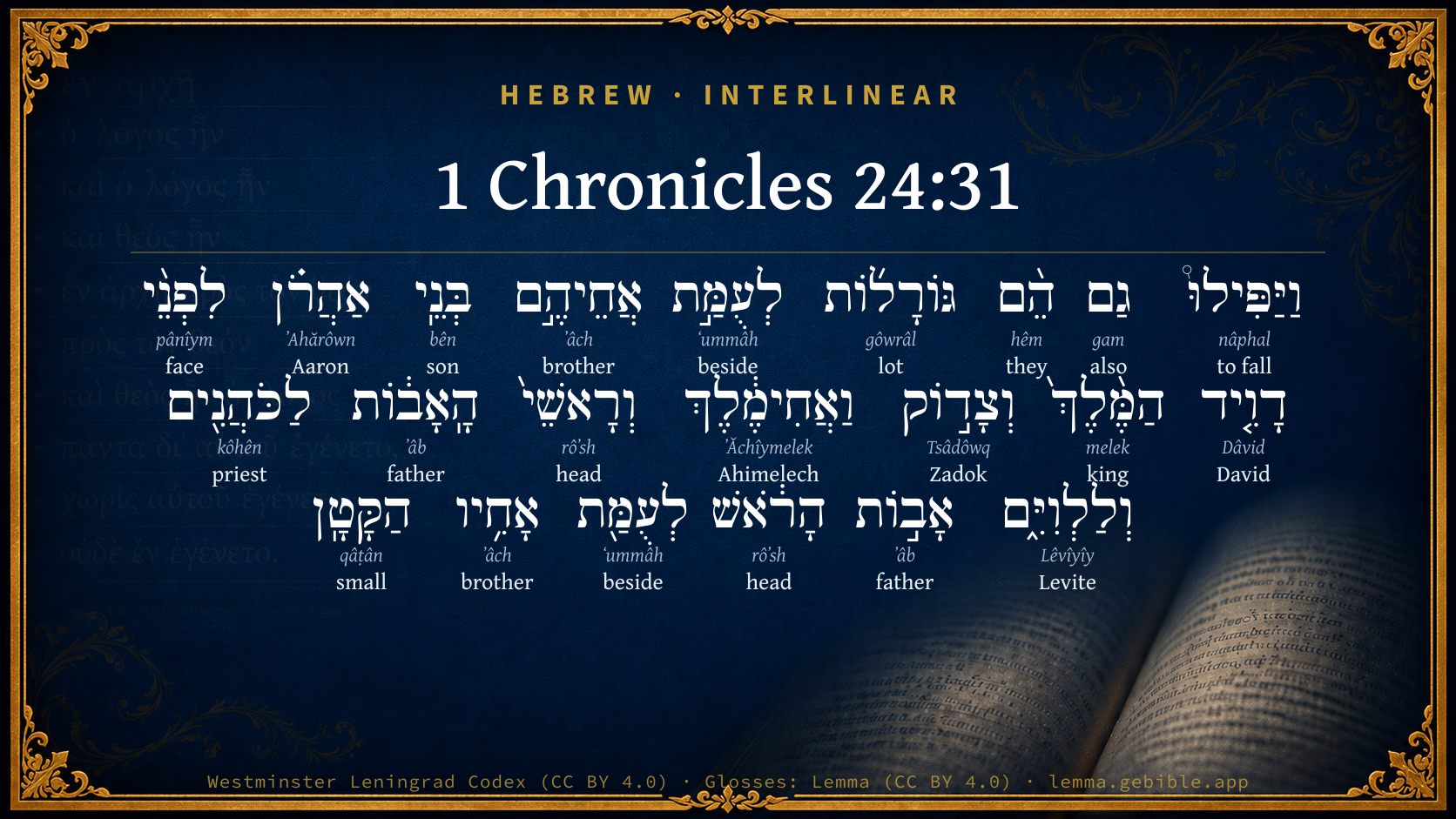
  1. וַיַּפִּילוּ֩ nâphal H5307 “and · to fall” Conjunction + Verb, Hiphil, Sequential Imperfect, 3rd Person, Masculine, Plural
  2. גַם gam H1571 “also” Adverb
  3. הֵ֨ם hêm H1992 “they” Pronoun, Personal, 3rd Person, Masculine, Plural
  4. גּוֹרָל֜וֹת gôwrâl H1486 “lots” Noun, Common, Masculine, Plural, Absolute
  5. לְעֻמַּ֣ת ʻummâh H5980 “to/for · beside of” Preposition + Noun, Common, Feminine, Singular, Construct
  6. אֲחֵיהֶ֣ם ʼâch H251 “brothers · their” Noun, Common, Masculine, Plural, Construct + Suffix, Personal, 3rd Person, Masculine, Plural
  7. בְּנֵֽי bên H1121 “sons of” Noun, Common, Masculine, Plural, Construct
  8. אַהֲרֹ֗ן ʼAhărôwn H175 “Aaron” Noun, Proper
  9. לִפְנֵ֨י pânîym H6440 “to/for · face(s) of” Preposition + Noun, Common, Both, Plural, Construct
  10. דָוִ֤יד Dâvid H1732 “David” Noun, Proper
  11. הַמֶּ֨לֶךְ֙ melek H4428 “the · king” Particle, Definite Article + Noun, Common, Masculine, Singular, Absolute
  12. וְצָד֣וֹק Tsâdôwq H6659 “and · Zadok” Conjunction + Noun, Proper
  13. וְרָאשֵׁי֙ rôʼsh H7218 “and · heads of” Conjunction + Noun, Common, Masculine, Plural, Construct
  14. הָֽאָב֔וֹת ʼâb H1 “the · fathers” Particle, Definite Article + Noun, Common, Masculine, Plural, Absolute
  15. לַכֹּהֲנִ֖ים kôhên H3548 “to/for the · priests” Preposition, Determined + Noun, Common, Masculine, Plural, Absolute
  16. וְלַלְוִיִּ֑ם Lêvîyîy H3881 “and · to/for the · Levites” Conjunction + Preposition, Determined + Noun, Gentilic, Masculine, Plural, Absolute
  17. אָב֣וֹת ʼâb H1 “fathers” Noun, Common, Masculine, Plural, Absolute
  18. הָרֹ֔אשׁ rôʼsh H7218 “the · head” Particle, Definite Article + Noun, Common, Masculine, Singular, Absolute
  19. לְעֻמַּ֖ת ʻummâh H5980 “to/for · beside of” Preposition + Noun, Common, Feminine, Singular, Construct
  20. אָחִ֥יו ʼâch H251 “brother · his” Noun, Common, Masculine, Singular, Construct + Suffix, Personal, 3rd Person, Masculine, Singular
  21. הַקָּטָֽן qâṭân H6996 “the · small” Particle, Definite Article + Adjective, Adjective, Masculine, Singular, Absolute

About this verse

These counts appear in no published source. They are computed here, from the morphology-tagged text and Lemma’s own curated glosses. What Lemma adds →

22
words
18
distinct lemmas
Historical
section

Notable vocabulary

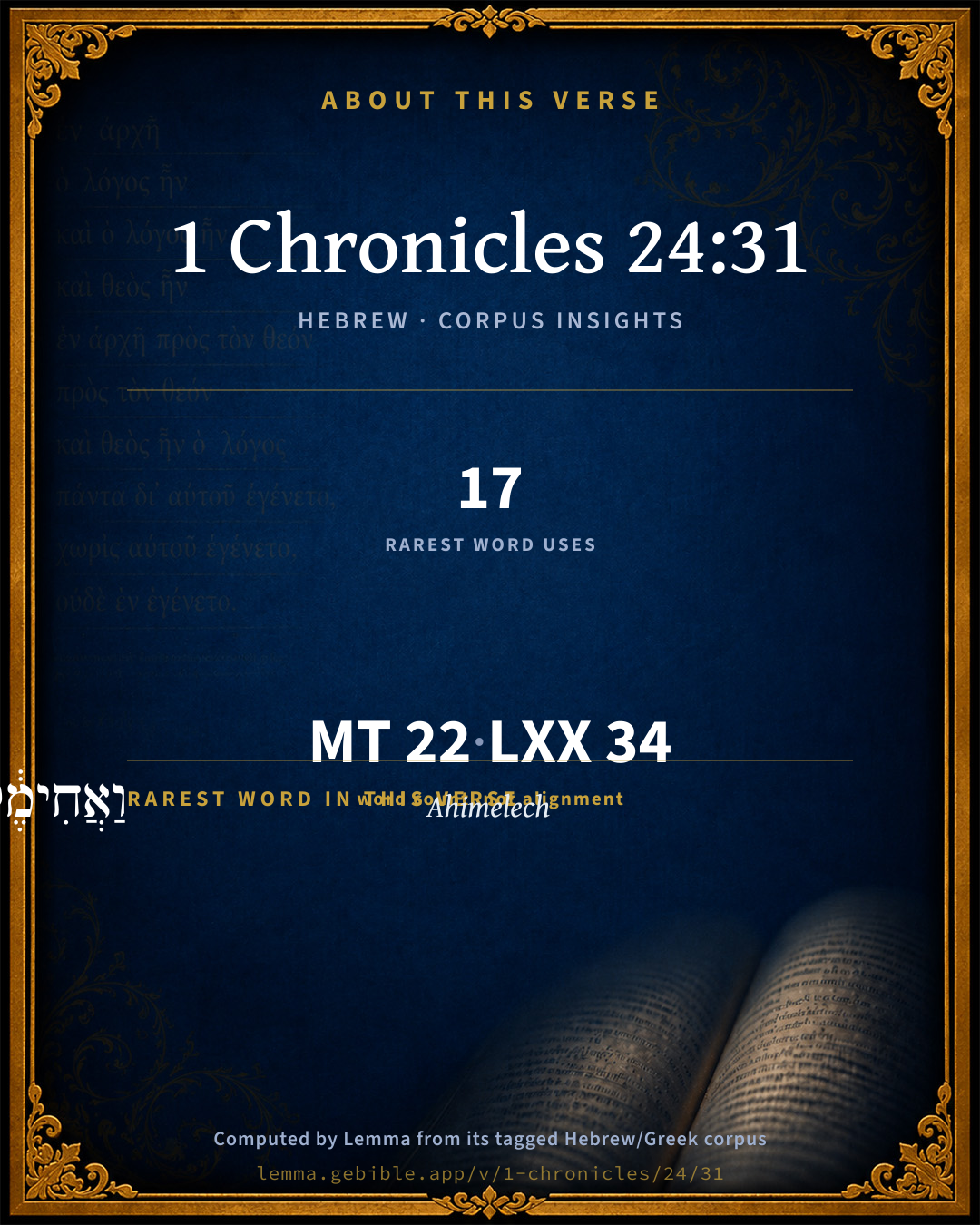
The rarest word here is וַאֲחִימֶ֔לֶךְ Ahimelech H288 — appearing just 17 times in the whole Hebrew Bible.

Shared distinctive vocabulary

וַאֲחִימֶ֔לֶךְ Ahimelech H288 occurs in 16 verses of the Hebrew Bible. Also found in:

Grammatical profile

  • 1 verb
  • 18 nouns
  • 1 adjective
  • 1 pronoun
  • 1 adverb

Verb forms

  • וַיַּפִּילוּ֩ Hiphil · Sequential Imperfect

Repetition

Words recur within this verse — often emphatic in Hebrew:

  • לְעֻמַּ֣ת beside H5980 ×2
  • אֲחֵיהֶ֣ם brother H251 ×2
  • וְרָאשֵׁי֙ head H7218 ×2
  • הָֽאָב֔וֹת father H1 ×2

Hebrew & Septuagint length

In English translation the verse runs 50 words from the Hebrew and 41 from the Septuagint (LXX English) — closely comparable.

A rough comparison of the two English renderings, which tokenize alike — not a word-level alignment.

Word counts can differ between the Hebrew and the Greek without any difference in meaning — e.g. the Hebrew direct-object marker אֵת has no separate Greek word, and Greek often adds the article ὁ.

In the original languages it is 22 Hebrew tokens and 34 Greek tokens — but the two are counted differently (Hebrew bundles its prefixes and suffixes into one token; the Greek is in lemma form), so that isn’t a like-for-like length.

Cross-references

4

Topical passages linked to 1 Chronicles 24:31 in the Treasury of Scripture Knowledge — connected by theme and wording, ordered by reader-vote popularity; previews shown in the World English Bible.

  • 1 Chronicles 24:5–6 Thus were they divided impartially by drawing lots; for there were princes of the sanctuary, and princes of God, both of the sons of Eleazar, and of the sons of Ithamar.
  • 1 Chronicles 25:8 They cast lots for their offices, all alike, as well the small as the great, the teacher as the scholar.
  • 1 Chronicles 26:13 They cast lots, the small as well as the great, according to their fathers' houses, for every gate.
  • Numbers 26:56 According to the lot shall their inheritance be divided between the more and the fewer.

Cross-references courtesy of OpenBible.info (CC BY 4.0).

Hebrew and Greek witnesses Masoretic Hebrew ↔ Greek Septuagint

The same verse in the two great witnesses to the Old Testament, shown verse-for-verse.

These are two independent witnesses, not word-aligned to each other, and the Septuagint is shown in lemma (dictionary) form.

Hebrew 1 Chronicles 24:31 Masoretic · Westminster Leningrad Codex

וַיַּפִּילוּ֩ גַם הֵ֨ם גּוֹרָל֜וֹת לְעֻמַּ֣ת אֲחֵיהֶ֣ם בְּנֵֽי אַהֲרֹ֗ן לִפְנֵ֨י דָוִ֤יד הַמֶּ֨לֶךְ֙ וְצָד֣וֹק וַאֲחִימֶ֔לֶךְ וְרָאשֵׁי֙ הָֽאָב֔וֹת לַכֹּהֲנִ֖ים וְלַלְוִיִּ֑ם אָב֣וֹת הָרֹ֔אשׁ לְעֻמַּ֖ת אָחִ֥יו הַקָּטָֽן

These likewise cast lots even as their brothers the sons of Aaron in the presence of David the king, and Zadok, and Ahimelech, and the heads of the fathers' [houses] of the priests and of the Levites; the fathers' [houses] of the chief even as those of his younger brother.

World English Bible · Public Domain

Greek LXX 1 Chronicles 24:31 Septuagint · lemma form

καί λαμβάνω καί αὐτός κλῆρος καθώς ὁ ἀδελφός αὐτός υἱός ἀαρών ἐναντίον ὁ βασιλεύς καί σαδωκ καί αχιμελεχ καί ἄρχων πατριά ὁ ἱερεύς καί ὁ λευίτης πατριάρχης αρααβ καθώς ὁ ἀδελφός αὐτός ὁ νέος

And they also received lots as their brethren the sons of Aaron before the king; Sadoc also, and Achimelech, and the chiefs of the families of the priests and of the Levites, principal heads of families, even as their younger brethren.

LXX2012 (modern English Septuagint) · Public Domain

Hebrew: Westminster Leningrad Codex (CC BY 4.0). Greek: Septuagint (public domain); English from LXX2012 (modern English Septuagint) (Public Domain). How the Septuagint differs from the Hebrew →

Commentary

Notes on 1 Chronicles 24:31 from classic Christian and Jewish commentators (each source and its license shown beneath its notes). The classic Christian expositions comment on the surrounding passage and are grouped to its opening verse, so a note may address several verses; the Jewish commentaries on the Tanakh (Rashi and others) are per-verse, so they appear only where the commentator wrote on this verse.

Lemma curates 59 commentaries, every one of them public domain or Creative Commons licensed, each selected and text-cleaned for this edition rather than reprinted as found. About our sources →

Joseph Benson's Commentary

1Ch 24:31. These likewise cast lots — There was the like solemnity used in their distribution as there was in that of the priests, by casting lots; whereby they knew what Levites should wait in every course with the sons of Aaron. Even the principal fathers over against their younger brethren — These words are somewhat obscure, but the meaning, says Bishop Patrick, is, that both elder and younger had their places by lot, not by seniority of houses: they who were of greater dignity drew lots against those who were of less: and they were to take their courses as they fell either to the elder or the younger family.

Joseph Benson's Commentary on the Old and New Testaments (1811–1818) — public domain. Text from a community e-Sword module.

Tyndale Open Study Notes

Tyndale Open Resources

24:31 The Levites were organized according to the same principles as the priests (24:5-6).

Tyndale Open Study Notes — © Tyndale Open Resources, licensed CC BY-SA 4.0. Text via the HelloAO Bible API.

Geneva Bible (1599)

Geneva Bible translators

That is, every one had that dignity, which fell unto him by lot.

Geneva Bible (1599) marginal notes — public domain. Text via Bolls.life.

Adam Clarke's Commentary

Verse 31. These likewise cast lots] The Levites were divided into twenty-four orders; and these were appointed by lot to serve under the twenty-four orders of the priests: the first order of Levities under the first order of priests, and so on. The meaning is not very clear: "both elder and younger," says Bishop Patrick, "had their places by lot, not by seniority of houses. They who were of greater dignity drew lots against those who were of less; and were to take their courses according to the lot they drew." This may have been the case; but we are very little interested in the subject.

Adam Clarke's Commentary on the Bible (1810–1826) — public domain. Text from a community e-Sword/MySword module.

Ellicott's Commentary for English Readers

(31) These likewise cast lots over against their brethren the sons of Aaron.—Rather, Just like, in the same way as their brethren, the priests. The same compound preposition (le‘ummath) recurs in 1Ch_26:12; 1Ch_26:16. In 2Sa_16:13 it has the sense of over against, or parallel with. The lots were cast, as in the case of the priests, to determine the order according to which the classes were to serve in rotation.

Their brethren the sons of Aaron.—This expression seems to indicate that the preceding list does not include all the Levites, but only those who assisted the priests in the Temple services: that is, the 24,000 of 1Ch_23:4. The chronicler naturally returned to them after his account of the priestly classes. Hence, perhaps, the omission of the Gershonite houses is intentional. The narrative proceeds to treat of the Levites who were not in immediate attendance on the priesthood in 1 Chronicles 25, 26

The chief of the fathers.—Rather, the chiefs of the clans.

Even the principal fathers over against their younger brethren.—Rather, clans—the chief just like his younger brother. The word “fathers” (âbôth) is a brief form of “father-houses” (bêth- âbôth). The meaning appears to be that all the Levitical houses received their position by lot, senior and junior branches alike. The order, as thus determined, is not communicated; nor is it expressly stated that the Levitical classes were twenty-four in number, but it appears highly probable, both from the data of the text, and from the analogy of the classes of the priests and the musicians (1 Chronicles 25).

A Bible Commentary for English Readers, edited by Charles John Ellicott (1878–1897) — public domain. Text from a community e-Sword module.

The Cambridge Bible for Schools and Colleges

gen. ed. J. J. S. Perowne

31. over against their brethren] R.V. even as their brethren.

and Ahimelech] We expect and Abiathar; cp. 1Ch_24:3; 1Ch_15:11; 1Ch_18:16; with the notes.

the chief of the fathers] R.V. the heads of the fathers’ houses.

even the principal … brethren] R.V. the fathers’ houses of the chief even as those of his younger brother.

The Cambridge Bible for Schools and Colleges (gen. ed. J. J. S. Perowne; Cambridge University Press, 1878–1918) — public domain. Text from a community e-Sword module.

John Gill's Exposition

These likewise cast lots over against their brethren, the sons of Aaron,.... These, being divided into twenty four classes also, cast lots, which class should answer to, attend upon, and serve the first course of the priests, and which the second, and so on. And this they did in the same solemn and public manner as the priests had done:

in the presence of David the king, and Zadok, and Ahimelech, and the chief of the fathers of the priests and Levites; as in Ch1 24:6.

even the principal fathers over against their younger brethren; the sense is, either that the one stood over against the other, to be distributed by lot, the one as well as the other; or they were chosen by lot, let it fall as it would, without any regard to age or dignity, to the seniority or largeness of houses and families; but as they were chosen, be they younger or elder, richer or poorer, their families more or less numerous and ancient, so they took their places.

Next: 1 Chronicles Chapter 25

John Gill's Exposition of the Whole Bible (1746–1763) — public domain (CC PDM 1.0). Text via the HelloAO Bible API.

Albert Barnes' Notes on the Bible

The principal fathers over against their younger brethren - i. e., “all the Levitical houses enumerated drew lots in their courses on equal terms, the older families having no advantage over the younger ones.” As there were 24 courses of the priests, so we must suppose that there were 24 of the Levites, though the number of the families as given in the text 1 Chr. 23:7-23; 1Ch 24:20-30 is 25.

Albert Barnes' Notes on the Bible (1834–1885) — public domain. Text from a community e-Sword/MySword module.

Haydock's Catholic Bible Commentary

Over-against, in imitation of the priests, (Calmet) being likewise divided into twenty-four classes. (Tirinus) --- Both, &c. Hebrew, "the principal fathers over-against their younger brethren." All the rest is omitted. Lots decided the place and functions both of father and children. (Haydock)

George Leo Haydock (1774–1849), Haydock's Catholic Family Bible and Commentary, 1859 edition — public domain. Excludes Psalms (Douay-Rheims chapter numbering differs from Protestant) and Deuterocanonical books (Catholic canon only).

Matthew Poole's English Annotations

Over against their brethren the sons of Aaron, i.e. answerable for number and order to those of the priests, so as there should be a several course of the Levites for each course of the priests. This is expressed concerning the singers, 1Ch 25, and the like is implied concerning the porters, 1Ch 26, and is here sufficiently intimated concerning those Levites which were employed in other sacred ministrations.

The principal fathers over against their younger brethren; the lots of the elder and younger brethren were promiscuously put together, and the order was settled as the lots came forth, without any regard to the age, or dignity, or number of the persons or families, the youngest family having thee first course if they had the first lot, &c.

Matthew Poole's English Annotations on the Holy Bible (1683–1685) — public domain. Text from a community e-Sword/MySword module.

Whedon's Commentary on the Bible

Daniel D. Whedon

31. The principal fathers over against their younger brethren — These courses were decided by lot, so that in the present classification the older houses had no advantage over the younger. Hence the differences between this list and that of chapter 23.

Daniel D. Whedon (gen. ed.), Commentary on the Old and New Testaments (1874–1909) — public domain. Text from a community e-Sword module.

The Pulpit Commentary

Over against over against. This translation of the Hebrew (tMl) is obscure and awkward. The meaning is "equally with," or "correspondingly with". (1Ch_26:12, 1Ch_26:16, etc.) The root means "communion," and the word is found only in the constructive state. The Vulgate shows the translation, Omnes sors aequaliter dividebat; tam majores quam minores.

The Pulpit Commentary (1880–1919), ed. H.D.M. Spence-Jones & Joseph S. Exell — public domain. Text from a community e-Sword module.

John Wesley's Explanatory Notes

Over against - Answerable for number and order to those of the priests, so that there should be a course of the Levites for each course of the priests.

John Wesley, Explanatory Notes Upon the Whole Bible (1754–1765) — public domain. Text via the GEBible commentary corpus.

Keil & Delitzsch

C. F. Keil & F. Delitzsch

These likewise cast lots over against their brethren, the sons of Aaron,.... These, being divided into twenty four classes also, cast lots, which class should answer to, attend upon, and serve the first course of the priests, and which the second, and so on. And this they did in the same solemn and public manner as the priests had done:

in the presence of David the king, and Zadok, and Ahimelech, and the chief of the fathers of the priests and Levites; as in Ch1 24:6.

even the principal fathers over against their younger brethren; the sense is, either that the one stood over against the other, to be distributed by lot, the one as well as the other; or they were chosen by lot, let it fall as it would, without any regard to age or dignity, to the seniority or largeness of houses and families; but as they were chosen, be they younger or elder, richer or poorer, their families more or less numerous and ancient, so they took their places.

Next: 1 Chronicles Chapter 25

Keil & Delitzsch — Biblical Commentary on the Old Testament (1861–1891) — public domain (CC PDM 1.0). Text via the HelloAO Bible API. (Old Testament only.)

Lesson kit

Teaching starters — assembled from the data on this page, not authored interpretation. Every prompt links to the verse data it draws on. Edit before teaching.

1 Chronicles, in the Historical, opens this verse with 22 words (18 distinct Hebrew lemmas). Its most distinctive word is ʼĂchîymelek (“Ahimelech”). A historical commentator’s framing appears above. Read the whole chapter for the surrounding context.

Discussion questions

  1. What does “Ahimelech” (ʼĂchîymelek) contribute to the verse as a whole?
  2. How does 1 Samuel 21:1, which shares the word «Ahimelech», read alongside this verse?
  3. What does the repetition of “beside” (2× in this one verse) do in this verse?
  4. The translations on this page render this verse differently — a whole-verse word diff, not a word-by-word alignment. What might account for the different wordings?
  5. «וַיַּפִּילוּ֩» is a Hiphil Sequential Imperfect verb. How does that grammatical form shape the action described?
  6. Compare how Joseph Benson's Commentary and Tyndale Open Study Notes read this verse. Where do they agree or differ?

Things to notice

Reading settings

Reading text

Shown beneath each verse's original-language words.

Old Testament
Old Testament edition

Read the OT as the Masoretic Hebrew (MT) or the Greek Septuagint (LXX).

English shown for the Greek Septuagint (in the Hebrew ↔ Greek comparison).

Comparing translations? Open the Compare panel on any verse page to stack up to four side by side.