
Exodus 19:21

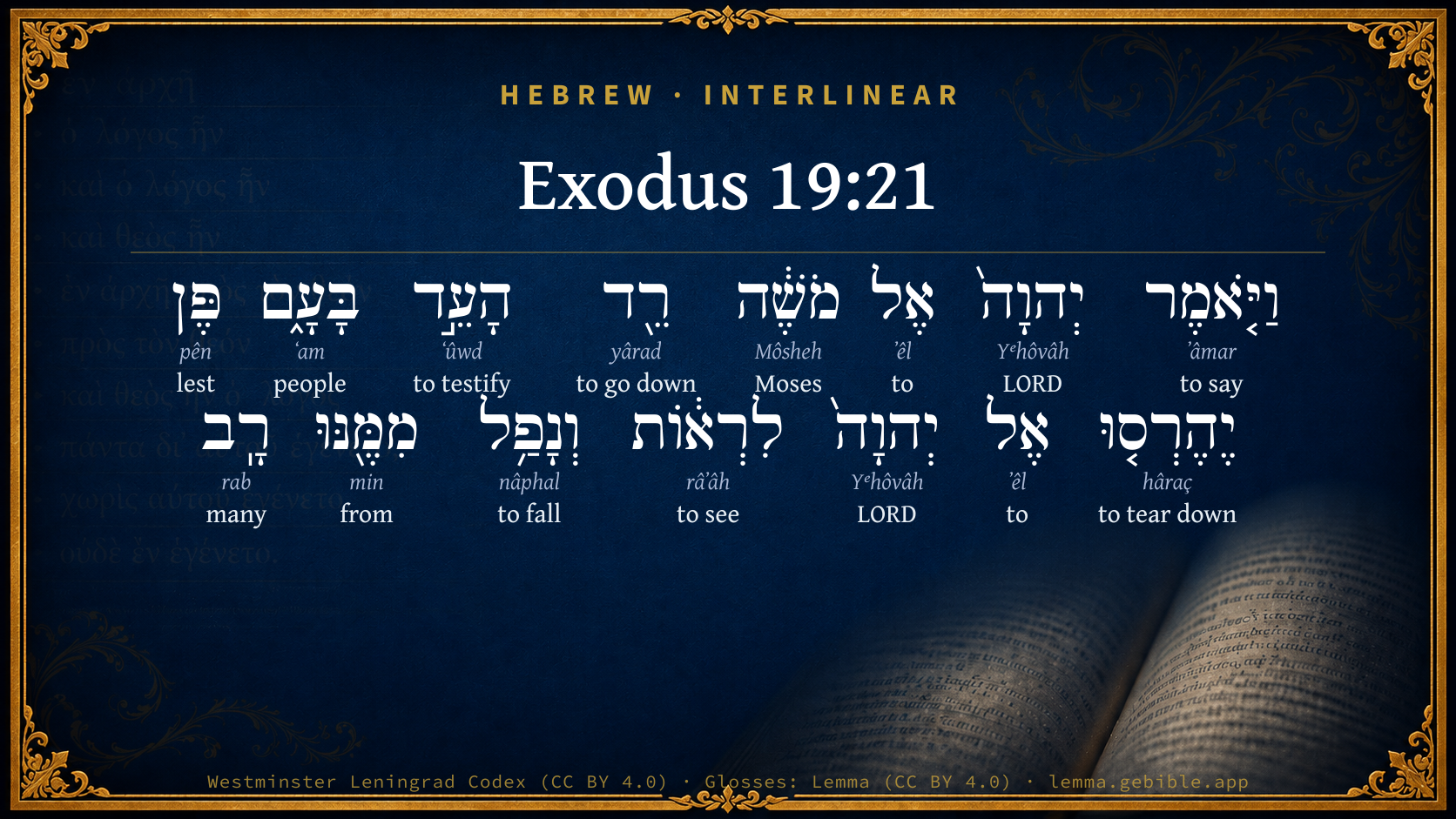
Hebrew (Westminster Leningrad Codex) Exodus 19:21 appears in the Hebrew Old Testament. The text above is from the Westminster Leningrad Codex. Each word links to its Strong’s number, a concise gloss, and parsing drawn from the Open Scriptures Hebrew Bible morphology. Click any word for its full Brown-Driver-Briggs (BDB) entry.
Download image
Cite this verse

Exodus 19:21 (World English Bible). Public Domain. Lemma interlinear Bible study tool, https://lemma.gebible.app/v/exodus/19/21.

Show BibTeX & RIS
BibTeX
RIS
English Translation
Yahweh said to Moses, "Go down, charge the people, lest they break through to Yahweh to gaze, and many of them perish.
World English Bible · Public Domain
Download a study sheet

One document with this verse’s original text, its word-by-word gloss line, the meaning frame, cross-references with their text, attributed commentary, and full source and license credits — printable, and it pastes into notes with its structure intact.

This verse Autodidact and up

Study sheet (.html) Plain text (.txt)

A passage Seminary Student

Up to 50 verses in one chapter. A passage sheet keeps up to 6 commentary sources and 12 cross-references per verse, in the order this page ranks them, and says so on the sheet whenever that leaves anything out. Ask for a single verse and you get the Autodidact verse sheet above.

Everything on this page stays free to read, with no account — the sheet is a download of what is already on screen, not access to it.

Want to remove ads? Support Godless Engineer
Compare translations 3

The same verse in 3 English versions, stacked beneath the original-language interlinear above. Click any original word for its lexicon entry.

Each is an independent rendering of the whole verse — the interlinear is not word-aligned to these translations.

Highlighted words mark where these versions differ — a whole-verse word diff, not a word-by-word alignment.

  • World English Bible Public Domain
    Yahweh said to Moses, "Go down, charge the people, lest they break through to Yahweh to gaze, and many of them perish.
  • King James Version Public Domain
    And the LORD said unto Moses, Go down, charge the people, lest they break through unto the LORD to gaze, and many of them perish.
  • unfoldingWord Literal Text CC BY-SA 4.0
    And Yahweh said to Moses, “Go down and warn the people lest they break through to Yahweh to see and many from them fall.

unfoldingWord Literal Text — © unfoldingWord, licensed CC BY-SA 4.0. Word-aligned USFM3 via Door43 (git.door43.org/unfoldingWord/en_ult).

Versions to compare (up to 4)

3 of 4 selected

Show all 18 translations

Every available English version of this verse, each an independent rendering of the whole verse.

  • World English Bible Public Domain
    Yahweh said to Moses, "Go down, charge the people, lest they break through to Yahweh to gaze, and many of them perish.
  • Berean Standard Bible Public Domain
    and the LORD said to him, “Go down and warn the people not to break through to see the LORD, lest many of them perish.
  • Majority Standard Bible Public Domain
    and the LORD said to him, “Go down and warn the people not to break through to see the LORD, lest many of them perish.
  • King James Version Public Domain
    And the LORD said unto Moses, Go down, charge the people, lest they break through unto the LORD to gaze, and many of them perish.
  • American Standard Version (1901) Public Domain
    And Jehovah said unto Moses, Go down, charge the people, lest they break through unto Jehovah to gaze, and many of them perish.
  • Revised Version (1885) Public Domain
    And the LORD said unto Moses, Go down, charge the people, lest they break through unto the LORD to gaze, and many of them perish.
  • Geneva Bible (1599) Public Domain
    Then the Lord said vnto Moses, Go down, charge the people, that they breake not their boundes, to go vp to the Lord to gaze, least many of them perish.
  • Douay-Rheims (1899) Public Domain
    He said unto him: Go down, and charge the people: lest they should have a mind to pass the limits to see the Lord, and a very great multitude of them should perish.
  • Young's Literal Translation Public Domain
    And Jehovah saith unto Moses, `Go down, protest to the people, lest they break through unto Jehovah to see, and many of them have fallen;
  • Literal Standard Version CC BY-SA 4.0
    And YHWH says to Moses, “Go down, protest to the people, lest they break through to YHWH to see, and many of them have fallen;
  • Unlocked Literal Bible CC BY-SA 4.0
    Yahweh said to Moses, “Go down and warn the people not to break through to me to look, or many of them will perish.
  • unfoldingWord Literal Text CC BY-SA 4.0
    And Yahweh said to Moses, “Go down and warn the people lest they break through to Yahweh to see and many from them fall.
  • Darby Bible Public Domain
    And Jehovah said to Moses, Go down, testify to the people that they break not through to Jehovah to gaze, and many of them perish.
  • World Messianic Bible Public Domain
    The LORD said to Moses, “Go down, warn the people, lest they break through to the LORD to gaze, and many of them perish.
  • Webster's Bible Public Domain
    And the LORD said to Moses, Go down, charge the people, lest they break through to the LORD to gaze, and many of them perish.
  • Free Bible Version CC BY-SA 4.0
    and the Lord told him, “Go back down, and warn the people not to force their way across the boundary to try to come to the Lord or they will die.
  • Bible in Basic English Public Domain
    And the Lord said to Moses, Go down and give the people orders to keep back, for fear that a great number of them, forcing their way through to see the Lord, may come to destruction.
  • JPS Tanakh (1917) Public Domain
    And the LORD said unto Moses: 'Go down, charge the people, lest they break through unto the LORD to gaze, and many of them perish.

Literal Standard Version (2020), Covenant Press — licensed CC BY-SA 4.0. Text via the HelloAO Bible API (eBible.org). Unlocked Literal Bible (unfoldingWord) — licensed CC BY-SA 4.0. Text via the HelloAO Bible API (eBible.org). unfoldingWord Literal Text — © unfoldingWord, licensed CC BY-SA 4.0. Word-aligned USFM3 via Door43 (git.door43.org/unfoldingWord/en_ult). Free Bible Version, Dr. Jonathan Gallagher — licensed CC BY-SA 4.0. Text via the HelloAO Bible API (eBible.org).

Word by word

More ways to search: Search by grammar → Find every occurrence → Compare this word →

Practice this passage: Drill this verse → Learn its vocabulary →

יֶהֶרְס֤וּ
hâraç
H2040
“to tear down”
Verb, Qal, Imperfect, 3rd Person, Masculine, Plural
Part of Speech
Verb
Stem
Qal
Form
Imperfect
Person
3rd Person
Gender
Masculine
Number
Plural
Full BDB Definition

Origin: a primitive root

TWOT: 516

to tear down, break down, overthrow, beat down, break, break through, destroy, pluck down, pull down, throw down, ruined, destroyer, utterly - (Qal) - to throw down, tear down - to break through - to break down, break away - (Niphal) to be torn down, be thrown down - (Piel) - to overthrow, tear down - destroyer (participle)
  1. וַיֹּ֤אמֶר ʼâmar H559 “and · to say” Conjunction + Verb, Qal, Sequential Imperfect, 3rd Person, Masculine, Singular
  2. יְהוָה֙ Yᵉhôvâh H3068 “LORD” Noun, Proper
  3. אֶל ʼêl H413 “to” Preposition
  4. מֹשֶׁ֔ה Môsheh H4872 “Moses” Noun, Proper
  5. רֵ֖ד yârad H3381 “go down” Verb, Qal, Imperative, 2nd Person, Masculine, Singular
  6. הָעֵ֣ד ʻûwd H5749 “testify” Verb, Hiphil, Imperative, 2nd Person, Masculine, Singular
  7. בָּעָ֑ם ʻam H5971 “in/at the · people” Preposition, Determined + Noun, Common, Masculine, Singular, Absolute
  8. פֶּן pên H6435 “lest” Conjunction
  9. אֶל ʼêl H413 “to” Preposition
  10. יְהוָה֙ Yᵉhôvâh H3068 “LORD” Noun, Proper
  11. לִרְא֔וֹת râʼâh H7200 “to see” Preposition + Verb, Qal, Infinitive Construct
  12. וְנָפַ֥ל nâphal H5307 “and · to fall” Conjunction + Verb, Qal, Sequential Perfect, 3rd Person, Masculine, Singular
  13. מִמֶּ֖נּוּ min H4480 “from · us” Preposition + Suffix, Personal, 1st Person, Common, Plural
  14. רָֽב rab H7227 “many” Adjective, Adjective, Masculine, Singular, Absolute

About this verse

These counts appear in no published source. They are computed here, from the morphology-tagged text and Lemma’s own curated glosses. What Lemma adds →

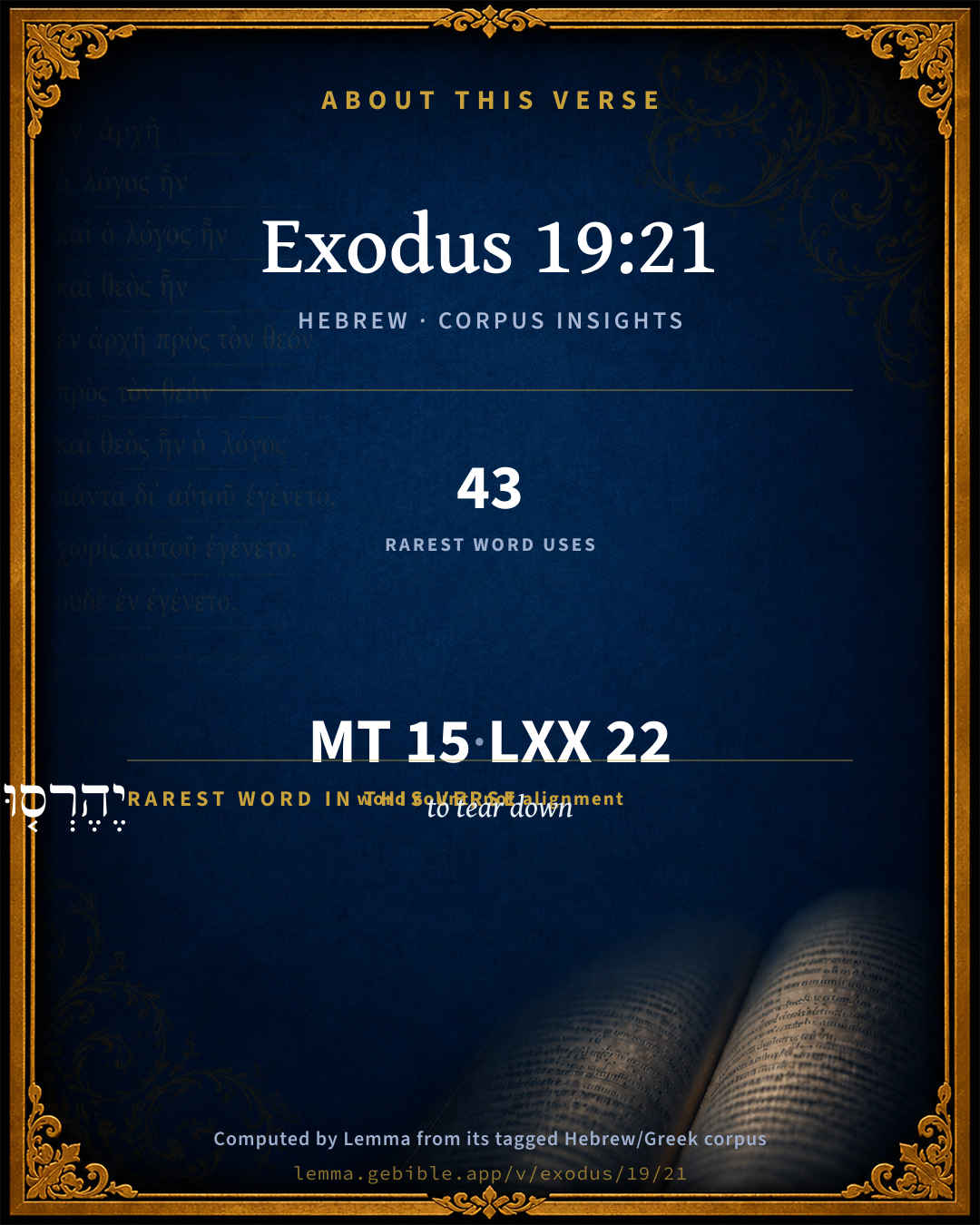
15
words
13
distinct lemmas
Pentateuch
section

Shared distinctive vocabulary

יֶהֶרְס֤וּ to tear down H2040 occurs in 42 verses of the Hebrew Bible. Also found in:

Grammatical profile

  • 6 verbs
  • 4 nouns
  • 1 adjective
  • 3 prepositions
  • 1 conjunction

Verb forms

  • וַיֹּ֤אמֶר Qal · Sequential Imperfect
  • רֵ֖ד Qal · Imperative
  • הָעֵ֣ד Hiphil · Imperative
  • יֶהֶרְס֤וּ Qal · Imperfect
  • לִרְא֔וֹת Qal · Infinitive Construct
  • וְנָפַ֥ל Qal · Sequential Perfect

Repetition

Words recur within this verse — often emphatic in Hebrew:

  • יְהוָה֙ LORD H3068 ×2
  • אֶל to H413 ×2

Hebrew & Septuagint length

In English translation the verse runs 22 words from the Hebrew and 30 from the Septuagint (LXX English) — closely comparable.

A rough comparison of the two English renderings, which tokenize alike — not a word-level alignment.

Word counts can differ between the Hebrew and the Greek without any difference in meaning — e.g. the Hebrew direct-object marker אֵת has no separate Greek word, and Greek often adds the article ὁ.

In the original languages it is 15 Hebrew tokens and 22 Greek tokens — but the two are counted differently (Hebrew bundles its prefixes and suffixes into one token; the Greek is in lemma form), so that isn’t a like-for-like length.

Cross-references

7

Topical passages linked to Exodus 19:21 in the Treasury of Scripture Knowledge — connected by theme and wording, ordered by reader-vote popularity; previews shown in the World English Bible.

  • 1 Samuel 6:19 He struck of the men of Beth-shemesh, because they had looked into the ark of Yahweh, he struck of the people fifty thousand seventy men; and the people mourned, because Yahweh had struck the people with a great slaughter.
  • Exodus 3:5 He said, "Don't come close. Take off your sandals from off your feet, for the place you are standing on is holy ground."
  • Hebrews 12:28–29 Therefore, receiving a Kingdom that can't be shaken, let us have grace, through which we serve God acceptably, with reverence and awe,
  • Exodus 3:3 Moses said, I will turn aside now, and see this great sight, why the bush is not burnt.
  • Exodus 19:12–13 You shall set bounds to the people round about, saying, 'Be careful that you don't go up onto the mountain, or touch its border. Whoever touches the mountain shall be surely put to death.
  • Exodus 33:20 He said, "You cannot see my face, for man may not see me and live."
  • Ecclesiastes 5:1 Guard your steps when you go to God's house; for to draw near to listen is better than to give the sacrifice of fools, for they don't know that they do evil.

Cross-references courtesy of OpenBible.info (CC BY 4.0).

Hebrew and Greek witnesses Masoretic Hebrew ↔ Greek Septuagint

The same verse in the two great witnesses to the Old Testament, shown verse-for-verse.

These are two independent witnesses, not word-aligned to each other, and the Septuagint is shown in lemma (dictionary) form.

Hebrew Exodus 19:21 Masoretic · Westminster Leningrad Codex

וַיֹּ֤אמֶר יְהוָה֙ אֶל מֹשֶׁ֔ה רֵ֖ד הָעֵ֣ד בָּעָ֑ם פֶּן יֶהֶרְס֤וּ אֶל יְהוָה֙ לִרְא֔וֹת וְנָפַ֥ל מִמֶּ֖נּוּ רָֽב

Yahweh said to Moses, "Go down, charge the people, lest they break through to Yahweh to gaze, and many of them perish.

World English Bible · Public Domain

Greek LXX Exodus 19:21 Septuagint · lemma form

καί εἶπον ὁ θεός πρός μωυσῆς λέγω καταβαίνω διαμαρτύρομαι ὁ λαός μήποτε ἐγγίζω πρός ὁ θεός κατανοέω καί πίπτω ἐκ αὐτός πλῆθος

And God spoke to Moses, saying, Go down, and solemnly charge the people, lest at any time they draw near to God to gaze, and a multitude of them fall.

LXX2012 (modern English Septuagint) · Public Domain

Hebrew: Westminster Leningrad Codex (CC BY 4.0). Greek: Septuagint (public domain); English from LXX2012 (modern English Septuagint) (Public Domain). How the Septuagint differs from the Hebrew →

Targum (Aramaic paraphrase)

2

The Targum is the ancient Jewish Aramaic paraphrase of the Hebrew Scriptures — an interpretive translation, not the Hebrew text itself. Onkelos (literal) and Pseudo-Jonathan (expansive) render the Torah, and Jonathan the Prophets. Coverage is partial: where no permissively-licensed English translation exists for a verse, only the Aramaic is shown. This is verse-level text, not a word-by-word alignment to the Hebrew.

  1. Targum Onkelos Torah (Genesis–Deuteronomy)
    וַאֲמַר יְיָ לְמשֶׁה חוּת אַסְהֵיד בְּעַמָא דִילְמָא יְפַגְרוּן קֳדָם יְיָ לְמֶחֱזֵי וְיִפֵּל מִנְהוֹן סַגִי:

    (no public-domain English translation for this verse)

    Targum Onkelos — Aramaic: “Onkelos Genesis” (public domain); “Onkelos Exodus” (public domain); “Onkelos Leviticus” (public domain); “Onkelos Numbers” (public domain); “Onkelos Deuteronomy” (public domain). English: “Sefaria Community Translation” (CC0 1.0 (public-domain dedication)); “J.W. Etheridge. The Targums of Onkelos and Jonathan Ben Uzziel on the Pentateuch. London: Longmans, Green, 1862” (public domain). Text via Sefaria.

  2. Targum Pseudo-Jonathan Torah (Genesis–Deuteronomy)
    וַאֲמַר יְיָ לְמשֶׁה חוּת אַסְהִיד בְּעַמָּא דִּלְמָא יְכַוְּונוּן קֳדָם יְיָ לְאִסְתַּכְּלָא וְיַפִּיל מִנְהוֹן רַב דִּבְהוֹן

    And the Lord said to Mosheh, Descend, and warn the people, lest they come directly before the Lord to gaze, and many of them fall.

    Targum Pseudo-Jonathan — Aramaic: “Targum Jonathan on Genesis” (public domain); “Targum Jonathan on Exodus” (public domain); “Targum Jonathan on Leviticus” (public domain); “Targum Jonathan on Numbers” (public domain); “Targum Jonathan on Deuteronomy” (public domain). English: “The Targum of Jonathan ben Uzziel, trans. J. W. Etheridge, London, 1862” (public domain). Text via Sefaria.

Commentary

Notes on Exodus 19:21 from classic Christian and Jewish commentators (each source and its license shown beneath its notes). The classic Christian expositions comment on the surrounding passage and are grouped to its opening verse, so a note may address several verses; the Jewish commentaries on the Tanakh (Rashi and others) are per-verse, so they appear only where the commentator wrote on this verse.

Lemma curates 59 commentaries, every one of them public domain or Creative Commons licensed, each selected and text-cleaned for this edition rather than reprinted as found. About our sources →

Ellicott's Commentary for English Readers

(21) Lest they break through—i.e., force their way through the barrier which Moses had erected.

To gaze, and many of them perish.—Some might have perished by the execution of the orders given in Exo_19:13. But the allusion is perhaps rather to such a heaven-sent plague as destroyed the men of Beth-shemesh to the number of 50,070 (1Sa_6:19).

GOD’S WARNING TO THE PEOPLE AGAINST A TOO NEAR APPROACH.

(21-25) Warning was given, as soon as God announced His intention of descending upon Sinai, that the people must not approach too near. “Bounds” were set, and the people required to keep within them. Actual contact with the mountain was forbidden under penalty of death (Exo_19:12). It is evident from Exo_19:23 that the command to “set bounds” had been obeyed, and a fence erected which it would have required some force to “break through;” nor can there be any doubt that Moses had promulgated the directions, which he had received from God, forbidding any approach to the mount, and threatening death to those who should “touch” it. Yet still it is evident from this concluding paragraph of the chapter (Exo_19:21-25) that the first warning was insufficient. An intention to “break through, to gaze,” must have been entertained by many. To this intention the existing priesthood, whatever it was, were parties (Exo_19:22). It always grates upon men’s feelings to be told that they are less holy than others; and we can easily understand that those who had hitherto acted as priests to the nation would resent their exclusion from “holy ground” to which the sons of Amram were about to be admitted. Even of the people there may have been many who participated in the feeling, and thought that Moses and Aaron were “taking too much upon them, seeing that the whole congregation” was holy. Hence, a further very stringent command was requisite, and Moses, having reached the summit, was sent down again from the top to the bottom in order to enjoin upon priests and people alike, in the most solemn possible way, the necessity of their observing the bounds set.

A Bible Commentary for English Readers, edited by Charles John Ellicott (1878–1897) — public domain. Text from a community e-Sword module.

Trapp's Complete Commentary

John Trapp

Exo 19:21 And the LORD said unto Moses, Go down, charge the people, lest they break through unto the LORD to gaze, and many of them perish.

Ver. 21. And many of them perish.] As the men of Bethshemesh did for prying into the ark. {1Sa 6:19} Arcana Dei, sunt Arca Dei: God’s secrets are his ark. Eorum quae scire nec datur, nec fas est, docta est ignorantia; scientiae appetentia, insaniae species. {a} Not to know what is not fit to know, is a learned ignorance; to desire to know in that case is a kind of madness. He that curiously searcheth into God’s majesty, shall be oppressed of his glory.

{a} Calvin.

John Trapp, A Commentary or Exposition upon All the Books of the Old and New Testament (1647–1656) — public domain. Text from a community e-Sword module.

Whedon's Commentary on the Bible

Daniel D. Whedon

REPEATED CHARGE TO THE PEOPLE, Exo_19:21-25.

21. Go down, charge the people — We here observe how Israel had to be admonished and taught by repeated commands. Once charging them solemnly is not enough, though even Moses (Exo_19:23) thought that the charge already given, and the bounds set about the mount, were all-sufficient. Precept upon precept, line upon line, here a little and there a little, (Isa_28:10,) was God’s order in giving the knowledge of his laws, and this fact will account for the repetitions of sundry laws noticeable in the Pentateuch.

Daniel D. Whedon (gen. ed.), Commentary on the Old and New Testaments (1874–1909) — public domain. Text from a community e-Sword module.

Tyndale Open Study Notes

Tyndale Open Resources

19:21-25 The repeated warnings that no one should break through to approach the Lord reinforced the impact of the phenomena the people had just witnessed. God is utterly transcendent, and he must be approached in the way he ordains or not at all.

Tyndale Open Study Notes — © Tyndale Open Resources, licensed CC BY-SA 4.0. Text via the HelloAO Bible API.

Jamieson, Fausset & Brown

Robert Jamieson, A. R. Fausset & David Brown

the Lord said unto Moses, Go down, charge the people--No sooner had Moses proceeded a little up the mount, than he was suddenly ordered to return, in order to keep the people from breaking through to gaze--a course adopted to heighten the impressive solemnity of the scene. The strict injunctions renewed to all, whatever their condition, at a time and in circumstances when the whole multitude of Israel were standing at the base of the mount, was calculated in the highest degree to solemnize and awe every heart.

Next: Exodus Chapter 20

Jamieson, Fausset & Brown — Commentary Critical and Explanatory on the Whole Bible (1871) — public domain (CC PDM 1.0). Text via the HelloAO Bible API.

The Cambridge Bible for Schools and Colleges

gen. ed. J. J. S. Perowne

21. break through] viz. the barriers that had been erected (v. 12). Lit. pull or tear down (Jdg_6:25 al.). So v. 24.

perish] lit. fall, i.e. be struck down suddenly by the lightning.

The Cambridge Bible for Schools and Colleges (gen. ed. J. J. S. Perowne; Cambridge University Press, 1878–1918) — public domain. Text from a community e-Sword module.

John Gill's Exposition

And the Lord said unto Moses, go down,.... As soon as he was got to the top of the mount he was bid to go down again to the bottom, with a message to the people:

charge the people, lest they break through unto the Lord to gaze; to see if they could observe any similitude or likeness of God, that they might have an idea of it in their minds, or make an image like unto it; to prevent which, the Lord, knowing the vanity and curiosity of their minds, ordered Moses to give them a strict charge not to transgress the bounds set them, or to break down or break through the fence of stones and sand, or hedge of bushes, brambles, and branches of trees, or whatever was placed for bounds:

and many of them perish; or "fall" (z); by the hand of God; either fall by death, or into some grievous calamity, as the men of Bethshemesh perished through looking into the ark, Sa1 6:19.

(z) Sept. "et corruant", Pagninus, Tigurine version; "et cadat", Montanus; "cadant", Junius & Tremellius, Piscator, Drusius; so Ainsworth.

John Gill's Exposition of the Whole Bible (1746–1763) — public domain (CC PDM 1.0). Text via the HelloAO Bible API.

Matthew Poole's English Annotations

Through curiosity to know in what form or manner I appear to thee.

Matthew Poole's English Annotations on the Holy Bible (1683–1685) — public domain. Text from a community e-Sword/MySword module.

The Pulpit Commentary

Vers. 21-25. The further warning to the people and the priests. It is very remarkable that, after all the directions given (vers. 10-13), and all the pains taken by Moses and the Israelites themselves (vers. 14, 15, 23), God should still have thought it necessary to interpose with a fresh warning, and to send Moses back from the top of the mount to the bottom, in order to communicate the renewed warning to the people. We can only suppose that, in spite of the instructions previously given and the precautions taken, there were those among the people who were prepared to "break through" the fence, and invade the mount, and who would have done so, to their own destruction (ver. 21), but for this second warning. The special mention of the "priests" (vers. 22, 24) raises the suspicion, that this proud and rebellious spirit was particularly developed among them. Accustomed to the exercise of sacred functions, they may have been inclined to regard their own purity as equal to that of Moses and Aaron; and they may even have resented their exclusion from a sacred spot to which the two sons of Amram were admitted. Apparently, they had conceived that the injunction to go through the recognised ceremonies of purification (ver. 10) did not apply to them, and had neglected to do so, on which account a special command had.to be issued, addressed to them only (ver. 22).

Charge the people lest they break throughi.e. , "lest they force a passage through the barrier made by Moses" in accordance with the command given in ver. 12. And many of them perish. Irreverent gazing on holy things was forbidden by the law, (Num_4:20) and on one occasion (1Sa_6:19) was actually punished with death. It did not, however, require a law to make it an offence, natural reason being quite sufficient to teach the duty of reverence.

The Pulpit Commentary (1880–1919), ed. H.D.M. Spence-Jones & Joseph S. Exell — public domain. Text from a community e-Sword module.

Rashi

Rabbi Shlomo Yitzchaki (Rashi)

העד בעם signifies, WARN THEM not to ascend the mountain.

פן יהרסו lit., LEST THEY BREAK DOWN — warn them that they shall not break down their post because that their longing is אל ה׳ TO THE LORD לראות TO SEE Him and they therefore would approach nearer towards the mountain,

ונפל ממנו רב AND MANY OF THEM FALL — whatever of them it may be that falls, even though it be a single person only, will be regarded by Me as רב, many (cf. Mekhilta).

פן יהרסו — The term הרס, “breaking down”, always denotes the separation of the collection of parts that constitute the edifice. Similarly those who depart from the position which people have taken up break down that position.

Rashi on the Tanakh — English translations: “The Judaica Press complete Tanach with Rashi, translated by A. J. Rosenberg” (CC BY 4.0); “Pentateuch with Rashi's commentary by M. Rosenbaum and A.M. Silbermann, 1929-1934” (public domain); “The Metsudah Tanach series, Lakewood, N.J” (CC BY 4.0); and “The Book of Joshua, Metsudah Publications, 1997” (CC BY 4.0). Text via Sefaria.

Lesson kit

Teaching starters — assembled from the data on this page, not authored interpretation. Every prompt links to the verse data it draws on. Edit before teaching.

Exodus, in the Pentateuch, opens this verse with 15 words (13 distinct Hebrew lemmas). Its most distinctive word is hâraç (“to tear down”). A historical commentator’s framing appears above. Read the whole chapter for the surrounding context.

Discussion questions

  1. What does “to tear down” (hâraç) contribute to the verse as a whole?
  2. How does Exodus 15:7, which shares the word «to tear down», read alongside this verse?
  3. What does the repetition of “LORD” (2× in this one verse) do in this verse?
  4. The translations on this page render this verse differently — a whole-verse word diff, not a word-by-word alignment. What might account for the different wordings?
  5. «וַיֹּ֤אמֶר» is a Qal Sequential Imperfect verb. How does that grammatical form shape the action described?
  6. Compare how Ellicott's Commentary for English Readers and Trapp's Complete Commentary read this verse. Where do they agree or differ?

Things to notice

Reading settings

Reading text

Shown beneath each verse's original-language words.

Old Testament
Old Testament edition

Read the OT as the Masoretic Hebrew (MT) or the Greek Septuagint (LXX).

English shown for the Greek Septuagint (in the Hebrew ↔ Greek comparison).

Comparing translations? Open the Compare panel on any verse page to stack up to four side by side.