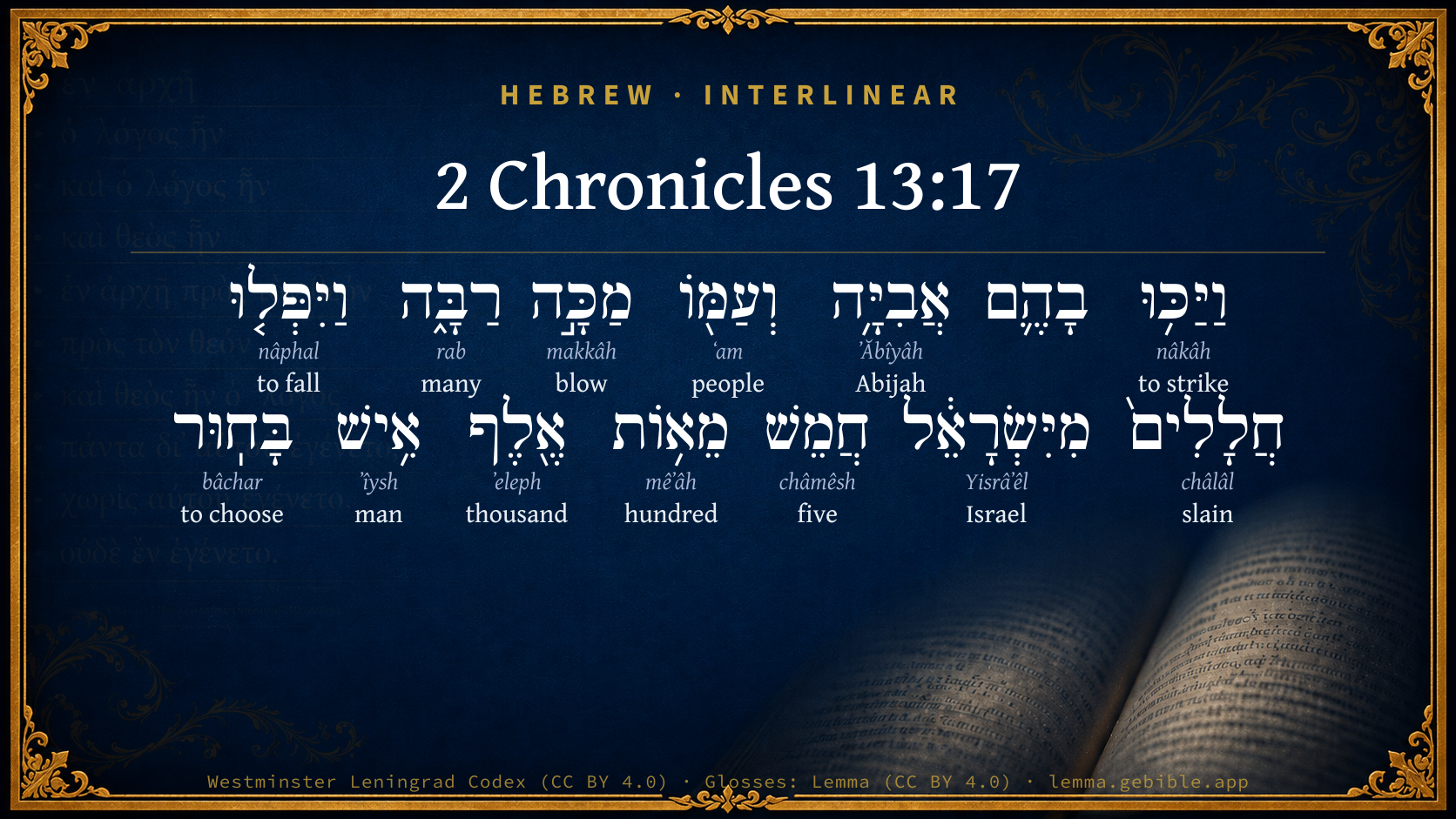
2 Chronicles 13:17

Hebrew (Westminster Leningrad Codex) 2 Chronicles 13:17 appears in the Hebrew Old Testament. The text above is from the Westminster Leningrad Codex. Each word links to its Strong’s number, a concise gloss, and parsing drawn from the Open Scriptures Hebrew Bible morphology. Click any word for its full Brown-Driver-Briggs (BDB) entry.
Download image
Cite this verse

2 Chronicles 13:17 (World English Bible). Public Domain. Lemma interlinear Bible study tool, https://lemma.gebible.app/v/2-chronicles/13/17.

Show BibTeX & RIS
BibTeX
RIS
English Translation
Abijah and his people killed them with a great slaughter: so there fell down slain of Israel five hundred thousand chosen men.
World English Bible · Public Domain
Download a study sheet

One document with this verse’s original text, its word-by-word gloss line, the meaning frame, cross-references with their text, attributed commentary, and full source and license credits — printable, and it pastes into notes with its structure intact.

This verse Autodidact and up

Study sheet (.html) Plain text (.txt)

A passage Seminary Student

Up to 50 verses in one chapter. A passage sheet keeps up to 6 commentary sources and 12 cross-references per verse, in the order this page ranks them, and says so on the sheet whenever that leaves anything out. Ask for a single verse and you get the Autodidact verse sheet above.

Everything on this page stays free to read, with no account — the sheet is a download of what is already on screen, not access to it.

Want to remove ads? Support Godless Engineer
Compare translations 3

The same verse in 3 English versions, stacked beneath the original-language interlinear above. Click any original word for its lexicon entry.

Each is an independent rendering of the whole verse — the interlinear is not word-aligned to these translations.

Highlighted words mark where these versions differ — a whole-verse word diff, not a word-by-word alignment.

  • World English Bible Public Domain
    Abijah and his people killed them with a great slaughter: so there fell down slain of Israel five hundred thousand chosen men.
  • King James Version Public Domain
    And Abijah and his people slew them with a great slaughter: so there fell down slain of Israel five hundred thousand chosen men.
  • unfoldingWord Literal Text CC BY-SA 4.0
    And Abijah and his people struck them a great striking, and they fell slain from Israel, 500,000 chosen men.

unfoldingWord Literal Text — © unfoldingWord, licensed CC BY-SA 4.0. Word-aligned USFM3 via Door43 (git.door43.org/unfoldingWord/en_ult).

Versions to compare (up to 4)

3 of 4 selected

Show all 18 translations

Every available English version of this verse, each an independent rendering of the whole verse.

  • World English Bible Public Domain
    Abijah and his people killed them with a great slaughter: so there fell down slain of Israel five hundred thousand chosen men.
  • Berean Standard Bible Public Domain
    Then Abijah and his people struck them with a mighty blow, and 500,000 chosen men of Israel fell slain.
  • Majority Standard Bible Public Domain
    Then Abijah and his people struck them with a mighty blow, and 500,000 chosen men of Israel fell slain.
  • King James Version Public Domain
    And Abijah and his people slew them with a great slaughter: so there fell down slain of Israel five hundred thousand chosen men.
  • American Standard Version (1901) Public Domain
    And Abijah and his people slew them with a great slaughter: so there fell down slain of Israel five hundred thousand chosen men.
  • Revised Version (1885) Public Domain
    And Abijah and his people slew them with a great slaughter: so there fell down slain of Israel five hundred thousand chosen men.
  • Geneva Bible (1599) Public Domain
    And Abiiah and his people slewe a great slaughter of them, so that there fel downe wounded of Israel fiue hundreth thousand chosen men.
  • Douay-Rheims (1899) Public Domain
    And Abia and his people slew them with a great slaughter, and there fell wounded of Israel five hundred thousand valiant men.
  • Young's Literal Translation Public Domain
    and Abijah and his people smite among them a great smiting, and there fall wounded of Israel five hundred thousand chosen men.
  • Literal Standard Version CC BY-SA 4.0
    and Abijah and his people strike among them a great striking, and five hundred thousand chosen men of Israel fall wounded.
  • Unlocked Literal Bible CC BY-SA 4.0
    Abijah and his army killed them with great slaughter; 500,000 chosen men of Israel fell dead.
  • unfoldingWord Literal Text CC BY-SA 4.0
    And Abijah and his people struck them a great striking, and they fell slain from Israel, 500,000 chosen men.
  • Darby Bible Public Domain
    And Abijah and his people slew them with a great slaughter; and there fell down slain of Israel five hundred thousand chosen men.
  • World Messianic Bible Public Domain
    Abijah and his people killed them with a great slaughter, so five hundred thousand chosen men of Israel fell down slain.
  • Webster's Bible Public Domain
    And Abijah and his people slew them with a great slaughter: so there fell down slain of Israel five hundred thousand chosen men.
  • Free Bible Version CC BY-SA 4.0
    Abijah and his men hit them hard, and 500,000 of Israel's best warriors were killed.
  • Bible in Basic English Public Domain
    And Abijah and his people put them to death with great destruction: five hundred thousand of the best of Israel were put to the sword.
  • JPS Tanakh (1917) Public Domain
    And Abijah and his people slew them with a great slaughter; so there fell down slain of Israel five hundred thousand chosen men.

Literal Standard Version (2020), Covenant Press — licensed CC BY-SA 4.0. Text via the HelloAO Bible API (eBible.org). Unlocked Literal Bible (unfoldingWord) — licensed CC BY-SA 4.0. Text via the HelloAO Bible API (eBible.org). unfoldingWord Literal Text — © unfoldingWord, licensed CC BY-SA 4.0. Word-aligned USFM3 via Door43 (git.door43.org/unfoldingWord/en_ult). Free Bible Version, Dr. Jonathan Gallagher — licensed CC BY-SA 4.0. Text via the HelloAO Bible API (eBible.org).

Word by word

More ways to search: Search by grammar → Find every occurrence → Compare this word →

Practice this passage: Drill this verse → Learn its vocabulary →

אֲבִיָּ֥ה
ʼĂbîyâh
H29
“Abijah”
Noun, Proper
Part of Speech
Noun
Type
Proper
Full BDB Definition

Origin: from H1 and H3050

TWOT: None

Abia or Abiah or Abijah = "Jehovah is (my) father" - king of Judah, son and successor of Rehoboam - second son of Samuel - son of Jeroboam the first, king of Israel - son of Becher, a Benjamite - head of a priestly house (one of the 24 Levite groups) - head of a priestly house (after the exile) - wife of Hezron - mother of Hezekiah (compare H21 )
  1. וַיַּכּ֥וּ nâkâh H5221 “and · to strike” Conjunction + Verb, Hiphil, Sequential Imperfect, 3rd Person, Masculine, Plural
  2. וְעַמּ֖וֹ ʻam H5971 “and · people · his” Conjunction + Noun, Common, Masculine, Singular, Construct + Suffix, Personal, 3rd Person, Masculine, Singular
  3. מַכָּ֣ה makkâh H4347 “blow” Noun, Common, Feminine, Singular, Absolute
  4. רַבָּ֑ה rab H7227 “many” Adjective, Adjective, Feminine, Singular, Absolute
  5. וַיִּפְּל֤וּ nâphal H5307 “and · to fall” Conjunction + Verb, Qal, Sequential Imperfect, 3rd Person, Masculine, Plural
  6. חֲלָלִים֙ châlâl H2491 “slain” Adjective, Adjective, Masculine, Plural, Absolute
  7. מִיִּשְׂרָאֵ֔ל Yisrâʼêl H3478 “from · Israel” Preposition + Noun, Proper
  8. חֲמֵשׁ châmêsh H2568 “five” Adjective, Cardinal number, Feminine, Singular, Absolute
  9. מֵא֥וֹת mêʼâh H3967 “hundred” Adjective, Cardinal number, Both, Plural, Absolute
  10. אֶ֖לֶף ʼeleph H505 “thousand” Adjective, Cardinal number, Both, Singular, Absolute
  11. אִ֥ישׁ ʼîysh H376 “man” Noun, Common, Masculine, Singular, Absolute
  12. בָּחֽוּר bâchar H977 “chosen” Verb, Qal, Participle Passive, Masculine, Singular, Absolute

About this verse

These counts appear in no published source. They are computed here, from the morphology-tagged text and Lemma’s own curated glosses. What Lemma adds →

14
words
13
distinct lemmas
Historical
section

Notable vocabulary

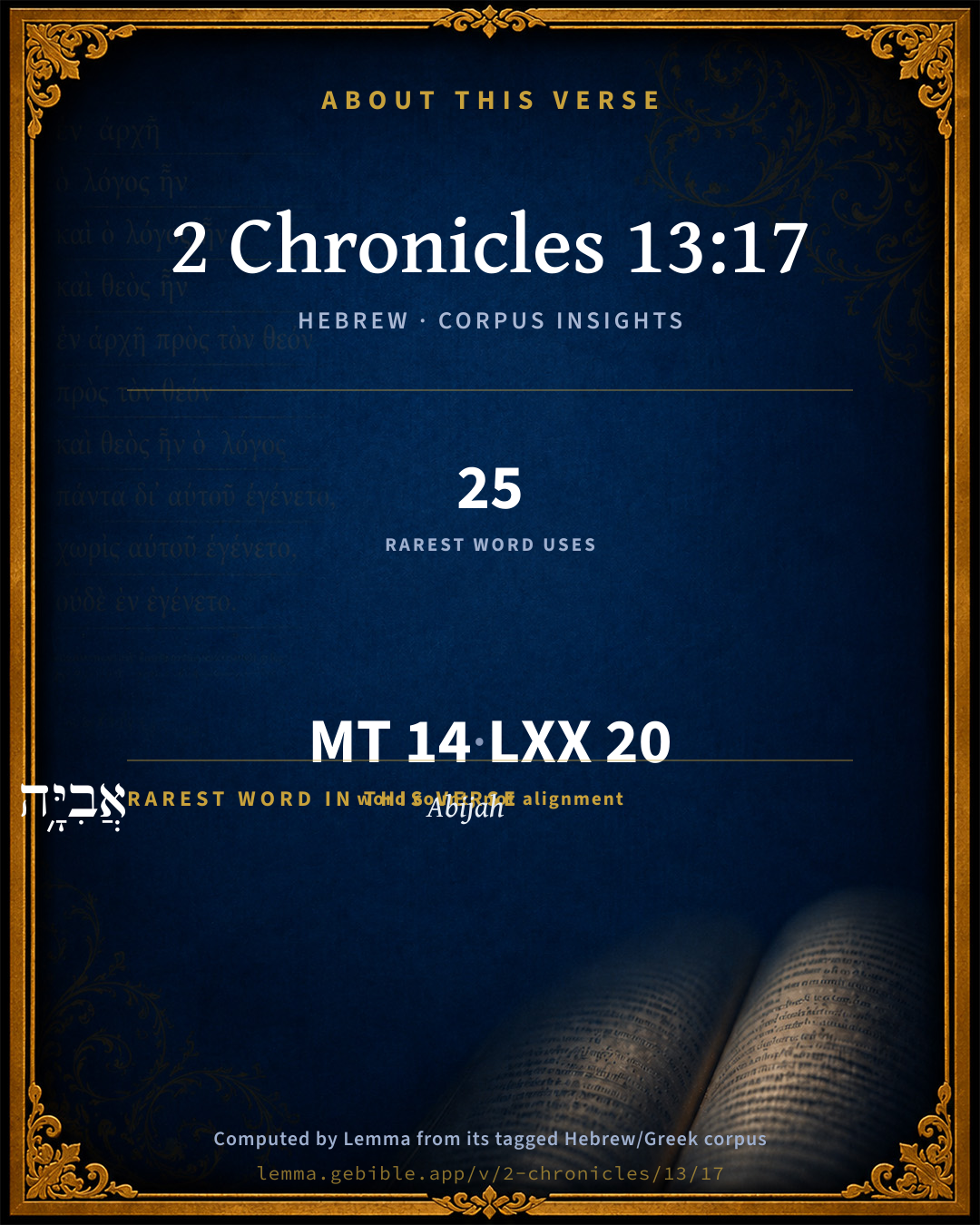
The rarest word here is אֲבִיָּ֥ה Abijah H29 — appearing just 25 times in the whole Hebrew Bible.

Shared distinctive vocabulary

אֲבִיָּ֥ה Abijah H29 occurs in 25 verses of the Hebrew Bible. Also found in:

Grammatical profile

  • 3 verbs
  • 5 nouns
  • 5 adjectives
  • 1 preposition

Verb forms

  • וַיַּכּ֥וּ Hiphil · Sequential Imperfect
  • וַיִּפְּל֤וּ Qal · Sequential Imperfect
  • בָּחֽוּר Qal · Participle Passive

Hebrew & Septuagint length

In English translation the verse runs 22 words from the Hebrew and 22 from the Septuagint (LXX English) — the same length.

A rough comparison of the two English renderings, which tokenize alike — not a word-level alignment.

Word counts can differ between the Hebrew and the Greek without any difference in meaning — e.g. the Hebrew direct-object marker אֵת has no separate Greek word, and Greek often adds the article ὁ.

In the original languages it is 14 Hebrew tokens and 20 Greek tokens — but the two are counted differently (Hebrew bundles its prefixes and suffixes into one token; the Greek is in lemma form), so that isn’t a like-for-like length.

Cross-references

7

Topical passages linked to 2 Chronicles 13:17 in the Treasury of Scripture Knowledge — connected by theme and wording, ordered by reader-vote popularity; previews shown in the World English Bible.

  • 2 Chronicles 13:3 Abijah joined battle with an army of valiant men of war, even four hundred thousand chosen men: and Jeroboam set the battle in array against him with eight hundred thousand chosen men, who were mighty men of valor.
  • 2 Chronicles 13:12 Behold, God is with us at our head, and his priests with the trumpets of alarm to sound an alarm against you. Children of Israel, don't you fight against Yahweh, the God of your fathers; for you shall not prosper.
  • 2 Chronicles 28:6 For Pekah the son of Remaliah killed in Judah one hundred twenty thousand in one day, all of them valiant men; because they had forsaken Yahweh, the God of their fathers.
  • Isaiah 10:16–19 Therefore will the Lord, Yahweh of Hosts, send among his fat ones leanness; and under his glory there shall be kindled a burning like the burning of fire.
  • Isaiah 37:36 The angel of Yahweh went forth, and struck in the camp of the Assyrians one hundred and eighty-five thousand; and when men arose early in the morning, behold, these were all dead bodies.
  • Nahum 1:5 The mountains quake before him, and the hills melt away. The earth trembles at his presence, yes, the world, and all who dwell in it.
  • 1 Corinthians 10:22 Or do we provoke the Lord to jealousy? Are we stronger than he?

Cross-references courtesy of OpenBible.info (CC BY 4.0).

Hebrew and Greek witnesses Masoretic Hebrew ↔ Greek Septuagint

The same verse in the two great witnesses to the Old Testament, shown verse-for-verse.

These are two independent witnesses, not word-aligned to each other, and the Septuagint is shown in lemma (dictionary) form.

Hebrew 2 Chronicles 13:17 Masoretic · Westminster Leningrad Codex

וַיַּכּ֥וּ בָהֶ֛ם אֲבִיָּ֥ה וְעַמּ֖וֹ מַכָּ֣ה רַבָּ֑ה וַיִּפְּל֤וּ חֲלָלִים֙ מִיִּשְׂרָאֵ֔ל חֲמֵשׁ מֵא֥וֹת אֶ֖לֶף אִ֥ישׁ בָּחֽוּר

Abijah and his people killed them with a great slaughter: so there fell down slain of Israel five hundred thousand chosen men.

World English Bible · Public Domain

Greek LXX 2 Chronicles 13:17 Septuagint · lemma form

καί πατάσσω ἐν αὐτός αβια καί ὁ λαός αὐτός πληγή μέγας καί πίπτω τραυματίας ἀπό ἰσραήλ πεντακόσιοι χιλίας ἀνήρ δυνατός

And Abia and his people struck them with a great slaughter: and there fell slain of Israel five hundred thousand mighty men.

LXX2012 (modern English Septuagint) · Public Domain

Hebrew: Westminster Leningrad Codex (CC BY 4.0). Greek: Septuagint (public domain); English from LXX2012 (modern English Septuagint) (Public Domain). How the Septuagint differs from the Hebrew →

Commentary

Notes on 2 Chronicles 13:17 from classic Christian and Jewish commentators (each source and its license shown beneath its notes). The classic Christian expositions comment on the surrounding passage and are grouped to its opening verse, so a note may address several verses; the Jewish commentaries on the Tanakh (Rashi and others) are per-verse, so they appear only where the commentator wrote on this verse.

Lemma curates 59 commentaries, every one of them public domain or Creative Commons licensed, each selected and text-cleaned for this edition rather than reprinted as found. About our sources →

Trapp's Complete Commentary

John Trapp

2Ch 13:17 And Abijah and his people slew them with a great slaughter: so there fell down slain of Israel five hundred thousand chosen men.

Ver. 17. So there fell down slain of Israel five hundred thousand.] A monstrous and matchless slaughter, far beyond that of Tamerlane when he took Bajazet, or Aetius, the Roman prefect, when he fought with Attilas and his Huns in the fields of Catalaunia, where were slain on both sides one hundred and sixty-five thousand. See on 2Ch 13:3.

John Trapp, A Commentary or Exposition upon All the Books of the Old and New Testament (1647–1656) — public domain. Text from a community e-Sword module.

Adam Clarke's Commentary

Verse 17. Slain - five hundred thousand chosen men.] Query, fifty thousand? This was a great slaughter: 2Ch 13:3, where all these numbers are supposed to be overcharged.

Adam Clarke's Commentary on the Bible (1810–1826) — public domain. Text from a community e-Sword/MySword module.

Ellicott's Commentary for English Readers

(17) Slew them with a great slaughter.—Literally, Smote in them a great smiting. Num_11:33.

Five hundred thousand chosen men.—Or more than half of Jeroboam’s entire army.

It is hardly true to say that “there is nothing in the original to indicate that this slaughter was all on one day.” (Speaker’s Commentary.) On the contrary, it is perfectly evident from the whole narrative that this verse describes the issue of a single great and decisive encounter of the rival hosts.

The result is certainly incredible, if the numbers be pressed; but it seems more reasonable to see in them “only a numerical expression of the belief of contemporaries of the war, that both kings had made a levy of all the fighting men in their respective realms, and that Jeroboam was defeated with such slaughter that he lost more than half his warriors” (Keil). The Syriac reads “five thousand.”

The number of slain on the other side is not stated. But it is absurd to talk as Reuss does, of Abijah’s 400,000 as being “still intact,” and then to ask why they did not proceed to reduce the northern kingdom.

A Bible Commentary for English Readers, edited by Charles John Ellicott (1878–1897) — public domain. Text from a community e-Sword module.

The Cambridge Bible for Schools and Colleges

gen. ed. J. J. S. Perowne

17. five hundred thousand] Contrast this statement with 2Ch_28:6, a hundred and twenty thousand in one day. The absence of the phrase in one day from the present passage is significant. It seems probable, when we consider the small interest taken by the Chronicler in military matters as such and the consequent looseness of his language regarding them, that he may intend 500,000 to represent the losses, not of a single battle, but of the whole campaign. That some farther fighting took place is suggested by 2Ch_13:19. Even so the losses are doubtless exaggerated.

The Cambridge Bible for Schools and Colleges (gen. ed. J. J. S. Perowne; Cambridge University Press, 1878–1918) — public domain. Text from a community e-Sword module.

John Gill's Exposition

Thus the children of Israel were brought under at that time,.... Humbled and weakened, but not reduced to the government of the house of David:

and the children of Judah prevailed; or grew strong:

because they relied upon the Lord God of their fathers; trusted in him, and not in an arm of flesh; the Targum is,"in the Word of the Lord God of their fathers.''

John Gill's Exposition of the Whole Bible (1746–1763) — public domain (CC PDM 1.0). Text via the HelloAO Bible API.

Albert Barnes' Notes on the Bible

Slain - The word means strictly “pierced,” and will include both the killed and the wounded. It is translated “wounded” in Lam 2:12.

Albert Barnes' Notes on the Bible (1834–1885) — public domain. Text from a community e-Sword/MySword module.

Haydock's Catholic Bible Commentary

Five. Some Latin editions have 50,000, (Calmet) which number is found in some manuscripts of Epiphanius. (Hudson’s Josephus) --- Hentenius has the same, and only remarks five manuscripts which had the greater number. See ver. 3. (Haydock) --- We do not read of such a slaughter in any one battle. But Israel made no resistance, and God assisted the four hundred thousand. (Menochius) --- Valiant. Protestants, "chosen." See chap xiv. 13. (Haydock) --- So many were either slain or wounded. (Du Hamel) --- Protestants intimate all were "slain." (Haydock)

George Leo Haydock (1774–1849), Haydock's Catholic Family Bible and Commentary, 1859 edition — public domain. Excludes Psalms (Douay-Rheims chapter numbering differs from Protestant) and Deuterocanonical books (Catholic canon only).

Matthew Poole's English Annotations

A vast number: but it hath been oft observed and recorded by sacred and profane historians, that in those ancient times there were very numerous armies, and ofttimes very great slaughters; and if this slaughter was more than ordinary, there is nothing strange nor incredible, because the Almighty God fought against the Israelites.

Matthew Poole's English Annotations on the Holy Bible (1683–1685) — public domain. Text from a community e-Sword/MySword module.

Whedon's Commentary on the Bible

Daniel D. Whedon

17. There fell down slain of Israel five hundred thousand chosen men — These many slain (חללים, pierced, wounded) probably include both killed and wounded during the whole war; not those who fell in any one engagement.

Daniel D. Whedon (gen. ed.), Commentary on the Old and New Testaments (1874–1909) — public domain. Text from a community e-Sword module.

The Pulpit Commentary

Slain; Hebrew, Even if we accept for a moment the immense numbers written here and elsewhere as authentic, a considerable deduction may be made from our difficulty by virtue of the fact that this word need not mean to describe the actually slain. It occurs about ninety-one times. Of these, in our Authorized Version, it is found rendered, including marginal options, as many as fifteen times "wounded," or by even a less severe meaning. However, whether "slain" or "wounded and slain," the alleged, numbers of our present text are, in our opinion, incredibly enormous.

The Pulpit Commentary (1880–1919), ed. H.D.M. Spence-Jones & Joseph S. Exell — public domain. Text from a community e-Sword module.

Scofield Reference Notes

C. I. Scofield

five

(See Scofield "1Co 10:8").

The Scofield Reference Bible (1917 edition), notes by C. I. Scofield — public domain. Text from a community e-Sword module.

Lesson kit

Teaching starters — assembled from the data on this page, not authored interpretation. Every prompt links to the verse data it draws on. Edit before teaching.

2 Chronicles, in the Historical, opens this verse with 14 words (13 distinct Hebrew lemmas). Its most distinctive word is ʼĂbîyâh (“Abijah”). A historical commentator’s framing appears above. Read the whole chapter for the surrounding context.

Discussion questions

  1. How does “Abijah” (ʼĂbîyâh) shape what this verse is saying?
  2. 1 Samuel 8:2 shares the word «Abijah» with this verse. How do the two illuminate each other?
  3. These translations render this verse differently. What is at stake in choosing one wording over another?
  4. The verb «וַיַּכּ֥וּ» is Hiphil Sequential Imperfect. How does its form color the action?
  5. Reading how Trapp's Complete Commentary and Adam Clarke's Commentary read this verse, where do the two commentators agree and where do they part?

Things to notice

Reading settings

Reading text

Shown beneath each verse's original-language words.

Old Testament
Old Testament edition

Read the OT as the Masoretic Hebrew (MT) or the Greek Septuagint (LXX).

English shown for the Greek Septuagint (in the Hebrew ↔ Greek comparison).

Comparing translations? Open the Compare panel on any verse page to stack up to four side by side.