Jeremiah 51:8

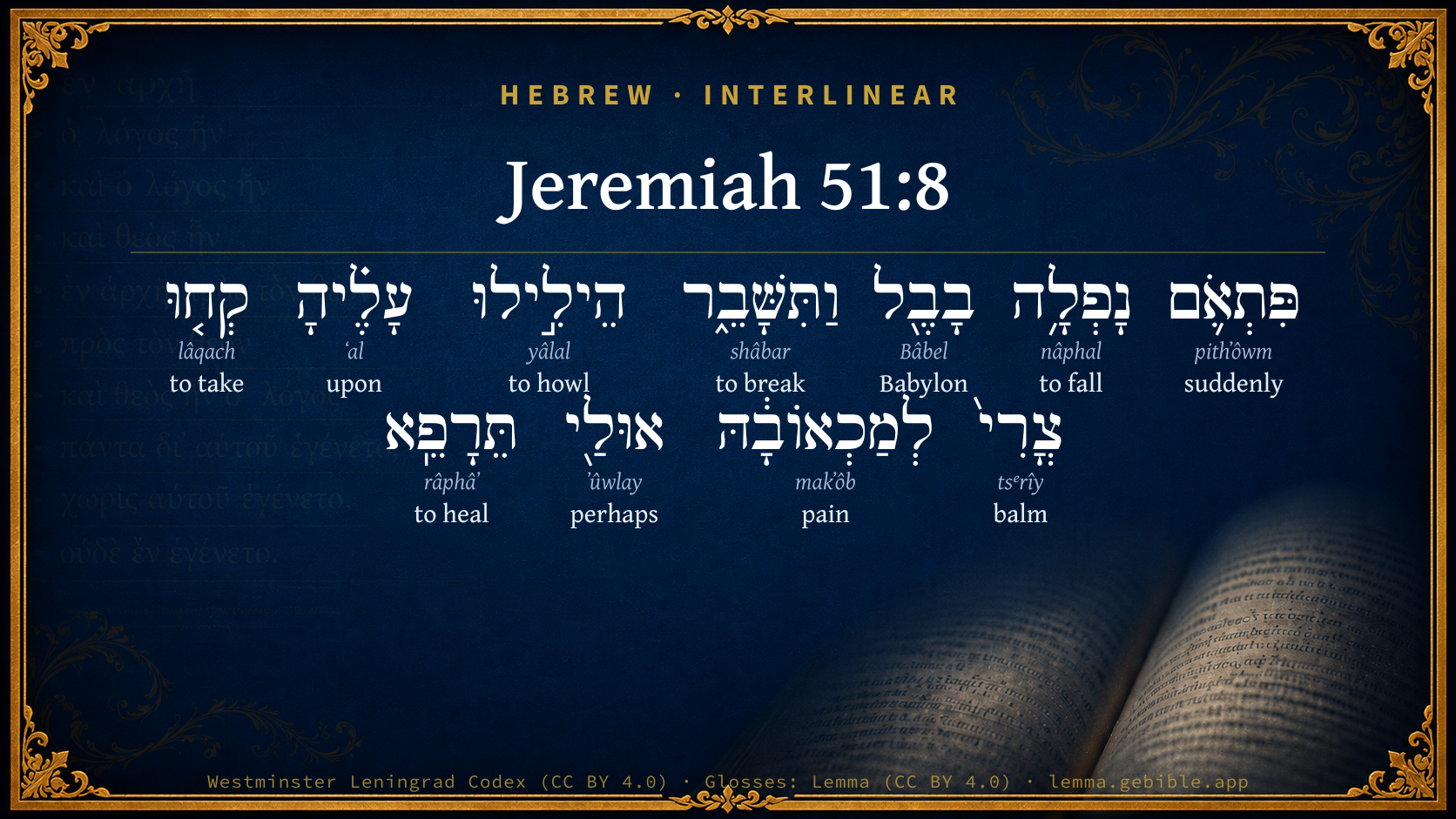
Hebrew (Westminster Leningrad Codex) Jeremiah 51:8 appears in the Hebrew Old Testament. The text above is from the Westminster Leningrad Codex. Each word links to its Strong’s number, a concise gloss, and parsing drawn from the Open Scriptures Hebrew Bible morphology. Click any word for its full Brown-Driver-Briggs (BDB) entry.
Download image
Cite this verse

Jeremiah 51:8 (World English Bible). Public Domain. Lemma interlinear Bible study tool, https://lemma.gebible.app/v/jeremiah/51/8.

Show BibTeX & RIS
BibTeX
RIS
English Translation
Babylon is suddenly fallen and destroyed: wail for her; take balm for her pain, if so be she may be healed.
World English Bible · Public Domain
Download a study sheet

One document with this verse’s original text, its word-by-word gloss line, the meaning frame, cross-references with their text, attributed commentary, and full source and license credits — printable, and it pastes into notes with its structure intact.

This verse Autodidact and up

Study sheet (.html) Plain text (.txt)

A passage Seminary Student

Up to 50 verses in one chapter. A passage sheet keeps up to 6 commentary sources and 12 cross-references per verse, in the order this page ranks them, and says so on the sheet whenever that leaves anything out. Ask for a single verse and you get the Autodidact verse sheet above.

Everything on this page stays free to read, with no account — the sheet is a download of what is already on screen, not access to it.

Want to remove ads? Support Godless Engineer
Compare translations 3

The same verse in 3 English versions, stacked beneath the original-language interlinear above. Click any original word for its lexicon entry.

Each is an independent rendering of the whole verse — the interlinear is not word-aligned to these translations.

Highlighted words mark where these versions differ — a whole-verse word diff, not a word-by-word alignment.

  • World English Bible Public Domain
    Babylon is suddenly fallen and destroyed: wail for her; take balm for her pain, if so be she may be healed.
  • King James Version Public Domain
    Babylon is suddenly fallen and destroyed: howl for her; take balm for her pain, if so be she may be healed.
  • unfoldingWord Literal Text CC BY-SA 4.0
    Babylon will fall suddenly and be destroyed. Wail for her! Give her medicine for her pain; perhaps she can be healed.

unfoldingWord Literal Text — © unfoldingWord, licensed CC BY-SA 4.0. Word-aligned USFM3 via Door43 (git.door43.org/unfoldingWord/en_ult).

Versions to compare (up to 4)

3 of 4 selected

Show all 18 translations

Every available English version of this verse, each an independent rendering of the whole verse.

  • World English Bible Public Domain
    Babylon is suddenly fallen and destroyed: wail for her; take balm for her pain, if so be she may be healed.
  • Berean Standard Bible Public Domain
    Suddenly Babylon has fallen and been shattered. Wail for her; get her balm for her pain; perhaps she can be healed.
  • Majority Standard Bible Public Domain
    Suddenly Babylon has fallen and been shattered. Wail for her; get her balm for her pain; perhaps she can be healed.
  • King James Version Public Domain
    Babylon is suddenly fallen and destroyed: howl for her; take balm for her pain, if so be she may be healed.
  • American Standard Version (1901) Public Domain
    Babylon is suddenly fallen and destroyed: wail for her; take balm for her pain, if so be she may be healed.
  • Revised Version (1885) Public Domain
    Babylon is suddenly fallen and destroyed: howl for her; take balm for her pain, if so be she may be healed.
  • Geneva Bible (1599) Public Domain
    Babel is suddenly fallen, and destroyed: howle for her, bring balme for her sore, if she may be healed.
  • Douay-Rheims (1899) Public Domain
    Babylon is suddenly fallen, and destroyed: howl for her, take balm for her pain, if so she may be healed.
  • Young's Literal Translation Public Domain
    Suddenly hath Babylon fallen, Yea, it is broken, howl ye for it, Take balm for her pain, if so be it may be healed.
  • Literal Standard Version CC BY-SA 4.0
    Babylon has suddenly fallen, || Indeed, she is broken, howl for her, || Take balm for her pain, perhaps she may be healed.
  • Unlocked Literal Bible CC BY-SA 4.0
    Babylon will fall suddenly and be destroyed. Wail for her! Give her medicine for her pain; perhaps she can be healed.
  • unfoldingWord Literal Text CC BY-SA 4.0
    Babylon will fall suddenly and be destroyed. Wail for her! Give her medicine for her pain; perhaps she can be healed.
  • Darby Bible Public Domain
    Babylon is suddenly fallen and ruined. Howl over her; take balm for her pain, if so be she may be healed.
  • World Messianic Bible Public Domain
    Babylon has suddenly fallen and been destroyed! Wail for her! Take balm for her pain. Perhaps she may be healed.
  • Webster's Bible Public Domain
    Babylon is suddenly fallen and destroyed: howl for her; take balm for her pain, it may be she may be healed.
  • Free Bible Version CC BY-SA 4.0
    Now, all of a sudden, Babylon has fallen. She has been smashed to pieces. Weep for her; get her some treatment for her pain. Maybe she can be healed.
  • Bible in Basic English Public Domain
    Sudden is the downfall of Babylon and her destruction: make cries of grief for her; take sweet oil for her pain, if it is possible for her to be made well.
  • JPS Tanakh (1917) Public Domain
    Babylon is suddenly fallen and destroyed, wail for her; take balm for her pain, if so be she may be healed.

Literal Standard Version (2020), Covenant Press — licensed CC BY-SA 4.0. Text via the HelloAO Bible API (eBible.org). Unlocked Literal Bible (unfoldingWord) — licensed CC BY-SA 4.0. Text via the HelloAO Bible API (eBible.org). unfoldingWord Literal Text — © unfoldingWord, licensed CC BY-SA 4.0. Word-aligned USFM3 via Door43 (git.door43.org/unfoldingWord/en_ult). Free Bible Version, Dr. Jonathan Gallagher — licensed CC BY-SA 4.0. Text via the HelloAO Bible API (eBible.org).

Word by word

More ways to search: Search by grammar → Find every occurrence → Compare this word →

Practice this passage: Drill this verse → Learn its vocabulary →

צֳרִי֙
tsᵉrîy
H6875
“balm”
Noun, Common, Masculine, Singular, Absolute
Part of Speech
Noun
Type
Common
Gender
Masculine
Number
Singular
State
Absolute
Full BDB Definition

Origin: from an unused root meaning to crack [as by pressure], hence, to leak

TWOT: 1967a

a kind of balsam, balm, salve - as merchandise - as medicine
  1. פִּתְאֹ֛ם pithʼôwm H6597 “suddenly” Adverb
  2. נָפְלָ֥ה nâphal H5307 “to fall” Verb, Qal, Perfect, 3rd Person, Feminine, Singular
  3. בָבֶ֖ל Bâbel H894 “Babylon” Noun, Proper
  4. וַתִּשָּׁבֵ֑ר shâbar H7665 “and · to break” Conjunction + Verb, Niphal, Sequential Imperfect, 3rd Person, Feminine, Singular
  5. הֵילִ֣ילוּ yâlal H3213 “howl” Verb, Hiphil, Imperative, 2nd Person, Masculine, Plural
  6. עָלֶ֗יהָ ʻal H5921 “upon · her” Preposition + Suffix, Personal, 3rd Person, Feminine, Singular
  7. קְח֤וּ lâqach H3947 “take” Verb, Qal, Imperative, 2nd Person, Masculine, Plural
  8. לְמַכְאוֹבָ֔הּ makʼôb H4341 “to/for · pain · her” Preposition + Noun, Common, Masculine, Singular, Construct + Suffix, Personal, 3rd Person, Feminine, Singular
  9. אוּלַ֖י ʼûwlay H194 “perhaps” Adverb
  10. תֵּרָפֵֽא râphâʼ H7495 “to heal” Verb, Niphal, Imperfect, 3rd Person, Feminine, Singular

About this verse

These counts appear in no published source. They are computed here, from the morphology-tagged text and Lemma’s own curated glosses. What Lemma adds →

11
words
11
distinct lemmas
Prophets
section

Notable vocabulary

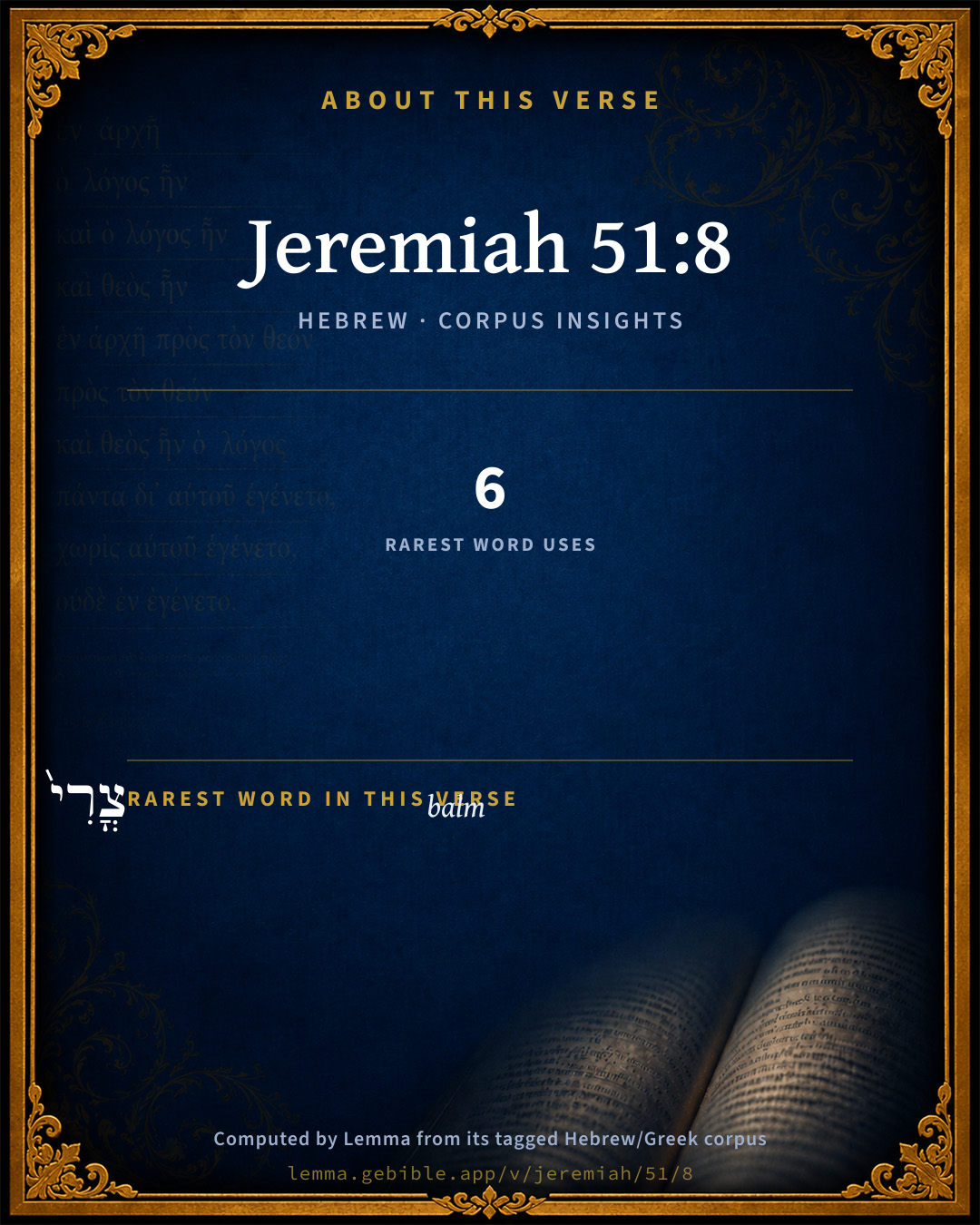
The rarest word here is צֳרִי֙ balm H6875 — appearing just 6 times in the whole Hebrew Bible.

Shared distinctive vocabulary

צֳרִי֙ balm H6875 occurs in 6 verses of the Hebrew Bible. Also found in:

Grammatical profile

  • 5 verbs
  • 3 nouns
  • 1 preposition
  • 2 adverbs

Verb forms

  • נָפְלָ֥ה Qal · Perfect
  • וַתִּשָּׁבֵ֑ר Niphal · Sequential Imperfect
  • הֵילִ֣ילוּ Hiphil · Imperative
  • קְח֤וּ Qal · Imperative
  • תֵּרָפֵֽא Niphal · Imperfect

Cross-references

19

Topical passages linked to Jeremiah 51:8 in the Treasury of Scripture Knowledge — connected by theme and wording, ordered by reader-vote popularity; previews shown in the World English Bible.

  • Isaiah 21:9 and, behold, here comes a troop of men, horsemen in pairs. He answered, Fallen, fallen is Babylon; and all the engraved images of her gods are broken to the ground.
  • Jeremiah 46:11 Go up into Gilead, and take balm, virgin daughter of Egypt: in vain do you use many medicines; there is no healing for you.
  • Revelation 14:8 Another, a second angel, followed, saying, "Babylon the great has fallen, which has made all the nations to drink of the wine of the wrath of her sexual immorality."
  • Jeremiah 48:20 Moab is disappointed; for it is broken down: wail and cry; tell you it by the Arnon, that Moab is laid waste.
  • Jeremiah 50:2 Declare you among the nations and publish, and set up a standard; publish, and don't conceal: say, Babylon is taken, Bel is disappointed, Merodach is dismayed; her images are disappointed, her idols are dismayed.
  • Revelation 18:2 He cried with a mighty voice, saying, "Fallen, fallen is Babylon the great, and she has become a habitation of demons, a prison of every unclean spirit, and a prison of every unclean and hateful bird!
  • Isaiah 13:6–7 Wail; for the day of Yahweh is at hand; as destruction from the Almighty shall it come.
  • Isaiah 47:9 but these two things shall come to you in a moment in one day, the loss of children, and widowhood; in their full measure shall they come on you, in the multitude of your sorceries, and the great abundance of your enchantments.
  • Jeremiah 8:22 Is there no balm in Gilead? is there no physician there? why then isn't the health of the daughter of my people recovered?
  • Jeremiah 30:12–15 For thus says Yahweh, Your hurt is incurable, and your wound grievous.
  • Jeremiah 48:31 Therefore will I wail for Moab; yes, I will cry out for all Moab: for the men of Kir Heres shall they mourn.
  • Jeremiah 51:41 How is Sheshach taken! and the praise of the whole earth seized! how is Babylon become a desolation among the nations!
  • Ezekiel 27:30–32 and shall cause their voice to be heard over you, and shall cry bitterly, and shall cast up dust on their heads, they shall wallow themselves in the ashes:
  • Ezekiel 30:2 Son of man, prophesy, and say, Thus says the Lord Yahweh: Wail, Alas for the day!
  • Daniel 5:24 Then was the part of the hand sent from before him, and this writing was inscribed.
  • Daniel 5:31 Darius the Mede received the kingdom, being about sixty-two years old.
  • Nahum 3:19 There is no healing your wound, for your injury is fatal. All who hear the report of you clap their hands over you; for who hasn't felt your endless cruelty?
  • Revelation 18:8–11 Therefore in one day her plagues will come: death, mourning, and famine; and she will be utterly burned with fire; for the Lord God who has judged her is strong.
  • Revelation 18:17–19 For in an hour such great riches are made desolate.' Every shipmaster, and everyone who sails anywhere, and mariners, and as many as gain their living by sea, stood far away,

Cross-references courtesy of OpenBible.info (CC BY 4.0).

Hebrew and Greek witnesses Masoretic Hebrew ↔ Greek Septuagint

The same verse in the two great witnesses to the Old Testament, shown verse-for-verse.

These are two independent witnesses, not word-aligned to each other, and the Septuagint is shown in lemma (dictionary) form.

Hebrew Jeremiah 51:8 Masoretic · Westminster Leningrad Codex

פִּתְאֹ֛ם נָפְלָ֥ה בָבֶ֖ל וַתִּשָּׁבֵ֑ר הֵילִ֣ילוּ עָלֶ֗יהָ קְח֤וּ צֳרִי֙ לְמַכְאוֹבָ֔הּ אוּלַ֖י תֵּרָפֵֽא

Babylon is suddenly fallen and destroyed: wail for her; take balm for her pain, if so be she may be healed.

World English Bible · Public Domain

Greek LXX Structure differs

In the Septuagint, Jeremiah is about an eighth shorter than the Hebrew and arranges its material differently — the Oracles Against the Nations (Hebrew chapters 46–51) appear in the middle of the Greek book, after 25:13. Because the chapter and verse boundaries do not line up, a verse-for-verse comparison with the Hebrew is not shown.

A verse-for-verse comparison isn’t shown here because the chapters and verses don’t line up. Switch to the LXX edition with the MT / LXX toggle above to read the Greek directly.

Hebrew: Westminster Leningrad Codex (CC BY 4.0). Greek: Septuagint (public domain); English from a public-domain English Septuagint. How the Septuagint differs from the Hebrew →

Targum (Aramaic paraphrase)

1

The Targum is the ancient Jewish Aramaic paraphrase of the Hebrew Scriptures — an interpretive translation, not the Hebrew text itself. Onkelos (literal) and Pseudo-Jonathan (expansive) render the Torah, and Jonathan the Prophets. Coverage is partial: where no permissively-licensed English translation exists for a verse, only the Aramaic is shown. This is verse-level text, not a word-by-word alignment to the Hebrew.

  1. Targum Jonathan Prophets (Joshua–Malachi)
    בִּתְכֵּיף נָפְלַת בָּבֶל וְאִתְּבָרַת אֱלִילוּ עֲלָהּ סָבוּ שְׁעִיף לִתְבִירָהּ מָאִים תִּתַּסִי:

    (no public-domain English translation for this verse)

    Targum Jonathan — Aramaic: “Mikraot Gedolot” (public domain). English: “Sefaria Community Translation” (CC0 1.0 (public-domain dedication)); “London "Chaldee Paraphrase," 1871” (public domain). Text via Sefaria.

Commentary

Notes on Jeremiah 51:8 from classic Christian and Jewish commentators (each source and its license shown beneath its notes). The classic Christian expositions comment on the surrounding passage and are grouped to its opening verse, so a note may address several verses; the Jewish commentaries on the Tanakh (Rashi and others) are per-verse, so they appear only where the commentator wrote on this verse.

Lemma curates 59 commentaries, every one of them public domain or Creative Commons licensed, each selected and text-cleaned for this edition rather than reprinted as found. About our sources →

Trapp's Complete Commentary

John Trapp

Jer 51:8 Babylon is suddenly fallen and destroyed: howl for her; take balm for her pain, if so be she may be healed.

Ver. 8. Babylon is suddenly fallen.] Jer 50:2. So ruet alto a culmine Roma So Rome will be destroyed from its highest heights. {Rev 14:8; Rev 18:2; Rev 18:10}

If so be she may be healed,] q.d., Try you may, but it is to no purpose. See Jer 46:11.

John Trapp, A Commentary or Exposition upon All the Books of the Old and New Testament (1647–1656) — public domain. Text from a community e-Sword module.

Joseph Benson's Commentary

Jer 51:8-9. Babylon is suddenly fallen — It was one of the aggravations of the punishment of Babylon, that her destruction came upon her suddenly and unexpectedly. Howl for her, &c. — So the kings, the merchants, and other factors, are described as lamenting the destruction of mystical Babylon, Rev 18:9; Rev 18:11; Rev 18:17-19. Take balm for her pain — Use your utmost endeavours, and try every thing you can to save her from destruction. This is spoken ironically, implying her ruin to be irrecoverable. We would have healed Babylon, but she is not healed — Some think “this is spoken in the name of God’s prophets, and the other witnesses of his truth, importing that they had sufficiently testified against her errors and idolatries, but that she was irreclaimable; and therefore that it was time for all the lovers of truth to depart out of her, lest they should be involved in her punishments.” But it is more probable that the nations which had been subject to Babylon, and were her allies, are the speakers here, declaring that they had assisted her to the utmost of their power, and had endeavoured to support her sinking cause, but all in vain, nothing which they had done or could do availing to save her from destruction. And therefore, as her case was desperate, it was time for them to shift for themselves, and to leave Babylon to its fate, since it seemed to be the decree of Heaven that it should fall. Those who have written of the downfall of Babylon relate, that when its affairs seemed to grow desperate, it was deserted by most of its allies, few or none of them persevering to lend it any assistance. Her judgment reacheth unto heaven — That is, her sin, bringing down God’s judgments; and is lifted up even to the skies — It comes to the ears of even God himself, and engages him to take account of it and punish her.

Joseph Benson's Commentary on the Old and New Testaments (1811–1818) — public domain. Text from a community e-Sword module.

Tyndale Open Study Notes

Tyndale Open Resources

51:8 Jeremiah foresaw the collapse of the Babylonian Empire. Although the Lord was carrying out justice, the event called for mourning.

Tyndale Open Study Notes — © Tyndale Open Resources, licensed CC BY-SA 4.0. Text via the HelloAO Bible API.

Jamieson, Fausset & Brown

Robert Jamieson, A. R. Fausset & David Brown

Her friends and confederates, who behold her fall, are invited to her aid. They reply, her case is incurable, and that they must leave her to her fate. (Isa 21:9; Rev 14:8; Rev 18:2, Rev 18:9).

balm-- (Jer 8:22; Jer 46:11).

Jamieson, Fausset & Brown — Commentary Critical and Explanatory on the Whole Bible (1871) — public domain (CC PDM 1.0). Text via the HelloAO Bible API.

Adam Clarke's Commentary

Verse 8. Babylon is suddenly fallen and destroyed] These appear to be the words of some of the spectators of Babylon's misery.

Adam Clarke's Commentary on the Bible (1810–1826) — public domain. Text from a community e-Sword/MySword module.

John Calvin's Commentaries

The Prophet now declares that the fall of Babylon would be sudden, that the faithful might understand that God could accomplish in one moment what he had decreed. For when the prophets spoke of God’s judgments, the people questioned among themselves, how could that be which surpassed the common ideas of men. That men, therefore, might not estimate God’s power according to their own thoughts, he introduces this word, suddenly; as though he had said, that God had no need of warlike forces; for though he makes no preparations, yet he can subvert every power that exists in the world.

He then adds, Howl for her; and this is said, because it could not be but that many nations would either bewail the ruin of so great a monarch, or be astonished at her, and thus many things would be said. He then says, that though the whole world were to howl for Babylon, it would yet fall and be suddenly broken, whenever it pleased God. And he says, by way of irony, Take balm, if peradventure it can be healed The word צרי, tsari, is, by some, rendered balsam, but it means rosin, for we know that it was deemed precious in Judea; and the Prophet no doubt accommodated what he said to what was commonly known. As then that medicament was in common use among the Jews, he now says, Take rosin As there is hardly any country which has not its peculiar remedies; so we see that Jeremiah refers not to what was usually done at Babylon, or to medicaments used by the Chaldeans, but to what was commonly used in his own country, as it appears from other places. Now rosin was a juice which flowed from trees, and it was a thick juice. The best rosin which we now use is from the terebinth; but in these parts they have what proceeds from the fir, for here the terebinth is not found. But Judea had a most valuable rosin, as we learn from many parts of Scripture. And under this one thing is included everything, Take rosin; as though he had said, “Let physicians come together (otherwise she will perish) from every place, if peradventure she can be healed.” This is said ironically, that the faithful might know that the diseases of Babylon would be incurable.

We have said elsewhere, that Babylon was not wholly demolished when taken by Cyrus, and that the people were not then driven away. They dwelt there as usual, though made tributary, as they were afterwards, under the dominion of the Persians. Babylon was also grievously oppressed, when punished for its revolt, until what Jeremiah and others prophesied was fulfilled. Then the time of which he speaks ought not to be confined to one calamity only, which was only a prelude to others still greater. He afterwards adds, —

John Calvin's Commentaries (1540-1563) — public domain. Text from the Calvin Translation Society English edition (1840s-50s) via the Christian Classics Ethereal Library (ccel.org). Calvin's coverage is partial (roughly two-thirds of the Bible); uncommented books and verses are honest gaps, never fabricated. The 19th-century editor's footnotes and remarks are omitted so the notes are faithfully Calvin's own voice.

Ellicott's Commentary for English Readers

(8) Babylon is suddenly fallen . . .—The form of announcement seems taken in part from Isa_21:9.

Take balm for her pain . . .—The words are significant. The captive people are not invited simply to raise a shout of triumph at the fall of their oppressor: they are to “take balm” (comp. the use of the same image in Jer_8:22; Jer_46:11), and try to heal her. They are still to “seek the peace of the city” (Jer_29:7), to render kindly service, to pour balm into the bleeding wounds.

A Bible Commentary for English Readers, edited by Charles John Ellicott (1878–1897) — public domain. Text from a community e-Sword module.

The Cambridge Bible for Schools and Colleges

gen. ed. J. J. S. Perowne

8. take balm] See on Jer_46:11.

The Cambridge Bible for Schools and Colleges (gen. ed. J. J. S. Perowne; Cambridge University Press, 1878–1918) — public domain. Text from a community e-Sword module.

John Gill's Exposition

Babylon is suddenly fallen and destroyed,.... Or "broken" (g); even into shivers, as a cup is; for when it had been used to answer the purposes designed by the Lord, he let it fall cut of his hands at once, and it was broken; or rather he dashed it in pieces, as a potter's vessel. The destruction of Babylon was brought about in a very short time, considering the strength of it; and was unexpected by the inhabitants of it, and by the nations round about; but, when it was come, it was irreparable: so the destruction of mystical Babylon will be in one hour, and it will be an utter and entire destruction, Rev 18:8;

howl for her; as the inhabitants of Babylon, and her friends and allies that loved her, did no doubt; and as the kings and merchants of the earth, and others, will howl for spiritual Babylon, Rev 18:9;

take balm for her pain, if so be she may be healed: or balsam; see Jer 46:11; which is said by way of derision and mockery, as Kimchi and Abarbinel observe; or in an ironical and sarcastic manner; suggesting, that, let what means soever be made use of, her wound was incurable, her ruin inevitable, and her case irrecoverable.

(g) "confracta est", Schmidt; "fracta est", Cocceius; "contrita est", Piscator.

John Gill's Exposition of the Whole Bible (1746–1763) — public domain (CC PDM 1.0). Text via the HelloAO Bible API.

Albert Barnes' Notes on the Bible

Destroyed - literally, broken, as was the hammer Jer 50:23. The cup, though of metal, is thrown down so violently as to be shattered by the fall.

Howl for her - The persons addressed are the many inhabitants of Babylon who were dragged from their homes to people its void places, and especially the Israelites. They have dwelt there long enough to feel pity for her, when they contrast her past magnificence with her terrible fall. Compare Jer 29:7.

Albert Barnes' Notes on the Bible (1834–1885) — public domain. Text from a community e-Sword/MySword module.

Haydock's Catholic Bible Commentary

Suddenly. She has not lost many battles; but is fallen at once from being the greatest city of the East.

George Leo Haydock (1774–1849), Haydock's Catholic Family Bible and Commentary, 1859 edition — public domain. Excludes Psalms (Douay-Rheims chapter numbering differs from Protestant) and Deuterocanonical books (Catholic canon only).

Matthew Poole's English Annotations

That is, she shall suddenly fall and be destroyed; you may try all the probable ways for her cure, but they will all be used to no purpose.

Matthew Poole's English Annotations on the Holy Bible (1683–1685) — public domain. Text from a community e-Sword/MySword module.

Whedon's Commentary on the Bible

Daniel D. Whedon

8. Destroyed — Literally, broken. This suggests a change in the figure, or that golden means ornamented with gold, or that this golden cup, though metal, is dashed so violently as to be shattered.

Daniel D. Whedon (gen. ed.), Commentary on the Old and New Testaments (1874–1909) — public domain. Text from a community e-Sword module.

The Pulpit Commentary

Destroyed. The Hebrew, more forcibly, has "is broken." The Authorized Version wished, perhaps, to avoid the objection that a golden cup could not, properly speaking, be broken. But if we once begin to harmonize the language of Hebrew poetry, we shall have no end. It is not the cup which falls, but the state, considered as a house. (the "breach" of God"s people is constantly referred to; e.g. Psa_60:2 Isa_30:26) Howl for her . Sympathetic bystanders are dramatically appealed to. From the next verse it would seem that they are the various foreigners who, whether by choice or force, have been resident in Babylon, and who have acquired an interest in her fate. Hitzig thinks the foreign mercenaries (Jer_50:37) or allies are specially referred to. Take balm for her pain. (comp. Jer_8:22 Jer_46:11) The images of fracture and woundare combined, as in Isa_30:26.

The Pulpit Commentary (1880–1919), ed. H.D.M. Spence-Jones & Joseph S. Exell — public domain. Text from a community e-Sword module.

Lesson kit

Teaching starters — assembled from the data on this page, not authored interpretation. Every prompt links to the verse data it draws on. Edit before teaching.

Jeremiah, in the Prophets, opens this verse with 11 words (11 distinct Hebrew lemmas). Its most distinctive word is tsᵉrîy (“balm”). A historical commentator’s framing appears above. Read the whole chapter for the surrounding context.

Discussion questions

  1. The word tsᵉrîy carries the sense “balm.” How does it shape the verse?
  2. How does Genesis 37:25, which shares the word «balm», read alongside this verse?
  3. These translations render this verse differently; the difference is in the English rendering, not the original. What questions does that raise?
  4. «נָפְלָ֥ה» is a Qal Perfect verb. How does that grammatical form shape the action described?
  5. Compare how Trapp's Complete Commentary and Joseph Benson's Commentary read this verse. Where do they agree or differ?

Things to notice

Reading settings

Reading text

Shown beneath each verse's original-language words.

Old Testament
Old Testament edition

Read the OT as the Masoretic Hebrew (MT) or the Greek Septuagint (LXX).

English shown for the Greek Septuagint (in the Hebrew ↔ Greek comparison).

Comparing translations? Open the Compare panel on any verse page to stack up to four side by side.