Judges 19:26

Hebrew (Westminster Leningrad Codex) Judges 19:26 appears in the Hebrew Old Testament. The text above is from the Westminster Leningrad Codex. Each word links to its Strong’s number, a concise gloss, and parsing drawn from the Open Scriptures Hebrew Bible morphology. Click any word for its full Brown-Driver-Briggs (BDB) entry.
Download image
Cite this verse

Judges 19:26 (World English Bible). Public Domain. Lemma interlinear Bible study tool, https://lemma.gebible.app/v/judges/19/26.

Show BibTeX & RIS
BibTeX
RIS
English Translation
Then came the woman in the dawning of the day, and fell down at the door of the man's house where her lord was, until it was light.
World English Bible · Public Domain
Download a study sheet

One document with this verse’s original text, its word-by-word gloss line, the meaning frame, cross-references with their text, attributed commentary, and full source and license credits — printable, and it pastes into notes with its structure intact.

This verse Autodidact and up

Study sheet (.html) Plain text (.txt)

A passage Seminary Student

Up to 50 verses in one chapter. A passage sheet keeps up to 6 commentary sources and 12 cross-references per verse, in the order this page ranks them, and says so on the sheet whenever that leaves anything out. Ask for a single verse and you get the Autodidact verse sheet above.

Everything on this page stays free to read, with no account — the sheet is a download of what is already on screen, not access to it.

Want to remove ads? Support Godless Engineer
Compare translations 3

The same verse in 3 English versions, stacked beneath the original-language interlinear above. Click any original word for its lexicon entry.

Each is an independent rendering of the whole verse — the interlinear is not word-aligned to these translations.

Highlighted words mark where these versions differ — a whole-verse word diff, not a word-by-word alignment.

  • World English Bible Public Domain
    Then came the woman in the dawning of the day, and fell down at the door of the man's house where her lord was, until it was light.
  • King James Version Public Domain
    Then came the woman in the dawning of the day, and fell down at the door of the man's house where her lord was, till it was light.
  • unfoldingWord Literal Text CC BY-SA 4.0
    And the woman came at the turning of the morning, and she fell down at the entrance of the house of the man where her master was there, until the light.

unfoldingWord Literal Text — © unfoldingWord, licensed CC BY-SA 4.0. Word-aligned USFM3 via Door43 (git.door43.org/unfoldingWord/en_ult).

Versions to compare (up to 4)

3 of 4 selected

Show all 18 translations

Every available English version of this verse, each an independent rendering of the whole verse.

  • World English Bible Public Domain
    Then came the woman in the dawning of the day, and fell down at the door of the man's house where her lord was, until it was light.
  • Berean Standard Bible Public Domain
    Early that morning, the woman went back to the house where her master was staying, collapsed at the doorway, and lay there until it was light.
  • Majority Standard Bible Public Domain
    Early that morning, the woman went back to the house where her master was staying, collapsed at the doorway, and lay there until it was light.
  • King James Version Public Domain
    Then came the woman in the dawning of the day, and fell down at the door of the man's house where her lord was, till it was light.
  • American Standard Version (1901) Public Domain
    Then came the woman in the dawning of the day, and fell down at the door of the man's house where her lord was, till it was light.
  • Revised Version (1885) Public Domain
    Then came the woman in the dawning of the day and fell down at the door of the man’s house where her lord was, till it was light.
  • Geneva Bible (1599) Public Domain
    So the woman came in the dawning of the day, and fell downe at the doore of the mans house where her Lord was, till the light day.
  • Douay-Rheims (1899) Public Domain
    But the woman, at the dawning of the day, came to the door of the house where her lord lodged, and there fell down.
  • Young's Literal Translation Public Domain
    and the woman cometh in at the turning of the morning, and falleth at the opening of the man's house, where her lord `is', till the light.
  • Literal Standard Version CC BY-SA 4.0
    and the woman comes in at the turning of the morning, and falls at the opening of the man’s house where her lord [is], until the light.
  • Unlocked Literal Bible CC BY-SA 4.0
    At dawn the woman came and she fell down at the door of the man's house where her master was, and she lay there until it was light.
  • unfoldingWord Literal Text CC BY-SA 4.0
    And the woman came at the turning of the morning, and she fell down at the entrance of the house of the man where her master was there, until the light.
  • Darby Bible Public Domain
    And as morning appeared, the woman came and fell down at the door of the man's house where her master was, till it was light.
  • World Messianic Bible Public Domain
    Then the woman came in the dawning of the day, and fell down at the door of the man’s house where her lord was, until it was light.
  • Webster's Bible Public Domain
    Then came the woman in the dawning of the day, and fell down at the door of the man's house where her lord was, till it was light.
  • Free Bible Version CC BY-SA 4.0
    As night turned into day she returned to the house where her master was staying and collapsed in front of the door as it got light.
  • Bible in Basic English Public Domain
    Then at the dawn of day the woman came, and, falling down at the door of the man's house where her master was, was stretched there till it was light.
  • JPS Tanakh (1917) Public Domain
    Then came the woman in the dawning of the day, and fell down at the door of the man's house where her lord was, till it was light.

Literal Standard Version (2020), Covenant Press — licensed CC BY-SA 4.0. Text via the HelloAO Bible API (eBible.org). Unlocked Literal Bible (unfoldingWord) — licensed CC BY-SA 4.0. Text via the HelloAO Bible API (eBible.org). unfoldingWord Literal Text — © unfoldingWord, licensed CC BY-SA 4.0. Word-aligned USFM3 via Door43 (git.door43.org/unfoldingWord/en_ult). Free Bible Version, Dr. Jonathan Gallagher — licensed CC BY-SA 4.0. Text via the HelloAO Bible API (eBible.org).

Word by word

More ways to search: Search by grammar → Find every occurrence → Compare this word →

Practice this passage: Drill this verse → Learn its vocabulary →

הָאֽוֹר
ʼôwr
H216
“the · light”
Particle, Definite Article + Noun, Common, Both, Singular, Absolute
Part of Speech
Particle + Noun
Type
Common
Gender
Both
Number
Singular
State
Absolute
Full BDB Definition

Origin: from H215

TWOT: 52a

light - light of day - light of heavenly luminaries (moon, sun, stars) - day-break, dawn, morning light - daylight - lightning - light of lamp - light of life - light of prosperity - light of instruction - light of face (figuratively) - Jehovah as Israel's light
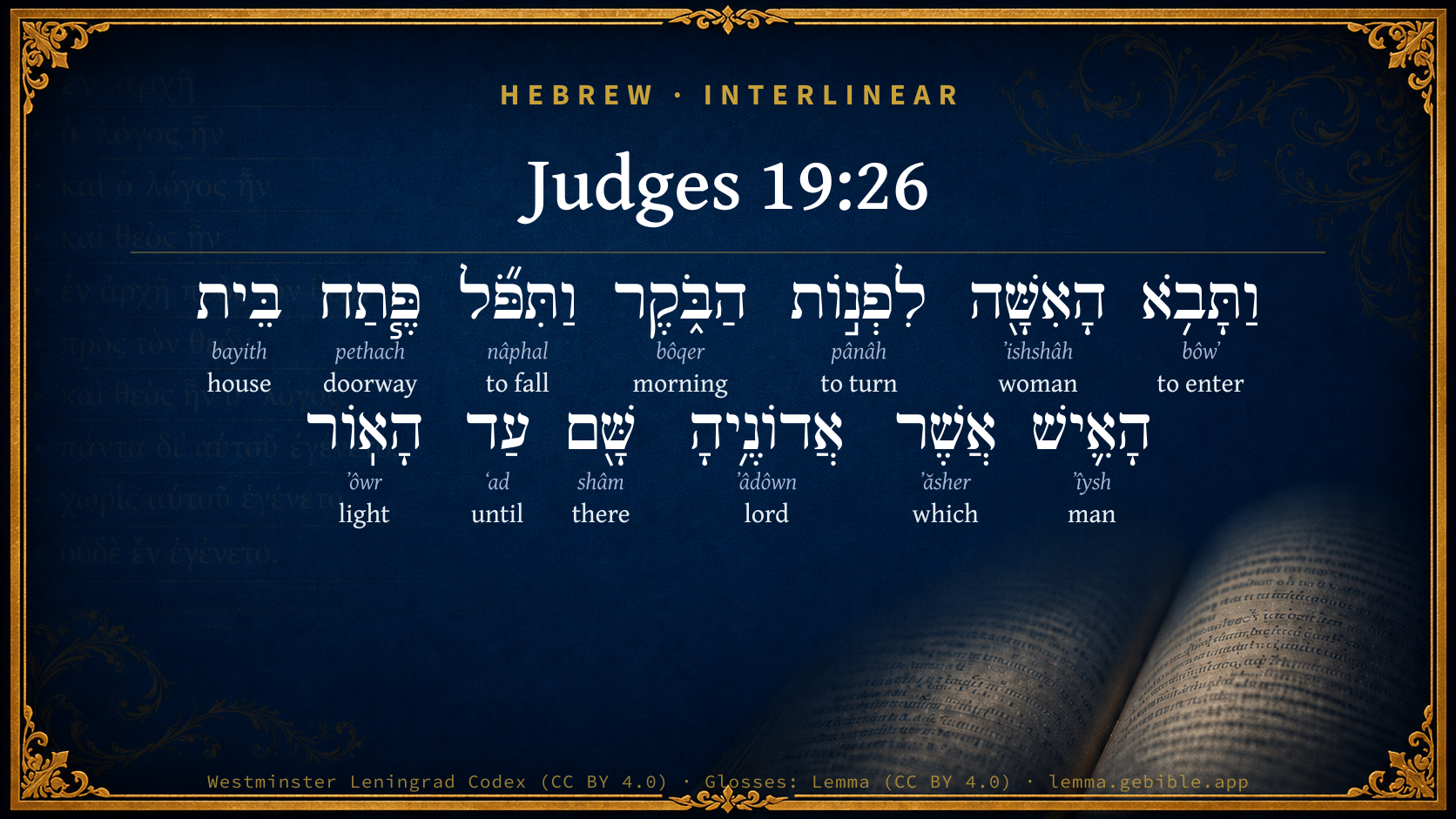
  1. וַתָּבֹ֥א bôwʼ H935 “and · to enter” Conjunction + Verb, Qal, Sequential Imperfect, 3rd Person, Feminine, Singular
  2. הָאִשָּׁ֖ה ʼishshâh H802 “the · woman” Particle, Definite Article + Noun, Common, Feminine, Singular, Absolute
  3. לִפְנ֣וֹת pânâh H6437 “to turn” Preposition + Verb, Qal, Infinitive Construct
  4. הַבֹּ֑קֶר bôqer H1242 “the · morning” Particle, Definite Article + Noun, Common, Masculine, Singular, Absolute
  5. וַתִּפֹּ֞ל nâphal H5307 “and · to fall” Conjunction + Verb, Qal, Sequential Imperfect, 3rd Person, Feminine, Singular
  6. פֶּ֧תַח pethach H6607 “doorway of” Noun, Common, Masculine, Singular, Construct
  7. בֵּית bayith H1004 “house of” Noun, Common, Masculine, Singular, Construct
  8. הָאִ֛ישׁ ʼîysh H376 “the · man” Particle, Definite Article + Noun, Common, Masculine, Singular, Absolute
  9. אֲשֶׁר ʼăsher H834 “which” Particle, Relative
  10. אֲדוֹנֶ֥יהָ ʼâdôwn H113 “lords · her” Noun, Common, Masculine, Plural, Construct + Suffix, Personal, 3rd Person, Feminine, Singular
  11. שָּׁ֖ם shâm H8033 “there” Adverb
  12. עַד ʻad H5704 “until” Preposition

About this verse

These counts appear in no published source. They are computed here, from the morphology-tagged text and Lemma’s own curated glosses. What Lemma adds →

13
words
13
distinct lemmas
Historical
section

Grammatical profile

  • 3 verbs
  • 7 nouns
  • 1 preposition
  • 1 adverb
  • 1 particle

Verb forms

  • וַתָּבֹ֥א Qal · Sequential Imperfect
  • לִפְנ֣וֹת Qal · Infinitive Construct
  • וַתִּפֹּ֞ל Qal · Sequential Imperfect

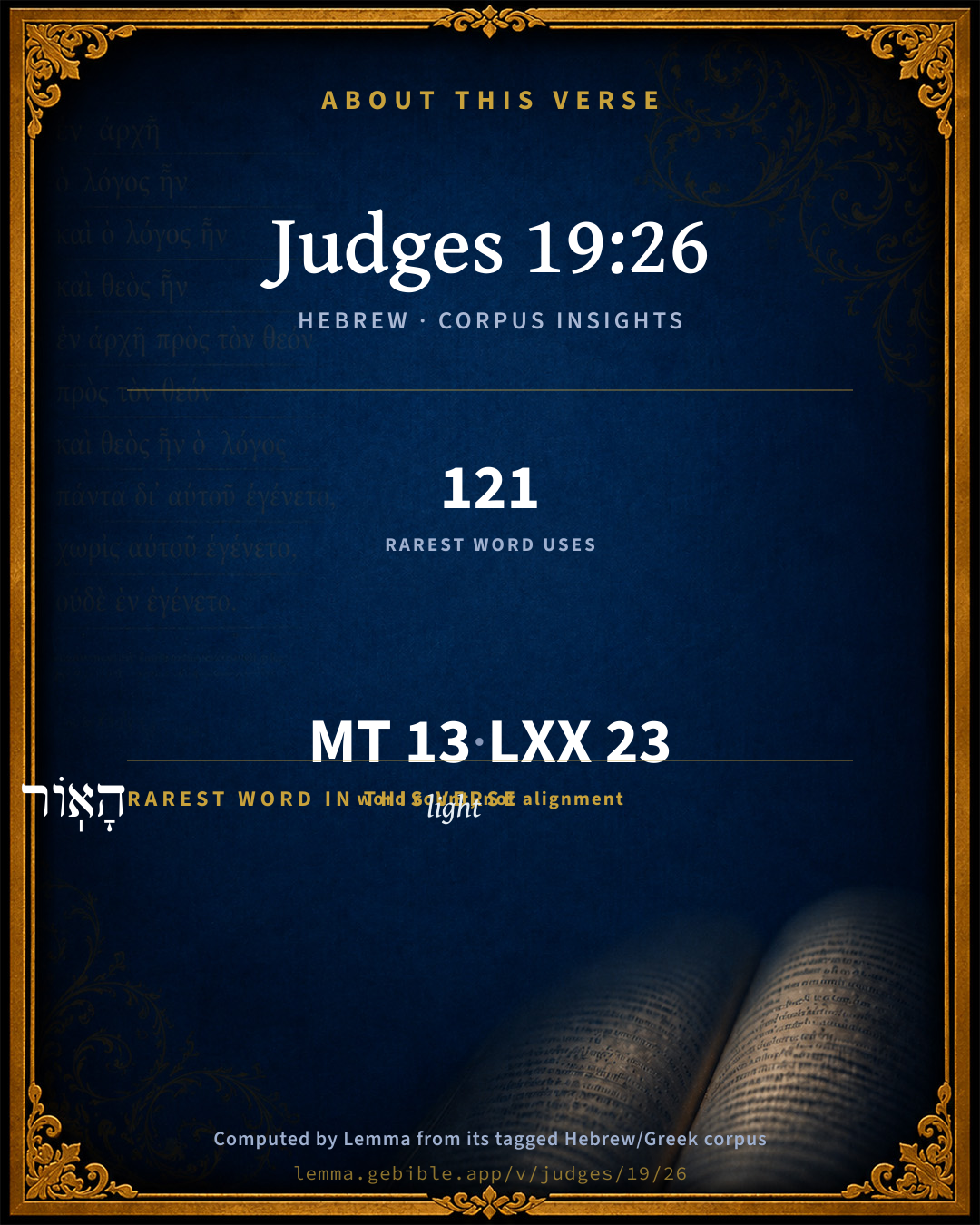
Hebrew & Septuagint length

In English translation the verse runs 28 words from the Hebrew and 23 from the Septuagint (LXX English) — closely comparable.

A rough comparison of the two English renderings, which tokenize alike — not a word-level alignment.

Word counts can differ between the Hebrew and the Greek without any difference in meaning — e.g. the Hebrew direct-object marker אֵת has no separate Greek word, and Greek often adds the article ὁ.

In the original languages it is 13 Hebrew tokens and 23 Greek tokens — but the two are counted differently (Hebrew bundles its prefixes and suffixes into one token; the Greek is in lemma form), so that isn’t a like-for-like length.

Cross-references

4

Topical passages linked to Judges 19:26 in the Treasury of Scripture Knowledge — connected by theme and wording, ordered by reader-vote popularity; previews shown in the World English Bible.

  • Genesis 18:12 Sarah laughed within herself, saying, "After I have grown old will I have pleasure, my lord being old also?"
  • Judges 19:3 Her husband arose, and went after her, to speak kindly to her, to bring her again, having his servant with him, and a couple of donkeys: and she brought him into her father's house; and when the father of the young lady saw him, he rejoiced to meet him.
  • Judges 19:27 Her lord rose up in the morning, and opened the doors of the house, and went out to go his way; and, behold, the woman his concubine was fallen down at the door of the house, with her hands on the threshold.
  • 1 Peter 3:6 as Sarah obeyed Abraham, calling him lord, whose children you now are, if you do well, and are not put in fear by any terror.

Cross-references courtesy of OpenBible.info (CC BY 4.0).

Hebrew and Greek witnesses Masoretic Hebrew ↔ Greek Septuagint

The same verse in the two great witnesses to the Old Testament, shown verse-for-verse.

These are two independent witnesses, not word-aligned to each other, and the Septuagint is shown in lemma (dictionary) form.

Hebrew Judges 19:26 Masoretic · Westminster Leningrad Codex

וַתָּבֹ֥א הָאִשָּׁ֖ה לִפְנ֣וֹת הַבֹּ֑קֶר וַתִּפֹּ֞ל פֶּ֧תַח בֵּית הָאִ֛ישׁ אֲשֶׁר אֲדוֹנֶ֥יהָ שָּׁ֖ם עַד הָאֽוֹר

Then came the woman in the dawning of the day, and fell down at the door of the man's house where her lord was, until it was light.

World English Bible · Public Domain

Greek LXX Judges 19:26 Septuagint · lemma form

καί ἔρχομαι ὁ γυνή πρός ὁ ὄρθρος καί πίπτω παρά ὁ θύρα ὁ οἶκος ὅς εἰμί αὐτός ἐκεῖ ὁ ἀνήρ ἕως ὁ διαφώσκω

And the woman came toward morning, and fell down at the door of the house where her husband was, until it was light.

LXX2012 (modern English Septuagint) · Public Domain

Hebrew: Westminster Leningrad Codex (CC BY 4.0). Greek: Septuagint (public domain); English from LXX2012 (modern English Septuagint) (Public Domain). How the Septuagint differs from the Hebrew →

Targum (Aramaic paraphrase)

1

The Targum is the ancient Jewish Aramaic paraphrase of the Hebrew Scriptures — an interpretive translation, not the Hebrew text itself. Onkelos (literal) and Pseudo-Jonathan (expansive) render the Torah, and Jonathan the Prophets. Coverage is partial: where no permissively-licensed English translation exists for a verse, only the Aramaic is shown. This is verse-level text, not a word-by-word alignment to the Hebrew.

  1. Targum Jonathan Prophets (Joshua–Malachi)
    וַאֲתַת אִתְּתָא לְמִפְנֵי צַפְרָא וּנְפַלַת בִּתְרַע בֵּית גַבְרָא דִי רִבּוֹנָהּ תַּמָן עַד דִי נְהוֹר:

    (no public-domain English translation for this verse)

    Targum Jonathan — Aramaic: “Mikraot Gedolot” (public domain). English: “Sefaria Community Translation” (CC0 1.0 (public-domain dedication)); “London "Chaldee Paraphrase," 1871” (public domain). Text via Sefaria.

Commentary

Notes on Judges 19:26 from classic Christian and Jewish commentators (each source and its license shown beneath its notes). The classic Christian expositions comment on the surrounding passage and are grouped to its opening verse, so a note may address several verses; the Jewish commentaries on the Tanakh (Rashi and others) are per-verse, so they appear only where the commentator wrote on this verse.

Lemma curates 59 commentaries, every one of them public domain or Creative Commons licensed, each selected and text-cleaned for this edition rather than reprinted as found. About our sources →

Trapp's Complete Commentary

John Trapp

Jdg 19:26 Then came the woman in the dawning of the day, and fell down at the door of the man’s house where her lord [was], till it was light.

Ver. 26. Fell down.] Dead. These villains had taken their lustful turns upon her, until they had turned her out of the world. And the like was done at Winchelsea in Sussex, by the French soldiers, upon a holiday, at the time of divine service, where a woman being of singular beauty, was, by their insatiable violations, murdered, and they got back to their ships before the country could rise upon them to take due vengeance. Hereupon King Edward III advanced toward Paris, and took it. {a}

{a} Speed, 714. Walsingham, 166.

John Trapp, A Commentary or Exposition upon All the Books of the Old and New Testament (1647–1656) — public domain. Text from a community e-Sword module.

Joseph Benson's Commentary

Jdg 19:26. Then came the woman, and fell down, &c. — Namely, dead; killed partly with grief of heart, and partly with excessive abuse. Thus the sin she formerly chose, (Jdg 19:2,) is now her destruction; and though her husband pardoned her, God would punish her, at least as to this life.

Joseph Benson's Commentary on the Old and New Testaments (1811–1818) — public domain. Text from a community e-Sword module.

Geneva Bible (1599)

Geneva Bible translators

She fell down dead, as verse 27.

Geneva Bible (1599) marginal notes — public domain. Text via Bolls.life.

Adam Clarke's Commentary

Verse 26. Fell down at the door] She had strength to reach the door, but not to knock for admittance: when she reached the door she fell down dead! The reason of this abominable and horrid catastrophe is strongly signified by the original words, Jdg 19:25: וידעו אותה ויתעללו בה כל הלילה vaiyedu othah, vaiyithallelu bah col hallailah, which we modestly translate, and they knew her, and they abused her all the night. More literally, but still not fully: Illi cum ea rem habuerunt, et alternatim in eam tota nocte ascenderunt. The hithpahel used here in the verb עלל greatly increases the sense: Conjugatio hithpahel frequentiam actus et immanem libidinem designat. The Arabic is not too strong; the following is its meaning: Exercuerunt in ea cupiditates suas, et maechati, sunt in ea ad matutinum usque.

Adam Clarke's Commentary on the Bible (1810–1826) — public domain. Text from a community e-Sword/MySword module.

Ellicott's Commentary for English Readers

(26) Then came the woman. . . .—It would be scarcely possible to enhance the depth of pathos and of horror which the sacred writer throws into these simple words. If to the wretched woman punishment had come in the guise of her sin (Wis_11:16, “that they might know that wherewithal a man sinneth, by the same also shall he be punished”) which had been the prime cause of the whole catastrophe, the Levite was punished both for his condonation of an offence which could not be condoned, and for the unmanly cowardice or heartless self-absorption which could alone have rendered it possible for him to accept personal safety at such a price.

A Bible Commentary for English Readers, edited by Charles John Ellicott (1878–1897) — public domain. Text from a community e-Sword module.

John Gill's Exposition

Then came the woman in the dawning of the day,.... When those wicked wretches who had abused her had left her, having had her from place to place, at some distance from the house out of which she was put, and to which she got again, as well as she could:

and fell down at the door of the man's house where her lord was; her husband, so called, not because she had been his servant, but because she was his wife; and at the door of the old man's house, where he was, which she knew, and had found out by one means or another; she fell down, either purposely for her ease, and to lie and wait there, until the time of opening the door in the morning; or rather through weakness, not being able to stand, nor so much as to knock at the door to get admittance: and there she lay

till it was light; broad daylight.

John Gill's Exposition of the Whole Bible (1746–1763) — public domain (CC PDM 1.0). Text via the HelloAO Bible API.

Haydock's Catholic Bible Commentary

Lord. So wives styled their husbands, 1 Peter iii. 5. --- Down dead through fatigue, (Menochius) shame, and grief. (Josephus) --- She had not power to knock. (Calmet) --- Though the former misconduct of this unhappy woman might call for punishment, yet, after she was reconciled to her husband, we cannot but think he used her ill, though he acted through a sort of constraint and ignorance. (Haydock) --- Instances of women dying under a similar treatment, may be found in Herodotus, and in the Russian and Turkish historians. (Calmet)

George Leo Haydock (1774–1849), Haydock's Catholic Family Bible and Commentary, 1859 edition — public domain. Excludes Psalms (Douay-Rheims chapter numbering differs from Protestant) and Deuterocanonical books (Catholic canon only).

Matthew Poole's English Annotations

Fell down, to wit, dead, as the following words show, and as that word is oft used, as Exo 19:21; Psa 82:7; 91:7; Hos 5:5; killed, partly with grief of heart, and partly with excessive abuse of her body, of which there have been divers instances. Thus the sin she formerly chose, Jdg 19:2, is now her destruction; and though her husband and pardoned her, God would punish her, at least as to this life.

Her lord; so he is called, either because he was her husband; for which cause Sarah called Abraham lord, 1Pe 3:6; or because she had been his maid-servant, as concubines oftentimes were; as Gen 30:3,9.

Matthew Poole's English Annotations on the Holy Bible (1683–1685) — public domain. Text from a community e-Sword/MySword module.

The Pulpit Commentary

Till it was light, or, as the words may mean, at daylight.

The Pulpit Commentary (1880–1919), ed. H.D.M. Spence-Jones & Joseph S. Exell — public domain. Text from a community e-Sword module.

John Wesley's Explanatory Notes

Fell down - Namely, dead; killed partly with grief of heart, and partly with excessive abuse. Thus the sin she formerly chose, ver. 2, is now her destruction; and though her husband pardoned her, God would punish her, at least as to this life.

John Wesley, Explanatory Notes Upon the Whole Bible (1754–1765) — public domain. Text via the GEBible commentary corpus.

Lesson kit

Teaching starters — assembled from the data on this page, not authored interpretation. Every prompt links to the verse data it draws on. Edit before teaching.

Judges, in the Historical, opens this verse with 13 words (13 distinct Hebrew lemmas). Its most distinctive word is ʼôwr (“light”). A historical commentator’s framing appears above. Read the whole chapter for the surrounding context.

Discussion questions

  1. The word ʼôwr carries the sense “light.” How does it shape the verse?
  2. Genesis 18:12 shares this passage’s theme. How do the two illuminate each other?
  3. The translations on this page render this verse differently — a whole-verse word diff, not a word-by-word alignment. What might account for the different wordings?
  4. The verb «וַתָּבֹ֥א» is Qal Sequential Imperfect. How does its form color the action?
  5. Reading how Trapp's Complete Commentary and Joseph Benson's Commentary read this verse, where do the two commentators agree and where do they part?

Things to notice

Reading settings

Reading text

Shown beneath each verse's original-language words.

Old Testament
Old Testament edition

Read the OT as the Masoretic Hebrew (MT) or the Greek Septuagint (LXX).

English shown for the Greek Septuagint (in the Hebrew ↔ Greek comparison).

Comparing translations? Open the Compare panel on any verse page to stack up to four side by side.