
1 Kings 8:56

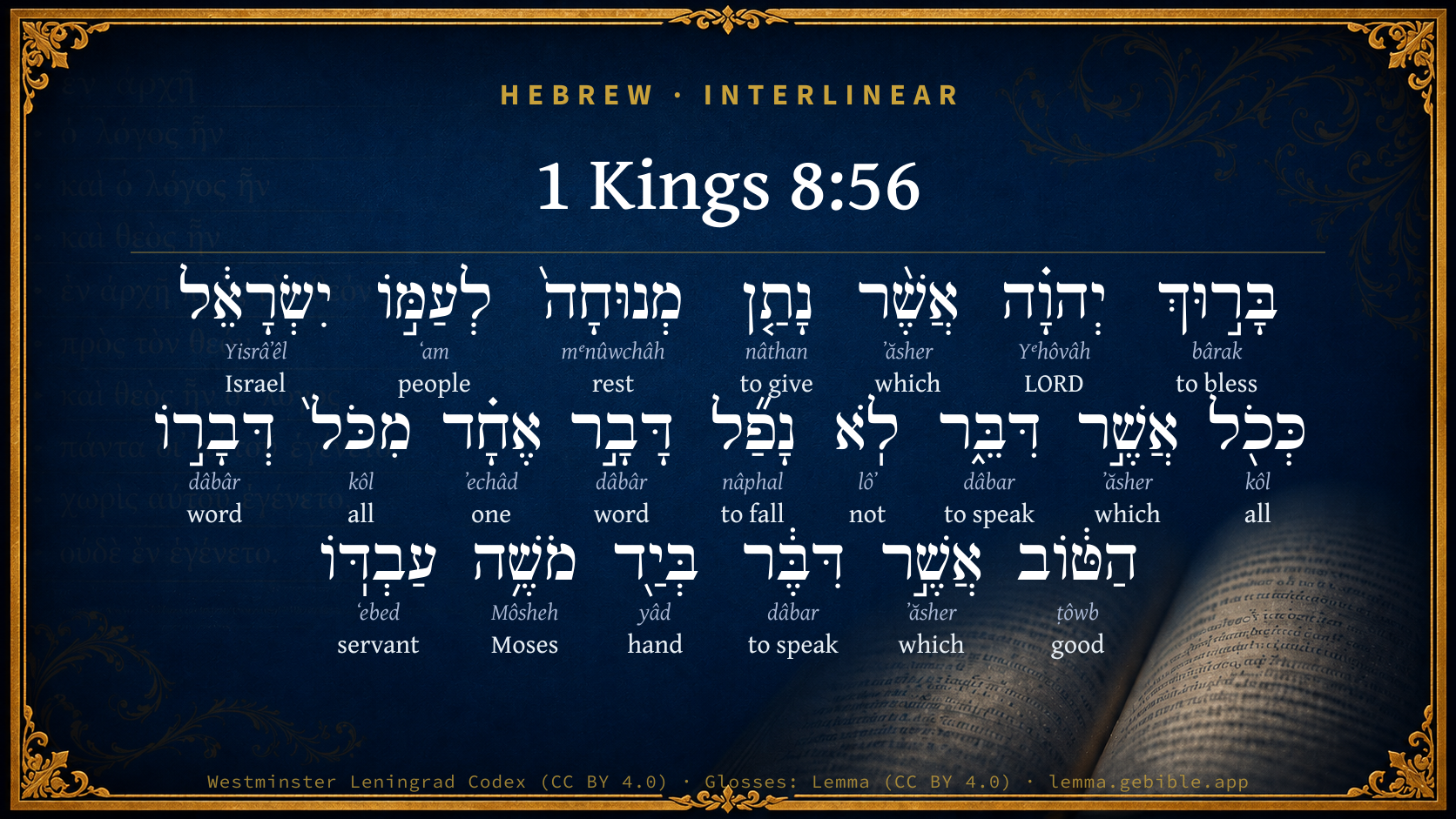
Hebrew (Westminster Leningrad Codex) 1 Kings 8:56 appears in the Hebrew Old Testament. The text above is from the Westminster Leningrad Codex. Each word links to its Strong’s number, a concise gloss, and parsing drawn from the Open Scriptures Hebrew Bible morphology. Click any word for its full Brown-Driver-Briggs (BDB) entry.
Download image
Cite this verse

1 Kings 8:56 (World English Bible). Public Domain. Lemma interlinear Bible study tool, https://lemma.gebible.app/v/1-kings/8/56.

Show BibTeX & RIS
BibTeX
RIS
English Translation
Blessed be Yahweh, who has given rest to his people Israel, according to all that he promised: there has not failed one word of all his good promise, which he promised by Moses his servant.
World English Bible · Public Domain
Download a study sheet

One document with this verse’s original text, its word-by-word gloss line, the meaning frame, cross-references with their text, attributed commentary, and full source and license credits — printable, and it pastes into notes with its structure intact.

This verse Autodidact and up

Study sheet (.html) Plain text (.txt)

A passage Seminary Student

Up to 50 verses in one chapter. A passage sheet keeps up to 6 commentary sources and 12 cross-references per verse, in the order this page ranks them, and says so on the sheet whenever that leaves anything out. Ask for a single verse and you get the Autodidact verse sheet above.

Everything on this page stays free to read, with no account — the sheet is a download of what is already on screen, not access to it.

Want to remove ads? Support Godless Engineer
Compare translations 3

The same verse in 3 English versions, stacked beneath the original-language interlinear above. Click any original word for its lexicon entry.

Each is an independent rendering of the whole verse — the interlinear is not word-aligned to these translations.

Highlighted words mark where these versions differ — a whole-verse word diff, not a word-by-word alignment.

  • World English Bible Public Domain
    Blessed be Yahweh, who has given rest to his people Israel, according to all that he promised: there has not failed one word of all his good promise, which he promised by Moses his servant.
  • King James Version Public Domain
    Blessed be the LORD, that hath given rest unto his people Israel, according to all that he promised: there hath not failed one word of all his good promise, which he promised by the hand of Moses his servant.
  • unfoldingWord Literal Text CC BY-SA 4.0
    “Blessed Yahweh, who has given rest to his people Israel, according to all that he spoke. One word has not fallen from all of his good word that he spoke by the hand of Moses his servant.

unfoldingWord Literal Text — © unfoldingWord, licensed CC BY-SA 4.0. Word-aligned USFM3 via Door43 (git.door43.org/unfoldingWord/en_ult).

Versions to compare (up to 4)

3 of 4 selected

Show all 18 translations

Every available English version of this verse, each an independent rendering of the whole verse.

  • World English Bible Public Domain
    Blessed be Yahweh, who has given rest to his people Israel, according to all that he promised: there has not failed one word of all his good promise, which he promised by Moses his servant.
  • Berean Standard Bible Public Domain
    “Blessed be the LORD, who has given rest to His people Israel according to all that He promised. Not one word has failed of all the good promises He made through His servant Moses.
  • Majority Standard Bible Public Domain
    “Blessed be the LORD, who has given rest to His people Israel according to all that He promised. Not one word has failed of all the good promises He made through His servant Moses.
  • King James Version Public Domain
    Blessed be the LORD, that hath given rest unto his people Israel, according to all that he promised: there hath not failed one word of all his good promise, which he promised by the hand of Moses his servant.
  • American Standard Version (1901) Public Domain
    Blessed be Jehovah, that hath given rest unto his people Israel, according to all that he promised: there hath not failed one word of all his good promise, which he promised by Moses his servant.
  • Revised Version (1885) Public Domain
    Blessed be the LORD, that hath given rest unto his people Israel, according to all that he promised: there hath not failed one word of all his good promise, which he promised by the hand of Moses his servant.
  • Geneva Bible (1599) Public Domain
    Blessed be the Lord that hath giuen rest vnto his people Israel, according to all that hee promised: there hath not fayled one word of all his good promise which he promised by the hand of Moses his seruant.
  • Douay-Rheims (1899) Public Domain
    Blessed be the Lord, who hath given rest to his people Israel, according to all that he promised: there hath not failed so much as one word of all the good things that he promised by his servant Moses.
  • Young's Literal Translation Public Domain
    `Blessed `is' Jehovah who hath given rest to His people Israel, according to all that He hath spoken; there hath not fallen one word of all His good word, which He spake by the hand of Moses his servant.
  • Literal Standard Version CC BY-SA 4.0
    “Blessed [is] YHWH who has given rest to His people Israel, according to all that He has spoken; not [even] one word has fallen of all His good word, which He spoke by the hand of His servant Moses.
  • Unlocked Literal Bible CC BY-SA 4.0
    “May Yahweh be praised, who has given rest to his people Israel, keeping all his promises. Not one word has failed out of all Yahweh's good promises that he made with Moses his servant.
  • unfoldingWord Literal Text CC BY-SA 4.0
    “Blessed Yahweh, who has given rest to his people Israel, according to all that he spoke. One word has not fallen from all of his good word that he spoke by the hand of Moses his servant.
  • Darby Bible Public Domain
    Blessed be Jehovah, who has given rest to his people Israel, according to all that he promised: there has not failed one word of all his good promises which he spoke through Moses his servant!
  • World Messianic Bible Public Domain
    “Blessed be the LORD, who has given rest to his people Israel, according to all that he promised. There has not failed one word of all his good promise, which he promised by Moses his servant.
  • Webster's Bible Public Domain
    Blessed be the LORD, that hath given rest to his people Israel, according to all that he promised: there hath not failed one word of all his good promise, which he promised by the hand of Moses his servant.
  • Free Bible Version CC BY-SA 4.0
    “Praise the Lord, who has given rest to his people Israel in accordance with everything he promised. Not a single word has failed among all the good promises he made through his servant Moses.
  • Bible in Basic English Public Domain
    Praise be to the Lord who has given rest to his people Israel, as he gave them his word to do; every word of all his oath, which he gave by the hand of Moses his servant, has come true.
  • JPS Tanakh (1917) Public Domain
    'Blessed be the LORD, that hath given rest unto His people Israel, according to all that He promised; there hath not failed one word of all His good promise, which He promised by the hand of Moses His servant.

Literal Standard Version (2020), Covenant Press — licensed CC BY-SA 4.0. Text via the HelloAO Bible API (eBible.org). Unlocked Literal Bible (unfoldingWord) — licensed CC BY-SA 4.0. Text via the HelloAO Bible API (eBible.org). unfoldingWord Literal Text — © unfoldingWord, licensed CC BY-SA 4.0. Word-aligned USFM3 via Door43 (git.door43.org/unfoldingWord/en_ult). Free Bible Version, Dr. Jonathan Gallagher — licensed CC BY-SA 4.0. Text via the HelloAO Bible API (eBible.org).

Word by word

More ways to search: Search by grammar → Find every occurrence → Compare this word →

Practice this passage: Drill this verse → Learn its vocabulary →

מְנוּחָה֙
mᵉnûwchâh
H4496
“rest”
Noun, Common, Both, Singular, Absolute
Part of Speech
Noun
Type
Common
Gender
Both
Number
Singular
State
Absolute
Full BDB Definition

Origin: from H4495

TWOT: 1323f

resting place, rest - resting place - rest, quietness
  1. בָּר֣וּךְ bârak H1288 “blessed” Verb, Qal, Participle Passive, Masculine, Singular, Absolute
  2. יְהוָ֗ה Yᵉhôvâh H3068 “LORD” Noun, Proper
  3. אֲשֶׁ֨ר ʼăsher H834 “which” Particle, Relative
  4. נָתַ֤ן nâthan H5414 “to give” Verb, Qal, Perfect, 3rd Person, Masculine, Singular
  5. לְעַמּ֣וֹ ʻam H5971 “to/for · people · his” Preposition + Noun, Common, Masculine, Singular, Construct + Suffix, Personal, 3rd Person, Masculine, Singular
  6. יִשְׂרָאֵ֔ל Yisrâʼêl H3478 “Israel” Noun, Proper
  7. כְּכֹ֖ל kôl H3605 “like/as · all” Preposition + Noun, Common, Masculine, Singular, Absolute
  8. אֲשֶׁ֣ר ʼăsher H834 “which” Particle, Relative
  9. דִּבֵּ֑ר dâbar H1696 “to speak” Verb, Piel, Perfect, 3rd Person, Masculine, Singular
  10. לֹֽא lôʼ H3808 “not” Particle, Negative
  11. נָפַ֞ל nâphal H5307 “to fall” Verb, Qal, Perfect, 3rd Person, Masculine, Singular
  12. דָּבָ֣ר dâbâr H1697 “word” Noun, Common, Masculine, Singular, Absolute
  13. אֶחָ֗ד ʼechâd H259 “one” Adjective, Cardinal number, Masculine, Singular, Absolute
  14. מִכֹּל֙ kôl H3605 “from · all of” Preposition + Noun, Common, Masculine, Singular, Construct
  15. דְּבָר֣וֹ dâbâr H1697 “word · his” Noun, Common, Masculine, Singular, Construct + Suffix, Personal, 3rd Person, Masculine, Singular
  16. הַטּ֔וֹב ṭôwb H2896 “the · good” Particle, Definite Article + Adjective, Adjective, Masculine, Singular, Absolute
  17. אֲשֶׁ֣ר ʼăsher H834 “which” Particle, Relative
  18. דִּבֶּ֔ר dâbar H1696 “to speak” Verb, Piel, Perfect, 3rd Person, Masculine, Singular
  19. בְּיַ֖ד yâd H3027 “in/at · hand of” Preposition + Noun, Common, Both, Singular, Construct
  20. מֹשֶׁ֥ה Môsheh H4872 “Moses” Noun, Proper
  21. עַבְדּֽוֹ ʻebed H5650 “servant · his” Noun, Common, Masculine, Singular, Construct + Suffix, Personal, 3rd Person, Masculine, Singular

About this verse

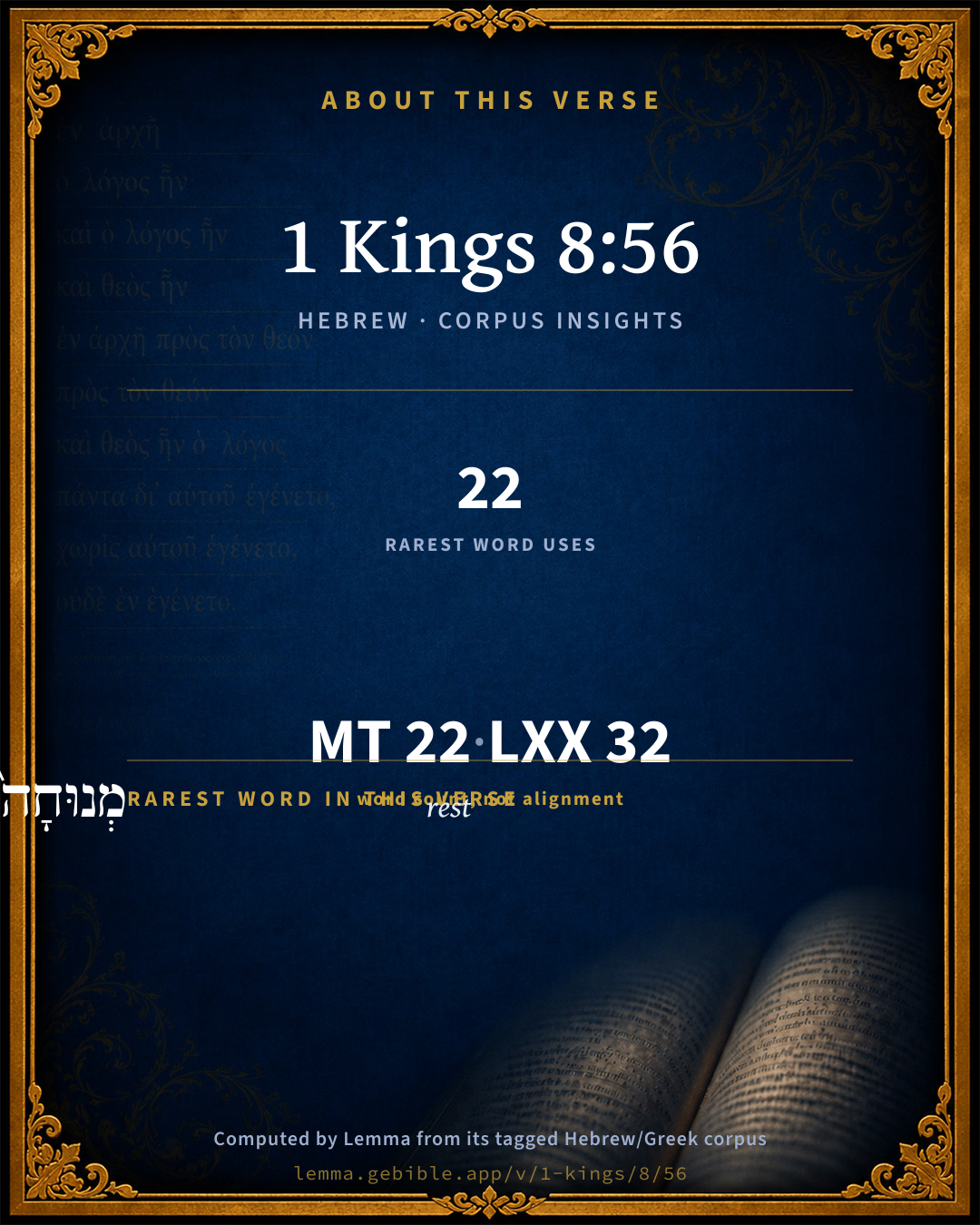
These counts appear in no published source. They are computed here, from the morphology-tagged text and Lemma’s own curated glosses. What Lemma adds →

22
words
17
distinct lemmas
Historical
section

Notable vocabulary

The rarest word here is מְנוּחָה֙ rest H4496 — appearing just 22 times in the whole Hebrew Bible.

Shared distinctive vocabulary

מְנוּחָה֙ rest H4496 occurs in 22 verses of the Hebrew Bible. Also found in:

Grammatical profile

  • 5 verbs
  • 11 nouns
  • 2 adjectives
  • 4 particles

Verb forms

  • בָּר֣וּךְ Qal · Participle Passive
  • נָתַ֤ן Qal · Perfect
  • דִּבֵּ֑ר Piel · Perfect
  • נָפַ֞ל Qal · Perfect
  • דִּבֶּ֔ר Piel · Perfect

Repetition

Words recur within this verse — often emphatic in Hebrew:

  • כְּכֹ֖ל all H3605 ×2
  • דִּבֵּ֑ר to speak H1696 ×2
  • דָּבָ֣ר word H1697 ×2
  • אֲשֶׁ֨ר which H834 ×3

Hebrew & Septuagint length

In English translation the verse runs 35 words from the Hebrew and 41 from the Septuagint (LXX English) — closely comparable.

A rough comparison of the two English renderings, which tokenize alike — not a word-level alignment.

Word counts can differ between the Hebrew and the Greek without any difference in meaning — e.g. the Hebrew direct-object marker אֵת has no separate Greek word, and Greek often adds the article ὁ.

In the original languages it is 22 Hebrew tokens and 32 Greek tokens — but the two are counted differently (Hebrew bundles its prefixes and suffixes into one token; the Greek is in lemma form), so that isn’t a like-for-like length.

Cross-references

12

Topical passages linked to 1 Kings 8:56 in the Treasury of Scripture Knowledge — connected by theme and wording, ordered by reader-vote popularity; previews shown in the World English Bible.

  • Joshua 23:14–15 Behold, this day I am going the way of all the earth: and you know in all your hearts and in all your souls, that not one thing has failed of all the good things which Yahweh your God spoke concerning you; all are happen to you, not one thing has failed of it.
  • Joshua 21:44–45 Yahweh gave them rest round about, according to all that he swore to their fathers: and there stood not a man of all their enemies before them; Yahweh delivered all their enemies into their hand.
  • 1 Samuel 3:19 Samuel grew, and Yahweh was with him, and did let none of his words fall to the ground.
  • Luke 21:33 Heaven and earth will pass away, but my words will by no means pass away.
  • Luke 1:72–73 To show mercy towards our fathers, To remember his holy covenant,
  • 2 Kings 10:10 Know now that there shall fall to the earth nothing of the word of Yahweh, which Yahweh spoke concerning the house of Ahab: for Yahweh has done that which he spoke by his servant Elijah.
  • Deuteronomy 3:20 until Yahweh give rest to your brothers, as to you, and they also possess the land which Yahweh your God gives them beyond the Jordan: then shall you return every man to his possession, which I have given you.
  • Deuteronomy 12:10 But when you go over the Jordan, and dwell in the land which Yahweh your God causes you to inherit, and he gives you rest from all your enemies round about, so that you dwell in safety;
  • Deuteronomy 12:12 You shall rejoice before Yahweh your God, you, and your sons, and your daughters, and your men-servants, and your maid-servants, and the Levite who is within your gates, because he has no portion nor inheritance with you.
  • 2 Chronicles 14:6 He built fortified cities in Judah; for the land was quiet, and he had no war in those years, because Yahweh had given him rest.
  • Luke 1:54–55 He has given help to Israel, his servant, that he might remember mercy,
  • Hebrews 4:3–9 For we who have believed do enter into that rest, even as he has said, "As I swore in my wrath, they will not enter into my rest;" although the works were finished from the foundation of the world.

Cross-references courtesy of OpenBible.info (CC BY 4.0).

Hebrew and Greek witnesses Masoretic Hebrew ↔ Greek Septuagint

The same verse in the two great witnesses to the Old Testament, shown verse-for-verse.

These are two independent witnesses, not word-aligned to each other, and the Septuagint is shown in lemma (dictionary) form.

Hebrew 1 Kings 8:56 Masoretic · Westminster Leningrad Codex

בָּר֣וּךְ יְהוָ֗ה אֲשֶׁ֨ר נָתַ֤ן מְנוּחָה֙ לְעַמּ֣וֹ יִשְׂרָאֵ֔ל כְּכֹ֖ל אֲשֶׁ֣ר דִּבֵּ֑ר לֹֽא נָפַ֞ל דָּבָ֣ר אֶחָ֗ד מִכֹּל֙ דְּבָר֣וֹ הַטּ֔וֹב אֲשֶׁ֣ר דִּבֶּ֔ר בְּיַ֖ד מֹשֶׁ֥ה עַבְדּֽוֹ

Blessed be Yahweh, who has given rest to his people Israel, according to all that he promised: there has not failed one word of all his good promise, which he promised by Moses his servant.

World English Bible · Public Domain

Greek LXX 1 Kings 8:56 Septuagint · lemma form

εὐλογητός κύριος σήμερον ὅς δίδωμι κατάπαυσις ὁ λαός αὐτός ἰσραήλ κατά πᾶς ὅσος λαλέω οὐ διαφωνέω λόγος εἷς ἐν πᾶς ὁ λόγος αὐτός ὁ ἀγαθός ὅς λαλέω ἐν χείρ μωυσῆς δοῦλος αὐτός

Blessed be the Lord this day, who has given rest to his people Israel, according to all that he said: there has not failed one word among all his good words which he spoke by the hand of his servant Moses.

LXX2012 (modern English Septuagint) · Public Domain

On this verse, The Cambridge Bible for Schools and Colleges discusses the Septuagint’s reading. Read the note in Commentary ↓

Hebrew: Westminster Leningrad Codex (CC BY 4.0). Greek: Septuagint (public domain); English from LXX2012 (modern English Septuagint) (Public Domain). How the Septuagint differs from the Hebrew →

Targum (Aramaic paraphrase)

1

The Targum is the ancient Jewish Aramaic paraphrase of the Hebrew Scriptures — an interpretive translation, not the Hebrew text itself. Onkelos (literal) and Pseudo-Jonathan (expansive) render the Torah, and Jonathan the Prophets. Coverage is partial: where no permissively-licensed English translation exists for a verse, only the Aramaic is shown. This is verse-level text, not a word-by-word alignment to the Hebrew.

  1. Targum Jonathan Prophets (Joshua–Malachi)
    בְּרִיךְ יְיָ דִי יְהִיב נְיָחָא לְעַמֵיהּ יִשְׂרָאֵל כְּכָל דִי מַלֵיל לָא בְּטִיל פִּתְגָמָא חַד מִכָּל פִּתְגָמוֹהִי תַקְנַיָא דִי מַלֵיל בִּידָא דְמֹשֶׁה עַבְדֵיהּ:

    (no public-domain English translation for this verse)

    Targum Jonathan — Aramaic: “Mikraot Gedolot” (public domain). English: “Sefaria Community Translation” (CC0 1.0 (public-domain dedication)); “London "Chaldee Paraphrase," 1871” (public domain). Text via Sefaria.

Commentary

Notes on 1 Kings 8:56 from classic Christian and Jewish commentators (each source and its license shown beneath its notes). The classic Christian expositions comment on the surrounding passage and are grouped to its opening verse, so a note may address several verses; the Jewish commentaries on the Tanakh (Rashi and others) are per-verse, so they appear only where the commentator wrote on this verse.

Lemma curates 59 commentaries, every one of them public domain or Creative Commons licensed, each selected and text-cleaned for this edition rather than reprinted as found. About our sources →

Trapp's Complete Commentary

John Trapp

1Ki 8:56 Blessed [be] the LORD, that hath given rest unto his people Israel, according to all that he promised: there hath not failed one word of all his good promise, which he promised by the hand of Moses his servant.

Ver. 56. Blessed be the Lord.] Praemittit gratiarum actionem benedictioni.

John Trapp, A Commentary or Exposition upon All the Books of the Old and New Testament (1647–1656) — public domain. Text from a community e-Sword module.

Ellicott's Commentary for English Readers

(56) That hath given rest.—Now for the first time the frequent promise of rest (Exo_33:14; Deu_12:10, &c.)—partially fulfilled after the conquest of the days of Joshua (Jos_21:44-45; Jos_23:1; Jos_23:14), and after the establishment of the kingdom of David (2Sa_7:1)—was perfectly accomplished under Solomon the Peaceful, and the whole charter of gift of the promised land (Jos_1:3-4) for the first time thoroughly entered upon. Of the “rest” of Israel, the transfer of the Ark of the Lord from the shifting Tabernacle to the fixed Temple was at once a sign and a pledge. Yet Solomon’s subsequent words imply that “entering into that rest” was conditional on fulfilment of Israel’s part in the covenant, by “walking in the ways of the Lord.” That condition, which he knew so well, he himself broke, and all Israel with him. Hence the fulfilment of the foreboding which emerges so constantly in his prayer. The glory of rest and happiness of his age was but a gleam of prosperity, soon to be swallowed up in dissension and disaster.

A Bible Commentary for English Readers, edited by Charles John Ellicott (1878–1897) — public domain. Text from a community e-Sword module.

The Cambridge Bible for Schools and Colleges

gen. ed. J. J. S. Perowne

56. that hath given rest unto his people] For Solomon’s reign was to be specially a time of peace (cf. 1Ki_2:33), and it was only in a time of profound tranquillity that the great works of the Temple and the king’s house could have been carried out. This no doubt was the idea of the LXX., who make this verse commence ‘Blessed be the Lord to-day.’

The Cambridge Bible for Schools and Colleges (gen. ed. J. J. S. Perowne; Cambridge University Press, 1878–1918) — public domain. Text from a community e-Sword module.

John Gill's Exposition

The Lord our God be with us as he was with our fathers,.... Abraham, Isaac, and Jacob, and those that came out of Egypt, and especially that entered into the land of Canaan under Joshua, and subdued it; as the Lord had been with them to guide and direct them, protect and defend them, succeed and prosper them, so Solomon desires he might be with them: nothing is more desirable than the presence of God; Solomon could not have prayed for a greater blessing for himself and his people; the Targum is,

"let the Word of the Lord our God be for our help, as he was for the help of our fathers:''

let him not leave us, nor forsake us: this was no doubt a prayer of faith, founded upon a divine promise, Jos 1:5.

John Gill's Exposition of the Whole Bible (1746–1763) — public domain (CC PDM 1.0). Text via the HelloAO Bible API.

Matthew Poole's English Annotations

There hath not failed one word of all his good promise: see the like Jos 21:45; 23:14; 2Ki 10:10.

Matthew Poole's English Annotations on the Holy Bible (1683–1685) — public domain. Text from a community e-Sword/MySword module.

The Pulpit Commentary

Blessed be the Lord, that hath given rest unto his people Israel, according to all that he promised a distinct reference to Deu_12:9, 10 (cf. 3:20), where we read that when the Lord should have given rest to Israel, then a place for sacrifice, etc., should be appointed (ver. 11). That place is now dedicated, and the king sees in this circumstance a proof that the rest is now at last fully attained. The permanent sanctuary is a pledge of settlement in the land. The rest hitherto enjoyed (Jos_21:44) had been but partial. Only under Solomon were the Philistines brought into complete subjection, 1Ki_9:16) and hitherto the ark had dwelt in curtains); there hath not failed Heb. fallen; 1Sa_3:19 one word a clear reference to Jos_21:45, asthe preceding words are to ver. 44 of all his good promise, which he promised by the hand (cf. ver. 53) of Moses his servant viz. in Lev_26:3-13, and in Deu_28:1-14, i.e., in the chapters which are the sources of this prayer, etc.

The Pulpit Commentary (1880–1919), ed. H.D.M. Spence-Jones & Joseph S. Exell — public domain. Text from a community e-Sword module.

John Wesley's Explanatory Notes

Blessed, &c. - This discharge he gives in the name of all Israel, to the everlasting honour of the Divine faithfulness, and the everlasting encouragement of all those that build upon the Divine promises.

John Wesley, Explanatory Notes Upon the Whole Bible (1754–1765) — public domain. Text via the GEBible commentary corpus.

Keil & Delitzsch

C. F. Keil & F. Delitzsch

The praise of Jehovah rests, so far as the first part is concerned, upon the promise in Deu 12:9-10, and upon its fulfilment in Jos 21:44-45 and Jos 23:14; and the second part is founded upon Lev 26:3-13 and Deu 28:1-14, where the "good word, which the Lord spake by Moses," is more precisely described as the blessing which the Lord had promised to His people and had hitherto bestowed upon them. He had already given Israel rest by means of Joshua when the land of Canaan was taken; but since many parts of the land still remained in the hands of the Canaanites, this rest was only fully secured to them by David's victories over all their enemies. This glorious fulfilment warranted the hope that the Lord would also fulfil in the future what He had promised His servant David (Sa2 7:10), if the people themselves would only faithfully adhere to their God. Solomon therefore sums up all his wishes for the good of the kingdom in Kg1 8:57-61 in the words, "May Jehovah our God be with us, as He was with our fathers; may He not leave us nor forsake us, to incline our heart to Himself, that we may walk in all His ways," etc. - that the evil words predicted by Moses in Lev 26:14., Deu 28:15, may not fall upon us. For Kg1 8:57 compare Deu 31:6, Deu 31:8, and Jos 1:5. יטּשׁנוּ אל corresponds to ירפּך אל in these passages. In the Pentateuch נטשׁ is used but once of men who forsake the Lord, viz., Deu 32:15; in other cases it is only used in the general sense of casting away, letting alone, and other similar meanings. It is first used of God, in the sense of forsaking His people, in Psa 27:9 in connection with עזב; and it frequently occurs afterwards in Jeremiah.

Keil & Delitzsch — Biblical Commentary on the Old Testament (1861–1891) — public domain (CC PDM 1.0). Text via the HelloAO Bible API. (Old Testament only.)

Rashi

Rabbi Shlomo Yitzchaki (Rashi)

Like all that He had said. And where did He speak? “And He will grant you rest from all your enemies.”

Rashi on the Tanakh — English translations: “The Judaica Press complete Tanach with Rashi, translated by A. J. Rosenberg” (CC BY 4.0); “Pentateuch with Rashi's commentary by M. Rosenbaum and A.M. Silbermann, 1929-1934” (public domain); “The Metsudah Tanach series, Lakewood, N.J” (CC BY 4.0); and “The Book of Joshua, Metsudah Publications, 1997” (CC BY 4.0). Text via Sefaria.

Lesson kit

Teaching starters — assembled from the data on this page, not authored interpretation. Every prompt links to the verse data it draws on. Edit before teaching.

1 Kings, in the Historical, opens this verse with 22 words (17 distinct Hebrew lemmas). Its most distinctive word is mᵉnûwchâh (“rest”). A historical commentator’s framing appears above. Read the whole chapter for the surrounding context.

Discussion questions

  1. How does “rest” (mᵉnûwchâh) shape what this verse is saying?
  2. Genesis 49:15 shares the word «rest» with this verse. How do the two illuminate each other?
  3. “all” occurs 2× in this one verse. What is the effect of the repetition?
  4. These translations render this verse differently; the difference is in the English rendering, not the original. What questions does that raise?
  5. The verb «בָּר֣וּךְ» is Qal Participle Passive. How does its form color the action?
  6. Reading how Trapp's Complete Commentary and Ellicott's Commentary for English Readers read this verse, where do the two commentators agree and where do they part?

Things to notice

Reading settings

Reading text

Shown beneath each verse's original-language words.

Old Testament
Old Testament edition

Read the OT as the Masoretic Hebrew (MT) or the Greek Septuagint (LXX).

English shown for the Greek Septuagint (in the Hebrew ↔ Greek comparison).

Comparing translations? Open the Compare panel on any verse page to stack up to four side by side.