Ezekiel 47:14

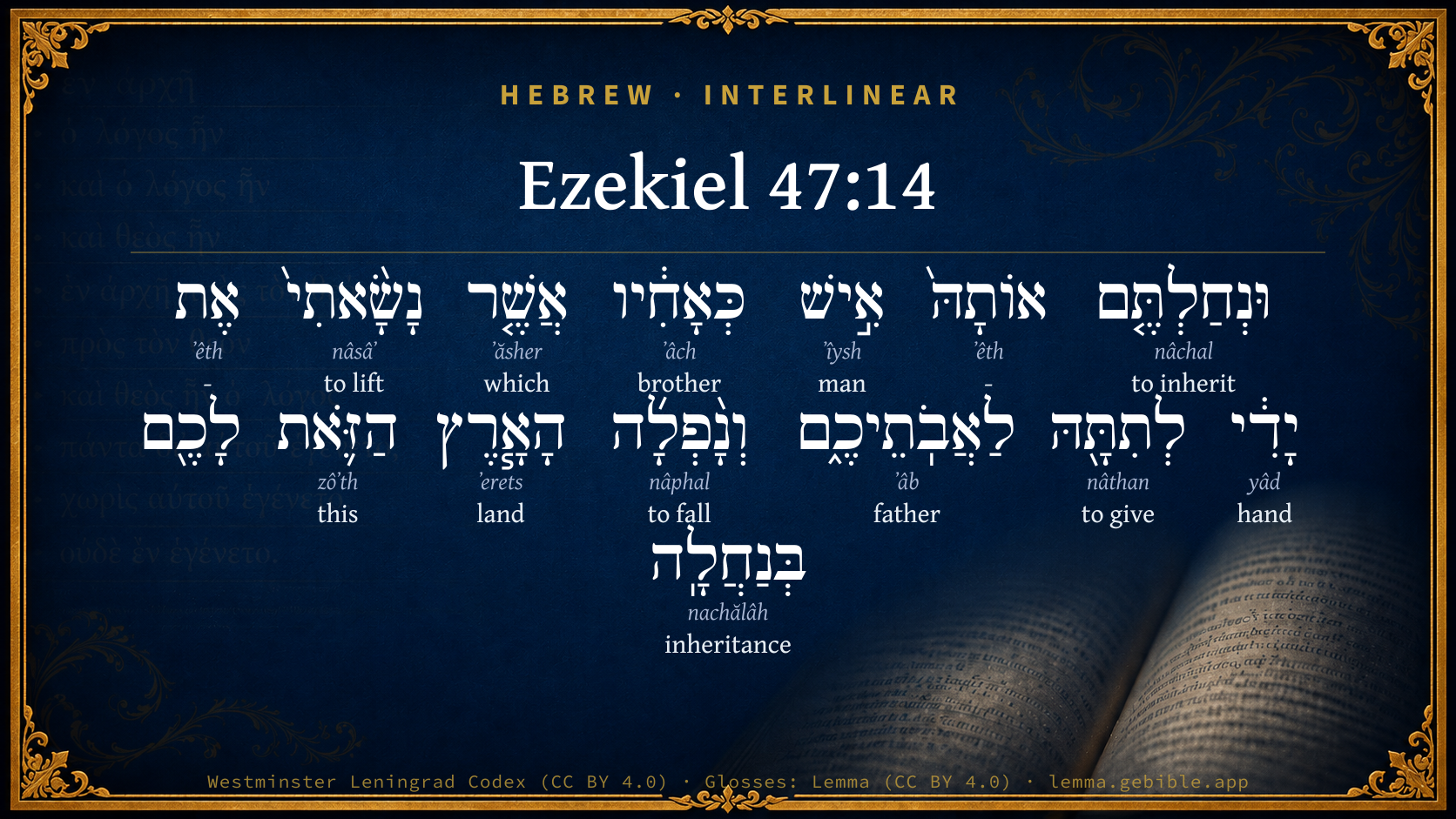
Hebrew (Westminster Leningrad Codex) Ezekiel 47:14 appears in the Hebrew Old Testament. The text above is from the Westminster Leningrad Codex. Each word links to its Strong’s number, a concise gloss, and parsing drawn from the Open Scriptures Hebrew Bible morphology. Click any word for its full Brown-Driver-Briggs (BDB) entry.
Download image
Cite this verse

Ezekiel 47:14 (World English Bible). Public Domain. Lemma interlinear Bible study tool, https://lemma.gebible.app/v/ezekiel/47/14.

Show BibTeX & RIS
BibTeX
RIS
English Translation
You shall inherit it, one as well as another; for I swore to give it to your fathers: and this land shall fall to you for inheritance.
World English Bible · Public Domain
Download a study sheet

One document with this verse’s original text, its word-by-word gloss line, the meaning frame, cross-references with their text, attributed commentary, and full source and license credits — printable, and it pastes into notes with its structure intact.

This verse Autodidact and up

Study sheet (.html) Plain text (.txt)

A passage Seminary Student

Up to 50 verses in one chapter. A passage sheet keeps up to 6 commentary sources and 12 cross-references per verse, in the order this page ranks them, and says so on the sheet whenever that leaves anything out. Ask for a single verse and you get the Autodidact verse sheet above.

Everything on this page stays free to read, with no account — the sheet is a download of what is already on screen, not access to it.

Want to remove ads? Support Godless Engineer
Compare translations 3

The same verse in 3 English versions, stacked beneath the original-language interlinear above. Click any original word for its lexicon entry.

Each is an independent rendering of the whole verse — the interlinear is not word-aligned to these translations.

Highlighted words mark where these versions differ — a whole-verse word diff, not a word-by-word alignment.

  • World English Bible Public Domain
    You shall inherit it, one as well as another; for I swore to give it to your fathers: and this land shall fall to you for inheritance.
  • King James Version Public Domain
    And ye shall inherit it, one as well as another: concerning the which I lifted up mine hand to give it unto your fathers: and this land shall fall unto you for inheritance.
  • unfoldingWord Literal Text CC BY-SA 4.0
    You are to divide equally what I lifted up my hand and swore to give to your fathers. This land will come to you as an inheritance.

unfoldingWord Literal Text — © unfoldingWord, licensed CC BY-SA 4.0. Word-aligned USFM3 via Door43 (git.door43.org/unfoldingWord/en_ult).

Versions to compare (up to 4)

3 of 4 selected

Show all 18 translations

Every available English version of this verse, each an independent rendering of the whole verse.

  • World English Bible Public Domain
    You shall inherit it, one as well as another; for I swore to give it to your fathers: and this land shall fall to you for inheritance.
  • Berean Standard Bible Public Domain
    You are to divide it equally among them. Because I swore with an uplifted hand to give it to your forefathers, this land will fall to you as an inheritance.
  • Majority Standard Bible Public Domain
    You are to divide it equally among them. Because I swore with an uplifted hand to give it to your forefathers, this land will fall to you as an inheritance.
  • King James Version Public Domain
    And ye shall inherit it, one as well as another: concerning the which I lifted up mine hand to give it unto your fathers: and this land shall fall unto you for inheritance.
  • American Standard Version (1901) Public Domain
    And ye shall inherit it, one as well as another; for I sware to give it unto your fathers: and this land shall fall unto you for inheritance.
  • Revised Version (1885) Public Domain
    And ye shall inherit it, one as well as another; concerning the which I lifted up mine hand to give it unto your fathers: and this land shall fall unto you for inheritance.
  • Geneva Bible (1599) Public Domain
    And ye shall inherite it, one as well as another: concerning the which I lift vp mine hand to giue it vnto your fathers, and this lande shall fall vnto you for inheritance.
  • Douay-Rheims (1899) Public Domain
    And you shall possess it, every man in like manner as his brother: concerning which I lifted up my hand to give it to your fathers: and this land shall fall unto you for a possession.
  • Young's Literal Translation Public Domain
    And ye have inherited it, one as well as another, in that I have lifted up My hand to give it to your fathers; and this land hath fallen to you in inheritance.
  • Literal Standard Version CC BY-SA 4.0
    And you have inherited it, one as well as another, in that I have lifted up My hand to give it to your fathers; and this land has fallen to you in inheritance.
  • Unlocked Literal Bible CC BY-SA 4.0
    You are to divide equally what I lifted up my hand and swore to give to your fathers. This land will come to you as an inheritance.
  • unfoldingWord Literal Text CC BY-SA 4.0
    You are to divide equally what I lifted up my hand and swore to give to your fathers. This land will come to you as an inheritance.
  • Darby Bible Public Domain
    And ye shall inherit it, one as well as another, [the land] concerning which I lifted up my hand to give it unto your fathers; and this land shall fall to you for inheritance.
  • World Messianic Bible Public Domain
    You shall inherit it, one as well as another; for I swore to give it to your fathers. This land will fall to you for inheritance.
  • Webster's Bible Public Domain
    And ye shall inherit it, one as well as another: concerning which I lifted up my hand to give it to your fathers: and this land shall fall to you for inheritance.
  • Free Bible Version CC BY-SA 4.0
    You are to allocate the land to them equally. I held up my hand and made a solemn promise to give it to your forefathers, so this land will come to you to own and to pass on as an inheritance.
  • Bible in Basic English Public Domain
    And you are to make an equal division of it; as I gave my oath to your fathers to give it to you: for this land is to be your heritage.
  • JPS Tanakh (1917) Public Domain
    And ye shall inherit it, one as well as another, concerning which I lifted up My hand to give it unto your fathers; and this land shall fall unto you for inheritance.

Literal Standard Version (2020), Covenant Press — licensed CC BY-SA 4.0. Text via the HelloAO Bible API (eBible.org). Unlocked Literal Bible (unfoldingWord) — licensed CC BY-SA 4.0. Text via the HelloAO Bible API (eBible.org). unfoldingWord Literal Text — © unfoldingWord, licensed CC BY-SA 4.0. Word-aligned USFM3 via Door43 (git.door43.org/unfoldingWord/en_ult). Free Bible Version, Dr. Jonathan Gallagher — licensed CC BY-SA 4.0. Text via the HelloAO Bible API (eBible.org).

Word by word

More ways to search: Search by grammar → Find every occurrence → Compare this word →

Practice this passage: Drill this verse → Learn its vocabulary →

וּנְחַלְתֶּ֤ם
nâchal
H5157
“and · to inherit”
Conjunction + Verb, Qal, Sequential Perfect, 2nd Person, Masculine, Plural
Part of Speech
Conjunction + Verb
Stem
Qal
Form
Sequential Perfect
Person
2nd Person
Gender
Masculine
Number
Plural
Full BDB Definition

Origin: a primitive root

TWOT: 1342

to get as a possession, acquire, inherit, possess - (Qal) - to take possession, inherit - to have or get as a possession or property (figuratively) - to divide the land for a possession - to acquire (testimonies) (figuratively) - (Piel) to divide for a possession - (Hithpael) to possess oneself of - (Hiphil) - to give as a possession - to cause to inherit, give as an inheritance - (Hophal) to be allotted, be made to possess
  1. אוֹתָהּ֙ ʼêth H853 “- · her” Particle, Direct Object + Suffix, Personal, 3rd Person, Feminine, Singular
  2. אִ֣ישׁ ʼîysh H376 “man” Noun, Common, Masculine, Singular, Absolute
  3. כְּאָחִ֔יו ʼâch H251 “like/as · brother · his” Preposition + Noun, Common, Masculine, Singular, Construct + Suffix, Personal, 3rd Person, Masculine, Singular
  4. אֲשֶׁ֤ר ʼăsher H834 “which” Particle, Relative
  5. נָשָׂ֨אתִי֙ nâsâʼ H5375 “to lift” Verb, Qal, Perfect, 1st Person, Common, Singular
  6. אֶת ʼêth H853 “-” Particle, Direct Object
  7. יָדִ֔י yâd H3027 “hand · my” Noun, Common, Both, Singular, Construct + Suffix, Personal, 1st Person, Common, Singular
  8. לְתִתָּ֖הּ nâthan H5414 “to give · her” Preposition + Verb, Qal, Infinitive Construct + Suffix, Personal, 3rd Person, Feminine, Singular
  9. לַאֲבֹֽתֵיכֶ֑ם ʼâb H1 “to/for · fathers · your” Preposition + Noun, Common, Masculine, Plural, Construct + Suffix, Personal, 2nd Person, Masculine, Plural
  10. וְנָ֨פְלָ֜ה nâphal H5307 “and · to fall” Conjunction + Verb, Qal, Sequential Perfect, 3rd Person, Feminine, Singular
  11. הָאָ֧רֶץ ʼerets H776 “the · land” Particle, Definite Article + Noun, Common, Both, Singular, Absolute
  12. הַזֹּ֛את zôʼth H2063 “the · this” Particle, Definite Article + Pronoun, Demonstrative, Feminine, Singular
  13. בְּנַחֲלָֽה nachălâh H5159 “in/at · inheritance” Preposition + Noun, Common, Feminine, Singular, Absolute

About this verse

These counts appear in no published source. They are computed here, from the morphology-tagged text and Lemma’s own curated glosses. What Lemma adds →

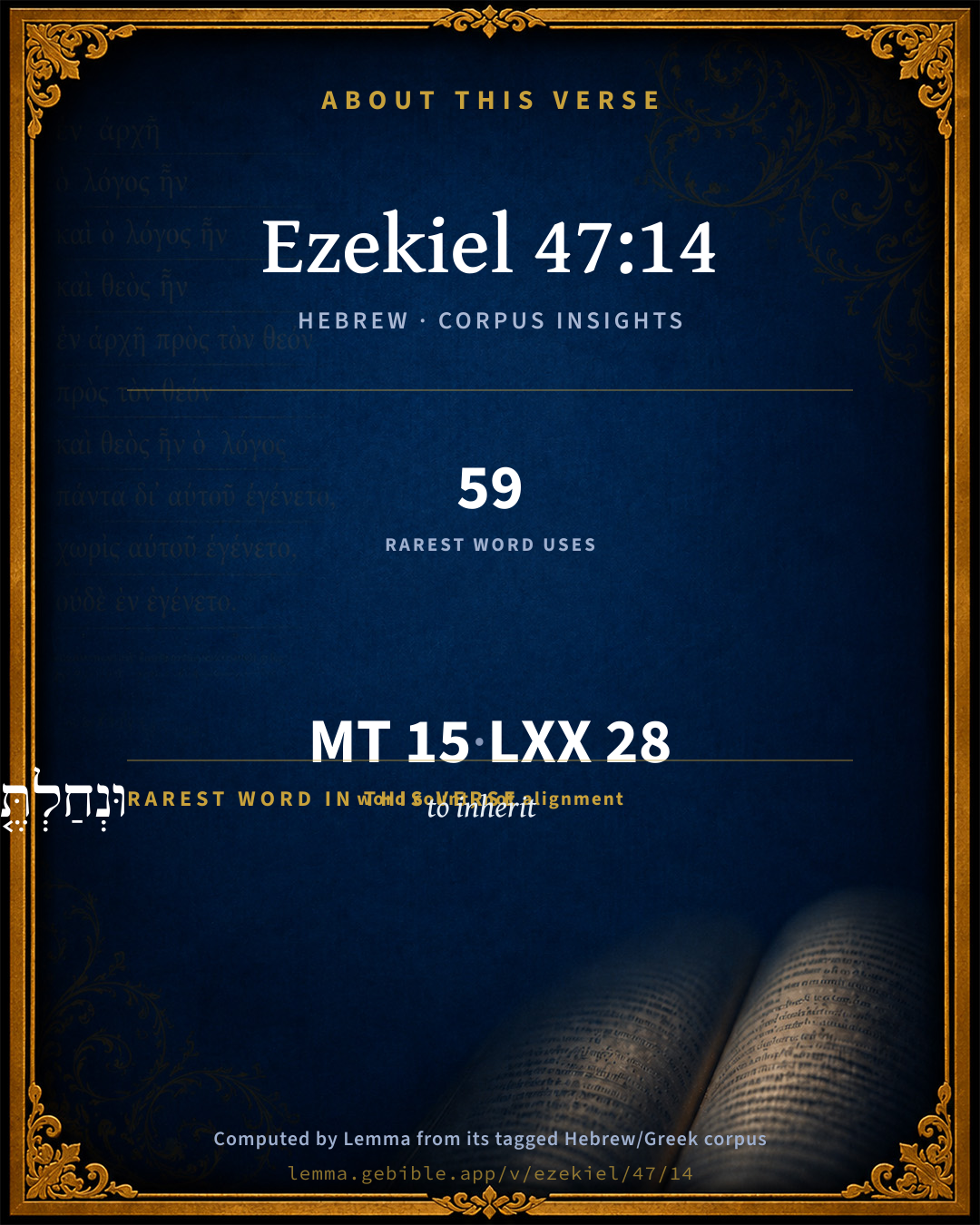
15
words
13
distinct lemmas
Prophets
section

Shared distinctive vocabulary

וּנְחַלְתֶּ֤ם to inherit H5157 occurs in 57 verses of the Hebrew Bible. Also found in:

Grammatical profile

  • 4 verbs
  • 6 nouns
  • 1 pronoun
  • 1 preposition
  • 3 particles

Verb forms

  • וּנְחַלְתֶּ֤ם Qal · Sequential Perfect
  • נָשָׂ֨אתִי֙ Qal · Perfect
  • לְתִתָּ֖הּ Qal · Infinitive Construct
  • וְנָ֨פְלָ֜ה Qal · Sequential Perfect

Hebrew & Septuagint length

In English translation the verse runs 27 words from the Hebrew and 36 from the Septuagint (LXX English) — closely comparable.

A rough comparison of the two English renderings, which tokenize alike — not a word-level alignment.

Word counts can differ between the Hebrew and the Greek without any difference in meaning — e.g. the Hebrew direct-object marker אֵת has no separate Greek word, and Greek often adds the article ὁ.

In the original languages it is 15 Hebrew tokens and 28 Greek tokens — but the two are counted differently (Hebrew bundles its prefixes and suffixes into one token; the Greek is in lemma form), so that isn’t a like-for-like length.

Cross-references

14

Topical passages linked to Ezekiel 47:14 in the Treasury of Scripture Knowledge — connected by theme and wording, ordered by reader-vote popularity; previews shown in the World English Bible.

  • Genesis 12:7 Yahweh appeared to Abram, and said, "I will give this land to your seed." He built an altar there to Yahweh, who appeared to him.
  • Ezekiel 20:5–6 and tell them, Thus says the Lord Yahweh: In the day when I chose Israel, and swore to the seed of the house of Jacob, and made myself known to them in the land of Egypt, when I swore to them, saying, I am Yahweh your God;
  • Ezekiel 48:29 This is the land which you shall divide by lot to the tribes of Israel for inheritance, and these are their several portions, says the Lord Yahweh.
  • Genesis 13:15 for all the land which you see, I will give to you, and to your offspring forever.
  • Genesis 15:7 He said to him, "I am Yahweh who brought you out of Ur of the Chaldees, to give you this land to inherit it."
  • Genesis 17:8 I will give to you, and to your seed after you, the land where you are traveling, all the land of Canaan, for an everlasting possession. I will be their God."
  • Genesis 26:3 Sojourn in this land, and I will be with you, and will bless you. For to you, and to your seed, I will give all these lands, and I will establish the oath which I swore to Abraham your father.
  • Genesis 28:13 Behold, Yahweh stood above it, and said, "I am Yahweh, the God of Abraham your father, and the God of Isaac. The land whereon you lie, to you will I give it, and to your seed.
  • Numbers 14:16 Because Yahweh was not able to bring this people into the land which he swore to them, therefore he has slain them in the wilderness.
  • Numbers 14:30 surely you shall not come into the land, concerning which I swore that I would make you dwell therein, save Caleb the son of Jephunneh, and Joshua the son of Nun.
  • Deuteronomy 1:8 Behold, I have set the land before you: go in and possess the land which Yahweh swore to your fathers, to Abraham, to Isaac, and to Jacob, to give to them and to their seed after them.
  • Proverbs 16:33 The lot is cast into the lap, But its every decision is from Yahweh.
  • Ezekiel 20:28 For when I had brought them into the land, which I swore to give to them, then they saw every high hill, and every thick tree, and they offered there their sacrifices, and there they presented the provocation of their offering; there also they made their sweet savor, and they poured out there their drink-offerings.
  • Ezekiel 20:42 You shall know that I am Yahweh, when I shall bring you into the land of Israel, into the country which I swore to give to your fathers.

Cross-references courtesy of OpenBible.info (CC BY 4.0).

Hebrew and Greek witnesses Masoretic Hebrew ↔ Greek Septuagint

The same verse in the two great witnesses to the Old Testament, shown verse-for-verse.

These are two independent witnesses, not word-aligned to each other, and the Septuagint is shown in lemma (dictionary) form.

Hebrew Ezekiel 47:14 Masoretic · Westminster Leningrad Codex

וּנְחַלְתֶּ֤ם אוֹתָהּ֙ אִ֣ישׁ כְּאָחִ֔יו אֲשֶׁ֤ר נָשָׂ֨אתִי֙ אֶת יָדִ֔י לְתִתָּ֖הּ לַאֲבֹֽתֵיכֶ֑ם וְנָ֨פְלָ֜ה הָאָ֧רֶץ הַזֹּ֛את לָכֶ֖ם בְּנַחֲלָֽה

You shall inherit it, one as well as another; for I swore to give it to your fathers: and this land shall fall to you for inheritance.

World English Bible · Public Domain

Greek LXX Ezekiel 47:14 Septuagint · lemma form

καί κατακληρονομέω αὐτός ἕκαστος καθώς ὁ ἀδελφός αὐτός εἰς ὅς αἴρω ὁ χείρ ἐγώ ὁ δίδωμι αὐτός ὁ πατήρ αὐτός καί πίπτω ὁ γῆ οὗτος σύ ἐν κληρονομία

And you⌃ shall inherit it, each according to his brother's portion, even the land concerning which I lifted up my hand to give it to your fathers: and this land shall fall to you by lot.

LXX2012 (modern English Septuagint) · Public Domain

Hebrew: Westminster Leningrad Codex (CC BY 4.0). Greek: Septuagint (public domain); English from LXX2012 (modern English Septuagint) (Public Domain). How the Septuagint differs from the Hebrew →

Targum (Aramaic paraphrase)

1

The Targum is the ancient Jewish Aramaic paraphrase of the Hebrew Scriptures — an interpretive translation, not the Hebrew text itself. Onkelos (literal) and Pseudo-Jonathan (expansive) render the Torah, and Jonathan the Prophets. Coverage is partial: where no permissively-licensed English translation exists for a verse, only the Aramaic is shown. This is verse-level text, not a word-by-word alignment to the Hebrew.

  1. Targum Jonathan Prophets (Joshua–Malachi)
    וְתַחְסְנוּן יָתָהּ גְבַר כַּאֲחוֹהִי דִי קַיְמֵית בְּמֵימְרִי לְמִתְּנָהּ לַאֲבָהַתְכוֹן וְתִתְפְּלֵיג אַרְעָא הָדָא לְכוֹן בְּאַחֲסָנָא:

    (no public-domain English translation for this verse)

    Targum Jonathan — Aramaic: “Mikraot Gedolot” (public domain). English: “Sefaria Community Translation” (CC0 1.0 (public-domain dedication)); “London "Chaldee Paraphrase," 1871” (public domain). Text via Sefaria.

Commentary

Notes on Ezekiel 47:14 from classic Christian and Jewish commentators (each source and its license shown beneath its notes). The classic Christian expositions comment on the surrounding passage and are grouped to its opening verse, so a note may address several verses; the Jewish commentaries on the Tanakh (Rashi and others) are per-verse, so they appear only where the commentator wrote on this verse.

Lemma curates 59 commentaries, every one of them public domain or Creative Commons licensed, each selected and text-cleaned for this edition rather than reprinted as found. About our sources →

Trapp's Complete Commentary

John Trapp

Eze 47:14 And ye shall inherit it, one as well as another: [concerning] the which I lifted up mine hand to give it unto your fathers: and this land shall fall unto you for inheritance.

Ver. 14. And ye shall inherit one as well as another.] Spiritual blessings are divided in solidum in gold coin among the community of God’s people; they all partake of one and the same saving grace of God, righteousness of Christ, and eternal life, though there are several degrees of grace and of glory. See Gal 3:26-29. All God’s sons are heirs, heirs of God, and co-heirs with Christ. {Rom 8:17}

John Trapp, A Commentary or Exposition upon All the Books of the Old and New Testament (1647–1656) — public domain. Text from a community e-Sword module.

Joseph Benson's Commentary

Eze 47:14. And ye shall inherit it, one as well as another — Namely, the ten tribes which are scattered abroad as well as Judah and Benjamin. These two tribes, together with some of the families of the tribe of Levi, made up the principal part of those who returned from the Babylonish captivity; by which it appears, that this prophecy has not yet been fulfilled, but relates to the general restoration of the Jews and Israelites, an event often foretold in the prophecies of the Old Testament. And this land shall fall unto you for inheritance — Here is an allusion to the manner of their first acquiring the possession of the land, which was by lot, by which means all controversies were prevented, the lot referring all things to the divine designation and appointment.

Joseph Benson's Commentary on the Old and New Testaments (1811–1818) — public domain. Text from a community e-Sword module.

Ellicott's Commentary for English Readers

(14) One as well as another.—This is the ordinary expression for equality. Unlike the former division of the laud, the territory is to be arranged in twelve equal portions. This is generally understood to mean that the strips of territory assigned to each tribe shall be of equal width, and such is undoubtedly the prophet’s meaning, since the vision throughout makes little account of the natural features of the country. It may be well to notice in passing, however, that the actual area of the territory given to the tribes is thus made very unequal. The country was nearly three times as broad at the south as at the north, and the southern tribes would thus have actually nearly three times as much land as the northern, although they were ideally equal. Were the portions to be made actually equal, the map given under Ezekiel 48 would be much changed. Such an arrangement would move the “oblation” farther south and give it ample room between east and west. Its north line would be a little north of Jerusalem, and its south within ten or twelve miles of Beersheba, and the Temple would be situated a few miles north-west of Hebron and still on the western watershed.

A Bible Commentary for English Readers, edited by Charles John Ellicott (1878–1897) — public domain. Text from a community e-Sword module.

John Gill's Exposition

And ye shall inherit it, one as well as another,.... That is, the twelve tribes shall equally inherit it; one tribe shall not have more, and another less, but each alike: this was not the case, at the division of the land, in the times of Moses and Joshua; for to such tribes as were very numerous a greater inheritance was given; and to those that were fewer in number a lesser inheritance, Num 26:54, and upon the return from the Babylonish captivity, as the tribes of Judah and Benjamin were the largest, and indeed the only tribes that returned as such, they had the share of the land; but as this respects the dispensation, it signifies, that those who are true Israelites indeed shall share in the same Gospel church state, the privileges and immunities of it alike, with all the blessings of grace and eternal glory; they being all one in Christ Jesus, Gal 3:28,

concerning the which I lifted up my hand to give it unto your fathers; that is, swore that he would give unto them the land of Canaan; typical of the Gospel church state and the heavenly glory; which are as sure to all the seed, by the word and oath of God, as that was:

and this land shall fall unto you for inheritance; by lot, by the appointment of God, and a goodly one it is, Psa 16:6.

John Gill's Exposition of the Whole Bible (1746–1763) — public domain (CC PDM 1.0). Text via the HelloAO Bible API.

Albert Barnes' Notes on the Bible

As well as - Or, as. Ezekiel is speaking of “tribes,” not “individuals.” Each tribe is to have an equal “breadth” of land assigned to it.

Albert Barnes' Notes on the Bible (1834–1885) — public domain. Text from a community e-Sword/MySword module.

Haydock's Catholic Bible Commentary

Brother. The seven tribes to the north have each an equal share, as the five who lay to the south of the Levites had with respect to each other, though their portion must have been only about half of what the former possessed, according to the map, chap. xlv. 1. (Haydock) --- Under Josue, the numbers of each tribe were considered. The present mysterious equality shews, perhaps, that there is no distinction of Jew or Gentile in the Church, and that Christ would come to redeem all. (Calmet) --- Lifted. People taking an oath acted in this manner. (Menochius)

George Leo Haydock (1774–1849), Haydock's Catholic Family Bible and Commentary, 1859 edition — public domain. Excludes Psalms (Douay-Rheims chapter numbering differs from Protestant) and Deuterocanonical books (Catholic canon only).

Matthew Poole's English Annotations

One as well as another; by equal right, each tribe and each family shall inherit their assigned portion, by right of children descended from a father whose it was by letters patent from heaven.

Concerning the which I lifted up mine hand; which by oath I bound myself, saith God, to give to you. See this form of oath Eze 20:5; 36:7.

Unto your fathers; first to Abraham, Gen 13:15; 15:18; next to Isaac, Gen 26:3; next to Jacob, Gen 28:13; and all three are frequently mentioned, as those to whom the Lord sware in this thing, Exo 33:1; Deu 1:8; 6:10, &c.

Shall fall; so we speak of the inheritance which is sure and firm by indefeasible right, and comes into actual possession; it may also refer to the dividing by lot, which God will guide, that each may have their own.

Unto you, returned captives, who were carried away and used as if nothing were your own, and as if you never should have any thing; but in their sight you shall inherit.

Matthew Poole's English Annotations on the Holy Bible (1683–1685) — public domain. Text from a community e-Sword/MySword module.

Whedon's Commentary on the Bible

Daniel D. Whedon

14. Ye shall inherit it, one as well as another — That is, ye shall share it equally. Just as the sacrifices in Ezekiel principally differ from those of the Mosaic law in the fundamental ideaof greater equality, so here this idea is again set forth.

Daniel D. Whedon (gen. ed.), Commentary on the Old and New Testaments (1874–1909) — public domain. Text from a community e-Sword module.

The Pulpit Commentary

Ye shall inherit it, one as well as another; literally, a man as his brother the customary Hebrew phrase for "equally". (see, however, 2Sa_11:25) The equal participants were to be tribes, not the families, as in the Mosaic distribution. (Num_33:54) Had the earlier principle of allotment been indicated as that to be followed in the future, it would not have been possible to give the tribes equal portions, as some tribes would certainly have a larger number of families than others. Nevertheless, the division was to be equal among the tribes, which shows it was rather of an ideal than of an actual distribution the prophet was speaking. Then what they should divide amongst themselves was to be the land concerning which Jehovah had lifted up his hand a peculiarly Ezekelian phrase, (see Eze_20:5, Eze_20:6, Eze_20:15, Eze_20:23, Eze_20:28, Eze_20:42) signifying "to swear" (comp. Gen_14:22; De 33) to give it unto their fathers. (see Gen_12:7 Gen_18:8 Gen_26:3 Gen_28:13) That the land was not divided after this fashion among the tribes that returned from exile is one more attestation that the prophet"s directions were not intended to be literally carried out.

The Pulpit Commentary (1880–1919), ed. H.D.M. Spence-Jones & Joseph S. Exell — public domain. Text from a community e-Sword module.

Rashi

Rabbi Shlomo Yitzchaki (Rashi)

as one another and not like the first one (Num. 26:54): “to each according to his numbered ones.” Now, instead, all the tribes will be equal, and every portion will be like a row in a vineyard from the eastern border until the ocean to the west, as is explained in the account, and no two tribes will be in strip.

Rashi on the Tanakh — English translations: “The Judaica Press complete Tanach with Rashi, translated by A. J. Rosenberg” (CC BY 4.0); “Pentateuch with Rashi's commentary by M. Rosenbaum and A.M. Silbermann, 1929-1934” (public domain); “The Metsudah Tanach series, Lakewood, N.J” (CC BY 4.0); and “The Book of Joshua, Metsudah Publications, 1997” (CC BY 4.0). Text via Sefaria.

Lesson kit

Teaching starters — assembled from the data on this page, not authored interpretation. Every prompt links to the verse data it draws on. Edit before teaching.

Ezekiel, in the Prophets, opens this verse with 15 words (13 distinct Hebrew lemmas). Its most distinctive word is nâchal (“to inherit”). A historical commentator’s framing appears above. Read the whole chapter for the surrounding context.

Discussion questions

  1. How does “to inherit” (nâchal) shape what this verse is saying?
  2. How does Exodus 23:30, which shares the word «to inherit», read alongside this verse?
  3. These translations render this verse differently; the difference is in the English rendering, not the original. What questions does that raise?
  4. «וּנְחַלְתֶּ֤ם» is a Qal Sequential Perfect verb. How does that grammatical form shape the action described?
  5. Compare how Trapp's Complete Commentary and Joseph Benson's Commentary read this verse. Where do they agree or differ?

Things to notice

Reading settings

Reading text

Shown beneath each verse's original-language words.

Old Testament
Old Testament edition

Read the OT as the Masoretic Hebrew (MT) or the Greek Septuagint (LXX).

English shown for the Greek Septuagint (in the Hebrew ↔ Greek comparison).

Comparing translations? Open the Compare panel on any verse page to stack up to four side by side.