
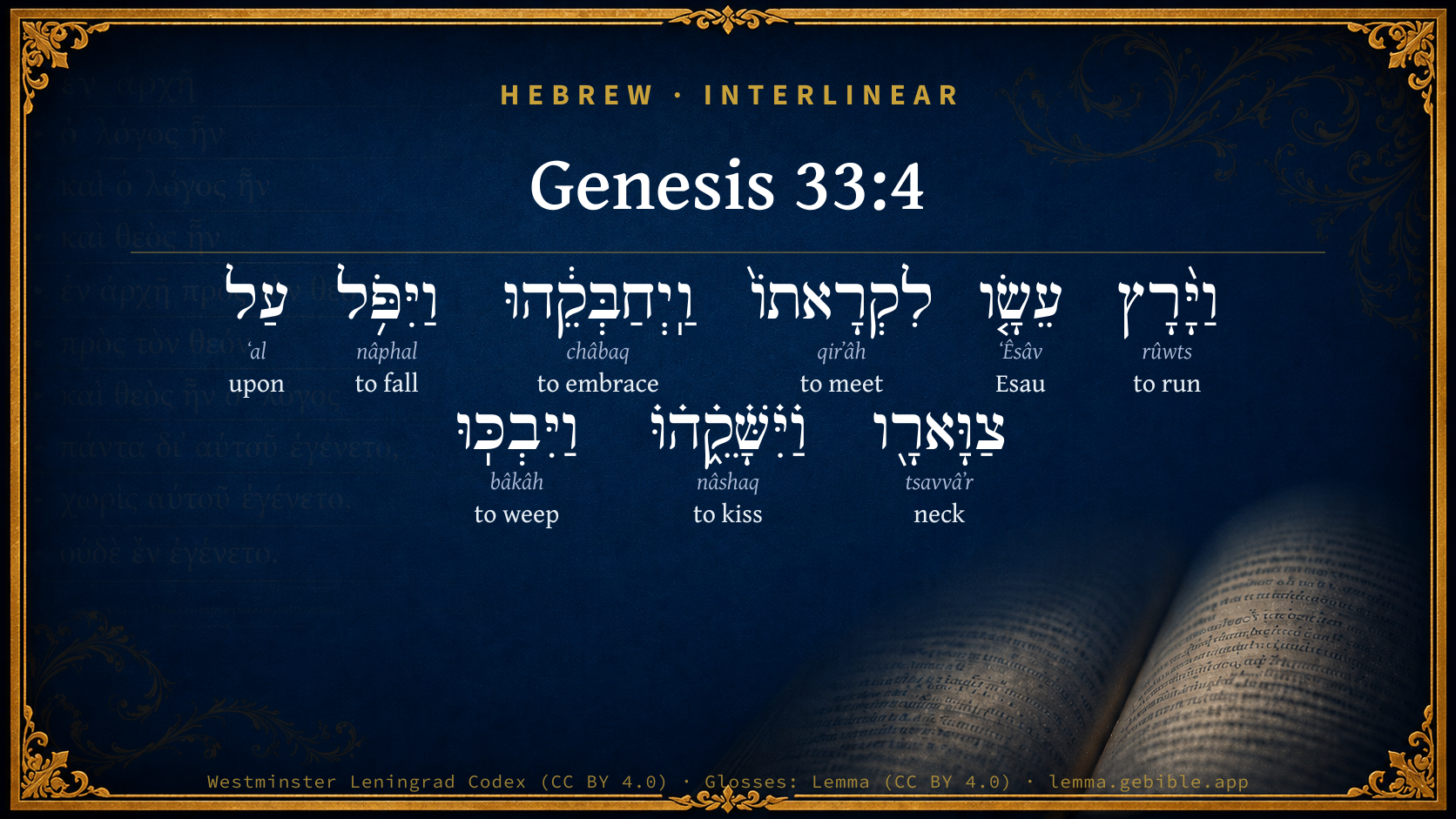
Genesis 33:4

Hebrew (Westminster Leningrad Codex) Genesis 33:4 appears in the Hebrew Old Testament. The text above is from the Westminster Leningrad Codex. Each word links to its Strong’s number, a concise gloss, and parsing drawn from the Open Scriptures Hebrew Bible morphology. Click any word for its full Brown-Driver-Briggs (BDB) entry.
Download image
Cite this verse

Genesis 33:4 (World English Bible). Public Domain. Lemma interlinear Bible study tool, https://lemma.gebible.app/v/genesis/33/4.

Show BibTeX & RIS
BibTeX
RIS
English Translation
Esau ran to meet him, embraced him, fell on his neck, kissed him, and they wept.
World English Bible · Public Domain
Download a study sheet

One document with this verse’s original text, its word-by-word gloss line, the meaning frame, cross-references with their text, attributed commentary, and full source and license credits — printable, and it pastes into notes with its structure intact.

This verse Autodidact and up

Study sheet (.html) Plain text (.txt)

A passage Seminary Student

Up to 50 verses in one chapter. A passage sheet keeps up to 6 commentary sources and 12 cross-references per verse, in the order this page ranks them, and says so on the sheet whenever that leaves anything out. Ask for a single verse and you get the Autodidact verse sheet above.

Everything on this page stays free to read, with no account — the sheet is a download of what is already on screen, not access to it.

Want to remove ads? Support Godless Engineer
Compare translations 3

The same verse in 3 English versions, stacked beneath the original-language interlinear above. Click any original word for its lexicon entry.

Each is an independent rendering of the whole verse — the interlinear is not word-aligned to these translations.

Highlighted words mark where these versions differ — a whole-verse word diff, not a word-by-word alignment.

  • World English Bible Public Domain
    Esau ran to meet him, embraced him, fell on his neck, kissed him, and they wept.
  • King James Version Public Domain
    And Esau ran to meet him, and embraced him, and fell on his neck, and kissed him: and they wept.
  • unfoldingWord Literal Text CC BY-SA 4.0
    But Esau ran to meet him and embraced him, and he fell on his neck and kissed him, and they cried.

unfoldingWord Literal Text — © unfoldingWord, licensed CC BY-SA 4.0. Word-aligned USFM3 via Door43 (git.door43.org/unfoldingWord/en_ult).

Versions to compare (up to 4)

3 of 4 selected

Show all 18 translations

Every available English version of this verse, each an independent rendering of the whole verse.

  • World English Bible Public Domain
    Esau ran to meet him, embraced him, fell on his neck, kissed him, and they wept.
  • Berean Standard Bible Public Domain
    Esau, however, ran to him and embraced him, threw his arms around his neck, and kissed him. And they both wept.
  • Majority Standard Bible Public Domain
    Esau, however, ran to him and embraced him, threw his arms around his neck, and kissed him. And they both wept.
  • King James Version Public Domain
    And Esau ran to meet him, and embraced him, and fell on his neck, and kissed him: and they wept.
  • American Standard Version (1901) Public Domain
    And Esau ran to meet him, and embraced him, and fell on his neck, and kissed him: and they wept.
  • Revised Version (1885) Public Domain
    And Esau ran to meet him, and embraced him, and fell on his neck, and kissed him: and they wept.
  • Geneva Bible (1599) Public Domain
    Then Esau ranne to meete him, and embraced him, and fell on his necke, and kissed him, and they wept.
  • Douay-Rheims (1899) Public Domain
    Then Esau ran to meet his brother, and embraced him: and clasping him fast about the neck, and kissing him, wept.
  • Young's Literal Translation Public Domain
    and Esau runneth to meet him, and embraceth him, and falleth on his neck, and kisseth him, and they weep;
  • Literal Standard Version CC BY-SA 4.0
    and Esau runs to meet him, and embraces him, and falls on his neck, and kisses him, and they weep;
  • Unlocked Literal Bible CC BY-SA 4.0
    Esau ran to meet him, embraced him, hugged his neck, and kissed him. Then they wept.
  • unfoldingWord Literal Text CC BY-SA 4.0
    But Esau ran to meet him and embraced him, and he fell on his neck and kissed him, and they cried.
  • Darby Bible Public Domain
    And Esau ran to meet him, and embraced him, and fell on his neck, and kissed him; and they wept.
  • World Messianic Bible Public Domain
    Esau ran to meet him, embraced him, fell on his neck, kissed him, and they wept.
  • Webster's Bible Public Domain
    And Esau ran to meet him, and embraced him, and fell on his neck, and kissed him: and they wept.
  • Free Bible Version CC BY-SA 4.0
    Esau ran over to him and hugged him. He put his arms around his neck and kissed him. The two of them wept.
  • Bible in Basic English Public Domain
    Then Esau came running up to him, and folding him in his arms, gave him a kiss: and the two of them were overcome with weeping.
  • JPS Tanakh (1917) Public Domain
    And Esau ran to meet him, and embraced him, and fell on his neck, and kissed him; and they wept.

Literal Standard Version (2020), Covenant Press — licensed CC BY-SA 4.0. Text via the HelloAO Bible API (eBible.org). Unlocked Literal Bible (unfoldingWord) — licensed CC BY-SA 4.0. Text via the HelloAO Bible API (eBible.org). unfoldingWord Literal Text — © unfoldingWord, licensed CC BY-SA 4.0. Word-aligned USFM3 via Door43 (git.door43.org/unfoldingWord/en_ult). Free Bible Version, Dr. Jonathan Gallagher — licensed CC BY-SA 4.0. Text via the HelloAO Bible API (eBible.org).

Word by word

More ways to search: Search by grammar → Find every occurrence → Compare this word →

Practice this passage: Drill this verse → Learn its vocabulary →

וַֽיְחַבְּקֵ֔הוּ
châbaq
H2263
“and · to embrace · him”
Conjunction + Verb, Piel, Sequential Imperfect, 3rd Person, Masculine, Singular + Suffix, Personal, 3rd Person, Masculine, Singular
Part of Speech
Conjunction + Verb
Stem
Piel
Form
Sequential Imperfect
Person
3rd Person
Gender
Masculine
Number
Singular
Full BDB Definition

Origin: a primitive root

TWOT: 597

to embrace, clasp - (Qal) - to embrace - to fold one's hands in idleness (figuratively) - (Piel) to embrace
  1. וַיָּ֨רָץ rûwts H7323 “and · to run” Conjunction + Verb, Qal, Sequential Imperfect, 3rd Person, Masculine, Singular
  2. עֵשָׂ֤ו ʻÊsâv H6215 “Esau” Noun, Proper
  3. לִקְרָאתוֹ֙ qirʼâh H7125 “to meet · him” Preposition + Verb, Qal, Infinitive Construct + Suffix, Personal, 3rd Person, Masculine, Singular
  4. וַיִּפֹּ֥ל nâphal H5307 “and · to fall” Conjunction + Verb, Qal, Sequential Imperfect, 3rd Person, Masculine, Singular
  5. עַל ʻal H5921 “upon” Preposition
  6. צַוָּארָ֖ו tsavvâʼr H6677 “neck · his” Noun, Common, Masculine, Singular, Construct + Suffix, Personal, 3rd Person, Masculine, Singular
  7. וַׄיִּׄשָּׁׄקֵ֑ׄהׄוּׄ nâshaq H5401 “and · to kiss · him” Conjunction + Verb, Qal, Sequential Imperfect, 3rd Person, Masculine, Singular + Suffix, Personal, 3rd Person, Masculine, Singular
  8. וַיִּבְכּֽוּ bâkâh H1058 “and · to weep” Conjunction + Verb, Qal, Sequential Imperfect, 3rd Person, Masculine, Plural

About this verse

These counts appear in no published source. They are computed here, from the morphology-tagged text and Lemma’s own curated glosses. What Lemma adds →

9
words
9
distinct lemmas
Pentateuch
section

Notable vocabulary

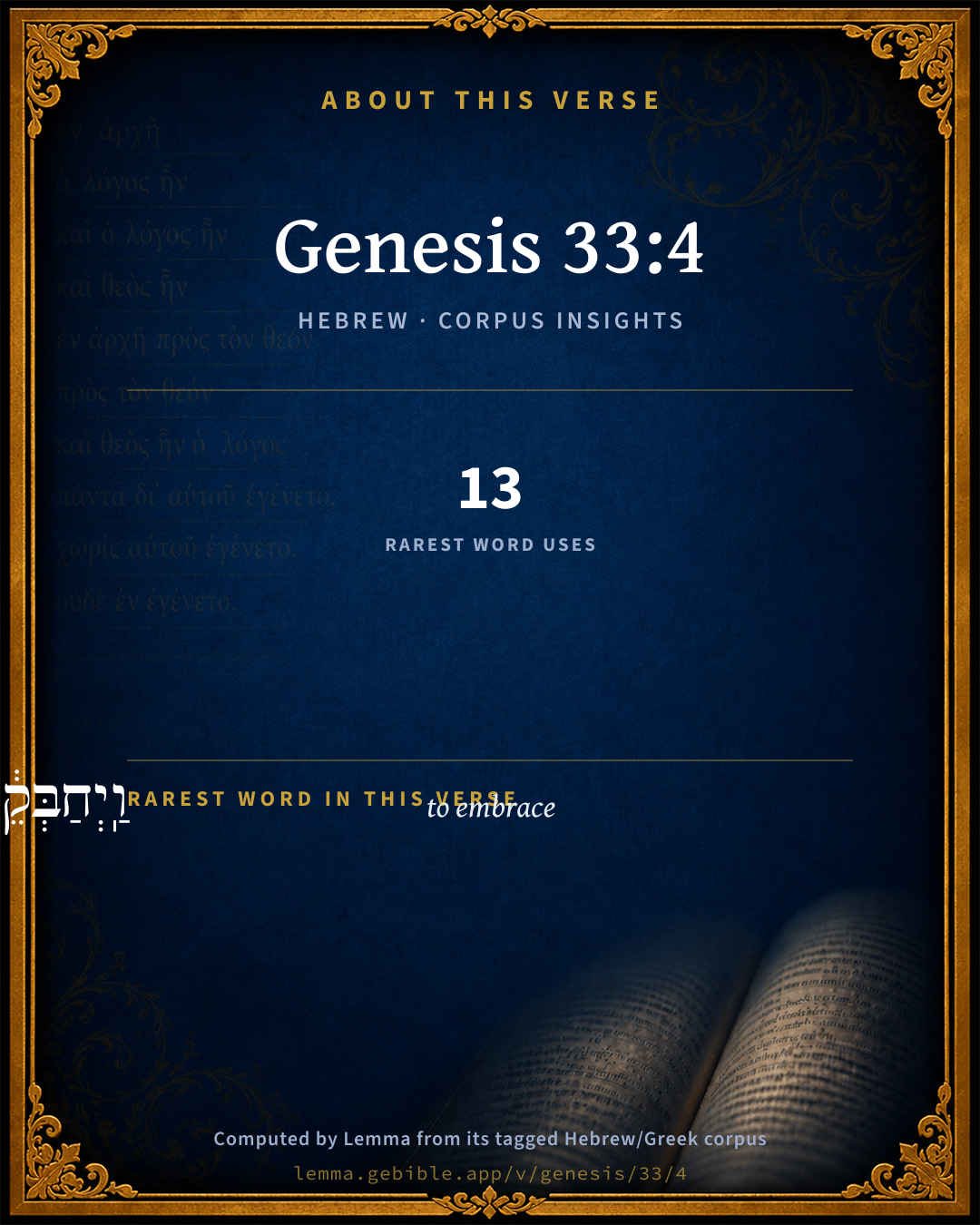
The rarest word here is וַֽיְחַבְּקֵ֔הוּ to embrace H2263 — appearing just 13 times in the whole Hebrew Bible.

Shared distinctive vocabulary

וַֽיְחַבְּקֵ֔הוּ to embrace H2263 occurs in 12 verses of the Hebrew Bible. Also found in:

Grammatical profile

  • 6 verbs
  • 2 nouns
  • 1 preposition

Verb forms

  • וַיָּ֨רָץ Qal · Sequential Imperfect
  • לִקְרָאתוֹ֙ Qal · Infinitive Construct
  • וַֽיְחַבְּקֵ֔הוּ Piel · Sequential Imperfect
  • וַיִּפֹּ֥ל Qal · Sequential Imperfect
  • וַׄיִּׄשָּׁׄקֵ֑ׄהׄוּׄ Qal · Sequential Imperfect
  • וַיִּבְכּֽוּ Qal · Sequential Imperfect

Hebrew & Septuagint length

In English translation the verse runs 16 words from the Hebrew and 22 from the Septuagint (LXX English) — closely comparable.

A rough comparison of the two English renderings, which tokenize alike — not a word-level alignment.

Word counts can differ between the Hebrew and the Greek without any difference in meaning — e.g. the Hebrew direct-object marker אֵת has no separate Greek word, and Greek often adds the article ὁ.

Cross-references

13

Topical passages linked to Genesis 33:4 in the Treasury of Scripture Knowledge — connected by theme and wording, ordered by reader-vote popularity; previews shown in the World English Bible.

  • Genesis 45:14–15 He fell on his brother Benjamin's neck, and wept, and Benjamin wept on his neck.
  • Psalms 34:4 I sought Yahweh, and he answered me, And delivered me from all my fears.
  • Luke 15:20 "He arose, and came to his father. But while he was still far off, his father saw him, and was moved with compassion, and ran, and fell on his neck, and kissed him.
  • Genesis 32:28 He said, "Your name will no longer be called 'Jacob,' but, 'Israel,' for you have fought with God and with men, and have prevailed."
  • Genesis 45:2 He wept aloud. The Egyptians heard, and the house of Pharaoh heard.
  • Genesis 46:29 Joseph made ready his chariot, and went up to meet Israel, his father, in Goshen. He presented himself to him, and fell on his neck, and wept on his neck a good while.
  • Acts 20:37 They all wept a lot, and fell on Paul's neck and kissed him,
  • Genesis 43:30 Joseph made haste; for his heart yearned over his brother: and he sought a place to weep; and he entered into his room, and wept there.
  • Nehemiah 1:11 Lord, I beg you, let now your ear be attentive to the prayer of your servant, and to the prayer of your servants, who delight to fear your name; and please prosper your servant this day, and grant him mercy in the sight of this man. Now I was cup bearer to the king.
  • Job 2:12 When they lifted up their eyes from a distance, and didn't recognize him, they raised their voices, and wept; and they each tore his robe, and sprinkled dust on their heads toward the sky.
  • Proverbs 16:7 When a man's ways please Yahweh, He makes even his enemies to be at peace with him.
  • Genesis 43:34 He sent portions to them from before him, but Benjamin's portion was five times as much as any of theirs. They drank, and were merry with him.
  • Proverbs 21:1 The king's heart is in Yahweh's hand like the watercourses. He turns it wherever he desires.

Cross-references courtesy of OpenBible.info (CC BY 4.0).

Hebrew and Greek witnesses Masoretic Hebrew ↔ Greek Septuagint

The same verse in the two great witnesses to the Old Testament, shown verse-for-verse.

These are two independent witnesses, not word-aligned to each other, and the Septuagint is shown in lemma (dictionary) form.

Hebrew Genesis 33:4 Masoretic · Westminster Leningrad Codex

וַיָּ֨רָץ עֵשָׂ֤ו לִקְרָאתוֹ֙ וַֽיְחַבְּקֵ֔הוּ וַיִּפֹּ֥ל עַל צַוָּארָ֖ו וַׄיִּׄשָּׁׄקֵ֑ׄהׄוּׄ וַיִּבְכּֽוּ

Esau ran to meet him, embraced him, fell on his neck, kissed him, and they wept.

World English Bible · Public Domain

Greek LXX Genesis 33:4 Septuagint · lemma form

καί προςτρέχω ησαυ εἰς συνάντησις αὐτός καί περιλαμβάνω αὐτός φιλέω καί προςπίπτω ἐπί ὁ τράχηλος αὐτός καί κλαίω ἀμφότεροι

And Esau ran on to meet him, and embraced him, and fell on his neck, and kissed him; and they both wept.

LXX2012 (modern English Septuagint) · Public Domain

On this verse, John Gill's Exposition discusses the Septuagint’s reading. Read the note in Commentary ↓

Hebrew: Westminster Leningrad Codex (CC BY 4.0). Greek: Septuagint (public domain); English from LXX2012 (modern English Septuagint) (Public Domain). How the Septuagint differs from the Hebrew →

Targum (Aramaic paraphrase)

2

The Targum is the ancient Jewish Aramaic paraphrase of the Hebrew Scriptures — an interpretive translation, not the Hebrew text itself. Onkelos (literal) and Pseudo-Jonathan (expansive) render the Torah, and Jonathan the Prophets. Coverage is partial: where no permissively-licensed English translation exists for a verse, only the Aramaic is shown. This is verse-level text, not a word-by-word alignment to the Hebrew.

  1. Targum Onkelos Torah (Genesis–Deuteronomy)
    וּרְהַט עֵשָׂו לְקַדָּמוּתֵהּ וְגַפְּפֵהּ וּנְפַל עַל צַוְּארֵהּ וְנַשְׁקֵהּ וּבְכוֹ

    (no public-domain English translation for this verse)

    Targum Onkelos — Aramaic: “Onkelos Genesis” (public domain); “Onkelos Exodus” (public domain); “Onkelos Leviticus” (public domain); “Onkelos Numbers” (public domain); “Onkelos Deuteronomy” (public domain). English: “Sefaria Community Translation” (CC0 1.0 (public-domain dedication)); “J.W. Etheridge. The Targums of Onkelos and Jonathan Ben Uzziel on the Pentateuch. London: Longmans, Green, 1862” (public domain). Text via Sefaria.

  2. Targum Pseudo-Jonathan Torah (Genesis–Deuteronomy)
    וּרְהַט עֵשָו לִקְדָמוּתֵיהּ וְגַפֵיף לֵיהּ וְאִתְרְכִין עַל צַוְורֵיהּ וּנְשֵׁיק לֵיהּ וּבְכוּן עֵשָו בָּכָא עַל צַעֲרָא דְשִׁינוֹי דְאִיתְמִזְמִיזוּ וְיַעֲקב בָּכָא עַל צַעֲרָא דְצַוָורֵיהּ

    And Esau ran to meet him, and embraced him, and fell upon his neck and kissed him, and they wept. Esau wept on account of the pain of his teeth which were shaken; but Jakob wept because of the pain of his neck.

    Targum Pseudo-Jonathan — Aramaic: “Targum Jonathan on Genesis” (public domain); “Targum Jonathan on Exodus” (public domain); “Targum Jonathan on Leviticus” (public domain); “Targum Jonathan on Numbers” (public domain); “Targum Jonathan on Deuteronomy” (public domain). English: “The Targum of Jonathan ben Uzziel, trans. J. W. Etheridge, London, 1862” (public domain). Text via Sefaria.

Commentary

Notes on Genesis 33:4 from classic Christian and Jewish commentators (each source and its license shown beneath its notes). The classic Christian expositions comment on the surrounding passage and are grouped to its opening verse, so a note may address several verses; the Jewish commentaries on the Tanakh (Rashi and others) are per-verse, so they appear only where the commentator wrote on this verse.

Lemma curates 59 commentaries, every one of them public domain or Creative Commons licensed, each selected and text-cleaned for this edition rather than reprinted as found. About our sources →

Trapp's Complete Commentary

John Trapp

Gen 33:4 And Esau ran to meet him, and embraced him, and fell on his neck, and kissed him: and they wept.

Ver. 4. And kissed him.] The word kissed hath a prick over every letter in the original: to note, say the Hebrew doctors, that this was a false and hypocritical kiss, a Judas-kiss. {Hebrew Text Note} Kαταφιλειν ου εστι φιλειν, saith Philo: Amos non semper est in osculo. But our interpreters are agreed that this kiss was a sign that his heart was changed from his former hatred, {a} and that those extraordinary pricks do denote the wonder of God’s work therein; which is further confirmed in that they both wept, which could not easily be counterfeit, though they were in Ishmael, that notable hypocrite, {Jer 41:6} and in the emperor Andronicus, who, when he had injuriously caused many of the nobility to be put to death, pretended himself sorry for them, and that with tears plentifully running down his aged cheeks, as if he had been the most sorrowful man alive. So the Egyptian crocodile, having killed some living beast, lieth upon the dead body, and washeth the head thereof with her warm tears, which she afterward devoureth, with the dead body. {b} We judge more charitably of Esau here. And yet we cannot be of their mind, that herehence conclude his true conversion and salvation. We must take heed we neither make censure’s whip nor charity’s cloak too long: we may offend in both, and incur the curse, as well by "calling evil good," as "good evil". {Isa 5:20} Latomus of Lovain wrote, that there was no other a faith in Abraham than in Cicero. Another wrote a long defence and commendation of Cicero, and makes him a very good Christian, and true penitentiary, because he saith, somewhere, Reprehendo peccata mea, quid Pompeio conflsus, eiusque partes secutus fuerim. I believe neither of them. {c}

{a} Qui probabilius loquuntur, aiunt eo ipso notari animi Esauici conversionem. - Am.

{b} Turk. Hist., fol. 50, 175.

{c} Joh. Manlii, loc. com., 496, 483.

John Trapp, A Commentary or Exposition upon All the Books of the Old and New Testament (1647–1656) — public domain. Text from a community e-Sword module.

Joseph Benson's Commentary

Gen 33:4. Esau ran to meet him — Not in anger, but in love: so wonderfully and suddenly had God, who hath the hearts of all men in his hands, and can turn them when and how he pleases, changed his heart; and of an implacable enemy, made him a kind and affectionate friend! Embraced him, fell on his neck, and kissed him — God is the God of nature, and to be without natural affection is to be without God. They wept — Jacob wept for joy to be thus kindly received; Esau, perhaps, with grief and shame, to think of the ill design he had conceived against his brother.

Joseph Benson's Commentary on the Old and New Testaments (1811–1818) — public domain. Text from a community e-Sword module.

Tyndale Open Study Notes

Tyndale Open Resources

33:4 Esau’s friendly greeting was an answer to prayer (32:11). God had rescued Jacob from Esau’s revenge.

Tyndale Open Study Notes — © Tyndale Open Resources, licensed CC BY-SA 4.0. Text via the HelloAO Bible API.

Jamieson, Fausset & Brown

Robert Jamieson, A. R. Fausset & David Brown

Esau ran to meet him--What a sudden and surprising change! Whether the sight of the princely present and the profound homage of Jacob had produced this effect, or it proceeded from the impulsive character of Esau, the cherished enmity of twenty years in a moment disappeared; the weapons of war were laid aside, and the warmest tokens of mutual affection reciprocated between the brothers. But doubtless, the efficient cause was the secret, subduing influence of grace (Pro 21:1), which converted Esau from an enemy into a friend.

Jamieson, Fausset & Brown — Commentary Critical and Explanatory on the Whole Bible (1871) — public domain (CC PDM 1.0). Text via the HelloAO Bible API.

Adam Clarke's Commentary

Verse 4. Esau ran to meet him] How sincere and genuine is this conduct of Esau, and at the same time how magnanimous! He had buried all his resentment, and forgotten all his injuries; and receives his brother with the strongest demonstrations, not only of forgiveness, but of fraternal affection.

And kissed him] וישקהו valyishshakehu. In the Masoretic Bibles each letter of this word is noted with a point over it to make it emphatic. And by this kind of notation the rabbins wished to draw the attention of the reader to the change that had taken place in Esau, and the sincerity with which he received his brother Jacob. A Hindoo when he meets a friend after absence throws his arms round him, and his head across his shoulders, twice over the right shoulder and once over the left, with other ceremonies according to the rank of the parties.

Adam Clarke's Commentary on the Bible (1810–1826) — public domain. Text from a community e-Sword/MySword module.

John Calvin's Commentaries

4. And Esau ran to meet him. That Esau meets his brother with unexpected benevolence and kindness, is the effect of the special favor of God. Therefore, by this method, God proved that he has the hearts of men in his hand, to soften their hardness, and to mitigate their cruelty as often as he pleases: in short, that he tames them as wild beasts are wont to be tamed; and then, that he hearkened to the prayers of his servant Jacob. Wherefore, if at any time the threats of enemies alarm us, let us learn to resort to this sacred anchor. God, indeed, works in various ways, and does not always incline cruel minds to humanity; but, while they rage, he restrains them from doing harm by his own power: but if it is right, he can as easily render them placable towards us; and we here see that Esau became so towards his brother Jacob. It is also possible, that even while cruelty was pent up within, the feeling of humanity may have had a temporary ascendancy. And as we see that the Egyptians were constrained, for a moment, to the exercise of humanity, although they were rendered nothing better than before, as their madness, which soon afterwards broke out, bears witness: so it is credible that the malice of Esau was now under constraint; and not only so, but that his mind was divinely moved to put on fraternal affection. For even in the reprobate, God’s established order of nature prevails, not indeed in an even tenor, but as far as he restrains them, to the end that they may not mingle all things in one common slaughter. And this is most necessary for the preservation of the human race. For few are so governed by the spirit of adoption, as sincerely to cultivate mutual charity among themselves, as brethren. Therefore, that men spare each other, and do not furiously rush on each other’s destruction, arises from no other cause than the secret providence of God, which watches for the protection of mankind. But to God the life of his own faithful people is still more precious, so that he vouchsafes to them peculiar care. Wherefore it is no wonder, that for the sake of his servant Jacob, he should have composed the fierce mind of Esau to gentleness.

John Calvin's Commentaries (1540-1563) — public domain. Text from the Calvin Translation Society English edition (1840s-50s) via the Christian Classics Ethereal Library (ccel.org). Calvin's coverage is partial (roughly two-thirds of the Bible); uncommented books and verses are honest gaps, never fabricated. The 19th-century editor's footnotes and remarks are omitted so the notes are faithfully Calvin's own voice.

Ellicott's Commentary for English Readers

(4) Esau ran to meet him.—Whatever may have been Esau’s intention when he started, no sooner does he see his brother than the old times of their childhood return to his heart, and he is overcome with love; nor does he ever seem afterwards to have wavered in his fraternal affection. We have had a proof before (in Gen_27:38) of Esau being a man of warm feelings, and similarly now he is again overmastered by his loving impulses. It is curious that the Hebrew word for “he kissed him” has had what are called extraordinary vowels attached to it, and the Masorites are supposed to signify thereby that Esau’s kiss was not a sign of genuine love. For such an ill-natured supposition there is no warrant whatsoever.

A Bible Commentary for English Readers, edited by Charles John Ellicott (1878–1897) — public domain. Text from a community e-Sword module.

The Cambridge Bible for Schools and Colleges

gen. ed. J. J. S. Perowne

4. And Esau] Esau’s conduct on this occasion is that of a good-natured and forgiving disposition. There is no statement of his having intended any mischief to Jacob. His appearance with four hundred men seems to have been accidental, and not with hostile intent against Jacob. He behaves throughout magnanimously and simply.

fell on his neck] In Gen_45:14, Gen_46:29 (J), this demonstration of feeling is followed by “weeping.”

kissed him] On the Hebrew word for “kissed him” the Massoretic, or traditional, Hebrew text has this note: “All of it punctuated,” i.e. every letter dotted. Probably the text was at an early date uncertain. The Rabbinic explanation is strange, i.e. “because he did not come to kiss him, but to bite him,” and the tradition goes on to say that Jacob’s neck was turned into marble!

they wept] The strong emotion of orientals; cf. Gen_45:2.

The Targum of pseudo-Jonathan, following up the absurd Rabbinic tradition arising from the Israelite hatred of Edom, explains that Jacob wept because his neck was painful, and Esau because he had pain in his teeth!

The Cambridge Bible for Schools and Colleges (gen. ed. J. J. S. Perowne; Cambridge University Press, 1878–1918) — public domain. Text from a community e-Sword module.

John Gill's Exposition

And Esau ran to meet him,.... If he rode on any creature, which is likely, he alighted from it on sight of his brother Jacob, and to express his joy on that occasion, and affection for him, made all the haste he could to meet him, as did the father of the prodigal, Luk 15:20,

and embraced him; in his arms, with the greatest respect and tenderness:

and fell on his neck; laid his head on his neck, where it remained for a while, not being able to lift it up, and speak unto him; the word is in the dual number, and signifies, as Ben Melech thinks, the two sides of the neck, the right and the left; and he might lay his head first on one side, and then on the other, to show the greatness of his affection:

and kissed him; in token of the same: there are three pricks over this word in the original more than ordinary, directing the attention of the reader to it, as something wonderful and worthy of observation: the Jewish writers (n) are divided about it; some think that this points at the insincerity of Esau in kissing his brother when he hated him; others, on the contrary, to his sincerity and heartiness in it, and which was matter of admiration, that he who laid up hatred in his heart against his brother, and had bore him a grudge for so many years, and it may be came out now, with an intention to destroy him, should have his heart so turned toward him, as to behave in this affectionate manner, which must be owing to the power of God working upon his heart, changing his mind, and making him thus soft, flexible, and compassionate; and to Jacob's humble submission to him, subservient to divine Providence as a means; and thus as he before had power with God in prayer on this same account, the effect of which he now perceived, so he had power with men, with his brother, as it was intimated to him he should:

and they wept; they "both" wept, as the Septuagint version adds, both Jacob and Esau, for joy at the sight of each other, and both seriously; and especially there can be no doubt of Jacob, who must be glad of this reconciliation, if it was only outward, since hereby his life, and the lives of his wives and children, would be spared.

(n) Zohar in Gen. fol. 99. 1. Bereshit Rabba, sect. 78. fol. 68. 3. Jarchi in loc.

John Gill's Exposition of the Whole Bible (1746–1763) — public domain (CC PDM 1.0). Text via the HelloAO Bible API.

Whedon's Commentary on the Bible

Daniel D. Whedon

4. Ran to meet… embraced… fell… kissed… wept — Five forms in which they exhibited the first fervent emotions of brotherly affection. The whole interview is characterized with a life-like simplicity, as though detailed by an eye-witness of the scene.

Daniel D. Whedon (gen. ed.), Commentary on the Old and New Testaments (1874–1909) — public domain. Text from a community e-Sword module.

John Wesley's Explanatory Notes

And Esau ran to meet him - Not in passion but in love. Embraced him, fell on his neck and kissed him - God hath the hearts of all men in his hands, and can turn them when and how he pleases. He can of a sudden convert enemies into friends, as he did two Sauls, one by restraining grace, 1 Sam. xxvi, 21, 25, the other by renewing grace, Acts ix, 21. And they wept - Jacob wept for joy to be thus kindly received; Esau perhaps wept for grief and shame to think of the ill design he had conceived against his brother.

John Wesley, Explanatory Notes Upon the Whole Bible (1754–1765) — public domain. Text via the GEBible commentary corpus.

unfoldingWord translationNotes

Door43 World Missions Community

meet him

"meet Jacob"

embraced him, hugged his neck, and kissed him

This can be translated as a new sentence. AT: "Esau put his arms around Jacob, hugged him, and kissed him"

Then they wept

This can be translated more explicitly. AT: "Then Esau and Jacob cried because they were happy to see each other again" (See: Assumed Knowledge and Implicit Information)

he saw the women and the children

"he saw the women and children who were with Jacob"

The children whom God has graciously given your servant

The phrase "your servant" is a polite way for Jacob to refer to himself. AT: "These are the children God has kindly given me, your servant" (See: First, Second, or Third Person)

translationWords

kiss

God

grace

servant

unfoldingWord translationNotes — © Distant Shores Media and the Door43 World Missions Community, licensed CC BY-SA 4.0. Source: git.door43.org/Door43/en_tn.

Rashi

Rabbi Shlomo Yitzchaki (Rashi)

ויחבקהו AND EMBRACED HIM — His pity was aroused when he saw him prostrating himself so many times (Genesis Rabbah 78:8).

וישקהו AND HE KISSED HIM — Dots are placed above the letters of this word, and a difference of opinion is expressed in the Baraitha of Sifré (בהעלותך) as to what these dots are intended to suggest: some explain the dotting as meaning that he did not kiss him with his whole heart, whereas R Simeon the son of Johai said: Is it not well-known that Esau hated Jacob? But at that moment his pity was really aroused and he kissed him with his whole heart. (Sifrei Bamidbar 69.2)

Rashi on the Tanakh — English translations: “The Judaica Press complete Tanach with Rashi, translated by A. J. Rosenberg” (CC BY 4.0); “Pentateuch with Rashi's commentary by M. Rosenbaum and A.M. Silbermann, 1929-1934” (public domain); “The Metsudah Tanach series, Lakewood, N.J” (CC BY 4.0); and “The Book of Joshua, Metsudah Publications, 1997” (CC BY 4.0). Text via Sefaria.

Radak

Rabbi David Kimhi (Radak)

וירץ, when Esau saw that Yaakov had humbled himself so much before him, he forgave what he had done to him and his sense of compassion was stirred.

וישקהו, the word has a dot on each of the letters. In Bereshit Rabbah 78,9 Rabbi Shimon ben Elazar says that everywhere where you find the dots do not cover each letter of the word underneath we give preference to the meaning of the text as is, without the dots. When there are more dots than letters, we give emphasis in our interpretation to the dots. In this instance, there are as many dots as there are letters in the word וישקהו, so that we understand that Esau kissed Esau sincerely with all his heart. To this Rabbi Yannai countered by asking that if this is indeed so, why bother to put any dots on the word if they do not affect the meaning? We therefore must interpret that originally Esau had intended to bite Yaakov’s neck feigning an embrace. G’d made his teeth as soft as wax and Yaakov’s neck as hard as ivory. ויבכו, one on account of his neck, the other on account of his teeth.

Radak on the Tanakh — English translations: “Sefaria Community Translation” (CC0 1.0 (public-domain dedication)); “Eliyahu Munk, HaChut Hameshulash” (CC BY 4.0); “Rabbi Mike Feuer, Jerusalem Anthology” (CC BY 4.0); and “R. David Kimhi on the first book of Psalms, Translated by R.G. Finch, London, 1919” (public domain). Text via Sefaria.

Lesson kit

Teaching starters — assembled from the data on this page, not authored interpretation. Every prompt links to the verse data it draws on. Edit before teaching.

Genesis, in the Pentateuch, opens this verse with 9 words (9 distinct Hebrew lemmas). Its most distinctive word is châbaq (“to embrace”). A historical commentator’s framing appears above. Read the whole chapter for the surrounding context.

Discussion questions

  1. How does “to embrace” (châbaq) shape what this verse is saying?
  2. Genesis 29:13 shares the word «to embrace» with this verse. How do the two illuminate each other?
  3. These translations render this verse differently. What is at stake in choosing one wording over another?
  4. The verb «וַיָּ֨רָץ» is Qal Sequential Imperfect. How does its form color the action?
  5. Reading how Trapp's Complete Commentary and Joseph Benson's Commentary read this verse, where do the two commentators agree and where do they part?

Things to notice

Reading settings

Reading text

Shown beneath each verse's original-language words.

Old Testament
Old Testament edition

Read the OT as the Masoretic Hebrew (MT) or the Greek Septuagint (LXX).

English shown for the Greek Septuagint (in the Hebrew ↔ Greek comparison).

Comparing translations? Open the Compare panel on any verse page to stack up to four side by side.