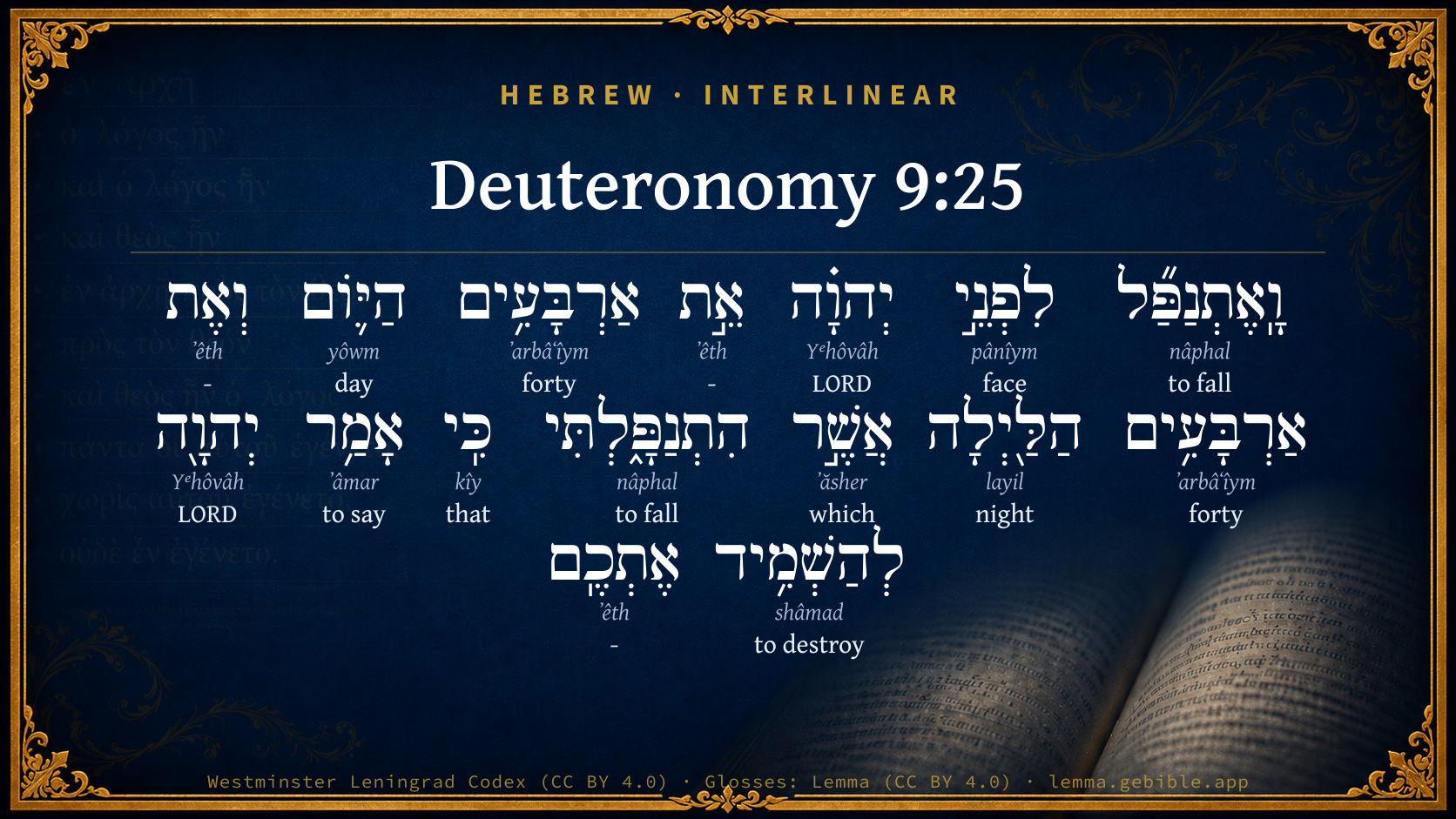
Deuteronomy 9:25

Hebrew (Westminster Leningrad Codex) Deuteronomy 9:25 appears in the Hebrew Old Testament. The text above is from the Westminster Leningrad Codex. Each word links to its Strong’s number, a concise gloss, and parsing drawn from the Open Scriptures Hebrew Bible morphology. Click any word for its full Brown-Driver-Briggs (BDB) entry.
Download image
Cite this verse

Deuteronomy 9:25 (World English Bible). Public Domain. Lemma interlinear Bible study tool, https://lemma.gebible.app/v/deuteronomy/9/25.

Show BibTeX & RIS
BibTeX
RIS
English Translation
So I fell down before Yahweh the forty days and forty nights that I fell down, because Yahweh had said he would destroy you.
World English Bible · Public Domain
Download a study sheet

One document with this verse’s original text, its word-by-word gloss line, the meaning frame, cross-references with their text, attributed commentary, and full source and license credits — printable, and it pastes into notes with its structure intact.

This verse Autodidact and up

Study sheet (.html) Plain text (.txt)

A passage Seminary Student

Up to 50 verses in one chapter. A passage sheet keeps up to 6 commentary sources and 12 cross-references per verse, in the order this page ranks them, and says so on the sheet whenever that leaves anything out. Ask for a single verse and you get the Autodidact verse sheet above.

Everything on this page stays free to read, with no account — the sheet is a download of what is already on screen, not access to it.

Want to remove ads? Support Godless Engineer
Compare translations 3

The same verse in 3 English versions, stacked beneath the original-language interlinear above. Click any original word for its lexicon entry.

Each is an independent rendering of the whole verse — the interlinear is not word-aligned to these translations.

Highlighted words mark where these versions differ — a whole-verse word diff, not a word-by-word alignment.

  • World English Bible Public Domain
    So I fell down before Yahweh the forty days and forty nights that I fell down, because Yahweh had said he would destroy you.
  • King James Version Public Domain
    Thus I fell down before the LORD forty days and forty nights, as I fell down at the first; because the LORD had said he would destroy you.
  • unfoldingWord Literal Text CC BY-SA 4.0
    And I prostrated myself to the face of Yahweh 40 days and 40 nights, and I prostrated myself because Yahweh had said to destroy you.

unfoldingWord Literal Text — © unfoldingWord, licensed CC BY-SA 4.0. Word-aligned USFM3 via Door43 (git.door43.org/unfoldingWord/en_ult).

Versions to compare (up to 4)

3 of 4 selected

Show all 18 translations

Every available English version of this verse, each an independent rendering of the whole verse.

  • World English Bible Public Domain
    So I fell down before Yahweh the forty days and forty nights that I fell down, because Yahweh had said he would destroy you.
  • Berean Standard Bible Public Domain
    So I fell down before the LORD for forty days and forty nights, because the LORD had said He would destroy you.
  • Majority Standard Bible Public Domain
    So I fell down before the LORD for forty days and forty nights, because the LORD had said He would destroy you.
  • King James Version Public Domain
    Thus I fell down before the LORD forty days and forty nights, as I fell down at the first; because the LORD had said he would destroy you.
  • American Standard Version (1901) Public Domain
    So I fell down before Jehovah the forty days and forty nights that I fell down, because Jehovah had said he would destroy you.
  • Revised Version (1885) Public Domain
    So I fell down before the LORD the forty days and forty nights that I fell down; because the LORD had said he would destroy you.
  • Geneva Bible (1599) Public Domain
    Then I fell downe before ye Lord fourtie dayes and fourtie nightes, as I fell downe before, because ye Lord had said, that he woulde destroy you.
  • Douay-Rheims (1899) Public Domain
    And I lay prostrate before the Lord forty days and nights, in which I humbly besought him, that he would not destroy you as he had threatened:
  • Young's Literal Translation Public Domain
    `And I throw myself before Jehovah, the forty days and the forty nights, as I had thrown myself, for Jehovah hath said -- to destroy you;
  • Literal Standard Version CC BY-SA 4.0
    And I throw myself before YHWH—the forty days and the forty nights when I had thrown myself—because YHWH has commanded to destroy you;
  • Unlocked Literal Bible CC BY-SA 4.0
    So I lay facedown before Yahweh those forty days and forty nights, because he had said that he would destroy you.
  • unfoldingWord Literal Text CC BY-SA 4.0
    And I prostrated myself to the face of Yahweh 40 days and 40 nights, and I prostrated myself because Yahweh had said to destroy you.
  • Darby Bible Public Domain
    So I fell down before Jehovah the forty days and forty nights, as I fell down; for Jehovah had said he would destroy you.
  • World Messianic Bible Public Domain
    So I fell down before the LORD the forty days and forty nights that I fell down, because the LORD had said he would destroy you.
  • Webster's Bible Public Domain
    Thus I fell down before the LORD forty days and forty nights, as I fell down at the first; because the LORD had said he would destroy you.
  • Free Bible Version CC BY-SA 4.0
    So I lay down on the ground before the Lord for forty days and forty nights, because the Lord had threatened to destroy you.
  • Bible in Basic English Public Domain
    So I went down on my face in prayer before the Lord for forty days and forty nights as I did at first; because the Lord had said that he would put an end to you.
  • JPS Tanakh (1917) Public Domain
    So I fell down before the LORD the forty days and forty nights that I fell down; because the LORD had said He would destroy you.

Literal Standard Version (2020), Covenant Press — licensed CC BY-SA 4.0. Text via the HelloAO Bible API (eBible.org). Unlocked Literal Bible (unfoldingWord) — licensed CC BY-SA 4.0. Text via the HelloAO Bible API (eBible.org). unfoldingWord Literal Text — © unfoldingWord, licensed CC BY-SA 4.0. Word-aligned USFM3 via Door43 (git.door43.org/unfoldingWord/en_ult). Free Bible Version, Dr. Jonathan Gallagher — licensed CC BY-SA 4.0. Text via the HelloAO Bible API (eBible.org).

Word by word

More ways to search: Search by grammar → Find every occurrence → Compare this word →

Practice this passage: Drill this verse → Learn its vocabulary →

לְהַשְׁמִ֥יד
shâmad
H8045
“to destroy”
Preposition + Verb, Hiphil, Infinitive Construct
Part of Speech
Preposition + Verb
Stem
Hiphil
Form
Infinitive Construct
Full BDB Definition

Origin: a primitive root

TWOT: 2406

to destroy, exterminate, be destroyed, be exterminated - (Niphal) - to be annihilated, be exterminated - to be destroyed, be devastated - (Hiphil) - to annihilate, exterminate - to destroy
  1. וָֽאֶתְנַפַּ֞ל nâphal H5307 “and · to fall” Conjunction + Verb, Hithpael, Sequential Imperfect, 1st Person, Common, Singular
  2. לִפְנֵ֣י pânîym H6440 “to/for · face(s) of” Preposition + Noun, Common, Both, Plural, Construct
  3. יְהוָ֗ה Yᵉhôvâh H3068 “LORD” Noun, Proper
  4. אֵ֣ת ʼêth H853 “-” Particle, Direct Object
  5. אַרְבָּעִ֥ים ʼarbâʻîym H705 “forty” Adjective, Cardinal number, Both, Plural, Absolute
  6. הַיּ֛וֹם yôwm H3117 “the · day” Particle, Definite Article + Noun, Common, Masculine, Singular, Absolute
  7. וְאֶת ʼêth H853 “and · -” Conjunction + Particle, Direct Object
  8. אַרְבָּעִ֥ים ʼarbâʻîym H705 “forty” Adjective, Cardinal number, Both, Plural, Absolute
  9. הַלַּ֖יְלָה layil H3915 “the · night” Particle, Definite Article + Noun, Common, Masculine, Singular, Absolute
  10. אֲשֶׁ֣ר ʼăsher H834 “which” Particle, Relative
  11. הִתְנַפָּ֑לְתִּי nâphal H5307 “to fall” Verb, Hithpael, Perfect, 1st Person, Common, Singular
  12. כִּֽי kîy H3588 “that” Conjunction
  13. אָמַ֥ר ʼâmar H559 “to say” Verb, Qal, Perfect, 3rd Person, Masculine, Singular
  14. יְהוָ֖ה Yᵉhôvâh H3068 “LORD” Noun, Proper
  15. אֶתְכֶֽם ʼêth H853 “- · you” Particle, Direct Object + Suffix, Personal, 2nd Person, Masculine, Plural

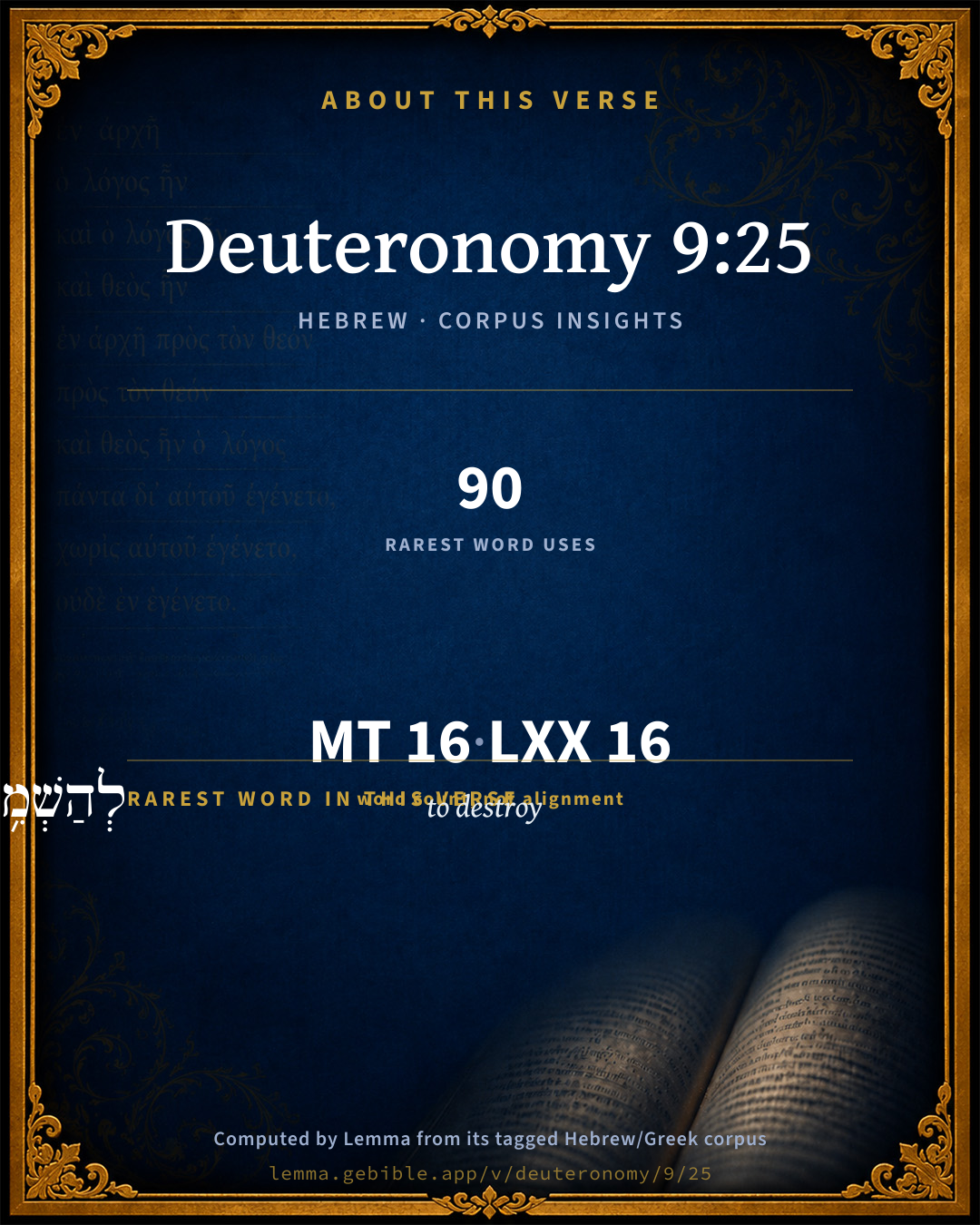
About this verse

These counts appear in no published source. They are computed here, from the morphology-tagged text and Lemma’s own curated glosses. What Lemma adds →

16
words
11
distinct lemmas
Pentateuch
section

Grammatical profile

  • 4 verbs
  • 5 nouns
  • 2 adjectives
  • 1 conjunction
  • 4 particles

Verb forms

  • וָֽאֶתְנַפַּ֞ל Hithpael · Sequential Imperfect
  • הִתְנַפָּ֑לְתִּי Hithpael · Perfect
  • אָמַ֥ר Qal · Perfect
  • לְהַשְׁמִ֥יד Hiphil · Infinitive Construct

Repetition

Words recur within this verse — often emphatic in Hebrew:

  • וָֽאֶתְנַפַּ֞ל to fall H5307 ×2
  • יְהוָ֗ה LORD H3068 ×2
  • אַרְבָּעִ֥ים forty H705 ×2

Hebrew & Septuagint length

In English translation the verse runs 24 words from the Hebrew and 27 from the Septuagint (LXX English) — closely comparable.

A rough comparison of the two English renderings, which tokenize alike — not a word-level alignment.

Word counts can differ between the Hebrew and the Greek without any difference in meaning — e.g. the Hebrew direct-object marker אֵת has no separate Greek word, and Greek often adds the article ὁ.

In the original languages it is 16 Hebrew tokens and 16 Greek tokens — but the two are counted differently (Hebrew bundles its prefixes and suffixes into one token; the Greek is in lemma form), so that isn’t a like-for-like length.

Cross-references

2

Topical passages linked to Deuteronomy 9:25 in the Treasury of Scripture Knowledge — connected by theme and wording, ordered by reader-vote popularity; previews shown in the World English Bible.

  • Deuteronomy 9:18 I fell down before Yahweh, as at the first, forty days and forty nights; I did neither eat bread nor drink water; because of all your sin which you sinned, in doing that which was evil in the sight of Yahweh, to provoke him to anger.
  • Deuteronomy 9:16 I looked, and, behold, you had sinned against Yahweh your God; you had made you a molten calf: you had turned aside quickly out of the way which Yahweh had commanded you.

Cross-references courtesy of OpenBible.info (CC BY 4.0).

Hebrew and Greek witnesses Masoretic Hebrew ↔ Greek Septuagint

The same verse in the two great witnesses to the Old Testament, shown verse-for-verse.

These are two independent witnesses, not word-aligned to each other, and the Septuagint is shown in lemma (dictionary) form.

Hebrew Deuteronomy 9:25 Masoretic · Westminster Leningrad Codex

וָֽאֶתְנַפַּ֞ל לִפְנֵ֣י יְהוָ֗ה אֵ֣ת אַרְבָּעִ֥ים הַיּ֛וֹם וְאֶת אַרְבָּעִ֥ים הַלַּ֖יְלָה אֲשֶׁ֣ר הִתְנַפָּ֑לְתִּי כִּֽי אָמַ֥ר יְהוָ֖ה לְהַשְׁמִ֥יד אֶתְכֶֽם

So I fell down before Yahweh the forty days and forty nights that I fell down, because Yahweh had said he would destroy you.

World English Bible · Public Domain

Greek LXX Deuteronomy 9:25 Septuagint · lemma form

καί δέομαι ἐναντίον κύριος τεσσαράκοντα ἡμέρα καί τεσσαράκοντα νύξ ὅσος δέομαι εἶπον γάρ κύριος ἐκὀλεθρεύω σύ

And I prayed before the Lord forty days and forty nights, the number that I prayed before, for the Lord said that he would utterly destroy you.

LXX2012 (modern English Septuagint) · Public Domain

Hebrew: Westminster Leningrad Codex (CC BY 4.0). Greek: Septuagint (public domain); English from LXX2012 (modern English Septuagint) (Public Domain). How the Septuagint differs from the Hebrew →

Targum (Aramaic paraphrase)

2

The Targum is the ancient Jewish Aramaic paraphrase of the Hebrew Scriptures — an interpretive translation, not the Hebrew text itself. Onkelos (literal) and Pseudo-Jonathan (expansive) render the Torah, and Jonathan the Prophets. Coverage is partial: where no permissively-licensed English translation exists for a verse, only the Aramaic is shown. This is verse-level text, not a word-by-word alignment to the Hebrew.

  1. Targum Onkelos Torah (Genesis–Deuteronomy)
    וְאִשְׁתַּטָחִית קֳדָם יְיָ יָת אַרְבְּעִין יְמָמִין וְיָת אַרְבְּעִין לֵילָוָן דִי אִשְׁתַּטָחִית אֲרֵי אֲמַר יְיָ לְשֵׁצָאָה יָתְכוֹן

    (no public-domain English translation for this verse)

    Targum Onkelos — Aramaic: “Onkelos Genesis” (public domain); “Onkelos Exodus” (public domain); “Onkelos Leviticus” (public domain); “Onkelos Numbers” (public domain); “Onkelos Deuteronomy” (public domain). English: “Sefaria Community Translation” (CC0 1.0 (public-domain dedication)); “J.W. Etheridge. The Targums of Onkelos and Jonathan Ben Uzziel on the Pentateuch. London: Longmans, Green, 1862” (public domain). Text via Sefaria.

  2. Targum Pseudo-Jonathan Torah (Genesis–Deuteronomy)
    וְאִשְׁתַּטָּחִית בִּצְלוֹ קֳדָם יְיָ יַת אַרְבְּעִין יְמָמִין וְיַת אַרְבְּעִין לֵילַוָן דְּאִשְׁתַּטָּחִית בִּצְלוֹ אֲרוּם אֲמַר יְיָ לִמְשֵׁצְיָא יַתְכוֹן

    And I bowed down in prayer before the Lord for the forty days and nights in which I was prostrate in supplication, because the Lord had said He was about to destroy you.

    Targum Pseudo-Jonathan — Aramaic: “Targum Jonathan on Genesis” (public domain); “Targum Jonathan on Exodus” (public domain); “Targum Jonathan on Leviticus” (public domain); “Targum Jonathan on Numbers” (public domain); “Targum Jonathan on Deuteronomy” (public domain). English: “The Targum of Jonathan ben Uzziel, trans. J. W. Etheridge, London, 1862” (public domain). Text via Sefaria.

Commentary

Notes on Deuteronomy 9:25 from classic Christian and Jewish commentators (each source and its license shown beneath its notes). The classic Christian expositions comment on the surrounding passage and are grouped to its opening verse, so a note may address several verses; the Jewish commentaries on the Tanakh (Rashi and others) are per-verse, so they appear only where the commentator wrote on this verse.

Lemma curates 59 commentaries, every one of them public domain or Creative Commons licensed, each selected and text-cleaned for this edition rather than reprinted as found. About our sources →

Trapp's Complete Commentary

John Trapp

Deu 9:25 Thus I fell down before the LORD forty days and forty nights, as I fell down [at the first]; because the LORD had said he would destroy you.

Ver. 25. Thus I fell down.] The three former verses come in by a parenthesis. Here he returns again to the history of his interceding for them the second time.

John Trapp, A Commentary or Exposition upon All the Books of the Old and New Testament (1647–1656) — public domain. Text from a community e-Sword module.

Joseph Benson's Commentary

Deu 9:25. I fell down — In a way of humiliation and supplication, on your behalf. Forty days — The same forty that were mentioned Deu 9:18, as appears by comparing this with the account given in Exodus, where this history is more fully related, and where this is related to have been done twice only. See Exo 32:10; Exo 33:5.

Joseph Benson's Commentary on the Old and New Testaments (1811–1818) — public domain. Text from a community e-Sword module.

Keil & Delitzsch

C. F. Keil & F. Delitzsch

After vindicating in this way the thought expressed in Deu 9:7, by enumerating the principal rebellions of the people against their God, Moses returns in Deu 9:25. to the apostasy at Sinai, for the purpose of showing still further how Israel had no righteousness or ground for boasting before God, and owed its preservation, with all the saving blessings of the covenant, solely to the mercy of God and His covenant faithfulness. To this end he repeats in Deu 9:26-29 the essential points in his intercession for the people after their sin at Sinai, and then proceeds to explain still further, in Deu 10:1-11, how the Lord had not only renewed the tables of the covenant in consequence of this intercession (Deu 10:1-5), but had also established the gracious institution of the priesthood for the time to come by appointing Eleazar in Aaron's stead as soon as his father died, and setting apart the tribe of Levi to carry the ark of the covenant and attend to the holy service, and had commanded them to continue their march to Canaan, and take possession of the land promised to the fathers (Deu 10:6-11). With the words "thus I fell down," in Deu 9:25, Moses returns to the intercession already briefly mentioned in Deu 9:18, and recalls to the recollection of the people the essential features of his plea at the time. For the words "the forty days and nights that I fell down," see at Deu 1:46. The substance of the intercession in Deu 9:26-29 is essentially the same as that in Exo 32:11-13; but given with such freedom as any other than Moses would hardly have allowed himself (Schultz), and in such a manner as to bring it into the most obvious relation to the words of God in Deu 9:12, Deu 9:13. אל־תּשׁחת, "Destroy not Thy people and Thine inheritance," says Moses, with reference to the words of the Lord to him: "thy people have corrupted themselves" (Deu 9:12). Israel was not Moses' nation, but the nation and inheritance of Jehovah; it was not Moses, but Jehovah, who had brought it out of Egypt. True, the people were stiffnecked (cf. Deu 9:13); but let the Lord remember the fathers, the oath given to Abraham, which is expressly mentioned in Exo 32:13 (see at Deu 7:8), and not turn to the stiffneckedness of the people (קשׁי equivalent to ערף קשׁה, Deu 9:13 and Deu 9:6), and to their wickedness and sin (i.e., not regard them and punish them). The honour of the Lord before the nations was concerned in this (Deu 9:28). The land whence Israel came out ("the land" = the people of the land, as in Gen 10:25, etc., viz., the Egyptians: the word is construed as a collective with a plural verb) must not have occasion to say, that Jehovah had not led His people into the promised land from incapacity or hatred. יכלת מבּלי recalls Num 14:16. Just as "inability" would be opposed to the nature of the absolute God, so "hatred" would be opposed to the choice of Israel as the inheritance of Jehovah, which He had brought out of Egypt by His divine and almighty power (cf. Exo 6:6).

Keil & Delitzsch — Biblical Commentary on the Old Testament (1861–1891) — public domain (CC PDM 1.0). Text via the HelloAO Bible API. (Old Testament only.)

Geneva Bible (1599)

Geneva Bible translators

Whereby is signified that God requireth earnest continuance in prayer.

Geneva Bible (1599) marginal notes — public domain. Text via Bolls.life.

Jamieson, Fausset & Brown

Robert Jamieson, A. R. Fausset & David Brown

Thus I fell down before the Lord forty days and forty nights, as I fell down at the first--After the enumeration of various acts of rebellion, he had mentioned the outbreak at Kadesh-barnea, which, on a superficial reading of this verse, would seem to have led Moses to a third and protracted season of humiliation. But on a comparison of this passage with Num 14:5, the subject and language of this prayer show that only the second act of intercession (Deu 9:18) is now described in fuller detail.

Next: Deuteronomy Chapter 10

Jamieson, Fausset & Brown — Commentary Critical and Explanatory on the Whole Bible (1871) — public domain (CC PDM 1.0). Text via the HelloAO Bible API.

Ellicott's Commentary for English Readers

(25) Thus I fell down . . .—Literally, And I fell down before Jehovah forty days and forty nights, as 1 had fallen down (originally on the fortieth day) when the Lord said He would destroy you: i.e., when He told Moses of the calf.

A Bible Commentary for English Readers, edited by Charles John Ellicott (1878–1897) — public domain. Text from a community e-Sword module.

The Cambridge Bible for Schools and Colleges

gen. ed. J. J. S. Perowne

25. So I fell down, etc.] Having recounted in Deu_9:22-24 the accumulated burdens of the people’s sins (there is therefore no need to doubt the originality of these verses, as Steuernagel does) under which he fell down, the speaker returns to the fact of his falling; and in—

The Cambridge Bible for Schools and Colleges (gen. ed. J. J. S. Perowne; Cambridge University Press, 1878–1918) — public domain. Text from a community e-Sword module.

John Gill's Exposition

Remember thy servants, Abraham, Isaac, and Jacob,.... The covenant he had made with them, the promises he had made to them of the multiplication of their seed, and of giving the land of Canaan to them; which is a third argument used with the Lord not to destroy them:

look not unto the stubbornness of this people, nor to their wickedness, nor to their sin; nor to the natural temper and disposition of the people, which was to be stubborn, obstinate, stiffnecked, and self-willed; nor to their wickedness, which appears in various instances; nor to that particular sin of idolatry they had now been guilty, of; tacitly owning that if God looked to these things, there was sufficient reason to destroy them.

John Gill's Exposition of the Whole Bible (1746–1763) — public domain (CC PDM 1.0). Text via the HelloAO Bible API.

Haydock's Catholic Bible Commentary

Nights. See ver. 18. (Calmet) --- After specifying various seditions of the people, Moses returns to what he had been saying respecting the tables of the law, and shews with what difficulty he obtained pardon for the people, and the second tables. (Haydock) --- Some people believe that Moses was thrice 40 days in the mountain. He mentions the prayer which he addressed to God before his first descent, Exodus xxxii. 11. (Menochius)

George Leo Haydock (1774–1849), Haydock's Catholic Family Bible and Commentary, 1859 edition — public domain. Excludes Psalms (Douay-Rheims chapter numbering differs from Protestant) and Deuterocanonical books (Catholic canon only).

Matthew Poole's English Annotations

Forty days and forty nights; the same mentioned before, Deu 9:18, as appears,

1. By comparing this with Exodus, where this history is more fully related, and where this is said to be done twice only.

2. By the occasion and matter of Moses’s prayer here following, which is the same with the former.

3. By the words here following,

as I fell down at first, which show that this was the second time of his so doing.

Matthew Poole's English Annotations on the Holy Bible (1683–1685) — public domain. Text from a community e-Sword/MySword module.

Whedon's Commentary on the Bible

Daniel D. Whedon

25-29. Remember thy servants — After the above enumeration of the principal occasions when the people awakened the anger of Jehovah, Moses returns to the apostasy at Horeb. He repeats the substance of his intercession with Jehovah, as given in Exo_32:11-13.

Daniel D. Whedon (gen. ed.), Commentary on the Old and New Testaments (1874–1909) — public domain. Text from a community e-Sword module.

The Pulpit Commentary

Ver. 25-29. Having enumerated these instances of the rebelliousness of the people, Moses reverts to the apostasy at Sinai, in order still more to impress on the minds of the people the conviction that not for any righteousness or merit of theirs, but solely of his own grace, was God fulfilling to them his covenant with their fathers.

Thus I fell down before the Lord forty days and forty nights, as I fell down at the first; rather, the forty days and forty nights in which I fell down. The reference is to the intercession before Moses came down from the mount, described in Exo_32:11-13. (For the form of the expression, cf. Deu_1:46)

The Pulpit Commentary (1880–1919), ed. H.D.M. Spence-Jones & Joseph S. Exell — public domain. Text from a community e-Sword module.

John Wesley's Explanatory Notes

I fell down forty days - The same as were mentioned before, ver. 18, as appears by comparing this with Exodus, where this history is more fully related, and where this is said to be done twice only.

John Wesley, Explanatory Notes Upon the Whole Bible (1754–1765) — public domain. Text via the GEBible commentary corpus.

unfoldingWord translationNotes

Door43 World Missions Community

General Information:

Moses continues reminding the people of Israel about what happened in the past.

lay facedown before Yahweh

"lay with my face on the ground." See how you translated this in Deuteronomy 9:18.

forty days and forty nights

"40 days and 40 nights" (See: Numbers)

you have redeemed

Moses speaks as if Yahweh had rescued the Israelites by paying money to free them from slavery. AT: "you have rescued" (See: Metaphor)

through your greatness

The word "greatness" is a metonym for Yahweh's great power. AT: "through your great power" (See: Metonymy)

with a mighty hand

Here "a mighty hand" refers to Yahweh's power. See how you translated similar words in Deuteronomy 4:34. AT: "with your mighty power" (See: Metaphor)

translationWords

inherit

redeem

might

hand

unfoldingWord translationNotes — © Distant Shores Media and the Door43 World Missions Community, licensed CC BY-SA 4.0. Source: git.door43.org/Door43/en_tn.

Rashi

Rabbi Shlomo Yitzchaki (Rashi)

ואתנפל וגו׳ AND I FELL DOWN [BEFORE THE LORD … THE FORTY DAYS … WHICH I HAD FALLEN DOWN] — These are the very same forty days mentioned above (v. 18), and it mentions them a second time here, because there is written here (in the next verse) the wording of his prayer, as it is said, “O Lord God, destroy not thy people, etc.”.

Rashi on the Tanakh — English translations: “The Judaica Press complete Tanach with Rashi, translated by A. J. Rosenberg” (CC BY 4.0); “Pentateuch with Rashi's commentary by M. Rosenbaum and A.M. Silbermann, 1929-1934” (public domain); “The Metsudah Tanach series, Lakewood, N.J” (CC BY 4.0); and “The Book of Joshua, Metsudah Publications, 1997” (CC BY 4.0). Text via Sefaria.

Ramban (Nachmanides)

Rabbi Moshe ben Nachman (Ramban / Nachmanides)

AND I FELL DOWN BEFORE THE ETERNAL. He is stating: “I had to cast myself down in prayer for you forty days and forty nights because of this great sin, for at first G-d said to destroy you, until I prayed to G-d and said ‘[O G-d Eternal], destroy not Thy people and Thine inheritance.’” This was his prayer before he came down from the mountain, and it was because of this prayer that he was answered with And the Eternal repented of the evil which He said He would do unto His people., Verse 14. The word “repented” here is an anthropomorphism (Ibn Ezra). He did not mention the prayer of the forty days and forty nights, for the measure thereof is longer than the earth, and broader than the sea. I have already explained. the reason why the Divine Names are written both with Aleph Daleth, and Yod Hei [in Verse 26: O G-d Eternal, destroy not Thy people etc.].

Ramban (Nachmanides) on the Tanakh — English translation: “Commentary on the Torah by Ramban (Nachmanides). Translated and annotated by Charles B. Chavel. New York, Shilo Pub. House, 1971-1976” (CC BY 4.0). Text via Sefaria.

Lesson kit

Teaching starters — assembled from the data on this page, not authored interpretation. Every prompt links to the verse data it draws on. Edit before teaching.

Deuteronomy, in the Pentateuch, opens this verse with 16 words (11 distinct Hebrew lemmas). Its most distinctive word is shâmad (“to destroy”). A historical commentator’s framing appears above. Read the whole chapter for the surrounding context.

Discussion questions

  1. How does “to destroy” (shâmad) shape what this verse is saying?
  2. How does Deuteronomy 9:18, which shares this passage’s theme, read alongside this verse?
  3. What does the repetition of “to fall” (2× in this one verse) do in this verse?
  4. The translations on this page render this verse differently — a whole-verse word diff, not a word-by-word alignment. What might account for the different wordings?
  5. «וָֽאֶתְנַפַּ֞ל» is a Hithpael Sequential Imperfect verb. How does that grammatical form shape the action described?
  6. Compare how Trapp's Complete Commentary and Joseph Benson's Commentary read this verse. Where do they agree or differ?

Things to notice

Reading settings

Reading text

Shown beneath each verse's original-language words.

Old Testament
Old Testament edition

Read the OT as the Masoretic Hebrew (MT) or the Greek Septuagint (LXX).

English shown for the Greek Septuagint (in the Hebrew ↔ Greek comparison).

Comparing translations? Open the Compare panel on any verse page to stack up to four side by side.