
1 Samuel 26:12

Hebrew (Westminster Leningrad Codex) 1 Samuel 26:12 appears in the Hebrew Old Testament. The text above is from the Westminster Leningrad Codex. Each word links to its Strong’s number, a concise gloss, and parsing drawn from the Open Scriptures Hebrew Bible morphology. Click any word for its full Brown-Driver-Briggs (BDB) entry.
Download image
Cite this verse

1 Samuel 26:12 (World English Bible). Public Domain. Lemma interlinear Bible study tool, https://lemma.gebible.app/v/1-samuel/26/12.

Show BibTeX & RIS
BibTeX
RIS
English Translation
So David took the spear and the jar of water from Saul's head; and they got them away: and no man saw it, nor knew it, neither did any awake; for they were all asleep, because a deep sleep from Yahweh was fallen on them.
World English Bible · Public Domain
Highlights
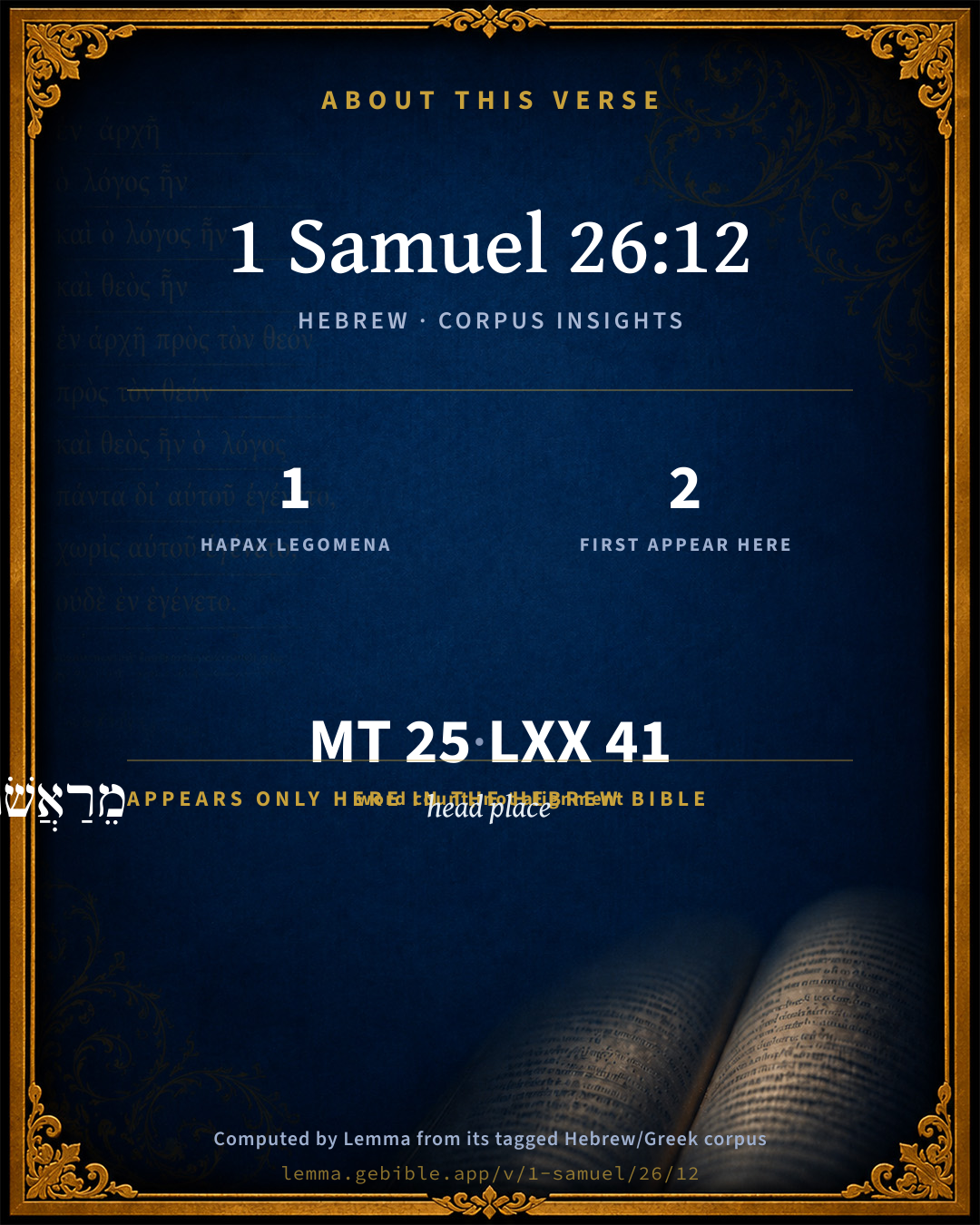
  • 1 hapax legomenon — only here in the Hebrew Bible
  • 2 first appearances in the Hebrew Bible
Full analysis ↓
Download a study sheet

One document with this verse’s original text, its word-by-word gloss line, the meaning frame, cross-references with their text, attributed commentary, and full source and license credits — printable, and it pastes into notes with its structure intact.

This verse Autodidact and up

Study sheet (.html) Plain text (.txt)

A passage Seminary Student

Up to 50 verses in one chapter. A passage sheet keeps up to 6 commentary sources and 12 cross-references per verse, in the order this page ranks them, and says so on the sheet whenever that leaves anything out. Ask for a single verse and you get the Autodidact verse sheet above.

Everything on this page stays free to read, with no account — the sheet is a download of what is already on screen, not access to it.

Want to remove ads? Support Godless Engineer
Compare translations 3

The same verse in 3 English versions, stacked beneath the original-language interlinear above. Click any original word for its lexicon entry.

Each is an independent rendering of the whole verse — the interlinear is not word-aligned to these translations.

Highlighted words mark where these versions differ — a whole-verse word diff, not a word-by-word alignment.

  • World English Bible Public Domain
    So David took the spear and the jar of water from Saul's head; and they got them away: and no man saw it, nor knew it, neither did any awake; for they were all asleep, because a deep sleep from Yahweh was fallen on them.
  • King James Version Public Domain
    So David took the spear and the cruse of water from Saul's bolster; and they gat them away, and no man saw it, nor knew it, neither awaked: for they were all asleep; because a deep sleep from the LORD was fallen upon them.
  • unfoldingWord Literal Text CC BY-SA 4.0
    And David took the spear and the jug of water from the head of Saul, and they went for themselves. And none was seeing, and none was knowing, and none was awakening, for all of them were sleeping, because a deep sleep of Yahweh had fallen on them.

unfoldingWord Literal Text — © unfoldingWord, licensed CC BY-SA 4.0. Word-aligned USFM3 via Door43 (git.door43.org/unfoldingWord/en_ult).

Versions to compare (up to 4)

3 of 4 selected

Show all 18 translations

Every available English version of this verse, each an independent rendering of the whole verse.

  • World English Bible Public Domain
    So David took the spear and the jar of water from Saul's head; and they got them away: and no man saw it, nor knew it, neither did any awake; for they were all asleep, because a deep sleep from Yahweh was fallen on them.
  • Berean Standard Bible Public Domain
    So David took the spear and water jug by Saul’s head, and they departed. No one saw them or knew about it, nor did anyone wake up; they all remained asleep, because a deep sleep from the LORD had fallen on them.
  • Majority Standard Bible Public Domain
    So David took the spear and water jug by Saul’s head, and they departed. No one saw them or knew about it, nor did anyone wake up; they all remained asleep, because a deep sleep from the LORD had fallen on them.
  • King James Version Public Domain
    So David took the spear and the cruse of water from Saul's bolster; and they gat them away, and no man saw it, nor knew it, neither awaked: for they were all asleep; because a deep sleep from the LORD was fallen upon them.
  • American Standard Version (1901) Public Domain
    So David took the spear and the cruse of water from Saul's head; and they gat them away: and no man saw it, nor knew it, neither did any awake; for they were all asleep, because a deep sleep from Jehovah was fallen upon them.
  • Revised Version (1885) Public Domain
    So David took the spear and the cruse of water from Saul’s head; and they gat them away, and no man saw it, nor knew it, neither did any awake: for they were all asleep; because a deep sleep from the LORD was fallen upon them.
  • Geneva Bible (1599) Public Domain
    So Dauid tooke the speare and the pot of water from Sauls head, and they gate them away, and no man saw it, nor marked it, neither did any awake, but they were all asleepe: for the Lord had sent a dead sleepe vpon them.
  • Douay-Rheims (1899) Public Domain
    So David took the spear, and the cup of water which was at Saul's head, and they went away: and no man saw it, or knew it, or awaked, but they were all asleep, for a deep sleep from the Lord was fallen upon them.
  • Young's Literal Translation Public Domain
    And David taketh the spear, and the cruse of water at the pillow of Saul, and they go away, and there is none seeing, and there is none knowing, and there is none awaking, for all of them are sleeping, for a deep sleep `from' Jehovah hath fallen upon them.
  • Literal Standard Version CC BY-SA 4.0
    And David takes the spear, and the jug of water by the pillow of Saul, and they go away, and there is none seeing, and there is none knowing, and there is none awaking, for all of them are sleeping, for a deep sleep [from] YHWH has fallen on them.
  • Unlocked Literal Bible CC BY-SA 4.0
    So David took the spear and the jar of water from Saul's head, and they got away. No one saw them or knew about it, nor did anyone wake up, for they were all asleep, because a deep sleep from Yahweh had fallen on them.
  • unfoldingWord Literal Text CC BY-SA 4.0
    And David took the spear and the jug of water from the head of Saul, and they went for themselves. And none was seeing, and none was knowing, and none was awakening, for all of them were sleeping, because a deep sleep of Yahweh had fallen on them.
  • Darby Bible Public Domain
    And David took the spear and the cruse of water from Saul's head; and they went away, and no man saw [it], and none knew [it], and none awaked, for they were all asleep; for a deep sleep from Jehovah had fallen upon them.
  • World Messianic Bible Public Domain
    So David took the spear and the jar of water from Saul’s head, and they went away. No man saw it, or knew it, nor did any awake; for they were all asleep, because a deep sleep from the LORD had fallen on them.
  • Webster's Bible Public Domain
    So David took the spear and the cruse of water from Saul's bolster; and they departed, and no man saw it, nor knew it, neither awaked: for they were all asleep: because a deep sleep from the LORD had fallen upon them.
  • Free Bible Version CC BY-SA 4.0
    David took the spear and water jug beside Saul's head, and they left. Nobody saw anything; nobody knew what had happened; nobody woke up. Everybody stayed asleep, because the Lord had made them fall into a deep sleep.
  • Bible in Basic English Public Domain
    So David took the spear and the vessel of water from Saul's head; and they got away without any man seeing them, or being conscious of their coming, or awaking; for they were all sleeping because a deep sleep from the Lord had come on them.
  • JPS Tanakh (1917) Public Domain
    So David took the spear and the cruse of water from Saul's head; and they got them away, and no man saw it, nor knew it, neither did any awake; for they were all asleep; because a deep sleep from the LORD was fallen upon them.

Literal Standard Version (2020), Covenant Press — licensed CC BY-SA 4.0. Text via the HelloAO Bible API (eBible.org). Unlocked Literal Bible (unfoldingWord) — licensed CC BY-SA 4.0. Text via the HelloAO Bible API (eBible.org). unfoldingWord Literal Text — © unfoldingWord, licensed CC BY-SA 4.0. Word-aligned USFM3 via Door43 (git.door43.org/unfoldingWord/en_ult). Free Bible Version, Dr. Jonathan Gallagher — licensed CC BY-SA 4.0. Text via the HelloAO Bible API (eBible.org).

Word by word

More ways to search: Search by grammar → Find every occurrence → Compare this word →

Practice this passage: Drill this verse → Learn its vocabulary →

מֵרַאֲשֹׁתֵ֣י
raʼăshôth
H7226
“head places of”
Noun, Common, Feminine, Plural, Construct
Part of Speech
Noun
Type
Common
Gender
Feminine
Number
Plural
State
Construct
Full BDB Definition

Origin: from H7218

TWOT: 2097f

head place, place at the head
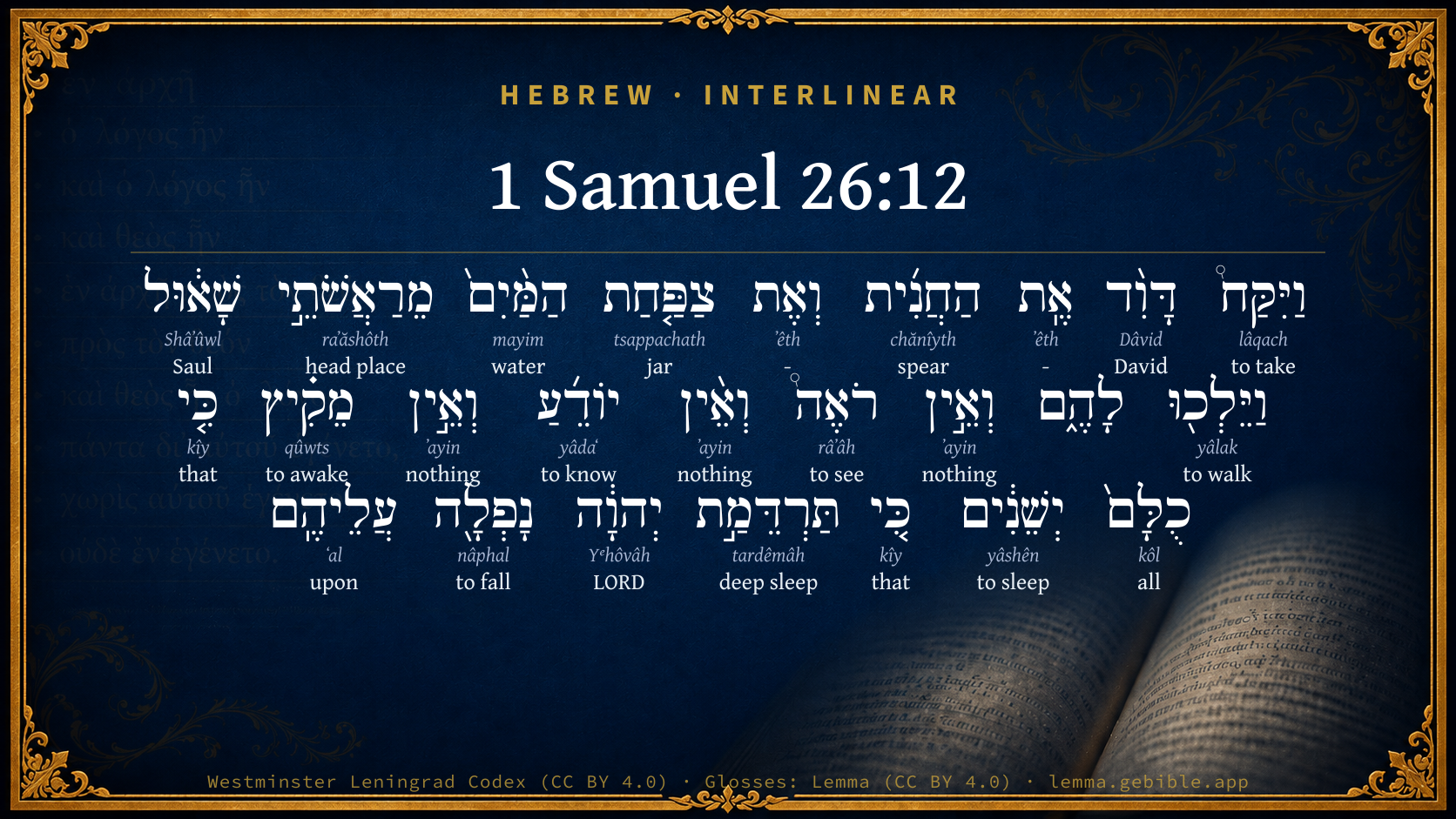
  1. וַיִּקַּח֩ lâqach H3947 “and · to take” Conjunction + Verb, Qal, Sequential Imperfect, 3rd Person, Masculine, Singular
  2. דָּוִ֨ד Dâvid H1732 “David” Noun, Proper
  3. אֶֽת ʼêth H853 “-” Particle, Direct Object
  4. הַחֲנִ֜ית chănîyth H2595 “the · spear” Particle, Definite Article + Noun, Common, Feminine, Singular, Absolute
  5. וְאֶת ʼêth H853 “and · -” Conjunction + Particle, Direct Object
  6. צַפַּ֤חַת tsappachath H6835 “jar of” Noun, Common, Feminine, Singular, Construct
  7. הַמַּ֨יִם֙ mayim H4325 “the · water(s)” Particle, Definite Article + Noun, Common, Masculine, Plural, Absolute
  8. שָׁא֔וּל Shâʼûwl H7586 “Saul” Noun, Proper
  9. וַיֵּלְכ֖וּ yâlak H3212 “and · to walk” Conjunction + Verb, Qal, Sequential Imperfect, 3rd Person, Masculine, Plural
  10. וְאֵ֣ין ʼayin H369 “and · nothing” Conjunction + Particle, Negative
  11. רֹאֶה֩ râʼâh H7200 “seeing” Verb, Qal, Participle Active, Masculine, Singular, Absolute
  12. וְאֵ֨ין ʼayin H369 “and · nothing” Conjunction + Particle, Negative
  13. יוֹדֵ֜עַ yâdaʻ H3045 “knowing” Verb, Qal, Participle Active, Masculine, Singular, Absolute
  14. וְאֵ֣ין ʼayin H369 “and · nothing” Conjunction + Particle, Negative
  15. מֵקִ֗יץ qûwts H6974 “awaking” Verb, Hiphil, Participle Active, Masculine, Singular, Absolute
  16. כִּ֤י kîy H3588 “that” Conjunction
  17. כֻלָּם֙ kôl H3605 “all · their” Noun, Common, Masculine, Singular, Construct + Suffix, Personal, 3rd Person, Masculine, Plural
  18. יְשֵׁנִ֔ים yâshên H3462 “asleep” Adjective, Adjective, Masculine, Plural, Absolute
  19. כִּ֚י kîy H3588 “that” Conjunction
  20. תַּרְדֵּמַ֣ת tardêmâh H8639 “deep sleep of” Noun, Common, Feminine, Singular, Construct
  21. יְהוָ֔ה Yᵉhôvâh H3068 “LORD” Noun, Proper
  22. נָפְלָ֖ה nâphal H5307 “to fall” Verb, Qal, Perfect, 3rd Person, Feminine, Singular
  23. עֲלֵיהֶֽם ʻal H5921 “upon · them” Preposition + Suffix, Personal, 3rd Person, Masculine, Plural

About this verse

These counts appear in no published source. They are computed here, from the morphology-tagged text and Lemma’s own curated glosses. What Lemma adds →

25
words
20
distinct lemmas
Historical
section

Notable vocabulary

1 hapax legomenon — a word that appears only here in the entire Hebrew Bible:

  • מֵרַאֲשֹׁתֵ֣י head place H7226

First appearance in Scripture

These words make their first canonical appearance in the Hebrew Bible here:

  • מֵרַאֲשֹׁתֵ֣י head place H7226
  • מֵקִ֗יץ to awake H6974

Shared distinctive vocabulary

צַפַּ֤חַת jar H6835 occurs in 7 verses of the Hebrew Bible. Also found in:

Grammatical profile

  • 6 verbs
  • 9 nouns
  • 1 adjective
  • 2 prepositions
  • 2 conjunctions
  • 5 particles

Verb forms

  • וַיִּקַּח֩ Qal · Sequential Imperfect
  • וַיֵּלְכ֖וּ Qal · Sequential Imperfect
  • רֹאֶה֩ Qal · Participle Active
  • יוֹדֵ֜עַ Qal · Participle Active
  • מֵקִ֗יץ Hiphil · Participle Active
  • נָפְלָ֖ה Qal · Perfect

Repetition

Words recur within this verse — often emphatic in Hebrew:

  • וְאֵ֣ין nothing H369 ×3
  • כִּ֤י that H3588 ×2

Hebrew & Septuagint length

In English translation the verse runs 45 words from the Hebrew and 49 from the Septuagint (LXX English) — closely comparable.

A rough comparison of the two English renderings, which tokenize alike — not a word-level alignment.

Word counts can differ between the Hebrew and the Greek without any difference in meaning — e.g. the Hebrew direct-object marker אֵת has no separate Greek word, and Greek often adds the article ὁ.

In the original languages it is 25 Hebrew tokens and 41 Greek tokens — but the two are counted differently (Hebrew bundles its prefixes and suffixes into one token; the Greek is in lemma form), so that isn’t a like-for-like length.

Cross-references

6

Topical passages linked to 1 Samuel 26:12 in the Treasury of Scripture Knowledge — connected by theme and wording, ordered by reader-vote popularity; previews shown in the World English Bible.

  • Genesis 2:21 Yahweh God caused a deep sleep to fall on the man, and he slept; and he took one of his ribs, and closed up the flesh in its place.
  • Genesis 15:12 When the sun was going down, a deep sleep fell on Abram. Now terror and great darkness fell on him.
  • Isaiah 29:10 For Yahweh has poured out on you the spirit of deep sleep, and has closed your eyes, the prophets; and your heads, the seers, has he covered.
  • 1 Samuel 24:4 The men of David said to him, Behold, the day of which Yahweh said to you, Behold, I will deliver your enemy into your hand, and you shall do to him as it shall seem good to you. Then David arose, and cut off the skirt of Saul's robe secretly.
  • 1 Samuel 26:7 So David and Abishai came to the people by night: and, behold, Saul lay sleeping within the place of the wagons, with his spear stuck in the ground at his head; and Abner and the people lay round about him.
  • Esther 6:1 On that night the king couldn't sleep; and he commanded to bring the book of records of the chronicles, and they were read before the king.

Cross-references courtesy of OpenBible.info (CC BY 4.0).

Hebrew and Greek witnesses Masoretic Hebrew ↔ Greek Septuagint

The same verse in the two great witnesses to the Old Testament, shown verse-for-verse.

These are two independent witnesses, not word-aligned to each other, and the Septuagint is shown in lemma (dictionary) form.

Hebrew 1 Samuel 26:12 Masoretic · Westminster Leningrad Codex

וַיִּקַּח֩ דָּוִ֨ד אֶֽת הַחֲנִ֜ית וְאֶת צַפַּ֤חַת הַמַּ֨יִם֙ מֵרַאֲשֹׁתֵ֣י שָׁא֔וּל וַיֵּלְכ֖וּ לָהֶ֑ם וְאֵ֣ין רֹאֶה֩ וְאֵ֨ין יוֹדֵ֜עַ וְאֵ֣ין מֵקִ֗יץ כִּ֤י כֻלָּם֙ יְשֵׁנִ֔ים כִּ֚י תַּרְדֵּמַ֣ת יְהוָ֔ה נָפְלָ֖ה עֲלֵיהֶֽם

So David took the spear and the jar of water from Saul's head; and they got them away: and no man saw it, nor knew it, neither did any awake; for they were all asleep, because a deep sleep from Yahweh was fallen on them.

World English Bible · Public Domain

Greek LXX 1 Samuel 26:12 Septuagint · lemma form

καί λαμβάνω δαυίδ ὁ δόρυ καί ὁ φακός ὁ ὕδωρ ἀπό πρός κεφαλή αὐτός καί ἀποἔρχομαι κατά ἑαυτοῦ καί οὐ εἰμί ὁ βλέπω καί οὐ εἰμί ὁ γιγνώσκω καί οὐ εἰμί ὁ ἐκἐγείρω πᾶς ὑπνόω ὅτι θάμβος κύριος ἐπιπίπτω ἐπί αὐτός

So David took the spear, and the pitcher of water from his bolster, and they went home: and there was no one that saw, and no one that knew, and there was no one that awoke, all being asleep, for a stupor from the Lord had fallen upon them.

LXX2012 (modern English Septuagint) · Public Domain

Hebrew: Westminster Leningrad Codex (CC BY 4.0). Greek: Septuagint (public domain); English from LXX2012 (modern English Septuagint) (Public Domain). How the Septuagint differs from the Hebrew →

Targum (Aramaic paraphrase)

1

The Targum is the ancient Jewish Aramaic paraphrase of the Hebrew Scriptures — an interpretive translation, not the Hebrew text itself. Onkelos (literal) and Pseudo-Jonathan (expansive) render the Torah, and Jonathan the Prophets. Coverage is partial: where no permissively-licensed English translation exists for a verse, only the Aramaic is shown. This is verse-level text, not a word-by-word alignment to the Hebrew.

  1. Targum Jonathan Prophets (Joshua–Malachi)
    וּנְסִיב דָוִד יַת מוּרְנִיתָא וְיַת מָנָא דְמַיָא מֵאִיסָדֵי שָׁאוּל וַאֲזַלוּ לְהוֹן וְלֵית דַחֲזֵי וְלֵית דִידַע וְלֵית דְמִתְעַר אֲרֵי כוּלְהוֹן דְמָכִין אֲרֵי שֵׁינָא תַקִיפָא מִן קֳדָם יְיָ נְפָלַת עֲלֵיהוֹן:

    (no public-domain English translation for this verse)

    Targum Jonathan — Aramaic: “Mikraot Gedolot” (public domain). English: “Sefaria Community Translation” (CC0 1.0 (public-domain dedication)); “London "Chaldee Paraphrase," 1871” (public domain). Text via Sefaria.

Commentary

Notes on 1 Samuel 26:12 from classic Christian and Jewish commentators (each source and its license shown beneath its notes). The classic Christian expositions comment on the surrounding passage and are grouped to its opening verse, so a note may address several verses; the Jewish commentaries on the Tanakh (Rashi and others) are per-verse, so they appear only where the commentator wrote on this verse.

Lemma curates 59 commentaries, every one of them public domain or Creative Commons licensed, each selected and text-cleaned for this edition rather than reprinted as found. About our sources →

Trapp's Complete Commentary

John Trapp

1Sa 26:12 So David took the spear and the cruse of water from Saul’s bolster; and they gat them away, and no man saw [it], nor knew [it], neither awaked: for they [were] all asleep; because a deep sleep from the LORD was fallen upon them.

Ver. 12. So David took the spear.] He took it himself, and would not trust Abishai with it, saith Vatablus, lest he should strike Saul with it; for his fingers even itched to be doing.

John Trapp, A Commentary or Exposition upon All the Books of the Old and New Testament (1647–1656) — public domain. Text from a community e-Sword module.

Geneva Bible (1599)

Geneva Bible translators

Hebrew, the heavy sleep of the Lord was fallen upon them.

Geneva Bible (1599) marginal notes — public domain. Text via Bolls.life.

Adam Clarke's Commentary

Verse 12. David took the spear and the cruse] The spear, we have already seen, was the emblem of power and regal dignity. But it is usual, in Arab camps, for every man to have his lance stuck in the ground beside him, that he may be ready for action in a moment. The cruse of water resembled, in some measure, the canteens of our soldiers. In such a climate, where water was always scarce, it was necessary for each man to carry a little with him, to refresh him on his march.

A deep sleep from the Lord] It is the same word which is used, Ge 2:21, to describe the sleep which God caused to fall upon Adam, when he formed Eve out of his side.

Adam Clarke's Commentary on the Bible (1810–1826) — public domain. Text from a community e-Sword/MySword module.

Ellicott's Commentary for English Readers

(12) No man saw it, nor knew it, neither awaked.—The Hebrew is more graphic: “And none saw, and none knew, and none awaked.”

A deep sleep from the Lord.—The inference here, at first sight, certainly is that an unnatural, or rather, a supernatural drowsiness had fallen on the camp of Saul. Still, it is not absolutely necessary to suppose that a special miracle was wrought on this occasion. The memory of great carelessness and want of vigilance in the royal army was evidently in David’s mind when he sarcastically reproves the royal general Abner, in 1Sa_26:14-16. They were in a friendly district, and never dreamed of a surprise, and possibly the rough soldiers on duty had been carousing. David too and Abishai, owing to their long experience in camp life, often flying before their enemies, were practised scouts, and in the dark night did their perilous work speedily and noiselessly.

A Bible Commentary for English Readers, edited by Charles John Ellicott (1878–1897) — public domain. Text from a community e-Sword module.

The Cambridge Bible for Schools and Colleges

gen. ed. J. J. S. Perowne

12. from Saul’s bolster] From Saul’s head.

a deep sleep] The word is used especially of supernaturally caused sleep, as in Gen_2:21; Gen_15:12.

The Cambridge Bible for Schools and Colleges (gen. ed. J. J. S. Perowne; Cambridge University Press, 1878–1918) — public domain. Text from a community e-Sword module.

John Gill's Exposition

So David took the spear, and the cruse of water, from Saul's bolster,.... Abishai either refusing to take them, since he might not take away his life; or it may be rather David thought better of it, and took them himself, lest Abishai should be tempted, when so near to Saul, and his spear in his hand, and should thrust him with it; though David may be said to take them by the hands of Abishai:

and they gat them away; with the above things along with them:

and no man saw it, nor knew it; saw them in the camp, or knew what they did:

neither awaked; at their talking together, at the motion of their feet, and taking away the spear and cruse:

for they were all asleep; which was very extraordinary, that among three thousand men none should be awake, not even the sentinels; which might seem impossible in a natural way, but it is accounted for by what follows:

because a deep sleep from the Lord was fallen upon them; or "a sleep of the Lord" (p); a very great one, an uncommon one; so great trees, mountains, &c. are called trees and mountains of God; or, according to our supplement, it was from the Lord, he was the cause and author of it; he cast them into this sleep, or caused it to fall upon them, and locked them up in it, that they might not hear David and his servant when they came among them.

(p) , "sopor Domini", V. L. Montanus, Munsterus "altus sopor Jehovae", Junias & Tremellius, Piscator.

John Gill's Exposition of the Whole Bible (1746–1763) — public domain (CC PDM 1.0). Text via the HelloAO Bible API.

Haydock's Catholic Bible Commentary

Water, for refreshment, or for purifications. --- Lord. It is not necessary to have recourse to a miracle, (Calmet) though it must have been by a special providence that all continued in such a deep sleep, (Haydock) to give David an opportunity of manifesting his innocence. (Worthington)

George Leo Haydock (1774–1849), Haydock's Catholic Family Bible and Commentary, 1859 edition — public domain. Excludes Psalms (Douay-Rheims chapter numbering differs from Protestant) and Deuterocanonical books (Catholic canon only).

Matthew Poole's English Annotations

Sent upon them by the Lord, for David’s advantage.

Matthew Poole's English Annotations on the Holy Bible (1683–1685) — public domain. Text from a community e-Sword/MySword module.

Whedon's Commentary on the Bible

Daniel D. Whedon

12. David took the spear and the cruse — From this the most careless reader might see that we have in this chapter a different occurrence from that of chap. 24. There David cuts off a piece of Saul’s garment for a trophy; here he takes his spear and cruse. And, it may be added, there Saul was in a cave, here in the midst of the baggage wagons of his army; there he was performing an act of nature, here he was fast asleep.

A deep sleep from the Lord was fallen upon them — So that Divine Providence favoured David in his daring enterprise.

Daniel D. Whedon (gen. ed.), Commentary on the Old and New Testaments (1874–1909) — public domain. Text from a community e-Sword module.

The Pulpit Commentary

And no man saw it, etc. The Hebrew text describes the occurrence in a much more lively manner: "And none saw, and none knew, and none awaked." A deep sleep from Jehovah, etc. So surprising a fact as that two men could penetrate into the very centre of a considerable army, and remove the king"s sceptre and water bottle from his side, could only be accounted for by the interference of Providence in their behalf.

The Pulpit Commentary (1880–1919), ed. H.D.M. Spence-Jones & Joseph S. Exell — public domain. Text from a community e-Sword module.

Lesson kit

Teaching starters — assembled from the data on this page, not authored interpretation. Every prompt links to the verse data it draws on. Edit before teaching.

1 Samuel, in the Historical, opens this verse with 25 words (20 distinct Hebrew lemmas). Its most distinctive word is raʼăshôth (“head place”). A historical commentator’s framing appears above. Read the whole chapter for the surrounding context.

Discussion questions

  1. The word raʼăshôth carries the sense “head place.” How does it shape the verse?
  2. 1 word here appears nowhere else in the Hebrew Bible. Why might the author reach for such rare wording?
  3. 2 words make their first appearance in Scripture here. What does this debut establish?
  4. How does 1 Samuel 26:11, which shares the word «jar», read alongside this verse?
  5. What does the repetition of “nothing” (3× in this one verse) do in this verse?
  6. These translations render this verse differently; the difference is in the English rendering, not the original. What questions does that raise?
  7. «וַיִּקַּח֩» is a Qal Sequential Imperfect verb. How does that grammatical form shape the action described?
  8. Compare how Trapp's Complete Commentary and Geneva Bible (1599) read this verse. Where do they agree or differ?

Things to notice

  • 1 word in this verse appears nowhere else in the Hebrew Bible.
  • 2 words make their first canonical appearance in Scripture here.
  • This verse counts 25 Hebrew ↔ 41 Greek words.
  • These translations choose different wording for 30 words in this verse.
  • “nothing” occurs 3× in this single verse.

Reading settings

Reading text

Shown beneath each verse's original-language words.

Old Testament
Old Testament edition

Read the OT as the Masoretic Hebrew (MT) or the Greek Septuagint (LXX).

English shown for the Greek Septuagint (in the Hebrew ↔ Greek comparison).

Comparing translations? Open the Compare panel on any verse page to stack up to four side by side.