
Ruth 2:10

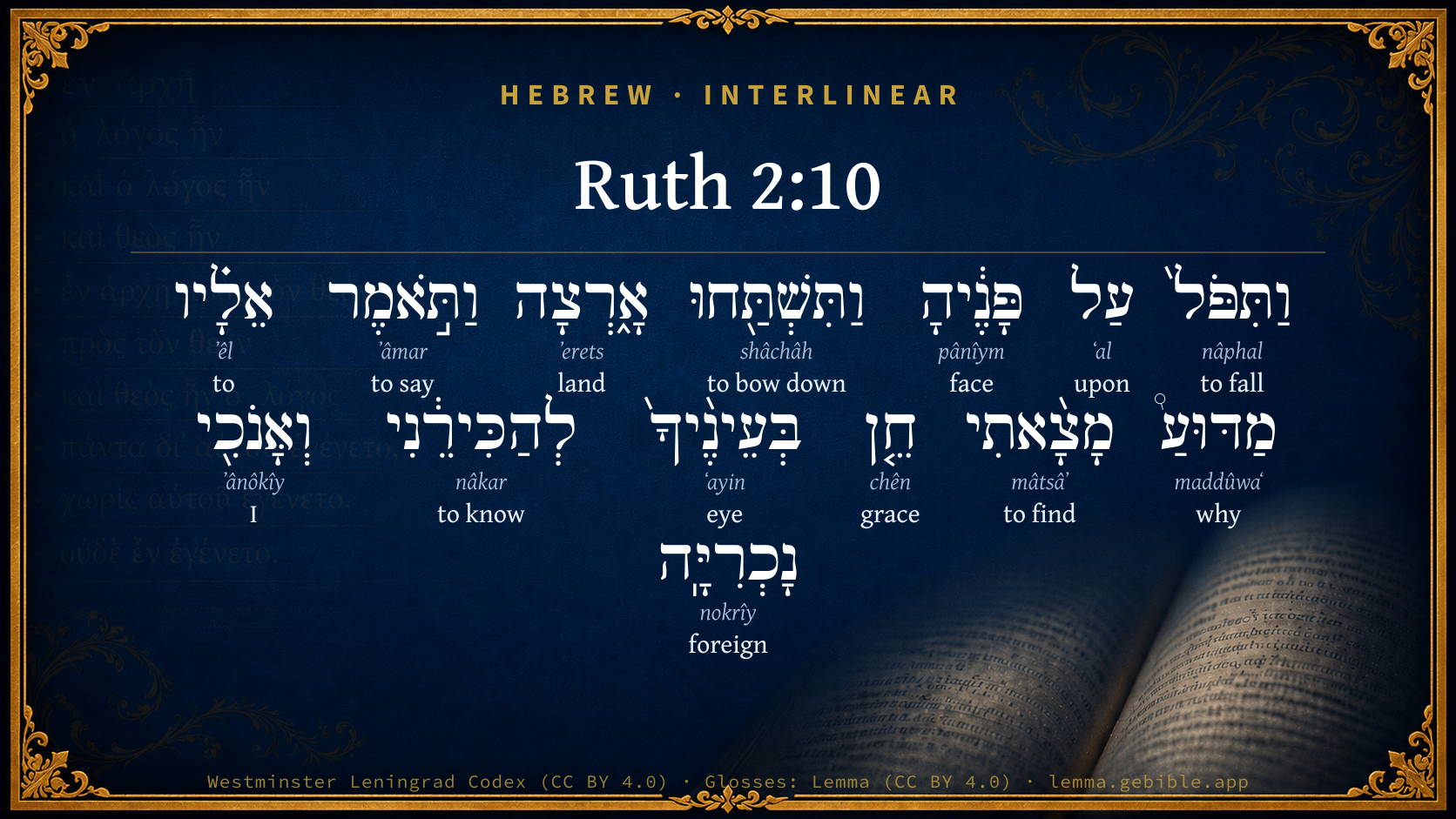
Hebrew (Westminster Leningrad Codex) Ruth 2:10 appears in the Hebrew Old Testament. The text above is from the Westminster Leningrad Codex. Each word links to its Strong’s number, a concise gloss, and parsing drawn from the Open Scriptures Hebrew Bible morphology. Click any word for its full Brown-Driver-Briggs (BDB) entry.
Download image
Cite this verse

Ruth 2:10 (World English Bible). Public Domain. Lemma interlinear Bible study tool, https://lemma.gebible.app/v/ruth/2/10.

Show BibTeX & RIS
BibTeX
RIS
English Translation
Then she fell on her face, and bowed herself to the ground, and said to him, Why have I found favor in your sight, that you should take knowledge of me, seeing I am a foreigner?
World English Bible · Public Domain
Download a study sheet

One document with this verse’s original text, its word-by-word gloss line, the meaning frame, cross-references with their text, attributed commentary, and full source and license credits — printable, and it pastes into notes with its structure intact.

This verse Autodidact and up

Study sheet (.html) Plain text (.txt)

A passage Seminary Student

Up to 50 verses in one chapter. A passage sheet keeps up to 6 commentary sources and 12 cross-references per verse, in the order this page ranks them, and says so on the sheet whenever that leaves anything out. Ask for a single verse and you get the Autodidact verse sheet above.

Everything on this page stays free to read, with no account — the sheet is a download of what is already on screen, not access to it.

Want to remove ads? Support Godless Engineer
Compare translations 3

The same verse in 3 English versions, stacked beneath the original-language interlinear above. Click any original word for its lexicon entry.

Each is an independent rendering of the whole verse — the interlinear is not word-aligned to these translations.

Highlighted words mark where these versions differ — a whole-verse word diff, not a word-by-word alignment.

  • World English Bible Public Domain
    Then she fell on her face, and bowed herself to the ground, and said to him, Why have I found favor in your sight, that you should take knowledge of me, seeing I am a foreigner?
  • King James Version Public Domain
    Then she fell on her face, and bowed herself to the ground, and said unto him, Why have I found grace in thine eyes, that thou shouldest take knowledge of me, seeing I am a stranger?
  • unfoldingWord Literal Text CC BY-SA 4.0
    Then she fell on her face and bowed down to the ground and said to him, “Why have I found favor in your eyes that you should take notice of me, since I am a foreigner?”

unfoldingWord Literal Text — © unfoldingWord, licensed CC BY-SA 4.0. Word-aligned USFM3 via Door43 (git.door43.org/unfoldingWord/en_ult).

Versions to compare (up to 4)

3 of 4 selected

Show all 18 translations

Every available English version of this verse, each an independent rendering of the whole verse.

  • World English Bible Public Domain
    Then she fell on her face, and bowed herself to the ground, and said to him, Why have I found favor in your sight, that you should take knowledge of me, seeing I am a foreigner?
  • Berean Standard Bible Public Domain
    At this, she fell on her face, bowing low to the ground, and said to him, “Why have I found such favor in your eyes that you should take notice of me, even though I am a foreigner?”
  • Majority Standard Bible Public Domain
    At this, she fell on her face, bowing low to the ground, and said to him, “Why have I found such favor in your eyes that you should take notice of me, even though I am a foreigner?”
  • King James Version Public Domain
    Then she fell on her face, and bowed herself to the ground, and said unto him, Why have I found grace in thine eyes, that thou shouldest take knowledge of me, seeing I am a stranger?
  • American Standard Version (1901) Public Domain
    Then she fell on her face, and bowed herself to the ground, and said unto him, Why have I found favor in thy sight, that thou shouldest take knowledge of me, seeing I am a foreigner?
  • Revised Version (1885) Public Domain
    Then she fell on her face, and bowed herself to the ground, and said unto him, Why have I found grace in thy sight, that thou shouldest take knowledge of me, seeing I am a stranger?
  • Geneva Bible (1599) Public Domain
    Then shee fell on her face, and bowed her selfe to the ground, and said vnto him, How haue I found fauour in thine eyes, that thou shouldest know me, seeing I am a stranger?
  • Douay-Rheims (1899) Public Domain
    She fell on her face and worshipping upon the ground, said to him: Whence cometh this to me, that I should find grace before thy eyes, and that thou shouldst vouchsafe to take notice of me a woman of another country?
  • Young's Literal Translation Public Domain
    And she falleth on her face, and boweth herself to the earth, and saith unto him, `Wherefore have I found grace in thine eyes, to discern me, and I a stranger?'
  • Literal Standard Version CC BY-SA 4.0
    And she falls on her face, and bows herself to the earth, and says to him, “Why have I found grace in your eyes, to discern me, and I a stranger?”
  • Unlocked Literal Bible CC BY-SA 4.0
    Then she bowed down before Boaz, touching her face to the ground. She said to him, “Why have I found such favor in your eyes that you should be concerned about me, a foreigner?”
  • unfoldingWord Literal Text CC BY-SA 4.0
    Then she fell on her face and bowed down to the ground and said to him, “Why have I found favor in your eyes that you should take notice of me, since I am a foreigner?”
  • Darby Bible Public Domain
    Then she fell on her face, and bowed herself to the ground, and said to him, Why have I found favour in thine eyes, that thou shouldest regard me, seeing I am a foreigner?
  • World Messianic Bible Public Domain
    Then she fell on her face and bowed herself to the ground, and said to him, “Why have I found favor in your sight, that you should take knowledge of me, since I am a foreigner?”
  • Webster's Bible Public Domain
    Then she fell on her face, and bowed herself to the ground, and said to him, Why have I found grace in thy eyes, that thou shouldst take knowledge of me, seeing I am a stranger?
  • Free Bible Version CC BY-SA 4.0
    She bowed down with her face to the ground. “Why are you being so kind to me or even notice me, seeing I'm a foreigner?” she asked him.
  • Bible in Basic English Public Domain
    Then she went down on her face to the earth, and said to him, Why have I grace in your eyes, that you give attention to me, seeing I am from a strange people?
  • JPS Tanakh (1917) Public Domain
    Then she fell on her face, and bowed down to the ground, and said unto him: 'Why have I found favour in thy sight, that thou shouldest take cognizance of me, seeing I am a foreigner?'

Literal Standard Version (2020), Covenant Press — licensed CC BY-SA 4.0. Text via the HelloAO Bible API (eBible.org). Unlocked Literal Bible (unfoldingWord) — licensed CC BY-SA 4.0. Text via the HelloAO Bible API (eBible.org). unfoldingWord Literal Text — © unfoldingWord, licensed CC BY-SA 4.0. Word-aligned USFM3 via Door43 (git.door43.org/unfoldingWord/en_ult). Free Bible Version, Dr. Jonathan Gallagher — licensed CC BY-SA 4.0. Text via the HelloAO Bible API (eBible.org).

Word by word

More ways to search: Search by grammar → Find every occurrence → Compare this word →

Practice this passage: Drill this verse → Learn its vocabulary →

נָכְרִיָּֽה
nokrîy
H5237
“foreign”
Adjective, Adjective, Feminine, Singular, Absolute
Part of Speech
Adjective
Type
Adjective
Gender
Feminine
Number
Singular
State
Absolute
Full BDB Definition

Origin: from H5235 (second form)

TWOT: 1368c

foreign, alien - foreign - foreigner (substantive) - foreign woman, harlot - unknown, unfamiliar (figuratively)
  1. וַתִּפֹּל֙ nâphal H5307 “and · to fall” Conjunction + Verb, Qal, Sequential Imperfect, 3rd Person, Feminine, Singular
  2. עַל ʻal H5921 “upon” Preposition
  3. פָּנֶ֔יהָ pânîym H6440 “face(s) · her” Noun, Common, Both, Plural, Construct + Suffix, Personal, 3rd Person, Feminine, Singular
  4. וַתִּשְׁתַּ֖חוּ shâchâh H7812 “and · to bow down” Conjunction + Verb, Hishtaphel, Sequential Imperfect, 3rd Person, Feminine, Singular
  5. אָ֑רְצָה ʼerets H776 “land · toward” Noun, Common, Both, Singular, Absolute + Suffix, Demonstrative
  6. וַתֹּ֣אמֶר ʼâmar H559 “and · to say” Conjunction + Verb, Qal, Sequential Imperfect, 3rd Person, Feminine, Singular
  7. אֵלָ֗יו ʼêl H413 “to · him” Preposition + Suffix, Personal, 3rd Person, Masculine, Singular
  8. מַדּוּעַ֩ maddûwaʻ H4069 “why” Particle, Interrogative
  9. מָצָ֨אתִי mâtsâʼ H4672 “to find” Verb, Qal, Perfect, 1st Person, Common, Singular
  10. חֵ֤ן chên H2580 “grace” Noun, Common, Masculine, Singular, Absolute
  11. בְּעֵינֶ֨יךָ֙ ʻayin H5869 “in/at · eyes · your” Preposition + Noun, Common, Both, Dual, Construct + Suffix, Personal, 2nd Person, Masculine, Singular
  12. לְהַכִּירֵ֔נִי nâkar H5234 “to know · me” Preposition + Verb, Hiphil, Infinitive Construct + Suffix, Personal, 1st Person, Common, Singular
  13. וְאָּנֹכִ֖י ʼânôkîy H595 “and · I” Conjunction + Pronoun, Personal, 1st Person, Common, Singular

About this verse

These counts appear in no published source. They are computed here, from the morphology-tagged text and Lemma’s own curated glosses. What Lemma adds →

14
words
14
distinct lemmas
Historical
section

Shared distinctive vocabulary

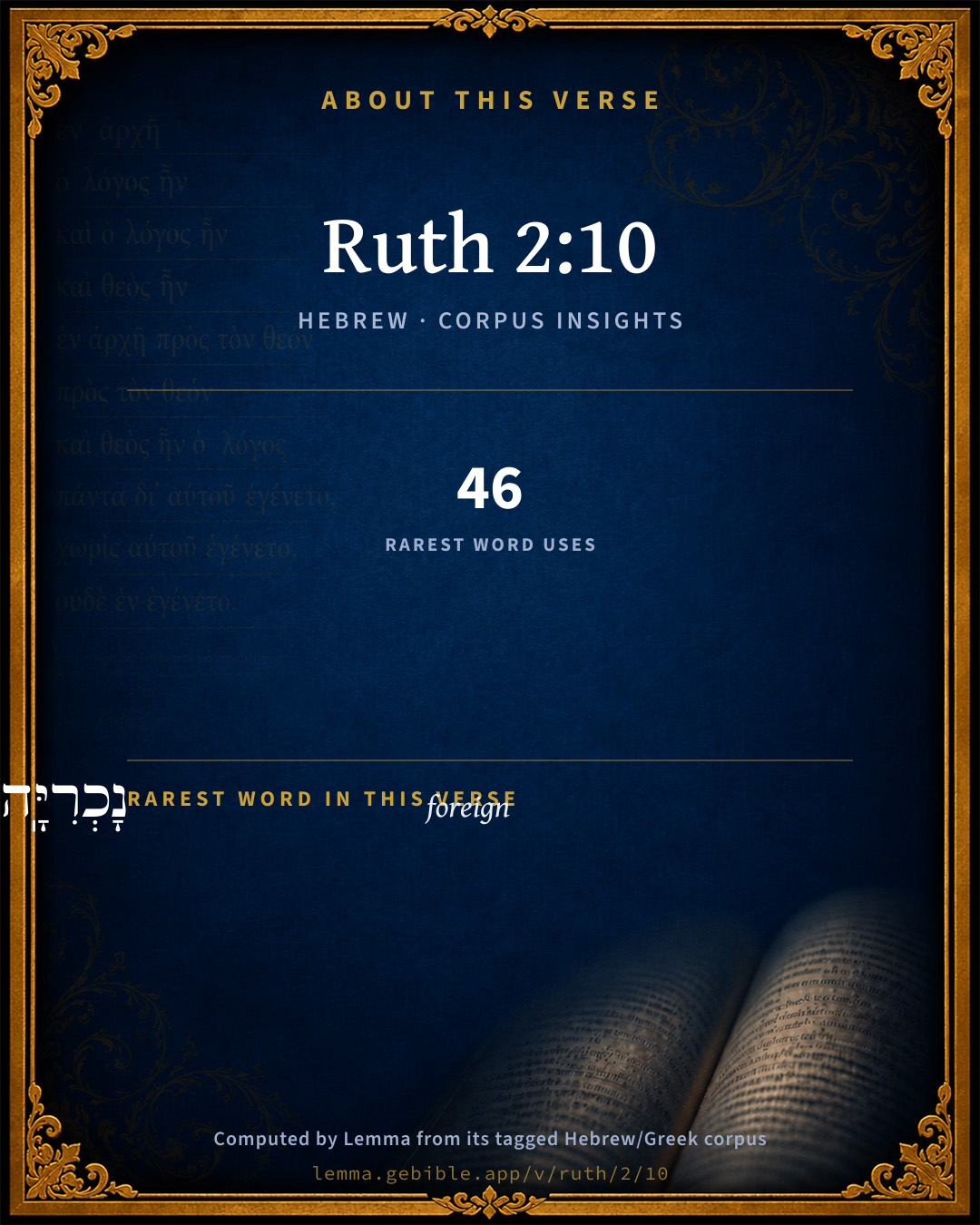
נָכְרִיָּֽה foreign H5237 occurs in 45 verses of the Hebrew Bible. Also found in:

Grammatical profile

  • 5 verbs
  • 4 nouns
  • 1 adjective
  • 1 pronoun
  • 2 prepositions
  • 1 particle

Verb forms

  • וַתִּפֹּל֙ Qal · Sequential Imperfect
  • וַתִּשְׁתַּ֖חוּ Hishtaphel · Sequential Imperfect
  • וַתֹּ֣אמֶר Qal · Sequential Imperfect
  • מָצָ֨אתִי Qal · Perfect
  • לְהַכִּירֵ֔נִי Hiphil · Infinitive Construct

Hebrew & Septuagint length

In English translation the verse runs 36 words from the Hebrew and 39 from the Septuagint (LXX English) — closely comparable.

A rough comparison of the two English renderings, which tokenize alike — not a word-level alignment.

Word counts can differ between the Hebrew and the Greek without any difference in meaning — e.g. the Hebrew direct-object marker אֵת has no separate Greek word, and Greek often adds the article ὁ.

Cross-references

14

Topical passages linked to Ruth 2:10 in the Treasury of Scripture Knowledge — connected by theme and wording, ordered by reader-vote popularity; previews shown in the World English Bible.

  • 1 Samuel 25:23 When Abigail saw David, she hurried, and alighted from her donkey, and fell before David on her face, and bowed herself to the ground.
  • Ruth 2:13 Then she said, Let me find favor in your sight, my lord, because you have comforted me, and because you have spoken kindly to your handmaid, though I am not as one of your handmaidens.
  • 2 Samuel 19:28 For all my father's house were but dead men before my lord the king; yet you set your servant among those who ate at your own table. What right therefore have I yet that I should cry any more to the king?
  • Luke 1:43 Why am I so favored, that the mother of my Lord should come to me?
  • Luke 1:48 For he has looked at the humble state of his handmaid. For behold, from now on, all generations will call me blessed.
  • Luke 17:16–18 He fell on his face at Jesus' feet, giving him thanks; and he was a Samaritan.
  • Romans 12:10 In love of the brothers be tenderly affectionate one to another; in honor preferring one another;
  • 2 Samuel 9:8 He did obeisance, and said, "What is your servant, that you should look on such a dead dog as I am?"
  • Genesis 18:2 He lifted up his eyes and looked, and saw that three men stood opposite him. When he saw them, he ran to meet them from the tent door, and bowed himself to the earth,
  • Ruth 2:2 Ruth the Moabitess said to Naomi, Let me now go to the field, and glean among the ears of grain after him in whose sight I shall find favor. She said to her, Go, my daughter.
  • Isaiah 56:3–8 Neither let the foreigner, who has joined himself to Yahweh, speak, saying, Yahweh will surely separate me from his people; neither let the eunuch say, Behold, I am a dry tree.
  • Matthew 15:22–28 Behold, a Canaanite woman came out from those borders, and cried, saying, "Have mercy on me, Lord, you son of David! My daughter is severely demonized!"
  • Matthew 25:35 for I was hungry, and you gave me food to eat; I was thirsty, and you gave me drink; I was a stranger, and you took me in;
  • Luke 7:6–7 Jesus went with them. When he was now not far from the house, the centurion sent friends to him, saying to him, "Lord, don't trouble yourself, for I am not worthy for you to come under my roof.

Cross-references courtesy of OpenBible.info (CC BY 4.0).

Hebrew and Greek witnesses Masoretic Hebrew ↔ Greek Septuagint

The same verse in the two great witnesses to the Old Testament, shown verse-for-verse.

These are two independent witnesses, not word-aligned to each other, and the Septuagint is shown in lemma (dictionary) form.

Hebrew Ruth 2:10 Masoretic · Westminster Leningrad Codex

וַתִּפֹּל֙ עַל פָּנֶ֔יהָ וַתִּשְׁתַּ֖חוּ אָ֑רְצָה וַתֹּ֣אמֶר אֵלָ֗יו מַדּוּעַ֩ מָצָ֨אתִי חֵ֤ן בְּעֵינֶ֨יךָ֙ לְהַכִּירֵ֔נִי וְאָּנֹכִ֖י נָכְרִיָּֽה

Then she fell on her face, and bowed herself to the ground, and said to him, Why have I found favor in your sight, that you should take knowledge of me, seeing I am a foreigner?

World English Bible · Public Domain

Greek LXX Ruth 2:10 Septuagint · lemma form

καί πίπτω ἐπί πρόσωπον αὐτός καί προςκυνέω ἐπί ὁ γῆ καί εἶπον πρός αὐτός τίς ὅτι εὑρίσκω χάρις ἐν ὀφθαλμός σύ ὁ ἐπιγιγνώσκω ἐγώ καί ἐγώ εἰμί ξένος

And she fell upon her face, and did reverence to the ground, and said to him, How is it that I have found grace in your eyes, that you should take notice of me, whereas I am a stranger?

LXX2012 (modern English Septuagint) · Public Domain

Hebrew: Westminster Leningrad Codex (CC BY 4.0). Greek: Septuagint (public domain); English from LXX2012 (modern English Septuagint) (Public Domain). How the Septuagint differs from the Hebrew →

Commentary

Notes on Ruth 2:10 from classic Christian and Jewish commentators (each source and its license shown beneath its notes). The classic Christian expositions comment on the surrounding passage and are grouped to its opening verse, so a note may address several verses; the Jewish commentaries on the Tanakh (Rashi and others) are per-verse, so they appear only where the commentator wrote on this verse.

Lemma curates 59 commentaries, every one of them public domain or Creative Commons licensed, each selected and text-cleaned for this edition rather than reprinted as found. About our sources →

Trapp's Complete Commentary

John Trapp

Rth 2:10 Then she fell on her face, and bowed herself to the ground, and said unto him, Why have I found grace in thine eyes, that thou shouldest take knowledge of me, seeing I [am] a stranger?

Ver. 10. Then she fell on her face, &c.] Here shine forth her humility, modesty, and many other graces: {a} she was, as Gualther saith of the Lady Jane Gray, Pietatis, prudentiae, et modestiae delicium. Yea, caelum quoddam lucidissimis virtutum stellis exornatum, as Bucholcer saith of Joseph. All the people of her city soon knew that she was a very virtuous woman, {Rth 3:11} and hence it was that she found so much favour, for true goodnass is very lovely: οττι καλον φιλον εστι.

That thou shouldest take knowledge of me.] Non sum dignus, Domine, quem diligas, saith Augustine. Every saint may say with admiration as he did in Joh 14:22, "Lord, how is it that thou hast manifested thyself to us, and not unto the world?"

{a} Rutha tanquam lucidum speculum multarum virtutum nobis proponitur. - Lavater.

John Trapp, A Commentary or Exposition upon All the Books of the Old and New Testament (1647–1656) — public domain. Text from a community e-Sword module.

The Biblical Illustrator

Joseph S. Exell

Rth_2:10

Then she fell on her face, and bowed herself to the ground.

The lowly attitude of a grateful heart

I. what deep and touching humility is expressed here.

II. what affectionate gratitude is here.

III. what confessions of unworthiness are here.

IV. what consciousness of need is here. (W. Baxendale.)

Ruths humility and gratitude

What had Boaz done for Ruth that she falls down on her knees and thanks him for his favours in language expressive of such warm gratitude? He had assured her of his protection. He had invited her to gather the gleanings of his corn, and to drink of his water. And what thanks do we give to Him who invites us to come and buy wine and milk from Him without money and without price? Ruth thought herself greatly honoured by the attentions of Boaz. She was a stranger and foreigner, an alien to the commonwealth of Israel, and did not reckon herself entitled to any kindness from the people of the Lord. The humble are always disposed to be thankful, and therefore they are always happy. When men are swelled with such a sense of their own merit that they think themselves entitled to everything, they will never be pleased. But you can scarcely displease the humble man, because he thinks anything better than he deserves. He enjoys peace in his own bosom, because his expectations are seldom disappointed. He acquires the goodwill of all around him, because he is thankful for the smallest favours, and not dissatisfied when he meets with none. (G. Lawson.)

The Biblical Illustrator, edited by Joseph S. Exell (c. 1880s–1900s) — public domain. Text from a community e-Sword module.

Joseph Benson's Commentary

Rth 2:10. Then she fell on her face — This was the humblest posture of reverence, either civil, when performed to men, or religious, when to God. And thus she shows both the lowliness of her mind and her gratitude. That thou shouldest take knowledge of me — That is, shouldest so much as notice me, and especially show me any respect or kindness.

Joseph Benson's Commentary on the Old and New Testaments (1811–1818) — public domain. Text from a community e-Sword module.

Geneva Bible (1599)

Geneva Bible translators

Even of the Moabites, which are enemies to God’s people.

Geneva Bible (1599) marginal notes — public domain. Text via Bolls.life.

Adam Clarke's Commentary

Verse 10. Then she fell on her face] Prostrated herself, as was the custom in the East when inferiors approached those of superior rank. The Targum adds to the conversation between Ruth and Boaz: "How, says she, have I obtained grace in thy sight, that thou shouldest acknowledge me who am a stranger and one of the daughters of Moab, of whom it is said, The unclean shall not enter into the congregation of the Lord? And Boaz, answered, It has been certainly told me by the word of the wise, that what the Lord hath decreed, he hath not decreed concerning the women but the men. And it hath been surely said to me by prophecy, that kings and prophets shall proceed from thee because of the good which thou hast done," &c.

Adam Clarke's Commentary on the Bible (1810–1826) — public domain. Text from a community e-Sword/MySword module.

Ellicott's Commentary for English Readers

(10) A stranger.—A foreigner. Note, however, that the Moabite language, though having its own peculiarities, really differed but little from Hebrew, as may be seen, for instance, from the famous inscription of King Mesha discovered in the land of Moab in 1868.

A Bible Commentary for English Readers, edited by Charles John Ellicott (1878–1897) — public domain. Text from a community e-Sword module.

The Cambridge Bible for Schools and Colleges

gen. ed. J. J. S. Perowne

10. take knowledge of me] with kindly purpose, Rth_2:19, Psa_142:4. A stranger had no right or claims on protection in a foreign land. The Hebr. has a subtle play on the two words take knowledge of me and stranger; the roots are distinct, but they sound alike.

The Cambridge Bible for Schools and Colleges (gen. ed. J. J. S. Perowne; Cambridge University Press, 1878–1918) — public domain. Text from a community e-Sword module.

John Gill's Exposition

Then she fell on her face, and bowed herself to the ground,.... In great humility, and under a deep sense of the favour done her, and as showing the greatest respect, in a civil manner, she was capable of:

and said unto him, why have I found grace in thine eyes: how is it that one so mean and unworthy should have such favour shown?

that thou shouldest take knowledge of me; take such notice of her, show such affection to her, and bestow such kindness on her:

seeing I am a stranger? not a citizen of Bethlehem, nor indeed one of the commonwealth of Israel; but, as the Targum,"of a strange people, of the daughters of Moab, and of a people who were not fit and worthy to enter into the congregation of the Lord.''

John Gill's Exposition of the Whole Bible (1746–1763) — public domain (CC PDM 1.0). Text via the HelloAO Bible API.

Albert Barnes' Notes on the Bible

She fell on her face - With Oriental reverence (compare Gen 33:3, and the marginal reference).

Albert Barnes' Notes on the Bible (1834–1885) — public domain. Text from a community e-Sword/MySword module.

Haydock's Catholic Bible Commentary

Country. St. Elizabeth was impressed with similar sentiments, when she was visited by the blessed Virgin; (Haydock) and so was David, when he considered the wonderful condescension of God, Psalm viii. 5., cxliii. 3., and Job vii. 17. (Calmet) --- Frequent instances occur in Scripture of people worshipping, or shewing their gratitude to their fellow creatures, by this posture of the body. (Menochius) --- Yet no suspicion of idolatry attaches to them, Genesis xxiii. ’7., &c. (Haydock)

George Leo Haydock (1774–1849), Haydock's Catholic Family Bible and Commentary, 1859 edition — public domain. Excludes Psalms (Douay-Rheims chapter numbering differs from Protestant) and Deuterocanonical books (Catholic canon only).

Matthew Poole's English Annotations

She fell on her face: this was the humblest posture of reverence; either civil, when performed to men, or religious, when to God. See Gen 18:2; 33:3; 42:6; Mat 2:11; 8:2.

Take knowledge of me, i.e. show any respect and kindness to me; for words of knowledge in Scripture commonly include affection.

Matthew Poole's English Annotations on the Holy Bible (1683–1685) — public domain. Text from a community e-Sword/MySword module.

Whedon's Commentary on the Bible

Daniel D. Whedon

10. Fell on her face — Prostrated herself in the humblest attitude before him, so as to show her gratitude by ceremony as well as by word. See note and cut at Mat_8:2.

Take knowledge of me — Regard me with such sympathy, kindness, and care.

A stranger — She was better known than she imagined.

Daniel D. Whedon (gen. ed.), Commentary on the Old and New Testaments (1874–1909) — public domain. Text from a community e-Sword module.

The Pulpit Commentary

RUTH did not seize the opportunity for bewailing the hardship of the lot to which she had been reduced, and which now constrained her to undertake a species of work which at one time she little anticipated. With beautiful humility and modesty, and in the profoundest gratitude, she accepted wonderingly the kindness of Boaz. And she fell on her face. A rather remarkable expression, physiologically viewed. Her face was part of herself. How then could she fall on it? It was part of that which fell, and yet she is said to fall upon (l) it, as if it had been underneath the self-hood that fell. It was what was undermost as she bowed herself, so that the pressure of the sum-total of the body fell on it as she gracefully stooped. And prostrated herself to the ground. Thus completing, and doubtless in no sprawling or clumsy way, her respectful obeisance. Her face would be made, with aesthetic delicacy of movement, to touch the ground. Wherefore have I found favor in thine eyes; She was surprised, amazed, bewildered. So that thou takest notice of me, and I a stranger! Boaz had done far more than merely rake notice of her. But, with equal gratitude and felicity, she specifies not the culminating acts of kindness, but the very first step that her benefactor had taken. He began by taking notice of her. There is an interesting paranomasia in the two words ynireyKih and hYrikn.

A foreigner, though unknown, and just indeed because unknown, is naturally noted and noticed.

Vers. 10-17. The harvest-field again.

Let us return to the Oriental harvest-field. Harvest-fields in general are lively scenes. Emphatically so in the East, where bright weather may be calculated on with almost absolute certainty. Pleasantry and work go hand in hand. Dr. W. M. Thomson, speaking of Phitistia, says, "When the fog dispersed, the whole plain appeared to be dotted over with harvesting parties; men reaping, women and children gleaning and gathering the grain into bundles, or taking care of the flocks, which followed closely upon the footsteps.of the gleaners. All seemed to be in good humor, enjoying the cool air of the morning. There was singing, alone and in chorus, incessant talking, home-made jokes and laughing loud and long" ("The Land and the Book, " p. 543). The harvest scene as represented on the shield of Achilles may be recalled (see the eighteenth book of the "Iliad").

1. We find Boaz and Ruth still standing where we left them (vers. 9, 10). Surely some great attraction is detaining the busy husbandman, a "man of affairs.

2. A group of Graces are tripping round about Ruth. There is, firstly, gratitude, always lovely and welcome. If in any soul it be meager, stinted, stunted, the soil of that soul is shallow. There is, secondly, respectfulness. "She fell on her face, and did obeisance to the ground" (ver. 10). Respectfulness is the homage that is due to a noble nature, and to him who is the Creator of it. We are to "honor the king." True; but we are likewise to "honor all men", (1Pe_2:17) for there is something kingly after all in the nature of all. Then there is, thirdly, wonder. "Why have I found favor in thine eyes, so that thou takest notice of me, and I a stranger?" (ver. 10). Some accept attentions and kind-nesses as things of course. Some almost exact them, as if they were dues. Not so the nobler souls. They wonder when distinction is conferred on them. Moses wondered: Who am I, that I should go unto Pharaoh, and that I should bring forth the children of Israel out of Egypt?" (Exo_3:11) David wondered: "Who am I, O Lord God? and what is my house, that thou hast brought me hitherto?". (2Sa_7:18) Paul wondered: "Unto me, who am less than the least of all saints, is this grace given, that I should preach among the Gentiles the unsearchable riches of Christ". (Eph_3:8)

3. Boaz explained to the wondering stranger why it gratified him to show her attention. It hath been fully showed unto me, all that thou hast done toward thy mother-in-law since the death of thy husband: and that thou hast left thy father and thy mother, and the land of thy nativity, and hast come to a people whom heretofore thou knewest not" (ver. 11). His spirit seems to kindle as he proceeds, so that his words become tipped with brightness and beauty. He "winds the robes of ideality around the bareness" of mere facts (J. Ingelow). He says, "The Lord requite thy work, and may thy recompense be complete from the Lord God of Israel, to trust under whose wings thou art come" (ver. 12). Words "fitly spoken!" "Words spoken in due season!" "How good they are!" A word, in particular, of well-deserved appreciation and commendation is peculiarly "good." It goes to the heart, and is often mighty to animate to victorious courage and hope. Nobler in its aims than "fame," it is yet, like "fame," a "spur: that the clear spirit doth raise, to scorn delights and live laborious days" (Milton).

4. Note the fine expression, "to trust under whose wings thou art come." Compare what the Psalmist says: "He that dwelleth in the secret place of the Most High shall abide under the shadow of the Almighty." "He shall cover thee with his feathers, and under his wings shalt thou trust". (Psa_91:1, Psa_91:4) Compare what Jesus said: "O Jerusalem, Jerusalem, how often would I have gathered thy children together, even as a hen gathereth her chickens under her wings, and ye would not". (Mat_23:37) Compare what the Christian poet says: "All my trust on thee is stayed; All my help from thee I bring; Cover my defenseless head With the shadow of thy wing.

1. Just as Boaz was turning to complete the supervision of his harvest-field, Ruth, with delicate acknowledgments for the past, prefers a humble request for the future. "May I continue, sir, to find favor in thine eyes; for indeed thou hast comforted me, and cheered the heart of thine handmaid, and yet I have not the position of one of thy maidens" (ver. 13). Thus from one to the other, under the impulse of some subtle spontaneity, was the shuttle of respectful feeling shot and re-shot.

2. The scene is now shifting. The two separate. Boaz proceeds to attend to the various details of his husbandry. Ruth returns to the monotony of her gleaning. Both exhibit a worthy example of painstaking industry.

3. Time advances. The work proceeds. The sun hastens towards its zenith. The hour for siesta is at hand. Boaz turns once more in the direction of Ruth. He rejoins her, and invites her to accompany him to the place of temporary shelter, refreshment, and rest. "At meal-time Boaz said to her, Come along hither, and eat of the bread, and dip thy morsel in the vinegar" (ver. 14). All the workers but of course not the gleaners assemble around the master. Ruth is seated among the rest, and is carefully attended to. "She sat beside the reapers: and Boaz prepared for her a bunch of parched corn, and she ate, and was satisfied, and left over" (ver. 14). Then there is more work. Boaz gives still more liberal instructions to the young men. "Even between the sheaves let her glean, and do not affront her" (ver. 15). "And even of set purpose draw out for her from the bundles, and leave them, and let her glean them, and do not find fault with her" (ver. 16). At length, at the close of the day, Ruth gathered her bundles together, and threshed them, and found that she had about an ephah of barley as much as a woman could be expected to carry. Thus is the dawn of Ruth"s prosperity growing brighter and brighter, and giving promise of a day that shall be as "the bridal of the earth and sky." The Lord is "recompensing her work." The shadows are fleeing. "As morning in the east, Stands winged to mount in day, So for a swift surprise of joy Our God prepares his way (Gibbons).

So assuredly will there be a corresponding dayspring from on high to all who, in the midst of thickening trials, maintain their integrity, and engage in "works of faith" and "labors of love." There may be, there will be, differences in the degree of prosperity and reward, even as star differeth from star in magnitude and luster. It is not to be expected that all shall have such reversions on earth as were granted to Job and to Ruth. Nevertheless, none will be forgotten. Every several blade of grass will have its own drop of dew. Love on the part of man will be crowned with love on the part of God. And when love rises to Jesus, the ideal Son of man, then it is capped with more love; for, says he, "my Father will love him, and we will come unto him, and make our abode with him". (Joh_14:23) All three will "sup together". (Rev_3:20) "Sorrow and sighing will flee away.

HOMILIES BY W.M. STATHAM Ver. 10. "I am a stranger!

What a touching word. In some cities there is the strangers" burying-ground. There they sleep as they lived, separated from their brethren.

I THE HEBREWS WERE KIND TO STRANGERS. Their Divine revelation gave them injunctions concerning the stranger within their gates. They were to be considerate and kind to the cattle; how much more to those made in the image of God like themselves! The young learnt this lesson; from earliest years they were taught the law while "sitting in the house." Boaz knew all this, and he "lived" it.

II STRANGERS HAVE SENSITIVE HEARTS. Their experiences make them quick to feel insult or blessing. Never can they quite escape the consciousness, "I am a stranger." In other lands, under other skies, the stranger carries far-away visions of the heart within, which make the spirit pensive. Consequently, care and love are intensely appreciated by them. Religion is the life of love and the death of selfishness wherever it lives and reigns in the heart.

III STRANGERS IN TIME MAKE A FATHERLAND OF THE NEW HOME. So did Ruth.

New ties sprang up; for love looks forward. Children take the place of ancestors, and we live in them. How often we are tempted to forget our own lot. "Remember that ye were strangers," therefore deal kindly with them. Think how precious to you was the fellowship of hearts that stole away your sadness as a stranger at school, or in the new city of life and duty. What a consolation it is that we are never strangers in our Father"s sight, and that everywhere we may find "home" in God. W.M.S.

The Pulpit Commentary (1880–1919), ed. H.D.M. Spence-Jones & Joseph S. Exell — public domain. Text from a community e-Sword module.

John Wesley's Explanatory Notes

Fell - This was the humblest posture of reverence, either civil when performed to men, or religious, when to God. Take knowledge - That is, shew any respect and kindness to me.

John Wesley, Explanatory Notes Upon the Whole Bible (1754–1765) — public domain. Text via the GEBible commentary corpus.

Keil & Delitzsch

C. F. Keil & F. Delitzsch

Deeply affected by this generosity, Ruth fell upon her face, bowing down to the ground (as in Sa1 25:23; Sa2 1:2; cf. Gen 23:7), to thank him reverentially, and said to Boaz, "Why have I found favour in thine eyes, that thou regardest me, who am only a stranger?" הכּיר, to look at with sympathy or care, to receive a person kindly (cf. Rut 2:19).

Keil & Delitzsch — Biblical Commentary on the Old Testament (1861–1891) — public domain (CC PDM 1.0). Text via the HelloAO Bible API. (Old Testament only.)

unfoldingWord translationNotes

Door43 World Missions Community

she bowed down before Boaz, touching her face to the ground

These are acts of respect and reverence. She was showing honor to Boaz out of gratefulness for what he had done for her. It was also a posture of humility.

Why have I found such favor ... a foreigner?

Ruth is asking a real question.

foreigner

Ruth had pledged her loyalty to the God of Israel in private, but she was known publicly as "the Moabitess."

It has been reported to me

This can be stated in active form. AT: "People have reported to me" or "People have told me" (See: Active or Passive)

to come to a people

Boaz is referring to Ruth coming to dwell with Naomi in a village and community, a country, and religion she did not know. (See: Metonymy)

reward you

"repay you" or "pay you back"

for your deed

This is an act of faith, choosing to live with Naomi in Bethlehem and trusting Naomi's God.

May you receive full payment from Yahweh

This is a poetic expression that is very similar to the previous sentence. AT: "May Yahweh give back to you even more than you have given" (See: Parallelism)

under whose wings you have found refuge

Boaz uses the picture of a mother bird gathering her chicks under her wings to protect them, in order to describe God's protection for those who trust in him. AT: "in whose safe care you have placed yourself" (See: Metaphor)

translationWords

Boaz

report

die

people group

Yahweh

receive

God

Israel

unfoldingWord translationNotes — © Distant Shores Media and the Door43 World Missions Community, licensed CC BY-SA 4.0. Source: git.door43.org/Door43/en_tn.

Lesson kit

Teaching starters — assembled from the data on this page, not authored interpretation. Every prompt links to the verse data it draws on. Edit before teaching.

Ruth, in the Historical, opens this verse with 14 words (14 distinct Hebrew lemmas). Its most distinctive word is nokrîy (“foreign”). A historical commentator’s framing appears above. Read the whole chapter for the surrounding context.

Discussion questions

  1. What does “foreign” (nokrîy) contribute to the verse as a whole?
  2. Genesis 31:15 shares the word «foreign» with this verse. How do the two illuminate each other?
  3. The translations on this page render this verse differently — a whole-verse word diff, not a word-by-word alignment. What might account for the different wordings?
  4. The verb «וַתִּפֹּל֙» is Qal Sequential Imperfect. How does its form color the action?
  5. Reading how Trapp's Complete Commentary and The Biblical Illustrator read this verse, where do the two commentators agree and where do they part?

Things to notice

Reading settings

Reading text

Shown beneath each verse's original-language words.

Old Testament
Old Testament edition

Read the OT as the Masoretic Hebrew (MT) or the Greek Septuagint (LXX).

English shown for the Greek Septuagint (in the Hebrew ↔ Greek comparison).

Comparing translations? Open the Compare panel on any verse page to stack up to four side by side.