
Numbers 34:2

Hebrew (Westminster Leningrad Codex) Numbers 34:2 appears in the Hebrew Old Testament. The text above is from the Westminster Leningrad Codex. Each word links to its Strong’s number, a concise gloss, and parsing drawn from the Open Scriptures Hebrew Bible morphology. Click any word for its full Brown-Driver-Briggs (BDB) entry.
Download image
Cite this verse

Numbers 34:2 (World English Bible). Public Domain. Lemma interlinear Bible study tool, https://lemma.gebible.app/v/numbers/34/2.

Show BibTeX & RIS
BibTeX
RIS
English Translation
Command the children of Israel, and tell them, When you come into the land of Canaan (this is the land that shall fall to you for an inheritance, even the land of Canaan according to the borders of it),
World English Bible · Public Domain
Download a study sheet

One document with this verse’s original text, its word-by-word gloss line, the meaning frame, cross-references with their text, attributed commentary, and full source and license credits — printable, and it pastes into notes with its structure intact.

This verse Autodidact and up

Study sheet (.html) Plain text (.txt)

A passage Seminary Student

Up to 50 verses in one chapter. A passage sheet keeps up to 6 commentary sources and 12 cross-references per verse, in the order this page ranks them, and says so on the sheet whenever that leaves anything out. Ask for a single verse and you get the Autodidact verse sheet above.

Everything on this page stays free to read, with no account — the sheet is a download of what is already on screen, not access to it.

Want to remove ads? Support Godless Engineer
Compare translations 3

The same verse in 3 English versions, stacked beneath the original-language interlinear above. Click any original word for its lexicon entry.

Each is an independent rendering of the whole verse — the interlinear is not word-aligned to these translations.

Highlighted words mark where these versions differ — a whole-verse word diff, not a word-by-word alignment.

  • World English Bible Public Domain
    Command the children of Israel, and tell them, When you come into the land of Canaan (this is the land that shall fall to you for an inheritance, even the land of Canaan according to the borders of it),
  • King James Version Public Domain
    Command the children of Israel, and say unto them, When ye come into the land of Canaan; (this is the land that shall fall unto you for an inheritance, even the land of Canaan with the coasts thereof:)
  • unfoldingWord Literal Text CC BY-SA 4.0
    “Command the sons of Israel and say to them, ‘When you enter into the land of Canaan, this is the land that has fallen to you as an inheritance, the land of Canaan and its borders,

unfoldingWord Literal Text — © unfoldingWord, licensed CC BY-SA 4.0. Word-aligned USFM3 via Door43 (git.door43.org/unfoldingWord/en_ult).

Versions to compare (up to 4)

3 of 4 selected

Show all 18 translations

Every available English version of this verse, each an independent rendering of the whole verse.

  • World English Bible Public Domain
    Command the children of Israel, and tell them, When you come into the land of Canaan (this is the land that shall fall to you for an inheritance, even the land of Canaan according to the borders of it),
  • Berean Standard Bible Public Domain
    “Command the Israelites and say to them: When you enter the land of Canaan, it will be allotted to you as an inheritance with these boundaries:
  • Majority Standard Bible Public Domain
    “Command the Israelites and say to them: When you enter the land of Canaan, it will be allotted to you as an inheritance with these boundaries:
  • King James Version Public Domain
    Command the children of Israel, and say unto them, When ye come into the land of Canaan; (this is the land that shall fall unto you for an inheritance, even the land of Canaan with the coasts thereof:)
  • American Standard Version (1901) Public Domain
    Command the children of Israel, and say unto them, When ye come into the land of Canaan (this is the land that shall fall unto you for an inheritance, even the land of Canaan according to the borders thereof),
  • Revised Version (1885) Public Domain
    Command the children of Israel, and say unto them, When ye come into the land of Canaan, (this is the land that shall fall unto you for an inheritance, even the land of Canaan according to the borders thereof,)
  • Geneva Bible (1599) Public Domain
    Commande the children of Israel, and say vnto them, When yee come into the land of Canaan, this is the land that shall fall vnto your inheritance: that is, the land of Canaan with the coastes thereof.
  • Douay-Rheims (1899) Public Domain
    Command the children of Israel, and then shalt say to them: When you are entered into the land of Chanaan, and it shall be fallen into your possession by lot, it shall be bounded by these limits:
  • Young's Literal Translation Public Domain
    `Command the sons of Israel, and thou hast said unto them, When ye are coming in unto the land of Canaan -- this `is' the land which falleth to you by inheritance, the land of Canaan, by its borders --
  • Literal Standard Version CC BY-SA 4.0
    “Command the sons of Israel, and you have said to them: When you are coming into the land of Canaan—this [is] the land which falls to you by inheritance, the land of Canaan, by its borders—
  • Unlocked Literal Bible CC BY-SA 4.0
    “Command the people of Israel and say to them, 'When you enter the land of Canaan, the land that will belong to you, the land of Canaan and its borders,
  • unfoldingWord Literal Text CC BY-SA 4.0
    “Command the sons of Israel and say to them, ‘When you enter into the land of Canaan, this is the land that has fallen to you as an inheritance, the land of Canaan and its borders,
  • Darby Bible Public Domain
    Command the children of Israel, and say unto them, When ye come into the land of Canaan, this shall be the land that shall fall to you for an inheritance, the land of Canaan according to the borders thereof.
  • World Messianic Bible Public Domain
    “Command the children of Israel, and tell them, ‘When you come into the land of Canaan (this is the land that shall fall to you for an inheritance, even the land of Canaan according to its borders),
  • Webster's Bible Public Domain
    Command the children of Israel, and say to them, When ye come into the land of Canaan; (this is the land that shall fall to you for an inheritance, even the land of Canaan with its borders.)
  • Free Bible Version CC BY-SA 4.0
    “Give this command to the Israelites: When you enter the country of Canaan, it will be allocated to you to own with the following boundaries:
  • Bible in Basic English Public Domain
    Give orders to the children of Israel and say to them, When you come into the land of Canaan; (this is the land which is to be your heritage, the land of Canaan inside these limits,)
  • JPS Tanakh (1917) Public Domain
    'Command the children of Israel, and say unto them: When ye come into the land of Canaan, this shall be the land that shall fall unto you for an inheritance, even the land of Canaan according to the borders thereof.

Literal Standard Version (2020), Covenant Press — licensed CC BY-SA 4.0. Text via the HelloAO Bible API (eBible.org). Unlocked Literal Bible (unfoldingWord) — licensed CC BY-SA 4.0. Text via the HelloAO Bible API (eBible.org). unfoldingWord Literal Text — © unfoldingWord, licensed CC BY-SA 4.0. Word-aligned USFM3 via Door43 (git.door43.org/unfoldingWord/en_ult). Free Bible Version, Dr. Jonathan Gallagher — licensed CC BY-SA 4.0. Text via the HelloAO Bible API (eBible.org).

Word by word

More ways to search: Search by grammar → Find every occurrence → Compare this word →

Practice this passage: Drill this verse → Learn its vocabulary →

לִגְבֻלֹתֶֽיהָ
gᵉbûwlâh
H1367
“to/for · boundaries · her”
Preposition + Noun, Common, Feminine, Plural, Construct + Suffix, Personal, 3rd Person, Feminine, Singular
Part of Speech
Preposition + Noun
Type
Common
Gender
Feminine
Number
Plural
State
Construct
Full BDB Definition

Origin: from H1366

TWOT: 307b

border, boundary
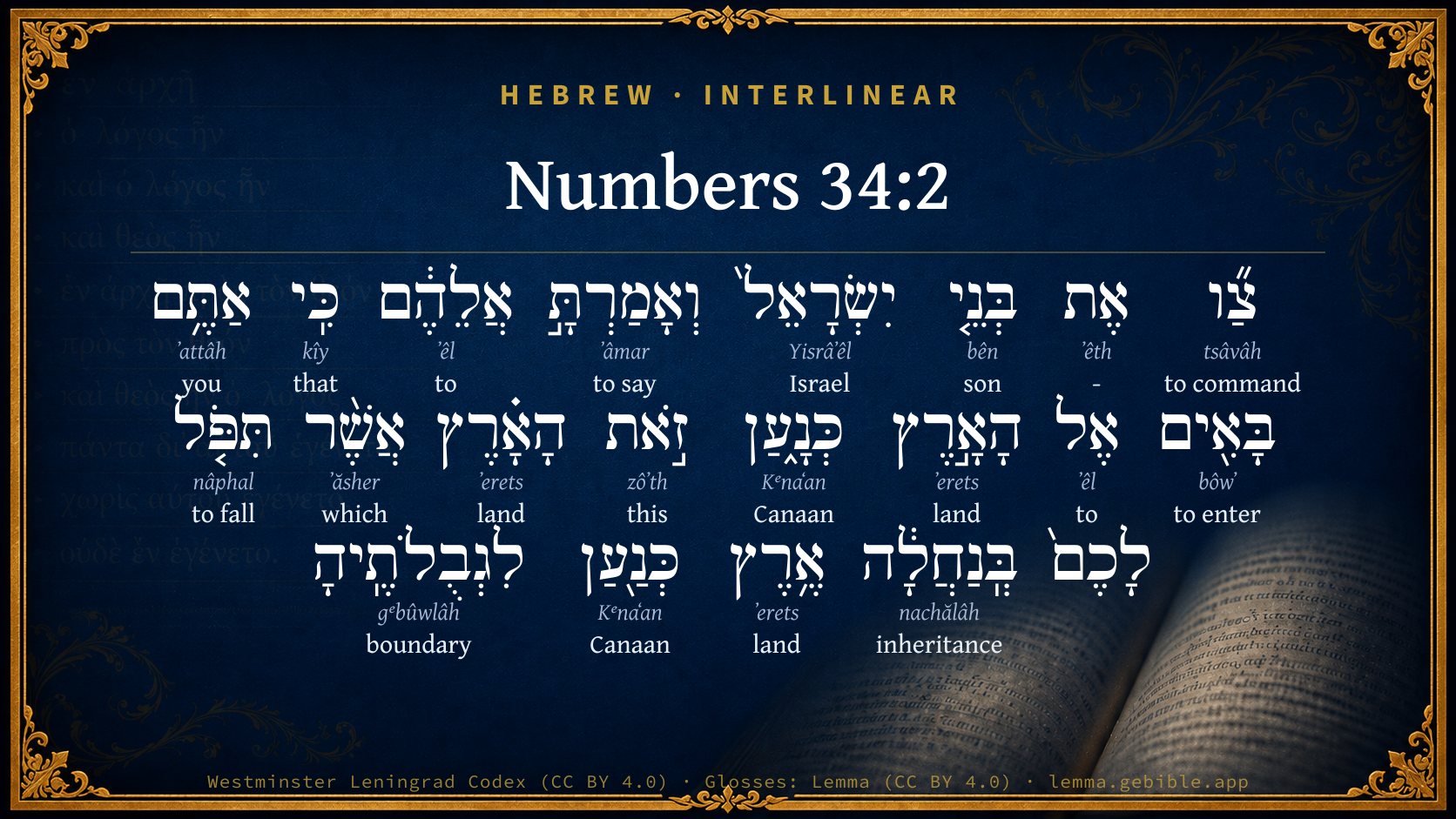
  1. צַ֞ו tsâvâh H6680 “command” Verb, Piel, Imperative, 2nd Person, Masculine, Singular
  2. אֶת ʼêth H853 “-” Particle, Direct Object
  3. בְּנֵ֤י bên H1121 “sons of” Noun, Common, Masculine, Plural, Construct
  4. יִשְׂרָאֵל֙ Yisrâʼêl H3478 “Israel” Noun, Proper
  5. וְאָמַרְתָּ֣ ʼâmar H559 “and · to say” Conjunction + Verb, Qal, Sequential Perfect, 2nd Person, Masculine, Singular
  6. אֲלֵהֶ֔ם ʼêl H413 “to · them” Preposition + Suffix, Personal, 3rd Person, Masculine, Plural
  7. כִּֽי kîy H3588 “that” Conjunction
  8. אַתֶּ֥ם ʼattâh H859 “you” Pronoun, Personal, 2nd Person, Masculine, Plural
  9. בָּאִ֖ים bôwʼ H935 “entering” Verb, Qal, Participle Active, Masculine, Plural, Absolute
  10. אֶל ʼêl H413 “to” Preposition
  11. הָאָ֣רֶץ ʼerets H776 “the · land” Particle, Definite Article + Noun, Common, Both, Singular, Absolute
  12. כְּנָ֑עַן Kᵉnaʻan H3667 “Canaan” Noun, Proper
  13. זֹ֣את zôʼth H2063 “this” Pronoun, Demonstrative, Feminine, Singular
  14. הָאָ֗רֶץ ʼerets H776 “the · land” Particle, Definite Article + Noun, Common, Both, Singular, Absolute
  15. אֲשֶׁ֨ר ʼăsher H834 “which” Particle, Relative
  16. תִּפֹּ֤ל nâphal H5307 “to fall” Verb, Qal, Imperfect, 3rd Person, Feminine, Singular
  17. בְּֽנַחֲלָ֔ה nachălâh H5159 “in/at · inheritance” Preposition + Noun, Common, Feminine, Singular, Absolute
  18. אֶ֥רֶץ ʼerets H776 “land of” Noun, Common, Both, Singular, Construct
  19. כְּנַ֖עַן Kᵉnaʻan H3667 “Canaan” Noun, Proper

About this verse

These counts appear in no published source. They are computed here, from the morphology-tagged text and Lemma’s own curated glosses. What Lemma adds →

21
words
16
distinct lemmas
Pentateuch
section

Notable vocabulary

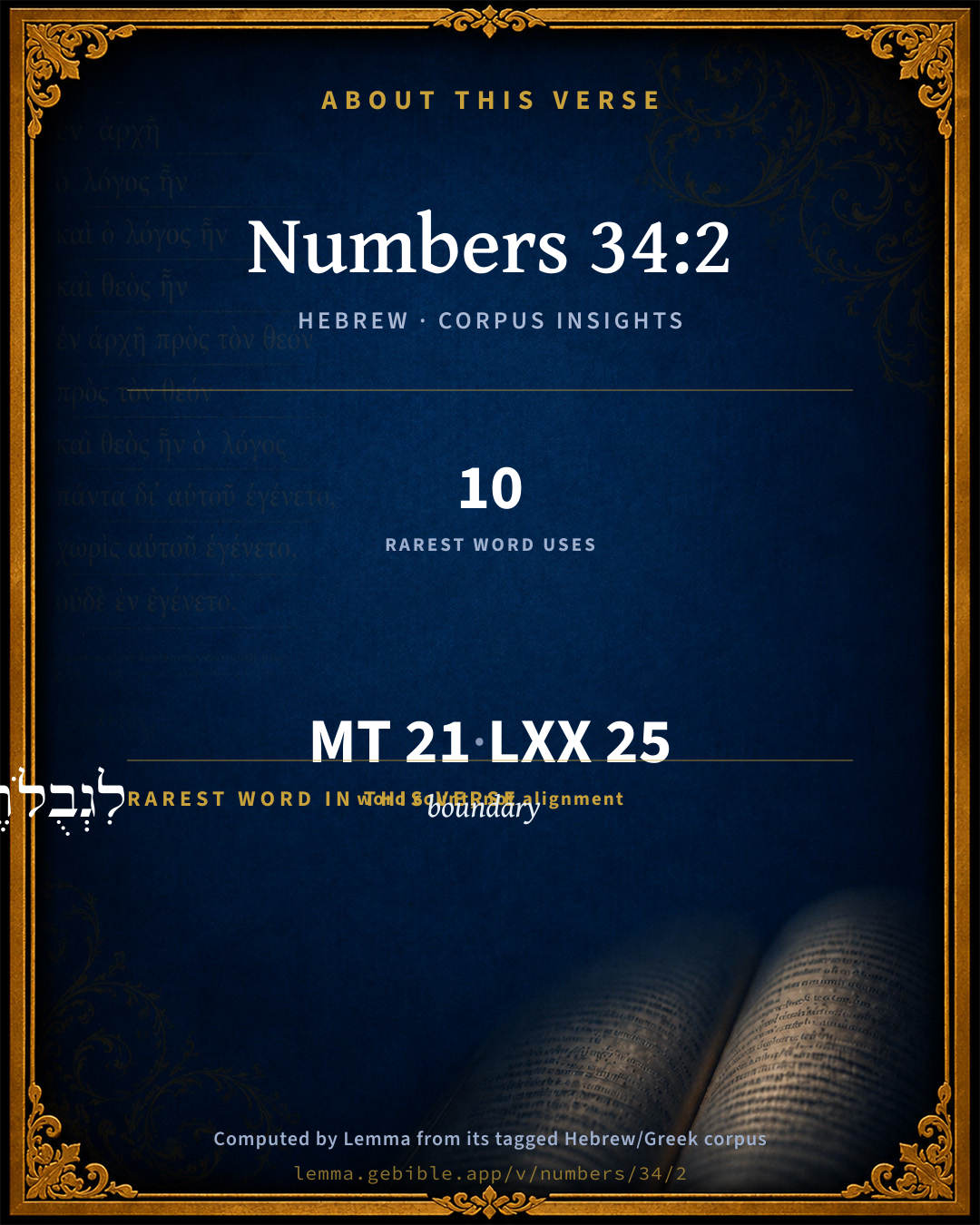
The rarest word here is לִגְבֻלֹתֶֽיהָ boundary H1367 — appearing just 10 times in the whole Hebrew Bible.

Shared distinctive vocabulary

לִגְבֻלֹתֶֽיהָ boundary H1367 occurs in 10 verses of the Hebrew Bible. Also found in:

Grammatical profile

  • 4 verbs
  • 9 nouns
  • 2 pronouns
  • 3 prepositions
  • 1 conjunction
  • 2 particles

Verb forms

  • צַ֞ו Piel · Imperative
  • וְאָמַרְתָּ֣ Qal · Sequential Perfect
  • בָּאִ֖ים Qal · Participle Active
  • תִּפֹּ֤ל Qal · Imperfect

Repetition

Words recur within this verse — often emphatic in Hebrew:

  • הָאָ֣רֶץ land H776 ×3
  • כְּנָ֑עַן Canaan H3667 ×2
  • אֲלֵהֶ֔ם to H413 ×2

Hebrew & Septuagint length

In English translation the verse runs 39 words from the Hebrew and 34 from the Septuagint (LXX English) — closely comparable.

A rough comparison of the two English renderings, which tokenize alike — not a word-level alignment.

Word counts can differ between the Hebrew and the Greek without any difference in meaning — e.g. the Hebrew direct-object marker אֵת has no separate Greek word, and Greek often adds the article ὁ.

In the original languages it is 21 Hebrew tokens and 25 Greek tokens — but the two are counted differently (Hebrew bundles its prefixes and suffixes into one token; the Greek is in lemma form), so that isn’t a like-for-like length.

Cross-references

16

Topical passages linked to Numbers 34:2 in the Treasury of Scripture Knowledge — connected by theme and wording, ordered by reader-vote popularity; previews shown in the World English Bible.

  • Genesis 17:8 I will give to you, and to your seed after you, the land where you are traveling, all the land of Canaan, for an everlasting possession. I will be their God."
  • Psalms 105:11 Saying, "To you I will give the land of Canaan, The lot of your inheritance;"
  • Deuteronomy 1:7–8 turn you, and take your journey, and go to the hill-country of the Amorites, and to all [the places] near thereunto, in the Arabah, in the hill-country, and in the lowland, and in the South, and by the sea-shore, the land of the Canaanites, and Lebanon, as far as the great river, the river Euphrates.
  • 1 Peter 1:3–4 Blessed be the God and Father of our Lord Jesus Christ, who according to his great mercy became our father again to a living hope through the resurrection of Jesus Christ from the dead,
  • Genesis 12:6–7 Abram passed through the land to the place of Shechem, to the oak of Moreh. The Canaanite was then in the land.
  • Genesis 13:15–17 for all the land which you see, I will give to you, and to your offspring forever.
  • Genesis 15:16–21 In the fourth generation they will come here again, for the iniquity of the Amorite is not yet full."
  • Numbers 33:51–53 Speak to the children of Israel, and tell them, When you pass over the Jordan into the land of Canaan,
  • Psalms 16:5–6 Yahweh assigned my portion and my cup. You made my lot secure.
  • Psalms 78:54–55 He brought them to the border of his sanctuary, To this mountain, which his right hand had taken.
  • Jeremiah 3:19 But I said, How I will put you among the children, and give you a pleasant land, a goodly heritage of the hosts of the nations! and I said, You shall call me My Father, and shall not turn away from following me.
  • Ezekiel 47:14 You shall inherit it, one as well as another; for I swore to give it to your fathers: and this land shall fall to you for inheritance.
  • Acts 17:26 He made from one blood every nation of men to dwell on all the surface of the earth, having determined appointed seasons, and the boundaries of their dwellings,
  • Acts 26:18 to open their eyes, that they may turn from darkness to light and from the power of Satan to God, that they may receive remission of sins and an inheritance among those who are sanctified by faith in me.'
  • Ephesians 1:14 who is a pledge of our inheritance, to the redemption of God's own possession, to the praise of his glory.
  • Ephesians 1:18 having the eyes of your hearts enlightened, that you may know what is the hope of his calling, and what are the riches of the glory of his inheritance in the saints,

Cross-references courtesy of OpenBible.info (CC BY 4.0).

Hebrew and Greek witnesses Masoretic Hebrew ↔ Greek Septuagint

The same verse in the two great witnesses to the Old Testament, shown verse-for-verse.

These are two independent witnesses, not word-aligned to each other, and the Septuagint is shown in lemma (dictionary) form.

Hebrew Numbers 34:2 Masoretic · Westminster Leningrad Codex

צַ֞ו אֶת בְּנֵ֤י יִשְׂרָאֵל֙ וְאָמַרְתָּ֣ אֲלֵהֶ֔ם כִּֽי אַתֶּ֥ם בָּאִ֖ים אֶל הָאָ֣רֶץ כְּנָ֑עַן זֹ֣את הָאָ֗רֶץ אֲשֶׁ֨ר תִּפֹּ֤ל לָכֶם֙ בְּֽנַחֲלָ֔ה אֶ֥רֶץ כְּנַ֖עַן לִגְבֻלֹתֶֽיהָ

Command the children of Israel, and tell them, When you come into the land of Canaan (this is the land that shall fall to you for an inheritance, even the land of Canaan according to the borders of it),

World English Bible · Public Domain

Greek LXX Numbers 34:2 Septuagint · lemma form

ἐντέλλομαι ὁ υἱός ἰσραήλ καί εἶπον πρός αὐτός σύ εἰςπορεύομαι εἰς ὁ γῆ χανααν οὗτος εἰμί σύ εἰς κληρονομία γῆ χανααν σύν ὁ ὅριον αὐτός

Charge the children of Israel, and you shall say to them, You⌃ are entering into the land of Chanaan: it shall be to you for an inheritance, the land of Chanaan with its boundaries.

LXX2012 (modern English Septuagint) · Public Domain

Hebrew: Westminster Leningrad Codex (CC BY 4.0). Greek: Septuagint (public domain); English from LXX2012 (modern English Septuagint) (Public Domain). How the Septuagint differs from the Hebrew →

Targum (Aramaic paraphrase)

2

The Targum is the ancient Jewish Aramaic paraphrase of the Hebrew Scriptures — an interpretive translation, not the Hebrew text itself. Onkelos (literal) and Pseudo-Jonathan (expansive) render the Torah, and Jonathan the Prophets. Coverage is partial: where no permissively-licensed English translation exists for a verse, only the Aramaic is shown. This is verse-level text, not a word-by-word alignment to the Hebrew.

  1. Targum Onkelos Torah (Genesis–Deuteronomy)
    פַּקֵד יָת בְּנֵי יִשְׂרָאֵל וְתֵימַר לְהוֹן אֲרֵי אַתּוּן עָאלִין לְאַרְעָא דִכְנָעַן דָא אַרְעָא דִי תִתְפְּלֵג לְכוֹן בְּאַחֲסָנָא אַרְעָא דִכְנַעַן לִתִחוּמָאָה

    (no public-domain English translation for this verse)

    Targum Onkelos — Aramaic: “Onkelos Genesis” (public domain); “Onkelos Exodus” (public domain); “Onkelos Leviticus” (public domain); “Onkelos Numbers” (public domain); “Onkelos Deuteronomy” (public domain). English: “Sefaria Community Translation” (CC0 1.0 (public-domain dedication)); “J.W. Etheridge. The Targums of Onkelos and Jonathan Ben Uzziel on the Pentateuch. London: Longmans, Green, 1862” (public domain). Text via Sefaria.

  2. Targum Pseudo-Jonathan Torah (Genesis–Deuteronomy)
    פַּקֵיד יַת בְּנֵי יִשְרָאֵל וְתֵימַר לְהוֹן אֲרוּם אַתּוּן עָלִין לְאַרְעָא דִכְנָעַן דָא אַרְעָא דְתִתְפְּלֵיג לְכוֹן בְּאַחְסָנָא אַרְעָא דִכְנַעַן בִּתְחוּמָהָא

    Command the sons of Israel, and say to them: When you have entered into the land of Kenaan, this shall be the land that shall be divided to you for an inheritance, the land of Kenaan by its limits.

    Targum Pseudo-Jonathan — Aramaic: “Targum Jonathan on Genesis” (public domain); “Targum Jonathan on Exodus” (public domain); “Targum Jonathan on Leviticus” (public domain); “Targum Jonathan on Numbers” (public domain); “Targum Jonathan on Deuteronomy” (public domain). English: “The Targum of Jonathan ben Uzziel, trans. J. W. Etheridge, London, 1862” (public domain). Text via Sefaria.

Commentary

Notes on Numbers 34:2 from classic Christian and Jewish commentators (each source and its license shown beneath its notes). The classic Christian expositions comment on the surrounding passage and are grouped to its opening verse, so a note may address several verses; the Jewish commentaries on the Tanakh (Rashi and others) are per-verse, so they appear only where the commentator wrote on this verse.

Lemma curates 59 commentaries, every one of them public domain or Creative Commons licensed, each selected and text-cleaned for this edition rather than reprinted as found. About our sources →

Trapp's Complete Commentary

John Trapp

Num 34:2 Command the children of Israel, and say unto them, When ye come into the land of Canaan; (this [is] the land that shall fall unto you for an inheritance, [even] the land of Canaan with the coasts thereof:)

Ver. 2. This is the land that shall fall.] It is God that assigns us our quarters, and cuts us out our several conditions, "appointing the bounds of our habitation." {Act 17:26} This should make us rest contented with our lot, and, having God our portion, say howsoever, as David did, "The lines are fallen to me in pleasant places." {Psa 16:6} It is what our Father sees fit for us.

John Trapp, A Commentary or Exposition upon All the Books of the Old and New Testament (1647–1656) — public domain. Text from a community e-Sword module.

Geneva Bible (1599)

Geneva Bible translators

Meaning, the description of the land.

Geneva Bible (1599) marginal notes — public domain. Text via Bolls.life.

Adam Clarke's Commentary

Verse 2. The land of Canaan with the coasts thereof] All description here is useless. The situation and boundaries of the land of Canaan can only be known by actual survey, or by consulting a good map.

Adam Clarke's Commentary on the Bible (1810–1826) — public domain. Text from a community e-Sword/MySword module.

Ellicott's Commentary for English Readers

XXXIV.

(2, 3) When ye come . . . —Better, Ye are entering into the land of Canaan; this is the land which shall fall unto you for an inheritance, (even) the land of Canaan, according to the borders thereof. And your south quarter (or, district) shall be from the wilderness of Zin by the side of Edom; and your south border shall be from the extremity of the salt sea eastward (or, on the east). It was important for the Israelites to be taught that, whilst divinely commissioned to exterminate the idolatrous inhabitants of the land of Canaan, they had no commission to make aggressive wars upon the surrounding nations which were beyond the confines of the land which was allotted to them. The southern boundary which is here described is the same as that of the tribe of Judah, as described in Jos_15:1-2. The land of the Israelites was to extend towards the south as far as the wilderness of Zin, which was to divide their territory from that of the Edomites.

A Bible Commentary for English Readers, edited by Charles John Ellicott (1878–1897) — public domain. Text from a community e-Sword module.

John Gill's Exposition

Command the children of Israel, and say unto them,.... Not to fix the borders, and settle the boundaries of the land, for that is done by the Lord himself, who has determined the times before appointed, and the bounds of men's habitations, and particularly of Israel, see Deu 32:8, but to observe and take notice of the limits he had fixed, that they might know how far they were to go on every side, whom they were to drive out, and what they were to divide and inherit, and see what was their right, and preserve it from the encroachments of their neighbours, as well as observe the goodness of God unto them, in thus providing for them:

when ye come into the land of Canaan; to take possession of it by virtue of a grant of it to them:

this is the land that shall fall unto you for an inheritance; it is said to "fall", because it was divided by lot, each tribe having such a part of it assigned to them, according to the lot that came up unto them: even

the land of Canaan, with the coasts thereof; or according to its borders, which are as follow.

John Gill's Exposition of the Whole Bible (1746–1763) — public domain (CC PDM 1.0). Text via the HelloAO Bible API.

Albert Barnes' Notes on the Bible

The land of Canaan - The name Canaan is here restricted to the territory west of the Jordan.

Albert Barnes' Notes on the Bible (1834–1885) — public domain. Text from a community e-Sword/MySword module.

Matthew Poole's English Annotations

Or, limits, or bounds, to wit, of the land beyond Jordan; which are here particularly described,

1. To direct and bound them in their wars and conquests, that they might not seek the enlargement of their empire, after the manner of other nations, but be contented with their own portion.

2. To encourage them in their attempt upon Canaan, and assure them of their success.

3. To guide them in the approaching distribution of the land.

Matthew Poole's English Annotations on the Holy Bible (1683–1685) — public domain. Text from a community e-Sword/MySword module.

The Pulpit Commentary

Into the land of Canaan. Canaan has here its proper signification as the land (roughly speaking) between Jordan and the sea. (so Num_32:32Jo Num_22:11, Num_22:32) Nor is there any clear instance of its including the trans-Jordanic territories. In the prophets the word reverts to its proper (etymological) meaning, as the "flat country" along the Mediterranean coast. (cf. Isa_19:18 Zep_2:5 Mat_15:22) This is the land that shall fall unto you. These words should not be placed in a parenthesis; it is a simple statement in the tautological style so common in these books. With the coasts thereof, or, "according to its boundaries," i.e., within the limits which nature and the Divine decree had set to the land of Canaan.

The Pulpit Commentary (1880–1919), ed. H.D.M. Spence-Jones & Joseph S. Exell — public domain. Text from a community e-Sword module.

John Wesley's Explanatory Notes

Coasts - Or limits or bounds, to wit, of the land beyond Jordan. Which are here particularly described,

1. to direct and bound them in their wars and conquests, that they might not seek the enlargement of their empire, after the manner of other nations, but be contented with their own portion.

2. To encourage them in their attempt upon Canaan, and assure them of their success. There was a much larger possession promised them, if they were obedient, even to the river Euphrates. But this, which is properly Canaan, lay in a very little compass. 'Tis but about an hundred and fifty miles in length, and about fifty in breadth. This was that little spot of ground, in which alone for many ages God was known! But its littleness was abundantly compensated by its fruitfulness: otherwise it could not have sustained so numerous a nation. See, how little a share of the world God often gives to his own people! But they that have their portion in heaven, can be content with a small pittance of this earth.

John Wesley, Explanatory Notes Upon the Whole Bible (1754–1765) — public domain. Text via the GEBible commentary corpus.

Rashi

Rabbi Shlomo Yitzchaki (Rashi)

ואת הארץ אשר תפול לכם וגו׳ THIS IS THE LAND THAT SHALL FALL TO YOU [FOR AN INHERITANCE] — Since many divine commandments have to be practised in the Land of Canaan and are not to be practised outside the Land, it (Scripture) feels compelled to describe the limiting lines of the boundaries of its sides all round, in order to tell you: from these boundaries and inward the divine commands have to be practised (cf. Gittin 8a).

תפול לכם [THE LAND WHICH] FALLS FOR YOU — Because it (the land) had to be divided by lot (which is said to fall upon a person), the division is expressed by the term “falling”. — And a Midrashic explanation of why this term is employed here states: It is because the Holy One, blessed be He, cast down (more lit., made fall) from heaven the tutelary angels of the seven nations of Canaan and placed them in fetters before Moses, He said to him, (Deuteronomy 1:21) “Behold the Lord God hath put before thee the tutelary angels of the land” — there is no more strength in them (cf. Midrash Tanchuma, Masei 4 and Rashi on Deuteronomy 2:31).

Rashi on the Tanakh — English translations: “The Judaica Press complete Tanach with Rashi, translated by A. J. Rosenberg” (CC BY 4.0); “Pentateuch with Rashi's commentary by M. Rosenbaum and A.M. Silbermann, 1929-1934” (public domain); “The Metsudah Tanach series, Lakewood, N.J” (CC BY 4.0); and “The Book of Joshua, Metsudah Publications, 1997” (CC BY 4.0). Text via Sefaria.

Ramban (Nachmanides)

Rabbi Moshe ben Nachman (Ramban / Nachmanides)

EL HA’ARETZ KENA’AN’ (INTO THE LAND OF CANAAN). “This is like [the expression]: and the prophecy of Oded the prophet, Note 284, for the grammatical reason why the verse requires the additional expression “a prophecy” after the initial words and a prophecy. Here too, the meaning of the verse is: into the land, the land of Canaan. [which is to be understood as: ‘and the prophecy, a prophecy of Oded the prophet’]. The sense [of the verse thus] is: ‘into the land, the land of Canaan.’” This is the language of Rabbi Abraham ibn Ezra, and so also did Rashi write. Scholars have brought a similar example: [I am] ‘ha’E-il beith eil’ [which they interpreted to mean: “I am G-d, who is the G-d of Beth-el”]. And I have already explained [there] the secret thereof.The correct interpretation of [the phrase] el ha’aretz kena’an appears to me to be that the name of this land is Canaan, like Mitzraim (Egypt), and the name of the land is identical with that of the people. Similarly, the inhabitants of Canaan, and O Canaan, the land of the Philistines; I will even destroy thee, that there shall be no inhabitant. Thus the expression here el ha’aretz kena’an is as one says, “‘the’ city Jerusalem;” and ‘the’ King David; and ‘the’ man Gabriel. does not mean “into the land [of the people] of Canaan” but “into the land [called] Canaan.” There is therefore no problem necessitating the above interpretation of Rashi and Ibn Ezra. See above in Seder Beha’alothcha, Note 284.

Ramban (Nachmanides) on the Tanakh — English translation: “Commentary on the Torah by Ramban (Nachmanides). Translated and annotated by Charles B. Chavel. New York, Shilo Pub. House, 1971-1976” (CC BY 4.0). Text via Sefaria.

Lesson kit

Teaching starters — assembled from the data on this page, not authored interpretation. Every prompt links to the verse data it draws on. Edit before teaching.

Numbers, in the Pentateuch, opens this verse with 21 words (16 distinct Hebrew lemmas). Its most distinctive word is gᵉbûwlâh (“boundary”). A historical commentator’s framing appears above. Read the whole chapter for the surrounding context.

Discussion questions

  1. The word gᵉbûwlâh carries the sense “boundary.” How does it shape the verse?
  2. How does Numbers 32:33, which shares the word «boundary», read alongside this verse?
  3. What does the repetition of “land” (3× in this one verse) do in this verse?
  4. These translations render this verse differently; the difference is in the English rendering, not the original. What questions does that raise?
  5. «צַ֞ו» is a Piel Imperative verb. How does that grammatical form shape the action described?
  6. Compare how Trapp's Complete Commentary and Geneva Bible (1599) read this verse. Where do they agree or differ?

Things to notice

Reading settings

Reading text

Shown beneath each verse's original-language words.

Old Testament
Old Testament edition

Read the OT as the Masoretic Hebrew (MT) or the Greek Septuagint (LXX).

English shown for the Greek Septuagint (in the Hebrew ↔ Greek comparison).

Comparing translations? Open the Compare panel on any verse page to stack up to four side by side.