
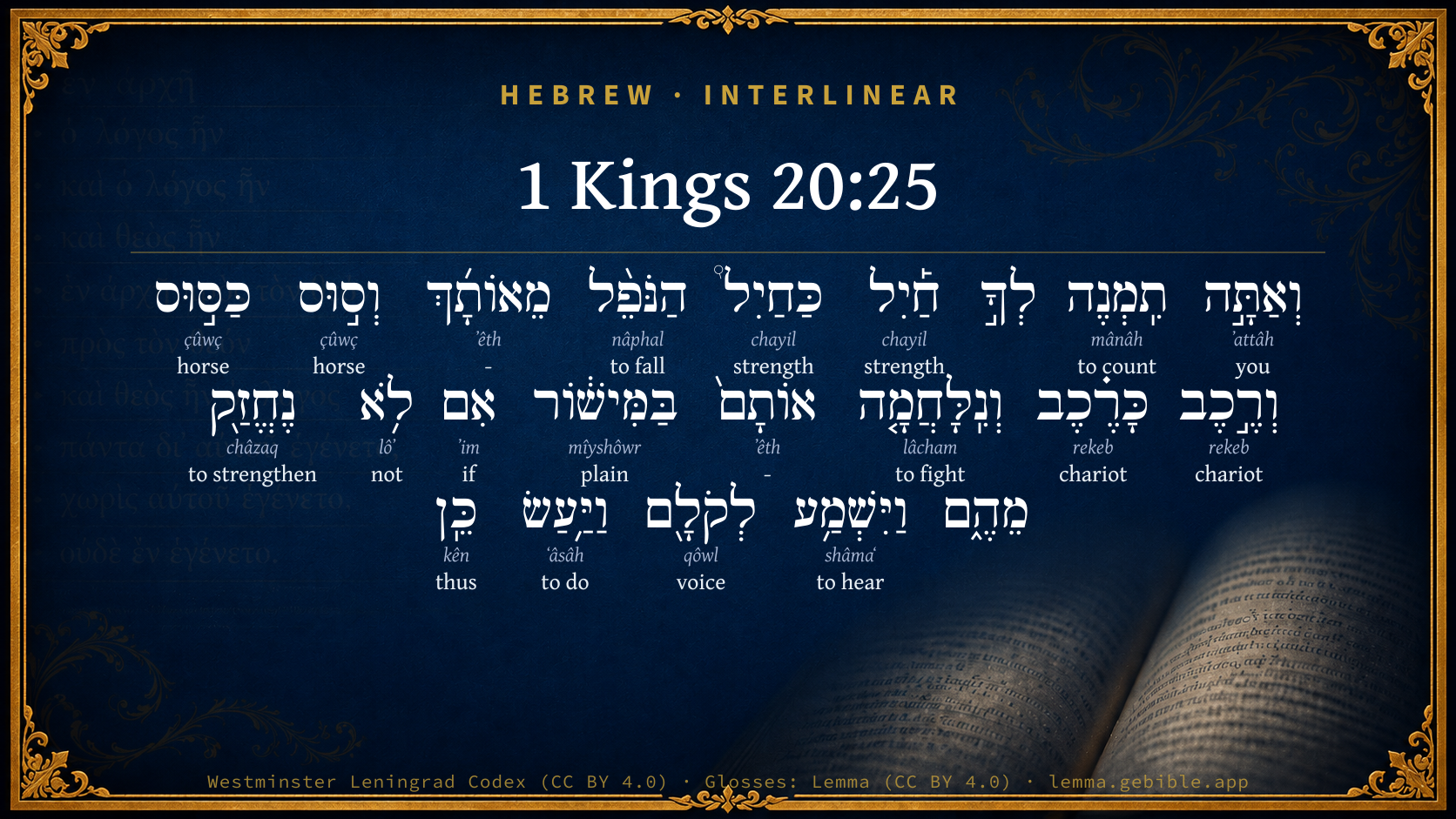
1 Kings 20:25

Hebrew (Westminster Leningrad Codex) 1 Kings 20:25 appears in the Hebrew Old Testament. The text above is from the Westminster Leningrad Codex. Each word links to its Strong’s number, a concise gloss, and parsing drawn from the Open Scriptures Hebrew Bible morphology. Click any word for its full Brown-Driver-Briggs (BDB) entry.
Download image
Cite this verse

1 Kings 20:25 (World English Bible). Public Domain. Lemma interlinear Bible study tool, https://lemma.gebible.app/v/1-kings/20/25.

Show BibTeX & RIS
BibTeX
RIS
English Translation
and number you an army, like the army that you have lost, horse for horse, and chariot for chariot; and we will fight against them in the plain, and surely we shall be stronger than they. He listened to their voice, and did so.
World English Bible · Public Domain
Download a study sheet

One document with this verse’s original text, its word-by-word gloss line, the meaning frame, cross-references with their text, attributed commentary, and full source and license credits — printable, and it pastes into notes with its structure intact.

This verse Autodidact and up

Study sheet (.html) Plain text (.txt)

A passage Seminary Student

Up to 50 verses in one chapter. A passage sheet keeps up to 6 commentary sources and 12 cross-references per verse, in the order this page ranks them, and says so on the sheet whenever that leaves anything out. Ask for a single verse and you get the Autodidact verse sheet above.

Everything on this page stays free to read, with no account — the sheet is a download of what is already on screen, not access to it.

Want to remove ads? Support Godless Engineer
Compare translations 3

The same verse in 3 English versions, stacked beneath the original-language interlinear above. Click any original word for its lexicon entry.

Each is an independent rendering of the whole verse — the interlinear is not word-aligned to these translations.

Highlighted words mark where these versions differ — a whole-verse word diff, not a word-by-word alignment.

  • World English Bible Public Domain
    and number you an army, like the army that you have lost, horse for horse, and chariot for chariot; and we will fight against them in the plain, and surely we shall be stronger than they. He listened to their voice, and did so.
  • King James Version Public Domain
    And number thee an army, like the army that thou hast lost, horse for horse, and chariot for chariot: and we will fight against them in the plain, and surely we shall be stronger than they. And he hearkened unto their voice, and did so.
  • unfoldingWord Literal Text CC BY-SA 4.0
    And you, you shall muster for yourself an army like the army having fallen from with you, and a horse like the horse and a chariot like the chariot, and we will fight them in the plain. Surely will we be stronger than them.” And he listened to their voice and did so.

unfoldingWord Literal Text — © unfoldingWord, licensed CC BY-SA 4.0. Word-aligned USFM3 via Door43 (git.door43.org/unfoldingWord/en_ult).

Versions to compare (up to 4)

3 of 4 selected

Show all 18 translations

Every available English version of this verse, each an independent rendering of the whole verse.

  • World English Bible Public Domain
    and number you an army, like the army that you have lost, horse for horse, and chariot for chariot; and we will fight against them in the plain, and surely we shall be stronger than they. He listened to their voice, and did so.
  • Berean Standard Bible Public Domain
    And you must raise an army like the one you have lost—horse for horse and chariot for chariot—so we can fight the Israelites on the plain, where we will surely prevail.” And the king approved their plan and acted accordingly.
  • Majority Standard Bible Public Domain
    And you must raise an army like the one you have lost—horse for horse and chariot for chariot—so we can fight the Israelites on the plain, where we will surely prevail.” And the king approved their plan and acted accordingly.
  • King James Version Public Domain
    And number thee an army, like the army that thou hast lost, horse for horse, and chariot for chariot: and we will fight against them in the plain, and surely we shall be stronger than they. And he hearkened unto their voice, and did so.
  • American Standard Version (1901) Public Domain
    and number thee an army, like the army that thou hast lost, horse for horse, and chariot for chariot; and we will fight against them in the plain, and surely we shall be stronger than they. And he hearkened unto their voice, and did so.
  • Revised Version (1885) Public Domain
    and number thee an army, like the army that thou hast lost, horse for horse, and chariot for chariot: and we will fight against them in the plain, and surely we shall be stronger than they. And he hearkened unto their voice, and did so.
  • Geneva Bible (1599) Public Domain
    And nomber thy selfe an armie, like the armie that thou hast lost, with such horses, and such charets, and we wil fight against them in the plaine, and doubtlesse we shall ouercome them: and he hearkened vnto their voyce, and did so.
  • Douay-Rheims (1899) Public Domain
    And make up the number of soldiers that have been slain of thine, and horses according to the former horses, and chariots according to the chariots which thou hadst before: and we will fight against them in the plains, and thou shalt see that we shall overcome them. He believed their counsel and did so.
  • Young's Literal Translation Public Domain
    and thou, number to thee a force as the force that is fallen from thee, and horse for horse, and chariot for chariot, and we fight with them in the plain; are we not stronger than they?' and he hearkeneth to their voice, and doth so.
  • Literal Standard Version CC BY-SA 4.0
    and you, number for yourself a force as the force that is fallen from you, and horse for horse, and chariot for chariot, and we fight with them in the plain; are we not stronger than they?” And he listens to their voice, and does so.
  • Unlocked Literal Bible CC BY-SA 4.0
    Raise up an army like the army you lost—horse for horse and chariot for chariot—so we can fight them in the plain. Then surely we will be stronger than they are.” So Ben Hadad listened to their advice and did what they advised.
  • unfoldingWord Literal Text CC BY-SA 4.0
    And you, you shall muster for yourself an army like the army having fallen from with you, and a horse like the horse and a chariot like the chariot, and we will fight them in the plain. Surely will we be stronger than them.” And he listened to their voice and did so.
  • Darby Bible Public Domain
    and number thee an army, like the army that thou hast lost, horse for horse, and chariot for chariot; and we will fight against them on the plateau: shall we not be stronger than they? And he hearkened to their voice, and did so.
  • World Messianic Bible Public Domain
    Muster an army like the army that you have lost, horse for horse and chariot for chariot. We will fight against them in the plain, and surely we will be stronger than they are.” He listened to their voice and did so.
  • Webster's Bible Public Domain
    And number thee an army, like the army that thou hast lost, horse for horse, and chariot for chariot: and we will fight against them in the plain, and surely we shall be stronger than they. And he hearkened to their voice, and did so.
  • Free Bible Version CC BY-SA 4.0
    You also have to raise another army to replace the one you lost—horse for horse, chariot for chariot. Then we can fight them in the lowlands and we will definitely beat them.” Ben-hadad listened to their advice and did as they said.
  • Bible in Basic English Public Domain
    And get together another army like the one which came to destruction, horse for horse, and carriage for carriage; and let us make war on them in the lowlands, and certainly we will be stronger than they. And he gave ear to what they said, and did so.
  • JPS Tanakh (1917) Public Domain
    and number thee an army, like the army that thou hast lost, horse for horse, and chariot for chariot; and we will fight against them in the plain, and surely we shall be stronger than they.' And he hearkened unto their voice, and did so.

Literal Standard Version (2020), Covenant Press — licensed CC BY-SA 4.0. Text via the HelloAO Bible API (eBible.org). Unlocked Literal Bible (unfoldingWord) — licensed CC BY-SA 4.0. Text via the HelloAO Bible API (eBible.org). unfoldingWord Literal Text — © unfoldingWord, licensed CC BY-SA 4.0. Word-aligned USFM3 via Door43 (git.door43.org/unfoldingWord/en_ult). Free Bible Version, Dr. Jonathan Gallagher — licensed CC BY-SA 4.0. Text via the HelloAO Bible API (eBible.org).

Word by word

More ways to search: Search by grammar → Find every occurrence → Compare this word →

Practice this passage: Drill this verse → Learn its vocabulary →

בַּמִּישׁ֔וֹר
mîyshôwr
H4334
“in/at the · plain”
Preposition, Determined + Noun, Common, Masculine, Singular, Absolute
Part of Speech
Preposition + Noun
Type
Common
Gender
Masculine
Number
Singular
State
Absolute
Full BDB Definition

Origin: from H3474

TWOT: 930f

level place, uprightness - level country, table-land, plain - level place - uprightness
  1. וְאַתָּ֣ה ʼattâh H859 “and · you” Conjunction + Pronoun, Personal, 2nd Person, Masculine, Singular
  2. תִֽמְנֶה mânâh H4487 “to count” Verb, Qal, Imperfect, 2nd Person, Masculine, Singular
  3. חַ֡יִל chayil H2428 “strength” Noun, Common, Masculine, Singular, Absolute
  4. כַּחַיִל֩ chayil H2428 “like/as the · strength” Preposition, Determined + Noun, Common, Masculine, Singular, Absolute
  5. הַנֹּפֵ֨ל nâphal H5307 “the · falling” Particle, Definite Article + Verb, Qal, Participle Active, Masculine, Singular, Absolute
  6. מֵאוֹתָ֜ךְ ʼêth H853 “from · - · you” Preposition + Particle, Direct Object + Suffix, Personal, 2nd Person, Feminine, Singular
  7. וְס֣וּס çûwç H5483 “and · horse” Conjunction + Noun, Common, Masculine, Singular, Absolute
  8. כַּסּ֣וּס çûwç H5483 “like/as the · horse” Preposition, Determined + Noun, Common, Masculine, Singular, Absolute
  9. וְרֶ֣כֶב rekeb H7393 “and · chariot” Conjunction + Noun, Common, Masculine, Singular, Absolute
  10. כָּרֶ֗כֶב rekeb H7393 “like/as the · chariot” Preposition, Determined + Noun, Common, Masculine, Singular, Absolute
  11. וְנִֽלָּחֲמָ֤ה lâcham H3898 “and · to fight” Conjunction + Verb, Niphal, Cohortative, 1st Person, Common, Plural
  12. אוֹתָם֙ ʼêth H853 “- · them” Particle, Direct Object + Suffix, Personal, 3rd Person, Masculine, Plural
  13. אִם ʼim H518 “if” Conjunction
  14. לֹ֥א lôʼ H3808 “not” Particle, Negative
  15. נֶחֱזַ֖ק châzaq H2388 “to strengthen” Verb, Qal, Imperfect, 1st Person, Common, Plural
  16. וַיִּשְׁמַ֥ע shâmaʻ H8085 “and · to hear” Conjunction + Verb, Qal, Sequential Imperfect, 3rd Person, Masculine, Singular
  17. לְקֹלָ֖ם qôwl H6963 “to/for · voice · their” Preposition + Noun, Common, Masculine, Singular, Construct + Suffix, Personal, 3rd Person, Masculine, Plural
  18. וַיַּ֥עַשׂ ʻâsâh H6213 “and · to do” Conjunction + Verb, Qal, Sequential Imperfect, 3rd Person, Masculine, Singular
  19. כֵּֽן kên H3651 “thus” Particle, Demonstrative

About this verse

These counts appear in no published source. They are computed here, from the morphology-tagged text and Lemma’s own curated glosses. What Lemma adds →

22
words
16
distinct lemmas
Historical
section

Notable vocabulary

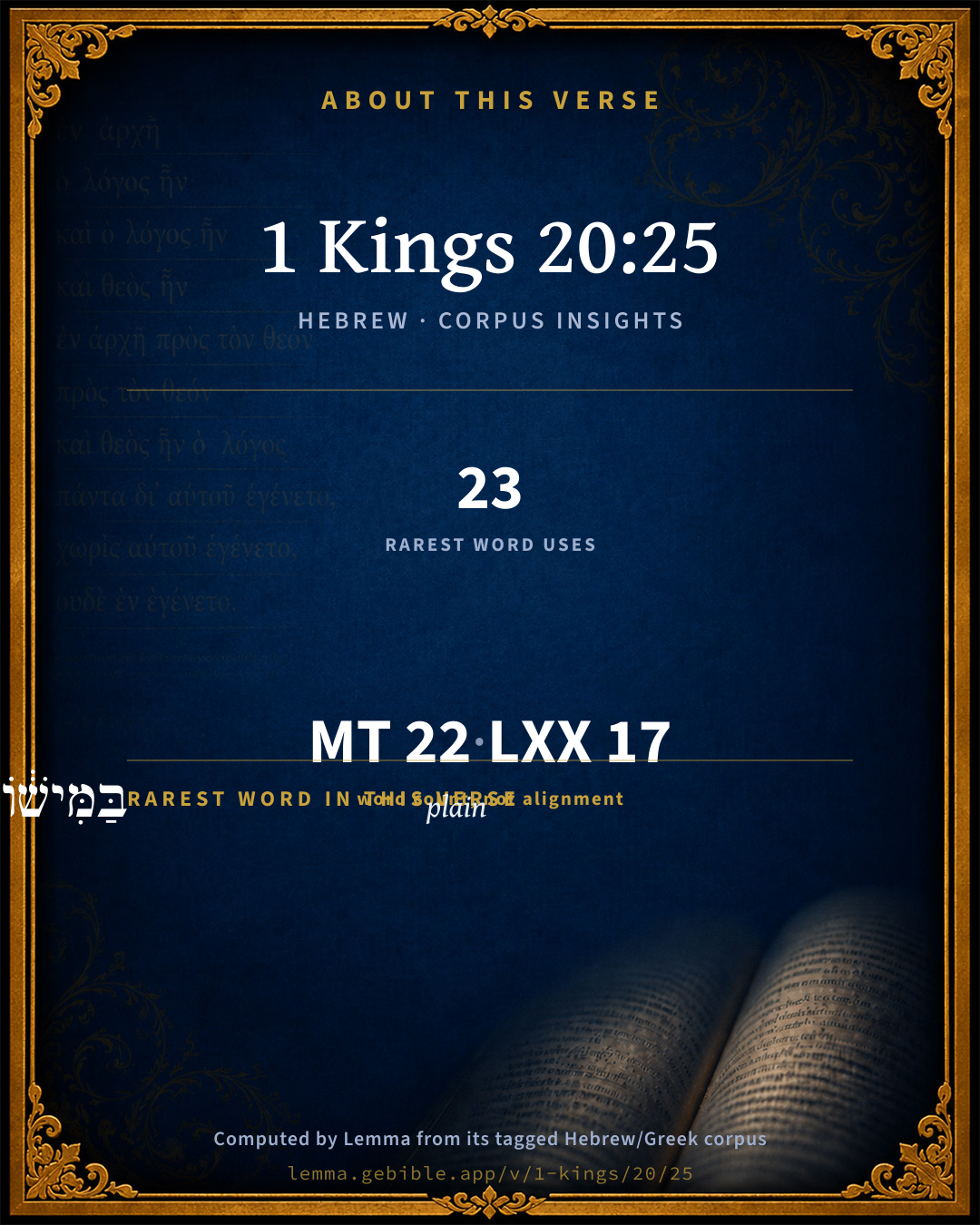
The rarest word here is בַּמִּישׁ֔וֹר plain H4334 — appearing just 23 times in the whole Hebrew Bible.

Shared distinctive vocabulary

בַּמִּישׁ֔וֹר plain H4334 occurs in 23 verses of the Hebrew Bible. Also found in:

Grammatical profile

  • 6 verbs
  • 8 nouns
  • 1 pronoun
  • 2 prepositions
  • 1 conjunction
  • 4 particles

Verb forms

  • תִֽמְנֶה Qal · Imperfect
  • הַנֹּפֵ֨ל Qal · Participle Active
  • וְנִֽלָּחֲמָ֤ה Niphal · Cohortative
  • נֶחֱזַ֖ק Qal · Imperfect
  • וַיִּשְׁמַ֥ע Qal · Sequential Imperfect
  • וַיַּ֥עַשׂ Qal · Sequential Imperfect

Repetition

Words recur within this verse — often emphatic in Hebrew:

  • חַ֡יִל strength H2428 ×2
  • וְס֣וּס horse H5483 ×2
  • וְרֶ֣כֶב chariot H7393 ×2

Hebrew & Septuagint length

In English translation the verse runs 44 words from the Hebrew and 28 from the Septuagint (LXX English) — the Septuagint runs noticeably shorter here. See the side-by-side →

A rough comparison of the two English renderings, which tokenize alike — not a word-level alignment.

Word counts can differ between the Hebrew and the Greek without any difference in meaning — e.g. the Hebrew direct-object marker אֵת has no separate Greek word, and Greek often adds the article ὁ.

In the original languages it is 22 Hebrew tokens and 17 Greek tokens — but the two are counted differently (Hebrew bundles its prefixes and suffixes into one token; the Greek is in lemma form), so that isn’t a like-for-like length.

Cross-references

1

Topical passages linked to 1 Kings 20:25 in the Treasury of Scripture Knowledge — connected by theme and wording, ordered by reader-vote popularity; previews shown in the World English Bible.

  • Psalms 10:3 For the wicked boasts of his heart's cravings, He blesses the greedy, and condemns Yahweh.

Cross-references courtesy of OpenBible.info (CC BY 4.0).

Hebrew and Greek witnesses Masoretic Hebrew ↔ Greek Septuagint

The same verse in the two great witnesses to the Old Testament, shown verse-for-verse.

Here the Septuagint runs noticeably shorter than the Hebrew — LXX2012 (modern English Septuagint) 28 words vs World English Bible 44. A rough length comparison of the two English translations, not a word-level alignment — read both below.

These are two independent witnesses, not word-aligned to each other, and the Septuagint is shown in lemma (dictionary) form.

Hebrew 1 Kings 20:25 Masoretic · Westminster Leningrad Codex

וְאַתָּ֣ה תִֽמְנֶה לְךָ֣ חַ֡יִל כַּחַיִל֩ הַנֹּפֵ֨ל מֵאוֹתָ֜ךְ וְס֣וּס כַּסּ֣וּס וְרֶ֣כֶב כָּרֶ֗כֶב וְנִֽלָּחֲמָ֤ה אוֹתָם֙ בַּמִּישׁ֔וֹר אִם לֹ֥א נֶחֱזַ֖ק מֵהֶ֑ם וַיִּשְׁמַ֥ע לְקֹלָ֖ם וַיַּ֥עַשׂ כֵּֽן

and number you an army, like the army that you have lost, horse for horse, and chariot for chariot; and we will fight against them in the plain, and surely we shall be stronger than they. He listened to their voice, and did so.

World English Bible · Public Domain

Greek LXX 1 Kings 20:25 Septuagint · lemma form

πλήν ματαίως αχααβ ὡς πιπράσκω ποιέω ὁ πονηρός ἐνώπιον κύριος ὡς μετατίθημι αὐτός ιεζαβελ ὁ γυνή αὐτός

But Achaab did wickedly, in that he sold himself to do that which was evil in the sight of the Lord, as his wife Jezabel led him astray.

LXX2012 (modern English Septuagint) · Public Domain

Hebrew: Westminster Leningrad Codex (CC BY 4.0). Greek: Septuagint (public domain); English from LXX2012 (modern English Septuagint) (Public Domain). How the Septuagint differs from the Hebrew →

Targum (Aramaic paraphrase)

1

The Targum is the ancient Jewish Aramaic paraphrase of the Hebrew Scriptures — an interpretive translation, not the Hebrew text itself. Onkelos (literal) and Pseudo-Jonathan (expansive) render the Torah, and Jonathan the Prophets. Coverage is partial: where no permissively-licensed English translation exists for a verse, only the Aramaic is shown. This is verse-level text, not a word-by-word alignment to the Hebrew.

  1. Targum Jonathan Prophets (Joshua–Malachi)
    וְאַתְּ תִּמְנֵי לָךְ מַשִׁרְיָן כְּמַשִׁרְיָן דְאִתְקְטָלָא מִנָךְ וְסוּסְוָן כְּסוּסְוָן וּרְתִיכִין כִּרְתִיכִין וְנַגִיחַ עִמְהוֹן בְּמֵישְׁרָא אִם לָא נִתְקֵיף מִנְהוֹן וְקַבֵּיל לְמֵימְרֵיהוֹן וַעֲבַד כֵּן:

    (no public-domain English translation for this verse)

    Targum Jonathan — Aramaic: “Mikraot Gedolot” (public domain). English: “Sefaria Community Translation” (CC0 1.0 (public-domain dedication)); “London "Chaldee Paraphrase," 1871” (public domain). Text via Sefaria.

Commentary

Notes on 1 Kings 20:25 from classic Christian and Jewish commentators (each source and its license shown beneath its notes). The classic Christian expositions comment on the surrounding passage and are grouped to its opening verse, so a note may address several verses; the Jewish commentaries on the Tanakh (Rashi and others) are per-verse, so they appear only where the commentator wrote on this verse.

Lemma curates 59 commentaries, every one of them public domain or Creative Commons licensed, each selected and text-cleaned for this edition rather than reprinted as found. About our sources →

Trapp's Complete Commentary

John Trapp

1Ki 20:25 And number thee an army, like the army that thou hast lost, horse for horse, and chariot for chariot: and we will fight against them in the plain, [and] surely we shall be stronger than they. And he hearkened unto their voice, and did so.

Ver. 25. The army that thou hast lost.] Heb., That was fallen. They who are fallen in the field are looked upon as lost. And yet Miles Cobelitz, a Christian soldier, sore wounded and all bloody, rising out of a heap of slain men after a great fight, stabbed to death Amurath, the great Turk, as he took a view of the dead bodies, which without number lay on heaps in the field. {a} And in that memorable fight betwixt the Dauphin of France and the Helvetians near Basle, Burchard Monk, a noble and valiant commander, vaunting of his victory, and putting up his helmet, that he might see what a slaughter had been made there that day, had his death wound given him by a half-dead Helvetian, who, getting up upon his knees, threw a stone at him, and hit him in the forehead. {b}

And we will flght against them in the plain.] See on 1Ki 20:23.

{a} Turk. Hist, fol. 200.

{b} Lavat. in Pro 27:1.

John Trapp, A Commentary or Exposition upon All the Books of the Old and New Testament (1647–1656) — public domain. Text from a community e-Sword module.

The Cambridge Bible for Schools and Colleges

gen. ed. J. J. S. Perowne

25. and number thee an army] Here we have a different verb from that in 15 and in 26, 27. Here the operation is one of numbering, making the force tally exactly in each arm with that which had been gathered in the previous year. The rendering of this verb by ‘number’ is an additional reason for changing ‘number’ to muster in the other places.

The Cambridge Bible for Schools and Colleges (gen. ed. J. J. S. Perowne; Cambridge University Press, 1878–1918) — public domain. Text from a community e-Sword module.

John Gill's Exposition

And number thee an army like the army that thou hast lost,.... Raise an army of an equal number, which they supposed he was able to do:

horse for horse and chariot for chariot; as many horses and chariots as he had before:

and we will fight against them in the plain; where they could make use of their horses and chariots to greater advantage than on hills and mountains, see Jdg 1:19.

and surely we shall be stronger than they; and beat them:

and he hearkened unto their voice, and did so; took their counsel, and prepared an army, and placed captains in it instead of kings.

John Gill's Exposition of the Whole Bible (1746–1763) — public domain (CC PDM 1.0). Text via the HelloAO Bible API.

Whedon's Commentary on the Bible

Daniel D. Whedon

25. Like the army that thou hast lost — Or, like the fallen army. Surely Syria must have been rich in soldiers and horses and chariots, to gather so soon another such army as Ben-hadad boasts of in 1Ki_20:10.

Daniel D. Whedon (gen. ed.), Commentary on the Old and New Testaments (1874–1909) — public domain. Text from a community e-Sword module.

The Pulpit Commentary

And number thee an army, like the army that thou hast lost Heb. that is fallen from thee, not as marg., that was fallen. For the form wOame. see Ewald, 264 b), horse for Heb. as horse, and chariot for chariot: and we will fight against them in the plain, and surely we shall be stronger than they. And he hearkened unto their voice, and did so.

The Pulpit Commentary (1880–1919), ed. H.D.M. Spence-Jones & Joseph S. Exell — public domain. Text from a community e-Sword module.

Rashi

Rabbi Shlomo Yitzchaki (Rashi)

And he will be more powerful than them. I.e., and you will see if we will not overpower them.

Rashi on the Tanakh — English translations: “The Judaica Press complete Tanach with Rashi, translated by A. J. Rosenberg” (CC BY 4.0); “Pentateuch with Rashi's commentary by M. Rosenbaum and A.M. Silbermann, 1929-1934” (public domain); “The Metsudah Tanach series, Lakewood, N.J” (CC BY 4.0); and “The Book of Joshua, Metsudah Publications, 1997” (CC BY 4.0). Text via Sefaria.

Lesson kit

Teaching starters — assembled from the data on this page, not authored interpretation. Every prompt links to the verse data it draws on. Edit before teaching.

1 Kings, in the Historical, opens this verse with 22 words (16 distinct Hebrew lemmas). Its most distinctive word is mîyshôwr (“plain”). The Greek Septuagint runs shorter here. A historical commentator’s framing appears above. Read the whole chapter for the surrounding context.

Discussion questions

  1. What does “plain” (mîyshôwr) contribute to the verse as a whole?
  2. Deuteronomy 3:10 shares the word «plain» with this verse. How do the two illuminate each other?
  3. “strength” occurs 2× in this one verse. What is the effect of the repetition?
  4. Compared with the Hebrew, the Septuagint runs shorter here. What questions does that raise?
  5. These translations render this verse differently. What is at stake in choosing one wording over another?
  6. The verb «תִֽמְנֶה» is Qal Imperfect. How does its form color the action?
  7. Reading how Trapp's Complete Commentary and The Cambridge Bible for Schools and Colleges read this verse, where do the two commentators agree and where do they part?

Things to notice

Reading settings

Reading text

Shown beneath each verse's original-language words.

Old Testament
Old Testament edition

Read the OT as the Masoretic Hebrew (MT) or the Greek Septuagint (LXX).

English shown for the Greek Septuagint (in the Hebrew ↔ Greek comparison).

Comparing translations? Open the Compare panel on any verse page to stack up to four side by side.