Jeremiah 22:7

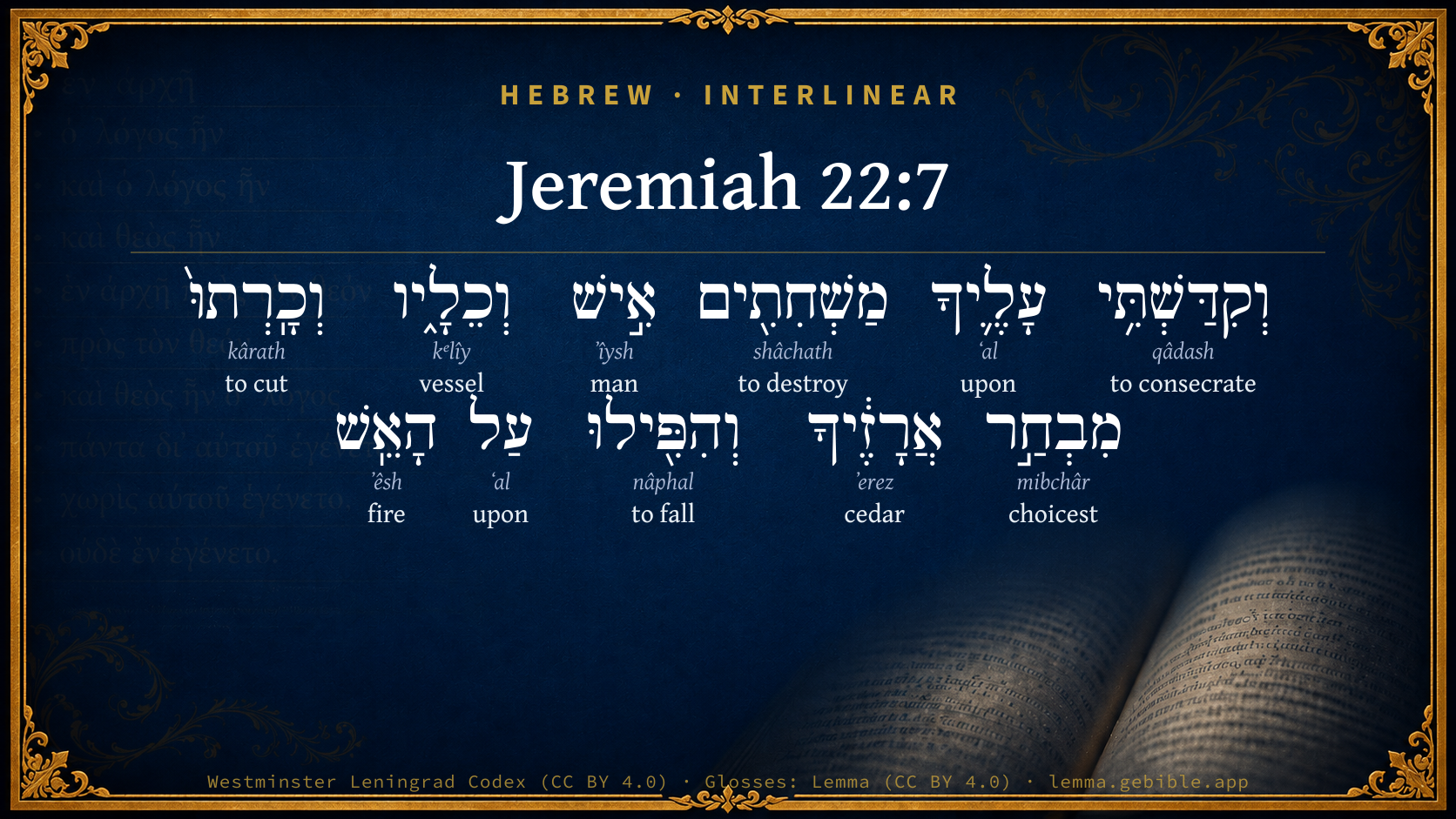
Hebrew (Westminster Leningrad Codex) Jeremiah 22:7 appears in the Hebrew Old Testament. The text above is from the Westminster Leningrad Codex. Each word links to its Strong’s number, a concise gloss, and parsing drawn from the Open Scriptures Hebrew Bible morphology. Click any word for its full Brown-Driver-Briggs (BDB) entry.
Download image
Cite this verse

Jeremiah 22:7 (World English Bible). Public Domain. Lemma interlinear Bible study tool, https://lemma.gebible.app/v/jeremiah/22/7.

Show BibTeX & RIS
BibTeX
RIS
English Translation
I will prepare destroyers against you, everyone with his weapons; and they shall cut down your choice cedars, and cast them into the fire.
World English Bible · Public Domain
Download a study sheet

One document with this verse’s original text, its word-by-word gloss line, the meaning frame, cross-references with their text, attributed commentary, and full source and license credits — printable, and it pastes into notes with its structure intact.

This verse Autodidact and up

Study sheet (.html) Plain text (.txt)

A passage Seminary Student

Up to 50 verses in one chapter. A passage sheet keeps up to 6 commentary sources and 12 cross-references per verse, in the order this page ranks them, and says so on the sheet whenever that leaves anything out. Ask for a single verse and you get the Autodidact verse sheet above.

Everything on this page stays free to read, with no account — the sheet is a download of what is already on screen, not access to it.

Want to remove ads? Support Godless Engineer
Compare translations 3

The same verse in 3 English versions, stacked beneath the original-language interlinear above. Click any original word for its lexicon entry.

Each is an independent rendering of the whole verse — the interlinear is not word-aligned to these translations.

Highlighted words mark where these versions differ — a whole-verse word diff, not a word-by-word alignment.

  • World English Bible Public Domain
    I will prepare destroyers against you, everyone with his weapons; and they shall cut down your choice cedars, and cast them into the fire.
  • King James Version Public Domain
    And I will prepare destroyers against thee, every one with his weapons: and they shall cut down thy choice cedars, and cast them into the fire.
  • unfoldingWord Literal Text CC BY-SA 4.0
    And I will consecrate destroyers against you, a man and his weapons, and they will cut down the choicest of your cedars and cast on the fire.

unfoldingWord Literal Text — © unfoldingWord, licensed CC BY-SA 4.0. Word-aligned USFM3 via Door43 (git.door43.org/unfoldingWord/en_ult).

Versions to compare (up to 4)

3 of 4 selected

Show all 18 translations

Every available English version of this verse, each an independent rendering of the whole verse.

  • World English Bible Public Domain
    I will prepare destroyers against you, everyone with his weapons; and they shall cut down your choice cedars, and cast them into the fire.
  • Berean Standard Bible Public Domain
    I will appoint destroyers against you, each man with his weapons, and they will cut down the choicest of your cedars and throw them into the fire.
  • Majority Standard Bible Public Domain
    I will appoint destroyers against you, each man with his weapons, and they will cut down the choicest of your cedars and throw them into the fire.
  • King James Version Public Domain
    And I will prepare destroyers against thee, every one with his weapons: and they shall cut down thy choice cedars, and cast them into the fire.
  • American Standard Version (1901) Public Domain
    And I will prepare destroyers against thee, every one with his weapons; and they shall cut down thy choice cedars, and cast them into the fire.
  • Revised Version (1885) Public Domain
    And I will prepare destroyers against thee, every one with his weapons: and they shall cut down thy choice cedars, and cast them into the fire.
  • Geneva Bible (1599) Public Domain
    And I will prepare destroyers against thee, euery one with his weapons, and they shall cut downe thy chiefe cedar trees, and cast them in the fire.
  • Douay-Rheims (1899) Public Domain
    And I will prepare against thee the destroyer and his weapons: and they shall cut down thy chosen cedars, and shall cast them headlong into the fire.
  • Young's Literal Translation Public Domain
    And I have separated for thee destroyers, Each with his weapons, And they have cut down the choice of thy cedars, And have cast them on the fire.
  • Literal Standard Version CC BY-SA 4.0
    And I have separated destroyers for you, || Each with his weapons, || And they have cut down the choice of your cedars, || And have cast them on the fire.”
  • Unlocked Literal Bible CC BY-SA 4.0
    For I have designated destroyers to come against you! Men with their weapons will cut off the best of your cedars and let them fall into the fire.
  • unfoldingWord Literal Text CC BY-SA 4.0
    And I will consecrate destroyers against you, a man and his weapons, and they will cut down the choicest of your cedars and cast on the fire.
  • Darby Bible Public Domain
    And I will prepare destroyers against thee, every one with his weapons; and they shall cut down the choice of thy cedars, and cast [them] into the fire.
  • World Messianic Bible Public Domain
    I will prepare destroyers against you, everyone with his weapons, and they will cut down your choice cedars, and cast them into the fire.
  • Webster's Bible Public Domain
    And I will prepare destroyers against thee, every one with his weapons: and they shall cut down thy choice cedars, and cast them into the fire.
  • Free Bible Version CC BY-SA 4.0
    I will choose men to come and destroy you, each with his own ax. They will chop down your fine cedars and throw them in the fire.
  • Bible in Basic English Public Domain
    And I will make ready those who will send destruction on you, everyone armed for war: by them your best cedar-trees will be cut down and put in the fire.
  • JPS Tanakh (1917) Public Domain
    And I will prepare destroyers against thee, every one with his weapons; and they shall cut down thy choice cedars, and cast them into the fire.

Literal Standard Version (2020), Covenant Press — licensed CC BY-SA 4.0. Text via the HelloAO Bible API (eBible.org). Unlocked Literal Bible (unfoldingWord) — licensed CC BY-SA 4.0. Text via the HelloAO Bible API (eBible.org). unfoldingWord Literal Text — © unfoldingWord, licensed CC BY-SA 4.0. Word-aligned USFM3 via Door43 (git.door43.org/unfoldingWord/en_ult). Free Bible Version, Dr. Jonathan Gallagher — licensed CC BY-SA 4.0. Text via the HelloAO Bible API (eBible.org).

Word by word

More ways to search: Search by grammar → Find every occurrence → Compare this word →

Practice this passage: Drill this verse → Learn its vocabulary →

מִבְחַ֣ר
mibchâr
H4005
“choicest of”
Noun, Common, Masculine, Singular, Construct
Part of Speech
Noun
Type
Common
Gender
Masculine
Number
Singular
State
Construct
Full BDB Definition

Origin: from H977

TWOT: 231d

choicest, best
  1. וְקִדַּשְׁתִּ֥י qâdash H6942 “and · to consecrate” Conjunction + Verb, Piel, Sequential Perfect, 1st Person, Common, Singular
  2. עָלֶ֛יךָ ʻal H5921 “upon · you” Preposition + Suffix, Personal, 2nd Person, Masculine, Singular
  3. מַשְׁחִתִ֖ים shâchath H7843 “destroying” Verb, Hiphil, Participle Active, Masculine, Plural, Absolute
  4. אִ֣ישׁ ʼîysh H376 “man” Noun, Common, Masculine, Singular, Absolute
  5. וְכֵלָ֑יו kᵉlîy H3627 “and · vessels · his” Conjunction + Noun, Common, Masculine, Plural, Construct + Suffix, Personal, 3rd Person, Masculine, Singular
  6. וְכָֽרְתוּ֙ kârath H3772 “and · to cut” Conjunction + Verb, Qal, Sequential Perfect, 3rd Person, Common, Plural
  7. אֲרָזֶ֔יךָ ʼerez H730 “cedars · your” Noun, Common, Masculine, Plural, Construct + Suffix, Personal, 2nd Person, Masculine, Singular
  8. וְהִפִּ֖ילוּ nâphal H5307 “and · to fall” Conjunction + Verb, Hiphil, Sequential Perfect, 3rd Person, Common, Plural
  9. עַל ʻal H5921 “upon” Preposition
  10. הָאֵֽשׁ ʼêsh H784 “the · fire” Particle, Definite Article + Noun, Common, Both, Singular, Absolute

About this verse

These counts appear in no published source. They are computed here, from the morphology-tagged text and Lemma’s own curated glosses. What Lemma adds →

11
words
10
distinct lemmas
Prophets
section

Notable vocabulary

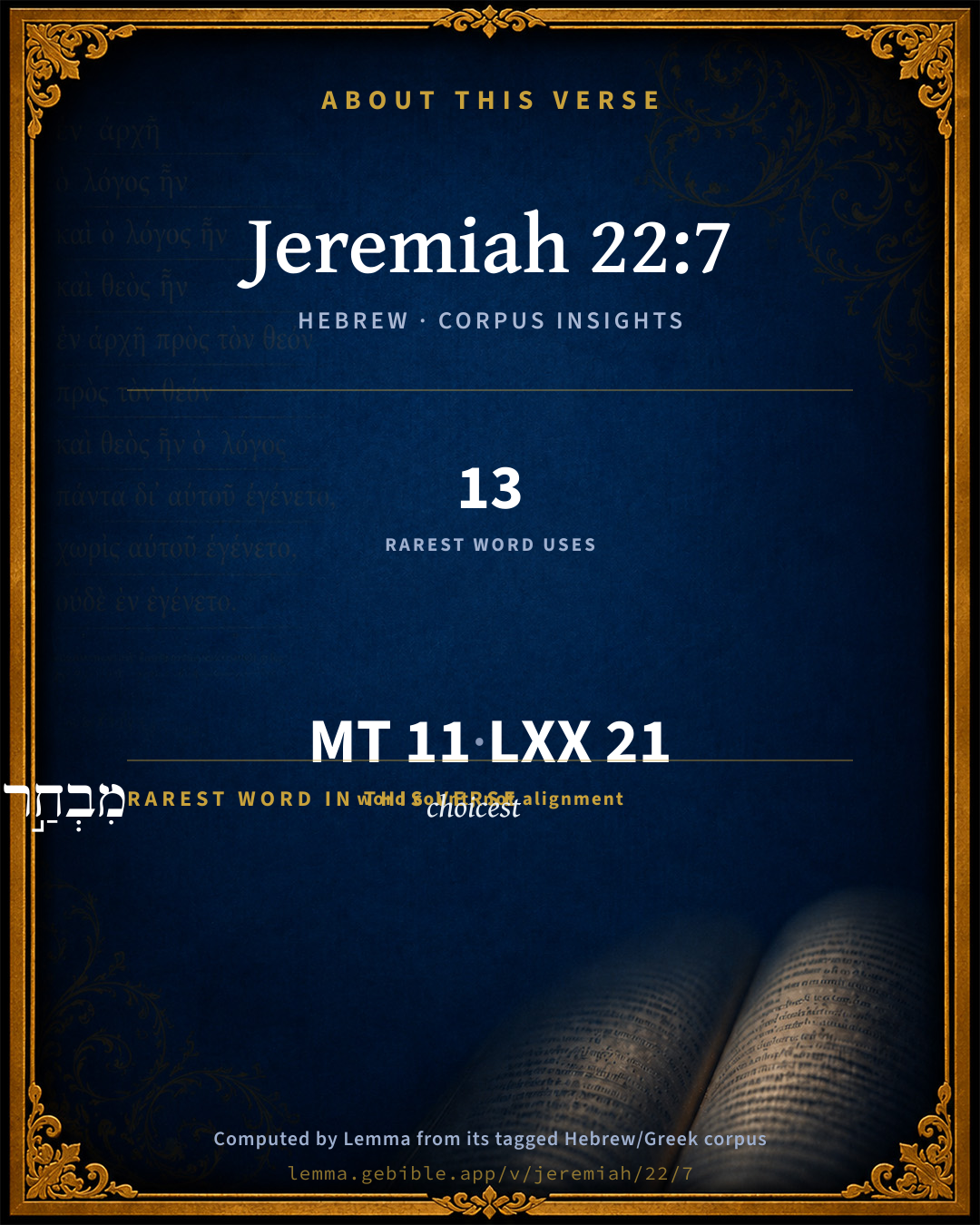
The rarest word here is מִבְחַ֣ר choicest H4005 — appearing just 13 times in the whole Hebrew Bible.

Shared distinctive vocabulary

מִבְחַ֣ר choicest H4005 occurs in 13 verses of the Hebrew Bible. Also found in:

Grammatical profile

  • 4 verbs
  • 5 nouns
  • 2 prepositions

Verb forms

  • וְקִדַּשְׁתִּ֥י Piel · Sequential Perfect
  • מַשְׁחִתִ֖ים Hiphil · Participle Active
  • וְכָֽרְתוּ֙ Qal · Sequential Perfect
  • וְהִפִּ֖ילוּ Hiphil · Sequential Perfect

Repetition

A word recurs within this verse — often emphatic in Hebrew:

  • עָלֶ֛יךָ upon H5921 ×2

Hebrew & Septuagint length

In the original languages it is 11 Hebrew tokens and 21 Greek tokens — but the two are counted differently (Hebrew bundles its prefixes and suffixes into one token; the Greek is in lemma form), so that isn’t a like-for-like length.

Cross-references

13

Topical passages linked to Jeremiah 22:7 in the Treasury of Scripture Knowledge — connected by theme and wording, ordered by reader-vote popularity; previews shown in the World English Bible.

  • Isaiah 10:33–34 Behold, the Lord, Yahweh of Hosts, will lop the boughs with terror: and the high of stature shall be hewn down, and the lofty shall be brought low.
  • Isaiah 37:24 By your servants have you defied the Lord, and have said, With the multitude of my chariots am I come up to the height of the mountains, to the innermost parts of Lebanon; and I will cut down the tall cedars of it, and the choice fir trees of it; and I will enter into its farthest height, the forest of its fruitful field;
  • Jeremiah 4:6–7 Set up a standard toward Zion: flee for safety, don't stay; for I will bring evil from the north, and a great destruction.
  • Isaiah 13:3–5 I have commanded my consecrated ones, yes, I have called my mighty men for my anger, even my proudly exulting ones.
  • Jeremiah 21:14 I will punish you according to the fruit of your doings, says Yahweh; and I will kindle a fire in her forest, and it shall devour all that is round about her.
  • Ezekiel 9:1–7 Then he cried in my ears with a loud voice, saying, Cause you them that have charge over the city to draw near, every man with his destroying weapon in his hand.
  • Isaiah 10:3–7 What will you do in the day of visitation, and in the desolation which shall come from far? to whom will you flee for help? and where will you leave your glory?
  • Isaiah 27:10–11 For the fortified city is solitary, a habitation deserted and forsaken, like the wilderness: there shall the calf feed, and there shall he lie down, and consume the branches of it.
  • Isaiah 54:16–17 Behold, I have created the smith who blows the fire of coals, and brings forth a weapon for his work; and I have created the waster to destroy.
  • Jeremiah 5:15 Behold, I will bring a nation on you from far, house of Israel, says Yahweh: it is a mighty nation, it is an ancient nation, a nation whose language you don't know, neither understand what they say.
  • Jeremiah 50:20–23 In those days, and in that time, says Yahweh, the iniquity of Israel shall be sought for, and there shall be none; and the sins of Judah, and they shall not be found: for I will pardon them whom I leave as a remnant.
  • Zechariah 11:1 Open your doors, Lebanon, That the fire may devour your cedars.
  • Matthew 22:7 When the king heard that, he was angry, and he sent his armies, destroyed those murderers, and burned their city.

Cross-references courtesy of OpenBible.info (CC BY 4.0).

Hebrew and Greek witnesses Masoretic Hebrew ↔ Greek Septuagint

The same verse in the two great witnesses to the Old Testament, shown verse-for-verse.

These are two independent witnesses, not word-aligned to each other, and the Septuagint is shown in lemma (dictionary) form.

Hebrew Jeremiah 22:7 Masoretic · Westminster Leningrad Codex

וְקִדַּשְׁתִּ֥י עָלֶ֛יךָ מַשְׁחִתִ֖ים אִ֣ישׁ וְכֵלָ֑יו וְכָֽרְתוּ֙ מִבְחַ֣ר אֲרָזֶ֔יךָ וְהִפִּ֖ילוּ עַל הָאֵֽשׁ

I will prepare destroyers against you, everyone with his weapons; and they shall cut down your choice cedars, and cast them into the fire.

World English Bible · Public Domain

Greek LXX Structure differs

In the Septuagint, Jeremiah is about an eighth shorter than the Hebrew and arranges its material differently — the Oracles Against the Nations (Hebrew chapters 46–51) appear in the middle of the Greek book, after 25:13. Because the chapter and verse boundaries do not line up, a verse-for-verse comparison with the Hebrew is not shown.

A verse-for-verse comparison isn’t shown here because the chapters and verses don’t line up. Switch to the LXX edition with the MT / LXX toggle above to read the Greek directly.

Hebrew: Westminster Leningrad Codex (CC BY 4.0). Greek: Septuagint (public domain); English from a public-domain English Septuagint. How the Septuagint differs from the Hebrew →

Targum (Aramaic paraphrase)

1

The Targum is the ancient Jewish Aramaic paraphrase of the Hebrew Scriptures — an interpretive translation, not the Hebrew text itself. Onkelos (literal) and Pseudo-Jonathan (expansive) render the Torah, and Jonathan the Prophets. Coverage is partial: where no permissively-licensed English translation exists for a verse, only the Aramaic is shown. This is verse-level text, not a word-by-word alignment to the Hebrew.

  1. Targum Jonathan Prophets (Joshua–Malachi)
    וְאַזְמִין עֲלָךְ מְחַבְּלִין גְבַר וְזֵינֵיהּ וְיִקְטְלוּן שְׁפַר גִבָּרָךְ כְּמָא דְקַצְצִין אָעֵי חוּרְשָׁא וְרָמָן לְנוּרָא:

    (no public-domain English translation for this verse)

    Targum Jonathan — Aramaic: “Mikraot Gedolot” (public domain). English: “Sefaria Community Translation” (CC0 1.0 (public-domain dedication)); “London "Chaldee Paraphrase," 1871” (public domain). Text via Sefaria.

Commentary

Notes on Jeremiah 22:7 from classic Christian and Jewish commentators (each source and its license shown beneath its notes). The classic Christian expositions comment on the surrounding passage and are grouped to its opening verse, so a note may address several verses; the Jewish commentaries on the Tanakh (Rashi and others) are per-verse, so they appear only where the commentator wrote on this verse.

Lemma curates 59 commentaries, every one of them public domain or Creative Commons licensed, each selected and text-cleaned for this edition rather than reprinted as found. About our sources →

Trapp's Complete Commentary

John Trapp

Jer 22:7 And I will prepare destroyers against thee, every one with his weapons: and they shall cut down thy choice cedars, and cast [them] into the fire.

Ver. 7. And I will prepare destroyers.] Heb., Sanctify them; that is, send them on mine errand, and let them forward. God’s holy hand is in all such desolations.

Every one with his weapons.] Or, Tools rather, to fell with.

And they shall cut down.] Sonat icta securibus ilex.

John Trapp, A Commentary or Exposition upon All the Books of the Old and New Testament (1647–1656) — public domain. Text from a community e-Sword module.

Geneva Bible (1599)

Geneva Bible translators

Thy buildings made of Cedar trees.

The Hebrew word signifieth to sanctify, because the Lord doth dedicate to his use and purpose such as he prepareth to execute his work, Isa. 13:3; Jer. 6:4 and 12:3.

Geneva Bible (1599) marginal notes — public domain. Text via Bolls.life.

Jamieson, Fausset & Brown

Robert Jamieson, A. R. Fausset & David Brown

prepare--literally, "sanctify," or solemnly set apart for a particular work (compare Isa 13:3).

thy choice cedars-- (Isa 37:24). Thy palaces built of choice cedars (Sol 1:17).

Jamieson, Fausset & Brown — Commentary Critical and Explanatory on the Whole Bible (1871) — public domain (CC PDM 1.0). Text via the HelloAO Bible API.

Adam Clarke's Commentary

Verse 7. They shall cut down thy choice cedars] The destruction of the country is expressed under the symbol of the destruction of a fine forest; a multitude of fellers come against it, each with his axe; and, there being no resistance, every tree is soon felled to the earth. "These destroyers," God says, "I have prepared, קדשתי kiddashti, I have sanctified-consecrated, to this work. They have their commission from me."

Adam Clarke's Commentary on the Bible (1810–1826) — public domain. Text from a community e-Sword/MySword module.

John Calvin's Commentaries

He expresses the manner, for he had only said before, that the ruin of the city Jerusalem was nigh at hand; he adds, that destroyers would come and those well armed with warlike instruments, who would cut down all the choicest cedars and cast them into the fire But he reminds them, that those destroyers would not come of themselves or through an impulse of their own, but through the secret operation of God; for if the Jews had thought that they had to do only with the Chaldeans, there would have been nothing to call forth the exercise of a religious principle; but the Prophet distinctly declares, that the Chaldeans would be the ministers of God, for they would be roused and led by him, according to what is often taught by the Prophets.

In short, these two things ought to be noticed, — first, that God had in readiness many ways by which he could punish the Jews. For the contempt of the ungodly arises, because they dream that God is unarmed and has not always the execution, as they say, ready at hand. Hence the Prophet shews that the Chaldeans would be ready as soon as God hissed for them, or gave them a sign. This is one thing. Secondly, it ought to be observed, that he reminds them that the Chaldeans would be the scourge of God, that the Jews might not think that they contended with mortals, but might know that they were summoned to render an account of their life, because they had too long been rebellious against God and his Prophets. This is what we must understand by the word prepare

Now as to the choice cedars, the Prophet again alludes to Mount Lebanon and to the forest of Jerusalem, which was mentioned yesterday. The word forest may, however, be applied to the buildings; for the Jews built their chambers for the most part of cedar wood, as it is well known; we may then apply this to their splendid and sumptuous houses; but we may also take it without a figure and apply it to the trees of Mount Lebanon. But the chief ornament of the country were the noble trees on that Mount; hence, by cedars, the Prophet no doubt designated whatever was splendid at Jerusalem and in the country around it. It follows, —

John Calvin's Commentaries (1540-1563) — public domain. Text from the Calvin Translation Society English edition (1840s-50s) via the Christian Classics Ethereal Library (ccel.org). Calvin's coverage is partial (roughly two-thirds of the Bible); uncommented books and verses are honest gaps, never fabricated. The 19th-century editor's footnotes and remarks are omitted so the notes are faithfully Calvin's own voice.

Ellicott's Commentary for English Readers

(7) I will prepare destroyers.—The verb, as in Jer_6:4, implies the idea of a solemn appointment or consecration.

They shall cut down thy choice cedars.—The metaphor of the preceding verse is carried further, and the “choice cedars” are the princes of the royal house of Judah, and the chief counsellors and generals, as well as the actual columns of cedar-wood.

A Bible Commentary for English Readers, edited by Charles John Ellicott (1878–1897) — public domain. Text from a community e-Sword module.

The Cambridge Bible for Schools and Colleges

gen. ed. J. J. S. Perowne

7. prepare] lit. as mg. sanctify. See on Jer_6:4, and cp. Isa_13:3.

thy choice cedars] the chief men of the State.

The Cambridge Bible for Schools and Colleges (gen. ed. J. J. S. Perowne; Cambridge University Press, 1878–1918) — public domain. Text from a community e-Sword module.

John Gill's Exposition

And I will prepare destroyers against thee,.... The Chaldeans, men of savage dispositions, bent upon the destruction of their neighbours; and who had already destroyed many nations, and so fit instruments for such service, as after mentioned; and who yet did not come merely of themselves, but were moved and directed to it by the powerful and all wise providence of God, in consequence of a previous preparation and appointment of them by the Lord in his counsels and purposes. It is, in the original text, "I will sanctify destroyers" (c); and not only intends a purpose and design; but suggests, that what they should do by his will and order would be consistent with his holiness and justice; and also that being prepared and ready, they might quickly expect a visit from them:

everyone with his weapons; of war, or slaughter weapons, as in Eze 9:2; or, "a man and his weapons" (d); not a single man only, as Nebuchadnezzar, but him and his army; everyone of the destroyers prepared with proper instruments to do execution: and

they shall cut down thy choice cedars, and cast them into the fire; the sons of the king, the princes of the blood, the nobles of the land, and other persons of rank and distinction, comparable to the tall cedars of Lebanon; so the Targum,

"and they shall slay the beauty of thy mighty ones, as the trees of a forest are cut down, and cast into the fire;''

or else the stately palaces of the king and his nobles, and other beautiful buildings, which were lined and ceiled with cedar, are here meant; and which the Chaldeans burnt with fire, Jer 52:13.

(c) "sanctificabo", V. L. Montanus, Cocceius. (d) "virum et arma ejus", Vulg. Lat. Vatablus; "virum et instrumenta ejus", Montanus, Cocceius.

John Gill's Exposition of the Whole Bible (1746–1763) — public domain (CC PDM 1.0). Text via the HelloAO Bible API.

Albert Barnes' Notes on the Bible

Prepare - i. e., consecrate, see Jer 6:4 note.

Thy choice cedars - The chief members of the royal lineage and the leading officers of state.

Albert Barnes' Notes on the Bible (1834–1885) — public domain. Text from a community e-Sword/MySword module.

Haydock's Catholic Bible Commentary

Prepare. Literally, sanctify; (Challoner) as various religious ceremonies were used before the declaration of war, and to know what would be the success. (Calmet) --- The Chaldeans were destined to execute God’s decrees. (St. Jerome) --- Cedars; fine buildings, (ver. 14.; Calmet) and chiefs. (Haydock)

George Leo Haydock (1774–1849), Haydock's Catholic Family Bible and Commentary, 1859 edition — public domain. Excludes Psalms (Douay-Rheims chapter numbering differs from Protestant) and Deuterocanonical books (Catholic canon only).

Matthew Poole's English Annotations

They shall not only be edged with their own lusts and malice; but commissioned and influenced by me, and shall come sufficiently prepared for their work. And they shall cut down and burn thy buildings, which are made of goodly cedars.

Matthew Poole's English Annotations on the Holy Bible (1683–1685) — public domain. Text from a community e-Sword/MySword module.

Whedon's Commentary on the Bible

Daniel D. Whedon

7. Prepare — Literally, consecrate.

Destroyers — These will come on His errand to execute his will. Strangely does such a word sound in application to cruel and merciless men; and yet the truth is a profound and comprehensive one. Any arrow which the Almighty places in his quiver, or shoots from his bow, is “consecrated” to a divine mission. But this does not at all contravene, mitigate, or in any way modify, the wickedness of these men. God has his plan: they have theirs. His purpose is always good, while that of his human agents may be evil.

Daniel D. Whedon (gen. ed.), Commentary on the Old and New Testaments (1874–1909) — public domain. Text from a community e-Sword module.

The Pulpit Commentary

I will prepare; literally, I will consecrate; the Babylonians being instruments of the Divine vengeance. (see on Jer_6:4)

The Pulpit Commentary (1880–1919), ed. H.D.M. Spence-Jones & Joseph S. Exell — public domain. Text from a community e-Sword module.

Rashi

Rabbi Shlomo Yitzchaki (Rashi)

And I will prepare and I will prepare.

and they will cut your choice cedars Since he compares him to the Lebanon, this expression is appropriate.

Rashi on the Tanakh — English translations: “The Judaica Press complete Tanach with Rashi, translated by A. J. Rosenberg” (CC BY 4.0); “Pentateuch with Rashi's commentary by M. Rosenbaum and A.M. Silbermann, 1929-1934” (public domain); “The Metsudah Tanach series, Lakewood, N.J” (CC BY 4.0); and “The Book of Joshua, Metsudah Publications, 1997” (CC BY 4.0). Text via Sefaria.

Lesson kit

Teaching starters — assembled from the data on this page, not authored interpretation. Every prompt links to the verse data it draws on. Edit before teaching.

Jeremiah, in the Prophets, opens this verse with 11 words (10 distinct Hebrew lemmas). Its most distinctive word is mibchâr (“choicest”). A historical commentator’s framing appears above. Read the whole chapter for the surrounding context.

Discussion questions

  1. How does “choicest” (mibchâr) shape what this verse is saying?
  2. Genesis 23:6 shares the word «choicest» with this verse. How do the two illuminate each other?
  3. “upon” occurs 2× in this one verse. What is the effect of the repetition?
  4. These translations render this verse differently. What is at stake in choosing one wording over another?
  5. The verb «וְקִדַּשְׁתִּ֥י» is Piel Sequential Perfect. How does its form color the action?
  6. Reading how Trapp's Complete Commentary and Geneva Bible (1599) read this verse, where do the two commentators agree and where do they part?

Things to notice

Reading settings

Reading text

Shown beneath each verse's original-language words.

Old Testament
Old Testament edition

Read the OT as the Masoretic Hebrew (MT) or the Greek Septuagint (LXX).

English shown for the Greek Septuagint (in the Hebrew ↔ Greek comparison).

Comparing translations? Open the Compare panel on any verse page to stack up to four side by side.