

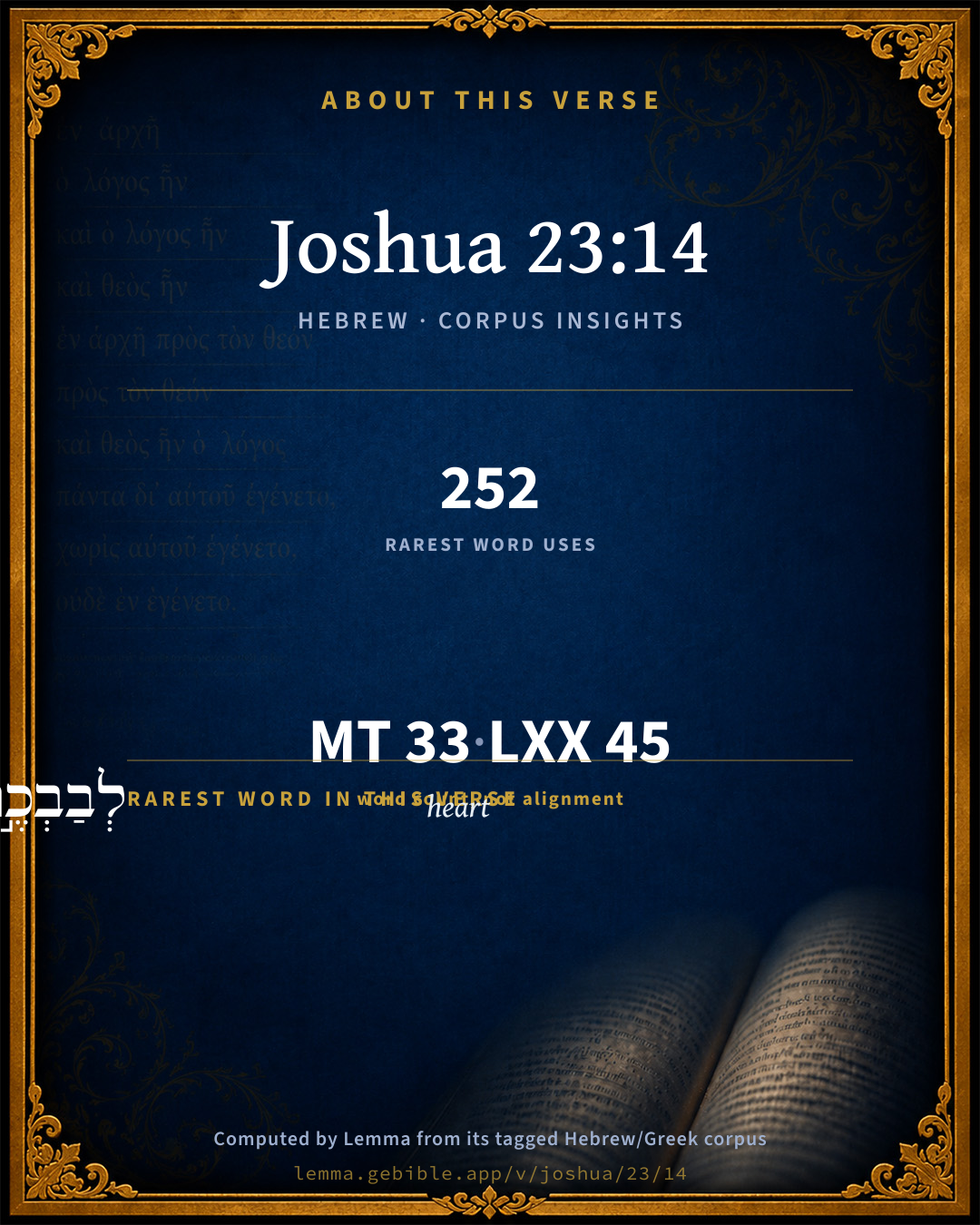
Joshua 23:14

Hebrew (Westminster Leningrad Codex) Joshua 23:14 appears in the Hebrew Old Testament. The text above is from the Westminster Leningrad Codex. Each word links to its Strong’s number, a concise gloss, and parsing drawn from the Open Scriptures Hebrew Bible morphology. Click any word for its full Brown-Driver-Briggs (BDB) entry.
Download image
Cite this verse

Joshua 23:14 (World English Bible). Public Domain. Lemma interlinear Bible study tool, https://lemma.gebible.app/v/joshua/23/14.

Show BibTeX & RIS
BibTeX
RIS
English Translation
Behold, this day I am going the way of all the earth: and you know in all your hearts and in all your souls, that not one thing has failed of all the good things which Yahweh your God spoke concerning you; all are happen to you, not one thing has failed of it.
World English Bible · Public Domain
Download a study sheet

One document with this verse’s original text, its word-by-word gloss line, the meaning frame, cross-references with their text, attributed commentary, and full source and license credits — printable, and it pastes into notes with its structure intact.

This verse Autodidact and up

Study sheet (.html) Plain text (.txt)

A passage Seminary Student

Up to 50 verses in one chapter. A passage sheet keeps up to 6 commentary sources and 12 cross-references per verse, in the order this page ranks them, and says so on the sheet whenever that leaves anything out. Ask for a single verse and you get the Autodidact verse sheet above.

Everything on this page stays free to read, with no account — the sheet is a download of what is already on screen, not access to it.

Want to remove ads? Support Godless Engineer
Compare translations 3

The same verse in 3 English versions, stacked beneath the original-language interlinear above. Click any original word for its lexicon entry.

Each is an independent rendering of the whole verse — the interlinear is not word-aligned to these translations.

Highlighted words mark where these versions differ — a whole-verse word diff, not a word-by-word alignment.

  • World English Bible Public Domain
    Behold, this day I am going the way of all the earth: and you know in all your hearts and in all your souls, that not one thing has failed of all the good things which Yahweh your God spoke concerning you; all are happen to you, not one thing has failed of it.
  • King James Version Public Domain
    And, behold, this day I am going the way of all the earth: and ye know in all your hearts and in all your souls, that not one thing hath failed of all the good things which the LORD your God spake concerning you; all are come to pass unto you, and not one thing hath failed thereof.
  • unfoldingWord Literal Text CC BY-SA 4.0
    And behold, today I myself am going in the way of all of the earth. And you know with all of your heart and with all of your soul that not one word has fallen from all of the good words that Yahweh your God spoke concerning you. The whole has come to you. Not one word has fallen from it.

unfoldingWord Literal Text — © unfoldingWord, licensed CC BY-SA 4.0. Word-aligned USFM3 via Door43 (git.door43.org/unfoldingWord/en_ult).

Versions to compare (up to 4)

3 of 4 selected

Show all 18 translations

Every available English version of this verse, each an independent rendering of the whole verse.

  • World English Bible Public Domain
    Behold, this day I am going the way of all the earth: and you know in all your hearts and in all your souls, that not one thing has failed of all the good things which Yahweh your God spoke concerning you; all are happen to you, not one thing has failed of it.
  • Berean Standard Bible Public Domain
    Now behold, today I am going the way of all the earth, and you know with all your heart and soul that not one of the good promises the LORD your God made to you has failed. Everything was fulfilled for you; not one promise has failed.
  • Majority Standard Bible Public Domain
    Now behold, today I am going the way of all the earth, and you know with all your heart and soul that not one of the good promises the LORD your God made to you has failed. Everything was fulfilled for you; not one promise has failed.
  • King James Version Public Domain
    And, behold, this day I am going the way of all the earth: and ye know in all your hearts and in all your souls, that not one thing hath failed of all the good things which the LORD your God spake concerning you; all are come to pass unto you, and not one thing hath failed thereof.
  • American Standard Version (1901) Public Domain
    And, behold, this day I am going the way of all the earth: and ye know in all your hearts and in all your souls, that not one thing hath failed of all the good things which Jehovah your God spake concerning you; all are come to pass unto you, not one thing hath failed thereof.
  • Revised Version (1885) Public Domain
    And, behold, this day I am going the way of all the earth: and ye know in all your hearts and in all your souls, that not one thing hath failed of all the good things which the LORD your God spake concerning you; all are come to pass unto you, not one thing hath failed thereof.
  • Geneva Bible (1599) Public Domain
    And beholde, this day do I enter into the way of all ye world, and ye know in al your heartes and in all your soules, that nothing hath failed of all the good things which the Lord your God promised you, but all are come to passe vnto you: nothing hath failed thereof.
  • Douay-Rheims (1899) Public Domain
    Behold this day I am going into the way of all the earth, and you shall know with all your mind that of all the words which the Lord promised to perform for you, not one hath failed.
  • Young's Literal Translation Public Domain
    `And lo, I am going, to-day, in the way of all the earth, and ye have known -- with all your heart, and with all your soul -- that there hath not fallen one thing of all the good things which Jehovah your God hath spoken concerning you; the whole have come to you; there hath not failed of it one thing.
  • Literal Standard Version CC BY-SA 4.0
    And behold, I am going, today, in the way of all the earth, and you have known—with all your heart, and with all your soul—that there has not fallen one thing of all the good things which your God YHWH has spoken concerning you; the whole have come to you; there has not failed of it one thing.
  • Unlocked Literal Bible CC BY-SA 4.0
    Now I am going the way of all the earth, and you know with all your hearts and souls that not one word has failed to come true of all the good things that Yahweh your God promised about you. All these things have come about for you. Not one of them has failed.
  • unfoldingWord Literal Text CC BY-SA 4.0
    And behold, today I myself am going in the way of all of the earth. And you know with all of your heart and with all of your soul that not one word has fallen from all of the good words that Yahweh your God spoke concerning you. The whole has come to you. Not one word has fallen from it.
  • Darby Bible Public Domain
    And behold, I am going this day the way of all the earth; and ye know in all your heart, and in all your soul, that not one thing hath failed of all the good words that Jehovah your God hath spoken concerning you: all are come to pass unto you -- not one thing hath failed thereof.
  • World Messianic Bible Public Domain
    “Behold, today I am going the way of all the earth. You know in all your hearts and in all your souls that not one thing has failed of all the good things which the LORD your God spoke concerning you. All have happened to you. Not one thing has failed of it.
  • Webster's Bible Public Domain
    And behold, this day I am going the way of all the earth; and ye know in all your hearts and in all your souls, that not one thing hath failed of all the good things which the LORD your God spoke concerning you: all are come to pass to you, and not one thing hath failed of it.
  • Free Bible Version CC BY-SA 4.0
    Now I am about to die, which is the fate of every living thing on the earth. Deep down you know that not a single one of the Lord's good promises has failed. Everything has come true. Not a single one has failed.
  • Bible in Basic English Public Domain
    Now I am about to go the way of all the earth: and you have seen and are certain, all of you, in your hearts and souls, that in all the good things which the Lord said about you, he has kept faith with you; everything has come true for you.
  • JPS Tanakh (1917) Public Domain
    And, behold, this day I am going the way of all the earth; consider ye therefore in all your heart and in all your soul, that not one thing hath failed of all the good things which the LORD your God spoke concerning you; all are come to pass unto you, not one thing hath failed thereof.

Literal Standard Version (2020), Covenant Press — licensed CC BY-SA 4.0. Text via the HelloAO Bible API (eBible.org). Unlocked Literal Bible (unfoldingWord) — licensed CC BY-SA 4.0. Text via the HelloAO Bible API (eBible.org). unfoldingWord Literal Text — © unfoldingWord, licensed CC BY-SA 4.0. Word-aligned USFM3 via Door43 (git.door43.org/unfoldingWord/en_ult). Free Bible Version, Dr. Jonathan Gallagher — licensed CC BY-SA 4.0. Text via the HelloAO Bible API (eBible.org).

Word by word

More ways to search: Search by grammar → Find every occurrence → Compare this word →

Practice this passage: Drill this verse → Learn its vocabulary →

לְבַבְכֶ֣ם
lêbâb
H3824
“heart · your”
Noun, Common, Masculine, Singular, Construct + Suffix, Personal, 2nd Person, Masculine, Plural
Part of Speech
Noun
Type
Common
Gender
Masculine
Number
Singular
State
Construct
Full BDB Definition

Origin: from H3823

TWOT: 1071a

inner man, mind, will, heart, soul, understanding - inner part, midst - midst (of things) - heart (of man) - soul, heart (of man) - mind, knowledge, thinking, reflection, memory - inclination, resolution, determination (of will) - conscience - heart (of moral character) - as seat of appetites - as seat of emotions and passions - as seat of courage
  1. וְהִנֵּ֨ה hinnêh H2009 “and · behold” Conjunction + Particle, Demonstrative
  2. אָנֹכִ֤י ʼânôkîy H595 “I” Pronoun, Personal, 1st Person, Common, Singular
  3. הוֹלֵךְ֙ hâlak H1980 “walking” Verb, Qal, Participle Active, Masculine, Singular, Absolute
  4. הַיּ֔וֹם yôwm H3117 “the · day” Particle, Definite Article + Noun, Common, Masculine, Singular, Absolute
  5. בְּדֶ֖רֶךְ derek H1870 “in/at · way of” Preposition + Noun, Common, Both, Singular, Construct
  6. כָּל kôl H3605 “all of” Noun, Common, Masculine, Singular, Construct
  7. הָאָ֑רֶץ ʼerets H776 “the · land” Particle, Definite Article + Noun, Common, Both, Singular, Absolute
  8. וִידַעְתֶּ֞ם yâdaʻ H3045 “and · to know” Conjunction + Verb, Qal, Sequential Perfect, 2nd Person, Masculine, Plural
  9. בְּכָל kôl H3605 “in/at · all of” Preposition + Noun, Common, Masculine, Singular, Construct
  10. וּבְכָל kôl H3605 “and · in/at · all of” Conjunction + Preposition + Noun, Common, Masculine, Singular, Construct
  11. נַפְשְׁכֶ֗ם nephesh H5315 “soul · your” Noun, Common, Both, Singular, Construct + Suffix, Personal, 2nd Person, Masculine, Plural
  12. כִּ֣י kîy H3588 “that” Conjunction
  13. לֹֽא lôʼ H3808 “not” Particle, Negative
  14. נָפַל֩ nâphal H5307 “to fall” Verb, Qal, Perfect, 3rd Person, Masculine, Singular
  15. דָּבָ֨ר dâbâr H1697 “word” Noun, Common, Masculine, Singular, Absolute
  16. אֶחָ֜ד ʼechâd H259 “one” Adjective, Cardinal number, Masculine, Singular, Absolute
  17. מִכֹּ֣ל kôl H3605 “from · all of” Preposition + Noun, Common, Masculine, Singular, Construct
  18. הַדְּבָרִ֣ים dâbâr H1697 “the · words” Particle, Definite Article + Noun, Common, Masculine, Plural, Absolute
  19. הַטּוֹבִ֗ים ṭôwb H2896 “the · good” Particle, Definite Article + Adjective, Adjective, Masculine, Plural, Absolute
  20. אֲשֶׁ֨ר ʼăsher H834 “which” Particle, Relative
  21. דִּבֶּ֜ר dâbar H1696 “to speak” Verb, Piel, Perfect, 3rd Person, Masculine, Singular
  22. יְהוָ֤ה Yᵉhôvâh H3068 “LORD” Noun, Proper
  23. אֱלֹהֵיכֶם֙ ʼĕlôhîym H430 “God(s) · your” Noun, Common, Masculine, Plural, Construct + Suffix, Personal, 2nd Person, Masculine, Plural
  24. עֲלֵיכֶ֔ם ʻal H5921 “upon · you” Preposition + Suffix, Personal, 2nd Person, Masculine, Plural
  25. הַכֹּל֙ kôl H3605 “the · all” Particle, Definite Article + Noun, Common, Masculine, Singular, Absolute
  26. בָּ֣אוּ bôwʼ H935 “to enter” Verb, Qal, Perfect, 3rd Person, Common, Plural
  27. לֹֽא lôʼ H3808 “not” Particle, Negative
  28. נָפַ֥ל nâphal H5307 “to fall” Verb, Qal, Perfect, 3rd Person, Masculine, Singular
  29. מִמֶּ֖נּוּ min H4480 “from · us” Preposition + Suffix, Personal, 1st Person, Common, Plural
  30. דָּבָ֥ר dâbâr H1697 “word” Noun, Common, Masculine, Singular, Absolute
  31. אֶחָֽד ʼechâd H259 “one” Adjective, Cardinal number, Masculine, Singular, Absolute

About this verse

These counts appear in no published source. They are computed here, from the morphology-tagged text and Lemma’s own curated glosses. What Lemma adds →

33
words
23
distinct lemmas
Historical
section

Grammatical profile

  • 6 verbs
  • 15 nouns
  • 3 adjectives
  • 1 pronoun
  • 3 prepositions
  • 1 conjunction
  • 4 particles

Verb forms

  • הוֹלֵךְ֙ Qal · Participle Active
  • וִידַעְתֶּ֞ם Qal · Sequential Perfect
  • נָפַל֩ Qal · Perfect
  • דִּבֶּ֜ר Piel · Perfect
  • בָּ֣אוּ Qal · Perfect
  • נָפַ֥ל Qal · Perfect

Repetition

Words recur within this verse — often emphatic in Hebrew:

  • כָּל all H3605 ×5
  • דָּבָ֨ר word H1697 ×3
  • נָפַל֩ to fall H5307 ×2
  • אֶחָ֜ד one H259 ×2
  • לֹֽא not H3808 ×2

Hebrew & Septuagint length

In English translation the verse runs 54 words from the Hebrew and 60 from the Septuagint (LXX English) — closely comparable.

A rough comparison of the two English renderings, which tokenize alike — not a word-level alignment.

Word counts can differ between the Hebrew and the Greek without any difference in meaning — e.g. the Hebrew direct-object marker אֵת has no separate Greek word, and Greek often adds the article ὁ.

In the original languages it is 33 Hebrew tokens and 45 Greek tokens — but the two are counted differently (Hebrew bundles its prefixes and suffixes into one token; the Greek is in lemma form), so that isn’t a like-for-like length.

Cross-references

14

Topical passages linked to Joshua 23:14 in the Treasury of Scripture Knowledge — connected by theme and wording, ordered by reader-vote popularity; previews shown in the World English Bible.

  • Luke 21:33 Heaven and earth will pass away, but my words will by no means pass away.
  • 1 Kings 2:2 I am going the way of all the earth: be you strong therefore, and show yourself a man;
  • Leviticus 26:3–13 "'If you walk in my statutes, and keep my commandments, and do them;
  • Joshua 21:43–45 So Yahweh gave to Israel all the land which he swore to give to their fathers; and they possessed it, and lived therein.
  • Ecclesiastes 9:10 Whatever your hand finds to do, do it with your might; for there is no work, nor device, nor knowledge, nor wisdom, in Sheol, where you are going.
  • Numbers 23:19 God is not a man, that he should lie, Neither the son of man, that he should repent: Has he said, and will he not do it? Or has he spoken, and will he not make it good?
  • Deuteronomy 28:1–14 It shall happen, if you shall listen diligently to the voice of Yahweh your God, to observe to do all his commandments which I command you this day, who Yahweh your God will set you on high above all the nations of the earth:
  • 1 Samuel 3:19 Samuel grew, and Yahweh was with him, and did let none of his words fall to the ground.
  • 1 Kings 8:56 Blessed be Yahweh, who has given rest to his people Israel, according to all that he promised: there has not failed one word of all his good promise, which he promised by Moses his servant.
  • Exodus 3:8 I have come down to deliver them out of the hand of the Egyptians, and to bring them up out of that land to a good and large land, to a land flowing with milk and honey; to the place of the Canaanite, the Hittite, the Amorite, the Perizzite, the Hivite, and the Jebusite.
  • Exodus 23:27–30 I will send my terror before you, and will confuse all the people to whom you come, and I will make all your enemies turn their backs to you.
  • Ecclesiastes 12:5 Yes, they shall be afraid of heights, And terrors will be in the way; And the almond tree shall blossom, And the grasshopper shall be a burden, And desire shall fail; Because man goes to his everlasting home, And the mourners go about the streets:
  • Job 30:23 For I know that you will bring me to death, To the house appointed for all living.
  • Hebrews 9:27 Inasmuch as it is appointed for men to die once, and after this, judgment,

Cross-references courtesy of OpenBible.info (CC BY 4.0).

Hebrew and Greek witnesses Masoretic Hebrew ↔ Greek Septuagint

The same verse in the two great witnesses to the Old Testament, shown verse-for-verse.

These are two independent witnesses, not word-aligned to each other, and the Septuagint is shown in lemma (dictionary) form.

Hebrew Joshua 23:14 Masoretic · Westminster Leningrad Codex

וְהִנֵּ֨ה אָנֹכִ֤י הוֹלֵךְ֙ הַיּ֔וֹם בְּדֶ֖רֶךְ כָּל הָאָ֑רֶץ וִידַעְתֶּ֞ם בְּכָל לְבַבְכֶ֣ם וּבְכָל נַפְשְׁכֶ֗ם כִּ֣י לֹֽא נָפַל֩ דָּבָ֨ר אֶחָ֜ד מִכֹּ֣ל הַדְּבָרִ֣ים הַטּוֹבִ֗ים אֲשֶׁ֨ר דִּבֶּ֜ר יְהוָ֤ה אֱלֹהֵיכֶם֙ עֲלֵיכֶ֔ם הַכֹּל֙ בָּ֣אוּ לָכֶ֔ם לֹֽא נָפַ֥ל מִמֶּ֖נּוּ דָּבָ֥ר אֶחָֽד

Behold, this day I am going the way of all the earth: and you know in all your hearts and in all your souls, that not one thing has failed of all the good things which Yahweh your God spoke concerning you; all are happen to you, not one thing has failed of it.

World English Bible · Public Domain

Greek LXX Joshua 23:14 Septuagint · lemma form

ἐγώ δέ ἀποτρέχω ὁ ὁδός καθά καί πᾶς ὁ ἐπί ὁ γῆ καί γιγνώσκω ὁ καρδία σύ καί ὁ ψυχή σύ διότι οὐ διαπίπτω εἷς λόγος ἀπό πᾶς ὁ λόγος ὅς εἶπον κύριος ὁ θεός σύ πρός πᾶς ὁ ἀναἥκω σύ οὐ διαφωνέω ἐκ αὐτός

But I hasten to go the way of death, as all that are upon the earth also do: and you⌃ know in your heart and in your soul, that not one word has fallen to the ground of all the words which the Lord our God has spoken respecting all that concerns us; there has not one of them failed.

LXX2012 (modern English Septuagint) · Public Domain

On this verse, Haydock's Catholic Bible Commentary discusses the Septuagint’s reading. Read the note in Commentary ↓

Hebrew: Westminster Leningrad Codex (CC BY 4.0). Greek: Septuagint (public domain); English from LXX2012 (modern English Septuagint) (Public Domain). How the Septuagint differs from the Hebrew →

Targum (Aramaic paraphrase)

1

The Targum is the ancient Jewish Aramaic paraphrase of the Hebrew Scriptures — an interpretive translation, not the Hebrew text itself. Onkelos (literal) and Pseudo-Jonathan (expansive) render the Torah, and Jonathan the Prophets. Coverage is partial: where no permissively-licensed English translation exists for a verse, only the Aramaic is shown. This is verse-level text, not a word-by-word alignment to the Hebrew.

  1. Targum Jonathan Prophets (Joshua–Malachi)
    וְהָא אֲנָא אָזֵיל יוֹמָא דֵין בְּאוֹרַח כָּל אַרְעָא וְתֵדְעוּן בְּכָל לִבְּכוֹן וּבְכָל נַפְשְׁכוֹן אֲרֵי לָא בַטִיל פִּתְגָמָא חָדָא מִכָּל פִּתְגָמַיָא תַקְנַיָא דִי מַלֵיל יְיָ אֱלָהָכוֹן עֲלֵיכוֹן כּוּלְהוֹן אִתְקַיְמוּ לְכוֹן לָא בָטֵיל מִנְכוֹן פִּתְגָמָא חָדָא:

    (no public-domain English translation for this verse)

    Targum Jonathan — Aramaic: “Mikraot Gedolot” (public domain). English: “Sefaria Community Translation” (CC0 1.0 (public-domain dedication)); “London "Chaldee Paraphrase," 1871” (public domain). Text via Sefaria.

Commentary

Notes on Joshua 23:14 from classic Christian and Jewish commentators (each source and its license shown beneath its notes). The classic Christian expositions comment on the surrounding passage and are grouped to its opening verse, so a note may address several verses; the Jewish commentaries on the Tanakh (Rashi and others) are per-verse, so they appear only where the commentator wrote on this verse.

Lemma curates 59 commentaries, every one of them public domain or Creative Commons licensed, each selected and text-cleaned for this edition rather than reprinted as found. About our sources →

Trapp's Complete Commentary

John Trapp

Jos 23:14 And, behold, this day I [am] going the way of all the earth: and ye know in all your hearts and in all your souls, that not one thing hath failed of all the good things which the LORD your God spake concerning you; all are come to pass unto you, [and] not one thing hath failed thereof.

Ver. 14. And, behold, this day I am going the way of all the earth.] I am a dying man: and the words of dying men are held to be living oracles: let therefore these last words of mine sink into your souls, and stick by you when I shall go hence and be no more seen. {2Pe 1:13}

John Trapp, A Commentary or Exposition upon All the Books of the Old and New Testament (1647–1656) — public domain. Text from a community e-Sword module.

The Biblical Illustrator

Joseph S. Exell

Jos_23:14

And behold this day I am going the way of all the earth.

Death common to all

Death is so dim-sighted and so blundering-footed that he staggers across Axminster tapestry as though it were a bare floor, and sees no difference between the fluttering rags of a tatterdemalion and a conquerors gonfalon. Side by side we must all come down. No first class, second class, or third class in death or the grave. Death goes into the house at Gads Hill, and he says, I want that novelist. Death goes into Windsor Castle, and he says, I want Victorias consort. Death goes into Fords Theatre, at Washington, and says, I want that President. Death goes on the Zulu battlefield, and says, I want that French Prince Imperial. Death goes into the marble palace at Madrid, and says Give me Queen Mercedes. Death goes into the almshouse, and says, Give me that pauper. Death comes to the Tay Bridge, and says, Discharge into my cold bosom all those passengers. (T. De Witt Talmage.)

Premonitions of death

The first symptom of approaching death with some, is the strong presentiment that they are about to die. Oganan, the mathematician, while in apparent health, rejected pupils from the feeling that he was on the eve of resting from his labours; and he expired soon after of an apoplectic stroke. Fletcher, the divine, had a dream which shadowed out his impending dissolution, and believing it to be the merciful warning of Heaven, he sent for a sculptor and ordered his tomb. Begin your work forthwith, he said at parting; there is no time to lose. And unless the artist had obeyed the admonition, death would have proved the quicker workman of the two. Mozart wrote his Requiem under the conviction that the monument he was raising to his genius would, by the power of association, prove a universal monument to his remains. When life was fleeting very fast, he called for the score, and musing over it, said, Did I not tell you truly that it was for myself that I composed this death chant?

Not one thing hath failed of all the good things which the Lord . . . spake.

Joshuas dying testimony to the faithfulness of God

I. Death is a way. It leads the believer from the means and streams of religious ordinances to the fountain-head of living waters; from the society of earthly, and at best imperfect connections, to the company of triumphant saints, &c.

II. Death is a way that all must go. Some journeys may be deferred and postponed a week, a month, a year, and perhaps be wholly declined. But this cannot be put off or avoided.

III. Death is a way which we may soon be required to take. (Isaac Bachus, D. D.)

Joshuas last confession

With Joshua as with Simeon, at eventide it was light, the hues of a golden sunset coloured with the tints of the rainbow, which St. John beheld before the throne. The words that I have read to you contain a retrospect and a prospect. He looks behind for them; he looks forward for himself.

1. We, too, have a retrospect like his, and we too have a prospect. Let us look back at life, each from our own standing-point, each colouring with the hues of his own experience the common outline. Begin at the beginning, and look back at childhood. I do not think childhood the happiest time of life, and therefore I will not say it is. And yet in the spring of our life, though it had its biting winds and its cold nights, lest our characters should bud too fast and in an atmosphere too genial we should grow unequally and develop too rapidly, there were gleams of bright sunshine, showers dropping with fruitfulness, in which our minds expanded and our souls grew. Some of us it may be were brought to the feet of Jesus, to hear His Word. As children we knew the Holy Scriptures, and our infant lips were tutored in prayer. But manhood is the time of mans glory, when we partake of the full joys of home life, when opinions mature and cultivation grows, and experience mellows, and noble duties open out before us, and grow into the full liberty of the sons of God, and by faith we overcome the wicked one. Oh, how full manhood may be of pure and generous happiness, if lived unto God, if we will but look up to Him as a reconciled Father, and in the comfort of the Holy Ghost follow the Lamb whithersoever He went on earth! Sorrow there must be, but there is strength to bear it; losses, but there is time to redeem them; sin, but the blood of Christ cleanses us from all sin; imperfectness, but then we are complete in Him. And then, as to old age, in one view of it that is the best of all. The aged man, if he is a Christian, is nearly at home. His activities may be diminished, but his wisdom is augmented. If not strong in action, he is great in counsel. He looks back over a past of unbroken, unvarying love, and his song is, Surely, goodness and mercy have followed me all the days of my life; I will dwell in the house of the Lord for ever. Oh, I pray you, wherever in life you be, whatever in life you have, gather up your mercies and count them; see how the Lords faithfulness has given you every one of the good things that He has promised to His people. Where you wandered, it was through your own wilfulness, and He brought you back. When you fell He lifted you up. When you wept your tears came to you with a message from God. You may indeed be forgetting Him; that I know not, but this I do know, that He has been love to you, trying to embrace you with the arms of His mercy, willing to draw you with the cords of love.

2. There is also a prospect. Behold, this day I am going the way of all the earth. It is appointed unto men once to die, and after that the judgment. My brethren, this way is a universal way, and a sorrowful way, and a cloudy way. (Bp. Thorold.)

Joshua intimating his own departure, and the favour of God toward Israel

I. The circumstances in which joshua here represents himself as placed. Time has gathered deaths memorials on that form; and warned, perhaps, by some communication from the world invisible, or feeling, it may be, in the pain, the weakness, or the gathering wrinkles, that his closing hour is near, he thus addresses the multitude around: Behold, this day I am going the way of all the earth. What was dying Joshua but just the representative of dying man? and what is Joshua dead but an instance, from the midst of ten thousand times ten thousand of the human form, erect and strong, and animated once, consigned to mournful silence, and the human spirit vanished from the scenes of enterprise and life, where it thought so loftily or toiled so zealously of old? And if we commit ourselves to the pages of recorded history, and find them full throughout with the alternations of life and death, or mark the common course of society and providence around us, how many an illustration may be found of what to us is specially momentous in the idea afforded by the words, the way of all the earth I

II. The appeal which joshua makes to the people he addresses.

1. Joshuas appeal may suggest the idea of a pious and active old age. To earlier years and robuster vigour may belong the more stirring and laborious forms of Christian enterprise and zeal; but age has the same principles of duty to regard, and the same animating motives to cherish in the heart. In the apparent proximity of death it has a consideration in some degree peculiar, to urge it on to zealous and devoted services for God; and, oh! how powerfully ought that consideration and many a motive else to animate the minds of those who, old and stricken in age, are ready, like Joshua, to say, I am going the way of all the earth! If you have given your more vigorous years to sin, why should you delay with contrite and devout heart to give the close of your continuance here to Christ, and piety, and God? And if you have, in some degree, like Joshua, given your earlier life to the cause of righteousness, oh I have you not found, in your experience of its dignity, anti blessedness, and worth, a motive strong to keep you steadfast to the end?

2. Not only is the appeal of Joshua in the text representative of a pious and zealous old age, but it expresses an important fact presented by the providence of God: Ye know, says he, in all your hearts, and in all your souls, that not one thing hath failed, &c. Of all men Christian believers perhaps will be the readiest to perceive, and the most willing to acknowledge, the absolute faithfulness and the gracious liberality of God; and how can they but know that, sad as the outward condition of Gods chosen may sometimes be, and sadder still as may be the general aspect of the earth, to neither can the Almightys pledge be broken, to neither can His promise fail? (Alex. S. Patterson.)

A man dying

I. A man dying in philosophic calmness: I am going the way of all the earth.

1. It is not a strange road. All that have ever been, have gone through it; and all that ever will be, must.

2. It is not an avoidable road. To complain is useless.

II. A man dying fully satisfied with god: Not one thing hath failed, &c.

1. That God had promised good things.

2. That all the good things promised had come.

III. A man dying with spiritual interest in survivors: Ye know, &c. He wished his contemporaries and survivors to cherish confidence in God when he was gone. (Homilist.)

The solicitude and testimony of a dying man

I. The solicitude of a noble veteran. Joshua was solicitous that the Israelites

(1) should continue in love to God (verse 11);

(2) should be separated from the world (verses 7, 12, 13);

(3) should be courageous m the ways of righteousness (verse 6).

II. The testimony of an aged pilgrim: And behold this, &c. We learn here

(1) That the faithfulness of God may be relied on.

(2) That the faithfulness of God extends to all His children.

(3) That the faithfulness of God is to His believing ones a conscious realisation.

III. The calmness of a dying saint. What a peaceful, glowing sunset! (W. Fry.)

Joshuas retrospect

There are certain occasions in life when it is irresistibly natural to look back. After climbing a difficult ascent, or concluding a tedious negotiation, or even winding up a long and troublesome letter, we like to take a final view of the whole. Joshua had now arrived at the culminating point of his mission.

I. The largeness of Gods promises. To bring Israel out of the prison-land of Egypt, through the death-land of the wilderness, into triumphant possession of the fortress-land of Canaan, was what God undertook. If some great leader had undertaken, some years back, to emancipate the negroes of the Southern States of America, to conduct them over the broad Atlantic, and make them owners and masters of military and imperial France, he would scarcely have promised any more, allowing for the difference of the times. All Gods promises are exceeding great and precious.

II. The steadiness of Gods purposes. Just when the promise appeared utterly forgotten, its final fulfilment was being planned. Just when the good seed appeared altogether perished, the labourers who were to gather in the harvest were being engaged. The rest of the history to which Joshua looked back furnished other instances of like kind.

III. The completeness of Gods work. God had wrought all that He had promised. I apply the subject to the earnest expectations of the humble believer in Christ. You too are looking forward to the end of your wanderings, to the enjoyment of absolute rest, to perfection of spiritual condition, to the subjugation of every enemy, in a word, to complete conformity to your Lord. Be assured that the time is approaching when you shall look back in triumph upon all. (Homilist.)

The last words of Joshua

You can hardly overdraw the character of the patriarch warrior who is about to surrender his command. He is one of the rare men of either economy of whom inspiration, always faithful, has preserved no record of blemish. And if you ask wherein lay the main charm of his character, we find it in the fact that he himself is so much concealed behind the grandeur of his own exploits. That is the highest order of excellence--to be self-concealed by the glory of events whereof we are the authors. I have sent for you, said a great man of modern days, from his death-bed to a youth who stood beside him, that you may see how a Christian can die. Let us see how a servant of the Lord can die who only saw the day of Christ from a distance. We might dwell, for a warrant in favour of repetition, on the fact that Joshua spends his last breath in telling something to the children of Israel which he himself admits they know already in all their hearts and in all their souls. Old-fashioned doctrines never look so new, never so precious, as when seen from the edge of the grave. But what absorbs the interest of this spectacle is not so much the triteness of the discussion as the motive Chat moved to its delivery. If Joshua does not say, he implies, that because the chills of death are at the very moment creeping round his heart and the tongue will not serve him much longer, on that very account he stirs them up to remembrance that the Lord has not been slack concerning His promise. Oh, surely, this is something new in the treatment of an old doctrine! The last faculties of the mind before it ceases to act and move amongst the living, turned upon the character and the honour of the great God, and that not so much towards the man himself, but towards the other men addressed. That a human being should be so able to forget himself, if not in the very struggles, in the nearest prospect, of mortality, as to busy himself entirely with the credit and the character of his Creator, that he should gather around him the thousands who will survive him, for nothing but to wring from them the acknowledgment that God is true--oh! you may fairly enough conclude that the speaker is not far off the world where God will be all in all. There is no test of a mans chief good like death. The miser will ask for his old strong-box to be placed beside him on the bed that he may see the last of the deity he has worshipped whilst he lived. The husband will turn his latest, fondest look, amongst all bystanders, towards the one sad face that belongs to her who has weathered with him so many a storm, and proved her love through evil and through good report. The statesman wanders in his last delirium on the future of the country, the helm of whose affairs he is quitting for ever. The scholar, too, seems reluctant to die till that one great work, the study of years, has received its finishing touch; and the mechanician, or the chemist, or the astronomer, is startled by the grim summons from the busy calculation, or the tiresome experiment, or the sweeping survey of the stars. And if each of these were to leave a witness from the death-bed, that witness would turn for a topic to the favourite and the darling of the life that is leaving him. Joshua does the same. What will they think of my God when I am gathered to the grave? I know Him, but do they? They do; but will they remember what they know? Will they serve my God as if they recollected that He has never failed them? It is not certain hearts that know forget: souls that have learned love their own lessons. Therefore will I make this work, the honour of Jehovah, at least as perfect as I can make it by hallowing in its behalf the faltering of the dying lip and the clouding of the dying brain. I must, says the dying hero, spend the last sands in the glass in putting the glory of the Divine administration beyond all reach of reproach. Are my warriors and myself at one upon the doctrine that the whole of an inheritance promised is as good, to faith, as the whole of it conferred? Are we going to part agreed that Palestine is already as truly the property of the sons of Abraham as Timnath-Serah, in Mount Ephraim, belongs to me? And so the good man could not rest in his grave till he had exchanged with his brethren in arms a new vow of allegiance to Him who has not, even in our day, with absolutely literal truth, accomplished the fulness of what is here taken as done. Here is faith for you The captain of the army will not die till he has overleapt centuries by a faith of his own, and carried all his squadrons with him in the leap. One of our great warriors ordered his ships into action with the shout of Victory, or Westminster Abbey! But what should we have thought had the cry been Victory and Westminster Abbey! Joshua foresaw that his own death, and the death of whole generations of soldiers, would make no difference to the conquest of Canaan. Millenniums are shorter than moments to him that believeth. This then was Joshuas judgment of the right business for a dying day. Beautiful ministry for last moments, to strengthen bystanders in their trust upon Gods word. It was to Israel almost as if a spectre spoke. You contract heavy responsibilities--you who stand, from time to time, in the chambers of dying believers. Next to hearing voices from heaven comes the hearing of voices from those who are just stepping from earth. Books are nothing to the last whispers-even the last smiles--of warriors laying down their swords, and of pilgrims sinking into rest. I pray that we may all die leaving some witness to the faithfulness of Christ. (H. Christopherson.)

Joshuas farewell charge

Notice, first, that in parting he says nothing of himself. He recalls to their minds only the source of all the power that was theirs in the past, and all the power that could be theirs in the future. His one thought in leaving them is to remind them of the character of God. That should ever be the thought of the pastor who is parting with his people--that he should say nothing of himself, or what he has done, or what, known only to himself and God perhaps, he has utterly failed to do, but that he should be exceeding anxious and exceeding jealous as to the character of God. The question which he seems to ask himself as he is about to leave them is not, What will the people think about me when I am gone from them? but, What will this people think about God? Will they serve Him as if they really believed in their heart and in their soul that God can never tail them? Will they feel that they may, and that they must, because of all that they know of God in the past, trust Him absolutely and utterly for the future? It is just possible he imagined that they might not, and so his endeavour is in parting to make this great truth of the absolute fidelity of God, which must be the foundation of all true religion, as strong in them as it could be. It is easy to say, of course, that God is true and faithful; but is there a man or woman here to-day who believes that every premise that God, in His written Word, or in revelation to their inmost and deepest spiritual nature, has made is actually fulfilled? What a changed world it would be if every baptized man and woman believed in their heart and soul, as a child believes the assurance of his father, that not one promise of God has ever failed! Joshua called them to witness that day that not one single promise that God had made them had failed; and yet there were the tribes that He had promised to drive out still occupying many places in the land; there was the Star unrisen yet that had been promised to come out of Jacob; there was the sceptre as yet unwielded by Israel; there were many things, if you read the history literally, that God had promised, and that, as far as mere human eye could see, were not accomplished; nay, the approach of their fulfilment was not discernible. And, nevertheless, he called on these men, who longed for these things, to whom these things had been promised and had not yet come, he calls them to bear witness that day that not one promise of the Lord their God had failed them. To his heart of faith and to his eye of faith, because God hath promised them, they were come to pass already; and he could not part from his people without endeavouring to make them as deeply persuaded of that truth as he was himself. And that, amid all the flux of time, that, amid all the great social, political, and economic changes that have swept over the world, that is the one foundation-truth still for nations and for men. In our national life it is the truth we mostly need. In our national life forces are being developed to-day into activity, of which none can at present forecast the issue. Beneath the smooth surface of our modern life fires are seething which reveal themselves now and again, as it were, in tongues of lurid flame that leap through the thin film of our civilisation. Now amid all this how can we look with anything like manly confidence to the remote, or even to the immediate, future? We must sink, as it seems to me, into despair, if we can only think of the schemes of rival politicians, or the impotence of social nostrums, or if we can only hear, as words of hope, the flabby platitudes of the feeble philanthropist. Our confidence and our hope must be based upon faith in the faithfulness of God, in Him as the eternal I Am, who sitteth above the water-floods, be the earth never so unquiet. Our cardinal faith must be that the Lord, who was God in all history, is God in history still, that He holds in His hands to-day all the strength and all the weakness of the nation and of man. He is not the God of the dead but of the living; and, if we will learn the lesson which He wilt be teaching us somehow, by prosperity or by disaster, even now, as we look around us on all the portents of the time, we may do so in the absolute confidence and in the faith and hope which we ought to possess as we say: No one good thing which the Lord our God hath promised has ever failed us. (Canon T. T. Shore.)

What made Joshua the man he was

Joshua, when he spoke those words, was one of Gods grand old friends. He and Caleb were the oldest men in that company. He tells them his experience of life. It is worth while to ask what made old Joshua the man he was. It was his character. If I met a man on the Manchester Exchange, and he told me he was building a new mill, fitting it up with the newest machinery, and that he would shortly turn out the finest yarn in the country, well, I would say to him: Youve got your work cut out, bur we shall see. So I walk round that way, and look at the new mill, with its fine machinery; see the manager--one who knows his business--and I say, Thats all right. Then I walk down to the mill gate to see what kind of raw material comes in. If the raw material is inferior, then the fine mill, with its machines, all goes for nothing--it wont do. The yarn wont wear. Now, make a man up of poor material, and hell not wear. What character has a man; what is he made of? That is a great question. There are two things about Joshuas character to be noticed.

I. Joshua became the man he was because he kept company with one older and better than himself. He was Moses servant. Watching Moses and hearing his words moulded Joshuas character. My advice to young people is to keep company with folks older and better than yourselves. Why does God let people live to a long age, if not to give the younger generation their experience? Dont leave home in a hurry. If father and mother are people that pray, dont hurry to leave them. It is the same with old books: those used to be bound in sheepskin; nothing to look at outside, but all inside. Nowadays they put it all outside, and the bookbinder does what the author should have done. It is a responsibility which older people should consider, that they ought to live so as to attract the young. This is one of the wants of the age. Live so that your young people may say when they go out into life, I leave my best friends behind. I never had such a fine compliment paid me before as I had from my boy the other day. It was in class, and when I came to my son Charlie, he said: Well, father, I am only getting my eyes opened to see what a privilege mine has been to live with such people as you and mother are. I wouldnt give that away for £20,000.

II. Joshua became the man he was because he had the courage of his convictions. There were twelve of them sent to spy Canaan, tea of them said, Its no use. The country is good enough, but it is full of giants. Yes, we shall go up, said Joshua and Caleb. Joshua was willing to be out-voted. It was ten to two, but the ten had their coffins made before the two. Have the courage to vote for the right. One man and God makes a strong party. Joshuas experience was that God had been as good as His word. There are no crises but what God can surmount them. Go and ask George Muller. A man thought that he would give a thankoffering for his life being spared to fifty years. He intended to give £50, and he thought he would send the Bristol Orphanage £10. He was so haunted by this thought that he could not wait for his birthday, but got an envelope and despatched a cheque for £10. He got the usual receipt, and there was no more of it until the yearly report of the Orphanage appeared. He thought he would just turn up the date and see if his money were there. There at the very date he saw George Mullers words, No money and no bread to-day, but cheque has arrived for £10. Friends, believe in a prayer-hearing God. Dont be afraid to leave your case in His hands if you are doing right. Some of these days you will have to say with Joshua, I go the way of all the earth. You will have to give up going to business and to lie in bed. Everything is growing dim, and the loved voices seem miles away. Will some of those loved ones, writing to the son in Australia, have to say, Fathers last words were these: Not one thing hath failed of all the good things which the Lord spake? (T. Champness.)

An elevation that explains the whole of life

The traveller who has reached the highest attainable summit of the Andes, and stands in the pure and cloudless atmosphere around them, can expatiate over a wide and almost boundless horizon; while another who remains in the valley below, amidst the haze of mist and vapour, must be satisfied with a comparatively poor and trifling view of the magnificence and beauty that surround him. It is thus with the Christian militant, in the war fare of his earthly state, and after his release to join the armies of the blessed in the rest of God. Here dimness and obscurity may in part intercept or much distort the prospect of Divine mercy, and all the rich consolations of a Saviours love. But when his liberated soul shall attain the felicities of heaven, he will stand upon an elevation commanding the boundless extent of Divine operation in the walk and world of providence and grace. His eye will be strengthened to behold, and his comprehension will be enlarged to understand them with knowledge, love, and wonder, increasing throughout eternity. No cloud will be seen throughout the universe of blessedness to intercept his vision. Every dispensation by which the Saviour visited and helped him, however misunderstood in the days of earthly darkness and ignorance, will then be fully explained, every difficulty solved, and every apparent contradiction harmonised for ever. (R. P. Buddicom, M. A.)

The promise of God has its season

As the herbs and flowers which sleep all winter in their roots underground, when the time of spring approacheth presently start forth of their beds, where they had lain so long unperceived, thus will the waits for the appointed time, and then comes. Every promise is dated, but with a mysterious character; and for want of skill in Gods chronology we are prone to think that God forgets us, when indeed we forget ourselves in being so bold to set God a time of our own, and in being angry that He comes not just then to us.

Confidence in Gods faithfulness

Your boy comes to you and asks you to buy him a fishing-rod, and he says, I saw one to-day in a window, which was just what I want. Cant I go down now and buy it? And you say, No, not to-day, wait a little. A week passes, and the lad begins to say to himself, I wonder if father has forgotten all about it? Then you put into his hands a better rod than he has ever seen before, and the boy is overwhelmed with surprise and pleasure. And yet the main thing in all this is not that your son received what he wanted, but the gift won, through delay, has given him a new view of his fathers wisdom, and a new confidence in his affection, which makes him say, Hereafter, when I want anything of this kind, I will leave it all to father. And so the main thing that a man gains, when God at last answers his prayer, is not the gift, but the clearer consciousness that God is better than His gifts, that he has all in God. (R. Vincent.)

.

The Biblical Illustrator, edited by Joseph S. Exell (c. 1880s–1900s) — public domain. Text from a community e-Sword module.

Joseph Benson's Commentary

Jos 23:14. I am going the way of all the earth — That is, of all flesh, or of all men; the way which all men go; I am about to die, as all men must. To die is to go a journey, a journey to our long home. And Joshua himself, though he could so ill be spared, cannot be exempted from this common lot. He takes notice of it, that they might look on these as his dying words, and regard them accordingly. Ye know — That is, you know assuredly: your own experience puts it out of all question.

Joseph Benson's Commentary on the Old and New Testaments (1811–1818) — public domain. Text from a community e-Sword module.

Keil & Delitzsch

C. F. Keil & F. Delitzsch

In the second part of his address, Joshua sums up briefly and concisely the leading thoughts of the first part, giving greater prominence, however, to the curse which would follow apostasy from the Lord.

Jos 23:14-16

Now that Joshua was going the way of all the earth (all the inhabitants of the earth), i.e., going to die (Kg1 2:2), the Israelites knew with all the heart and all the soul, i.e., were fully convinced, that of all the good words (gracious promises) of God not one had failed, but all had come to pass (vid., Jos 21:45). But it was just as certain that the Lord would bring upon them every evil word that He spake through Moses (Lev 26:14-33; Deut 28:15-68, and Deu 29:14-28), if they transgressed His covenant. "The evil word" is the curse of rejection (Deu 30:1, Deu 30:15). "Until He have destroyed:" see Deu 7:24, and Deu 28:48. The other words as in Jos 23:13. If they went after other gods and served them, the wrath of the Lord would burn against them, and they would be quickly destroyed from the good land which He had given them (vid., Deu 11:17).

Keil & Delitzsch — Biblical Commentary on the Old Testament (1861–1891) — public domain (CC PDM 1.0). Text via the HelloAO Bible API. (Old Testament only.)

Geneva Bible (1599)

Geneva Bible translators

I die according to the course of nature.

Most certainly.

Geneva Bible (1599) marginal notes — public domain. Text via Bolls.life.

Adam Clarke's Commentary

Verse 14. The way of all the earth] I am about to die; I am going into the grave.

Not one thing hath failed, &c.] God had so remarkably and literally fulfilled his promises, that not one of his enemies could state that even the smallest of them had not had its most literal accomplishment: this all Israel could testify.

Adam Clarke's Commentary on the Bible (1810–1826) — public domain. Text from a community e-Sword/MySword module.

John Calvin's Commentaries

14. And, behold, this day I am going, etc As it has been appointed unto all men once to die, (Hebrews 9:27) Joshua says that in regard to himself the common end of all is at hand, inasmuch as he, too, was born mortal. These expressions are evidently adapted to console the people, and prevent them from feeling immoderate grief at the bereavement when he should be taken from them. For there cannot be a doubt that his loss filled the people with the deepest regret, when they saw themselves reduced, as it were, to a mutilated trunk, by being deprived of their head. He therefore admonishes them, that since the race of life is ended by having reached the goal, they were not to ask that his condition should be different from that of the whole human race. Meanwhile he does not intimate that the form of dying is the same in all, because the believers of heavenly doctrine are distinguished from unbelievers by an incorruptible seed, not allowing them in like manner to perish, but only adverts to that which is common, namely, departure from the world after the course of life is ended. The substance of his whole address amounts to this, that as God had proved himself true by his favors and the fulfillment of his promises, so his threatening would not be empty or vain, and he would certainly avenge the profanation of his worship by their final destruction.

John Calvin's Commentaries (1540-1563) — public domain. Text from the Calvin Translation Society English edition (1840s-50s) via the Christian Classics Ethereal Library (ccel.org). Calvin's coverage is partial (roughly two-thirds of the Bible); uncommented books and verses are honest gaps, never fabricated. The 19th-century editor's footnotes and remarks are omitted so the notes are faithfully Calvin's own voice.

Ellicott's Commentary for English Readers

(14) Ye know . . . that not one thing hath failed.—These words, as well as the similar statement in Jos_21:43-45, show that though the conquest of Canaan by Joshua was in one way a limited conquest, yet it fully satisfied the hopes of Israel for the time: i.e., that they understood the Divine promises in that sense in which we see them to have been actually fulfilled.

A Bible Commentary for English Readers, edited by Charles John Ellicott (1878–1897) — public domain. Text from a community e-Sword module.

The Cambridge Bible for Schools and Colleges

gen. ed. J. J. S. Perowne

14. I am going the way of all the earth] i.e. on the way to death, which a man goes and returns not; the way which all the earth, the whole world, must take, “into the land of darkness and the shadow of death.” Comp. Job_10:21; and 1Ki_2:2, where the words are used by David in his last address to Solomon.

The Cambridge Bible for Schools and Colleges (gen. ed. J. J. S. Perowne; Cambridge University Press, 1878–1918) — public domain. Text from a community e-Sword module.

John Gill's Exposition

And, behold, this day I am going the way of all the earth,.... That is, about to die; not that precise day, but in a short time, of which the daily increasing infirmities of old age gave him notice. Death is a journey from this world to another, a man's going to his long home, a path trodden by all men, and but once (t); a way in which all men without exception must and do walk, and even the best as well as the greatest of men, such as Joshua; no man is exempted from death, be he ever so great or good, ever so wise and knowing, ever so holy or so useful; see Kg1 2:2,

and ye know in all your hearts, and in all your souls; in their consciences; it was a glaring truth, which none could deny; it had a testimony in every man's breast:

that not one thing hath failed of all the good things which the Lord your God hath spoken concerning you; particularly concerning the good land, and the Lord's bringing them into it, removing the old inhabitants, and settling them in their room, and putting them in possession of all temporal good things and spiritual privileges, as the word and ordinances:

all are come to pass unto you, and not one thing hath failed thereof; see Jos 21:45.

(t) "----Sed omnes una manet nox, Et calcanda semel via lethi". --Horat. Carmin. l. 1. Ode 28.

John Gill's Exposition of the Whole Bible (1746–1763) — public domain (CC PDM 1.0). Text via the HelloAO Bible API.

Haydock's Catholic Bible Commentary

This day: shortly I must die. (Calmet) --- Metam properamus ad unam. (Horace) "We hasten to one common goal." (Haydock) --- The pagans called death, or the grave, the common place; and Plautus says, in the same sense, Quin prius me ad plures penetravi. (Calmet) "Before I penetrate the receptacle of the many." (Haydock) --- Mind. Hebrew, "you know in your hearts, and in all your souls;" you are convinced, you cannot be ignorant that God has fulfilled his engagements. (Calmet) --- The Septuagint read, "you shall know," &c. The experience of future ages will only establish this truth more fully. (Haydock)

George Leo Haydock (1774–1849), Haydock's Catholic Family Bible and Commentary, 1859 edition — public domain. Excludes Psalms (Douay-Rheims chapter numbering differs from Protestant) and Deuterocanonical books (Catholic canon only).

Matthew Poole's English Annotations

Of all the earth, i.e. of all flesh, or of all men; the way which all men go; I am about to die, as all men must, Heb 9:27. The same phrase is 1Ki 2:2.

Ye know in all your hearts and in all your souls, i.e. you know assuredly; your own experience puts it out of all question.

Not one thing hath failed.

Quest. How is this true, when so great a part of the promised land and people yet remain unconquered?

Answ. God promised them to destroy all their enemies, and to give them the whole land, not at once, but by degrees, by little and little, as is expressed Deu 7:22, and as was most convenient for them.

Matthew Poole's English Annotations on the Holy Bible (1683–1685) — public domain. Text from a community e-Sword/MySword module.

Whedon's Commentary on the Bible

Daniel D. Whedon

14. This day I am going — The expression this day is used here, as in Deu_9:1, to denote what is about to take place — shortly.

Daniel D. Whedon (gen. ed.), Commentary on the Old and New Testaments (1874–1909) — public domain. Text from a community e-Sword module.

The Pulpit Commentary

And not one thing hath failed thereof. This is a good instance of the habit of repetition so common to Hebrew writers. It is to be remembered that they had no italics, no stops, and, owing to the want of copiousness in their language, a great want generally of the means possessed in more modern languages of emphasizing their words. They, therefore, had recourse to what is still a favourite rhetorical artifice, the practice of repetition.

The Pulpit Commentary (1880–1919), ed. H.D.M. Spence-Jones & Joseph S. Exell — public domain. Text from a community e-Sword module.

John Wesley's Explanatory Notes

Of all the earth - That is, of all flesh, or of all men; the way which all men go; I am about to die, as all men must. To die is, to go a journey, a journey to our long home. And Joshua himself, tho' he could so ill be spared, cannot be exempted from this common lot. He takes notice of it, that they might look on these as his dying words, and regard them accordingly. Ye know - That is, you know assuredly; your own experience puts it out of all question.

John Wesley, Explanatory Notes Upon the Whole Bible (1754–1765) — public domain. Text via the GEBible commentary corpus.

Kretzmann's Popular Commentary

Paul E. Kretzmann

An Earnest Warning

v. 14. And, behold, this day I am going the way of all the earth, for Joshua was on his way to the land of darkness and the shadow of death; and ye know in all your hearts and in all your souls that not one thing hath failed of all the good things which the Lord, your God, spake concerning you, not a single word, a single promise of the Lord fell to the ground, became void, remained unfulfilled, as they well knew; all are come to pass unto you, and not one thing hath failed thereof. But the very greatness of the Lord’s goodness and mercy laid additional obligations upon the whole people.

v. 15. Therefore it shall come to pass that, as all good things are come upon you which the Lord, your God, promised you, so shall the Lord bring upon you all evil things, as He had threatened, Lev 26:14-33; Deu 28:15-68, until He have destroyed you from off this good land which the Lord, your God, hath given you.

v. 16. When ye have transgressed the covenant of the Lord, your God, which He commanded you, and have gone and served other gods, for faithfulness to Jehovah was the essence of the covenant, and bowed yourselves to them, then shall the anger of the Lord be kindled against you, and ye shall perish quickly from off the good land which He hath given unto you, Deu 11:17. To abstain from intimacy with the world is a form of protecting our souls. Carelessness in this respect may result in the loss of our inheritance and in bringing God’s wrath and curse upon us.

Paul E. Kretzmann, Popular Commentary of the Bible (1921–1924) — public domain. Text from a community e-Sword module.

unfoldingWord translationNotes

Door43 World Missions Community

I am going the way of all the earth

Joshua uses a polite term to refer to his death. AT: "I am going to die" (See: Euphemism)

know with all your hearts and souls

Here the words "hearts" and "souls" have similar meanings. Together they emphasize deep personal knowledge. (See: Doublet)

not one word has failed to come true

These words emphasize that Yahweh's promises have all occurred. This can be stated in positive form. AT: "every word has come true" (See: Double Negatives and Parallelism)

translationWords

heart

soul

promise

unfoldingWord translationNotes — © Distant Shores Media and the Door43 World Missions Community, licensed CC BY-SA 4.0. Source: git.door43.org/Door43/en_tn.

Lesson kit

Teaching starters — assembled from the data on this page, not authored interpretation. Every prompt links to the verse data it draws on. Edit before teaching.

Joshua, in the Historical, opens this verse with 33 words (23 distinct Hebrew lemmas). Its most distinctive word is lêbâb (“heart”). A historical commentator’s framing appears above. Read the whole chapter for the surrounding context.

Discussion questions

  1. What does “heart” (lêbâb) contribute to the verse as a whole?
  2. Luke 21:33 shares this passage’s theme. How do the two illuminate each other?
  3. “all” occurs 5× in this one verse. What is the effect of the repetition?
  4. The translations on this page render this verse differently — a whole-verse word diff, not a word-by-word alignment. What might account for the different wordings?
  5. The verb «הוֹלֵךְ֙» is Qal Participle Active. How does its form color the action?
  6. Reading how Trapp's Complete Commentary and The Biblical Illustrator read this verse, where do the two commentators agree and where do they part?

Things to notice

Reading settings

Reading text

Shown beneath each verse's original-language words.

Old Testament
Old Testament edition

Read the OT as the Masoretic Hebrew (MT) or the Greek Septuagint (LXX).

English shown for the Greek Septuagint (in the Hebrew ↔ Greek comparison).

Comparing translations? Open the Compare panel on any verse page to stack up to four side by side.