
Genesis 4:5

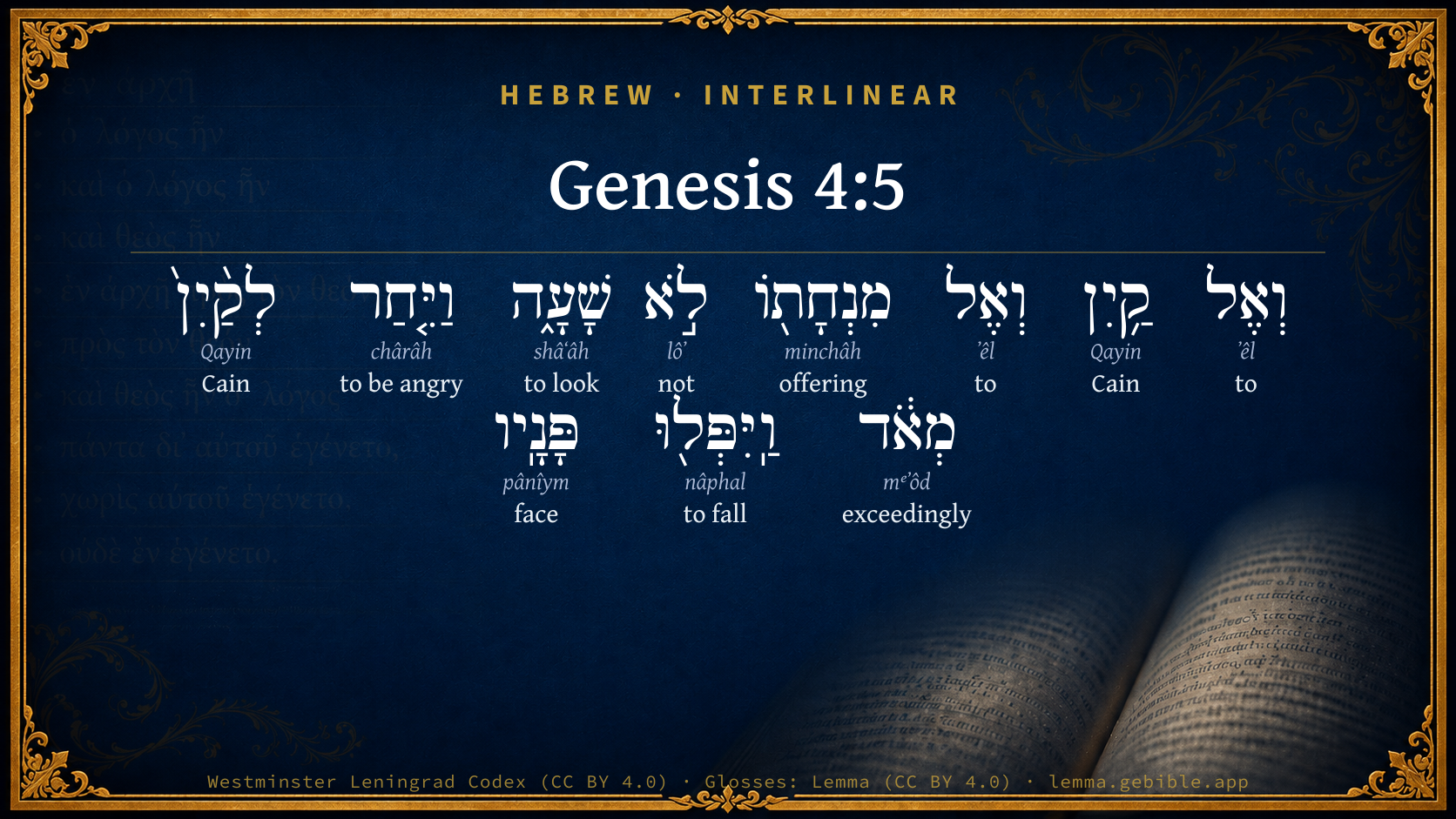
Hebrew (Westminster Leningrad Codex) Genesis 4:5 appears in the Hebrew Old Testament. The text above is from the Westminster Leningrad Codex. Each word links to its Strong’s number, a concise gloss, and parsing drawn from the Open Scriptures Hebrew Bible morphology. Click any word for its full Brown-Driver-Briggs (BDB) entry.
Download image
Cite this verse

Genesis 4:5 (World English Bible). Public Domain. Lemma interlinear Bible study tool, https://lemma.gebible.app/v/genesis/4/5.

Show BibTeX & RIS
BibTeX
RIS
English Translation
but he didn't respect Cain and his offering. Cain was very angry, and the expression on his face fell.
World English Bible · Public Domain
Highlights
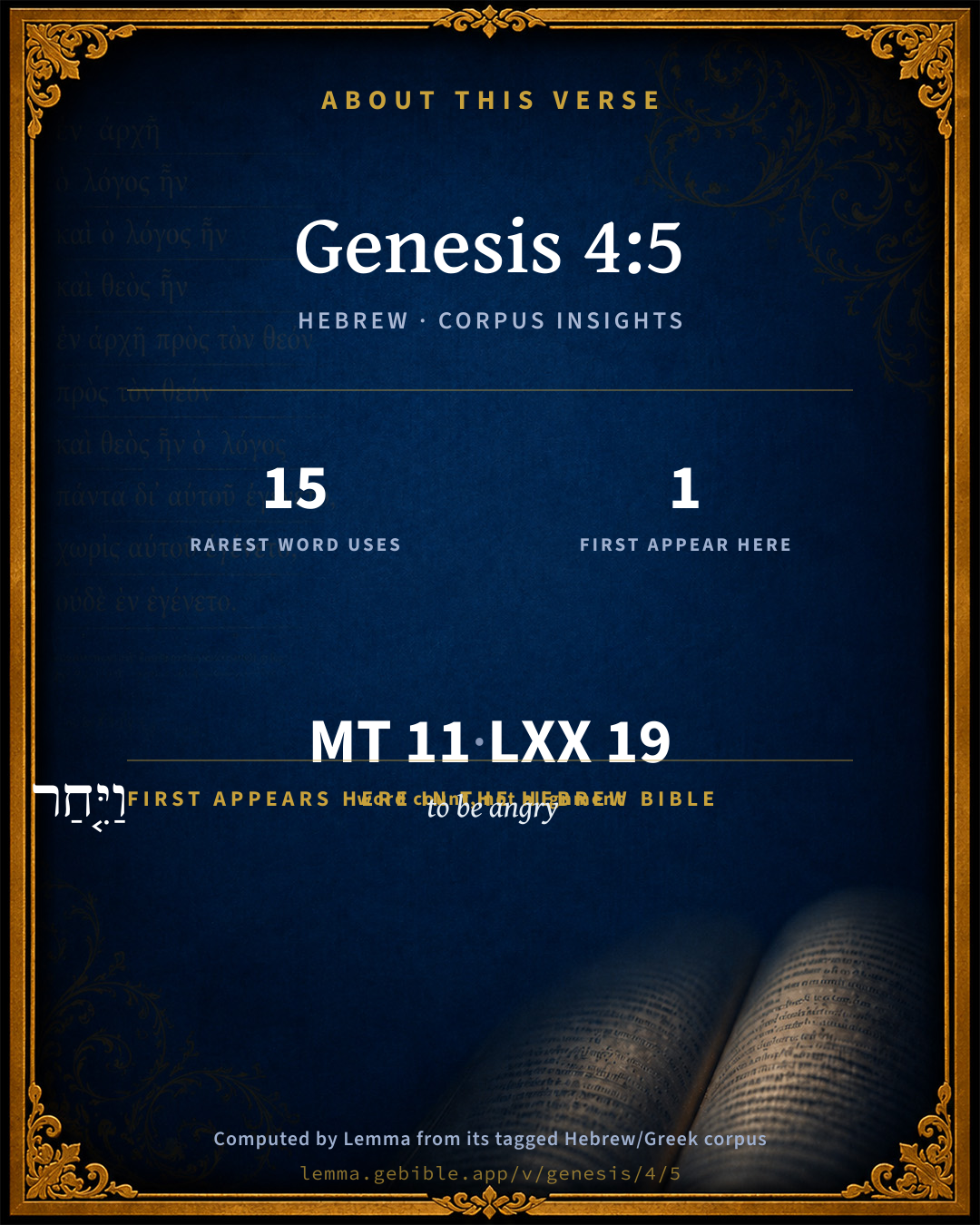
  • 1 first appearance in the Hebrew Bible
Full analysis ↓
Download a study sheet

One document with this verse’s original text, its word-by-word gloss line, the meaning frame, cross-references with their text, attributed commentary, and full source and license credits — printable, and it pastes into notes with its structure intact.

This verse Autodidact and up

Study sheet (.html) Plain text (.txt)

A passage Seminary Student

Up to 50 verses in one chapter. A passage sheet keeps up to 6 commentary sources and 12 cross-references per verse, in the order this page ranks them, and says so on the sheet whenever that leaves anything out. Ask for a single verse and you get the Autodidact verse sheet above.

Everything on this page stays free to read, with no account — the sheet is a download of what is already on screen, not access to it.

Want to remove ads? Support Godless Engineer
Compare translations 3

The same verse in 3 English versions, stacked beneath the original-language interlinear above. Click any original word for its lexicon entry.

Each is an independent rendering of the whole verse — the interlinear is not word-aligned to these translations.

Highlighted words mark where these versions differ — a whole-verse word diff, not a word-by-word alignment.

  • World English Bible Public Domain
    but he didn't respect Cain and his offering. Cain was very angry, and the expression on his face fell.
  • King James Version Public Domain
    But unto Cain and to his offering he had not respect. And Cain was very wroth, and his countenance fell.
  • unfoldingWord Literal Text CC BY-SA 4.0
    But he did not look on Cain and his offering. So Cain burned with intense anger, and his face fell.

unfoldingWord Literal Text — © unfoldingWord, licensed CC BY-SA 4.0. Word-aligned USFM3 via Door43 (git.door43.org/unfoldingWord/en_ult).

Versions to compare (up to 4)

3 of 4 selected

Show all 18 translations

Every available English version of this verse, each an independent rendering of the whole verse.

  • World English Bible Public Domain
    but he didn't respect Cain and his offering. Cain was very angry, and the expression on his face fell.
  • Berean Standard Bible Public Domain
    but He had no regard for Cain and his offering. So Cain became very angry, and his countenance fell.
  • Majority Standard Bible Public Domain
    but He had no regard for Cain and his offering. So Cain became very angry, and his countenance fell.
  • King James Version Public Domain
    But unto Cain and to his offering he had not respect. And Cain was very wroth, and his countenance fell.
  • American Standard Version (1901) Public Domain
    but unto Cain and to his offering he had not respect. And Cain was very wroth, and his countenance fell.
  • Revised Version (1885) Public Domain
    but unto Cain and to his offering he had not respect. And Cain was very wroth, and his countenance fell.
  • Geneva Bible (1599) Public Domain
    But vnto Kain and to his offering he had no regarde: wherefore Kain was exceeding wroth, and his countenance fell downe.
  • Douay-Rheims (1899) Public Domain
    But to Cain and his offerings he had no respect: and Cain was exceedingly angry, and his countenance fell.
  • Young's Literal Translation Public Domain
    and unto Cain and unto his present He hath not looked; and it is very displeasing to Cain, and his countenance is fallen.
  • Literal Standard Version CC BY-SA 4.0
    and to Cain and to his present He has not looked; and it is very displeasing to Cain, and his countenance is fallen.
  • Unlocked Literal Bible CC BY-SA 4.0
    but Cain and his offering he did not accept. So Cain was very angry, and he scowled.
  • unfoldingWord Literal Text CC BY-SA 4.0
    But he did not look on Cain and his offering. So Cain burned with intense anger, and his face fell.
  • Darby Bible Public Domain
    and upon Cain, and on his offering, he did not look. And Cain was very angry, and his countenance fell.
  • World Messianic Bible Public Domain
    but he didn’t respect Cain and his offering. Cain was very angry, and the expression on his face fell.
  • Webster's Bible Public Domain
    But to Cain and to his offering he had not respect. And Cain was very wroth, and his countenance fell.
  • Free Bible Version CC BY-SA 4.0
    but he wasn't pleased with Cain and his offering, which made Cain very angry and he frowned in annoyance.
  • Bible in Basic English Public Domain
    But in Cain and his offering he had no pleasure. And Cain was angry and his face became sad.
  • JPS Tanakh (1917) Public Domain
    but unto Cain and to his offering He had not respect. And Cain was very wroth, and his countenance fell.

Literal Standard Version (2020), Covenant Press — licensed CC BY-SA 4.0. Text via the HelloAO Bible API (eBible.org). Unlocked Literal Bible (unfoldingWord) — licensed CC BY-SA 4.0. Text via the HelloAO Bible API (eBible.org). unfoldingWord Literal Text — © unfoldingWord, licensed CC BY-SA 4.0. Word-aligned USFM3 via Door43 (git.door43.org/unfoldingWord/en_ult). Free Bible Version, Dr. Jonathan Gallagher — licensed CC BY-SA 4.0. Text via the HelloAO Bible API (eBible.org).

Word by word

More ways to search: Search by grammar → Find every occurrence → Compare this word →

Practice this passage: Drill this verse → Learn its vocabulary →

שָׁעָ֑ה
shâʻâh
H8159
“to look”
Verb, Qal, Perfect, 3rd Person, Masculine, Singular
Part of Speech
Verb
Stem
Qal
Form
Perfect
Person
3rd Person
Gender
Masculine
Number
Singular
Full BDB Definition

Origin: a primitive root

TWOT: 2429

to look at or to, regard, gaze at or about - (Qal) to gaze at, regard, behold, look about - (Hiphil) to look away, cause gaze to turn away - (Hithpael) to look in dismay, gaze about (in anxiety)
  1. וְאֶל ʼêl H413 “and · to” Conjunction + Preposition
  2. קַ֥יִן Qayin H7014 “Cain” Noun, Proper
  3. וְאֶל ʼêl H413 “and · to” Conjunction + Preposition
  4. מִנְחָת֖וֹ minchâh H4503 “offering · his” Noun, Common, Feminine, Singular, Construct + Suffix, Personal, 3rd Person, Masculine, Singular
  5. לֹ֣א lôʼ H3808 “not” Particle, Negative
  6. וַיִּ֤חַר chârâh H2734 “and · to be angry” Conjunction + Verb, Qal, Sequential Imperfect, 3rd Person, Masculine, Singular
  7. לְקַ֨יִן֙ Qayin H7014 “to/for · Cain” Preposition + Noun, Proper
  8. מְאֹ֔ד mᵉʼôd H3966 “exceedingly” Adverb
  9. וַֽיִּפְּל֖וּ nâphal H5307 “and · to fall” Conjunction + Verb, Qal, Sequential Imperfect, 3rd Person, Masculine, Plural
  10. פָּנָֽיו pânîym H6440 “face(s) · his” Noun, Common, Both, Plural, Construct + Suffix, Personal, 3rd Person, Masculine, Singular

About this verse

These counts appear in no published source. They are computed here, from the morphology-tagged text and Lemma’s own curated glosses. What Lemma adds →

11
words
9
distinct lemmas
Pentateuch
section

Notable vocabulary

The rarest word here is שָׁעָ֑ה to look H8159 — appearing just 15 times in the whole Hebrew Bible.

First appearance in Scripture

This word makes its first canonical appearance in the Hebrew Bible here:

  • וַיִּ֤חַר to be angry H2734

Shared distinctive vocabulary

שָׁעָ֑ה to look H8159 occurs in 15 verses of the Hebrew Bible. Also found in:

Grammatical profile

  • 3 verbs
  • 4 nouns
  • 2 prepositions
  • 1 adverb
  • 1 particle

Verb forms

  • שָׁעָ֑ה Qal · Perfect
  • וַיִּ֤חַר Qal · Sequential Imperfect
  • וַֽיִּפְּל֖וּ Qal · Sequential Imperfect

Repetition

Words recur within this verse — often emphatic in Hebrew:

  • קַ֥יִן Cain H7014 ×2
  • וְאֶל to H413 ×2

Hebrew & Septuagint length

In English translation the verse runs 19 words from the Hebrew and 17 from the Septuagint (LXX English) — closely comparable.

A rough comparison of the two English renderings, which tokenize alike — not a word-level alignment.

Word counts can differ between the Hebrew and the Greek without any difference in meaning — e.g. the Hebrew direct-object marker אֵת has no separate Greek word, and Greek often adds the article ὁ.

In the original languages it is 11 Hebrew tokens and 19 Greek tokens — but the two are counted differently (Hebrew bundles its prefixes and suffixes into one token; the Greek is in lemma form), so that isn’t a like-for-like length.

Cross-references

10

Topical passages linked to Genesis 4:5 in the Treasury of Scripture Knowledge — connected by theme and wording, ordered by reader-vote popularity; previews shown in the World English Bible.

  • Hebrews 11:4 By faith, Abel offered to God a more excellent sacrifice than Cain, through which he had testimony given to him that he was righteous, God bearing witness with respect to his gifts; and through it he, being dead, still speaks.
  • Job 5:2 For resentment kills the foolish man, And jealousy kills the simple.
  • Acts 13:45 But when the Jews saw the multitudes, they were filled with jealousy, and contradicted the things which were spoken by Paul, and blasphemed.
  • Isaiah 3:10–11 Tell the righteous "Good!" For they shall eat the fruit of their deeds.
  • Luke 15:28–30 But he was angry, and would not go in. Therefore his father came out, and begged him.
  • Genesis 31:2 Jacob saw the expression on Laban's face, and, behold, it was not toward him as before.
  • Genesis 31:5 and said to them, "I see the expression on your father's face, that it is not toward me as before; but the God of my father has been with me.
  • Numbers 16:15 Moses was very angry, and said to Yahweh, "Don't respect their offering: I have not taken one donkey from them, neither have I hurt one of them."
  • Psalms 20:3 Remember all your offerings, And accept your burnt sacrifice. Selah.
  • Matthew 20:15 Isn't it lawful for me to do what I want to with what I own? Or is your eye evil, because I am good?'

Cross-references courtesy of OpenBible.info (CC BY 4.0).

Hebrew and Greek witnesses Masoretic Hebrew ↔ Greek Septuagint

The same verse in the two great witnesses to the Old Testament, shown verse-for-verse.

These are two independent witnesses, not word-aligned to each other, and the Septuagint is shown in lemma (dictionary) form.

Hebrew Genesis 4:5 Masoretic · Westminster Leningrad Codex

וְאֶל קַ֥יִן וְאֶל מִנְחָת֖וֹ לֹ֣א שָׁעָ֑ה וַיִּ֤חַר לְקַ֨יִן֙ מְאֹ֔ד וַֽיִּפְּל֖וּ פָּנָֽיו

but he didn't respect Cain and his offering. Cain was very angry, and the expression on his face fell.

World English Bible · Public Domain

Greek LXX Genesis 4:5 Septuagint · lemma form

ἐπί δέ καιν καί ἐπί ὁ θυσία αὐτός οὐ προςἔχω καί λυπέω ὁ καιν λίαν καί συνπίπτω ὁ πρόσωπον

but Cain and his sacrifices he regarded not, and Cain was exceedingly sorrowful and his countenance fell.

LXX2012 (modern English Septuagint) · Public Domain

On this verse, The Cambridge Bible for Schools and Colleges discusses the Septuagint’s reading. Read the note in Commentary ↓

Hebrew: Westminster Leningrad Codex (CC BY 4.0). Greek: Septuagint (public domain); English from LXX2012 (modern English Septuagint) (Public Domain). How the Septuagint differs from the Hebrew →

Targum (Aramaic paraphrase)

2

The Targum is the ancient Jewish Aramaic paraphrase of the Hebrew Scriptures — an interpretive translation, not the Hebrew text itself. Onkelos (literal) and Pseudo-Jonathan (expansive) render the Torah, and Jonathan the Prophets. Coverage is partial: where no permissively-licensed English translation exists for a verse, only the Aramaic is shown. This is verse-level text, not a word-by-word alignment to the Hebrew.

  1. Targum Onkelos Torah (Genesis–Deuteronomy)
    וּבְּקַיִן וּבְּקוּרְבָּנֵהּ לָא הֲוַת רַעֲוָא וּתְקֵף לְקַיִן לַחֲדָא וְאִתְכְּבִישׁוּ אַפּוֹהִי

    (no public-domain English translation for this verse)

    Targum Onkelos — Aramaic: “Onkelos Genesis” (public domain); “Onkelos Exodus” (public domain); “Onkelos Leviticus” (public domain); “Onkelos Numbers” (public domain); “Onkelos Deuteronomy” (public domain). English: “Sefaria Community Translation” (CC0 1.0 (public-domain dedication)); “J.W. Etheridge. The Targums of Onkelos and Jonathan Ben Uzziel on the Pentateuch. London: Longmans, Green, 1862” (public domain). Text via Sefaria.

  2. Targum Pseudo-Jonathan Torah (Genesis–Deuteronomy)
    וּלְקַיִן וּלְקָרְבָּנֵיהּ לָא סְבַר אַפִּין וּתְקֵיף לְקַיִן לַחֲדָא וְאִתְכְּבִישׁוּ אִקוּנִין דְאַפּוֹהִי

    but to Kain and to his oblation He gave no countenance. And Kain was angered greatly, and the features of his face were downcast.

    Targum Pseudo-Jonathan — Aramaic: “Targum Jonathan on Genesis” (public domain); “Targum Jonathan on Exodus” (public domain); “Targum Jonathan on Leviticus” (public domain); “Targum Jonathan on Numbers” (public domain); “Targum Jonathan on Deuteronomy” (public domain). English: “The Targum of Jonathan ben Uzziel, trans. J. W. Etheridge, London, 1862” (public domain). Text via Sefaria.

Commentary

Notes on Genesis 4:5 from classic Christian and Jewish commentators (each source and its license shown beneath its notes). The classic Christian expositions comment on the surrounding passage and are grouped to its opening verse, so a note may address several verses; the Jewish commentaries on the Tanakh (Rashi and others) are per-verse, so they appear only where the commentator wrote on this verse.

Lemma curates 59 commentaries, every one of them public domain or Creative Commons licensed, each selected and text-cleaned for this edition rather than reprinted as found. About our sources →

Trapp's Complete Commentary

John Trapp

Gen 4:5 But unto Cain and to his offering he had not respect. And Cain was very wroth, and his countenance fell.

Ver. 5. But to Cain and his offering, &c.] Because he brought not the person but the work of a person { non personam, sed opus personae,} as Luther {a} hath it; who also calls those Cainists that offer to God the work done, but do not offer themselves to God. Works materially good may never prove so, formally and eventually. That which is fair to men, is abomination to God. {Luk 16:15} He rejected the swan for sacrifice, {Lev 11:18} because under a white feather it hath black skin. Sordet in conspectu Iudicis quod fulget in conspectu operantis, saith Gregory. A thing may shine in the night from its rottenness.

{a} Luth., in Decal

John Trapp, A Commentary or Exposition upon All the Books of the Old and New Testament (1647–1656) — public domain. Text from a community e-Sword module.

Joseph Benson's Commentary

Gen 4:5-7. Cain was very wroth — Full of rage against God and his brother. His countenance fell — His looks became sour, dejected, and angry. The Lord said unto Cain — to convince him of his sin, and bring him to repentance, Why art thou wroth? What cause has been given thee, either by me or thy brother? If thou doest well, shalt thou not be accepted? — Either, 1st, If thou hadst done well, as thy brother did, thou shouldest have been accepted as he was. God is no respecter of persons; so that, if we come short of acceptance with him, the fault is wholly our own. This will justify God in the destruction of sinners, and will aggravate their ruin. There is not a damned sinner in hell, but, if he had done well, as he might have done, had been a glorified saint in heaven. Every mouth will shortly be stopped with this. Or, 2d, If now thou do well — If thou repent of thy sin, reform thy heart and life, and bring thy sacrifice in a better manner; thou shalt yet be accepted. See how early the gospel was preached, and the benefit of it offered even to one of the chief of sinners! He sets before him also death and a curse; but, if not well — Seeing thou didst not do well: not offer in faith, and in a right manner; sin lieth at the door — That is, sin only hinders thy acceptance. All this considered, Cain had no reason to be angry with his brother, but at himself only. Unto thee shall be his desire — He shall continue to respect thee as an elder brother, and thou, as the firstborn, shalt rule over him as much as ever. God’s acceptance of Abel’s offering did not transfer the birthright to him, (which Cain was jealous of,) nor put upon him that dignity and power which are said to belong to it, Gen 49:3.

Joseph Benson's Commentary on the Old and New Testaments (1811–1818) — public domain. Text from a community e-Sword module.

Geneva Bible (1599)

Geneva Bible translators

Because he was an hypocrite, and offered only for an outward show without sincerity of heart.

Geneva Bible (1599) marginal notes — public domain. Text via Bolls.life.

Adam Clarke's Commentary

Verse 5. Unto Cain] As being unconscious of his sinfulness, and consequently unhumbled, and to his offering, as not being accompanied, as Abel's was, with faith and a sacrifice for sin, he had not respect - He could not, consistently with his holiness and justice, approve of the one or receive the other. Of the manner in which God testified his approbation we are not informed; it was probably, as in the case of Elijah, by sending down fire from heaven, and consuming the sacrifice.

Cain was very wroth] That displeasure which should have been turned against his own unhumbled heart was turned against his innocent brother, who, though not more highly privileged than he, made a much better use of the advantages which he shared in common with his ungodly and unnatural brother.

Adam Clarke's Commentary on the Bible (1810–1826) — public domain. Text from a community e-Sword/MySword module.

John Calvin's Commentaries

5. But unto Cain and to his offering he had not respect. It is not to be doubted, that Cain conducted himself as hypocrites are accustomed to do; namely, that he wished to appease God, as one discharging a debt, by external sacrifices, without the least intention of dedicating himself to God. But this is true worship, to offer ourselves as spiritual sacrifices to God. When God sees such hypocrisy, combined with gross and manifest mockery of himself; it is not surprising that he hates it, and is unable to bear it; whence also it follows, that he rejects with contempt the works of those who withdraw themselves from him. For it is his will, first to have us devoted to himself; he then seeks our works in testimony of our obedience to him, but only in the second place. It is to be remarked, that all the figments by which men mock both God and themselves are the fruits of unbelief: To this is added pride, because unbelievers, despising the Mediator’s grace, throw themselves fearlessly into the presence of God. The Jews foolishly imagine that the oblations of Cain were unacceptable, because he defrauded God of the full ears of corn, and meanly offered him only barren or half-filled ears. Deeper and more hidden was the evil; namely that impurity of heart of which I have been speaking; just as, on the other hand, the strong scent of burning fat could not conciliate the divine favor to the sacrifices of Abel; but, being pervaded by the good odour of faith, they had a sweet-smelling savor.

And Cain was very wroth. In this place it is asked, whence Cain understood that his brother’s oblations were preferred to his? The Hebrews, according to their manner, report to divinations and imagine that the sacrifice of Abel was consumed by celestial fire; but, since we ought not to allow ourselves so great a license as to invent miracles, for which we have no testimony of Scripture, let Jewish fables be dismissed. It is, indeed, more probable, that Cain formed the judgement which Moses records, from the events which followed. He saw that it was better with his brother than with himself; thence he inferred, that God was pleased with his brother, and displeased with himself. We know also, that to hypocrites nothing seems of greater value, nothing is more to their heart’s content, then earthly blessing. Moreover, in the person of Cain is portrayed to us the likeness of a wicked man, who yet desires to be esteemed just, and even arrogates to himself the first place among saints. Such persons truly, by external works, strenuously labor to deserve well at the hands of God; but, retaining a heart inwrapped in deceit, they present to him nothing but a mask; so that, in their labourious and anxious religious worship, there is nothing sincere, nothing but mere pretense. When they afterwards see that they gain no advantage, they betray the venom of their minds; for they not only complain against God, but break forth in manifest fury, so that, if they were able, they would gladly tear him don from his heavenly throne. Such is the innate pride of all hypocrites, that, by the very appearance of obedience, they would hold God as under obligation to them; because they cannot escape from his authority, they try to sooth him with blandishments, as they would a child; in the meantime, while they count much of their fictitious trifles, they think that God does them great wrong if he does not applaud them; but when he pronounces their offerings frivolous and of no value in his sight, they first begin to murmur, and then to rage. Their impiety alone hinders God from being reconciled unto them; but they wish to bargain with God on their own terms. When this is denied, they burn with furious indignation, which, though conceived against God, they cast forth upon his children. Thus, when Cain was angry with God, his fury was poured forth on his unoffending brother. When Moses says, “his countenance fell,” (the word countenance is in Hebrew put in the plural number for the singular,) he means, that not only was he seized with a sudden vehement anger, but that, from a lingering sadness, he cherished a feeling so malignant that he was wasting with envy.

John Calvin's Commentaries (1540-1563) — public domain. Text from the Calvin Translation Society English edition (1840s-50s) via the Christian Classics Ethereal Library (ccel.org). Calvin's coverage is partial (roughly two-thirds of the Bible); uncommented books and verses are honest gaps, never fabricated. The 19th-century editor's footnotes and remarks are omitted so the notes are faithfully Calvin's own voice.

Ellicott's Commentary for English Readers

(5) Cain was very wroth.—Heb., it burned to Cain exceedingly: that is, his heart was full of hot indignant feelings, because of the preference shown to his younger brother.

A Bible Commentary for English Readers, edited by Charles John Ellicott (1878–1897) — public domain. Text from a community e-Sword module.

The Cambridge Bible for Schools and Colleges

gen. ed. J. J. S. Perowne

5. but unto Cain] In what way the Divine displeasure was conveyed is not recorded. The suggestion that fire from heaven consumed the offering of Abel, but left that of Cain untouched, is a pure conjecture based upon the group of passages in the O.T., in which the fire from God attested the approval of the sacrifice, Lev_9:24; Jdg_6:21; Jdg_13:19-20; 1Ki_18:38; 1Ch_21:26; 2Ch_7:1; 1Ma_2:10-11.

It is a serious omission, also, that we are left to conjecture the reason for the favour shewn to Abel and withheld from Cain. We can hardly doubt, that in the original form of the story the reason was stated; and, if so, that the reason represented in the folk-lore of Israel would not have been in harmony with the religious teaching of the book.

Taking, therefore, the omission of the reason in conjunction with the language of Gen_4:6-7, and with the general religious purport of the context, we should probably be right in interring that the passage, as it stands, intends to ascribe the difference in the acceptability of the two offerings to the difference in the spirit with which they had been made. Jehovah looked at the heart (cf. 1Sa_16:7). Thus the first mention of worship in Holy Scripture seems to emphasize the fundamental truth that the worth of worship lies in the spirit of the worshipper, cf. Joh_4:24, “God is spirit; and they that worship him must worship in spirit and truth.” This is the thought of Heb_11:4, “By faith Abel offered unto God a more excellent sacrifice than Cain.… God bearing witness in respect of his gifts.”

The following conjectures have at different times been put forward to explain the preference of Jehovah:

(a) It has been suggested that Abel’s offering was preferred, because it consisted of flesh, and that Cain’s was rejected, because it consisted of vegetable produce. Each man offered of the fruits of his work and calling. Did the original story contain a condemnation of the agricultural as compared with the pastoral calling? But Adam was commanded to till the ground (Gen_2:15, Gen_3:19).

(b) The old Jewish explanation was that Cain had failed to perform the proper ritual of his offering, and therefore incurred the Divine displeasure: see note on the LXX of Gen_4:7. But, again, if so, it has to be assumed that Divine directions upon the ritual of service had previously been communicated to man.

(c) The common Christian explanation that Cain’s sacrifice, being “without shedding of blood” (Heb_9:22. cf. Lev_17:11), could not find acceptance, equally assumes that the right kind of sacrifice had previously been Divinely instituted, and that Cain’s rejection was, therefore, due to the wilful violation of a positive command as well as to the infringement of sacrificial rule.

In the silence of the narrative respecting the origin of the institution of sacrifice, these conjectures are merely guess-work, and must be considered more or less fanciful.

his countenance fell] A picture true to nature and more familiar than easy to express in any other words.

The passage illustrates the progress of sin in Cain’s heart. Firstly, disappointment and wounded pride, aggravated by envy of his brother, lead to anger; secondly, anger unrestrained, and brooding sullenly over an imaginary wrong, rouses the spirit of revenge; thirdly, revenge seeks an outlet in passion, and vents itself in violence and murder.

The Cambridge Bible for Schools and Colleges (gen. ed. J. J. S. Perowne; Cambridge University Press, 1878–1918) — public domain. Text from a community e-Sword module.

John Gill's Exposition

But unto Cain and to his offering he had not respect,.... Not because of the matter of it, as some have thought; but because it was not offered in faith and sincerity, but in a formal and hypocritical manner, without any regard to the Messiah and his sacrifice, and without any view to the glory of God: no notice was taken, no approbation was given of it by the above token, or any other; so that it was manifest to Cain himself, that God did not approve of it, or was well pleased with it, as with his brother's:

and Cain was very wroth; with God, to whom he offered it, because he did not accept of it, and with his brother, because he and his sacrifice were preferred to him and his:

and his countenance fell; the briskness and cheerfulness of his countenance went off, and he looked dejected; and instead of lifting up his face towards heaven; he looked with a down look to the earth; he looked churlish, morose, and sullen, ill natured, full of malice and revenge, and as if he was studying which way to vent it; he knit his brows and gnashed his teeth, put on a surly countenance; and there might be seen in his face all the signs, not only of grief and disappointment, but of rage and fury; though (i) some interpret it of shame and confusion.

(i) R. Jonah apud R. Sol. Urbin. Ohel Moed, fol. 9. p. 2.

John Gill's Exposition of the Whole Bible (1746–1763) — public domain (CC PDM 1.0). Text via the HelloAO Bible API.

Matthew Poole's English Annotations

Cain was very wroth; partly with God, who, had cast so public a disgrace upon him, and given the preference to his younger brother; and partly with Abel, because he had received more honour from God, and therefore was likely to have more respect and privilege from his parents than himself.

His countenance fell; whereas before it was lifted up and cheerful, now it fell down through sense of guilt, disappointment of his hope, shame and grief, and envy at his brother.

Matthew Poole's English Annotations on the Holy Bible (1683–1685) — public domain. Text from a community e-Sword/MySword module.

Whedon's Commentary on the Bible

Daniel D. Whedon

5. But unto Cain… not respect — Why? From Heb_11:4, we infer that it was because of some lack of faith, for “by faith Abel offered unto God a more excellent sacrifice than Cain.” Cain’s, then, was not the blossomings or the fruit of faith in Jehovah. It sprung from no profound conception of the grounds or need of sacrifice. And, perhaps, as suggested above, Cain’s lack of faith was evinced by his neglect to bring a bleeding victim. If animal sacrifices were of divine institution, (see note on 3:21,) Cain must have known the fact and the mode; but so far from regarding it, he seems not to have been even careful to bring the firstfruits of the ground. Hence his offering was not a doing well. Gen_4:7.

Cain was very wroth — Manifestly yielding to passions of jealousy and anger.

His countenance fell — Like a sullen, spoiled child, pouting with bad passion, and waiting for an opportunity of revenge.

Daniel D. Whedon (gen. ed.), Commentary on the Old and New Testaments (1874–1909) — public domain. Text from a community e-Sword module.

The Pulpit Commentary

But unto Cain and to his offering he had not respect. Because of the absence of those qualities which distinguished Abel and his offering; not because the heart of Cain was "no more pure," but "imbued with a criminal propensity" (Kalisch), which it was not until his offering was rejected. The visible sign, whatever it was, being awanting in the case of Cain"s oblation, its absence left the offerer in no dubiety as to the Divine displeasure with both himself and his offering. In the rejection of Cain"s offering Bohlen sees the animus of a Levitical narrator, who looks down slightingly on offerings of the fruits and flowers of earth; but, as Havernick well remarks, the theocracy was essentially based on agriculture, while the Mosaic institute distinctly recognized the legality and value of bloodless offerings. And Cain was very wroth (literally, it burned with Cain exceedingly), and his countenance fell. In fierce resentment against his brother, possibly in disappointed rage against himself, almost certainly in anger against God (cf. Neh_6:16; Job_29:24; Jer_3:12, and contrast. (Job_11:15) There was apparently no sorrow for sin, "no spirit of inquiry, self-examination, prayer to God for light or pardon, clearly showing that Cain was far from a right state of mind" (Murphy). Yet the Lord does not forthwith abandon the contumacious and insensate transgressor, but patiently expostulates with and instructs him as to how he too might obtain the same blessing of acceptance which his younger brother enjoyed.

The Pulpit Commentary (1880–1919), ed. H.D.M. Spence-Jones & Joseph S. Exell — public domain. Text from a community e-Sword module.

John Wesley's Explanatory Notes

And Cain was wroth, and his countenance fell - Not so much out of grief as malice and rage. His sullen churlish countenance, and down-look, betrayed his passionate resentment.

John Wesley, Explanatory Notes Upon the Whole Bible (1754–1765) — public domain. Text via the GEBible commentary corpus.

Radak

Rabbi David Kimhi (Radak)

ואל קין ואל מנחתו לא שעה, but to Kayin and to his offering G’d did not turn benevolently. His intention had not been good and pure; G’d does not need to accept gifts proffered reluctantly, as He is not in need of them. How did Kayin find out that G’d had not looked with favour on his offering? He found out that Hevel’s offering had been accepted, fire descending on it from heaven and consuming it. Nothing of that kind happened to Kayin’s offering. This caused Kayin dismay and anger and his face became downcast. The expression נפלו פניו, describes that someone feels insulted, depressed..

Radak on the Tanakh — English translations: “Sefaria Community Translation” (CC0 1.0 (public-domain dedication)); “Eliyahu Munk, HaChut Hameshulash” (CC BY 4.0); “Rabbi Mike Feuer, Jerusalem Anthology” (CC BY 4.0); and “R. David Kimhi on the first book of Psalms, Translated by R.G. Finch, London, 1919” (public domain). Text via Sefaria.

Lesson kit

Teaching starters — assembled from the data on this page, not authored interpretation. Every prompt links to the verse data it draws on. Edit before teaching.

Genesis, in the Pentateuch, opens this verse with 11 words (9 distinct Hebrew lemmas). Its most distinctive word is shâʻâh (“to look”). A historical commentator’s framing appears above. Read the whole chapter for the surrounding context.

Discussion questions

  1. The word shâʻâh carries the sense “to look.” How does it shape the verse?
  2. This is the first place “to be angry” appears in Scripture (first appears here). What does its debut here establish?
  3. How does Genesis 4:4, which shares the word «to look», read alongside this verse?
  4. What does the repetition of “Cain” (2× in this one verse) do in this verse?
  5. The translations on this page render this verse differently — a whole-verse word diff, not a word-by-word alignment. What might account for the different wordings?
  6. «שָׁעָ֑ה» is a Qal Perfect verb. How does that grammatical form shape the action described?
  7. Compare how Trapp's Complete Commentary and Joseph Benson's Commentary read this verse. Where do they agree or differ?

Things to notice

Reading settings

Reading text

Shown beneath each verse's original-language words.

Old Testament
Old Testament edition

Read the OT as the Masoretic Hebrew (MT) or the Greek Septuagint (LXX).

English shown for the Greek Septuagint (in the Hebrew ↔ Greek comparison).

Comparing translations? Open the Compare panel on any verse page to stack up to four side by side.