
Isaiah 24:20

Hebrew (Westminster Leningrad Codex) Isaiah 24:20 appears in the Hebrew Old Testament. The text above is from the Westminster Leningrad Codex. Each word links to its Strong’s number, a concise gloss, and parsing drawn from the Open Scriptures Hebrew Bible morphology. Click any word for its full Brown-Driver-Briggs (BDB) entry.
Download image
Cite this verse

Isaiah 24:20 (World English Bible). Public Domain. Lemma interlinear Bible study tool, https://lemma.gebible.app/v/isaiah/24/20.

Show BibTeX & RIS
BibTeX
RIS
English Translation
The earth shall stagger like a drunken man, and shall sway back and forth like a hammock; and the disobedience of it shall be heavy on it, and it shall fall, and not rise again.
World English Bible · Public Domain
Download a study sheet

One document with this verse’s original text, its word-by-word gloss line, the meaning frame, cross-references with their text, attributed commentary, and full source and license credits — printable, and it pastes into notes with its structure intact.

This verse Autodidact and up

Study sheet (.html) Plain text (.txt)

A passage Seminary Student

Up to 50 verses in one chapter. A passage sheet keeps up to 6 commentary sources and 12 cross-references per verse, in the order this page ranks them, and says so on the sheet whenever that leaves anything out. Ask for a single verse and you get the Autodidact verse sheet above.

Everything on this page stays free to read, with no account — the sheet is a download of what is already on screen, not access to it.

Want to remove ads? Support Godless Engineer
Compare translations 3

The same verse in 3 English versions, stacked beneath the original-language interlinear above. Click any original word for its lexicon entry.

Each is an independent rendering of the whole verse — the interlinear is not word-aligned to these translations.

Highlighted words mark where these versions differ — a whole-verse word diff, not a word-by-word alignment.

  • World English Bible Public Domain
    The earth shall stagger like a drunken man, and shall sway back and forth like a hammock; and the disobedience of it shall be heavy on it, and it shall fall, and not rise again.
  • King James Version Public Domain
    The earth shall reel to and fro like a drunkard, and shall be removed like a cottage; and the transgression thereof shall be heavy upon it; and it shall fall, and not rise again.
  • unfoldingWord Literal Text CC BY-SA 4.0
    Reeling, the earth reels like a drunkard, and it sways like a hut. And its transgression is heavy upon it, and it will fall and not add to arise.

unfoldingWord Literal Text — © unfoldingWord, licensed CC BY-SA 4.0. Word-aligned USFM3 via Door43 (git.door43.org/unfoldingWord/en_ult).

Versions to compare (up to 4)

3 of 4 selected

Show all 18 translations

Every available English version of this verse, each an independent rendering of the whole verse.

  • World English Bible Public Domain
    The earth shall stagger like a drunken man, and shall sway back and forth like a hammock; and the disobedience of it shall be heavy on it, and it shall fall, and not rise again.
  • Berean Standard Bible Public Domain
    The earth staggers like a drunkard and sways like a shack. Earth’s rebellion weighs it down, and it falls, never to rise again.
  • Majority Standard Bible Public Domain
    The earth staggers like a drunkard and sways like a shack. Earth’s rebellion weighs it down, and it falls, never to rise again.
  • King James Version Public Domain
    The earth shall reel to and fro like a drunkard, and shall be removed like a cottage; and the transgression thereof shall be heavy upon it; and it shall fall, and not rise again.
  • American Standard Version (1901) Public Domain
    The earth shall stagger like a drunken man, and shall sway to and fro like a hammock; and the transgression thereof shall be heavy upon it, and it shall fall, and not rise again.
  • Revised Version (1885) Public Domain
    The earth shall stagger like a drunken man, and shall be moved to and fro like a hut; and the transgression thereof shall be heavy upon it, and it shall fall, and not rise again.
  • Geneva Bible (1599) Public Domain
    The earth shall reele to and from like a drunken man, and shall be remooued like a tent, and the iniquitie thereof shall be heauie vpon it: so that it shall fall, and rise no more.
  • Douay-Rheims (1899) Public Domain
    With shaking shall the earth be shaken as a drunken man, and shall be removed as the tent of one night: and the iniquity thereof shall be heavy upon it, and it shall fell, and not rise again.
  • Young's Literal Translation Public Domain
    Stagger greatly doth the land as a drunkard, And it hath been moved as a lodge, And heavy on it hath been its transgression, And it hath fallen, and addeth not to rise.
  • Literal Standard Version CC BY-SA 4.0
    The earth staggers greatly as a drunkard, || And it has been moved as a lodge, || And its transgression has been heavy on it, || And it has fallen, and does not add to rise.
  • Unlocked Literal Bible CC BY-SA 4.0
    The earth will stagger like a drunken man and it will sway back and forth like a hut. Its sin will be heavy on it and it will fall and never rise again.
  • unfoldingWord Literal Text CC BY-SA 4.0
    Reeling, the earth reels like a drunkard, and it sways like a hut. And its transgression is heavy upon it, and it will fall and not add to arise.
  • Darby Bible Public Domain
    The earth reeleth to and fro like a drunkard, and is shaken like a night hut; and its transgression is heavy upon it; and it falleth and shall not rise again.
  • World Messianic Bible Public Domain
    The earth will stagger like a drunken man, and will sway back and forth like a hammock. Its disobedience will be heavy on it, and it will fall and not rise again.
  • Webster's Bible Public Domain
    The earth shall reel to and fro like a drunkard, and shall be removed like a cottage; and the transgression of it shall be heavy upon it; and it shall fall, and not rise again.
  • Free Bible Version CC BY-SA 4.0
    The earth staggers to and fro like a drunk, and sways this way and that like a shelter. The guilt of its rebelliousness weighs heavily on it, and it collapses—it won't rise again.
  • Bible in Basic English Public Domain
    The earth will be moving uncertainly, like a man overcome by drink; it will be shaking like a tent; and the weight of its sin will be on it, crushing it down so that it will not get up again.
  • JPS Tanakh (1917) Public Domain
    The earth reeleth to and fro like a drunken man, and swayeth to and fro as a lodge; and the transgression thereof is heavy upon it, and it shall fall, and not rise again.

Literal Standard Version (2020), Covenant Press — licensed CC BY-SA 4.0. Text via the HelloAO Bible API (eBible.org). Unlocked Literal Bible (unfoldingWord) — licensed CC BY-SA 4.0. Text via the HelloAO Bible API (eBible.org). unfoldingWord Literal Text — © unfoldingWord, licensed CC BY-SA 4.0. Word-aligned USFM3 via Door43 (git.door43.org/unfoldingWord/en_ult). Free Bible Version, Dr. Jonathan Gallagher — licensed CC BY-SA 4.0. Text via the HelloAO Bible API (eBible.org).

Word by word

More ways to search: Search by grammar → Find every occurrence → Compare this word →

Practice this passage: Drill this verse → Learn its vocabulary →

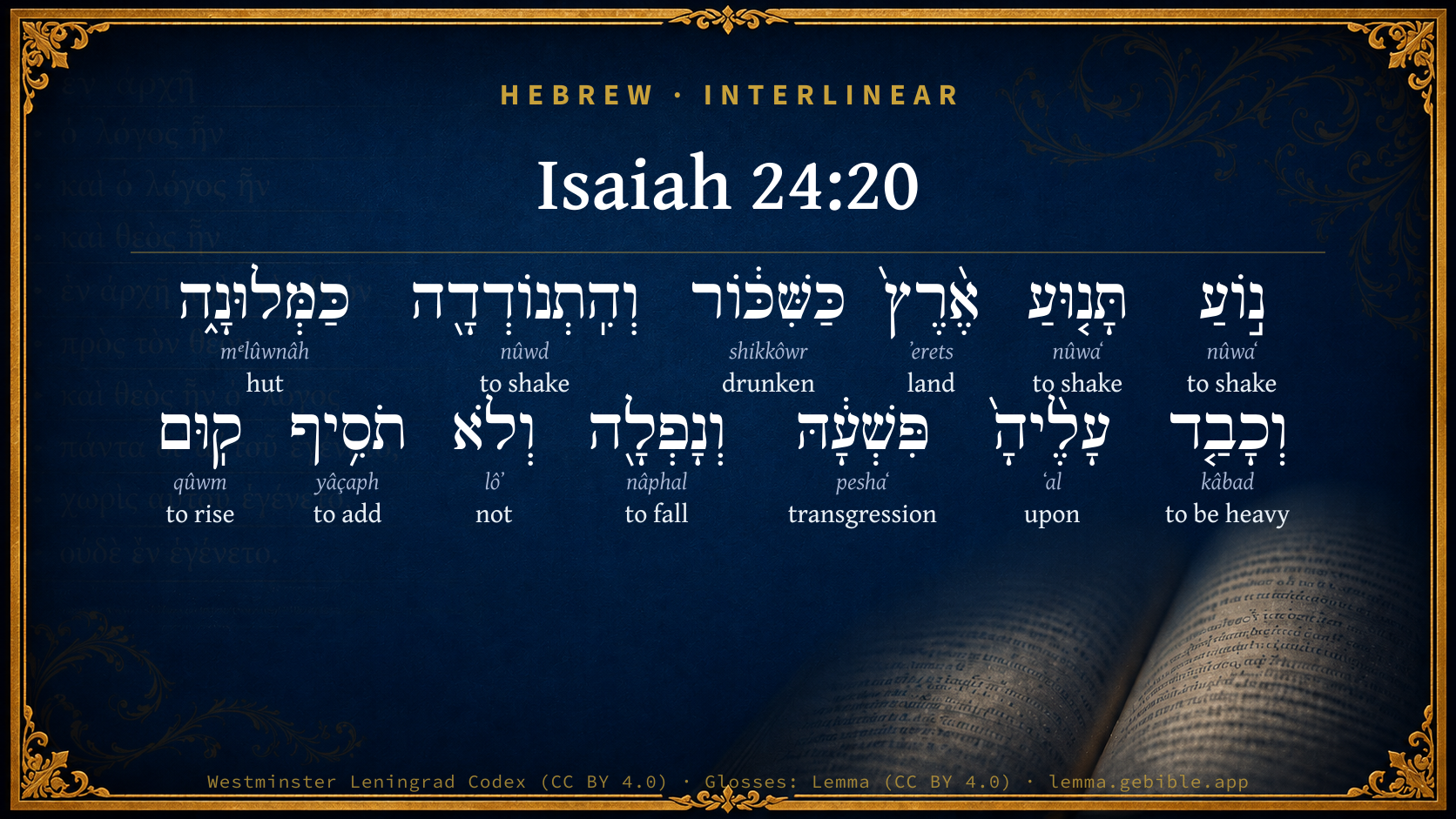
כַּמְּלוּנָ֑ה
mᵉlûwnâh
H4412
“like/as the · hut”
Preposition, Determined + Noun, Common, Feminine, Singular, Absolute
Part of Speech
Preposition + Noun
Type
Common
Gender
Feminine
Number
Singular
State
Absolute
Full BDB Definition

Origin: from H3885

TWOT: 1096b

lodge, hut
  1. נ֣וֹעַ nûwaʻ H5128 “to shake” Verb, Qal, Infinitive Absolute
  2. תָּנ֤וּעַ nûwaʻ H5128 “to shake” Verb, Qal, Imperfect, 3rd Person, Feminine, Singular
  3. אֶ֨רֶץ֙ ʼerets H776 “land” Noun, Common, Both, Singular, Absolute
  4. כַּשִּׁכּ֔וֹר shikkôwr H7910 “like/as the · drunken” Preposition, Determined + Adjective, Adjective, Masculine, Singular, Absolute
  5. וְהִֽתְנוֹדְדָ֖ה nûwd H5110 “and · to shake” Conjunction + Verb, Hithpolel, Sequential Perfect, 3rd Person, Feminine, Singular
  6. וְכָבַ֤ד kâbad H3513 “and · to be heavy” Conjunction + Verb, Qal, Sequential Perfect, 3rd Person, Masculine, Singular
  7. עָלֶ֨יהָ֙ ʻal H5921 “upon · her” Preposition + Suffix, Personal, 3rd Person, Feminine, Singular
  8. פִּשְׁעָ֔הּ peshaʻ H6588 “transgression · her” Noun, Common, Masculine, Singular, Construct + Suffix, Personal, 3rd Person, Feminine, Singular
  9. וְנָפְלָ֖ה nâphal H5307 “and · to fall” Conjunction + Verb, Qal, Sequential Perfect, 3rd Person, Feminine, Singular
  10. וְלֹא lôʼ H3808 “and · not” Conjunction + Particle, Negative
  11. תֹסִ֥יף yâçaph H3254 “to add” Verb, Hiphil, Imperfect, 3rd Person, Feminine, Singular
  12. קֽוּם qûwm H6965 “to rise” Verb, Qal, Infinitive Construct

About this verse

These counts appear in no published source. They are computed here, from the morphology-tagged text and Lemma’s own curated glosses. What Lemma adds →

13
words
12
distinct lemmas
Prophets
section

Notable vocabulary

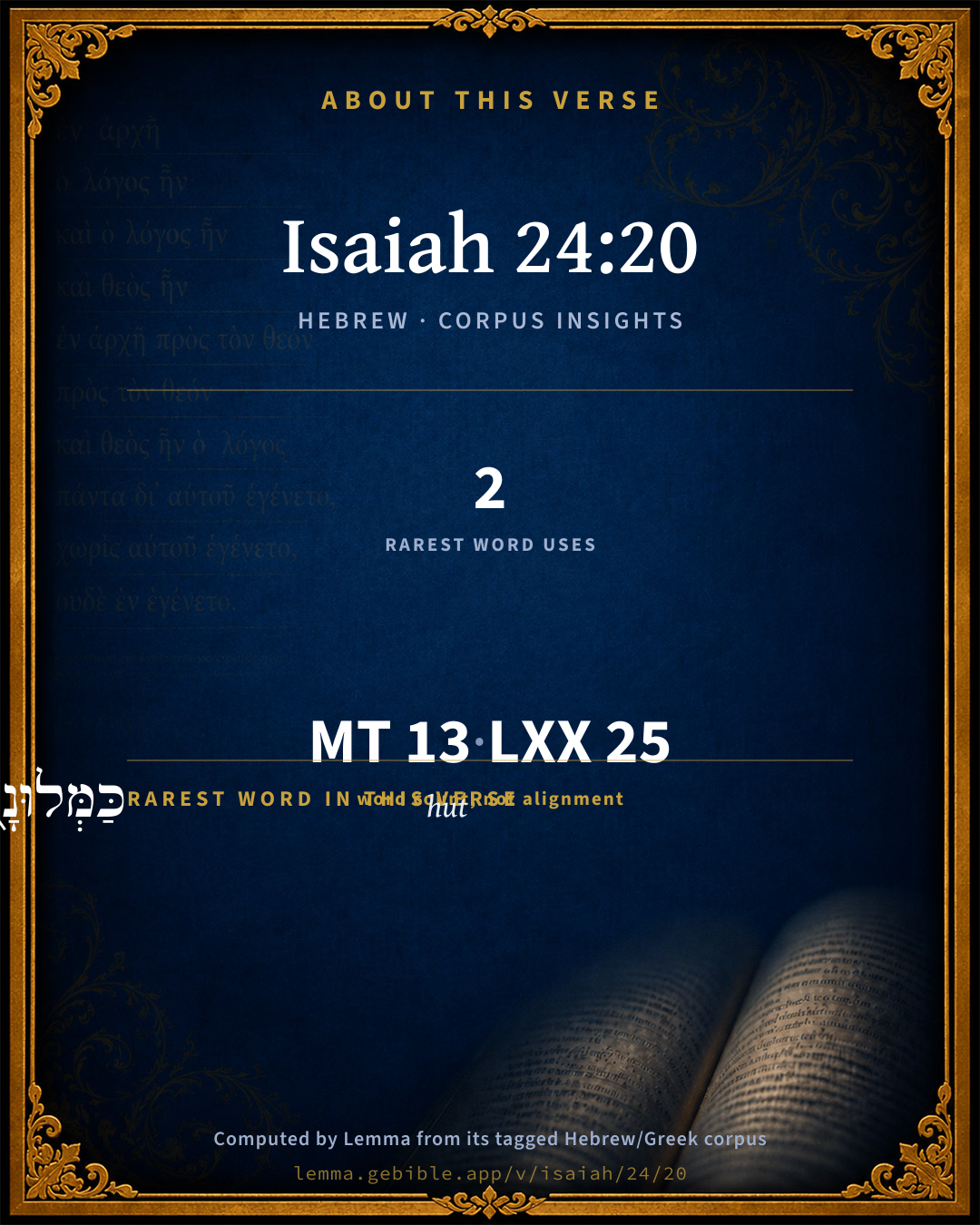
The rarest word here is כַּמְּלוּנָ֑ה hut H4412 — appearing just 2 times in the whole Hebrew Bible.

Shared distinctive vocabulary

כַּמְּלוּנָ֑ה hut H4412 occurs in 2 verses of the Hebrew Bible. Also found in:

Grammatical profile

  • 7 verbs
  • 3 nouns
  • 1 adjective
  • 1 preposition
  • 1 particle

Verb forms

  • נ֣וֹעַ Qal · Infinitive Absolute
  • תָּנ֤וּעַ Qal · Imperfect
  • וְהִֽתְנוֹדְדָ֖ה Hithpolel · Sequential Perfect
  • וְכָבַ֤ד Qal · Sequential Perfect
  • וְנָפְלָ֖ה Qal · Sequential Perfect
  • תֹסִ֥יף Hiphil · Imperfect
  • קֽוּם Qal · Infinitive Construct

Repetition

A word recurs within this verse — often emphatic in Hebrew:

  • נ֣וֹעַ to shake H5128 ×2

Hebrew & Septuagint length

In English translation the verse runs 35 words from the Hebrew and 38 from the Septuagint (LXX English) — closely comparable.

A rough comparison of the two English renderings, which tokenize alike — not a word-level alignment.

Word counts can differ between the Hebrew and the Greek without any difference in meaning — e.g. the Hebrew direct-object marker אֵת has no separate Greek word, and Greek often adds the article ὁ.

In the original languages it is 13 Hebrew tokens and 25 Greek tokens — but the two are counted differently (Hebrew bundles its prefixes and suffixes into one token; the Greek is in lemma form), so that isn’t a like-for-like length.

Cross-references

18

Topical passages linked to Isaiah 24:20 in the Treasury of Scripture Knowledge — connected by theme and wording, ordered by reader-vote popularity; previews shown in the World English Bible.

  • Isaiah 19:14 Yahweh has mixed a spirit of perverseness in the midst of her; and they have caused Egypt to go astray in every work of it, as a drunken man staggers in his vomit.
  • Isaiah 29:9 Stay you and wonder; take your pleasure and be blind: they are drunken, but not with wine; they stagger, but not with strong drink.
  • Daniel 11:19 Then he shall turn his face toward the fortresses of his own land; but he shall stumble and fall, and shall not be found.
  • Hosea 4:1–5 Hear the word of Yahweh, you children of Israel; For Yahweh has a charge against the inhabitants of the land: "Indeed there is no truth, Nor goodness, Nor knowledge of God in the land.
  • Amos 8:14 Those who swear by the sin of Samaria, And say, 'As your god, Dan, lives;' And, 'As the way of Beersheba lives;' They will fall, and never rise up again."
  • Revelation 18:21 A mighty angel took up a stone like a great millstone and cast it into the sea, saying, "Thus with violence will Babylon, the great city, be thrown down, and will be found no more at all.
  • Lamentations 1:14 The yoke of my transgressions is bound by his hand; They are knit together, they are come up on my neck; he has made my strength to fail: The Lord has delivered me into their hands, against whom I am not able to stand.
  • Zechariah 5:5–8 Then the angel who talked with me came forward, and said to me, "Lift up now your eyes, and see what is this that is appearing."
  • Psalms 38:4 For my iniquities have gone over my head. As a heavy burden, they are too heavy for me.
  • Psalms 107:27 They reel back and forth, and stagger like a drunken man, And are at their wits' end.
  • Isaiah 1:8 The daughter of Zion is left like a shelter in a vineyard, Like a hut in a field of melons, Like a besieged city.
  • Isaiah 1:28 But the destruction of transgressors and sinners shall be together, And those who forsake Yahweh shall be consumed.
  • Isaiah 5:7–30 For the vineyard of Yahweh of Hosts is the house of Israel, And the men of Judah his pleasant plant: And he looked for justice, but, behold, oppression; For righteousness, but, behold, a cry of distress.
  • Isaiah 38:12 My dwelling is removed, and is carried away from me as a shepherd's tent: I have rolled up, like a weaver, my life; he will cut me off from the loom: From day even to night will you make an end of me.
  • Isaiah 43:27 Your first father sinned, and your teachers have transgressed against me.
  • Jeremiah 8:4 Moreover you shall tell them, Thus says Yahweh: Shall men fall, and not rise up again? Shall one turn away, and not return?
  • Jeremiah 25:27 You shall tell them, Thus says Yahweh of Hosts, the God of Israel: Drink you, and be drunken, and spew, and fall, and rise no more, because of the sword which I will send among you.
  • Matthew 23:35–36 that on you may come all the righteous blood shed on the earth, from the blood of righteous Abel to the blood of Zachariah son of Barachiah, whom you killed between the sanctuary and the altar.

Cross-references courtesy of OpenBible.info (CC BY 4.0).

Hebrew and Greek witnesses Masoretic Hebrew ↔ Greek Septuagint

The same verse in the two great witnesses to the Old Testament, shown verse-for-verse.

These are two independent witnesses, not word-aligned to each other, and the Septuagint is shown in lemma (dictionary) form.

Hebrew Isaiah 24:20 Masoretic · Westminster Leningrad Codex

נ֣וֹעַ תָּנ֤וּעַ אֶ֨רֶץ֙ כַּשִּׁכּ֔וֹר וְהִֽתְנוֹדְדָ֖ה כַּמְּלוּנָ֑ה וְכָבַ֤ד עָלֶ֨יהָ֙ פִּשְׁעָ֔הּ וְנָפְלָ֖ה וְלֹא תֹסִ֥יף קֽוּם

The earth shall stagger like a drunken man, and shall sway back and forth like a hammock; and the disobedience of it shall be heavy on it, and it shall fall, and not rise again.

World English Bible · Public Domain

Greek LXX Isaiah 24:20 Septuagint · lemma form

κλίνω καί σείω ὡς ὀπωροφυλάκιον ὁ γῆ ὡς ὁ μεθύω καί κραιπαλάω καί πίπτω καί οὐ μή δύναμαι ἀναἵστημι καταἰσχύω γάρ ἐπί αὐτός ὁ ἀνομία

It reels as a drunkard and one oppressed with wine, and the earth shall be shaken as a storehouse of fruits; for iniquity has prevailed upon it, and it shall fall, and shall not be able to rise.

LXX2012 (modern English Septuagint) · Public Domain

Hebrew: Westminster Leningrad Codex (CC BY 4.0). Greek: Septuagint (public domain); English from LXX2012 (modern English Septuagint) (Public Domain). How the Septuagint differs from the Hebrew →

Targum (Aramaic paraphrase)

1

The Targum is the ancient Jewish Aramaic paraphrase of the Hebrew Scriptures — an interpretive translation, not the Hebrew text itself. Onkelos (literal) and Pseudo-Jonathan (expansive) render the Torah, and Jonathan the Prophets. Coverage is partial: where no permissively-licensed English translation exists for a verse, only the Aramaic is shown. This is verse-level text, not a word-by-word alignment to the Hebrew.

  1. Targum Jonathan Prophets (Joshua–Malachi)
    אִשְׁתְּדָאָה תִּשְׁתְּדֵי אַרְעָא כְּרַוְיָא וּתְהֵי אַזְלָא וְאַתְיָא כְּעַרְסְלָא וְיִתְקְפוּן עֲלָהּ חוֹבָהָא וְתִפּוֹל וְלָא תוֹסִיף לְמֵקָם:

    The land is utterly cast down like a drunkard, she is totterings like a couch: and her sins are heavy upon her: she shall fall, and rise no more.

    Targum Jonathan — Aramaic: “Mikraot Gedolot” (public domain). English: “Sefaria Community Translation” (CC0 1.0 (public-domain dedication)); “London "Chaldee Paraphrase," 1871” (public domain). Text via Sefaria.

Commentary

Notes on Isaiah 24:20 from classic Christian and Jewish commentators (each source and its license shown beneath its notes). The classic Christian expositions comment on the surrounding passage and are grouped to its opening verse, so a note may address several verses; the Jewish commentaries on the Tanakh (Rashi and others) are per-verse, so they appear only where the commentator wrote on this verse.

Lemma curates 59 commentaries, every one of them public domain or Creative Commons licensed, each selected and text-cleaned for this edition rather than reprinted as found. About our sources →

Trapp's Complete Commentary

John Trapp

Isa 24:20 The earth shall reel to and fro like a drunkard, and shall be removed like a cottage; and the transgression thereof shall be heavy upon it; and it shall fall, and not rise again.

Ver. 20. The earth shall reel to and fro like a drunkard.] As the inhabitants thereof had drunk in iniquity like water; {Job 15:16} so they should now drink and be drunk with the cup of God’s wrath.

And shall be removed like a cottage.] Or, Lodge, hut, or tent; so shall they be tossed and tumbled from one place to another.

And the transgression,] i.e., The punishment of your transgression. Observe here the wages and the weight of sin.

John Trapp, A Commentary or Exposition upon All the Books of the Old and New Testament (1647–1656) — public domain. Text from a community e-Sword module.

Jamieson, Fausset & Brown

Robert Jamieson, A. R. Fausset & David Brown

removed like a cottage--(See on Isa 1:8). Here, a hanging couch, suspended from the trees by cords, such as NIEBUHR describes the Arab keepers of lands as having, to enable them to keep watch, and at the same time to be secure from wild beasts. Translate, "Shall wave to and fro like a hammock" swung about by the wind.

heavy upon it--like an overwhelming burden.

not rise again--not meaning, that it never would rise (Isa 24:23), but in those convulsions it would not rise, it would surely fall.

Jamieson, Fausset & Brown — Commentary Critical and Explanatory on the Whole Bible (1871) — public domain (CC PDM 1.0). Text via the HelloAO Bible API.

Adam Clarke's Commentary

Verse 20. Like a cottage - "Like a lodge for a night"] See Clarke on Isa 1:8.

Adam Clarke's Commentary on the Bible (1810–1826) — public domain. Text from a community e-Sword/MySword module.

Ellicott's Commentary for English Readers

(20) The earth shall reel to and fro . . .—The point of the first comparison is obvious. (Comp. the like illustration of a ship tossed by the waves in Psa_107:27.) The second becomes clearer if we render hammock instead of cottage, a hanging mat, suspended from a tree, in which the keeper of the vineyard slept, moving with every breath of wind; the very type of instability. In the words that follow the prophet traces the destruction to its source. The physical catastrophe is not the result of merely physical causes. The earth totters under the weight of its iniquity, and falls (we must remember the Hebrew idea of the world as resting upon pillars, 1Sa_2:8), never to rise again. In its vision of the last things the picture finds a parallel, though under different imagery, in 2Pe_3:10-13.

A Bible Commentary for English Readers, edited by Charles John Ellicott (1878–1897) — public domain. Text from a community e-Sword module.

The Cambridge Bible for Schools and Colleges

gen. ed. J. J. S. Perowne

20. reel to and fro like a drunkard] Cf. Psa_107:27.

shall be removed like a cottage] Better as in R.V. shall be moved to and fro like a hut. The word for “hut” is that used in ch. Isa_1:8 of the watchman’s frail shelter in the cucumber-field. It might here be fitly rendered “hammock.”

the transgression thereof shall be heavy upon it] The material fabric of the earth is as it were crushed beneath the accumulated guilt of its inhabitants (cf. Isa_24:5, Isa_26:21).

it shall fall, and not rise again] Apparently a citation from Amo_5:2.

The Cambridge Bible for Schools and Colleges (gen. ed. J. J. S. Perowne; Cambridge University Press, 1878–1918) — public domain. Text from a community e-Sword module.

John Gill's Exposition

And it shall come to pass in that day,.... Not at the precise exact time the earth shall be dissolved, but previous to it, within that dispensation that is called the last day:

that the Lord shall punish the host of the high ones that are on high; which is not to be understood of the darkening of the sun, moon, and stars in the heavens, as some; nor of the visiting of angels, as Aben Ezra; nor of the punishment of Satan, and his principalities and powers, who are reserved to the judgment of the great day; much less of the people of the Jews, their kings and rulers; nor the great monarchs of the earth, the Assyrian, Chaldean, and others; but of antichrist and, his dignified clergy, cardinals, archbishops, bishops, &c. who are the "host or army of that high one" (z), as it may be rendered; of him that exalts himself above all that is called God, sitting in the high place in the temple of God, as if he was God; him, with all his mighty ones, will Christ, who is the true Jehovah, destroy with the breath of his mouth and the brightness of his coming; see Th2 2:4,

and the kings of the earth upon the earth; the kings of the earth, who have committed fornication with the whore of Rome; and who will make war with the Lamb, and shall be overcome by him, Rev 17:2 or, "the kings of he earth" with "their earth" (a); both they and their land shall be visited.

(z) "super exercitum excelsi", Pagninus, Montanus, So Cocceius. (a) "cum terra ipsorum", Junius & Tremellius.

John Gill's Exposition of the Whole Bible (1746–1763) — public domain (CC PDM 1.0). Text via the HelloAO Bible API.

Albert Barnes' Notes on the Bible

The earth shall reel to and fro like a drunkard - This is descriptive of the agitation that occurs in an earthquake when everything is shaken from its foundation, and when trees and towers are shaken by the mighty concussion. The same figure is used in Isa 29:9. See also the description of a tempest at sea, in Psa 107:27 :

They reel to and fro,

And stagger like a drunken man,

And are at their wit’s end.

And shall be removed like a cottage - Or rather, shall move or vacillate (התנודדה hitenôdedâh) like a cottage. The word “cottage” (מלוּנה melûnâh from לין lı̂yn, “to pass the night, to lodge for a night”) means properly a temporary shed or lodge for the watchman of a garden or vineyard (see the note at Isa 1:8). Sometimes these cottages were erected in the form of a hut; and sometimes they were a species of hanging bed or couch, that was suspended from the limbs of trees. They were made either by interweaving the limbs of a tree, or by suspending them by cords from the branches of trees, or by extending a cord or cords from one tree to another, and laying a couch or bed on the cords. They were thus made to afford a convenient place for observation, and also to afford security from the access of wild beasts. Travelers in the East even now resort to such a temporary lodge for security (see Niebuhr’s Description of Arabia). These lodges were easily moved to and fro, and swung about by the wind - and this is the idea in the verse before us. The whole land was agitated as with an earthquake; it reeled like a drunkard; it moved, and was unsettled, as the hanging couch on the trees was driven to and fro by the wind.

And the transgression thereof shall be heavy upon it - Like a vast incumbent weight on a dwelling which it cannot sustain, and beneath which it is crushed.

And it shall fall, and not rise again - This does not mean, as I apprehend, that the nation should never be restored to its former dignity and rank as a people, for the prophet immediately Isa 24:23 speaks of such a restoration, and of the re-establishment of the theocracy; but it must mean that in those convulsions it would not rise. It would not be able to recover itself; it would certainly be prostrated. As we say of a drunkard, he may stumble often, and partially recover himself, yet he will certainly fall so as not then to be able to recover himself, so it would be with that agitated and convulsed land. They would make many efforts to recover themselves, and they would partially succeed, yet they would ultimately be completely prostrate in the dust.

Albert Barnes' Notes on the Bible (1834–1885) — public domain. Text from a community e-Sword/MySword module.

Haydock's Catholic Bible Commentary

Night, unexpectedly, (Haydock) and with the utmost speed. (Calmet)

George Leo Haydock (1774–1849), Haydock's Catholic Family Bible and Commentary, 1859 edition — public domain. Excludes Psalms (Douay-Rheims chapter numbering differs from Protestant) and Deuterocanonical books (Catholic canon only).

Matthew Poole's English Annotations

The earth; the people of the earth.

Shall reel to and fro like a drunkard; shall be sorely perplexed and distressed, not knowing whither to go, nor what to do. Like a cottage; or like a lodge in a garden, of which this word is used, Isa 1:8, which is soon taken down, and set up ill another place, as occasion requires. Or, as others render it, like a tent, which is easily and commonly carried from place to place.

The transgression thereof shall be heavy upon it; those sins which they formerly esteemed light and pleasant shall now be most burdensome and grievous to them, because of the dreadful punishments which shall follow them.

Matthew Poole's English Annotations on the Holy Bible (1683–1685) — public domain. Text from a community e-Sword/MySword module.

The Pulpit Commentary

The earth... shall be removed like a cottage; rather, sways to and fro like a hammock, Rosenm observes, "Alludit ad pensiles lectos, quos, metu ferrarum, in arboribus sibi parare solent, istis in terris, non custodes solum hortorum camporumve, sed et iter facientes." The transgression thereof shall be heavy upon it; i.e. the earth perishes on account of men"s sins. It shall fall, and not rise again. The present earth is to disappear altogether, and to be superseded by "a new heaven and a new earth". (Rev_21:1)

The burden of earth"s transgressions.

"And the transgression thereof shall be heavy upon it." Sin on man is often figured as a burden. Bunyan"s picture of Graceless with the load on his back is familiar enough to be understood by all. Prophets picture God"s impending judgments as a burden ready to fall and crush. We will he retake the term as referring to the transgressions rather than to the direct judgments.

I The BURDEN THAT CRUSHES MEN. It is transgression, which is precisely thiswillful sin. "Sin is a burden to the whole creation; it is a heavy burden, a burden under which it groans now and will sink at last. Sin is the ruin of states and kingdoms and families; they fall under the weight of that talent of lead". (Zec_5:7, Zec_5:8) Illustrative cases may be given of the crushing of health, position, success, friendship, family, by the burden of willful sin. Pressed down by it, humanity cries as did St. Paul, "O wretched man that I am! who shall deliver me from the body of this death?

II DELIVERANCE FROM THIS BURDEN IS BEYOND MAN"S POWER. All kinds of purely human forces have been tried self-struggles, strong will, education, philosophy, religious systems, legal enactments, watching of one another, refinements of art, etc.; but none have succeeded yet in doing away with the sin of the individual, and so none have even reached the fringe of the world"s misery. Have we any better reason to hope for the success of the modern panacea of scientific knowledge, than our fathers had of the nostrums they tried? Before God intervened, there was "no eye to pity, and no arm to save." For "sin" man has never been able to find "balm in Gilead;" there is no adequate "physician" there.

III MAN"S HELPLESSNESS SHOULD MAKE HIM CRY MIGHTILY UNTO GOD. "Thou canst save, and thou alone." Yet precisely in this men fail. They will die rather than turn to God for pardon and life. And why? Because they do not "know and believe the love which God hath unto them." False and unworthy notions of the God of love, and Father of Jesus: have long prevailed, and they keep men away from God. So our work is to preach the gospel of the grace of God, which alone can lift the burden of transgression that now presses so heavily, so crushingly, on men"s shoulders, that they "fall, and cannot rise again. R.T.

The Pulpit Commentary (1880–1919), ed. H.D.M. Spence-Jones & Joseph S. Exell — public domain. Text from a community e-Sword module.

John Wesley's Explanatory Notes

A tent - Which is easily and commonly carried from place to place.

John Wesley, Explanatory Notes Upon the Whole Bible (1754–1765) — public domain. Text via the GEBible commentary corpus.

J. A. Alexander on Isaiah

Joseph Addison Alexander

“The earth reels, reels like a drunken man, and is shaken like a hammock. And heavy upon her is her guilt, and she shall fall and rise no more.” The ideas earth and land, both which are expressed by the Hebrew word, run into one another and are interchanged in a manner not to be expressed in a translation. The old translation of the second clause (removed like a cottage) is now commonly abandoned. The Hebrew word denotes properly a temporary lodging-place. In Isa 1:8 it was applied to a watch-shed in a melon-field. Here it seems to signify something more moveable and something suspended in the air. The latest writers are accordingly agreed in retaining the interpretation which makes it mean a cloth or mat suspended between trees or boughs of trees for the use of nocturnal watchers. Such are described by Niebuhr as common in Arabia, and are known throughout the east by a name essentially identical with those used in the Chaldee, Syriac, and Arabic versions of this sentence.

Joseph Addison Alexander, The Prophecies of Isaiah (1846–1847; New York: Scribner, 1870–1878) — public domain. Text from a community e-Sword module.

Rashi

Rabbi Shlomo Yitzchaki (Rashi)

like a lodge a booth of the watchmen at the top of a tree.

Rashi on the Tanakh — English translations: “The Judaica Press complete Tanach with Rashi, translated by A. J. Rosenberg” (CC BY 4.0); “Pentateuch with Rashi's commentary by M. Rosenbaum and A.M. Silbermann, 1929-1934” (public domain); “The Metsudah Tanach series, Lakewood, N.J” (CC BY 4.0); and “The Book of Joshua, Metsudah Publications, 1997” (CC BY 4.0). Text via Sefaria.

Ibn Ezra

Rabbi Abraham ibn Ezra

The earth shall reel, etc. The inhabitants of the land will flee from one place to the other, and be moved like the cottage of the watchman; for the watchman changes the place of his abode.

And shall be heavy, etc. When they will be about to move and to flee, their transgression will be too heavy for them, and they will fall.

קום To rise. It is infinitive; comp. אלקום no rising up (Prov. 30:31 ).

Ibn Ezra on the Tanakh — English translations: “Sefaria Community Translation” (CC0 1.0 (public-domain dedication)); “Yalkut, Sifsei Chachomim Chumash, Metsudah Publications, 2009” (CC BY 4.0); and “Commentary of Ibn Ezra on Isaiah - trans. by M. Friedlander, 1873” (public domain). Text via Sefaria.

Lesson kit

Teaching starters — assembled from the data on this page, not authored interpretation. Every prompt links to the verse data it draws on. Edit before teaching.

Isaiah, in the Prophets, opens this verse with 13 words (12 distinct Hebrew lemmas). Its most distinctive word is mᵉlûwnâh (“hut”). A historical commentator’s framing appears above. Read the whole chapter for the surrounding context.

Discussion questions

  1. What does “hut” (mᵉlûwnâh) contribute to the verse as a whole?
  2. How does Isaiah 1:8, which shares the word «hut», read alongside this verse?
  3. What does the repetition of “to shake” (2× in this one verse) do in this verse?
  4. These translations render this verse differently. What is at stake in choosing one wording over another?
  5. «נ֣וֹעַ» is a Qal Infinitive Absolute verb. How does that grammatical form shape the action described?
  6. Compare how Trapp's Complete Commentary and Jamieson, Fausset & Brown read this verse. Where do they agree or differ?

Things to notice

Reading settings

Reading text

Shown beneath each verse's original-language words.

Old Testament
Old Testament edition

Read the OT as the Masoretic Hebrew (MT) or the Greek Septuagint (LXX).

English shown for the Greek Septuagint (in the Hebrew ↔ Greek comparison).

Comparing translations? Open the Compare panel on any verse page to stack up to four side by side.