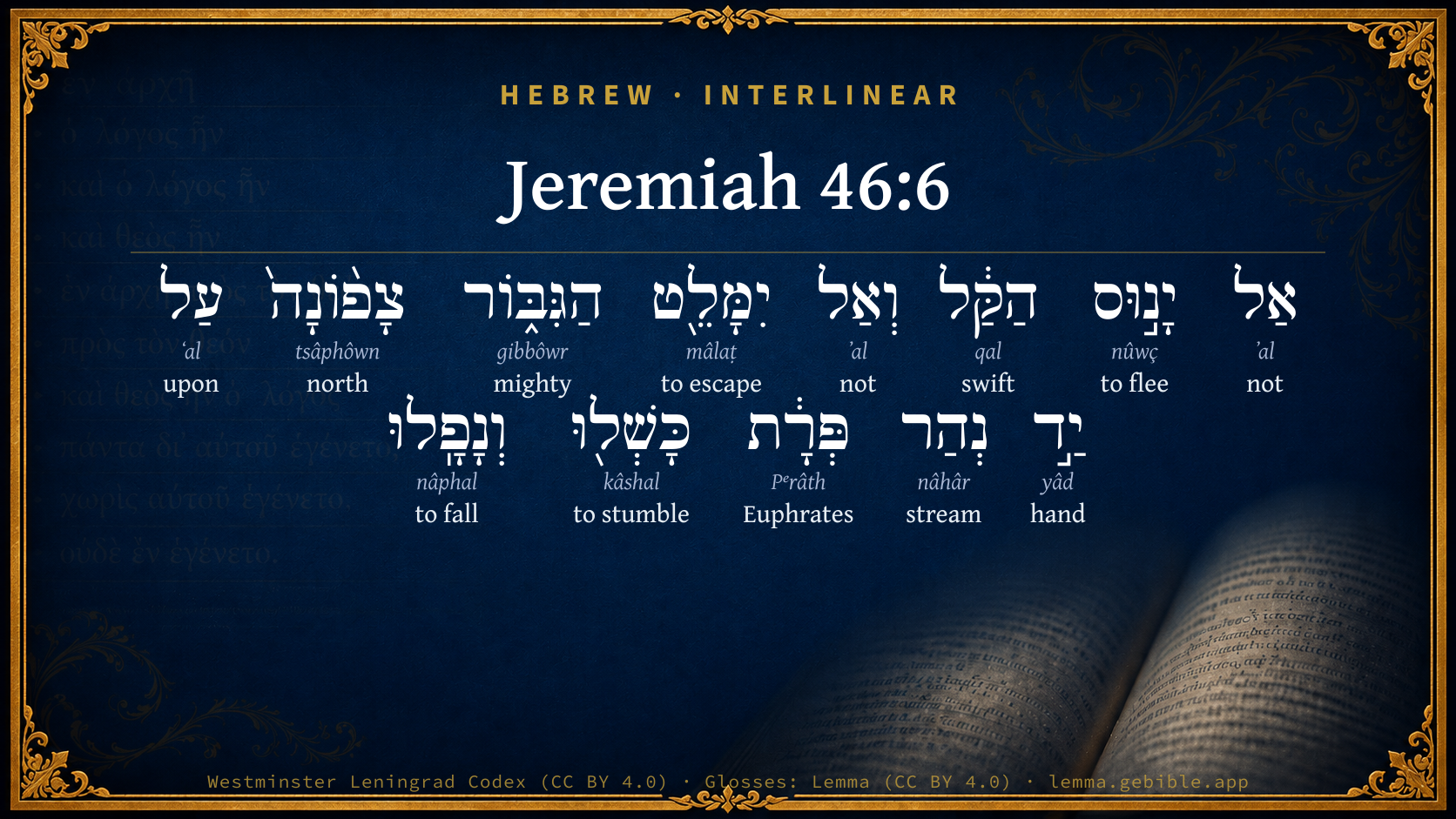
Jeremiah 46:6

Hebrew (Westminster Leningrad Codex) Jeremiah 46:6 appears in the Hebrew Old Testament. The text above is from the Westminster Leningrad Codex. Each word links to its Strong’s number, a concise gloss, and parsing drawn from the Open Scriptures Hebrew Bible morphology. Click any word for its full Brown-Driver-Briggs (BDB) entry.
Download image
Cite this verse

Jeremiah 46:6 (World English Bible). Public Domain. Lemma interlinear Bible study tool, https://lemma.gebible.app/v/jeremiah/46/6.

Show BibTeX & RIS
BibTeX
RIS
English Translation
Don't let the swift flee away, nor the mighty man escape; in the north by the river Euphrates have they stumbled and fallen.
World English Bible · Public Domain
Download a study sheet

One document with this verse’s original text, its word-by-word gloss line, the meaning frame, cross-references with their text, attributed commentary, and full source and license credits — printable, and it pastes into notes with its structure intact.

This verse Autodidact and up

Study sheet (.html) Plain text (.txt)

A passage Seminary Student

Up to 50 verses in one chapter. A passage sheet keeps up to 6 commentary sources and 12 cross-references per verse, in the order this page ranks them, and says so on the sheet whenever that leaves anything out. Ask for a single verse and you get the Autodidact verse sheet above.

Everything on this page stays free to read, with no account — the sheet is a download of what is already on screen, not access to it.

Want to remove ads? Support Godless Engineer
Compare translations 3

The same verse in 3 English versions, stacked beneath the original-language interlinear above. Click any original word for its lexicon entry.

Each is an independent rendering of the whole verse — the interlinear is not word-aligned to these translations.

Highlighted words mark where these versions differ — a whole-verse word diff, not a word-by-word alignment.

  • World English Bible Public Domain
    Don't let the swift flee away, nor the mighty man escape; in the north by the river Euphrates have they stumbled and fallen.
  • King James Version Public Domain
    Let not the swift flee away, nor the mighty man escape; they shall stumble, and fall toward the north by the river Euphrates.
  • unfoldingWord Literal Text CC BY-SA 4.0
    the swift cannot run away, and the soldiers cannot escape. They stumble in the north and fall beside the Euphrates River.

unfoldingWord Literal Text — © unfoldingWord, licensed CC BY-SA 4.0. Word-aligned USFM3 via Door43 (git.door43.org/unfoldingWord/en_ult).

Versions to compare (up to 4)

3 of 4 selected

Show all 18 translations

Every available English version of this verse, each an independent rendering of the whole verse.

  • World English Bible Public Domain
    Don't let the swift flee away, nor the mighty man escape; in the north by the river Euphrates have they stumbled and fallen.
  • Berean Standard Bible Public Domain
    “The swift cannot flee, and the warrior cannot escape! In the north by the River Euphrates they stumble and fall.
  • Majority Standard Bible Public Domain
    “The swift cannot flee, and the warrior cannot escape! In the north by the River Euphrates they stumble and fall.
  • King James Version Public Domain
    Let not the swift flee away, nor the mighty man escape; they shall stumble, and fall toward the north by the river Euphrates.
  • American Standard Version (1901) Public Domain
    Let not the swift flee away, nor the mighty man escape; in the north by the river Euphrates have they stumbled and fallen.
  • Revised Version (1885) Public Domain
    Let not the swift flee away, nor the mighty man escape; in the north by the river Euphrates have they stumbled, and fallen.
  • Geneva Bible (1599) Public Domain
    The swift shall not flee away, nor the strong man escape: they shall stumble, and fall towarde the North by the riuer Perath.
  • Douay-Rheims (1899) Public Domain
    Let not the swift flee away, nor the strong think to escape: they are overthrown, and fallen down, towards the north by the river Euphrates.
  • Young's Literal Translation Public Domain
    The swift do not flee, nor do the mighty escape, Northward, by the side of the river Phrat, They have stumbled and fallen.
  • Literal Standard Version CC BY-SA 4.0
    The swift do not flee, nor do the mighty escape, || Northward, by the side of the Euphrates River, || They have stumbled and fallen.
  • Unlocked Literal Bible CC BY-SA 4.0
    the swift cannot run away, and the soldiers cannot escape. They stumble in the north and fall beside the Euphrates River.
  • unfoldingWord Literal Text CC BY-SA 4.0
    the swift cannot run away, and the soldiers cannot escape. They stumble in the north and fall beside the Euphrates River.
  • Darby Bible Public Domain
    Let not the swift flee away, neither let the mighty man escape! -- Toward the north, hard by the river Euphrates, they have stumbled and fallen.
  • World Messianic Bible Public Domain
    “Don’t let the swift flee away, nor the mighty man escape. In the north by the river Euphrates they have stumbled and fallen.
  • Webster's Bible Public Domain
    Let not the swift flee away, nor the mighty man escape! they shall stumble, and fall towards the north by the river Euphrates.
  • Free Bible Version CC BY-SA 4.0
    Even the fastest of them can't get away; the soldiers can't escape. There in the north beside the Euphrates they fall and die.
  • Bible in Basic English Public Domain
    Let not the quick-footed go in flight, or the man of war get away; on the north, by the river Euphrates, they are slipping and falling.
  • JPS Tanakh (1917) Public Domain
    The swift cannot flee away, nor the mighty man escape; in the north by the river Euphrates have they stumbled and fallen.

Literal Standard Version (2020), Covenant Press — licensed CC BY-SA 4.0. Text via the HelloAO Bible API (eBible.org). Unlocked Literal Bible (unfoldingWord) — licensed CC BY-SA 4.0. Text via the HelloAO Bible API (eBible.org). unfoldingWord Literal Text — © unfoldingWord, licensed CC BY-SA 4.0. Word-aligned USFM3 via Door43 (git.door43.org/unfoldingWord/en_ult). Free Bible Version, Dr. Jonathan Gallagher — licensed CC BY-SA 4.0. Text via the HelloAO Bible API (eBible.org).

Word by word

More ways to search: Search by grammar → Find every occurrence → Compare this word →

Practice this passage: Drill this verse → Learn its vocabulary →

הַקַּ֔ל
qal
H7031
“the · swift”
Particle, Definite Article + Adjective, Adjective, Masculine, Singular, Absolute
Part of Speech
Particle + Adjective
Type
Adjective
Gender
Masculine
Number
Singular
State
Absolute
Full BDB Definition

Origin: contracted from H7043

TWOT: 2028a

swift, light, fleet - swift - one who is swift
  1. אַל ʼal H408 “not” Particle, Negative
  2. יָנ֣וּס nûwç H5127 “to flee” Verb, Qal, Jussive, 3rd Person, Masculine, Singular
  3. וְאַל ʼal H408 “and · not” Conjunction + Particle, Negative
  4. יִמָּלֵ֖ט mâlaṭ H4422 “to escape” Verb, Niphal, Jussive, 3rd Person, Masculine, Singular
  5. הַגִּבּ֑וֹר gibbôwr H1368 “the · mighty” Particle, Definite Article + Adjective, Adjective, Masculine, Singular, Absolute
  6. צָפ֨וֹנָה֙ tsâphôwn H6828 “north · toward” Noun, Common, Feminine, Singular, Absolute + Suffix, Demonstrative
  7. עַל ʻal H5921 “upon” Preposition
  8. יַ֣ד yâd H3027 “hand of” Noun, Common, Both, Singular, Construct
  9. נְהַר nâhâr H5104 “stream of” Noun, Common, Masculine, Singular, Construct
  10. פְּרָ֔ת Pᵉrâth H6578 “Euphrates” Noun, Proper
  11. כָּשְׁל֖וּ kâshal H3782 “to stumble” Verb, Qal, Perfect, 3rd Person, Common, Plural
  12. וְנָפָֽלוּ nâphal H5307 “and · to fall” Conjunction + Verb, Qal, Perfect, 3rd Person, Common, Plural

About this verse

These counts appear in no published source. They are computed here, from the morphology-tagged text and Lemma’s own curated glosses. What Lemma adds →

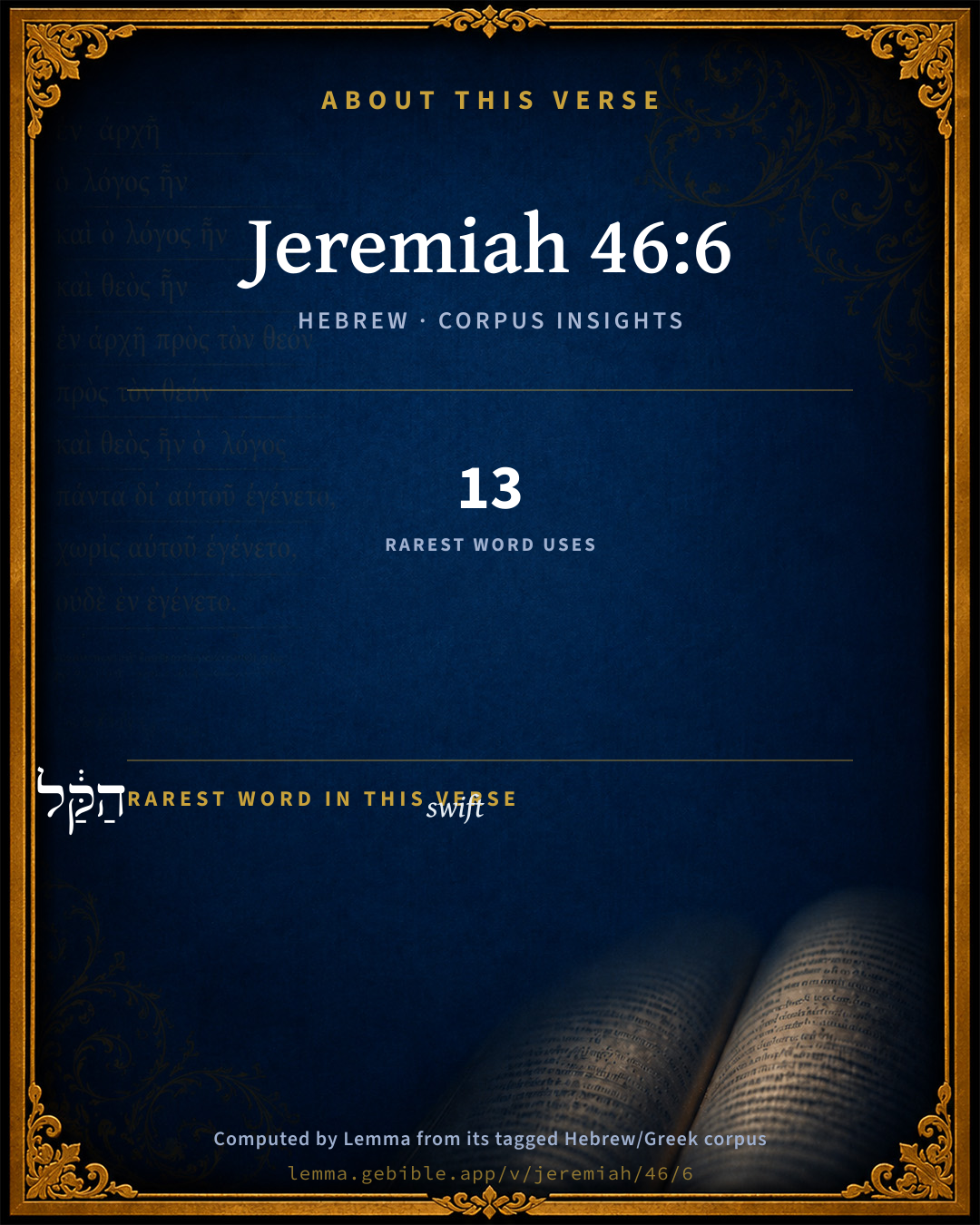
13
words
12
distinct lemmas
Prophets
section

Notable vocabulary

The rarest word here is הַקַּ֔ל swift H7031 — appearing just 13 times in the whole Hebrew Bible.

Shared distinctive vocabulary

הַקַּ֔ל swift H7031 occurs in 13 verses of the Hebrew Bible. Also found in:

Grammatical profile

  • 4 verbs
  • 4 nouns
  • 2 adjectives
  • 1 preposition
  • 2 particles

Verb forms

  • יָנ֣וּס Qal · Jussive
  • יִמָּלֵ֖ט Niphal · Jussive
  • כָּשְׁל֖וּ Qal · Perfect
  • וְנָפָֽלוּ Qal · Perfect

Repetition

A word recurs within this verse — often emphatic in Hebrew:

  • אַל not H408 ×2

Cross-references

20

Topical passages linked to Jeremiah 46:6 in the Treasury of Scripture Knowledge — connected by theme and wording, ordered by reader-vote popularity; previews shown in the World English Bible.

  • Daniel 11:19 Then he shall turn his face toward the fortresses of his own land; but he shall stumble and fall, and shall not be found.
  • Jeremiah 46:12 The nations have heard of your shame, and the earth is full of your cry; for the mighty man has stumbled against the mighty, they are fallen both of them together.
  • Judges 4:15–21 Yahweh confused Sisera, and all his chariots, and all his host, with the edge of the sword before Barak; and Sisera alighted from his chariot, and fled away on his feet.
  • Psalms 27:2 When evil-doers came at me to eat up my flesh, Even my adversaries and my foes, they stumbled and fell.
  • Psalms 33:16–17 There is no king saved by the multitude of a host. A mighty man is not delivered by great strength.
  • Psalms 147:10–11 He doesn't delight in the strength of the horse. He takes no pleasure in the legs of a man.
  • Ecclesiastes 9:11 I returned, and saw under the sun, that the race is not to the swift, nor the battle to the strong, neither yet bread to the wise, nor yet riches to men of understanding, nor yet favor to men of skill; but time and chance happen to them all.
  • Isaiah 8:15 Many shall stumble thereon, and fall, and be broken, and be snared, and be taken.
  • Isaiah 30:16–17 but you said, No, for we will flee on horses; therefore shall you flee: and, We will ride on the swift; therefore shall those who pursue you be swift.
  • Jeremiah 1:14 Then Yahweh said to me, Out of the north evil shall break forth on all the inhabitants of the land.
  • Jeremiah 4:6 Set up a standard toward Zion: flee for safety, don't stay; for I will bring evil from the north, and a great destruction.
  • Jeremiah 6:1 Flee for safety, you children of Benjamin, out of the midst of Jerusalem, and blow the trumpet in Tekoa, and raise up a signal on Beth Haccherem; for evil looks forth from the north, and a great destruction.
  • Jeremiah 20:11 But Yahweh is with me as an awesome mighty one: therefore my persecutors shall stumble, and they shall not prevail; they shall be utterly disappointed, because they have not dealt wisely, even with an everlasting dishonor which shall never be forgotten.
  • Jeremiah 25:9 behold, I will send and take all the families of the north, says Yahweh, and [I will send] to Nebuchadrezzar the king of Babylon, my servant, and will bring them against this land, and against the inhabitants of it, and against all these nations round about; and I will utterly destroy them, and make them an astonishment, and a hissing, and perpetual desolations.
  • Jeremiah 46:10 For that day is [a day] of the Lord, Yahweh of Hosts, a day of vengeance, that he may avenge him of his adversaries: and the sword shall devour and be satiate, and shall drink its fill of their blood; for the Lord, Yahweh of hosts, has a sacrifice in the north country by the river Euphrates.
  • Jeremiah 46:16 He made many to stumble, yes, they fell one on another: and they said, Arise, and let us go again to our own people, and to the land of our birth, from the oppressing sword.
  • Jeremiah 50:32 The proud one shall stumble and fall, and none shall raise him up; and I will kindle a fire in his cities, and it shall devour all who are round about him.
  • Amos 2:14–15 Flight will perish from the swift; And the strong won't strengthen his force; Neither shall the mighty deliver himself;
  • Amos 9:1–3 I saw the Lord standing beside the altar, and he said, "Strike the tops of the pillars, that the thresholds may shake; and break them in pieces on the head of all of them; and I will kill the last of them with the sword: there shall not one of them flee away, and there shall not one of them escape.
  • Daniel 11:22 The overwhelming forces shall be overwhelmed from before him, and shall be broken; yes, also the prince of the covenant.

Cross-references courtesy of OpenBible.info (CC BY 4.0).

Hebrew and Greek witnesses Masoretic Hebrew ↔ Greek Septuagint

The same verse in the two great witnesses to the Old Testament, shown verse-for-verse.

These are two independent witnesses, not word-aligned to each other, and the Septuagint is shown in lemma (dictionary) form.

Hebrew Jeremiah 46:6 Masoretic · Westminster Leningrad Codex

אַל יָנ֣וּס הַקַּ֔ל וְאַל יִמָּלֵ֖ט הַגִּבּ֑וֹר צָפ֨וֹנָה֙ עַל יַ֣ד נְהַר פְּרָ֔ת כָּשְׁל֖וּ וְנָפָֽלוּ

Don't let the swift flee away, nor the mighty man escape; in the north by the river Euphrates have they stumbled and fallen.

World English Bible · Public Domain

Greek LXX Structure differs

In the Septuagint, Jeremiah is about an eighth shorter than the Hebrew and arranges its material differently — the Oracles Against the Nations (Hebrew chapters 46–51) appear in the middle of the Greek book, after 25:13. Because the chapter and verse boundaries do not line up, a verse-for-verse comparison with the Hebrew is not shown.

A verse-for-verse comparison isn’t shown here because the chapters and verses don’t line up. Switch to the LXX edition with the MT / LXX toggle above to read the Greek directly.

Hebrew: Westminster Leningrad Codex (CC BY 4.0). Greek: Septuagint (public domain); English from a public-domain English Septuagint. How the Septuagint differs from the Hebrew →

Targum (Aramaic paraphrase)

1

The Targum is the ancient Jewish Aramaic paraphrase of the Hebrew Scriptures — an interpretive translation, not the Hebrew text itself. Onkelos (literal) and Pseudo-Jonathan (expansive) render the Torah, and Jonathan the Prophets. Coverage is partial: where no permissively-licensed English translation exists for a verse, only the Aramaic is shown. This is verse-level text, not a word-by-word alignment to the Hebrew.

  1. Targum Jonathan Prophets (Joshua–Malachi)
    לָא יַעֲרוֹק דְקָלֵיל וְלָא יִשְׁתֵּיזֵיב דְגִבַּר בְאַרְעָא צִפּוּנָא עַל כֵּיף נַהֲרָא פְּרָת אִתַּקָלוּ וּנְפָלוּ:

    (no public-domain English translation for this verse)

    Targum Jonathan — Aramaic: “Mikraot Gedolot” (public domain). English: “Sefaria Community Translation” (CC0 1.0 (public-domain dedication)); “London "Chaldee Paraphrase," 1871” (public domain). Text via Sefaria.

Commentary

Notes on Jeremiah 46:6 from classic Christian and Jewish commentators (each source and its license shown beneath its notes). The classic Christian expositions comment on the surrounding passage and are grouped to its opening verse, so a note may address several verses; the Jewish commentaries on the Tanakh (Rashi and others) are per-verse, so they appear only where the commentator wrote on this verse.

Lemma curates 59 commentaries, every one of them public domain or Creative Commons licensed, each selected and text-cleaned for this edition rather than reprinted as found. About our sources →

Trapp's Complete Commentary

John Trapp

Jer 46:6 Let not the swift flee away, nor the mighty man escape; they shall stumble, and fall toward the north by the river Euphrates.

Ver. 6. Let not the swift fly away,] i.e., Think to save themselves by flight.

Nor the mighty man escape,] i.e., Think to save himself by his might, be he never so stout hearted.

Toward the north,] i.e., Toward Carchemish, the stage of the war, where Pharaohnecho had beaten Nebuchadnezzar the elder, and is now beaten in the same place by Nebuchadnezzar the younger, alterna victoria in another victory. {a}

{a} Herod., lib. ii., αλλοπροσαλλος.

John Trapp, A Commentary or Exposition upon All the Books of the Old and New Testament (1647–1656) — public domain. Text from a community e-Sword module.

Geneva Bible (1599)

Geneva Bible translators

The Babylonians shall discomfit them at the river Euphrates.

Geneva Bible (1599) marginal notes — public domain. Text via Bolls.life.

Jamieson, Fausset & Brown

Robert Jamieson, A. R. Fausset & David Brown

Let not--equivalent to the strongest negation. Let not any of the Egyptian warriors think to escape by swiftness or by might.

toward the north--that is, in respect to Egypt or Judea. In the northward region, by the Euphrates (see Jer 46:2).

Jamieson, Fausset & Brown — Commentary Critical and Explanatory on the Whole Bible (1871) — public domain (CC PDM 1.0). Text via the HelloAO Bible API.

Adam Clarke's Commentary

Verse 6. Let not the swift flee away] Even the swiftest shall not be able to escape.

They shall - fall toward the north] By the Euphrates, which was northward of Judea. Here the Egyptian army was routed with great slaughter.

Adam Clarke's Commentary on the Bible (1810–1826) — public domain. Text from a community e-Sword/MySword module.

John Calvin's Commentaries

He then says first that they would gain power, but he speaks presently of their fall, unless it be thought that the same thing is repeated: and the beginning of the verse may be read affirmatively, “The swift shall not flee,” etc. But as the particle אל, al, is often used in a prohibitory sense, the verse may be evidently explained as spoken by God, and thus it may be read in connection with the previous verse, Let not the swift flee, nor the brave escape For God here declares authoritatively, that celerity and courage would be of no avail to the Egyptians, because the swiftest would be taken by their enemies, and the bravest would fall.

He says, In the land of the north, on the bank of the river We know that Babylon and Assyria and Chaldea and those countries, were northward with respect to Judea. Whenever then the Prophets speak of the Babylonians, they call them Northlanders; but Egypt was to the south, as it is clear from many parts of Scripture. But as the Prophet here speaks of the Egyptians, he rightly makes Chaldea to be northward. Then he says, On the bank of the river Euphrates they shall stumble, or fall. The meaning is, that the event of war is in the power of God, so that he would tear in pieces and lay prostrate or scatter the Egyptians, however well equipped they might be, and trust in their own strength.

We must also observe, that whatever subsidies men pro-cum for themselves in order to protect their safety, they are nothing when God is opposed to them. The Prophet indeed mentions only two things; but he means that though men may excel in many things and possess many endowments, they must yet perish, when that is God’s will: flight cannot save the swift, nor strength the valiant. It follows —

John Calvin's Commentaries (1540-1563) — public domain. Text from the Calvin Translation Society English edition (1840s-50s) via the Christian Classics Ethereal Library (ccel.org). Calvin's coverage is partial (roughly two-thirds of the Bible); uncommented books and verses are honest gaps, never fabricated. The 19th-century editor's footnotes and remarks are omitted so the notes are faithfully Calvin's own voice.

John Gill's Exposition

Let not the swift flee away, nor the mighty men escape,.... Those that were swift of foot, like Asahel, or carried but light armour, let not such trust to their swiftness or light carriage; nor let the mighty man think to escape by reason of his great strength, to make his way through the enemy, and get out of his hands. Or this may be rendered as future, "the swift shall not flee away", &c. (t) so the Targum; neither the one nor the other shall escape by the nimbleness of their heels, or the stoutness of their hearts:

they shall stumble and fall toward the north, by the river Euphrates; which lay north of Judea, where the prophet was, to whom this word came; and also was to the north of Egypt, whose destruction is here threatened: the place where this route and slaughter would be made was Carchemish, which was situated by that river; on the north side of which city, according to Abarbinel, the battle was; and which sense is mentioned by Kimchi, which the other follows.

(t) "non fugiet", Pagninus, Montanus; "non effugiet", Munster, Tigurine version.

John Gill's Exposition of the Whole Bible (1746–1763) — public domain (CC PDM 1.0). Text via the HelloAO Bible API.

Albert Barnes' Notes on the Bible

Translate it: “The swift shall not flee away, and the hero shall not escape: in the north on the bank of the river Euphrates they shall stumble and fall.”

Albert Barnes' Notes on the Bible (1834–1885) — public domain. Text from a community e-Sword/MySword module.

Haydock's Catholic Bible Commentary

Away. It will be in vain. (Calmet) --- Nechao went to defend Charcamis, but lost "many myriads in the battle," and all the country "as far as Pelusium, except Judea." (Josephus, [Antiquities?] x. 7.)

George Leo Haydock (1774–1849), Haydock's Catholic Family Bible and Commentary, 1859 edition — public domain. Excludes Psalms (Douay-Rheims chapter numbering differs from Protestant) and Deuterocanonical books (Catholic canon only).

Matthew Poole's English Annotations

That is, it is in vain for the swift to flee away, the mighty men shall not escape, but they shall stumble and fall at Carchemish, which was near the river Euphrates, and northward from Egypt.

Matthew Poole's English Annotations on the Holy Bible (1683–1685) — public domain. Text from a community e-Sword/MySword module.

The Pulpit Commentary

Let not the swift flee away. A strong way of expressing that even the swiftest cannot expect to flee, just as, in Isa_2:9, "forgive them not" means "thou canst not forgive them." Nothing seems to have struck the Jews so much as the unparalleled swiftness of the Chaldean warriors. (Heb_1:6, 8 Jer_4:13) They shall stumble; literally, they have stumbled; it is most probably the prophetic perfect ("they shall certainly fall"), though Ewald denies this, and consequently maintains that the prophecy was written after the battle of Carchemish. Toward the north; i.e. "in the northern region," or, more loosely, "in the north" (comp. ver. 10). Carchemish was, of course, far to the north of Jerusalem.

The Pulpit Commentary (1880–1919), ed. H.D.M. Spence-Jones & Joseph S. Exell — public domain. Text from a community e-Sword module.

John Wesley's Explanatory Notes

Let not the swift - It is in vain for the swift to flee away, the mighty men shall not escape, but they shall stumble and fall at Carchemish, which was near the river Euphrates, and northward from Egypt.

John Wesley, Explanatory Notes Upon the Whole Bible (1754–1765) — public domain. Text via the GEBible commentary corpus.

Lesson kit

Teaching starters — assembled from the data on this page, not authored interpretation. Every prompt links to the verse data it draws on. Edit before teaching.

Jeremiah, in the Prophets, opens this verse with 13 words (12 distinct Hebrew lemmas). Its most distinctive word is qal (“swift”). A historical commentator’s framing appears above. Read the whole chapter for the surrounding context.

Discussion questions

  1. What does “swift” (qal) contribute to the verse as a whole?
  2. How does 2 Samuel 2:18, which shares the word «swift», read alongside this verse?
  3. What does the repetition of “not” (2× in this one verse) do in this verse?
  4. These translations render this verse differently; the difference is in the English rendering, not the original. What questions does that raise?
  5. «יָנ֣וּס» is a Qal Jussive verb. How does that grammatical form shape the action described?
  6. Compare how Trapp's Complete Commentary and Geneva Bible (1599) read this verse. Where do they agree or differ?

Things to notice

Reading settings

Reading text

Shown beneath each verse's original-language words.

Old Testament
Old Testament edition

Read the OT as the Masoretic Hebrew (MT) or the Greek Septuagint (LXX).

English shown for the Greek Septuagint (in the Hebrew ↔ Greek comparison).

Comparing translations? Open the Compare panel on any verse page to stack up to four side by side.