Micah 7:8

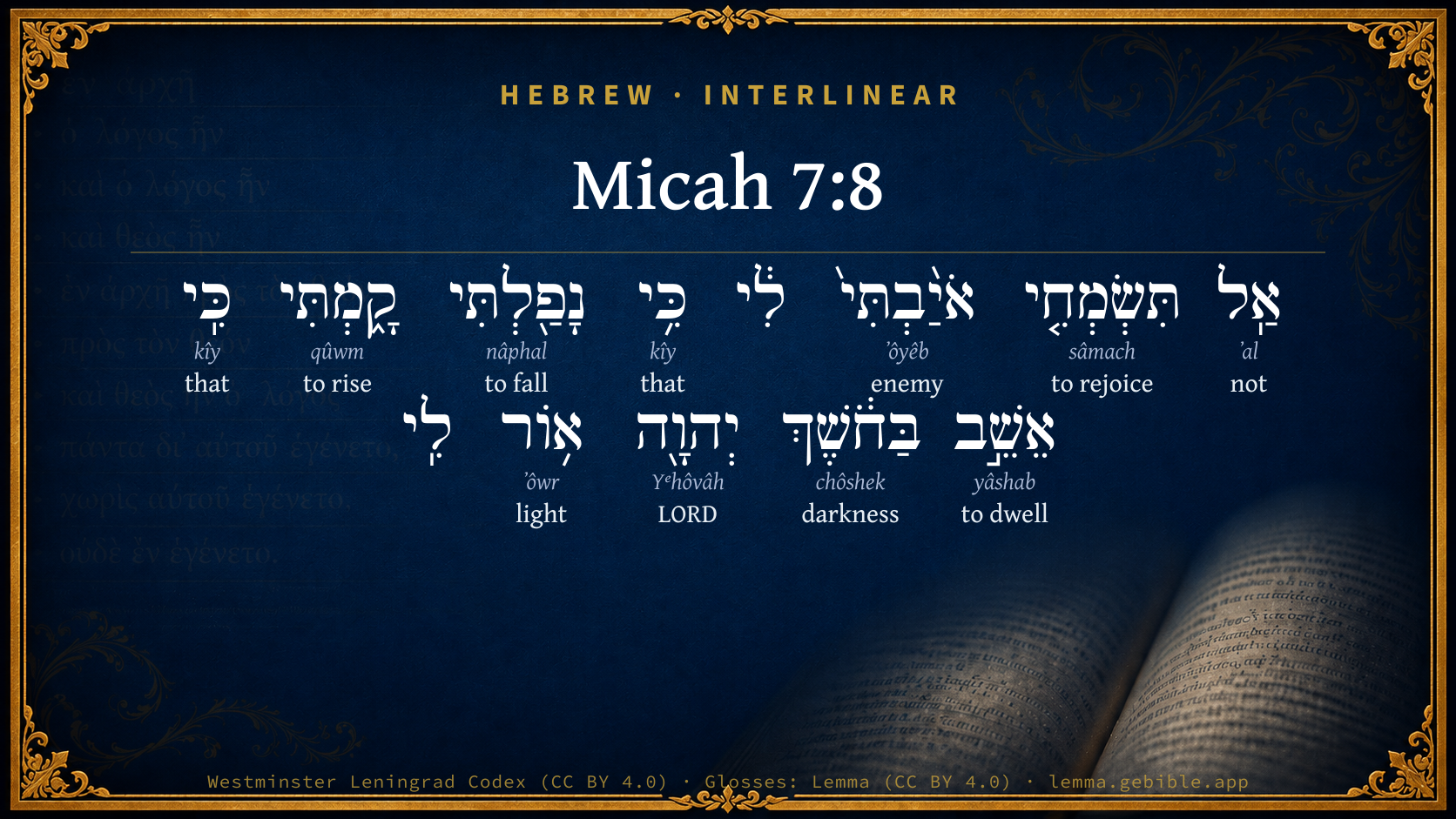
Hebrew (Westminster Leningrad Codex) Micah 7:8 appears in the Hebrew Old Testament. The text above is from the Westminster Leningrad Codex. Each word links to its Strong’s number, a concise gloss, and parsing drawn from the Open Scriptures Hebrew Bible morphology. Click any word for its full Brown-Driver-Briggs (BDB) entry.
Download image
Cite this verse

Micah 7:8 (World English Bible). Public Domain. Lemma interlinear Bible study tool, https://lemma.gebible.app/v/micah/7/8.

Show BibTeX & RIS
BibTeX
RIS
English Translation
Don't rejoice against me, my enemy. When I fall, I will arise. When I sit in darkness, Yahweh will be a light to me.
World English Bible · Public Domain
Download a study sheet

One document with this verse’s original text, its word-by-word gloss line, the meaning frame, cross-references with their text, attributed commentary, and full source and license credits — printable, and it pastes into notes with its structure intact.

This verse Autodidact and up

Study sheet (.html) Plain text (.txt)

A passage Seminary Student

Up to 50 verses in one chapter. A passage sheet keeps up to 6 commentary sources and 12 cross-references per verse, in the order this page ranks them, and says so on the sheet whenever that leaves anything out. Ask for a single verse and you get the Autodidact verse sheet above.

Everything on this page stays free to read, with no account — the sheet is a download of what is already on screen, not access to it.

Want to remove ads? Support Godless Engineer
Compare translations 3

The same verse in 3 English versions, stacked beneath the original-language interlinear above. Click any original word for its lexicon entry.

Each is an independent rendering of the whole verse — the interlinear is not word-aligned to these translations.

Highlighted words mark where these versions differ — a whole-verse word diff, not a word-by-word alignment.

  • World English Bible Public Domain
    Don't rejoice against me, my enemy. When I fall, I will arise. When I sit in darkness, Yahweh will be a light to me.
  • King James Version Public Domain
    Rejoice not against me, O mine enemy: when I fall, I shall arise; when I sit in darkness, the LORD shall be a light unto me.
  • unfoldingWord Literal Text CC BY-SA 4.0
    Do not rejoice over me, my enemy. After I fall, I will rise. When I sit in darkness, Yahweh will be a light for me.

unfoldingWord Literal Text — © unfoldingWord, licensed CC BY-SA 4.0. Word-aligned USFM3 via Door43 (git.door43.org/unfoldingWord/en_ult).

Versions to compare (up to 4)

3 of 4 selected

Show all 18 translations

Every available English version of this verse, each an independent rendering of the whole verse.

  • World English Bible Public Domain
    Don't rejoice against me, my enemy. When I fall, I will arise. When I sit in darkness, Yahweh will be a light to me.
  • Berean Standard Bible Public Domain
    Do not gloat over me, my enemy! Though I have fallen, I will arise; though I sit in darkness, the LORD will be my light.
  • Majority Standard Bible Public Domain
    Do not gloat over me, my enemy! Though I have fallen, I will arise; though I sit in darkness, the LORD will be my light.
  • King James Version Public Domain
    Rejoice not against me, O mine enemy: when I fall, I shall arise; when I sit in darkness, the LORD shall be a light unto me.
  • American Standard Version (1901) Public Domain
    Rejoice not against me, O mine enemy: when I fall, I shall arise; when I sit in darkness, Jehovah will be a light unto me.
  • Revised Version (1885) Public Domain
    Rejoice not against me, O mine enemy: when I fall, I shall arise; when I sit in darkness, the LORD shall be a light unto me.
  • Geneva Bible (1599) Public Domain
    Reioyce not against me, O mine enemie: though I fall, I shall arise: when I shall sit in darkenesse, the Lord shalbe a light vnto me.
  • Douay-Rheims (1899) Public Domain
    Rejoice not, thou, my enemy, over me, because I am fallen: I shall arise, when I sit in darkness, the Lord is my light.
  • Young's Literal Translation Public Domain
    Thou dost not rejoice over me, O mine enemy, When I have fallen, I have risen, When I sit in darkness Jehovah is a light to me.
  • Literal Standard Version CC BY-SA 4.0
    You do not rejoice over me, O my enemy, || When I have fallen, I have risen, || When I sit in darkness YHWH is a light to me.
  • Unlocked Literal Bible CC BY-SA 4.0
    Do not rejoice over me, my enemy. After I fall, I will rise. When I sit in darkness, Yahweh will be a light for me.
  • unfoldingWord Literal Text CC BY-SA 4.0
    Do not rejoice over me, my enemy. After I fall, I will rise. When I sit in darkness, Yahweh will be a light for me.
  • Darby Bible Public Domain
    Rejoice not against me, O mine enemy: though I fall, I shall arise; when I sit in darkness, Jehovah shall be a light unto me.
  • World Messianic Bible Public Domain
    Don’t rejoice against me, my enemy. When I fall, I will arise. When I sit in darkness, the LORD will be a light to me.
  • Webster's Bible Public Domain
    Rejoice not against me, O my enemy: when I fall, I shall arise; when I sit in darkness, the LORD will be a light to me.
  • Free Bible Version CC BY-SA 4.0
    Don't gloat over me, my enemies! Even though I fall, I will rise again. Though I sit in darkness, the Lord is my light.
  • Bible in Basic English Public Domain
    Do not be glad because of my sorrow, O my hater: after my fall I will be lifted up; when I am seated in the dark, the Lord will be a light to me.
  • JPS Tanakh (1917) Public Domain
    Rejoice not against me, O mine enemy; though I am fallen, I shall arise; though I sit in darkness, the LORD is a light unto me.

Literal Standard Version (2020), Covenant Press — licensed CC BY-SA 4.0. Text via the HelloAO Bible API (eBible.org). Unlocked Literal Bible (unfoldingWord) — licensed CC BY-SA 4.0. Text via the HelloAO Bible API (eBible.org). unfoldingWord Literal Text — © unfoldingWord, licensed CC BY-SA 4.0. Word-aligned USFM3 via Door43 (git.door43.org/unfoldingWord/en_ult). Free Bible Version, Dr. Jonathan Gallagher — licensed CC BY-SA 4.0. Text via the HelloAO Bible API (eBible.org).

Word by word

More ways to search: Search by grammar → Find every occurrence → Compare this word →

Practice this passage: Drill this verse → Learn its vocabulary →

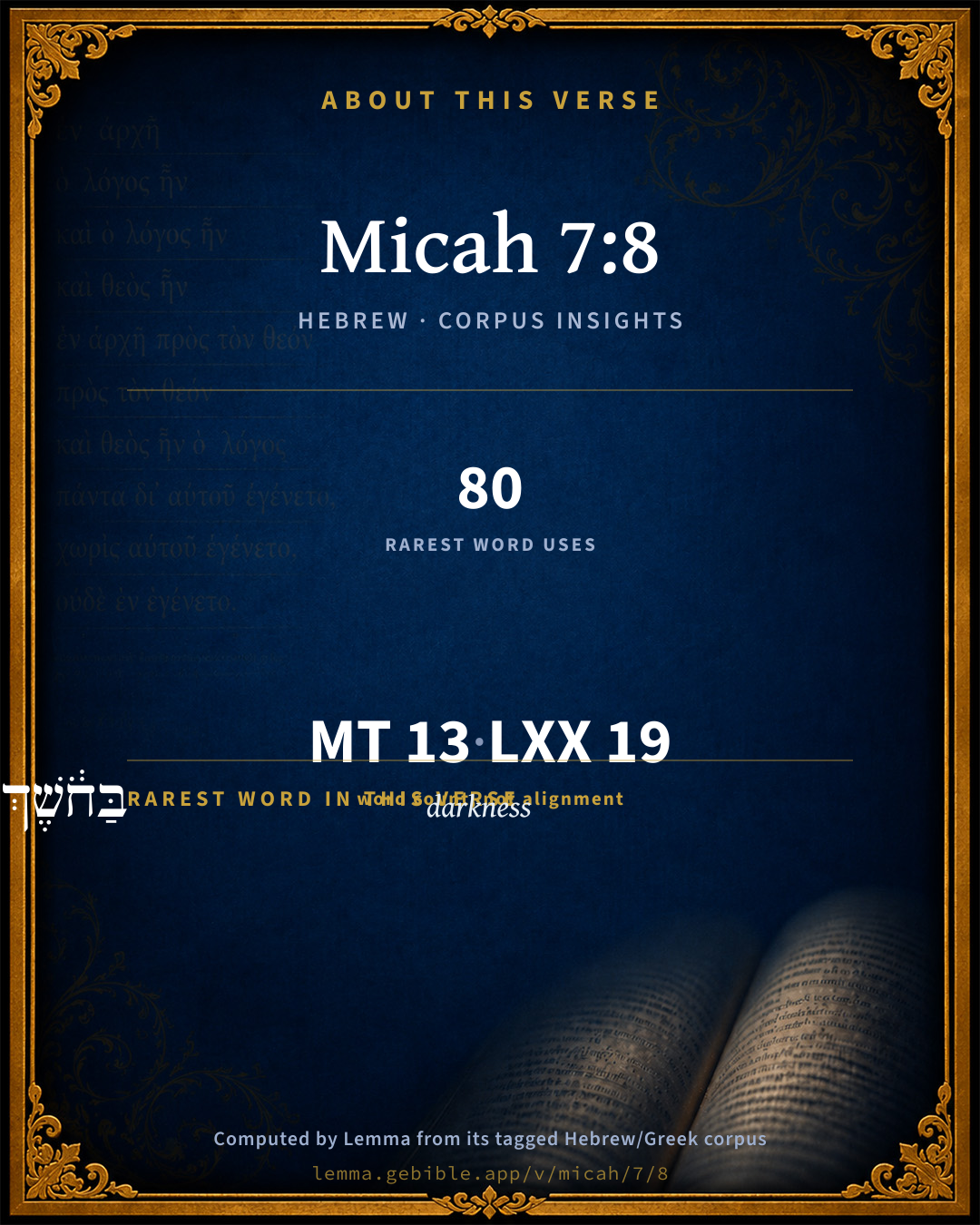
בַּחֹ֔שֶׁךְ
chôshek
H2822
“in/at the · darkness”
Preposition, Determined + Noun, Common, Masculine, Singular, Absolute
Part of Speech
Preposition + Noun
Type
Common
Gender
Masculine
Number
Singular
State
Absolute
Full BDB Definition

Origin: from H2821

TWOT: 769a

darkness, obscurity - darkness - secret place
  1. אַֽל ʼal H408 “not” Particle, Negative
  2. תִּשְׂמְחִ֤י sâmach H8055 “to rejoice” Verb, Qal, Jussive, 2nd Person, Feminine, Singular
  3. אֹיַ֨בְתִּי֙ ʼôyêb H341 “enemy · me” Verb, Qal, Participle Active, Feminine, Singular, Construct + Suffix, Personal, 1st Person, Common, Singular
  4. כִּ֥י kîy H3588 “that” Conjunction
  5. נָפַ֖לְתִּי nâphal H5307 “to fall” Verb, Qal, Perfect, 1st Person, Common, Singular
  6. קָ֑מְתִּי qûwm H6965 “to rise” Verb, Qal, Perfect, 1st Person, Common, Singular
  7. כִּֽי kîy H3588 “that” Conjunction
  8. אֵשֵׁ֣ב yâshab H3427 “to dwell” Verb, Qal, Imperfect, 1st Person, Common, Singular
  9. יְהוָ֖ה Yᵉhôvâh H3068 “LORD” Noun, Proper
  10. א֥וֹר ʼôwr H216 “light” Noun, Common, Both, Singular, Absolute

About this verse

These counts appear in no published source. They are computed here, from the morphology-tagged text and Lemma’s own curated glosses. What Lemma adds →

13
words
10
distinct lemmas
Prophets
section

Grammatical profile

  • 5 verbs
  • 3 nouns
  • 2 prepositions
  • 2 conjunctions
  • 1 particle

Verb forms

  • תִּשְׂמְחִ֤י Qal · Jussive
  • אֹיַ֨בְתִּי֙ Qal · Participle Active
  • נָפַ֖לְתִּי Qal · Perfect
  • קָ֑מְתִּי Qal · Perfect
  • אֵשֵׁ֣ב Qal · Imperfect

Repetition

A word recurs within this verse — often emphatic in Hebrew:

  • כִּ֥י that H3588 ×2

Hebrew & Septuagint length

In English translation the verse runs 24 words from the Hebrew and 28 from the Septuagint (LXX English) — closely comparable.

A rough comparison of the two English renderings, which tokenize alike — not a word-level alignment.

Word counts can differ between the Hebrew and the Greek without any difference in meaning — e.g. the Hebrew direct-object marker אֵת has no separate Greek word, and Greek often adds the article ὁ.

In the original languages it is 13 Hebrew tokens and 19 Greek tokens — but the two are counted differently (Hebrew bundles its prefixes and suffixes into one token; the Greek is in lemma form), so that isn’t a like-for-like length.

Cross-references

38

Topical passages linked to Micah 7:8 in the Treasury of Scripture Knowledge — connected by theme and wording, ordered by reader-vote popularity; previews shown in the World English Bible.

  • John 8:12 Again, therefore, Jesus spoke to them, saying, "I am the light of the world. He who follows me will not walk in the darkness, but will have the light of life."
  • Psalms 27:1 Yahweh is my light and my salvation. Whom shall I fear? Yahweh is the strength of my life. Of whom shall I be afraid?
  • Isaiah 9:2 The people who walked in darkness have seen a great light: those who lived in the land of the shadow of death, on them has the light shined.
  • Psalms 112:4 Light dawns in the darkness for the upright, Gracious, merciful, and righteous.
  • Psalms 107:10–15 Some sat in darkness and in the shadow of death, Being bound in affliction and iron,
  • Proverbs 24:16–18 For a righteous man falls seven times, and rises up again; But the wicked are overthrown by calamity.
  • Obadiah 1:12 But don't look down on your brother in the day of his disaster, and don't rejoice over the children of Judah in the day of their destruction. Don't speak proudly in the day of distress.
  • 2 Corinthians 4:6 seeing it is God who said, "Light will shine out of darkness," who has shone in our hearts, to give the light of the knowledge of the glory of God in the face of Jesus Christ.
  • Psalms 38:16 For I said, "Don't let them gloat over me, Or exalt themselves over me when my foot slips."
  • Psalms 41:10–12 But you, Yahweh, have mercy on me, and raise me up, That I may repay them.
  • Psalms 84:11 For Yahweh God is a sun and a shield. Yahweh will give grace and glory. He withholds no good thing from those who walk blamelessly.
  • Psalms 97:11 Light is sown for the righteous, And gladness for the upright in heart.
  • Job 31:29 "If I have rejoiced at the destruction of him who hated me, Or lifted up myself when evil found him;
  • Revelation 22:5 There will be no night, and they need no lamp light; for the Lord God will illuminate them. They will reign forever and ever.
  • Isaiah 60:1–3 Arise, shine; for your light is come, and the glory of Yahweh is risen on you.
  • Psalms 35:19 Don't let those who are my enemies wrongfully rejoice over me; Neither let them wink with the eye who hate me without a cause.
  • Ezekiel 35:15 As you did rejoice over the inheritance of the house of Israel, because it was desolate, so will I do to you: you shall be desolate, Mount Seir, and all Edom, even all of it; and they shall know that I am Yahweh.
  • Micah 7:10 Then my enemy will see it, And shame will cover her who said to me, Where is Yahweh your God? Then my enemy will see me and will cover her shame. Now she will be trodden down like the mire of the streets.
  • Ezekiel 25:6 For thus says the Lord Yahweh: Because you have clapped your hands, and stamped with the feet, and rejoiced with all the despite of your soul against the land of Israel;
  • Malachi 4:2 But to you who fear my name shall the sun of righteousness arise with healing in its wings. You will go out, and leap like calves of the stall.
  • John 16:20 Most assuredly I tell you, that you will weep and lament, but the world will rejoice. You will be sorrowful, but your sorrow will be turned into joy.
  • Psalms 13:4–6 Lest my enemy say, "I have prevailed against him;" Lest my adversaries rejoice when I fall.
  • Psalms 35:24–26 Vindicate me, Yahweh my God, according to your righteousness; Don't let them gloat over me.
  • Acts 26:18 to open their eyes, that they may turn from darkness to light and from the power of Satan to God, that they may receive remission of sins and an inheritance among those who are sanctified by faith in me.'
  • Psalms 37:21 The wicked borrow, and don't pay back, But the righteous give generously.
  • Psalms 37:24 Though he stumble, he shall not fall, For Yahweh holds him up with his hand.
  • Isaiah 2:5 House of Jacob, come, and let us walk in the light of Yahweh.
  • Isaiah 49:9 saying to those who are bound, Go forth; to those who are in darkness, Show yourselves. They shall feed in the ways, and on all bare heights shall be their pasture.
  • Jeremiah 50:11 Because you are glad, because you rejoice, O you who plunder my heritage, because you are wanton as a heifer that treads out [the grain], and neigh as strong horses;
  • Amos 9:11 In that day I will raise up the tent of David who is fallen, and close up its breaches, and I will raise up its ruins, and I will build it as in the days of old;
  • Matthew 4:16 The people who sat in darkness saw a great light, To those who sat in the region and shadow of death, To them light has dawned."
  • Luke 1:78–79 Because of the tender mercy of our God, Whereby the dawn from on high will visit us,
  • Revelation 11:10–12 Those who dwell on the earth rejoice over them, and they will be glad. They will give gifts to one another, because these two prophets tormented those who dwell on the earth.
  • Psalms 35:15–16 But in my adversity, they rejoiced, and gathered themselves together. The attackers gathered themselves together against me, and I didn't know it. They tore at me, and didn't cease.
  • Isaiah 50:10 Who is among you who fears Yahweh, who obeys the voice of his servant? He who walks in darkness, and has no light, let him trust in the name of Yahweh, and rely on his God.
  • Isaiah 60:19–20 The sun shall be no more your light by day; neither for brightness shall the moon give light to you: but Yahweh will be to you an everlasting light, and your God your glory.
  • Lamentations 4:21–22 Rejoice and be glad, daughter of Edom, that dwell in the land of Uz: The cup shall pass through to you also; you shall be drunken, and shall make yourself naked.
  • Revelation 21:23 The city has no need for the sun, neither of the moon, to shine, for the very glory of God illuminated it, and its lamp is the Lamb.

Cross-references courtesy of OpenBible.info (CC BY 4.0).

Hebrew and Greek witnesses Masoretic Hebrew ↔ Greek Septuagint

The same verse in the two great witnesses to the Old Testament, shown verse-for-verse.

These are two independent witnesses, not word-aligned to each other, and the Septuagint is shown in lemma (dictionary) form.

Hebrew Micah 7:8 Masoretic · Westminster Leningrad Codex

אַֽל תִּשְׂמְחִ֤י אֹיַ֨בְתִּי֙ לִ֔י כִּ֥י נָפַ֖לְתִּי קָ֑מְתִּי כִּֽי אֵשֵׁ֣ב בַּחֹ֔שֶׁךְ יְהוָ֖ה א֥וֹר לִֽי

Don't rejoice against me, my enemy. When I fall, I will arise. When I sit in darkness, Yahweh will be a light to me.

World English Bible · Public Domain

Greek LXX Micah 7:8 Septuagint · lemma form

μή ἐπιχαίρω ἐγώ ὁ ἔχθρα ἐγώ ὅτι πίπτω καί ἀναἵστημι διότι ἐάν καταἵζω ἐν ὁ σκότος κύριος φωτίζω ἐγώ

Rejoice not against me, my enemy; for I have fallen yet shall arise; for though I should sit in darkness, the Lord shall be a light to me.

LXX2012 (modern English Septuagint) · Public Domain

Hebrew: Westminster Leningrad Codex (CC BY 4.0). Greek: Septuagint (public domain); English from LXX2012 (modern English Septuagint) (Public Domain). How the Septuagint differs from the Hebrew →

Targum (Aramaic paraphrase)

1

The Targum is the ancient Jewish Aramaic paraphrase of the Hebrew Scriptures — an interpretive translation, not the Hebrew text itself. Onkelos (literal) and Pseudo-Jonathan (expansive) render the Torah, and Jonathan the Prophets. Coverage is partial: where no permissively-licensed English translation exists for a verse, only the Aramaic is shown. This is verse-level text, not a word-by-word alignment to the Hebrew.

  1. Targum Jonathan Prophets (Joshua–Malachi)
    לָא תֶחְדוּן בְּעֵיל דְבָבוּתִי לִי דְנָפְלֵית אָקוּם אֲרֵי יְתִיבֵית כִדְבְקִבְלָא יְיָ יַנְהַר עֲלָי:

    (no public-domain English translation for this verse)

    Targum Jonathan — Aramaic: “Mikraot Gedolot” (public domain). English: “Sefaria Community Translation” (CC0 1.0 (public-domain dedication)); “London "Chaldee Paraphrase," 1871” (public domain). Text via Sefaria.

Commentary

Notes on Micah 7:8 from classic Christian and Jewish commentators (each source and its license shown beneath its notes). The classic Christian expositions comment on the surrounding passage and are grouped to its opening verse, so a note may address several verses; the Jewish commentaries on the Tanakh (Rashi and others) are per-verse, so they appear only where the commentator wrote on this verse.

Lemma curates 59 commentaries, every one of them public domain or Creative Commons licensed, each selected and text-cleaned for this edition rather than reprinted as found. About our sources →

Trapp's Complete Commentary

John Trapp

Mic 7:8 Rejoice not against me, O mine enemy: when I fall, I shall arise; when I sit in darkness, the LORD [shall be] a light unto me.

Ver. 8. Rejoice not against me, O mine enemy] Here is the triumph of faith, in the fail of outward comforts, in the midst of the world’s insultations and irrisions. Ne laeteris de me. O daughter of Babylon, that art to be destroyed, thou that art victrix gentium, captiva vitiorum (as Austin said of Rome in her pride), thou that for present carriest the ball upon the foot, and none can come near thee: Rejoice not against me, as forlorn and hopeless; say not, "This is Zion, the outcast, whom no man seeketh after," Jer 30:17. For assure thyself, The right hand of the Lord will change all this, and

“ Flebile principium melior fortuna sequetur. ”

When I fall, I shall arise] Because fall I never so low, I cannot fall below the supporting hand of God, which will help me up again, Psa 37:24. The wicked fall and never rise, Amo 8:14, they shall drink of the cup of God’s wrath, "and be drunken, and spew, and fall, and rise no more," Jer 25:27; their carcases shall fall as dung upon the open field, and as the handful after the harvestman, and none shall gather them, Jer 9:22. This is fearful. If Haman fall before Mordecai the Jew, he shall not easily stop, or step back, Est 6:13. A Jew may fall before a Persian and get up and prevail. But if a Persian or other persecutor begin to fall before a Jew, he can neither stay nor rise. There is an invisible hand of omnipotence that strikes in for his own, and confounds their opposites.

When I sit in darkness, the Lord shall be a light unto me] He can lighten the greatest darkness, as be did the dungeons to the martyrs. From the delectable orchard of the Leonine dungeon, so Algerius, an Italian martyr, dated his heavenly epistle. I am now in the Bishop of London’s coal house (saith Mr Philpot), a dark and ugly brison as any is about London; but my dark body of sin hath well deserved the same; and the Lord now hath brought me into outer darkness, that I might be the more lightened by him; as he is most present with his children in the midst of darkness. And in his letter to the Lady Vane, I thank the Lord, saith he, I am not alone, but have six other faithful companions, who in our darkness do cheerfully sing hymns and praises to God for his great goodness. We are so joyful that I wish you part of my joy. The posy of the city of Geneva stamped round about their money was formerly out of Job, Post tenebras spero lucern, After darkness I look for light; but the Reformation once settled among them, they changed it into Post tenebras lux (Scultet. Annul.), Light after darkness. Like as the Saxon princes, before they became Christians, gave for their arms a black horse; but being once baptized, a white.

John Trapp, A Commentary or Exposition upon All the Books of the Old and New Testament (1647–1656) — public domain. Text from a community e-Sword module.

The Biblical Illustrator

Joseph S. Exell

Mic_7:8

Rejoice not against me, O mine enemy; when I fail, I shall arise; when I sit in darkness, the Lord shall be a light unto me

The rejoicing foe rebuked

I.

The rejoicing foe. At the moment of conversion, the soul enters upon a conflict which continues until his dying day. The bugle that calls him to peace with God, calls him also to battle. Over and above the conflicts arising from his own evil heart, and the temptations of a godless world, the saint has in Satan a sworn foe. Let me beseech you to remember that in Satan you have a personal living foe. In order to form some idea of the foe we have to fight, look at the names given to him in Scripture. These best reveal his character. Apoliyon, the destroyer. Satan, the accuser. The Devil, or murderer. He comes at unawares. He assaults our weakest part.

II. The rejoicing foe rebuked. In our text there is no attempt to deny the fact of the fall, or excuse its guilt. Whence does the fallen Christian obtain his comfort, if it be not in ignoring the past? He rejoices in the thought of restoration. The future is his reservoir of gladness. I shall arise, he says, a wiser man; a more watchful man; a humbler man. Gods true saints shall be raised from the ground, however hard their fall. Next to the salvation of the sinner, the recovery of the saint brings glory to our Lord. (A. G. Brown.)

Chequered experience

I. The conflict supposed. The language is very strong; the figurative terms employed suggest their own images; it is a sad but not a desperate case; there is hope in the Lord concerning this thing; but, meanwhile, there is a conflict going on which puts to the proof the strength and courage of Micah. We are here meditating upon the mental warfare that went on in the battlefield of a prophets heart. That which belonged to him is common to us all--not always, but at certain times. Some Christians make this mistake; they seem to expect that because they are Christians they shall be exempt from the temptations and evil inclinations of other men.

II. The sources of this spiritual conflict. We want nothing but the history of our heart to explain this. The sources of this conflict of thought and feeling are threefold,--the world, the devil, and death.

III. Thy frequent anticipation of death, which is a source of perpetual conflict to many. The fear of death is natural; it is probably a principle implanted from above, to prevent man from rushing unbidden into the presence of God. And to this fear the believer is liable, even as the unbeliever. (W. G. Barrett.)

The Biblical Illustrator, edited by Joseph S. Exell (c. 1880s–1900s) — public domain. Text from a community e-Sword module.

Joseph Benson's Commentary

Mic 7:8-9. Rejoice not against me, O mine enemy — Here begins a new subject; the Jewish nation in general being here introduced speaking in their captivity, and addressing themselves to the Chaldeans. When I fall I shall rise — Or, because I am fallen; for I shall rise. When I sit in darkness, the Lord shall be a light unto me — Neither rejoice nor triumph over me, because I at present sit in darkness, or misery, for Jehovah will again make me prosperous. I will bear the indignation of the Lord — I will patiently, or without repining, bear the affliction, or punishment, Jehovah has inflicted upon me. Because I have sinned against him — Because I am sensible I have highly offended him by my idolatry, injustice, and unmercifulness. Until he plead my cause, and execute judgment for me — Until he shall be pleased to acknowledge my cause, in consequence of my repentance and perseverance in the worship of him, and avenge my injuries on my enemies. It may well be supposed that the Chaldeans made a mock of the Jews for persevering in the worship of Jehovah, or that God who (as they supposed) had not been able to deliver them, his worshippers, out of their hands, the worshippers of Bel and Nebo; whom therefore they esteemed more powerful. He will bring me forth to the light — He will again bring me into a prosperous condition. And I shall behold his righteousness — Or rather, his goodness. What we render righteousness, often signifies, according to the Hebrew, beneficence, or goodness.

Joseph Benson's Commentary on the Old and New Testaments (1811–1818) — public domain. Text from a community e-Sword module.

Tyndale Open Study Notes

Tyndale Open Resources

7:8 Though I sit in darkness: The prophet confidently trusts in God to be his light (cp. Ps 27:1) even in deep difficulty, knowing that his enemies would not overcome him (cp. Ps 23:4-5). God’s Spirit gave him the power and confidence to perform his prophetic task (Mic 3:8).

Tyndale Open Study Notes — © Tyndale Open Resources, licensed CC BY-SA 4.0. Text via the HelloAO Bible API.

Geneva Bible (1599)

Geneva Bible translators

This is spoken in the person of the Church which calleth the malignant Church her enemy.

Geneva Bible (1599) marginal notes — public domain. Text via Bolls.life.

Jamieson, Fausset & Brown

Robert Jamieson, A. R. Fausset & David Brown

Rejoice not--at my fall.

when I fall, I shall arise-- (Psa 37:24; Pro 24:16).

when I sit in darkness, the Lord shall be a light--Israel reasons as her divine representative, Messiah, reasoned by faith in His hour of darkness and desertion (Isa 50:7-8, Isa 50:10). Israel addresses Babylon, her triumphant foe (or Edom), as a female; the type of her last and worst foes (Psa 137:7-8). "Mine enemy," in Hebrew, is feminine.

Jamieson, Fausset & Brown — Commentary Critical and Explanatory on the Whole Bible (1871) — public domain (CC PDM 1.0). Text via the HelloAO Bible API.

Adam Clarke's Commentary

Verse 8. Rejoice not against me, O mine enemy] The captive Israelites are introduced as speaking here and in the preceding verse. The enemy are the Assyrians and Chaldeans; the fall is their idolatry and consequent captivity; the darkness, the calamities they suffered in that captivity; their rise and light, their restoration and consequent blessedness.

To rejoice over the fall or miseries of any man, betrays a malignant spirit. I have known several instances where people professing to hold a very pure and Christian creed, having become unfaithful and fallen into sin, their opponents, who held a very impure and unchristian creed, have exulted with "Ha, ha! so would we have it!" and have shown their malignity more fully, by giving all possible publicity and circulation to such accounts. Perhaps in the sight of God this was worse than the poor wretch's fall, in which they exulted as having taken place in one who held a creed different from their own. But these arose again from their fall, while those jesters at holiness continued in the gall of bitterness and bonds of inward corruption.

Adam Clarke's Commentary on the Bible (1810–1826) — public domain. Text from a community e-Sword/MySword module.

John Calvin's Commentaries

Here the Prophet assumes the character of the Church and repels a temptation, which proves very severe to us in adversities; for there is not so much bitterness in the evil itself, as in the mockery of the wicked, when they petulantly insult us and deride our faith. And to noble minds reproach is ever sharper than death itself: and yet the devil almost always employs this artifice; for when he sees that we stand firm in temptations, he suborns the wicked and sharpens their tongues to speak evil of use and to wound us with slanders. This is the reason why the Prophet directs his discourse now to the enemies of the Church. But as God calls the Church his spouse, and as she is described to us under the character of a woman, so also he compares here the enemies of the holy people to a petulant woman. As, therefore, when there is emulation between two women, she, who sees her enemy pressed down by evils and adverse events, immediately raises up herself and triumphs; so also the Prophet says respecting the enemies of the Church; they sharpened their tongues, and vomited forth their bitterness, as soon as they saw the children of God in trouble or nearly overwhelmed with adversities. We now then understand the design of the Prophet, — that he wished to arm us, as I have said, against the taunts of the ungodly, lest they should prevail against us when God presses us down with adversities, but that we may stand courageously, and with composed and tranquil minds, swallow down the indignity.

Rejoice not over me, he says, O my enemy Why not? He adds a consolation; for it would not be enough for one to repel with disdain the taunts of his enemy; but the Prophet says here, Rejoice not, for should I fall, I shall rise; or though I fall, I shall rise: and the passage seems to harmonize better when there is a pause after Rejoice not over me; and then to add, Though I fall, I shall rise, though I sit in darkness, Jehovah shall be a light to me The Prophet means, that the state of the Church was not past hope. There would be ample room for our enemies to taunt us, were it not that this promise cannot fail us, — seven times in the day the just falls, and rises again, (Proverbs 24:16.) — How so? For God puts under him his own hand. We now perceive the meaning of this passage. For if God deprived us of all hope, enemies might justly deride us, and we must be silent: but since we are surely persuaded that God is ready at hand to restore us again, we can boldly answer our enemies when they annoy with their derisions; though I fall, I shall rise: “There is now no reason for thee to triumph over me when I fall; for it is God’s will that I should fall, but it is for this end — that I may soon rise again; and though I now lie in darkness, yet the Lord will be my light.”

We hence see that our hope triumphs against all temptations: and this passage shows in a striking manner, how true is that saying of John, — that our faith gains the victory over the world, (1 John 5:4.) For when sorrow and trouble take possession of our hearts, we shall not fail if this comes to our mind — that God will be our aid in the time of need. And when men vomit forth their poison against us, we ought to be furnished with the same weapons: then our minds shall never succumb, but boldly repel all the taunts of Satan and of wicked men. This we learn from this passage.

Now, from what the Prophet says, Though I fall, I shall rise again, we see what God would have us to expect, even a happy and joyful exit at all times from our miseries; but on this subject I shall have to speak more copiously a little farther on. As to the latter clause, When I sit in darkness, God will be my light, it seems to be a confirmation of the preceding sentence, where the Prophet declares, that the fall of the Church would not be fatal. But yet some think that more is expressed, namely, that in the very darkness some spark of light would still shine. They then distinguish between this clause and the former one, which speaks of the fall and the rise of the faithful, in this manner, — that while they lie, as it were, sunk in darkness, they shall not even then be without consolation, for God’s favor would ever shine on them. And this seems to be a correct view: for it cannot be that any one will expect the deliverance of which the Prophet speaks, except he sees some light even in the thickest darkness, and sustains himself by partaking, in some measure, of God’s goodness: and a taste of God’s favor in distresses is suitably compared to light; as when one is cast into a deep pit, by raising upward his eyes, he sees at a distance the light of the sun; so also the obscure and thick darkness of tribulations may not so far prevail as to shut out from us every spark of light, and to prevent faith from raising our eyes upwards, that we may have some taste of God’s goodness. Let us proceed —

John Calvin's Commentaries (1540-1563) — public domain. Text from the Calvin Translation Society English edition (1840s-50s) via the Christian Classics Ethereal Library (ccel.org). Calvin's coverage is partial (roughly two-thirds of the Bible); uncommented books and verses are honest gaps, never fabricated. The 19th-century editor's footnotes and remarks are omitted so the notes are faithfully Calvin's own voice.

Ellicott's Commentary for English Readers

(8) O mine enemy.—The Hebrew word is strictly a female enemy (see Mic_7:10), and is used of enemies collectively. The cities of Babylon and Edom are probably intended. They are mentioned together in Psalms 137 : “Remember, O Lord, the children of Edom.” . . . “O Babylon, that art to be destroyed.” The fall of those cities should be final, but Jerusalem would rise again.

A Bible Commentary for English Readers, edited by Charles John Ellicott (1878–1897) — public domain. Text from a community e-Sword module.

The Cambridge Bible for Schools and Colleges

gen. ed. J. J. S. Perowne

8. O mine enemy] i.e. the instrument of God’s ‘visitation,’ the heathen oppressor of Israel.

when I fall] Rather, for (if) I have fallen. The ‘falling’ is of course not that of sin, but of calamity, which is often represented as a stumbling-block.

when I sit in darkness] Another figure for trouble; comp. Isa_60:1; Isa_9:2.

the Lord shall be a light] Again an image from the Psalter; comp. Psa_27:1.

The Cambridge Bible for Schools and Colleges (gen. ed. J. J. S. Perowne; Cambridge University Press, 1878–1918) — public domain. Text from a community e-Sword module.

John Gill's Exposition

Rejoice not against me, O mine enemy,.... These are the words of the prophet in the name of the church, continued in an apostrophe or address to his and their enemy; by whom may be meant, literally, the Chaldeans or Edomites, or both, who rejoiced at the destruction of Jerusalem, and the calamities the people of the Jews were brought into at it; see Psa 137:7; spiritually, Satan the great enemy of mankind, and especially of the church and people of God, to whom it is a pleasure to draw them into any sin or snare, and to do them any hurt and mischief; and also the Inert of the world, who hate and persecute the saints; and watch for their haltings, and rejoice at their falls into sin, and at any calamity and affliction that may attend them, though there is no just reason for it; since this will not always be the case of the saints, they will be in a better situation, and in more comfortable circumstances; and it will be the turn of their enemies to be afflicted, punished, and tormented:

when I fall, I shall arise; or, "though I fall" (z), or "have fallen"; into outward afflictions and distresses, which come not by chance, but by divine appointment; or into the temptations of Satan, and by them, which sometimes is suffered for wise and purposes; or into sin, which even a good man, a truly righteous man, is frequently left unto; but then he does not fall from real goodness, from true grace, nor from his justifying righteousness, which is everlasting, and connected with eternal life: he may fall from a lively exercise of grace, from steadfastness in the faith, and a profession of it; but not from the principle of grace, nor a state of grace; or from the love and favour of God: he may fall, but not totally or finally, or so as to perish everlastingly; nor is he utterly cast down, the Lord upholds him, and raises him up again; he rises, as the church here believes she should, out of his present state and condition, into a more comfortable one; not in his own strength, but in the strength of the Lord, under a sense of sin, by the exercise of true repentance for it, and by faith in Christ, and in a view of pardoning grace and mercy; see Psa 37:24;

when I sit in darkness; or "though" (a). The Targum is,

"as it were in darkness;''

not in a state of unregeneracy, which is a state of total darkness, but in affliction and distress; for, as light often signifies prosperity, so darkness adversity, any afflictive dispensation of Providence; and especially when this attended with desertion, or the hidings of God's face; it is to be, not without any light of grace in the heart, or without the light of the word, or means of grace; but to be without the light of God's countenance; which is very uncomfortable, and makes dark providences darker still; see Isa 50:10; yet, notwithstanding all this,

the Lord shall be a light unto me; by delivering out of affliction; by lifting up the light of his countenance; by causing Christ the sun of righteousness to arise; by sending his Spirit to illuminate, refresh, and comfort; by his word, which is a lamp to the feet, a light to the path, a light shining in a dark place; see Psa 27:1. This passage is applied by the Jews (b) to the days of the Messiah.

(z) "quamvis cecidi", Drusius, Burkius. (a) "quamvis sedero", Drusius; "quamvis sedeam", Burkius. (b) Debarim Rabba, parash. 11. fol. 245. 3.

John Gill's Exposition of the Whole Bible (1746–1763) — public domain (CC PDM 1.0). Text via the HelloAO Bible API.

Albert Barnes' Notes on the Bible

Rejoice not against me, O mine enemy - The prophet still more makes himself one with the people, not only as looking for God, but in penitence, as Daniel bewails “his own sins and the sins of his people” Dan 9:10. The “enemy” is Babylon and “Edom” Oba 1:10, Oba 1:12; Psa 137:7; and then, in all times, (since this was written for all times, and the relations of the people of God and of its enemies are the same,) whosoever, whether devils or evil men, rejoice over the falls of God’s people. “Rejoice not”; for thou hast no real cause; “the triumphing of the ungodly”, and the fall of the godly, “is but for a moment. When I fall, I shall arise” Psa 30:5; (literally, “when I have fallen, I have arisen”;) expressing both the certainty and speed of the recovery. To fall and to arise is one. : “The fall of infirmity is not grave, if free from the desire of the will. Have the will to rise, He is at hand who will cause thee to rise.” (Ibid. 5:47): “Though I have sinned, Thou forgivest the sin; though I have fallen, thou raisest up; lest they, who rejoice in the sins of others, should have occasion to exult. For we who have sinned more, have gained more; for Thy grace maketh more blessed than our own innocence.”

When I sit in darkness, the Lord shall be a light unto me - Montanus: “He does not say ‘lie,’ but sit; she was not as one dead, without hope of life, but she sat solitary as a widow, helpless, unable to restore herself, yet waiting for God’s time. The darkness of the captivity was lightened by the light of the prophetic grace which shone through Daniel and Ezekiel, and by the faithfulness of the three children, and the brightness of divine glory shed abroad through them, when Nebuchadnezzar proclaimed to all people that their God was “God of gods and Lord of kings” Dan 2:47, and that none should “speak anything amiss against Him” Dan 3:29. Still more when, at the close of the captivity, they were delivered from sorrow, trouble, bondage, death, to joy, rest, freedom, life. Yet how much more in Christ, (for whom this deliverance prepared,) when “the people that walked in darkness have seern a great light: they that dwell in the land of the shadow of death, upon them hath the light shined” Isa 9:2. “God is not only our light”, as (Lap.) “restoring us” outwardly “to gladness, freedom, happiness, whereof light is a symbol, as darkness is of sorrow, captivity, adversity, death.” Scripture speaks of God, in a directer way, as being Himself our light. “The Lord is my light” Psa 27:1. “The Lord shall be unto thee an everlasting light” Isa 60:19. He calls Himself, “The light of Israel” Isa 10:17. He is our light, by infusing knowledge, joy, heavenly brightness, in any outward lot. He does not say, “after darkness, comes light,” but “when I shall sit in darkness”, then, “the Lord is light unto me”. The “sitting in darkness” is the occasion of the light, in that the soul or the people in sorrow turns to Him who is their light. in their sin, which was so punished, they were turned away from the light.

Albert Barnes' Notes on the Bible (1834–1885) — public domain. Text from a community e-Sword/MySword module.

Matthew Poole's English Annotations

The prophet in this verse personates the church, and brings her in bespeaking the enemy in this manner:

Rejoice not; let it be no pleasure or matter of glorying to time, that the day of calamity hath overtaken me.

Against me; Israel of God, the remnant, the faithful, which are the church of God.

O mine enemy; O Assyria, Edom, or Babylon. When I fall, into a low condition, into deepest distresses, I shall arise; I shall not always lie in them, God will raise me out of them.

When I (the prophet intends the good, the few righteous ones among those degenerate multitudes) sit in darkness, when affliction, war, famine, and captivity, as a dismal cloud, shall cover us, and benight the daughter of light, when fallen as low as a captive,

the Lord shall be a light unto me; shall support, comfort, and deliver me, his presence and favour shall, as the sun rising, dispel the darkness of the night. This is spoken more especially concerning Judah.

Matthew Poole's English Annotations on the Holy Bible (1683–1685) — public domain. Text from a community e-Sword/MySword module.

The Pulpit Commentary

Israel in her sorrow and captivity asserts her undiminished confidence in the Lord. O mine enemy. The oppressor of the Church, the worldly power, is represented at one time by Asshur, at another by Babylon. God uses these heathen kingdoms as agents of his vengeance. When I fall; have I fallen; if I have fallen; i.e. suppose I have suffered calamity and loss. (Amo_5:2) Sit in darkness. Darkness is another metaphor for distress. (Psa_23:4 Isa_9:2 Lam_3:6 Amo_5:18) The Lord shall be a light unto me, giving me gladness and true discernment. (comp. Psa_27:1 Psa_97:11) The distinction between darkness and the full light of day is more marked in Eastern countries than in our Northern climes.

Vers. 8, 9. From darkness into light.

"When I sit in darkness, the Lord shall be a Light unto me.. He will bring me forth to the light." The Bible is "the heart book of the world." "In order to the unravelment of its deep spiritual teaching, we must study it in the light of our own soul experiences of our joys and sorrows and needs. It is one thing to be able to understand the volume in the meaning of its words and the construction of its phrases and forms of expression; but it is quite another thing to feel that it is ours to enter into the inward experiences of God"s saints of old, through whom he speaks to us in these wondrous pages experiences by which he has fitted them to be his messengers of help and hope to the world; and to enter into these we must bring our hearts as well as our intellects to the study of the book, and endeavour to trace the application of its teachings to the wants and aspirations of the human spirit. Notice in the human experience here described

I DARKNESS. The adverse influences of life are thus symbolized. We are constantly attended by these. It must be so. Human life is a pilgrimage, and no traveller can expect to reach the end of his journey without feeling weary and worn. It is a voyage, and hence we must encounter storms. The world is a stage, and we are the players, and although to outward appearances it may seem that we are acting our respective parts with ease, who can tell what anxiety is encountered behind the scenes? These adverse influences meet us in life"s daily duties. They are often occasioned by differences in temper and disposition, giving rise to misunderstanding; or by the temporal circumstances being straitened; or by prolonged and tedious suspense in reference to the success or failure of certain projects; or by baffled hopes and expectations. They come to us in the form of the sorrows of life. There is failure of health, with the anxious days and weary nights it brings to the household. There is bereavement, with its attendant grief and gloom. There are also cruel misrepresentations, malicious censures, unjust reproaches (ver. 10). And these adverse influences follow in quick succession. When sorrows come, they come not single spies, But in battalions.

They fill the heart with sadness, and there settles down upon the troubled spirit the darkness of night. "I sit in darkness.

II LIGHT IN DARKNESS. Light is revealing, restoring, gladdening, in its effects. Under its influence that which was before concealed becomes manifest to us; new life is put into us, and joy and gladness become inspired within. So shall it be with the good in a spiritual sense. In their gloomiest seasons these gracious influences shall be experienced by them by reason of the presence with them of the Lord their God. It is not so much that the Lord will cause light to break in upon them (although that is gloriously true), as that he himself will be with them as their Light. "When I sit in darkness the Lord shall be a Light unto me;" "The Lord is my Light and my Salvation."; (Psa_27:1) "In his favour is life". (Psa_30:5) Light in darkness, springing from the conscious presence of the Lord, is the thought here expressed. And in the next verse is the additional, yet closely related thought of

III PASSING OUT OF DARKNESS INTO THE LIGHT. "He will bring me forth to the light" (ver. 9). So has it been in the past in the experience of the good. Jacob; (comp. Gen_42:36 with Gen_45:26-28) Elijah; (1Ki_19:4 with vers. 5-8, 18) the Sunammite; (comp. 2Ki_4:20 with ver. 37) the Captivity. (comp. Ps 123 with Ps 126) So still to all trusting hearts; and so hereafter, "The Lord shall be thine everlasting Light, and the days of thy mourning shall be ended". (Isa_60:20)

Vers. 8, 9. God the Vindicator of the penitent.

The truths here taught might be applied to the people of Israel, with whom the prophet identifies himself, when humbled before exulting foes like the Edomites (Oba_1:8-15) or their Chaldean conquerors. Light came to them in Babylon, through the witness borne by Daniel and his friends, the ministry of Ezekiel, the favour of Cyrus, and above all by their deliverance from the curse of idolatry before their restoration to their land. They may be applied also to a Church in a depressed or fallen state. A godly remnant could yet look forward to deliverance and revival. E.g. Sardis. (Rev_3:1-5) We may also use the words as describing the experience of a sinner humbled before God and man. Notice

I HIS PRESENT STATE.

1. He has fallen. Then he had stood before. He has been no hypocrite, but a pilgrim on the highway from the City of Destruction to the Celestial City. Like Christian in Bunyan"s immortal allegory, he has been confronted by Apollyon. In the struggle he has been wounded in the head, the hand, and the foot. "Then Apollyon, espying his opportunity, began to gather up close to Christian, and, wrestling with him, gave him a dreadful fall; and with that Christian"s sword flew out of his hand." Prostrate and powerless, he seems "drawn unto death and ready to be slain.

2. He sits in darkness. A hardened sinner in such a crisis may have a light, such as it is. ("Walk in the light of your fire, and in the sparks that ye have kindled," Isa_50:11) But the fallen Christian is heard bemoaning himself. (Job_29:2, Job_29:3) The sun, the light of God"s countenance, is gone. It is a night of mist. Not even a star of promise can be seen except when the mist is for a moment or two dispersed before a rising breath of the Divine Comforter, who, though grieved, will not depart.

3. He is exposed to the indignation of the Lord. He cannot attribute his darkness to sickness or nervous depression. In the gloom caused by conscience he sees the shadow caused by the righteous anger of God. (Isa_59:1, Isa_59:2) "Therefore we wait for light, but behold obscurity; for brightness, but we walk in darkness," "For our transgressions are multiplied," etc. (vers. 9, 12).

4. He has to bear the scorn of men. His enemies rejoice. This makes the cup of bitterness overflow. The self-righteous formalist thanks God he is not as other men, or even at this Christian. The profligate man finds one more excuse for asserting that there is no such thing as real religion. (cf. Psa_35:15, Psa_35:16, Psa_35:21, Psa_35:25) We can imagine the morbid curiosity in the streets of Jerusalem, when it began to be whispered that a dark deed had been committed in the palace of King David, and that Uriah"s death had been procured by foul means. Would not the men of Belial mock at the royal psalmist seducer murderer? (1Sa_12:14) How the soldiers and the servants round the fire within the judgment must have chuckled while Peter was weeping without! The world may hold its most riotous carnival, not when martyrs are burning at the stake, or their dead bodies are lying in the street of Sodom, but when the Saviour is wounded in the house of his friends, and the Church is mourning over the lost reputations of its fallen members. (Luk_17:1)

II THE GROUNDS OF HIS CONFIDENCE FOR THE FUTURE. The fallen Christian looks forward to rising again. He anticipates a new day when the Sun of Righteousness shall again rise on him. He speaks boldly (ver. 8). This is either the grossest presumption or the noblest faith. It is like Samson"s boast, "I will go out as at other times;" or like David"s trustful anticipation, "Then will I teach transgressors thy ways," etc. That these words are no vain vaunting we learn from the grounds of his confidence.

1. He resolves quietly to endure Gods chastening strokes. Such submission is one sign of genuine repentance. Illust.: The Jews in captivity; (Lev_26:40-42, "and they then accept, the punishment of their iniquity; then will I remember my covenant, etc.) Eli; (1Sa_3:18) David, all through his long chastisement. (see e.g, 2Sa_12:20 2Sa_15:25, 26 16:11; cf. Job_34:31 Lam_3:39 Heb_12:5-7)

2. He puts his trust entirely is God. He has just before (ver. 7) spoken of himself as shut up to God. Again he returns to him and repeatedly expresses his faith, "The Lord shall be a Light unto me: he shall plead my cause: he will bring me forth to the light." His godly sorrow and cheerful submission are signs that there is a mystic film, a spiritual cord that binds him, even in his fallen state, to his Father-God And he has promises to him. (Psa_37:24 Pro_24:16) Illust.: Jonah, (Jon_2:3, Jon_2:4) St. Paul. (Rom_7:24, Rom_7:25) Grievous as are the sins of God"s adopted children, they are provided for: "My little children, these things write I unto you, that ye sin not. And if any man sin if any one of you little children sin, grievous and aggravated as your sin may be have an Advocate with the Father, Jesus Christ the righteous: and he is the Propitiation for our sins". (1Jn_2:1, 1Jn_2:2) God vindicates such a penitent. He restores his soul. He renews his peace. He re-establishes his tarnished reputation. He puts a new song in his mouth. E.S.P. (Psa_40:1-3 Isa_12:1, 2 57:18, 19)

The Pulpit Commentary (1880–1919), ed. H.D.M. Spence-Jones & Joseph S. Exell — public domain. Text from a community e-Sword module.

John Wesley's Explanatory Notes

Rejoice not - The prophet personates the church. Let it be no matter of glorying to thee, that the day of calamity hath overtaken me. In darkness - When affliction, war, famine, and captivity cover me. A light - Shall support, comfort and deliver me.

John Wesley, Explanatory Notes Upon the Whole Bible (1754–1765) — public domain. Text via the GEBible commentary corpus.

Rashi

Rabbi Shlomo Yitzchaki (Rashi)

Rejoice not... my enemy—Babylon and the wicked city of Rome.

Rashi on the Tanakh — English translations: “The Judaica Press complete Tanach with Rashi, translated by A. J. Rosenberg” (CC BY 4.0); “Pentateuch with Rashi's commentary by M. Rosenbaum and A.M. Silbermann, 1929-1934” (public domain); “The Metsudah Tanach series, Lakewood, N.J” (CC BY 4.0); and “The Book of Joshua, Metsudah Publications, 1997” (CC BY 4.0). Text via Sefaria.

Lesson kit

Teaching starters — assembled from the data on this page, not authored interpretation. Every prompt links to the verse data it draws on. Edit before teaching.

Micah, in the Prophets, opens this verse with 13 words (10 distinct Hebrew lemmas). Its most distinctive word is chôshek (“darkness”). A historical commentator’s framing appears above. Read the whole chapter for the surrounding context.

Discussion questions

  1. How does “darkness” (chôshek) shape what this verse is saying?
  2. How does John 8:12, which shares this passage’s theme, read alongside this verse?
  3. What does the repetition of “that” (2× in this one verse) do in this verse?
  4. The translations on this page render this verse differently — a whole-verse word diff, not a word-by-word alignment. What might account for the different wordings?
  5. «תִּשְׂמְחִ֤י» is a Qal Jussive verb. How does that grammatical form shape the action described?
  6. Compare how Trapp's Complete Commentary and The Biblical Illustrator read this verse. Where do they agree or differ?

Things to notice

Reading settings

Reading text

Shown beneath each verse's original-language words.

Old Testament
Old Testament edition

Read the OT as the Masoretic Hebrew (MT) or the Greek Septuagint (LXX).

English shown for the Greek Septuagint (in the Hebrew ↔ Greek comparison).

Comparing translations? Open the Compare panel on any verse page to stack up to four side by side.