
Numbers 5:21

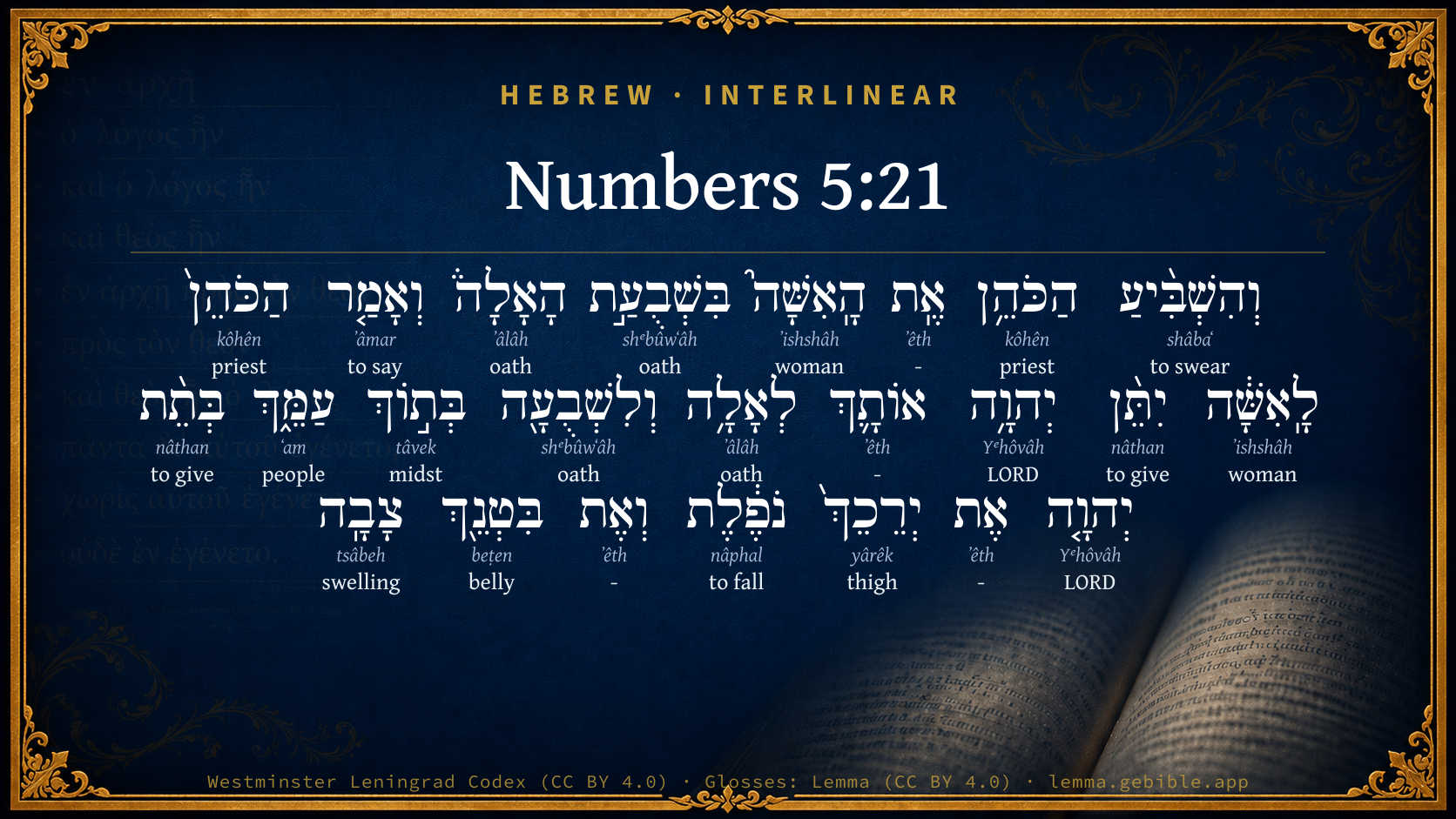
Hebrew (Westminster Leningrad Codex) Numbers 5:21 appears in the Hebrew Old Testament. The text above is from the Westminster Leningrad Codex. Each word links to its Strong’s number, a concise gloss, and parsing drawn from the Open Scriptures Hebrew Bible morphology. Click any word for its full Brown-Driver-Briggs (BDB) entry.
Download image
Cite this verse

Numbers 5:21 (World English Bible). Public Domain. Lemma interlinear Bible study tool, https://lemma.gebible.app/v/numbers/5/21.

Show BibTeX & RIS
BibTeX
RIS
English Translation
then the priest shall cause the woman to swear with the oath of cursing, and the priest shall tell the woman, 'Yahweh make you a curse and an oath among your people, when Yahweh allows your thigh to fall away, and your body to swell;
World English Bible · Public Domain
Highlights
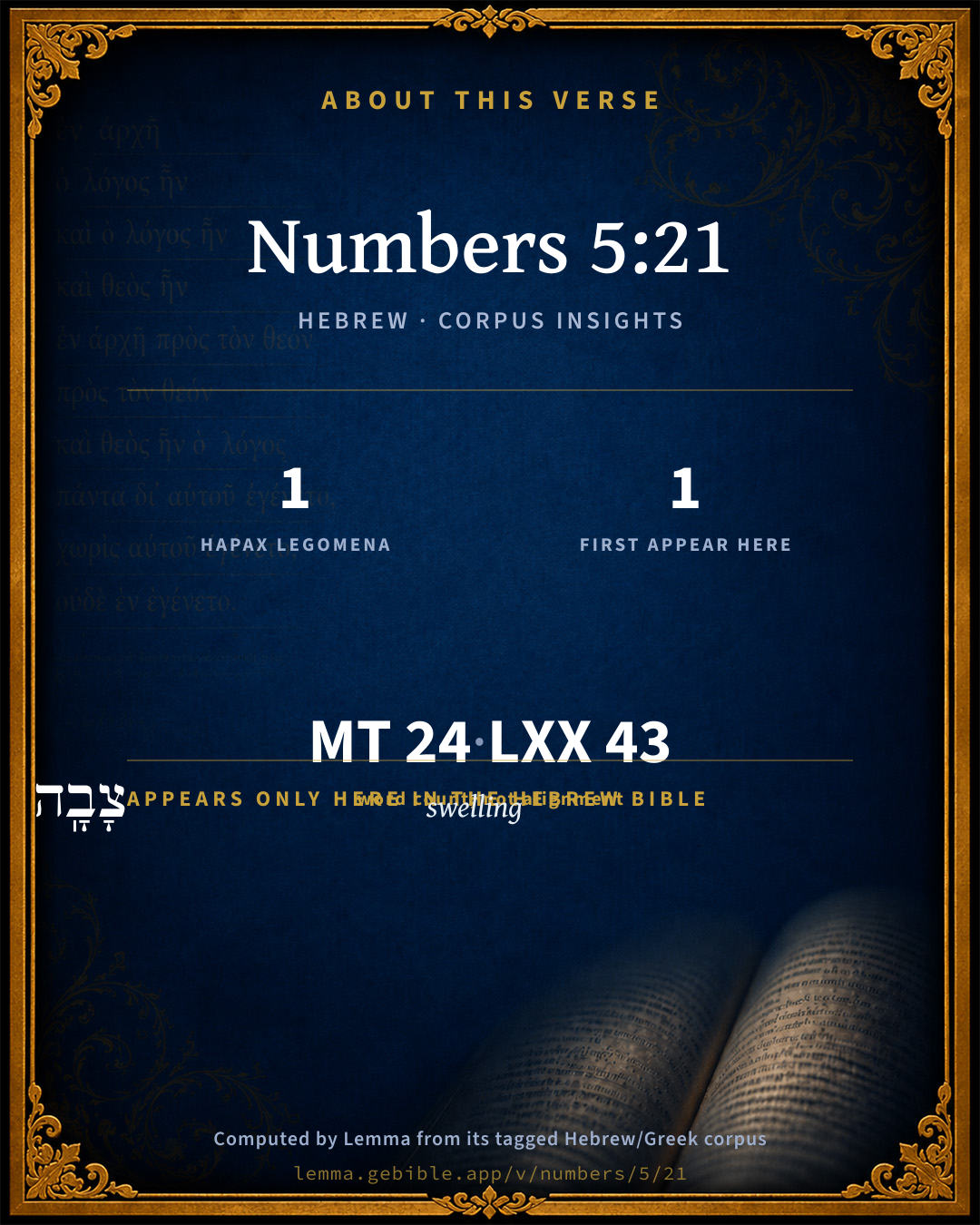
  • 1 hapax legomenon — only here in the Hebrew Bible
  • 1 first appearance in the Hebrew Bible
Full analysis ↓
Download a study sheet

One document with this verse’s original text, its word-by-word gloss line, the meaning frame, cross-references with their text, attributed commentary, and full source and license credits — printable, and it pastes into notes with its structure intact.

This verse Autodidact and up

Study sheet (.html) Plain text (.txt)

A passage Seminary Student

Up to 50 verses in one chapter. A passage sheet keeps up to 6 commentary sources and 12 cross-references per verse, in the order this page ranks them, and says so on the sheet whenever that leaves anything out. Ask for a single verse and you get the Autodidact verse sheet above.

Everything on this page stays free to read, with no account — the sheet is a download of what is already on screen, not access to it.

Want to remove ads? Support Godless Engineer
Compare translations 3

The same verse in 3 English versions, stacked beneath the original-language interlinear above. Click any original word for its lexicon entry.

Each is an independent rendering of the whole verse — the interlinear is not word-aligned to these translations.

Highlighted words mark where these versions differ — a whole-verse word diff, not a word-by-word alignment.

  • World English Bible Public Domain
    then the priest shall cause the woman to swear with the oath of cursing, and the priest shall tell the woman, 'Yahweh make you a curse and an oath among your people, when Yahweh allows your thigh to fall away, and your body to swell;
  • King James Version Public Domain
    Then the priest shall charge the woman with an oath of cursing, and the priest shall say unto the woman, The LORD make thee a curse and an oath among thy people, when the LORD doth make thy thigh to rot, and thy belly to swell;
  • unfoldingWord Literal Text CC BY-SA 4.0
    and the priest shall make the woman swear with the oath of the curse. And the priest shall say to the woman, “Yahweh will give you to a curse and to an oath in the midst of your people when Yahweh gives your thigh falling and your belly swelling.

unfoldingWord Literal Text — © unfoldingWord, licensed CC BY-SA 4.0. Word-aligned USFM3 via Door43 (git.door43.org/unfoldingWord/en_ult).

Versions to compare (up to 4)

3 of 4 selected

Show all 18 translations

Every available English version of this verse, each an independent rendering of the whole verse.

  • World English Bible Public Domain
    then the priest shall cause the woman to swear with the oath of cursing, and the priest shall tell the woman, 'Yahweh make you a curse and an oath among your people, when Yahweh allows your thigh to fall away, and your body to swell;
  • Berean Standard Bible Public Domain
    and the priest shall have the woman swear under the oath of the curse—‘then may the LORD make you an attested curse among your people by making your thigh shrivel and your belly swell.
  • Majority Standard Bible Public Domain
    and the priest shall have the woman swear under the oath of the curse—‘then may the LORD make you an attested curse among your people by making your thigh shrivel and your belly swell.
  • King James Version Public Domain
    Then the priest shall charge the woman with an oath of cursing, and the priest shall say unto the woman, The LORD make thee a curse and an oath among thy people, when the LORD doth make thy thigh to rot, and thy belly to swell;
  • American Standard Version (1901) Public Domain
    then the priest shall cause the woman to swear with the oath of cursing, and the priest shall say unto the woman, Jehovah make thee a curse and an oath among thy people, when Jehovah doth make thy thigh to fall away, and thy body to swell;
  • Revised Version (1885) Public Domain
    then the priest shall cause the woman to swear with the oath of cursing, and the priest shall say unto the woman, The LORD make thee a curse and an oath among thy people, when the LORD doth make thy thigh to fall away, and thy belly to swell;
  • Geneva Bible (1599) Public Domain
    (Then the Priest shall charge the woman with an othe of cursing, and the Priest shall say vnto the woman) The Lord make thee to be accursed, and detestable for the othe among thy people, and the Lord cause thy thigh to rot, and thy belly to swell:
  • Douay-Rheims (1899) Public Domain
    These curses shall light upon thee: The Lord make thee a curse, and an example for all among his people: may he make thy thigh to rot, and may thy belly swell and burst asunder.
  • Young's Literal Translation Public Domain
    (then the priest hath caused the woman to swear with an oath of execration, and the priest hath said to the woman) -- Jehovah doth give thee for an execration, and for a curse, in the midst of thy people, in Jehovah's giving thy thigh to fall, and thy belly to swell,
  • Literal Standard Version CC BY-SA 4.0
    then the priest has caused the woman to swear with an oath of execration, and the priest has said to the woman—YHWH gives you for an execration and for a curse in the midst of your people, in YHWH’s giving your thigh to fall and your belly to swell,
  • Unlocked Literal Bible CC BY-SA 4.0
    then, (the priest must cause the woman to swear an oath that can bring down a curse on her, and then he must continue speaking to the woman) 'Yahweh will make you into a curse that will be shown to your people to be such. This will happen if Yahweh causes your thigh to waste away and your abdomen to swell.
  • unfoldingWord Literal Text CC BY-SA 4.0
    and the priest shall make the woman swear with the oath of the curse. And the priest shall say to the woman, “Yahweh will give you to a curse and to an oath in the midst of your people when Yahweh gives your thigh falling and your belly swelling.
  • Darby Bible Public Domain
    -- then the priest shall adjure the woman with the oath of cursing, and the priest shall say unto the woman: Jehovah make thee a curse and an oath among thy people, when Jehovah doth make thy thigh to shrink, and thy belly to swell;
  • World Messianic Bible Public Domain
    then the priest shall cause the woman to swear with the oath of cursing, and the priest shall tell the woman, “May the LORD make you a curse and an oath among your people, when the LORD allows your thigh to fall away, and your body to swell;
  • Webster's Bible Public Domain
    Then the priest shall charge the woman with an oath of cursing, and the priest shall say to the woman, The LORD make thee a curse and an oath among thy people, when the LORD doth make thy thigh to perish, and thy belly to swell;
  • Free Bible Version CC BY-SA 4.0
    (Here the priest shall place the woman under the oath of the curse as follows.) “May the Lord place a curse on you that everyone knows about by having your thighs shrink and your belly swell up.
  • Bible in Basic English Public Domain
    Then the priest will put the oath of the curse on the woman, and say to her, May the Lord make you a curse and an oath among your people, sending on you wasting of the legs and disease of the stomach;
  • JPS Tanakh (1917) Public Domain
    then the priest shall cause the woman to swear with the oath of cursing, and the priest shall say unto the woman — the LORD make thee a curse and an oath among thy people, when the LORD doth make thy thigh to fall away, and thy belly to swell;

Literal Standard Version (2020), Covenant Press — licensed CC BY-SA 4.0. Text via the HelloAO Bible API (eBible.org). Unlocked Literal Bible (unfoldingWord) — licensed CC BY-SA 4.0. Text via the HelloAO Bible API (eBible.org). unfoldingWord Literal Text — © unfoldingWord, licensed CC BY-SA 4.0. Word-aligned USFM3 via Door43 (git.door43.org/unfoldingWord/en_ult). Free Bible Version, Dr. Jonathan Gallagher — licensed CC BY-SA 4.0. Text via the HelloAO Bible API (eBible.org).

Word by word

More ways to search: Search by grammar → Find every occurrence → Compare this word →

Practice this passage: Drill this verse → Learn its vocabulary →

צָבָֽה
tsâbeh
H6639
“swelling”
Adjective, Adjective, Feminine, Singular, Absolute
Part of Speech
Adjective
Type
Adjective
Gender
Feminine
Number
Singular
State
Absolute
Full BDB Definition

Origin: from H6638

TWOT: 1868a

swelling, swollen
  1. וְהִשְׁבִּ֨יעַ shâbaʻ H7650 “and · to swear” Conjunction + Verb, Hiphil, Sequential Perfect, 3rd Person, Masculine, Singular
  2. הַכֹּהֵ֥ן kôhên H3548 “the · priest” Particle, Definite Article + Noun, Common, Masculine, Singular, Absolute
  3. אֶֽת ʼêth H853 “-” Particle, Direct Object
  4. הָֽאִשָּׁה֮ ʼishshâh H802 “the · woman” Particle, Definite Article + Noun, Common, Feminine, Singular, Absolute
  5. בִּשְׁבֻעַ֣ת shᵉbûwʻâh H7621 “in/at · oath of” Preposition + Noun, Common, Feminine, Singular, Construct
  6. הָאָלָה֒ ʼâlâh H423 “the · oath” Particle, Definite Article + Noun, Common, Feminine, Singular, Absolute
  7. וְאָמַ֤ר ʼâmar H559 “and · to say” Conjunction + Verb, Qal, Sequential Perfect, 3rd Person, Masculine, Singular
  8. הַכֹּהֵן֙ kôhên H3548 “the · priest” Particle, Definite Article + Noun, Common, Masculine, Singular, Absolute
  9. לָֽאִשָּׁ֔ה ʼishshâh H802 “to/for the · woman” Preposition, Determined + Noun, Common, Feminine, Singular, Absolute
  10. יִתֵּ֨ן nâthan H5414 “to give” Verb, Qal, Imperfect, 3rd Person, Masculine, Singular
  11. יְהוָ֥ה Yᵉhôvâh H3068 “LORD” Noun, Proper
  12. אוֹתָ֛ךְ ʼêth H853 “- · you” Particle, Direct Object + Suffix, Personal, 2nd Person, Feminine, Singular
  13. לְאָלָ֥ה ʼâlâh H423 “to/for · oath” Preposition + Noun, Common, Feminine, Singular, Absolute
  14. וְלִשְׁבֻעָ֖ה shᵉbûwʻâh H7621 “and · to/for · oath” Conjunction + Preposition + Noun, Common, Feminine, Singular, Absolute
  15. בְּת֣וֹךְ tâvek H8432 “in/at · midst of” Preposition + Noun, Common, Masculine, Singular, Construct
  16. עַמֵּ֑ךְ ʻam H5971 “people · your” Noun, Common, Masculine, Singular, Construct + Suffix, Personal, 2nd Person, Feminine, Singular
  17. בְּתֵ֨ת nâthan H5414 “in/at · to give” Preposition + Verb, Qal, Infinitive Construct
  18. יְהוָ֤ה Yᵉhôvâh H3068 “LORD” Noun, Proper
  19. אֶת ʼêth H853 “-” Particle, Direct Object
  20. יְרֵכֵךְ֙ yârêk H3409 “thigh · your” Noun, Common, Feminine, Singular, Construct + Suffix, Personal, 2nd Person, Feminine, Singular
  21. נֹפֶ֔לֶת nâphal H5307 “falling” Verb, Qal, Participle Active, Feminine, Singular, Absolute
  22. וְאֶת ʼêth H853 “and · -” Conjunction + Particle, Direct Object
  23. בִּטְנֵ֖ךְ beṭen H990 “belly · your” Noun, Common, Feminine, Singular, Construct + Suffix, Personal, 2nd Person, Feminine, Singular

About this verse

These counts appear in no published source. They are computed here, from the morphology-tagged text and Lemma’s own curated glosses. What Lemma adds →

24
words
15
distinct lemmas
Pentateuch
section

Notable vocabulary

1 hapax legomenon — a word that appears only here in the entire Hebrew Bible:

  • צָבָֽה swelling H6639

First appearance in Scripture

This word makes its first canonical appearance in the Hebrew Bible here:

  • צָבָֽה swelling H6639

Shared distinctive vocabulary

בִּשְׁבֻעַ֣ת oath H7621 occurs in 29 verses of the Hebrew Bible. Also found in:

Grammatical profile

  • 5 verbs
  • 14 nouns
  • 1 adjective
  • 4 particles

Verb forms

  • וְהִשְׁבִּ֨יעַ Hiphil · Sequential Perfect
  • וְאָמַ֤ר Qal · Sequential Perfect
  • יִתֵּ֨ן Qal · Imperfect
  • בְּתֵ֨ת Qal · Infinitive Construct
  • נֹפֶ֔לֶת Qal · Participle Active

Repetition

Words recur within this verse — often emphatic in Hebrew:

  • הַכֹּהֵ֥ן priest H3548 ×2
  • הָֽאִשָּׁה֮ woman H802 ×2
  • בִּשְׁבֻעַ֣ת oath H7621 ×2
  • הָאָלָה֒ oath H423 ×2
  • יִתֵּ֨ן to give H5414 ×2
  • יְהוָ֥ה LORD H3068 ×2

Hebrew & Septuagint length

In English translation the verse runs 45 words from the Hebrew and 53 from the Septuagint (LXX English) — closely comparable.

A rough comparison of the two English renderings, which tokenize alike — not a word-level alignment.

Word counts can differ between the Hebrew and the Greek without any difference in meaning — e.g. the Hebrew direct-object marker אֵת has no separate Greek word, and Greek often adds the article ὁ.

In the original languages it is 24 Hebrew tokens and 43 Greek tokens — but the two are counted differently (Hebrew bundles its prefixes and suffixes into one token; the Greek is in lemma form), so that isn’t a like-for-like length.

Cross-references

8

Topical passages linked to Numbers 5:21 in the Treasury of Scripture Knowledge — connected by theme and wording, ordered by reader-vote popularity; previews shown in the World English Bible.

  • Joshua 6:26 Joshua charged them with an oath at that time, saying, Cursed be the man before Yahweh, that rises up and builds this city Jericho: with the loss of his firstborn shall he lay the foundation of it, and with the loss of his youngest son shall he set up the gates of it.
  • 1 Samuel 14:24 The men of Israel were distressed that day; for Saul had adjured the people, saying, Cursed be the man who eats any food until it be evening, and I be avenged on my enemies. So none of the people tasted food.
  • Nehemiah 10:29 They joined with their brothers, their nobles, and entered into a curse, and into an oath, to walk in God's law, which was given by Moses the servant of God, and to observe and do all the commandments of Yahweh our Lord, and his ordinances and his statutes;
  • Jeremiah 29:22 and of them shall be taken up a curse by all the captives of Judah who are in Babylon, saying, Yahweh make you like Zedekiah and like Ahab, whom the king of Babylon roasted in the fire;
  • 2 Chronicles 21:15 and you shall have great sickness by disease of your bowels, until your bowels fall out by reason of the sickness, day by day.
  • Proverbs 10:7 The memory of the righteous is blessed, But the name of the wicked will rot.
  • Isaiah 65:15 You shall leave your name for a curse to my chosen; and the Lord Yahweh will kill you; and he will call his servants by another name:
  • Matthew 26:74 Then he began to curse and to swear, "I don't know the man!" Immediately the rooster crowed.

Cross-references courtesy of OpenBible.info (CC BY 4.0).

Hebrew and Greek witnesses Masoretic Hebrew ↔ Greek Septuagint

The same verse in the two great witnesses to the Old Testament, shown verse-for-verse.

These are two independent witnesses, not word-aligned to each other, and the Septuagint is shown in lemma (dictionary) form.

Hebrew Numbers 5:21 Masoretic · Westminster Leningrad Codex

וְהִשְׁבִּ֨יעַ הַכֹּהֵ֥ן אֶֽת הָֽאִשָּׁה֮ בִּשְׁבֻעַ֣ת הָאָלָה֒ וְאָמַ֤ר הַכֹּהֵן֙ לָֽאִשָּׁ֔ה יִתֵּ֨ן יְהוָ֥ה אוֹתָ֛ךְ לְאָלָ֥ה וְלִשְׁבֻעָ֖ה בְּת֣וֹךְ עַמֵּ֑ךְ בְּתֵ֨ת יְהוָ֤ה אֶת יְרֵכֵךְ֙ נֹפֶ֔לֶת וְאֶת בִּטְנֵ֖ךְ צָבָֽה

then the priest shall cause the woman to swear with the oath of cursing, and the priest shall tell the woman, 'Yahweh make you a curse and an oath among your people, when Yahweh allows your thigh to fall away, and your body to swell;

World English Bible · Public Domain

Greek LXX Numbers 5:21 Septuagint · lemma form

καί ὁρκίζω ὁ ἱερεύς ὁ γυνή ἐν ὁ ὅρκος ὁ ἀρά οὗτος καί εἶπον ὁ ἱερεύς ὁ γυνή δίδωμι κύριος σύ ἐν ἀρά καί ἐνόρκιος ἐν μέσος ὁ λαός σύ ἐν ὁ δίδωμι κύριος ὁ μηρός σύ διαπίπτω καί ὁ κοιλία σύ πρήθω

then the priest shall adjure the woman by the oaths of this curse, and the priest shall say to the woman, The Lord bring you into a curse and under an oath in the midst of your people, in that the Lord should cause your thigh to rot and your belly to swell;

LXX2012 (modern English Septuagint) · Public Domain

On this verse, Whedon's Commentary on the Bible discusses the Septuagint’s reading. Read the note in Commentary ↓

Hebrew: Westminster Leningrad Codex (CC BY 4.0). Greek: Septuagint (public domain); English from LXX2012 (modern English Septuagint) (Public Domain). How the Septuagint differs from the Hebrew →

Targum (Aramaic paraphrase)

2

The Targum is the ancient Jewish Aramaic paraphrase of the Hebrew Scriptures — an interpretive translation, not the Hebrew text itself. Onkelos (literal) and Pseudo-Jonathan (expansive) render the Torah, and Jonathan the Prophets. Coverage is partial: where no permissively-licensed English translation exists for a verse, only the Aramaic is shown. This is verse-level text, not a word-by-word alignment to the Hebrew.

  1. Targum Onkelos Torah (Genesis–Deuteronomy)
    וְיוֹמֵי כַהֲנָא יָת אִתְּתָא בְּמוֹמָתָא דִלְוָטָּא וְיֵימַר כַּהֲנָא לְאִתְּתָא יִתֵּן יְיָ יָתִיךְ לִלְוַטּ וּלְמוֹמֵי בְּגוֹ עַמִיךְ בִּדְיִתֵּן יְיָ יָת יַרְכִּיךְ מַסְיָא וְיָת מְעַיְכִי נְפִיחִין

    (no public-domain English translation for this verse)

    Targum Onkelos — Aramaic: “Onkelos Genesis” (public domain); “Onkelos Exodus” (public domain); “Onkelos Leviticus” (public domain); “Onkelos Numbers” (public domain); “Onkelos Deuteronomy” (public domain). English: “Sefaria Community Translation” (CC0 1.0 (public-domain dedication)); “J.W. Etheridge. The Targums of Onkelos and Jonathan Ben Uzziel on the Pentateuch. London: Longmans, Green, 1862” (public domain). Text via Sefaria.

  2. Targum Pseudo-Jonathan Torah (Genesis–Deuteronomy)
    וְיוֹמֵי כַּהֲנָא יַת אִתְּתָא בְּקִיוּם זְנוּמְתָּא וְיֵימַר כַּהֲנָא לְאִתְּתָא יִתֵּן יְיָ יָתִיךְ לִלְוַט וְלִמְמוֹמֵי בְּגוֹ בְּנֵי עַמִיךְ בִּדְיִתֵּן יְיָ יַת יְרֵכוֹנֵךְ מִתְמַסְיָן וְיַת כַּרְסִיךְ מְנַפְחָא

    Then shall the priest adjure the woman by the oath of malediction, and say to the woman,-The Lord make thee a curse and an execration among the children of thy people, in causing thy thigh to corrupt, and thy belly to swell;.

    Targum Pseudo-Jonathan — Aramaic: “Targum Jonathan on Genesis” (public domain); “Targum Jonathan on Exodus” (public domain); “Targum Jonathan on Leviticus” (public domain); “Targum Jonathan on Numbers” (public domain); “Targum Jonathan on Deuteronomy” (public domain). English: “The Targum of Jonathan ben Uzziel, trans. J. W. Etheridge, London, 1862” (public domain). Text via Sefaria.

Commentary

Notes on Numbers 5:21 from classic Christian and Jewish commentators (each source and its license shown beneath its notes). The classic Christian expositions comment on the surrounding passage and are grouped to its opening verse, so a note may address several verses; the Jewish commentaries on the Tanakh (Rashi and others) are per-verse, so they appear only where the commentator wrote on this verse.

Lemma curates 59 commentaries, every one of them public domain or Creative Commons licensed, each selected and text-cleaned for this edition rather than reprinted as found. About our sources →

Trapp's Complete Commentary

John Trapp

Num 5:21 Then the priest shall charge the woman with an oath of cursing, and the priest shall say unto the woman, The LORD make thee a curse and an oath among thy people, when the LORD doth make thy thigh to rot, and thy belly to swell;

Ver. 21. Thy thigh to rot, and thy belly to swell.] God takes notice of the offending member; as he did in those blasphemers, who gnawed their tongues; {Rev 16:10} Absalom’s hair; Jeroboam’s hand; the adulterer’s loins; {Pro 5:11} Zimri and Cozbi, thrust through the belly. {Num 25:8} Charles II, King of Navarre, Joan, Queen of Naples, &c., suffered as they sinned.

John Trapp, A Commentary or Exposition upon All the Books of the Old and New Testament (1647–1656) — public domain. Text from a community e-Sword module.

Tyndale Open Study Notes

Tyndale Open Resources

5:21 when he makes you infertile, causing your womb to shrivel: Literally when he causes your thigh to waste away. “Thigh” is a euphemism for the reproductive organs (cp. Gen 24:2; 47:29); something would go wrong with her reproductive abilities. The punishment suited the crime as sexual immorality resulted in the inability to have children.

Tyndale Open Study Notes — © Tyndale Open Resources, licensed CC BY-SA 4.0. Text via the HelloAO Bible API.

Geneva Bible (1599)

Geneva Bible translators

Hebrew, to fall.

Both because she had committed so heinous a fault, and forsware herself in denying the same.

Geneva Bible (1599) marginal notes — public domain. Text via Bolls.life.

Jamieson, Fausset & Brown

Robert Jamieson, A. R. Fausset & David Brown

The Lord make thee a curse, &c.--a usual form of imprecation (Isa 65:15; Jer 29:22).

Jamieson, Fausset & Brown — Commentary Critical and Explanatory on the Whole Bible (1871) — public domain (CC PDM 1.0). Text via the HelloAO Bible API.

Adam Clarke's Commentary

Verse 21. The Lord make thee a curse and an oath] Let thy name and punishment be remembered and mentioned as an example and terror to all others. Like that mentioned Jer 29:22-23: "The Lord make thee like Zedekiah, and like Ahab, whom the king of Babylon roasted in the fire, because they have committed villany in Israel, and have committed adultery with their neighbours' wives." - Ainsworth.

Adam Clarke's Commentary on the Bible (1810–1826) — public domain. Text from a community e-Sword/MySword module.

John Gill's Exposition

Then the priest shall charge the woman with an oath of cursing,.... An oath which has a curse annexed to it, if taken falsely, which was to be pronounced upon the woman if guilty:

and the priest shall say unto the woman; pronouncing the imprecation or curse upon her, she having taken the oath, should she be guilty of the crime suspected of, and she had swore concerning:

the Lord make thee a curse, and an oath among the people; accursed according to the oath taken; or let this be the form of an oath and imprecation used by the people, saying, if I have done so and so, let me be accursed as such a woman, or let not that happen to me, as did to such a woman, so Jarchi:

when the Lord doth make thy thigh to rot, and thy belly to swell; upon drinking the bitter waters; but though these things followed upon that, yet not as the natural cause of them, for they are ascribed to the Lord, and to a supernatural and miraculous power of his, which went along with the drinking of them.

John Gill's Exposition of the Whole Bible (1746–1763) — public domain (CC PDM 1.0). Text via the HelloAO Bible API.

Haydock's Catholic Bible Commentary

Curse. Hebrew, "an object of execration, and an oath," &c., so that people can wish no greater misfortune to befall any one, than what thou shalt endure. (Haydock)

George Leo Haydock (1774–1849), Haydock's Catholic Family Bible and Commentary, 1859 edition — public domain. Excludes Psalms (Douay-Rheims chapter numbering differs from Protestant) and Deuterocanonical books (Catholic canon only).

Matthew Poole's English Annotations

An oath, i.e. a form of cursing or imprecatory oaths, that when they would curse a person, they may wish that they may be as cursed and miserable as thou wast upon this occasion. See the phrase Isa 65:15; Jer 29:22 and compare Gen 48:20; Rth 4:11,12.

Thy thigh; a modest signification of the genital parts, used both in Scripture, as Gen 46:26; Exo 1:5, and other authors, that the sin might be evident in the punishment.

To rot, Heb. to fall, i.e. to die or waste away, as the word is used, 1Ch 21:14, compared with 2Sa 24:15.

To swell, suddenly and violently till it burst, which the Jews note was frequent in this and like cases, as Exo 32:20. And it was a clear evidence of the truth of their religion.

Matthew Poole's English Annotations on the Holy Bible (1683–1685) — public domain. Text from a community e-Sword/MySword module.

Whedon's Commentary on the Bible

Daniel D. Whedon

21. The Lord make thee… an oath — So signal a mark of Jehovah’s wrath was she to bear, that in future adjurations she was to be held up as the conspicuous example and measure of his vengeance, and the imprecation was to be, “May I become like this accursed woman!”

Make thy thigh to rot — Hebrew, to fall.

Belly to swell — Greek, to be burnt. The precise nature of the punishment here threatened is more clearly gathered from the original. The thigh is a euphemism for the sexual organs.

Gen_46:26. Hence the painful infliction, the falling of the womb, attended by an inflammation, which, in the Septuagint, is rendered by the word burn. Michaelis suggests that an ovarian tumour, with its dreadful suffering and emaciation, is here denounced as the penalty. Josephus calls it the ordinary dropsy. Theodoret says, “The punishment shall come from the same source as the sin.” See Rom_6:19. The instrument of the momentary sin shall be the channel through which the penal pain shall be poured during all the life of the convicted adulteress. Verily, “the way of the transgressor is hard.”

Daniel D. Whedon (gen. ed.), Commentary on the Old and New Testaments (1874–1909) — public domain. Text from a community e-Sword module.

The Pulpit Commentary

Then the priest shall say unto the woman. These words are parenthetical, just as in Mat_9:6. The latter part of the oath is called "an oath of cursing," because it contained the imprecations on the guilty. To rot. Hebrew, "to fall." Ton sou diapeptwkota , Septuagint. To swell. The Hebrew zabeh is not of quite certain meaning, but probably this.

The Pulpit Commentary (1880–1919), ed. H.D.M. Spence-Jones & Joseph S. Exell — public domain. Text from a community e-Sword module.

John Wesley's Explanatory Notes

An oath - That is, a form of cursing, that when they would curse a person, they may wish that they may be as miserable as thou wast. Thy thigh - A modest expression, used both in scripture, as Gen. xlvi, 26, Exod. i, 5, and other authors. To rot - Hebrew. to fall, that is, to die or waste away. To swell - Suddenly and violently till it burst, which the Jews note was frequent in this case. And it was a clear evidence of the truth of their religion.

John Wesley, Explanatory Notes Upon the Whole Bible (1754–1765) — public domain. Text via the GEBible commentary corpus.

Rashi

Rabbi Shlomo Yitzchaki (Rashi)

בשבעת האלה [AND THE PRIEST SHALL ADJURE THE WOMAN] WITH AN ADJURATION OF CURSING — i.e., an oath which contains the curse.

יתן ה’ אותך לאלה THE LORD MAKE THEE AN EXECRATION — i.e. that everybody will curse through thee (i.e., by mention of thy name), saying, “May misfortune come upon you just as it came upon Mrs. so-and-so!”

ולשבעה [THE LORD MAKE THEE AN EXECRATION] AND AN OATH — This means, that everybody will swear through thee (i.e., by mention of thy name) — “If not (i.e., if I am not speaking the truth) may misfortune happen to me just as it happened to Mrs. So-and-so!” In a similar sense it states, (Isaiah 65:15) “and ye shall leave your name as an oath unto my chosen” which means that the righteous take an oath by mention of the punishment that came upon evil-doers. So, too, in reference to the blessing, does it state, (Genesis 12:3) “and through thee (i.e., by mention of thy name) shall bless themselves [all the families of the earth]”; (Genesis 48:20) “By thee shall Israel bless, saying, [God make thee as Ephraim and as Manasseh]” (Sifrei Bamidbar 14).

את ירכך [WHEN THE LORD DOTH MAKE] THY THIGH [TO FALL, AND THY BELLY TO SWELL] — In uttering the curse that will befall her because of her sin he mentions the thigh before the belly (whilst in v. 22 the belly is stated to be affected first), because with it (the thigh) she began to sin (cf. Sotah 8b, 9b).

צבה — Understand this as the Targum does: SWOLLEN.

Rashi on the Tanakh — English translations: “The Judaica Press complete Tanach with Rashi, translated by A. J. Rosenberg” (CC BY 4.0); “Pentateuch with Rashi's commentary by M. Rosenbaum and A.M. Silbermann, 1929-1934” (public domain); “The Metsudah Tanach series, Lakewood, N.J” (CC BY 4.0); and “The Book of Joshua, Metsudah Publications, 1997” (CC BY 4.0). Text via Sefaria.

Lesson kit

Teaching starters — assembled from the data on this page, not authored interpretation. Every prompt links to the verse data it draws on. Edit before teaching.

Numbers, in the Pentateuch, opens this verse with 24 words (15 distinct Hebrew lemmas). Its most distinctive word is tsâbeh (“swelling”). A historical commentator’s framing appears above. Read the whole chapter for the surrounding context.

Discussion questions

  1. The word tsâbeh carries the sense “swelling.” How does it shape the verse?
  2. This verse holds 1 word here found nowhere else in the Hebrew Bible. What might the rare word draw attention to?
  3. The word “swelling” first appears here in Scripture. What is being introduced at this debut?
  4. Genesis 24:8 shares the word «oath» with this verse. How do the two illuminate each other?
  5. “priest” occurs 2× in this one verse. What is the effect of the repetition?
  6. The translations on this page render this verse differently — a whole-verse word diff, not a word-by-word alignment. What might account for the different wordings?
  7. The verb «וְהִשְׁבִּ֨יעַ» is Hiphil Sequential Perfect. How does its form color the action?
  8. Reading how Trapp's Complete Commentary and Tyndale Open Study Notes read this verse, where do the two commentators agree and where do they part?

Things to notice

  • 1 word in this verse appears nowhere else in the Hebrew Bible.
  • 1 word makes its first canonical appearance in Scripture here.
  • This verse counts 24 Hebrew ↔ 43 Greek words.
  • These translations choose different wording for 23 words in this verse.
  • “priest” occurs 2× in this single verse.

Reading settings

Reading text

Shown beneath each verse's original-language words.

Old Testament
Old Testament edition

Read the OT as the Masoretic Hebrew (MT) or the Greek Septuagint (LXX).

English shown for the Greek Septuagint (in the Hebrew ↔ Greek comparison).

Comparing translations? Open the Compare panel on any verse page to stack up to four side by side.