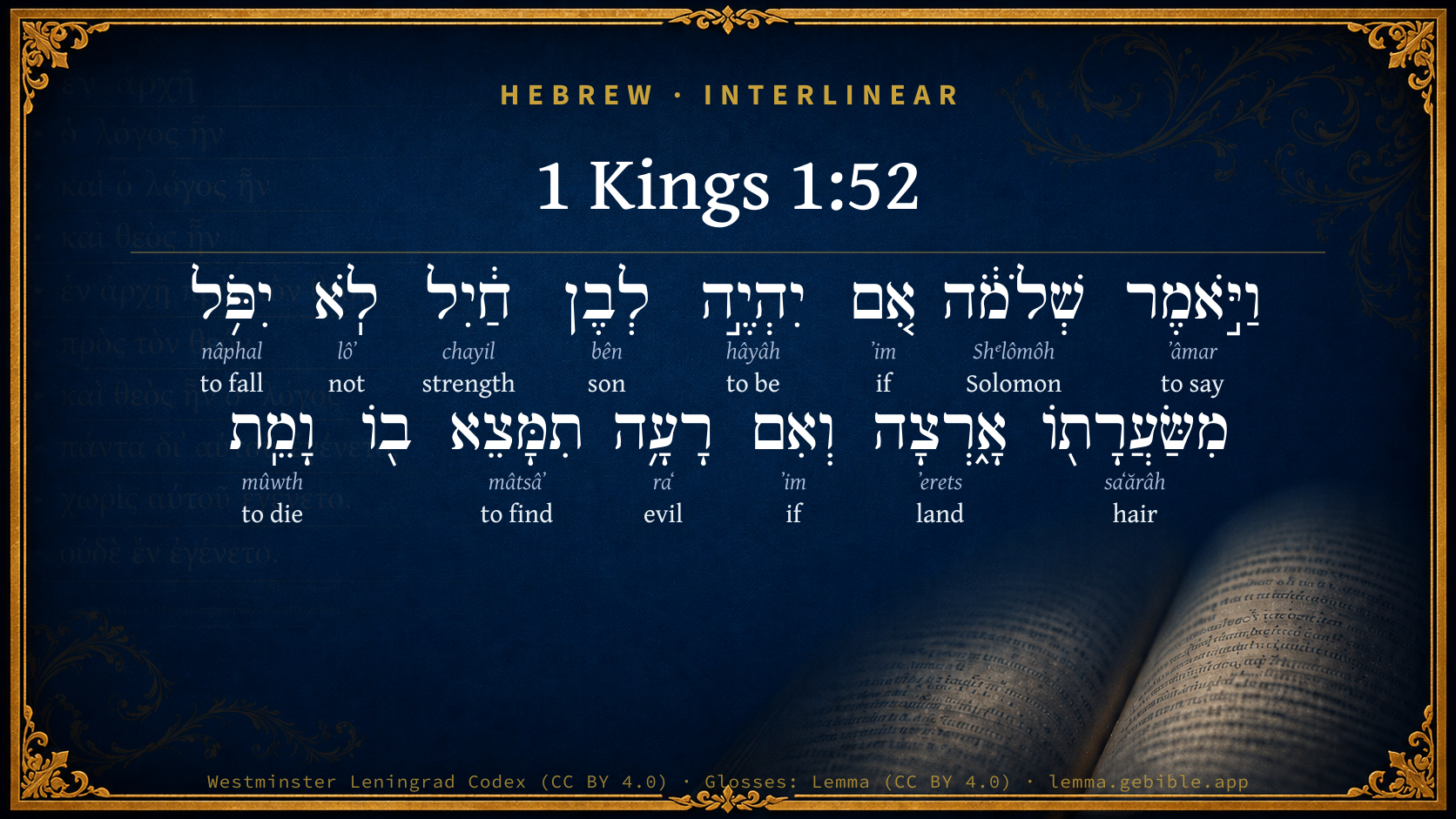
1 Kings 1:52

Hebrew (Westminster Leningrad Codex) 1 Kings 1:52 appears in the Hebrew Old Testament. The text above is from the Westminster Leningrad Codex. Each word links to its Strong’s number, a concise gloss, and parsing drawn from the Open Scriptures Hebrew Bible morphology. Click any word for its full Brown-Driver-Briggs (BDB) entry.
Download image
Cite this verse

1 Kings 1:52 (World English Bible). Public Domain. Lemma interlinear Bible study tool, https://lemma.gebible.app/v/1-kings/1/52.

Show BibTeX & RIS
BibTeX
RIS
English Translation
Solomon said, If he shall show himself a worthy man, there shall not a hair of him fall to the earth; but if wickedness be found in him, he shall die.
World English Bible · Public Domain
Download a study sheet

One document with this verse’s original text, its word-by-word gloss line, the meaning frame, cross-references with their text, attributed commentary, and full source and license credits — printable, and it pastes into notes with its structure intact.

This verse Autodidact and up

Study sheet (.html) Plain text (.txt)

A passage Seminary Student

Up to 50 verses in one chapter. A passage sheet keeps up to 6 commentary sources and 12 cross-references per verse, in the order this page ranks them, and says so on the sheet whenever that leaves anything out. Ask for a single verse and you get the Autodidact verse sheet above.

Everything on this page stays free to read, with no account — the sheet is a download of what is already on screen, not access to it.

Want to remove ads? Support Godless Engineer
Compare translations 3

The same verse in 3 English versions, stacked beneath the original-language interlinear above. Click any original word for its lexicon entry.

Each is an independent rendering of the whole verse — the interlinear is not word-aligned to these translations.

Highlighted words mark where these versions differ — a whole-verse word diff, not a word-by-word alignment.

  • World English Bible Public Domain
    Solomon said, If he shall show himself a worthy man, there shall not a hair of him fall to the earth; but if wickedness be found in him, he shall die.
  • King James Version Public Domain
    And Solomon said, If he will show himself a worthy man, there shall not an hair of him fall to the earth: but if wickedness shall be found in him, he shall die.
  • unfoldingWord Literal Text CC BY-SA 4.0
    And Solomon said, “If he will be a son of valor, from his hair shall not fall to the ground. But if evil is found in him, then he shall die.”

unfoldingWord Literal Text — © unfoldingWord, licensed CC BY-SA 4.0. Word-aligned USFM3 via Door43 (git.door43.org/unfoldingWord/en_ult).

Versions to compare (up to 4)

3 of 4 selected

Show all 18 translations

Every available English version of this verse, each an independent rendering of the whole verse.

  • World English Bible Public Domain
    Solomon said, If he shall show himself a worthy man, there shall not a hair of him fall to the earth; but if wickedness be found in him, he shall die.
  • Berean Standard Bible Public Domain
    And Solomon replied, “If he is a man of character, not a single hair of his will fall to the ground. But if evil is found in him, he will die.”
  • Majority Standard Bible Public Domain
    And Solomon replied, “If he is a man of character, not a single hair of his will fall to the ground. But if evil is found in him, he will die.”
  • King James Version Public Domain
    And Solomon said, If he will show himself a worthy man, there shall not an hair of him fall to the earth: but if wickedness shall be found in him, he shall die.
  • American Standard Version (1901) Public Domain
    And Solomon said, If he shall show himself a worthy man, there shall not a hair of him fall to the earth; but if wickedness be found in him, he shall die.
  • Revised Version (1885) Public Domain
    And Solomon said, If he shall shew himself a worthy man, there shall not an hair of him fall to the earth: but if wickedness be found in him, he shall die.
  • Geneva Bible (1599) Public Domain
    Then Salomon sayd, If he will shewe him selfe a worthy man, there shall not an heare of him fall to the earth, but if wickednes be found in him, he shall dye.
  • Douay-Rheims (1899) Public Domain
    And Solomon said: If he be a good man, there shall not so much as one hair of his head fall to the ground: but if evil be found in him, he shall die.
  • Young's Literal Translation Public Domain
    And Solomon saith, `If he becometh a virtuous man -- there doth not fall of his hair to the earth, and if evil is found in him -- then he hath died.'
  • Literal Standard Version CC BY-SA 4.0
    And Solomon says, “If he becomes a virtuous man—there does not fall [even one] hair of his to the earth, and if evil is found in him—then he has died.”
  • Unlocked Literal Bible CC BY-SA 4.0
    Solomon said, “If he will show himself a worthy man, not a hair of his will fall to the earth, but if wickedness is found in him, he will die.”
  • unfoldingWord Literal Text CC BY-SA 4.0
    And Solomon said, “If he will be a son of valor, from his hair shall not fall to the ground. But if evil is found in him, then he shall die.”
  • Darby Bible Public Domain
    And Solomon said, If he be a worthy man, there shall not one of his hairs fall to the earth; but if wickedness be found in him, he shall die.
  • World Messianic Bible Public Domain
    Solomon said, “If he shows himself a worthy man, not a hair of his shall fall to the earth; but if wickedness is found in him, he shall die.”
  • Webster's Bible Public Domain
    And Solomon said, If he will show himself a worthy man, there shall not a hair of him fall to the earth: but if wickedness shall be found in him, he shall die.
  • Free Bible Version CC BY-SA 4.0
    Solomon replied, “If he is an honorable man, not one hair of his will fall to the ground. But if he shows himself to be evil, he will die.”
  • Bible in Basic English Public Domain
    And Solomon said, If he is seen to be a man of good faith, not a hair of him will be touched; but if any wrongdoing is seen in him, he is to be put to death.
  • JPS Tanakh (1917) Public Domain
    And Solomon said: 'If he shall show himself a worthy man, there shall not a hair of him fall to the earth; but if wickedness be found in him, he shall die.'

Literal Standard Version (2020), Covenant Press — licensed CC BY-SA 4.0. Text via the HelloAO Bible API (eBible.org). Unlocked Literal Bible (unfoldingWord) — licensed CC BY-SA 4.0. Text via the HelloAO Bible API (eBible.org). unfoldingWord Literal Text — © unfoldingWord, licensed CC BY-SA 4.0. Word-aligned USFM3 via Door43 (git.door43.org/unfoldingWord/en_ult). Free Bible Version, Dr. Jonathan Gallagher — licensed CC BY-SA 4.0. Text via the HelloAO Bible API (eBible.org).

Word by word

More ways to search: Search by grammar → Find every occurrence → Compare this word →

Practice this passage: Drill this verse → Learn its vocabulary →

מִשַּׂעֲרָת֖וֹ
saʻărâh
H8185
“from · hair · his”
Preposition + Noun, Common, Feminine, Singular, Construct + Suffix, Personal, 3rd Person, Masculine, Singular
Part of Speech
Preposition + Noun
Type
Common
Gender
Feminine
Number
Singular
State
Construct
Full BDB Definition

Origin: from H8181

TWOT: 2274b

a single hair
  1. וַיֹּ֣אמֶר ʼâmar H559 “and · to say” Conjunction + Verb, Qal, Sequential Imperfect, 3rd Person, Masculine, Singular
  2. שְׁלֹמֹ֔ה Shᵉlômôh H8010 “Solomon” Noun, Proper
  3. אִ֚ם ʼim H518 “if” Conjunction
  4. יִהְיֶ֣ה hâyâh H1961 “to be” Verb, Qal, Imperfect, 3rd Person, Masculine, Singular
  5. לְבֶן bên H1121 “to/for · son of” Preposition + Noun, Common, Masculine, Singular, Construct
  6. חַ֔יִל chayil H2428 “strength” Noun, Common, Masculine, Singular, Absolute
  7. לֹֽא lôʼ H3808 “not” Particle, Negative
  8. יִפֹּ֥ל nâphal H5307 “to fall” Verb, Qal, Imperfect, 3rd Person, Masculine, Singular
  9. אָ֑רְצָה ʼerets H776 “land · toward” Noun, Common, Both, Singular, Absolute + Suffix, Demonstrative
  10. וְאִם ʼim H518 “and · if” Conjunction + Conjunction
  11. רָעָ֥ה raʻ H7451 “evil” Noun, Common, Feminine, Singular, Absolute
  12. תִמָּצֵא mâtsâʼ H4672 “to find” Verb, Niphal, Imperfect, 3rd Person, Feminine, Singular
  13. וָמֵֽת mûwth H4191 “and · to die” Conjunction + Verb, Qal, Sequential Perfect, 3rd Person, Masculine, Singular

About this verse

These counts appear in no published source. They are computed here, from the morphology-tagged text and Lemma’s own curated glosses. What Lemma adds →

15
words
13
distinct lemmas
Historical
section

Notable vocabulary

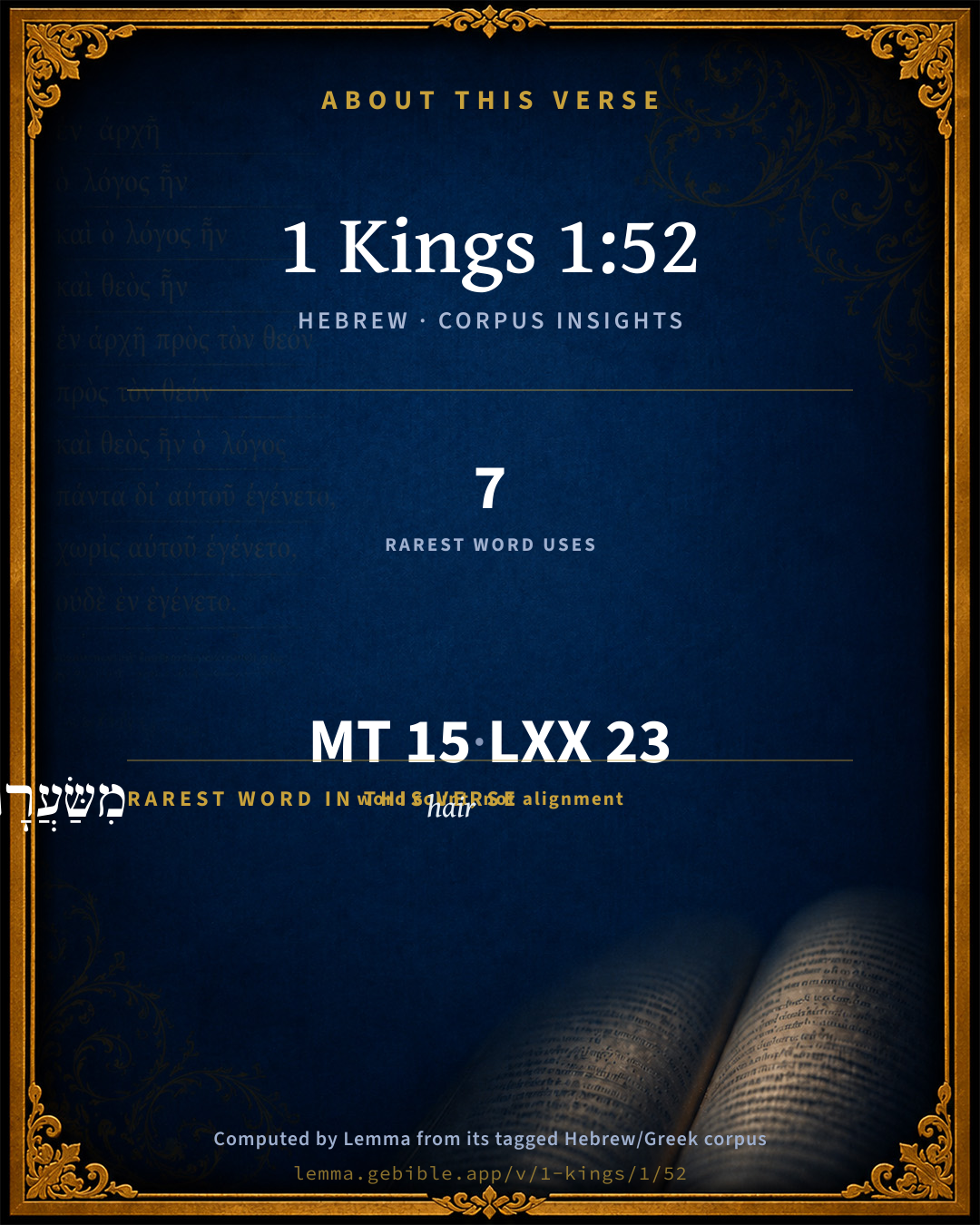
The rarest word here is מִשַּׂעֲרָת֖וֹ hair H8185 — appearing just 7 times in the whole Hebrew Bible.

Shared distinctive vocabulary

מִשַּׂעֲרָת֖וֹ hair H8185 occurs in 7 verses of the Hebrew Bible. Also found in:

Grammatical profile

  • 5 verbs
  • 6 nouns
  • 1 preposition
  • 2 conjunctions
  • 1 particle

Verb forms

  • וַיֹּ֣אמֶר Qal · Sequential Imperfect
  • יִהְיֶ֣ה Qal · Imperfect
  • יִפֹּ֥ל Qal · Imperfect
  • תִמָּצֵא Niphal · Imperfect
  • וָמֵֽת Qal · Sequential Perfect

Repetition

A word recurs within this verse — often emphatic in Hebrew:

  • אִ֚ם if H518 ×2

Hebrew & Septuagint length

In English translation the verse runs 31 words from the Hebrew and 31 from the Septuagint (LXX English) — the same length.

A rough comparison of the two English renderings, which tokenize alike — not a word-level alignment.

Word counts can differ between the Hebrew and the Greek without any difference in meaning — e.g. the Hebrew direct-object marker אֵת has no separate Greek word, and Greek often adds the article ὁ.

In the original languages it is 15 Hebrew tokens and 23 Greek tokens — but the two are counted differently (Hebrew bundles its prefixes and suffixes into one token; the Greek is in lemma form), so that isn’t a like-for-like length.

Cross-references

8

Topical passages linked to 1 Kings 1:52 in the Treasury of Scripture Knowledge — connected by theme and wording, ordered by reader-vote popularity; previews shown in the World English Bible.

  • 1 Samuel 14:45 The people said to Saul, Shall Jonathan die, who has worked this great salvation in Israel? Far from it: as Yahweh lives, there shall not one hair of his head fall to the ground; for he has worked with God this day. So the people rescued Jonathan, that he didn't die.
  • 2 Samuel 14:11 Then said she, Please let the king remember Yahweh your God, that the avenger of blood destroy not any more, lest they destroy my son. He said, As Yahweh lives, there shall not one hair of your son fall to the earth.
  • Proverbs 13:6 Righteousness guards the way of integrity, But wickedness overthrows the sinner.
  • 1 Kings 2:21–25 She said, Let Abishag the Shunammite be given to Adonijah your brother as wife.
  • Job 15:22 He doesn't believe that he shall return out of darkness, He is waited for by the sword.
  • Proverbs 21:12 The Righteous One considers the house of the wicked, And brings the wicked to ruin.
  • Acts 27:34 Therefore I beg you to take some food, for this is for your safety; for not a hair will perish from any of your heads."
  • Luke 21:18 And not a hair of your head will perish.

Cross-references courtesy of OpenBible.info (CC BY 4.0).

Hebrew and Greek witnesses Masoretic Hebrew ↔ Greek Septuagint

The same verse in the two great witnesses to the Old Testament, shown verse-for-verse.

These are two independent witnesses, not word-aligned to each other, and the Septuagint is shown in lemma (dictionary) form.

Hebrew 1 Kings 1:52 Masoretic · Westminster Leningrad Codex

וַיֹּ֣אמֶר שְׁלֹמֹ֔ה אִ֚ם יִהְיֶ֣ה לְבֶן חַ֔יִל לֹֽא יִפֹּ֥ל מִשַּׂעֲרָת֖וֹ אָ֑רְצָה וְאִם רָעָ֥ה תִמָּצֵא ב֖וֹ וָמֵֽת

Solomon said, If he shall show himself a worthy man, there shall not a hair of him fall to the earth; but if wickedness be found in him, he shall die.

World English Bible · Public Domain

Greek LXX 1 Kings 1:52 Septuagint · lemma form

καί εἶπον σαλωμών ἐάν γίγνομαι εἰς υἱός δύναμις εἰ πίπτω ὁ θρίξ αὐτός ἐπί ὁ γῆ καί ἐάν κακία εὑρίσκω ἐν αὐτός θανατόω

And Solomon said, If he should be a valiant man, there shall not a hair of his fall to the ground; but if evil be found in him, he shall die.

LXX2012 (modern English Septuagint) · Public Domain

Hebrew: Westminster Leningrad Codex (CC BY 4.0). Greek: Septuagint (public domain); English from LXX2012 (modern English Septuagint) (Public Domain). How the Septuagint differs from the Hebrew →

Targum (Aramaic paraphrase)

1

The Targum is the ancient Jewish Aramaic paraphrase of the Hebrew Scriptures — an interpretive translation, not the Hebrew text itself. Onkelos (literal) and Pseudo-Jonathan (expansive) render the Torah, and Jonathan the Prophets. Coverage is partial: where no permissively-licensed English translation exists for a verse, only the Aramaic is shown. This is verse-level text, not a word-by-word alignment to the Hebrew.

  1. Targum Jonathan Prophets (Joshua–Malachi)
    וַאֲמַר שְׁלֹמֹה אִם יְהֵי לִגְבַר דָחִיל חֵטְאִין לָא יִפּוֹל מִשְׂעַר רֵישֵׁיהּ לְאַרְעָא וְאִם בִּישְׁתָא תִשְׁתְּכַח בֵּיהּ וְיִתְקְטֵיל:

    (no public-domain English translation for this verse)

    Targum Jonathan — Aramaic: “Mikraot Gedolot” (public domain). English: “Sefaria Community Translation” (CC0 1.0 (public-domain dedication)); “London "Chaldee Paraphrase," 1871” (public domain). Text via Sefaria.

Commentary

Notes on 1 Kings 1:52 from classic Christian and Jewish commentators (each source and its license shown beneath its notes). The classic Christian expositions comment on the surrounding passage and are grouped to its opening verse, so a note may address several verses; the Jewish commentaries on the Tanakh (Rashi and others) are per-verse, so they appear only where the commentator wrote on this verse.

Lemma curates 59 commentaries, every one of them public domain or Creative Commons licensed, each selected and text-cleaned for this edition rather than reprinted as found. About our sources →

Trapp's Complete Commentary

John Trapp

1Ki 1:52 And Solomon said, If he will shew himself a worthy man, there shall not an hair of him fall to the earth: but if wickedness shall be found in him, he shall die.

Ver. 52. If he will show himself a worthy man.] viz., For future; his present offence I pardon him, but he is upon his good behaviour.

A worthy man.] Heb., A son of valour: if he can conquer his passions, and submit to my government.

John Trapp, A Commentary or Exposition upon All the Books of the Old and New Testament (1647–1656) — public domain. Text from a community e-Sword module.

Joseph Benson's Commentary

1Ki 1:52-53. And Solomon said, &c. — Solomon did not swear unto him, as he desired, but only declared that he gave him a full pardon for what was past, on condition that he behaved himself as became a good subject for the time to come. But if wickedness be found in him, he shall die — That is, if he did any thing in future which manifested that he had still a rebellious mind, the pardon, now granted, should signify nothing, because he had broken the condition of it. He came and bowed himself to King Solomon — Thereby owning him for his sovereign, such respect not being otherwise due from one brother to another. And Solomon said unto him, Go to thy house — There to lead a private life, without noise, equipage, or numerous attendants, and not meddling with the affairs of the kingdom.

Joseph Benson's Commentary on the Old and New Testaments (1811–1818) — public domain. Text from a community e-Sword module.

Adam Clarke's Commentary

Verse 52. If he will show himself a worthy man] If, from henceforth, he behave well, show himself to be contented, and not endeavour to make partisans, or stir up insurrections among the people, he shall be safe; but if wickedness be found in him - if he act at all contrary to this - he shall die; his blood shall be upon him.

Adam Clarke's Commentary on the Bible (1810–1826) — public domain. Text from a community e-Sword/MySword module.

Ellicott's Commentary for English Readers

(52) There shall not a hair of him fall.—Solomon’s pardon, though according to Oriental ideas, an act of extraordinary grace, was yet characteristically cautious and conditional, to be withdrawn accordingly on the first symptom of any renewal of Adonijah’s pretensions.

A Bible Commentary for English Readers, edited by Charles John Ellicott (1878–1897) — public domain. Text from a community e-Sword module.

The Cambridge Bible for Schools and Colleges

gen. ed. J. J. S. Perowne

52. not a hair of him fall to the earth] The expression is common and proverbial to express that no harm of any kind shall befall. Cf. 1Sa_14:45; 2Sa_14:11.

if wickedness shall be found in him] Josephus gives the sense: ‘If he shall again be caught with any new plots.’

The Cambridge Bible for Schools and Colleges (gen. ed. J. J. S. Perowne; Cambridge University Press, 1878–1918) — public domain. Text from a community e-Sword module.

John Gill's Exposition

And Solomon said, if he will show himself a worthy man,.... Will behave himself well as a good subject, and be careful not to offend for the future, or appear to be one that fears sin, as the Targum; particularly the crimes of sedition, rebellion, and treason:

there shall not an hair of him fall to the earth; not the least harm should be done him:

but if wickedness shall be found in him, he shall die; that is, if any crime worthy of death be committed by him, or any overt act of treason, and the like, he should surely be put to death, and find no mercy, notwithstanding the present general pardon. This was very wisely done by Solomon, to begin his reign without shedding blood even of delinquents; and especially of his brother, and his elder brother too; and by granting his life for the future on his good behaviour.

John Gill's Exposition of the Whole Bible (1746–1763) — public domain (CC PDM 1.0). Text via the HelloAO Bible API.

Albert Barnes' Notes on the Bible

There shalt not an hair ... - This was a proverbial expression, meaning “he shall suffer no hurt at all.” Solomon’s clemency in pardoning Adonijah is very remarkable. In the East not only are pretenders almost always punished with death, but it has often been the custom for each king upon his accession to put to death all his brothers as mere possible pretenders.

Albert Barnes' Notes on the Bible (1834–1885) — public domain. Text from a community e-Sword/MySword module.

Matthew Poole's English Annotations

A worthy man, Heb. a man of strength or courage; for it requires great strength of mind and resolution to resist all temptations of vice, and to do virtuously.

There shall not an hair of him fall to the earth: herein Solomon manifests his clemency and brotherly affection, and withal his prudence in sparing him, whom, being his brother, and his eldest brother too, it would have been invidious to have slain.

If wickedness shall be found in him; not only if he shall be guilty of some capital crime, but of any great wickedness or evil design; for as this pardon was Solomon’s free act, so he might justly qualify it as he pleased.

Matthew Poole's English Annotations on the Holy Bible (1683–1685) — public domain. Text from a community e-Sword/MySword module.

Whedon's Commentary on the Bible

Daniel D. Whedon

52. Show himself a worthy man — Atone for his past misconduct by showing henceforth a thorough loyalty to Solomon.

There shall not a hair of him fall — Thus the first official act of the new king’s reign is one of magnanimity, and indicative of a gracious and peaceful rule.

If wickedness… be found in him — Especially, any attempts upon the rights, prerogatives, or authority of the reigning king. But Adonijah’s restless spirit soon led him to ruin. See 1Ki_2:13-25.

Daniel D. Whedon (gen. ed.), Commentary on the Old and New Testaments (1874–1909) — public domain. Text from a community e-Sword module.

The Pulpit Commentary

And Solomon said i.e., he refused to swear, If he will shew himself a worthy man lyijAB, cf. lyijA ver.42, there shall not a hair of him fall to the earth i.e., not a single hair shall be injured. Same expression 1Sa_14:45; 2Sa_14:11; Act_27:34. It was evidently a familiar saying but if wickedness shall be found in him, i.e., if he shall commit any fresh crime he shall die Hebrew tmew; "then he shall die," emphatic.

The Pulpit Commentary (1880–1919), ed. H.D.M. Spence-Jones & Joseph S. Exell — public domain. Text from a community e-Sword module.

unfoldingWord translationNotes

Door43 World Missions Community

General Information:

Solomon spares the life of Adonijah.

not a hair of his will fall to the earth

This is an exaggeration to say that Solomon will keep Adonijah safe. AT: "not a hair of his head will fall" or "I will keep him safe" (See: Assumed Knowledge and Implicit Information and Hyperbole and Generalization)

wickedness is found in him

The abstract noun "wickedness" can be translated as a verb. It is spoken of as if it were an object that could be found in a container. This can be translated in active form. AT: "he does what is evil" (See: Abstract Nouns and Metaphor and Active or Passive)

translationWords

worthy

evil

die

altar

unfoldingWord translationNotes — © Distant Shores Media and the Door43 World Missions Community, licensed CC BY-SA 4.0. Source: git.door43.org/Door43/en_tn.

Lesson kit

Teaching starters — assembled from the data on this page, not authored interpretation. Every prompt links to the verse data it draws on. Edit before teaching.

1 Kings, in the Historical, opens this verse with 15 words (13 distinct Hebrew lemmas). Its most distinctive word is saʻărâh (“hair”). A historical commentator’s framing appears above. Read the whole chapter for the surrounding context.

Discussion questions

  1. What does “hair” (saʻărâh) contribute to the verse as a whole?
  2. How does Judges 20:16, which shares the word «hair», read alongside this verse?
  3. What does the repetition of “if” (2× in this one verse) do in this verse?
  4. The translations on this page render this verse differently — a whole-verse word diff, not a word-by-word alignment. What might account for the different wordings?
  5. «וַיֹּ֣אמֶר» is a Qal Sequential Imperfect verb. How does that grammatical form shape the action described?
  6. Compare how Trapp's Complete Commentary and Joseph Benson's Commentary read this verse. Where do they agree or differ?

Things to notice

Reading settings

Reading text

Shown beneath each verse's original-language words.

Old Testament
Old Testament edition

Read the OT as the Masoretic Hebrew (MT) or the Greek Septuagint (LXX).

English shown for the Greek Septuagint (in the Hebrew ↔ Greek comparison).

Comparing translations? Open the Compare panel on any verse page to stack up to four side by side.