Numbers 16:22

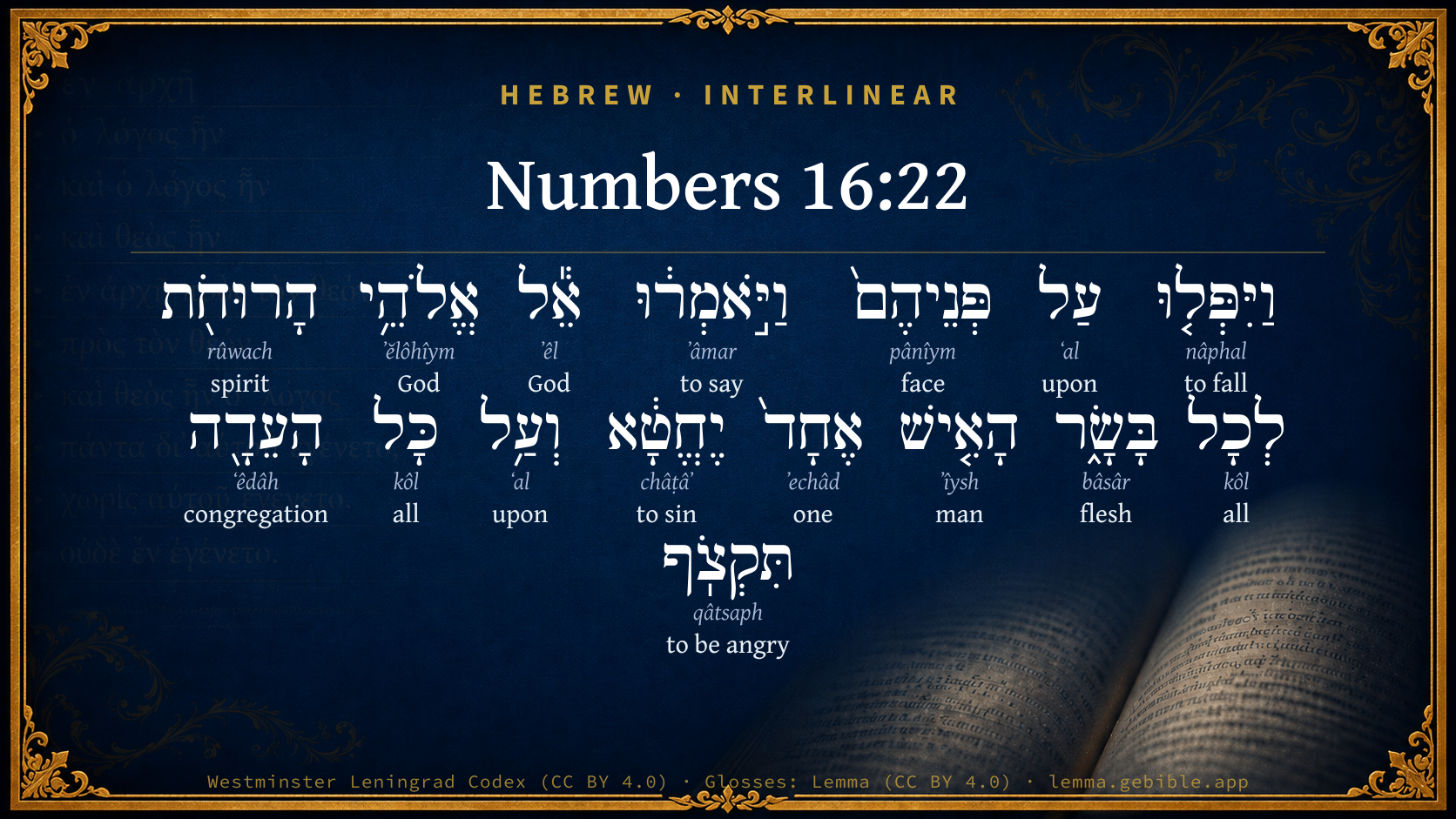
Hebrew (Westminster Leningrad Codex) Numbers 16:22 appears in the Hebrew Old Testament. The text above is from the Westminster Leningrad Codex. Each word links to its Strong’s number, a concise gloss, and parsing drawn from the Open Scriptures Hebrew Bible morphology. Click any word for its full Brown-Driver-Briggs (BDB) entry.
Download image
Cite this verse

Numbers 16:22 (World English Bible). Public Domain. Lemma interlinear Bible study tool, https://lemma.gebible.app/v/numbers/16/22.

Show BibTeX & RIS
BibTeX
RIS
English Translation
They fell on their faces, and said, God, the God of the spirits of all flesh, shall one man sin, and will you be angry with all the congregation?
World English Bible · Public Domain
Download a study sheet

One document with this verse’s original text, its word-by-word gloss line, the meaning frame, cross-references with their text, attributed commentary, and full source and license credits — printable, and it pastes into notes with its structure intact.

This verse Autodidact and up

Study sheet (.html) Plain text (.txt)

A passage Seminary Student

Up to 50 verses in one chapter. A passage sheet keeps up to 6 commentary sources and 12 cross-references per verse, in the order this page ranks them, and says so on the sheet whenever that leaves anything out. Ask for a single verse and you get the Autodidact verse sheet above.

Everything on this page stays free to read, with no account — the sheet is a download of what is already on screen, not access to it.

Want to remove ads? Support Godless Engineer
Compare translations 3

The same verse in 3 English versions, stacked beneath the original-language interlinear above. Click any original word for its lexicon entry.

Each is an independent rendering of the whole verse — the interlinear is not word-aligned to these translations.

Highlighted words mark where these versions differ — a whole-verse word diff, not a word-by-word alignment.

  • World English Bible Public Domain
    They fell on their faces, and said, God, the God of the spirits of all flesh, shall one man sin, and will you be angry with all the congregation?
  • King James Version Public Domain
    And they fell upon their faces, and said, O God, the God of the spirits of all flesh, shall one man sin, and wilt thou be wroth with all the congregation?
  • unfoldingWord Literal Text CC BY-SA 4.0
    And they fell on their faces and said, “God, the God of the spirits of all flesh, will one man sin and you be angry against all the congregation?”

unfoldingWord Literal Text — © unfoldingWord, licensed CC BY-SA 4.0. Word-aligned USFM3 via Door43 (git.door43.org/unfoldingWord/en_ult).

Versions to compare (up to 4)

3 of 4 selected

Show all 18 translations

Every available English version of this verse, each an independent rendering of the whole verse.

  • World English Bible Public Domain
    They fell on their faces, and said, God, the God of the spirits of all flesh, shall one man sin, and will you be angry with all the congregation?
  • Berean Standard Bible Public Domain
    But Moses and Aaron fell facedown and said, “O God, the God of the spirits of all flesh, when one man sins, will You be angry with the whole congregation?”
  • Majority Standard Bible Public Domain
    But Moses and Aaron fell facedown and said, “O God, the God of the spirits of all flesh, when one man sins, will You be angry with the whole congregation?”
  • King James Version Public Domain
    And they fell upon their faces, and said, O God, the God of the spirits of all flesh, shall one man sin, and wilt thou be wroth with all the congregation?
  • American Standard Version (1901) Public Domain
    And they fell upon their faces, and said, O God, the God of the spirits of all flesh, shall one man sin, and wilt thou be wroth with all the congregation?
  • Revised Version (1885) Public Domain
    And they fell upon their faces, and said, O God, the God of the spirits of all flesh, shall one man sin, and wilt thou be wroth with all the congregation?
  • Geneva Bible (1599) Public Domain
    And they fell vpon their faces and saide, O God the God of the spirits, of all fleshe, hath not one man onely sinned, and wilt thou bee wroth with all the Congregation?
  • Douay-Rheims (1899) Public Domain
    They fell flat on their face, and said: O most mighty, the God of the spirits of all flesh, for one man's sin shall thy wrath rage against all?
  • Young's Literal Translation Public Domain
    and they fall on their faces, and say, `God, God of the spirits of all flesh -- the one man sinneth, and against all the company Thou art wroth!'
  • Literal Standard Version CC BY-SA 4.0
    and they fall on their faces, and say, “God, God of the spirits of all flesh—one man sins, and are You angry against all the congregation?”
  • Unlocked Literal Bible CC BY-SA 4.0
    Moses and Aaron lay facedown and said, “God, the God of the spirits of all humanity, if one man sins, must you be angry with all the community?”
  • unfoldingWord Literal Text CC BY-SA 4.0
    And they fell on their faces and said, “God, the God of the spirits of all flesh, will one man sin and you be angry against all the congregation?”
  • Darby Bible Public Domain
    And they fell on their faces, and said, O ùGod, the God of the spirits of all flesh! shall *one* man sin, and wilt thou be wroth with the whole assembly?
  • World Messianic Bible Public Domain
    They fell on their faces, and said, “God, the God of the spirits of all flesh, shall one man sin, and will you be angry with all the congregation?”
  • Webster's Bible Public Domain
    And they fell upon their faces, and said, O God, the God of the spirits of all flesh, shall one man sin, and wilt thou be wroth with all the congregation?
  • Free Bible Version CC BY-SA 4.0
    But Moses and Aaron fell facedown on the ground said, “God—God of everything that lives—when it's only one man who sins, must you be angry with everybody?”
  • Bible in Basic English Public Domain
    Then falling down on their faces they said, O God, the God of the spirits of all flesh, because of one man's sin will your wrath be moved against all the people?
  • JPS Tanakh (1917) Public Domain
    And they fell upon their faces, and said: 'O God, the God of the spirits of all flesh, shall one man sin, and wilt Thou be wroth with all the congregation?'

Literal Standard Version (2020), Covenant Press — licensed CC BY-SA 4.0. Text via the HelloAO Bible API (eBible.org). Unlocked Literal Bible (unfoldingWord) — licensed CC BY-SA 4.0. Text via the HelloAO Bible API (eBible.org). unfoldingWord Literal Text — © unfoldingWord, licensed CC BY-SA 4.0. Word-aligned USFM3 via Door43 (git.door43.org/unfoldingWord/en_ult). Free Bible Version, Dr. Jonathan Gallagher — licensed CC BY-SA 4.0. Text via the HelloAO Bible API (eBible.org).

Word by word

More ways to search: Search by grammar → Find every occurrence → Compare this word →

Practice this passage: Drill this verse → Learn its vocabulary →

תִּקְצֹֽף
qâtsaph
H7107
“to be angry”
Verb, Qal, Imperfect, 2nd Person, Masculine, Singular
Part of Speech
Verb
Stem
Qal
Form
Imperfect
Person
2nd Person
Gender
Masculine
Number
Singular
Full BDB Definition

Origin: a primitive root

TWOT: 2058

to be displeased, be angry, fret oneself, be wroth - (Qal) to be wroth, to be full of wrath, to be furious - (Hiphil) to provoke to wrath or anger - (Hithpael) to put oneself in a rage, anger oneself
  1. וַיִּפְּל֤וּ nâphal H5307 “and · to fall” Conjunction + Verb, Qal, Sequential Imperfect, 3rd Person, Masculine, Plural
  2. עַל ʻal H5921 “upon” Preposition
  3. פְּנֵיהֶם֙ pânîym H6440 “face(s) · their” Noun, Common, Both, Plural, Construct + Suffix, Personal, 3rd Person, Masculine, Plural
  4. וַיֹּ֣אמְר֔וּ ʼâmar H559 “and · to say” Conjunction + Verb, Qal, Sequential Imperfect, 3rd Person, Masculine, Plural
  5. אֵ֕ל ʼêl H410 “God” Noun, Common, Masculine, Singular, Absolute
  6. אֱלֹהֵ֥י ʼĕlôhîym H430 “God(s) of” Noun, Common, Masculine, Plural, Construct
  7. הָרוּחֹ֖ת rûwach H7307 “the · spirits” Particle, Definite Article + Noun, Common, Both, Plural, Absolute
  8. לְכָל kôl H3605 “to/for · all of” Preposition + Noun, Common, Masculine, Singular, Construct
  9. בָּשָׂ֑ר bâsâr H1320 “flesh” Noun, Common, Masculine, Singular, Absolute
  10. הָאִ֤ישׁ ʼîysh H376 “the · man” Particle, Definite Article + Noun, Common, Masculine, Singular, Absolute
  11. אֶחָד֙ ʼechâd H259 “one” Adjective, Cardinal number, Masculine, Singular, Absolute
  12. יֶחֱטָ֔א châṭâʼ H2398 “to sin” Verb, Qal, Imperfect, 3rd Person, Masculine, Singular
  13. וְעַ֥ל ʻal H5921 “and · upon” Conjunction + Preposition
  14. כָּל kôl H3605 “all of” Noun, Common, Masculine, Singular, Construct
  15. הָעֵדָ֖ה ʻêdâh H5712 “the · congregation” Particle, Definite Article + Noun, Common, Feminine, Singular, Absolute

About this verse

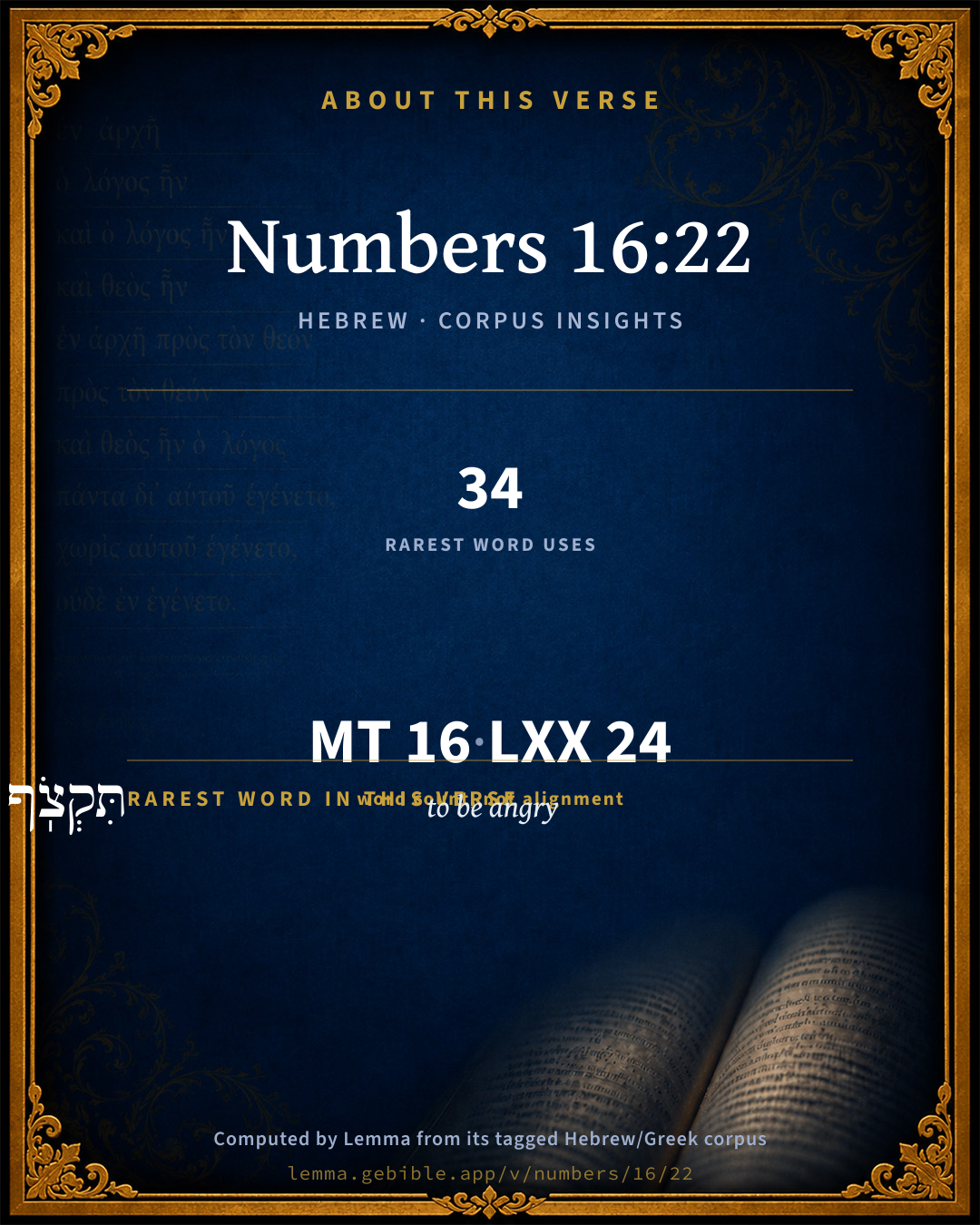
These counts appear in no published source. They are computed here, from the morphology-tagged text and Lemma’s own curated glosses. What Lemma adds →

16
words
14
distinct lemmas
Pentateuch
section

Shared distinctive vocabulary

תִּקְצֹֽף to be angry H7107 occurs in 32 verses of the Hebrew Bible. Also found in:

Grammatical profile

  • 4 verbs
  • 9 nouns
  • 1 adjective
  • 2 prepositions

Verb forms

  • וַיִּפְּל֤וּ Qal · Sequential Imperfect
  • וַיֹּ֣אמְר֔וּ Qal · Sequential Imperfect
  • יֶחֱטָ֔א Qal · Imperfect
  • תִּקְצֹֽף Qal · Imperfect

Repetition

Words recur within this verse — often emphatic in Hebrew:

Hebrew & Septuagint length

In English translation the verse runs 29 words from the Hebrew and 34 from the Septuagint (LXX English) — closely comparable.

A rough comparison of the two English renderings, which tokenize alike — not a word-level alignment.

Word counts can differ between the Hebrew and the Greek without any difference in meaning — e.g. the Hebrew direct-object marker אֵת has no separate Greek word, and Greek often adds the article ὁ.

In the original languages it is 16 Hebrew tokens and 24 Greek tokens — but the two are counted differently (Hebrew bundles its prefixes and suffixes into one token; the Greek is in lemma form), so that isn’t a like-for-like length.

Cross-references

16

Topical passages linked to Numbers 16:22 in the Treasury of Scripture Knowledge — connected by theme and wording, ordered by reader-vote popularity; previews shown in the World English Bible.

  • Numbers 27:16 Let Yahweh, the God of the spirits of all flesh, appoint a man over the congregation,
  • Job 12:10 In whose hand is the life of every living thing, The breath of all mankind?
  • Zechariah 12:1 An oracle. The word of Yahweh concerning Israel. Yahweh, who stretches out the heavens, and lays the foundation of the earth, and forms the spirit of man within him says:
  • Ecclesiastes 12:7 And the dust returns to the earth as it was, And the spirit returns to God who gave it.
  • Hebrews 12:9 Furthermore, we had the fathers of our flesh to chasten us, and we paid them respect. Shall we not much rather be in subjection to the Father of spirits, and live?
  • Genesis 18:23–25 Abraham drew near, and said, "Will you consume the righteous with the wicked?
  • Romans 5:18 So then as through one trespass, all men were condemned; even so through one act of righteousness, all men were justified to life.
  • Genesis 18:32 He said, "Oh don't let the Lord be angry, and I will speak yet but this once. What if ten are found there?" He said, "I will not destroy it for the ten's sake."
  • Numbers 14:5 Then Moses and Aaron fell on their faces before all the assembly of the congregation of the children of Israel.
  • Numbers 16:45 Get away from among this congregation, that I may consume them in a moment. They fell on their faces.
  • 2 Samuel 24:17 David spoke to Yahweh when he saw the angel who struck the people, and said, Behold, I have sinned, and I have done perversely; but these sheep, what have they done? Please let your hand be against me, and against my father's house.
  • Isaiah 57:16 For I will not contend forever, neither will I be always angry; for the spirit would faint before me, and the souls who I have made.
  • Numbers 16:4 When Moses heard it, he fell on his face:
  • Joshua 7:1–26 But the children of Israel committed a trespass in the devoted thing; for Achan, the son of Carmi, the son of Zabdi, the son of Zerah, of the tribe of Judah, took of the devoted thing: and the anger of Yahweh was kindled against the children of Israel.
  • 2 Samuel 24:1 Again the anger of Yahweh was kindled against Israel, and he moved David against them, saying, Go, number Israel and Judah.
  • 1 Corinthians 13:7 bears all things, believes all things, hopes all things, endures all things.

Cross-references courtesy of OpenBible.info (CC BY 4.0).

Hebrew and Greek witnesses Masoretic Hebrew ↔ Greek Septuagint

The same verse in the two great witnesses to the Old Testament, shown verse-for-verse.

These are two independent witnesses, not word-aligned to each other, and the Septuagint is shown in lemma (dictionary) form.

Hebrew Numbers 16:22 Masoretic · Westminster Leningrad Codex

וַיִּפְּל֤וּ עַל פְּנֵיהֶם֙ וַיֹּ֣אמְר֔וּ אֵ֕ל אֱלֹהֵ֥י הָרוּחֹ֖ת לְכָל בָּשָׂ֑ר הָאִ֤ישׁ אֶחָד֙ יֶחֱטָ֔א וְעַ֥ל כָּל הָעֵדָ֖ה תִּקְצֹֽף

They fell on their faces, and said, God, the God of the spirits of all flesh, shall one man sin, and will you be angry with all the congregation?

World English Bible · Public Domain

Greek LXX Numbers 16:22 Septuagint · lemma form

καί πίπτω ἐπί πρόσωπον αὐτός καί εἶπον θεός θεός ὁ πνεῦμα καί πᾶς σάρξ εἰ ἄνθρωπος εἷς ἁμαρτάνω ἐπί πᾶς ὁ συναγωγή ὀργή κύριος

And they fell on their faces, and said, O God, the God of spirits and of all flesh, if one man has sinned, shall the wrath of the Lord be upon the whole congregation?

LXX2012 (modern English Septuagint) · Public Domain

Hebrew: Westminster Leningrad Codex (CC BY 4.0). Greek: Septuagint (public domain); English from LXX2012 (modern English Septuagint) (Public Domain). How the Septuagint differs from the Hebrew →

Targum (Aramaic paraphrase)

2

The Targum is the ancient Jewish Aramaic paraphrase of the Hebrew Scriptures — an interpretive translation, not the Hebrew text itself. Onkelos (literal) and Pseudo-Jonathan (expansive) render the Torah, and Jonathan the Prophets. Coverage is partial: where no permissively-licensed English translation exists for a verse, only the Aramaic is shown. This is verse-level text, not a word-by-word alignment to the Hebrew.

  1. Targum Onkelos Torah (Genesis–Deuteronomy)
    וּנְפָלוּ עַל אַפֵּיהוֹן וַאֲמָרוּ אֵל אֱלָהָא רוּחַיָא לְכָל בִּשְׂרָא גַבְרָא חָד יֵיחוֹב וְעַל כָּל כְּנִשְׁתָּא יְהֵי רוּגְזָא

    (no public-domain English translation for this verse)

    Targum Onkelos — Aramaic: “Onkelos Genesis” (public domain); “Onkelos Exodus” (public domain); “Onkelos Leviticus” (public domain); “Onkelos Numbers” (public domain); “Onkelos Deuteronomy” (public domain). English: “Sefaria Community Translation” (CC0 1.0 (public-domain dedication)); “J.W. Etheridge. The Targums of Onkelos and Jonathan Ben Uzziel on the Pentateuch. London: Longmans, Green, 1862” (public domain). Text via Sefaria.

  2. Targum Pseudo-Jonathan Torah (Genesis–Deuteronomy)
    וְאִתְרְכִינוּ בִּצְלוֹ עַל אַפֵּיהוֹן וַאֲמָרוּ אֵל אֱלָהָא דְשַׁוֵי רוּחַ נִשְׁמָתָא בְּגוּפֵי בְּנֵי נְשָׁא וּמִנֵיהּ מִתְיַהֲבָא רוּחָא לְכָל בִּישְרָא הַאִין גַבְרָא חַד יֵיחוֹב וְעַל כָּל כְּנִישְׁתָּא יְהֵי רוּגְזָא

    But they bowed down upon their faces in prayer, and said: El Eloha, who hast put the spirit of life in the bodies of the children of men, and from whom is given the spirit of all flesh, - if one man hath sinned, wilt Thou be angry with all the congregation

    Targum Pseudo-Jonathan — Aramaic: “Targum Jonathan on Genesis” (public domain); “Targum Jonathan on Exodus” (public domain); “Targum Jonathan on Leviticus” (public domain); “Targum Jonathan on Numbers” (public domain); “Targum Jonathan on Deuteronomy” (public domain). English: “The Targum of Jonathan ben Uzziel, trans. J. W. Etheridge, London, 1862” (public domain). Text via Sefaria.

Commentary

Notes on Numbers 16:22 from classic Christian and Jewish commentators (each source and its license shown beneath its notes). The classic Christian expositions comment on the surrounding passage and are grouped to its opening verse, so a note may address several verses; the Jewish commentaries on the Tanakh (Rashi and others) are per-verse, so they appear only where the commentator wrote on this verse.

Lemma curates 59 commentaries, every one of them public domain or Creative Commons licensed, each selected and text-cleaned for this edition rather than reprinted as found. About our sources →

Trapp's Complete Commentary

John Trapp

Num 16:22 And they fell upon their faces, and said, O God, the God of the spirits of all flesh, shall one man sin, and wilt thou be wroth with all the congregation?

Ver. 22. The God of the spirits.] The Former and Father of spirits, {Zec 12:1 Heb 12:9} "that giveth to all ζωην και πνοην, life and breath," {Act 17:25} in whose hand is the soul of all living, and the spirit of all flesh. {Job 12:10}

John Trapp, A Commentary or Exposition upon All the Books of the Old and New Testament (1647–1656) — public domain. Text from a community e-Sword module.

Joseph Benson's Commentary

Num 16:22. The God of the spirits of all flesh — And this is no empty title here, but very emphatical. Thou art the Maker of spirits, destroy not thy own workmanship. O thou who art the preserver of men, and of their spirits, the Lord of spirits, (Job 12:10,) who, as thou mayest justly destroy this people, so thou canst preserve whom thou pleasest; the Father of spirits, the souls. Deal mercifully with thy own children: the Searcher of spirits, thou canst distinguish between those who have maliciously raised this tumult, and those whose ignorance and simple credulity hath made them a prey to crafty seducers. Of all flesh — Of all mankind: the word flesh is often put for men. One man — Korah, the ringleader of this division.

Joseph Benson's Commentary on the Old and New Testaments (1811–1818) — public domain. Text from a community e-Sword module.

Geneva Bible (1599)

Geneva Bible translators

Or, of every creature.

Geneva Bible (1599) marginal notes — public domain. Text via Bolls.life.

Jamieson, Fausset & Brown

Robert Jamieson, A. R. Fausset & David Brown

they fell upon their faces, and said, O God, the God of the spirits of all flesh--The benevolent importunity of their prayer was the more remarkable that the intercession was made for their enemies.

Jamieson, Fausset & Brown — Commentary Critical and Explanatory on the Whole Bible (1871) — public domain (CC PDM 1.0). Text via the HelloAO Bible API.

Adam Clarke's Commentary

Verse 22. O God, the God of the spirits of all flesh] אל אלהי הרוחת לכל בשר El Elohey haruchoth lechol basar. This address sufficiently proves that these holy men believed that man is a being compounded of flesh and spirit, and that these principles are perfectly distinct. Either the materiality of the human soul is a human fable, or, if it be a true doctrine, these men did not pray under the influence of the Divine Spirit. In Nu 27:16 there is a similar form of expression: Let the Lord, the God of the spirits of all flesh. And in Job 12:10: In whose hand is the soul (נפש nephesh) of all living; and the spirit (רוח ruach) of all flesh of man. Are not these decisive proofs that the Old Testament teaches that there is an immortal spirit in man? "But does not רוח ruach signify wind or breath?" Sometimes it does, but certainly not here; for how absurd would it be to say, O God, the God of the breaths of all flesh!

Adam Clarke's Commentary on the Bible (1810–1826) — public domain. Text from a community e-Sword/MySword module.

The Cambridge Bible for Schools and Colleges

gen. ed. J. J. S. Perowne

22. the God of the spirits of all flesh] The God who made and sustains the life of every human being. In early days Jehovah was thought of as the particular deity of Israel alone. But by the time of the priestly writer the nation had long advanced to the deeper and truer conception of monotheism.

shall one man sin] i.e. Korah. The words very clearly imply that Dathan and Abiram do not belong to the narrative.

The Cambridge Bible for Schools and Colleges (gen. ed. J. J. S. Perowne; Cambridge University Press, 1878–1918) — public domain. Text from a community e-Sword module.

John Gill's Exposition

And they fell upon their faces,.... That is, Moses and Aaron, in order to deprecate the wrath of God, and beseech him to avert the threatened judgment; and so the Targum of Jonathan has it,"they bowed themselves in prayer upon their faces;"

and said, O God, the God of the spirits of all flesh; the Maker of all men, as of their bodies, which are flesh, so of their souls or spirits, which are immaterial and immortal; hence he is called "the Father of spirits", Heb 12:9, who, as the Targum, puts the spirit in the bodies of men; or, as others, who knows the spirits of men; their thoughts, as Jarchi, the inward frames and dispositions of their minds; who knows who have sinned, and who not; and whether their sins proceed from weakness, and being misled, or whether from a malevolent disposition, presumption, and self-will:

shall one man sin: meaning Korah, who was the ringleader:

and wilt thou be wroth with all the congregation? who, through ignorance and weakness, and by artifice and imposition, are drawn in to join with him; the plea is much the same with that of Abraham, Gen 18:25.

John Gill's Exposition of the Whole Bible (1746–1763) — public domain (CC PDM 1.0). Text via the HelloAO Bible API.

Haydock's Catholic Bible Commentary

God, who givest life to all, and searchest the inmost recesses of the heart. (Menochius)

George Leo Haydock (1774–1849), Haydock's Catholic Family Bible and Commentary, 1859 edition — public domain. Excludes Psalms (Douay-Rheims chapter numbering differs from Protestant) and Deuterocanonical books (Catholic canon only).

Matthew Poole's English Annotations

Of the spirits, i.e. of souls, as the word spirit in Scripture is oft used, as Psa 31:5; 77:3; Pro 17:22; Ecc 12:7; Luk 23:46; Act 7:59. And this is no empty title here, but very emphatical and argmmentative, thus, Thou art the Maker of spirits, Zec 12:1, destroy not thy own workmanship, Isa 64:8. O thou who art the preserver of men, and of their spirits; the Lord of spirits, Job 12:10; who as thou mayst justly destroy this people, so thou canst preserve whom thou pleasest: the Father of spirits, Heb 12:9; O deal mercifully with thy own children: the Searcher of spirits, thou canst distinguish between those who have maliciously raised this tumult, and those whose ignorance and simple credulity hath made them a prey to crafty seducers.

Of all flesh, i.e. of all mankind: the word flesh is put for men, as Gen 6:13; Job 12:10; Isa 40:5,6; Eze 20:48; 21:4,5.

One man, to wit, Korah, the ringleader of this sedition.

Matthew Poole's English Annotations on the Holy Bible (1683–1685) — public domain. Text from a community e-Sword/MySword module.

Whedon's Commentary on the Bible

Daniel D. Whedon

22. They fell upon their faces — This posture denotes the earnestness of the intercession of these two men, against whom this vast conspiracy was directed. Here is an out-gleaming of that love which shone forth so gloriously from the cross of Jesus Christ, “Father, forgive them.”

The God of the spirits of all flesh — The appeal is not to the God of the covenant, the God of Abraham, Isaac, and Jacob, because Israel is now temporarily outside of the covenant, but to God the Creator. “It is of little consequence whether these words are to be understood as relating to all the animal kingdom, or to the human race alone; because Moses simply prayed that as God was the Creator and Architect of the world he would not destroy the men whom he had created, but rather have mercy upon the works of his own hands.” — Calvin.

One man sin — Literally, shall the one man sin, that is, Korah, the ringleader of the conspiracy. A degree of culpability attached to all who countenanced the plot; but many were swept in by the current of wicked feeling, not from hostility to Moses and Aaron, but from too great weakness to resist the prevailing sentiment. For these Moses intercedes.

Daniel D. Whedon (gen. ed.), Commentary on the Old and New Testaments (1874–1909) — public domain. Text from a community e-Sword module.

The Pulpit Commentary

O God, the God of the spirits of all flesh. rcBAkl tjoWrh yjeloa lae. The ruach is the spirit of life which the Creator has imparted unto perishable flesh, and made it live. In some sense it belongs to beasts as well as to men; (Ecc_3:19, Ecc_3:21) but in the common use of the word men only are thought of, as having received it by a special communication of a higher order. (Gen_2:7 1Co_15:45) Moses, therefore, really appeals to God, as the Author and Giver of that imperishable life-principle which is lodged in the mortal flesh of all men, not to destroy the works of his own hands, the creatures made in his own image. Here we have in its germ that idea of the universal fatherhood of God which remained undeveloped in Jewish thought until Judaism itself expanded into Christianity. (cf. Isa_63:16 Isa_64:8, 9 Act_17:26, Act_17:29) Shall one man sin. Rather, "the one man (vyaih) hath sinned," i.e., Korah, who had misled all the rest.

"The God of the spirits of all flesh.

This name of God reminds us of some of the relations in which God stands to us his creatures, who are immortal spirits in mortal flesh. We select three, and speak of him

I As PROPIETOR. "He formeth the spirit of man within him". (Zec_12:1) The verb used is applied to a potter or a smith, and reminds us that God has modeled the human spirit, with its varied powers, according to his own ideal. (Psa_33:15) Since he formed man in his own image, he is "the Father of spirits" in a sense in which he is not the Father of animals. Thus he is our Proprietor, who can say, "All souls are mine," who feels a deep interest in "the work of his own hands", (Psa_138:8) and who will use, according to his judgment, the spirits he has formed and variously endowed. See Moses" use of this truth in Num_27:15-17.

II As HEART-SEARCHER. Sin has broken into the natural relation of God to his creatures. He has to deal with them as sinners with various degrees of criminality. Hence need of discrimination which only the Creator and Searcher of hearts possesses. This truth used by Abraham (Gen_18:23-33) and by Moses and Aaron (verse 22). It is only the Heart-Searcher who can righteously adjust

(1) the direct punishment of sin, which falls only on the guilty, (Eze_18:1-32) and

(2) the indirect consequences, which may fall on the innocent, (Exo_34:7) as on Dathan"s children (verses 27, 32).

In this narrative we see

(1) conditional preservation (verse 24),

(2) diverse judgments (verses 32, 35, 49),

(3) bereavements and dishonour to the survivors. (Num_27:3) Faith in "God, the God of the spirits of all flesh," may keep us calm in the midst of judgments. (Isa_57:16)

III As THE SAVIOR. If God were not a Saviour there would soon be no "spirits of flesh" to be the God of. (Mal_3:6) But God"s salvation is for all flesh. (2Co_5:19 1Ti_2:6 1Jn_2:2) If God is our Saviour, then we may delight in his proprietorship of us. (Psa_119:94 Psa_116:12 Isa_43:1) And we can cheerfully accept any discipline which our Heart-Searcher sends; (Heb_12:5-10) for "the God of my life" is also "the God of my salvation. P.

The Pulpit Commentary (1880–1919), ed. H.D.M. Spence-Jones & Joseph S. Exell — public domain. Text from a community e-Sword module.

John Wesley's Explanatory Notes

The spirits - And this is no empty title here, but very emphatical. Thou art the maker of spirits, destroy not thy own workmanship! O thou who art the preserver of men, and of their spirits, the Lord of spirits, Job xii, 10, who as thou mayst justly destroy this people, so thou canst preserve whom thou pleasest: the father of spirits, the souls. Deal mercifully with thy own children: the searcher of spirits, thou canst distinguish between those who have maliciously railed this tumult, and those whose ignorance and simple credulity hath made them a prey to crafty seducers. Of all flesh - Of all mankind: the word flesh is often put for men. One man - Korah, the ringleader of this sedition.

John Wesley, Explanatory Notes Upon the Whole Bible (1754–1765) — public domain. Text via the GEBible commentary corpus.

Rashi

Rabbi Shlomo Yitzchaki (Rashi)

אל אלהי הרוחות O GOD, THE GOD OF THE SPIRITS [OF ALL FLESH] — i.e., “[O God] who knowest the thoughts of every man”. Thy nature is not like that of human beings: an earthly king against whom part of his country commits an offence, does not know who the sinner is, and therefore when he becomes angry he exacts punishment from all of them. But Thou — before Thee all human thoughts lie open and Thou knowest who is the sinner (Midrash Tanchuma, Korach 7).

האיש אחד means, THE ONE MAN IS THE SINNER, and על כל העדה תקצוף YOU ARE ANGRY WITH ALL THE CONGREGATION?! Whereupon the Holy One, blessed be He, replied, “You have spoken well; I know and shall make known who has sinned and who has not sinned” (Midrash Tanchuma, Korach 7).

Rashi on the Tanakh — English translations: “The Judaica Press complete Tanach with Rashi, translated by A. J. Rosenberg” (CC BY 4.0); “Pentateuch with Rashi's commentary by M. Rosenbaum and A.M. Silbermann, 1929-1934” (public domain); “The Metsudah Tanach series, Lakewood, N.J” (CC BY 4.0); and “The Book of Joshua, Metsudah Publications, 1997” (CC BY 4.0). Text via Sefaria.

Ibn Ezra

Rabbi Abraham ibn Ezra

If one man sins. This refers to Korach, who congregated the entire congregation against Moshe and Aharon. Some hold the view that Almighty, the God of the spirits connotes that He has the power to search out a man’s spirit because He is his God, and He knows that one man alone, Korach, sinned, even if he caused others to sin.

Ibn Ezra on the Tanakh — English translations: “Sefaria Community Translation” (CC0 1.0 (public-domain dedication)); “Yalkut, Sifsei Chachomim Chumash, Metsudah Publications, 2009” (CC BY 4.0); and “Commentary of Ibn Ezra on Isaiah - trans. by M. Friedlander, 1873” (public domain). Text via Sefaria.

Lesson kit

Teaching starters — assembled from the data on this page, not authored interpretation. Every prompt links to the verse data it draws on. Edit before teaching.

Numbers, in the Pentateuch, opens this verse with 16 words (14 distinct Hebrew lemmas). Its most distinctive word is qâtsaph (“to be angry”). A historical commentator’s framing appears above. Read the whole chapter for the surrounding context.

Discussion questions

  1. What does “to be angry” (qâtsaph) contribute to the verse as a whole?
  2. How does Genesis 40:2, which shares the word «to be angry», read alongside this verse?
  3. What does the repetition of “upon” (2× in this one verse) do in this verse?
  4. These translations render this verse differently. What is at stake in choosing one wording over another?
  5. «וַיִּפְּל֤וּ» is a Qal Sequential Imperfect verb. How does that grammatical form shape the action described?
  6. Compare how Trapp's Complete Commentary and Joseph Benson's Commentary read this verse. Where do they agree or differ?

Things to notice

Reading settings

Reading text

Shown beneath each verse's original-language words.

Old Testament
Old Testament edition

Read the OT as the Masoretic Hebrew (MT) or the Greek Septuagint (LXX).

English shown for the Greek Septuagint (in the Hebrew ↔ Greek comparison).

Comparing translations? Open the Compare panel on any verse page to stack up to four side by side.