
Judges 3:25

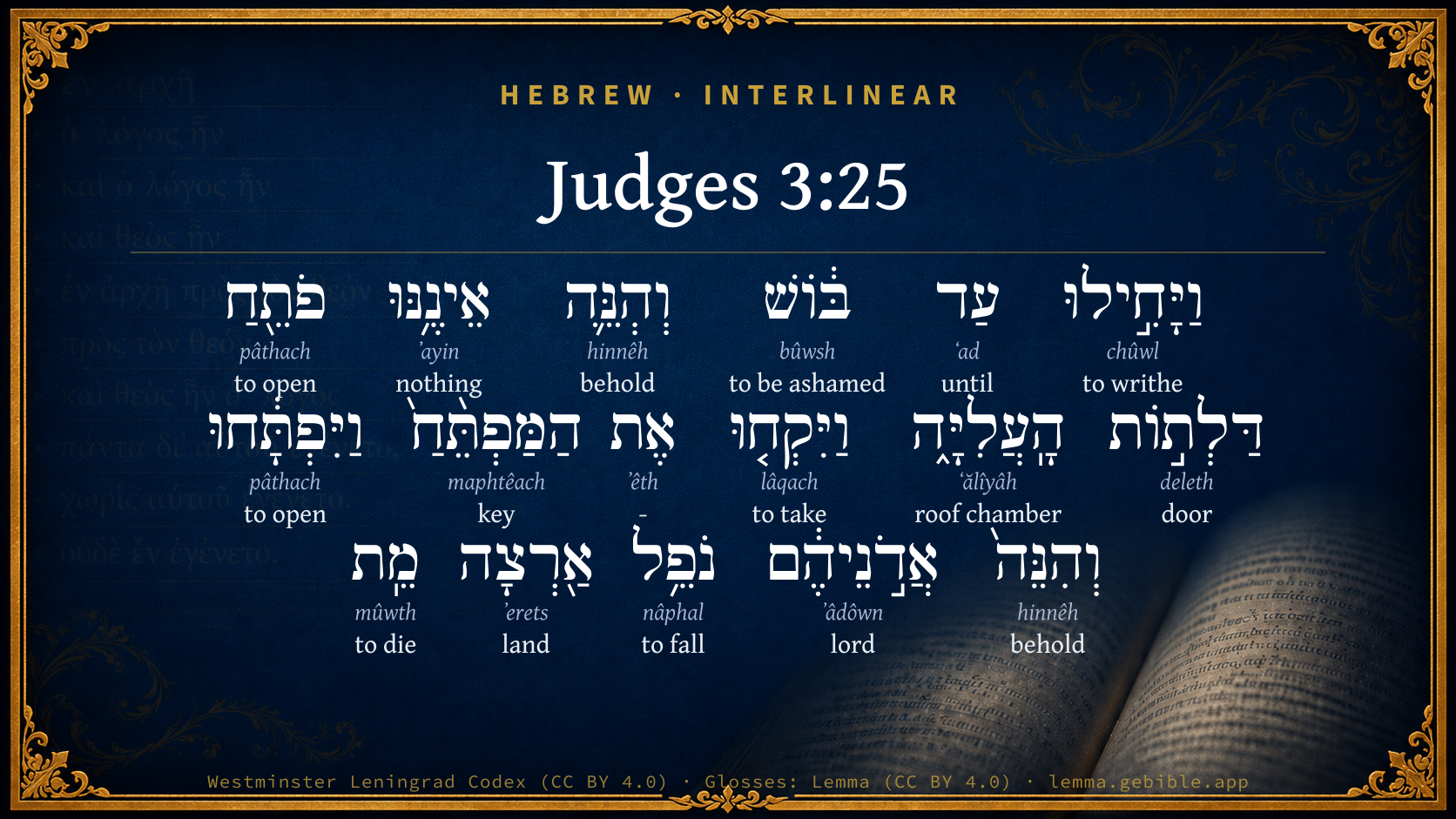
Hebrew (Westminster Leningrad Codex) Judges 3:25 appears in the Hebrew Old Testament. The text above is from the Westminster Leningrad Codex. Each word links to its Strong’s number, a concise gloss, and parsing drawn from the Open Scriptures Hebrew Bible morphology. Click any word for its full Brown-Driver-Briggs (BDB) entry.
Download image
Cite this verse

Judges 3:25 (World English Bible). Public Domain. Lemma interlinear Bible study tool, https://lemma.gebible.app/v/judges/3/25.

Show BibTeX & RIS
BibTeX
RIS
English Translation
They waited until they were ashamed; and, behold, he didn't open the doors of the upper room: therefore they took the key, and opened [them], and, behold, their lord was fallen down dead on the earth.
World English Bible · Public Domain
Highlights
  • 1 first appearance in the Hebrew Bible
Full analysis ↓
Download a study sheet

One document with this verse’s original text, its word-by-word gloss line, the meaning frame, cross-references with their text, attributed commentary, and full source and license credits — printable, and it pastes into notes with its structure intact.

This verse Autodidact and up

Study sheet (.html) Plain text (.txt)

A passage Seminary Student

Up to 50 verses in one chapter. A passage sheet keeps up to 6 commentary sources and 12 cross-references per verse, in the order this page ranks them, and says so on the sheet whenever that leaves anything out. Ask for a single verse and you get the Autodidact verse sheet above.

Everything on this page stays free to read, with no account — the sheet is a download of what is already on screen, not access to it.

Want to remove ads? Support Godless Engineer
Compare translations 3

The same verse in 3 English versions, stacked beneath the original-language interlinear above. Click any original word for its lexicon entry.

Each is an independent rendering of the whole verse — the interlinear is not word-aligned to these translations.

Highlighted words mark where these versions differ — a whole-verse word diff, not a word-by-word alignment.

  • World English Bible Public Domain
    They waited until they were ashamed; and, behold, he didn't open the doors of the upper room: therefore they took the key, and opened [them], and, behold, their lord was fallen down dead on the earth.
  • King James Version Public Domain
    And they tarried till they were ashamed: and, behold, he opened not the doors of the parlor; therefore they took a key, and opened them: and, behold, their lord was fallen down dead on the earth.
  • unfoldingWord Literal Text CC BY-SA 4.0
    So they waited until they felt ashamed, but behold, he was not opening the doors of the upper room. So they took the opener and they opened, and behold, their lord fallen on the ground, dead.

unfoldingWord Literal Text — © unfoldingWord, licensed CC BY-SA 4.0. Word-aligned USFM3 via Door43 (git.door43.org/unfoldingWord/en_ult).

Versions to compare (up to 4)

3 of 4 selected

Show all 18 translations

Every available English version of this verse, each an independent rendering of the whole verse.

  • World English Bible Public Domain
    They waited until they were ashamed; and, behold, he didn't open the doors of the upper room: therefore they took the key, and opened [them], and, behold, their lord was fallen down dead on the earth.
  • Berean Standard Bible Public Domain
    So they waited until they became worried and saw that he had still not opened the doors of the upper room. Then they took the key and opened the doors—and there was their lord lying dead on the floor.
  • Majority Standard Bible Public Domain
    So they waited until they became worried and saw that he had still not opened the doors of the upper room. Then they took the key and opened the doors—and there was their lord lying dead on the floor.
  • King James Version Public Domain
    And they tarried till they were ashamed: and, behold, he opened not the doors of the parlor; therefore they took a key, and opened them: and, behold, their lord was fallen down dead on the earth.
  • American Standard Version (1901) Public Domain
    And they tarried till they were ashamed; and, behold, he opened not the doors of the upper room: therefore they took the key, and opened `them', and, behold, their lord was fallen down dead on the earth.
  • Revised Version (1885) Public Domain
    And they tarried till they were ashamed: and, behold, he opened not the doors of the parlour; therefore they took the key, and opened them: and, behold, their lord was fallen down dead on the earth.
  • Geneva Bible (1599) Public Domain
    And they taryed till they were ashamed: and seeing he opened not the doores of the parler, they tooke the key, and opened them, and behold, their lord was fallen dead on the earth.
  • Douay-Rheims (1899) Public Domain
    And waiting a long time till they were ashamed, and seeing that no man opened the door, they took a key: and opening, they found their lord lying dead on the ground.
  • Young's Literal Translation Public Domain
    And they stay till confounded, and lo, he is not opening the doors of the upper chamber, and they take the key, and open, and lo, their lord is fallen to the earth -- dead.
  • Literal Standard Version CC BY-SA 4.0
    And they stay until confounded, and behold, he is not opening the doors of the upper chamber, and they take the key, and open, and behold, their lord is fallen to the earth—dead.
  • Unlocked Literal Bible CC BY-SA 4.0
    They were growing more concerned until they felt they were neglecting their duty when the king still did not open the doors to the upper room. So they took the key and opened them, and there lay their master, fallen to the floor, dead.
  • unfoldingWord Literal Text CC BY-SA 4.0
    So they waited until they felt ashamed, but behold, he was not opening the doors of the upper room. So they took the opener and they opened, and behold, their lord fallen on the ground, dead.
  • Darby Bible Public Domain
    And they waited till they were utterly at a loss; but when he still did not open the doors of the roof chamber, they took the key and opened them; and there lay their lord dead on the floor.
  • World Messianic Bible Public Domain
    They waited until they were ashamed; and behold, he didn’t open the doors of the upper room. Therefore they took the key and opened them, and behold, their lord had fallen down dead on the floor.
  • Webster's Bible Public Domain
    And they tarried till they were ashamed: and behold, he opened not the doors of the parlor, therefore they took a key and opened them: and behold, their lord lay dead on the earth.
  • Free Bible Version CC BY-SA 4.0
    So they waited until they couldn't stand it any more, and since he still hadn't opened the doors of the room, they went and found the key and opened the doors. There was their lord, lying dead on the floor.
  • Bible in Basic English Public Domain
    And they went on waiting till they were shamed, but the doors were still shut; so they took the key, and, opening them, saw their lord stretched out dead on the floor.
  • JPS Tanakh (1917) Public Domain
    And they tarried till they were ashamed; and, behold, he opened not the doors of the upper chamber; therefore they took the key, and opened them; and, behold, their lord was fallen down dead on the earth.

Literal Standard Version (2020), Covenant Press — licensed CC BY-SA 4.0. Text via the HelloAO Bible API (eBible.org). Unlocked Literal Bible (unfoldingWord) — licensed CC BY-SA 4.0. Text via the HelloAO Bible API (eBible.org). unfoldingWord Literal Text — © unfoldingWord, licensed CC BY-SA 4.0. Word-aligned USFM3 via Door43 (git.door43.org/unfoldingWord/en_ult). Free Bible Version, Dr. Jonathan Gallagher — licensed CC BY-SA 4.0. Text via the HelloAO Bible API (eBible.org).

Word by word

More ways to search: Search by grammar → Find every occurrence → Compare this word →

Practice this passage: Drill this verse → Learn its vocabulary →

הַמַּפְתֵּ֨חַ֙
maphtêach
H4668
“the · key”
Particle, Definite Article + Noun, Common, Masculine, Singular, Absolute
Part of Speech
Particle + Noun
Type
Common
Gender
Masculine
Number
Singular
State
Absolute
Full BDB Definition

Origin: from H6605

TWOT: 1854f

key, opening instrument
  1. וַיָּחִ֣ילוּ chûwl H2342 “and · to writhe” Conjunction + Verb, Qal, Sequential Imperfect, 3rd Person, Masculine, Plural
  2. עַד ʻad H5704 “until” Preposition
  3. בּ֔וֹשׁ bûwsh H954 “to be ashamed” Verb, Qal, Infinitive Construct
  4. וְהְנֵּ֛ה hinnêh H2009 “and · behold” Conjunction + Particle, Demonstrative
  5. אֵינֶ֥נּוּ ʼayin H369 “nothing · him” Particle, Negative + Suffix, Personal, 3rd Person, Masculine, Singular
  6. פֹתֵ֖חַ pâthach H6605 “opening” Verb, Qal, Participle Active, Masculine, Singular, Absolute
  7. דַּלְת֣וֹת deleth H1817 “doors of” Noun, Common, Feminine, Plural, Construct
  8. הָֽעֲלִיָּ֑ה ʻălîyâh H5944 “the · roof chamber” Particle, Definite Article + Noun, Common, Feminine, Singular, Absolute
  9. וַיִּקְח֤וּ lâqach H3947 “and · to take” Conjunction + Verb, Qal, Sequential Imperfect, 3rd Person, Masculine, Plural
  10. אֶת ʼêth H853 “-” Particle, Direct Object
  11. וַיִּפְתָּ֔חוּ pâthach H6605 “and · to open” Conjunction + Verb, Qal, Sequential Imperfect, 3rd Person, Masculine, Plural
  12. וְהִנֵּה֙ hinnêh H2009 “and · behold” Conjunction + Particle, Demonstrative
  13. אֲדֹ֣נֵיהֶ֔ם ʼâdôwn H113 “lords · their” Noun, Common, Masculine, Plural, Construct + Suffix, Personal, 3rd Person, Masculine, Plural
  14. נֹפֵ֥ל nâphal H5307 “falling” Verb, Qal, Participle Active, Masculine, Singular, Absolute
  15. אַ֖רְצָה ʼerets H776 “land · toward” Noun, Common, Both, Singular, Absolute + Suffix, Demonstrative
  16. מֵֽת mûwth H4191 “dying” Verb, Qal, Participle Active, Masculine, Singular, Absolute

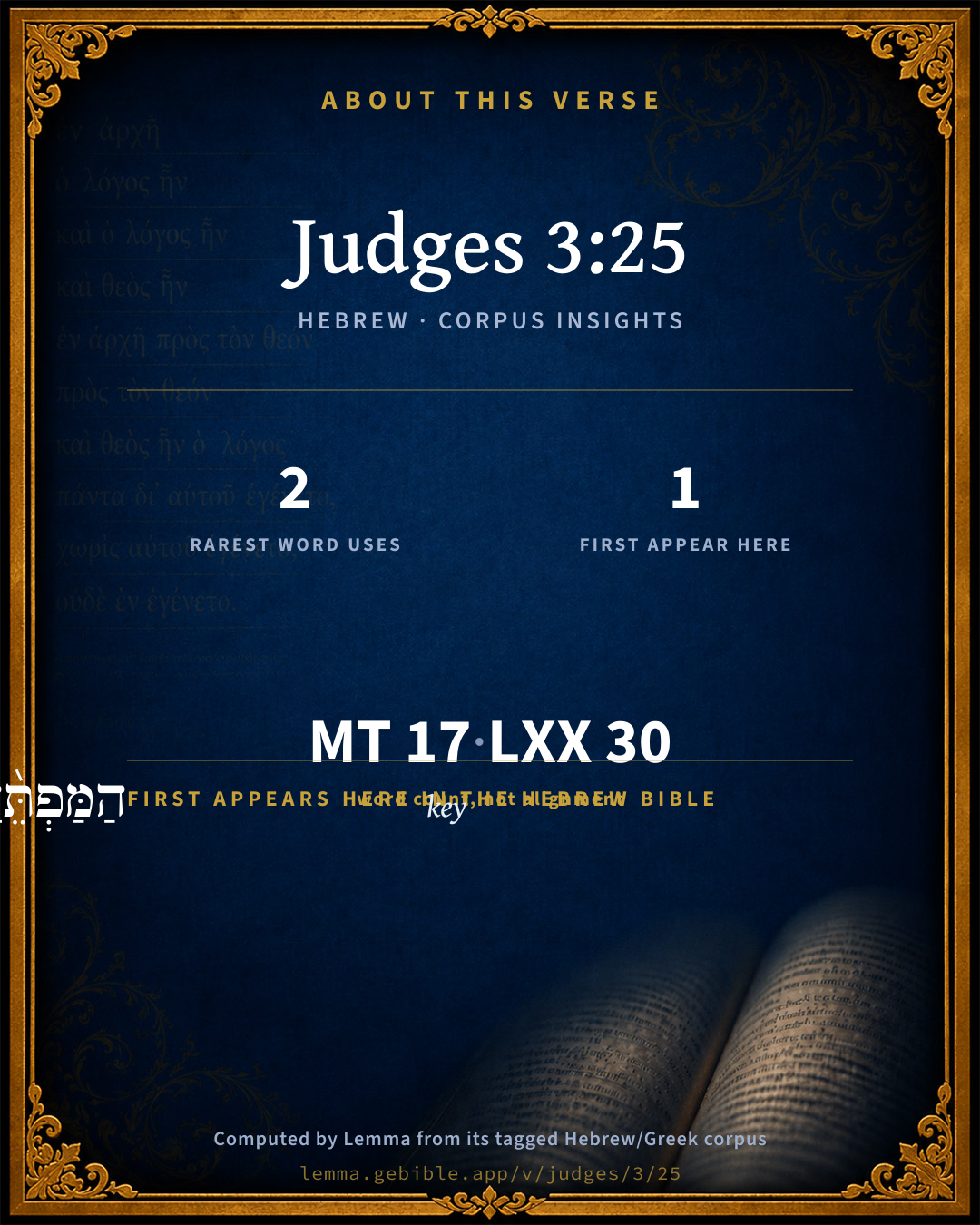
About this verse

These counts appear in no published source. They are computed here, from the morphology-tagged text and Lemma’s own curated glosses. What Lemma adds →

17
words
15
distinct lemmas
Historical
section

Notable vocabulary

The rarest word here is הַמַּפְתֵּ֨חַ֙ key H4668 — appearing just 2 times in the whole Hebrew Bible.

First appearance in Scripture

This word makes its first canonical appearance in the Hebrew Bible here:

  • הַמַּפְתֵּ֨חַ֙ key H4668

Shared distinctive vocabulary

הַמַּפְתֵּ֨חַ֙ key H4668 occurs in 2 verses of the Hebrew Bible. Also found in:

Grammatical profile

  • 7 verbs
  • 5 nouns
  • 1 preposition
  • 4 particles

Verb forms

  • וַיָּחִ֣ילוּ Qal · Sequential Imperfect
  • בּ֔וֹשׁ Qal · Infinitive Construct
  • פֹתֵ֖חַ Qal · Participle Active
  • וַיִּקְח֤וּ Qal · Sequential Imperfect
  • וַיִּפְתָּ֔חוּ Qal · Sequential Imperfect
  • נֹפֵ֥ל Qal · Participle Active
  • מֵֽת Qal · Participle Active

Repetition

Words recur within this verse — often emphatic in Hebrew:

  • וְהְנֵּ֛ה behold H2009 ×2
  • פֹתֵ֖חַ to open H6605 ×2

Hebrew & Septuagint length

In English translation the verse runs 36 words from the Hebrew and 40 from the Septuagint (LXX English) — closely comparable.

A rough comparison of the two English renderings, which tokenize alike — not a word-level alignment.

Word counts can differ between the Hebrew and the Greek without any difference in meaning — e.g. the Hebrew direct-object marker אֵת has no separate Greek word, and Greek often adds the article ὁ.

In the original languages it is 17 Hebrew tokens and 30 Greek tokens — but the two are counted differently (Hebrew bundles its prefixes and suffixes into one token; the Greek is in lemma form), so that isn’t a like-for-like length.

Hebrew and Greek witnesses Masoretic Hebrew ↔ Greek Septuagint

The same verse in the two great witnesses to the Old Testament, shown verse-for-verse.

These are two independent witnesses, not word-aligned to each other, and the Septuagint is shown in lemma (dictionary) form.

Hebrew Judges 3:25 Masoretic · Westminster Leningrad Codex

וַיָּחִ֣ילוּ עַד בּ֔וֹשׁ וְהְנֵּ֛ה אֵינֶ֥נּוּ פֹתֵ֖חַ דַּלְת֣וֹת הָֽעֲלִיָּ֑ה וַיִּקְח֤וּ אֶת הַמַּפְתֵּ֨חַ֙ וַיִּפְתָּ֔חוּ וְהִנֵּה֙ אֲדֹ֣נֵיהֶ֔ם נֹפֵ֥ל אַ֖רְצָה מֵֽת

They waited until they were ashamed; and, behold, he didn't open the doors of the upper room: therefore they took the key, and opened [them], and, behold, their lord was fallen down dead on the earth.

World English Bible · Public Domain

Greek LXX Judges 3:25 Septuagint · lemma form

καί ὑπομένω ἕως αἰσχύνω καί ἰδού οὐ εἰμί ὁ ἀναοἴγω ὁ θύρα ὁ ὑπερῷον καί λαμβάνω ὁ κλείς καί ἀναοἴγω καί ἰδού ὁ κύριος αὐτός πίπτω ἐπί ὁ γῆ θνήσκω

And they waited till they were ashamed, and, behold, there was no one that opened the doors of the upper chamber; and they took the key, and opened them; and, behold, their lord was fallen down dead upon the earth.

LXX2012 (modern English Septuagint) · Public Domain

Hebrew: Westminster Leningrad Codex (CC BY 4.0). Greek: Septuagint (public domain); English from LXX2012 (modern English Septuagint) (Public Domain). How the Septuagint differs from the Hebrew →

Targum (Aramaic paraphrase)

1

The Targum is the ancient Jewish Aramaic paraphrase of the Hebrew Scriptures — an interpretive translation, not the Hebrew text itself. Onkelos (literal) and Pseudo-Jonathan (expansive) render the Torah, and Jonathan the Prophets. Coverage is partial: where no permissively-licensed English translation exists for a verse, only the Aramaic is shown. This is verse-level text, not a word-by-word alignment to the Hebrew.

  1. Targum Jonathan Prophets (Joshua–Malachi)
    וְאוֹרִיכוּ עַד סַגִי וְהָא לֵיתוֹהִי פָּתַח דָשֵׁי עִלִיתָא וּנְסִיבוּ יַת מַפְתְּחָא וּפְתַחוּ וְהָא רִבּוֹנְהוֹן טָרִיף רְמֵי עַל אַרְעָא מִית:

    (no public-domain English translation for this verse)

    Targum Jonathan — Aramaic: “Mikraot Gedolot” (public domain). English: “Sefaria Community Translation” (CC0 1.0 (public-domain dedication)); “London "Chaldee Paraphrase," 1871” (public domain). Text via Sefaria.

Commentary

Notes on Judges 3:25 from classic Christian and Jewish commentators (each source and its license shown beneath its notes). The classic Christian expositions comment on the surrounding passage and are grouped to its opening verse, so a note may address several verses; the Jewish commentaries on the Tanakh (Rashi and others) are per-verse, so they appear only where the commentator wrote on this verse.

Lemma curates 59 commentaries, every one of them public domain or Creative Commons licensed, each selected and text-cleaned for this edition rather than reprinted as found. About our sources →

Trapp's Complete Commentary

John Trapp

Jdg 3:25 And they tarried till they were ashamed: and, behold, he opened not the doors of the parlour; therefore they took a key, and opened [them]: and, behold, their lord [was] fallen down dead on the earth.

Ver. 25. And they tarried till they were ashamed,] viz., Of their long staying, and not looking after their lord.

And, behold, their lord was fallen down dead.]

“ Ad generum Cereris sine caede et sanguine pauci

Descendunt reges, et sicca morte tyranni. ”

God, when he hath chastised his children, doth many times cast the rod into the fire: witness the persecutors in all ages, many of whom came to untimely ends. Most of the Caesars, till Constantine, got nothing by their adoption or designation, nisi ut citius interficerentur, but to be the sooner slain.

John Trapp, A Commentary or Exposition upon All the Books of the Old and New Testament (1647–1656) — public domain. Text from a community e-Sword module.

Joseph Benson's Commentary

Jdg 3:25. They tarried till they were ashamed — Till they were in great confusion, not conceiving what could cause him to sleep so much longer than usual; and not knowing what to say or think, afraid that they should either disturb him, or be guilty of neglect toward him. They took a key and opened them — Another key, it being usual in the courts of kings for more persons than one to be intrusted with keys to the same room.

Joseph Benson's Commentary on the Old and New Testaments (1811–1818) — public domain. Text from a community e-Sword module.

Ellicott's Commentary for English Readers

(25) Tarried till they were ashamed.—See 2Ki_2:17; 2Ki_8:11. It is a dangerous matter to intrude on the privacy of an Oriental king.

A key.—Literally, the opener. The ancient key was simply a bar of wood, hooked at the end, which passed through a hole in the door and caught the bolt inside.

Their lord was fallen down dead.—Comp. Jdg_4:22.

A Bible Commentary for English Readers, edited by Charles John Ellicott (1878–1897) — public domain. Text from a community e-Sword module.

The Cambridge Bible for Schools and Colleges

gen. ed. J. J. S. Perowne

25. till they were ashamed] Cf. 2Ki_2:17; 2Ki_8:11; an idiom expressive of surprise and perplexity.

the key, and opened them] The lock or bolt was constructed most likely in the same fashion as the wooden locks still used in Palestine; the bolt is shot by hand, the key is used only for unlocking.

was fallen down dead] Cf. Jdg_4:22; Jdt_14:14 f.

The Cambridge Bible for Schools and Colleges (gen. ed. J. J. S. Perowne; Cambridge University Press, 1878–1918) — public domain. Text from a community e-Sword module.

John Gill's Exposition

And Ehud escaped while they tarried,.... While the servants of the king of Moab tarried waiting for the opening of the doors of the parlour, this gave him time enough to make his escape, so as to be out of the reach of pursuers; or else the sense is, that even when they had opened the doors, and found the king dead, while they were in confusion at it, not knowing what to ascribe it to, the dagger being enclosed in the wound, and perhaps but little blood, if any, issued out, being closed up with fat, and so had no suspicion of his being killed by Ehud; but rather supposing it to be an accidental fall from his seat, and might call in the physicians to examine him, and use their skill, if there were any hopes of recovery; all which prolonged time, and facilitated the escape of Ehud:

and passed beyond the quarries, and escaped to Seirath; he got beyond the quarries, which were by Gilgal, which shows that it could not be at Jericho where the king of Moab was, as Josephus thinks, but either in his own country beyond Jordan, though no mention is made of Ehud's crossing Jordan, or however some place nearer the fords of Jordan; since Gilgal, from whence he returned, and whither he came again after he had killed the king of Moab, lay on that side of Jericho which was towards Jordan; and this Seirath he escaped to was in or near the mountain of Ephraim, as appears from Jdg 3:27,, but of it we have no account elsewhere; but it is thought by some learned men (l) to be the place where Seth's pillars stood, and they to be the engravings here spoken of, which we translate "quarries": the words of Josephus (m) are, that the posterity of Seth, who very much studied astronomy, having heard that Adam foretold the destruction of the universe at one time by fire, and at another by water, erected two pillars, one of stone, and the other of brick, on which they inscribed their inventions (in astronomy), that they might be preserved, and which remain to this day in the land of Siriad; but this account of Josephus seems to be taken from a fabulous relation of Manetho, the Egyptian, and is abundantly confuted by Dr. Stillingfleet (n). Jarchi interprets this of Seirath, a thick wood or forest, the trees of which grew as thick as the hair on a man's head, and so a proper place to escape to, and hide in: it may be it was the woody part of the mount Ephraim, see Jos 17:18.

(l) Marsham. Chronicon, p. 39. Vossius de 70 Interpret. p. 271. (m) Antiqu. l. 1. c. 2. sect. 3. (n) Origines Sacrae, l. 1. c. 2.

John Gill's Exposition of the Whole Bible (1746–1763) — public domain (CC PDM 1.0). Text via the HelloAO Bible API.

Albert Barnes' Notes on the Bible

A key - literally, “an opener.” Probably a wooden instrument with which they either lifted up the latch within, or drew back the wooden bar or bolt. The chief officer of Eglon’s household probably had a second key (compare Isa 22:15, Isa 22:20-22; Isa 37:2).

Albert Barnes' Notes on the Bible (1834–1885) — public domain. Text from a community e-Sword/MySword module.

Haydock's Catholic Bible Commentary

Ashamed, perceiving that their hopes had been vain, (Calmet) and not knowing what to do, (Menochius) they began to fear the worst. (Haydock)

George Leo Haydock (1774–1849), Haydock's Catholic Family Bible and Commentary, 1859 edition — public domain. Excludes Psalms (Douay-Rheims chapter numbering differs from Protestant) and Deuterocanonical books (Catholic canon only).

Matthew Poole's English Annotations

Ashamed, or, confounded, not knowing what to say or think; lest they should either disturb him, or be guilty of neglect towards him.

A key; another key, it being usual in princes’ courts to have divers keys for the same door.

Matthew Poole's English Annotations on the Holy Bible (1683–1685) — public domain. Text from a community e-Sword/MySword module.

Whedon's Commentary on the Bible

Daniel D. Whedon

25. Took a key — See on Jdg_3:23.

Dead on the earth — That is, on the floor of his chamber. Perhaps the fatal thrust of Ehud’s dagger had not produced instant death, but had so far disabled the king that he could not raise an alarm. He was found dead.

Daniel D. Whedon (gen. ed.), Commentary on the Old and New Testaments (1874–1909) — public domain. Text from a community e-Sword module.

John Wesley's Explanatory Notes

Ashamed - Or, confounded, not knowing what to say or think; lest they should either disturb him, or be guilty of neglect towards him. A key - Another key, it being usual in princes courts to have divers keys for the same door.

John Wesley, Explanatory Notes Upon the Whole Bible (1754–1765) — public domain. Text via the GEBible commentary corpus.

Rashi

Rabbi Shlomo Yitzchaki (Rashi)

A considerable time. [lit.] Until [it constituted] delay, as if to say, a considerable time.

Rashi on the Tanakh — English translations: “The Judaica Press complete Tanach with Rashi, translated by A. J. Rosenberg” (CC BY 4.0); “Pentateuch with Rashi's commentary by M. Rosenbaum and A.M. Silbermann, 1929-1934” (public domain); “The Metsudah Tanach series, Lakewood, N.J” (CC BY 4.0); and “The Book of Joshua, Metsudah Publications, 1997” (CC BY 4.0). Text via Sefaria.

Lesson kit

Teaching starters — assembled from the data on this page, not authored interpretation. Every prompt links to the verse data it draws on. Edit before teaching.

Judges, in the Historical, opens this verse with 17 words (15 distinct Hebrew lemmas). Its most distinctive word is maphtêach (“key”). A historical commentator’s framing appears above. Read the whole chapter for the surrounding context.

Discussion questions

  1. The word maphtêach carries the sense “key.” How does it shape the verse?
  2. The word “key” first appears here in Scripture. What is being introduced at this debut?
  3. Isaiah 22:22 shares the word «key» with this verse. How do the two illuminate each other?
  4. “behold” occurs 2× in this one verse. What is the effect of the repetition?
  5. These translations render this verse differently. What is at stake in choosing one wording over another?
  6. The verb «וַיָּחִ֣ילוּ» is Qal Sequential Imperfect. How does its form color the action?
  7. Reading how Trapp's Complete Commentary and Joseph Benson's Commentary read this verse, where do the two commentators agree and where do they part?

Things to notice

Reading settings

Reading text

Shown beneath each verse's original-language words.

Old Testament
Old Testament edition

Read the OT as the Masoretic Hebrew (MT) or the Greek Septuagint (LXX).

English shown for the Greek Septuagint (in the Hebrew ↔ Greek comparison).

Comparing translations? Open the Compare panel on any verse page to stack up to four side by side.