
Exodus 15:16

Hebrew (Westminster Leningrad Codex) Exodus 15:16 appears in the Hebrew Old Testament. The text above is from the Westminster Leningrad Codex. Each word links to its Strong’s number, a concise gloss, and parsing drawn from the Open Scriptures Hebrew Bible morphology. Click any word for its full Brown-Driver-Briggs (BDB) entry.
Download image
Cite this verse

Exodus 15:16 (World English Bible). Public Domain. Lemma interlinear Bible study tool, https://lemma.gebible.app/v/exodus/15/16.

Show BibTeX & RIS
BibTeX
RIS
English Translation
Terror and dread falls on them. By the greatness of your arm they are as still as a stone; Until your people pass over, Yahweh, Until the people pass over who you have purchased.
World English Bible · Public Domain
Highlights
  • 1 first appearance in the Hebrew Bible
Full analysis ↓
Download a study sheet

One document with this verse’s original text, its word-by-word gloss line, the meaning frame, cross-references with their text, attributed commentary, and full source and license credits — printable, and it pastes into notes with its structure intact.

This verse Autodidact and up

Study sheet (.html) Plain text (.txt)

A passage Seminary Student

Up to 50 verses in one chapter. A passage sheet keeps up to 6 commentary sources and 12 cross-references per verse, in the order this page ranks them, and says so on the sheet whenever that leaves anything out. Ask for a single verse and you get the Autodidact verse sheet above.

Everything on this page stays free to read, with no account — the sheet is a download of what is already on screen, not access to it.

Want to remove ads? Support Godless Engineer
Compare translations 3

The same verse in 3 English versions, stacked beneath the original-language interlinear above. Click any original word for its lexicon entry.

Each is an independent rendering of the whole verse — the interlinear is not word-aligned to these translations.

Highlighted words mark where these versions differ — a whole-verse word diff, not a word-by-word alignment.

  • World English Bible Public Domain
    Terror and dread falls on them. By the greatness of your arm they are as still as a stone; Until your people pass over, Yahweh, Until the people pass over who you have purchased.
  • King James Version Public Domain
    Fear and dread shall fall upon them; by the greatness of thine arm they shall be as still as a stone; till thy people pass over, O LORD, till the people pass over, which thou hast purchased.
  • unfoldingWord Literal Text CC BY-SA 4.0
    Terror and dread fall on them. By the greatness of your arm, they are still as a stone until your people pass by, Yahweh, until this people you acquired pass by.

unfoldingWord Literal Text — © unfoldingWord, licensed CC BY-SA 4.0. Word-aligned USFM3 via Door43 (git.door43.org/unfoldingWord/en_ult).

Versions to compare (up to 4)

3 of 4 selected

Show all 18 translations

Every available English version of this verse, each an independent rendering of the whole verse.

  • World English Bible Public Domain
    Terror and dread falls on them. By the greatness of your arm they are as still as a stone; Until your people pass over, Yahweh, Until the people pass over who you have purchased.
  • Berean Standard Bible Public Domain
    and terror and dread will fall on them. By the power of Your arm they will be as still as a stone until Your people pass by, O LORD, until the people You have bought pass by.
  • Majority Standard Bible Public Domain
    and terror and dread will fall on them. By the power of Your arm they will be as still as a stone until Your people pass by, O LORD, until the people You have bought pass by.
  • King James Version Public Domain
    Fear and dread shall fall upon them; by the greatness of thine arm they shall be as still as a stone; till thy people pass over, O LORD, till the people pass over, which thou hast purchased.
  • American Standard Version (1901) Public Domain
    Terror and dread falleth upon them; By the greatness of thine arm they are as still as a stone; Till thy people pass over, O Jehovah, Till the people pass over that thou hast purchased.
  • Revised Version (1885) Public Domain
    Terror and dread falleth upon them; By the greatness of thine arm they are as still as a stone; Till thy people pass over, O LORD, Till the people pass over which thou hast purchased.
  • Geneva Bible (1599) Public Domain
    Feare and dread shall fall vpon them: because of the greatnesse of thine arme, they shalbe stil as a stone, till thy people passe, O Lord: til this people passe, which thou hast purchased.
  • Douay-Rheims (1899) Public Domain
    Let fear and dread fall upon them, in the greatness of thy arm: let them become unmoveable as a stone, until thy people, O Lord, pass by: until this thy people pass by, which thou hast possessed.
  • Young's Literal Translation Public Domain
    Fall on them doth terror and dread; By the greatness of Thine arm They are still as a stone, Till Thy people pass over, O Jehovah; Till the people pass over Whom Thou hast purchased.
  • Literal Standard Version CC BY-SA 4.0
    Terror and dread fall on them; By the greatness of Your arm || They are still as a stone, || Until Your people pass over, O YHWH; Until the people pass over || Whom You have purchased.
  • Unlocked Literal Bible CC BY-SA 4.0
    Terror and dread will fall on them. Because of your arm's power, they will become as still as a stone until your people pass by, Yahweh— until the people you have rescued pass by.
  • unfoldingWord Literal Text CC BY-SA 4.0
    Terror and dread fall on them. By the greatness of your arm, they are still as a stone until your people pass by, Yahweh, until this people you acquired pass by.
  • Darby Bible Public Domain
    Fear and dread fall upon them; By the greatness of thine arm they are still as a stone; Till thy people pass over, Jehovah, Till the people pass over that thou hast purchased.
  • World Messianic Bible Public Domain
    Terror and dread falls on them. By the greatness of your arm they are as still as a stone, until your people pass over, LORD, until the people you have purchased pass over.
  • Webster's Bible Public Domain
    Fear and dread shall fall upon them; by the greatness of thy arm they shall be as still as a stone; till thy people pass over, O LORD, till the people pass over, which thou hast purchased.
  • Free Bible Version CC BY-SA 4.0
    Terror and fright will fall on them. Lord, because of your great power, they will be as still as stone until your people pass by, until the people you bought pass by.
  • Bible in Basic English Public Domain
    Fear and grief came on them; by the strength of your arm they were turned to stone; till your people went over, O Lord, till the people went over whom you have made yours.
  • JPS Tanakh (1917) Public Domain
    Terror and dread falleth upon them; by the greatness of Thine arm they are as still as a stone; till Thy people pass over, O LORD, till the people pass over that Thou hast gotten.

Literal Standard Version (2020), Covenant Press — licensed CC BY-SA 4.0. Text via the HelloAO Bible API (eBible.org). Unlocked Literal Bible (unfoldingWord) — licensed CC BY-SA 4.0. Text via the HelloAO Bible API (eBible.org). unfoldingWord Literal Text — © unfoldingWord, licensed CC BY-SA 4.0. Word-aligned USFM3 via Door43 (git.door43.org/unfoldingWord/en_ult). Free Bible Version, Dr. Jonathan Gallagher — licensed CC BY-SA 4.0. Text via the HelloAO Bible API (eBible.org).

Word by word

More ways to search: Search by grammar → Find every occurrence → Compare this word →

Practice this passage: Drill this verse → Learn its vocabulary →

ז֥וּ
zûw
H2098
“this”
Particle, Relative
Part of Speech
Particle
Type
Relative
Full BDB Definition

Origin: for H2088

TWOT: 528

this, such (demonstrative pronoun) - (of) which, (of) whom (relative pronoun)
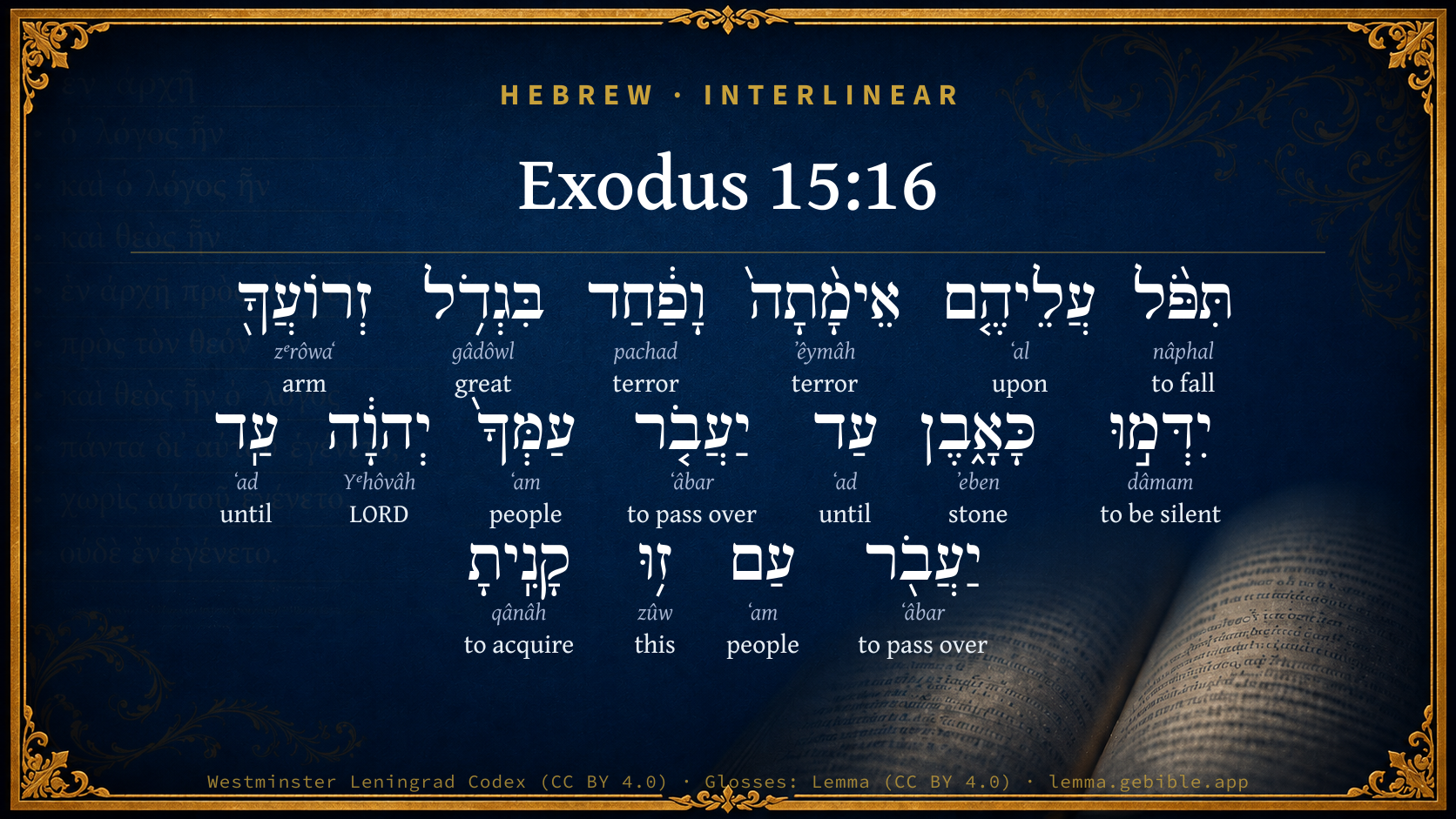
  1. תִּפֹּ֨ל nâphal H5307 “to fall” Verb, Qal, Imperfect, 3rd Person, Feminine, Singular
  2. עֲלֵיהֶ֤ם ʻal H5921 “upon · them” Preposition + Suffix, Personal, 3rd Person, Masculine, Plural
  3. אֵימָ֨תָה֙ ʼêymâh H367 “terror” Noun, Common, Feminine, Singular, Absolute + Suffix, h
  4. וָפַ֔חַד pachad H6343 “and · terror” Conjunction + Noun, Common, Masculine, Singular, Absolute
  5. בִּגְדֹ֥ל gâdôwl H1419 “in/at · great of” Preposition + Adjective, Adjective, Masculine, Singular, Construct
  6. זְרוֹעֲךָ֖ zᵉrôwaʻ H2220 “arm · your” Noun, Common, Both, Singular, Construct + Suffix, Personal, 2nd Person, Masculine, Singular
  7. יִדְּמ֣וּ dâmam H1826 “to be silent” Verb, Qal, Imperfect, 3rd Person, Masculine, Plural
  8. כָּאָ֑בֶן ʼeben H68 “like/as the · stone” Preposition, Determined + Noun, Common, Feminine, Singular, Absolute
  9. עַד ʻad H5704 “until” Preposition
  10. יַעֲבֹ֤ר ʻâbar H5674 “to pass over” Verb, Qal, Imperfect, 3rd Person, Masculine, Singular
  11. עַמְּךָ֙ ʻam H5971 “people · your” Noun, Common, Masculine, Singular, Construct + Suffix, Personal, 2nd Person, Masculine, Singular
  12. יְהוָ֔ה Yᵉhôvâh H3068 “LORD” Noun, Proper
  13. עַֽד ʻad H5704 “until” Preposition
  14. יַעֲבֹ֖ר ʻâbar H5674 “to pass over” Verb, Qal, Imperfect, 3rd Person, Masculine, Singular
  15. עַם ʻam H5971 “people” Noun, Common, Masculine, Singular, Absolute
  16. קָנִֽיתָ qânâh H7069 “to acquire” Verb, Qal, Perfect, 2nd Person, Masculine, Singular

About this verse

These counts appear in no published source. They are computed here, from the morphology-tagged text and Lemma’s own curated glosses. What Lemma adds →

17
words
14
distinct lemmas
Pentateuch
section

Notable vocabulary

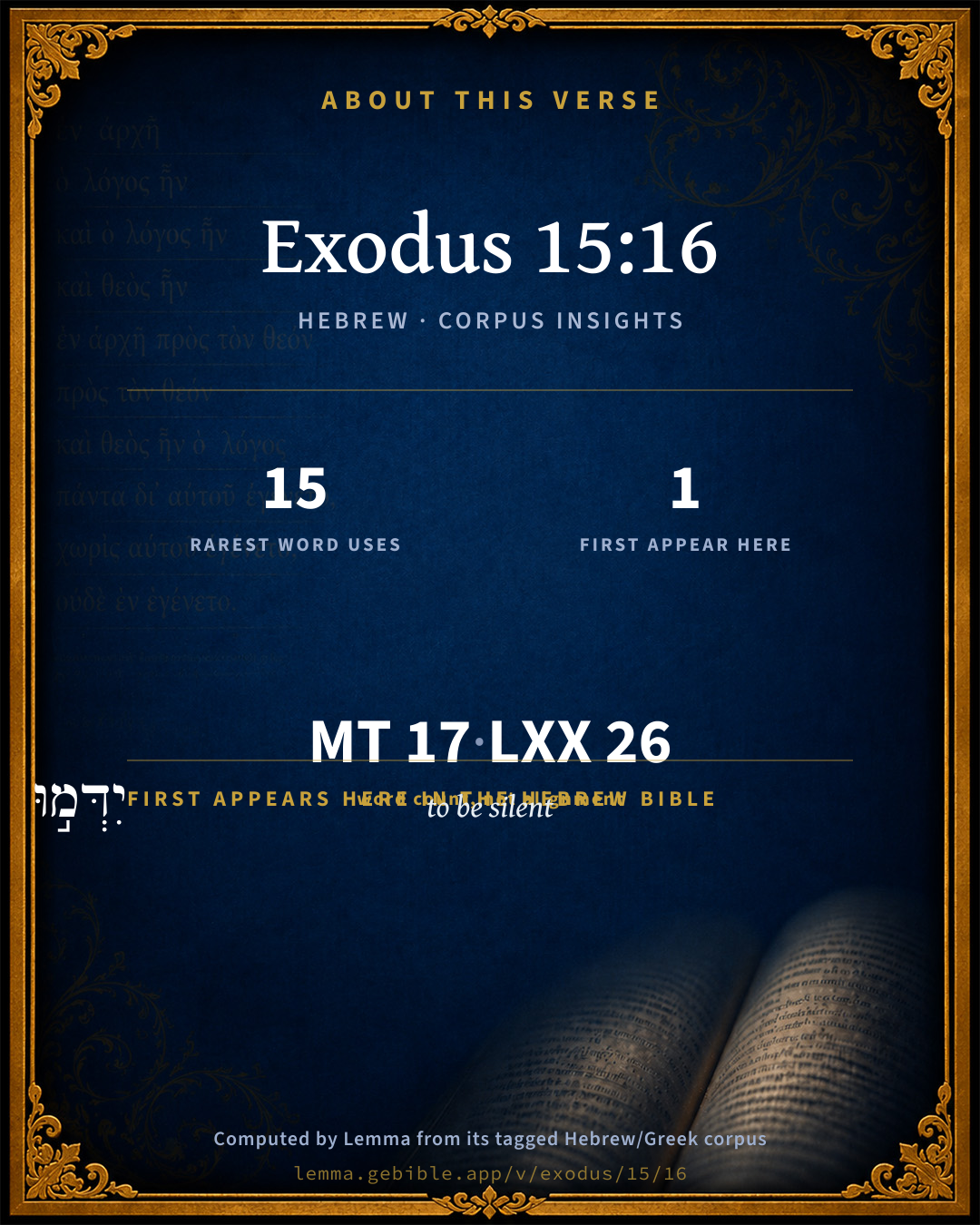
The rarest word here is ז֥וּ this H2098 — appearing just 15 times in the whole Hebrew Bible.

First appearance in Scripture

This word makes its first canonical appearance in the Hebrew Bible here:

  • יִדְּמ֣וּ to be silent H1826

Shared distinctive vocabulary

ז֥וּ this H2098 occurs in 15 verses of the Hebrew Bible. Also found in:

Grammatical profile

  • 5 verbs
  • 7 nouns
  • 1 adjective
  • 3 prepositions
  • 1 particle

Verb forms

  • תִּפֹּ֨ל Qal · Imperfect
  • יִדְּמ֣וּ Qal · Imperfect
  • יַעֲבֹ֤ר Qal · Imperfect
  • יַעֲבֹ֖ר Qal · Imperfect
  • קָנִֽיתָ Qal · Perfect

Repetition

Words recur within this verse — often emphatic in Hebrew:

  • עַד until H5704 ×2
  • יַעֲבֹ֤ר to pass over H5674 ×2
  • עַמְּךָ֙ people H5971 ×2

Hebrew & Septuagint length

In English translation the verse runs 34 words from the Hebrew and 35 from the Septuagint (LXX English) — closely comparable.

A rough comparison of the two English renderings, which tokenize alike — not a word-level alignment.

Word counts can differ between the Hebrew and the Greek without any difference in meaning — e.g. the Hebrew direct-object marker אֵת has no separate Greek word, and Greek often adds the article ὁ.

In the original languages it is 17 Hebrew tokens and 26 Greek tokens — but the two are counted differently (Hebrew bundles its prefixes and suffixes into one token; the Greek is in lemma form), so that isn’t a like-for-like length.

Cross-references

19

Topical passages linked to Exodus 15:16 in the Treasury of Scripture Knowledge — connected by theme and wording, ordered by reader-vote popularity; previews shown in the World English Bible.

  • Psalms 74:2 Remember your congregation, which you purchased of old, Which you have redeemed to be the tribe of your inheritance; Mount Zion, in which you have lived.
  • Deuteronomy 2:25 This day will I begin to put the dread of you and the fear of you on the peoples who are under the whole sky, who shall hear the report of you, and shall tremble, and be in anguish because of you.
  • Joshua 2:9 and she said to the men, I know that Yahweh has given you the land, and that the fear of you is fallen on us, and that all the inhabitants of the land melt away before you.
  • 1 Samuel 25:37 It happened in the morning, when the wine was gone out of Nabal, that his wife told him these things, and his heart died within him, and he became as a stone.
  • Exodus 11:7 But against any of the children of Israel a dog won't even bark or move its tongue, against man or animal; that you may know that Yahweh makes a distinction between the Egyptians and Israel.
  • Deuteronomy 11:25 There shall no man be able to stand before you: Yahweh your God shall lay the fear of you and the dread of you on all the land that you shall tread on, as he has spoken to you.
  • Isaiah 43:1–3 But now thus says Yahweh who created you, Jacob, and he who formed you, Israel: Don't be afraid, for I have redeemed you; I have called you by your name, you are mine.
  • Isaiah 51:10 Isn't it you who dried up the sea, the waters of the great deep; who made the depths of the sea a way for the redeemed to pass over?
  • Jeremiah 31:11 For Yahweh has ransomed Jacob, and redeemed him from the hand of him who was stronger than he.
  • Titus 2:14 who gave himself for us, that he might redeem us from all iniquity, and purify for himself a people for his own possession, zealous for good works.
  • 1 Peter 2:9 But you are a chosen race, a royal priesthood, a holy nation, a people for God's own possession, that you may show forth the excellencies of him who called you out of darkness into his marvelous light:
  • 2 Peter 2:1 But there also arose false prophets among the people, as among you also there will be false teachers, who will secretly bring in destructive heresies, denying even the Master who bought them, bringing on themselves swift destruction.
  • Exodus 19:5–6 Now therefore, if you will indeed obey my voice, and keep my covenant, then you shall be my own possession from among all peoples; for all the earth is mine;
  • Exodus 23:27 I will send my terror before you, and will confuse all the people to whom you come, and I will make all your enemies turn their backs to you.
  • Deuteronomy 32:6 Do you thus requite Yahweh, Foolish people and unwise? Isn't he your father who has bought you? He has made you, and established you.
  • Deuteronomy 32:9 For Yahweh's portion is his people; Jacob is the lot of his inheritance.
  • 1 Samuel 2:9 He will keep the feet of his holy ones; But the wicked shall be put to silence in darkness; For by strength shall no man prevail.
  • 2 Samuel 7:23 What one nation in the earth is like your people, even like Israel, whom God went to redeem to himself for a people, and to make him a name, and to do great things for you, and awesome things for your land, before your people, whom you redeem to you out of Egypt, [from] the nations and their gods?
  • Acts 20:28 Take heed, therefore, to yourselves, and to all the flock, in which the Holy Spirit has made you overseers, to shepherd the assembly of the Lord and God which he purchased with his own blood.

Cross-references courtesy of OpenBible.info (CC BY 4.0).

Hebrew and Greek witnesses Masoretic Hebrew ↔ Greek Septuagint

The same verse in the two great witnesses to the Old Testament, shown verse-for-verse.

These are two independent witnesses, not word-aligned to each other, and the Septuagint is shown in lemma (dictionary) form.

Hebrew Exodus 15:16 Masoretic · Westminster Leningrad Codex

תִּפֹּ֨ל עֲלֵיהֶ֤ם אֵימָ֨תָה֙ וָפַ֔חַד בִּגְדֹ֥ל זְרוֹעֲךָ֖ יִדְּמ֣וּ כָּאָ֑בֶן עַד יַעֲבֹ֤ר עַמְּךָ֙ יְהוָ֔ה עַֽד יַעֲבֹ֖ר עַם ז֥וּ קָנִֽיתָ

Terror and dread falls on them. By the greatness of your arm they are as still as a stone; Until your people pass over, Yahweh, Until the people pass over who you have purchased.

World English Bible · Public Domain

Greek LXX Exodus 15:16 Septuagint · lemma form

ἐπιπίπτω ἐπί αὐτός φόβος καί τρόμος μέγεθος βραχίων σύ ἀπολιθόω ἕως ἄν παραἔρχομαι ὁ λαός σύ κύριος ἕως ἄν παραἔρχομαι ὁ λαός σύ οὗτος ὅς κτάομαι

Let trembling and fear fall upon them; by the greatness of your arm, let them become as stone; till your people pass over, O Lord, till this your people pass over, whom you have purchased.

LXX2012 (modern English Septuagint) · Public Domain

Hebrew: Westminster Leningrad Codex (CC BY 4.0). Greek: Septuagint (public domain); English from LXX2012 (modern English Septuagint) (Public Domain). How the Septuagint differs from the Hebrew →

Targum (Aramaic paraphrase)

2

The Targum is the ancient Jewish Aramaic paraphrase of the Hebrew Scriptures — an interpretive translation, not the Hebrew text itself. Onkelos (literal) and Pseudo-Jonathan (expansive) render the Torah, and Jonathan the Prophets. Coverage is partial: where no permissively-licensed English translation exists for a verse, only the Aramaic is shown. This is verse-level text, not a word-by-word alignment to the Hebrew.

  1. Targum Onkelos Torah (Genesis–Deuteronomy)
    תַּפִּיל עֲלֵיהוֹן אֵימְתָא וְדַחַלְתָּא בִּסְגֵי תָקְפָּךְ יִשְׁתְּקוּן כְּאַבְנָא עַד דְיֵעִבַּר עַמָךְ יְיָ יָת אַרְנוֹנָא עַד דְיֵעִבַּר עַמָא דְנַן דִי פְרַקְתָּא יָת יַרְדְנָא:

    (no public-domain English translation for this verse)

    Targum Onkelos — Aramaic: “Onkelos Genesis” (public domain); “Onkelos Exodus” (public domain); “Onkelos Leviticus” (public domain); “Onkelos Numbers” (public domain); “Onkelos Deuteronomy” (public domain). English: “Sefaria Community Translation” (CC0 1.0 (public-domain dedication)); “J.W. Etheridge. The Targums of Onkelos and Jonathan Ben Uzziel on the Pentateuch. London: Longmans, Green, 1862” (public domain). Text via Sefaria.

  2. Targum Pseudo-Jonathan Torah (Genesis–Deuteronomy)
    תַּפִּיל עֲלֵיהוֹן אֵימָתָא דְמוֹתָא וּדְחִילָתָא בִּתְקוֹף אֶדְרַע וּגְבוּרְתָּךְ יִשְׁתַּתְּקוּן הֵי כְאַבְנַיָא עַד זְמַן דִּי יַעֲבְרוּן עַמָּךְ יְיָ יַת נַחֲלֵי אַרְנוֹנָא עַד זְמַן דִּי יַעֲבְרוּן עַמָּךְ הָאִילֵין דְּקָנִיתָא יַת מְגוּזָתֵיהּ דְּיוּבְקָא

    Through the power of Thy mighty arm, let the terrors of death fall upon them, let them be silent as a stone, till the time when Thy people, O Lord, shall have passed the streams of Arnona, till the time when Thy people whom Thou didst ransom shall have crossed the dividing current of Jabeka.

    Targum Pseudo-Jonathan — Aramaic: “Targum Jonathan on Genesis” (public domain); “Targum Jonathan on Exodus” (public domain); “Targum Jonathan on Leviticus” (public domain); “Targum Jonathan on Numbers” (public domain); “Targum Jonathan on Deuteronomy” (public domain). English: “The Targum of Jonathan ben Uzziel, trans. J. W. Etheridge, London, 1862” (public domain). Text via Sefaria.

Commentary

Notes on Exodus 15:16 from classic Christian and Jewish commentators (each source and its license shown beneath its notes). The classic Christian expositions comment on the surrounding passage and are grouped to its opening verse, so a note may address several verses; the Jewish commentaries on the Tanakh (Rashi and others) are per-verse, so they appear only where the commentator wrote on this verse.

Lemma curates 59 commentaries, every one of them public domain or Creative Commons licensed, each selected and text-cleaned for this edition rather than reprinted as found. About our sources →

Trapp's Complete Commentary

John Trapp

Exo 15:16 Fear and dread shall fall upon them; by the greatness of thine arm they shall be [as] still as a stone; till thy people pass over, O LORD, till the people pass over, [which] thou hast purchased.

Ver. 16. Till thy people pass over.] Over Jordan; as now they have done over the Red Sea, into Canaan.

John Trapp, A Commentary or Exposition upon All the Books of the Old and New Testament (1647–1656) — public domain. Text from a community e-Sword module.

Geneva Bible (1599)

Geneva Bible translators

Or, for thy great power.

Geneva Bible (1599) marginal notes — public domain. Text via Bolls.life.

Adam Clarke's Commentary

Verse 16. Till thy people pass over] Not over the Red Sea, for that event had been already celebrated; but over the desert and Jordan, in order to be brought into the promised land.

Adam Clarke's Commentary on the Bible (1810–1826) — public domain. Text from a community e-Sword/MySword module.

Ellicott's Commentary for English Readers

(16) Fear and dread shall fall upon them.—A portion of the Edomites felt so much fear of Israel that they allowed them to pass through their coasts (Deu_2:4). The Moabites of Aracted similarly (Deu_2:29).

Till thy people pass over—i.e., cross the frontier of the Canaanites, and enter their country. There is no need to suppose that Moses had as yet any distinct idea of the place where the frontier would be crossed.

A Bible Commentary for English Readers, edited by Charles John Ellicott (1878–1897) — public domain. Text from a community e-Sword module.

The Cambridge Bible for Schools and Colleges

gen. ed. J. J. S. Perowne

16.Terror and dread fell upon them;

By the greatness of thine arm, they were as still as a stone:

Till thy people passed through, O Yahweh,

Till thy people passed through, which thou hadst purchased.

Terror, &c.] Cf. Jos_2:9 ‘and that your terror is fallen upon us.’

as still as a stone] i.e. at once motionless (Jos_10:13 Heb.) and silent (Psa_31:17) through fear. For the comparison, cf. the ‘dumb stone’ of Hab_2:19.

passed through] viz. the nations through whom they passed on their progress to Canaan (Di. Bä., &c.): cf. for the expression Deu_29:16 ‘and how we passed through the midst of the nations through which ye passed.’ The poet idealizes the past; and pictures the neighbouring peoples terror-struck, unable to move a hand to resist Israel, as it marched on to take possession of its inheritance in Canaan. The words do not refer, as the rend. of EVV. would imply that they do, to the passage of the Jordan.

purchased] The word does mean (marg.) to get (Gen_4:1, Pro_16:16 al.) or acquire; but it is commonly used in the sense of to get by purchase, or buy (Gen_33:19, &c.). And this no doubt is its meaning here; the idea being that Jehovah has ‘redeemed’ Israel (v. 13, Exo_6:6), like a slave, from servitude, and purchased it as His own possession (cf. Neh_5:8 RVm.). The word is used similarly of Israel in Isa_11:11 (see RVm.), Psa_74:2 (cf. Psa_78:54 b).

The Cambridge Bible for Schools and Colleges (gen. ed. J. J. S. Perowne; Cambridge University Press, 1878–1918) — public domain. Text from a community e-Sword module.

John Gill's Exposition

Fear and dread shall fall upon them.... On the several nations and people before mentioned, especially the Canaanites, which the Targums of Jonathan and Jerusalem interpret of the fear of death, lest the Israelites should fall upon them and destroy them, or God should fight for them, against them, and bring ruin and destruction on them:

by the greatness of thine arm they shall be as still as a stone; awed by the power of God, visible in what he had done for the Israelites, and upon their enemies; they should be like stocks and stones, immovable, have no power to act, nor stir a foot in their own defence, and against Israel, come to invade and possess their land; nor in the least molest them, or stop them in their passage over Jordan, or dispute it with them, but stand like persons thunderstruck, and as stupid as stones, not having any spirit or courage left in them:

till thy people pass over, O Lord, till the people pass over, which thou hast purchased; pass over the brook of Arnon, and the ford of Jabbok, according to the Targum of Jonathan; or the ford of Jabbok, and the ford of Jordan, according to the Jerusalem Targum; the river of Jordan is doubtless literally meant, at least chiefly; and the accomplishment of this prediction may be seen in Jos 3:15 which was an emblem of the quiet passage of Christ's purchased people, through the ford or river of death, to the Canaan of everlasting rest and happiness: Christ's people are purchased by him, who is able to make the purchase, and had a right to do it, and has actually made it, by giving his flesh, shedding his blood, laying down his life, and giving himself a ransom price for them: these do, and must pass over Jordan, or go through the cold stream of death; it is the way of all the earth, of good men as well as others; it is a passage from one world to another; and there is no getting to the heavenly Canaan without going this way, or through this ford; and all the Lord's purchased people, like Israel, clean pass over through it, not one are left in it; their bodies are raised again, their souls are reunited to them, and both come safe to heaven and happiness: and, for the most part, they have a quiet and easy passage, the enemy is not suffered to disturb them, neither the sins and corruptions of their nature, nor an evil heart of unbelief, nor Satan with his temptations; and the terrors of death are taken away from them; so that they can sit and sing on the shores of eternity, in the view of death and another world, saying, death, where is thy sting? grave, where is thy victory? &c. and this is to be ascribed to the greatness of Jehovah's arm, to his almighty power, on which they lean, and go on comfortably in the wilderness; and by this they are carried safely through death to glory, and it is owing to this that the enemy and the avenger are stilled.

John Gill's Exposition of the Whole Bible (1746–1763) — public domain (CC PDM 1.0). Text via the HelloAO Bible API.

Haydock's Catholic Bible Commentary

In the, &c. When they shall behold thy wonders, wrought in our defence. --- Let them cease to make opposition. Hebrew, "let them be silent as a stone." (Haydock)

George Leo Haydock (1774–1849), Haydock's Catholic Family Bible and Commentary, 1859 edition — public domain. Excludes Psalms (Douay-Rheims chapter numbering differs from Protestant) and Deuterocanonical books (Catholic canon only).

Matthew Poole's English Annotations

Be as still, or, be as silent; they shall be so struck. with amazement, that they shall be impotent both for speech and motion.

Matthew Poole's English Annotations on the Holy Bible (1683–1685) — public domain. Text from a community e-Sword/MySword module.

The Pulpit Commentary

Fear and dread shall fall upon them. Compare Deu_2:25 Deu_11:25. The Edomites of Mount Seir and the Moabites gave Israel a free passage through their borders, (Deu_2:4-8, Deu_2:18, Deu_2:29) being afraid to oppose them. Till thy people pass over, O Lord. Some see in this an anticipation of the crossing of Jordan; but perhaps Moses meant no more than the crossing of the Canaanite frontier, in some place or other, which must take place if the urea was to be occupied. The event made the expression used peculiarly appropriate. When thou hast purchased. By bringing his people out of Egypt, their ownership had passed to him from the Egyptians, just as if he had bought them. (see Exo_6:6, 7 19:5)

The Pulpit Commentary (1880–1919), ed. H.D.M. Spence-Jones & Joseph S. Exell — public domain. Text from a community e-Sword module.

unfoldingWord translationNotes

Door43 World Missions Community

Connecting Statement:

Moses continues to sing about how the people of other nations will feel when they see God's people.

Terror and dread will fall on them

These two words mean that fear will come upon them. AT: "Fear will come upon them" (See: Doublet)

dread

Dread is extreme fear or anxiety about something that is going to happen or might happen.

Because of your arm's power

God's arm represents his great strength. AT: "Because of your great strength" (See: Metonymy)

they will become as still as a stone

Possible meanings are 1) "They will be silent like stone" or 2) "They will be motionless as stone" (See: Simile)

translationWords

terror

unfoldingWord translationNotes — © Distant Shores Media and the Door43 World Missions Community, licensed CC BY-SA 4.0. Source: git.door43.org/Door43/en_tn.

Rashi

Rabbi Shlomo Yitzchaki (Rashi)

תפל עליהם אימתה THERE SHALL FALL UPON THEM DREAD — upon those of them who are far away (Mekhilta),

ופחד AND HORROR — shall fall upon those of them who are near by; and all this really happened just as the matter is stated, (Joshua 2:10) “For we have heard how the Lord dried up [the waters of the Red Sea]” (Mekhilta).

עד יעבר... עד יעבר TILL THY PEOPLE PASS … TILL THE PEOPLE PASS — The repetition must be explained as the Targum takes it (until they pass over the Arnon, until they pass over the Jordan).

קנית denotes [THE PEOPLE] WHICH THOU HOLDEST DEAR above all peoples — like an article purchased (קנוי) at a high price and which is therefore held in affection by the man who bought it.

Rashi on the Tanakh — English translations: “The Judaica Press complete Tanach with Rashi, translated by A. J. Rosenberg” (CC BY 4.0); “Pentateuch with Rashi's commentary by M. Rosenbaum and A.M. Silbermann, 1929-1934” (public domain); “The Metsudah Tanach series, Lakewood, N.J” (CC BY 4.0); and “The Book of Joshua, Metsudah Publications, 1997” (CC BY 4.0). Text via Sefaria.

Lesson kit

Teaching starters — assembled from the data on this page, not authored interpretation. Every prompt links to the verse data it draws on. Edit before teaching.

Exodus, in the Pentateuch, opens this verse with 17 words (14 distinct Hebrew lemmas). Its most distinctive word is zûw (“this”). A historical commentator’s framing appears above. Read the whole chapter for the surrounding context.

Discussion questions

  1. What does “this” (zûw) contribute to the verse as a whole?
  2. This is the first place “to be silent” appears in Scripture (first appears here). What does its debut here establish?
  3. How does Exodus 15:13, which shares the word «this», read alongside this verse?
  4. What does the repetition of “until” (2× in this one verse) do in this verse?
  5. These translations render this verse differently; the difference is in the English rendering, not the original. What questions does that raise?
  6. «תִּפֹּ֨ל» is a Qal Imperfect verb. How does that grammatical form shape the action described?
  7. Compare how Trapp's Complete Commentary and Geneva Bible (1599) read this verse. Where do they agree or differ?

Things to notice

Reading settings

Reading text

Shown beneath each verse's original-language words.

Old Testament
Old Testament edition

Read the OT as the Masoretic Hebrew (MT) or the Greek Septuagint (LXX).

English shown for the Greek Septuagint (in the Hebrew ↔ Greek comparison).

Comparing translations? Open the Compare panel on any verse page to stack up to four side by side.