
2 Samuel 14:11

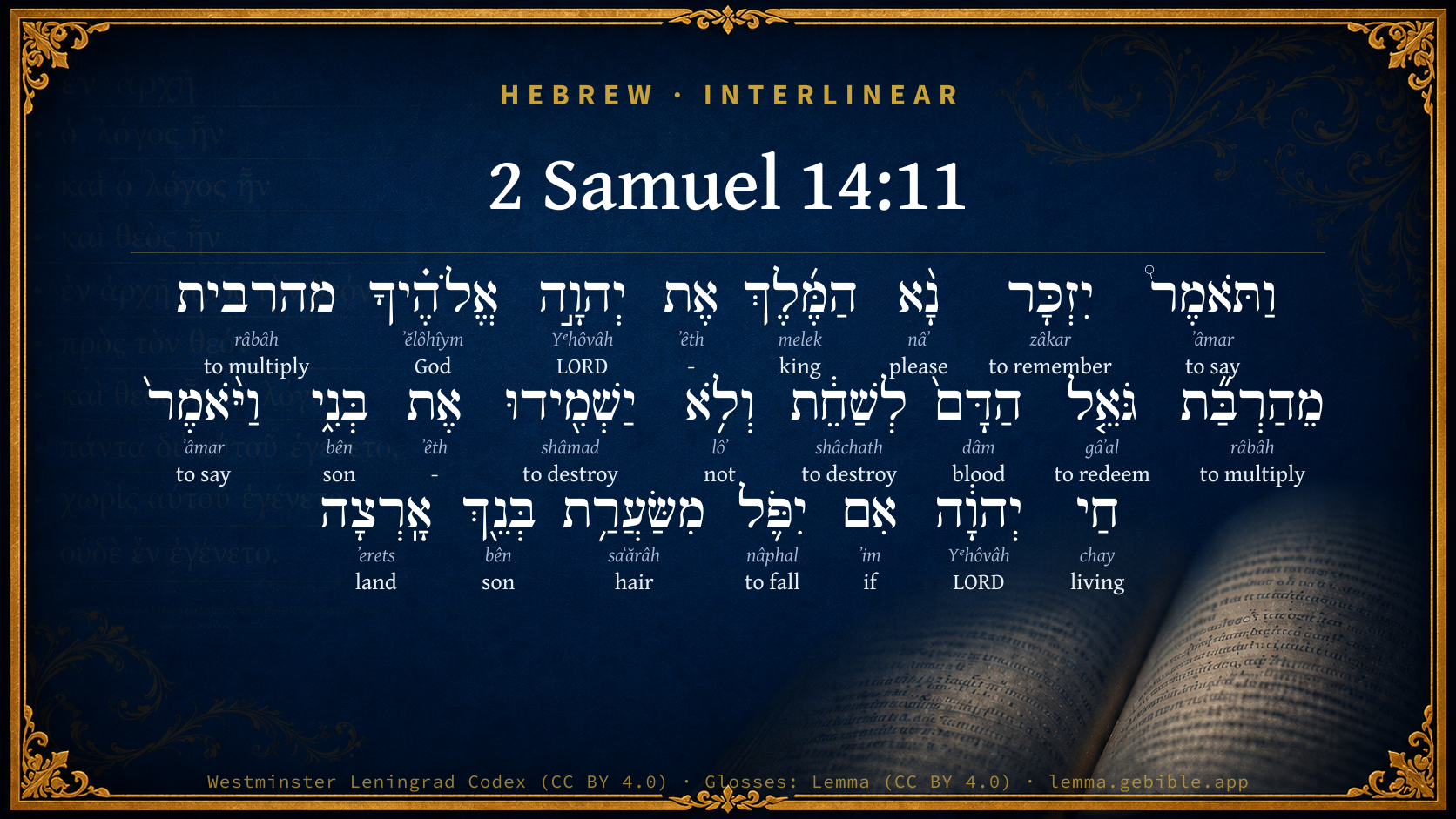
Hebrew (Westminster Leningrad Codex) 2 Samuel 14:11 appears in the Hebrew Old Testament. The text above is from the Westminster Leningrad Codex. Each word links to its Strong’s number, a concise gloss, and parsing drawn from the Open Scriptures Hebrew Bible morphology. Click any word for its full Brown-Driver-Briggs (BDB) entry.
Download image
Cite this verse

2 Samuel 14:11 (World English Bible). Public Domain. Lemma interlinear Bible study tool, https://lemma.gebible.app/v/2-samuel/14/11.

Show BibTeX & RIS
BibTeX
RIS
English Translation
Then said she, Please let the king remember Yahweh your God, that the avenger of blood destroy not any more, lest they destroy my son. He said, As Yahweh lives, there shall not one hair of your son fall to the earth.
World English Bible · Public Domain
Download a study sheet

One document with this verse’s original text, its word-by-word gloss line, the meaning frame, cross-references with their text, attributed commentary, and full source and license credits — printable, and it pastes into notes with its structure intact.

This verse Autodidact and up

Study sheet (.html) Plain text (.txt)

A passage Seminary Student

Up to 50 verses in one chapter. A passage sheet keeps up to 6 commentary sources and 12 cross-references per verse, in the order this page ranks them, and says so on the sheet whenever that leaves anything out. Ask for a single verse and you get the Autodidact verse sheet above.

Everything on this page stays free to read, with no account — the sheet is a download of what is already on screen, not access to it.

Want to remove ads? Support Godless Engineer
Compare translations 3

The same verse in 3 English versions, stacked beneath the original-language interlinear above. Click any original word for its lexicon entry.

Each is an independent rendering of the whole verse — the interlinear is not word-aligned to these translations.

Highlighted words mark where these versions differ — a whole-verse word diff, not a word-by-word alignment.

  • World English Bible Public Domain
    Then said she, Please let the king remember Yahweh your God, that the avenger of blood destroy not any more, lest they destroy my son. He said, As Yahweh lives, there shall not one hair of your son fall to the earth.
  • King James Version Public Domain
    Then said she, I pray thee, let the king remember the LORD thy God, that thou wouldest not suffer the revengers of blood to destroy any more, lest they destroy my son. And he said, As the LORD liveth, there shall not one hair of thy son fall to the earth.
  • unfoldingWord Literal Text CC BY-SA 4.0
    And she said, “May the king please remember Yahweh your God, from the increasing of the avenger of blood to destroy. Then they will not destroy my son.” And he said, “The life of Yahweh, if from the hair of your son should fall to the ground!”

unfoldingWord Literal Text — © unfoldingWord, licensed CC BY-SA 4.0. Word-aligned USFM3 via Door43 (git.door43.org/unfoldingWord/en_ult).

Versions to compare (up to 4)

3 of 4 selected

Show all 18 translations

Every available English version of this verse, each an independent rendering of the whole verse.

  • World English Bible Public Domain
    Then said she, Please let the king remember Yahweh your God, that the avenger of blood destroy not any more, lest they destroy my son. He said, As Yahweh lives, there shall not one hair of your son fall to the earth.
  • Berean Standard Bible Public Domain
    “Please,” she replied, “may the king invoke the LORD your God to prevent the avenger of blood from increasing the devastation, so that my son may not be destroyed!” “As surely as the LORD lives,” he vowed, “not a hair of your son’s head will fall to the ground.”
  • Majority Standard Bible Public Domain
    “Please,” she replied, “may the king invoke the LORD your God to prevent the avenger of blood from increasing the devastation, so that my son may not be destroyed!” “As surely as the LORD lives,” he vowed, “not a hair of your son’s head will fall to the ground.”
  • King James Version Public Domain
    Then said she, I pray thee, let the king remember the LORD thy God, that thou wouldest not suffer the revengers of blood to destroy any more, lest they destroy my son. And he said, As the LORD liveth, there shall not one hair of thy son fall to the earth.
  • American Standard Version (1901) Public Domain
    Then said she, I pray thee, let the king remember Jehovah thy God, that the avenger of blood destroy not any more, lest they destroy my son. And he said, As Jehovah liveth, there shall not one hair of thy son fall to the earth.
  • Revised Version (1885) Public Domain
    Then said she, I pray thee, let the king remember the LORD thy God, that the avenger of blood destroy not any more, lest they destroy my son. And he said, As the LORD liveth, there shalt not one hair of thy son fall to the earth.
  • Geneva Bible (1599) Public Domain
    Then said she, I pray thee, let the King remember the Lord thy God, that thou wouldest not suffer many reuengers of blood to destroy, lest they slay my sonne. And he answered, As the Lord liueth, there shall not one heare of thy sonne fall to the earth.
  • Douay-Rheims (1899) Public Domain
    And she said: Let the king remember the Lord his God, that the next of kin be not multiplied to take revenge, and that they may not kill my son. And he said: As the Lord liveth, there shall not one hair of thy son fall to the earth.
  • Young's Literal Translation Public Domain
    And she saith, `Let, I pray thee, the king remember by Jehovah thy God, that the redeemer of blood add not to destroy, and they destroy not my son;' and he saith, `Jehovah liveth; if there doth fall of the hair of thy son to the earth.'
  • Literal Standard Version CC BY-SA 4.0
    And she says, “Please let the king remember by your God YHWH, that the redeemer of blood does not add to destroy, and they do not destroy my son”; and he says, “YHWH lives; if there falls [even one] hair of your son to the earth.”
  • Unlocked Literal Bible CC BY-SA 4.0
    Then she said, “Please, may the king call to mind Yahweh your God, so that the avenger of blood will not destroy anyone further, so that they will not destroy my son.” The king replied, “As Yahweh lives, not one hair of your son will fall to the ground.”
  • unfoldingWord Literal Text CC BY-SA 4.0
    And she said, “May the king please remember Yahweh your God, from the increasing of the avenger of blood to destroy. Then they will not destroy my son.” And he said, “The life of Yahweh, if from the hair of your son should fall to the ground!”
  • Darby Bible Public Domain
    Then she said, I pray thee, let the king remember Jehovah thy God, that thou wouldest not suffer the revengers of blood to destroy any more, lest they cut off my son. And he said, [As] Jehovah liveth, there shall not one hair of thy son fall to the earth.
  • World Messianic Bible Public Domain
    Then she said, “Please let the king remember the LORD your God, that the avenger of blood destroy not any more, lest they destroy my son.” He said, “As the LORD lives, not one hair of your son shall fall to the earth.”
  • Webster's Bible Public Domain
    Then said she, I pray thee, let the king remember the LORD thy God, that thou wouldest not suffer the revengers of blood to destroy any more, lest they destroy my son. And he said, As the LORD liveth, there shall not one hair of thy son fall to the earth.
  • Free Bible Version CC BY-SA 4.0
    “Please, Your Majesty,” the woman continued, “swear by the Lord your God that you will stop the person wanting to avenge the murder from making it worse by killing my son!” “As the Lord lives,” he promised, “not a single hair from your son's head will fall to the ground.”
  • Bible in Basic English Public Domain
    Then she said, Let the king keep in mind the Lord your God, so that he who gives punishment for blood may be kept back from further destruction and that no one may send death on my son. And he said, By the living Lord, not a hair of your son's head will come to the earth.
  • JPS Tanakh (1917) Public Domain
    Then said she: 'I pray thee, let the king remember the LORD thy God, that the avenger of blood destroy not any more, lest they destroy my son.' And he said: 'As the LORD liveth, there shall not one hair of thy son fall to the earth.'

Literal Standard Version (2020), Covenant Press — licensed CC BY-SA 4.0. Text via the HelloAO Bible API (eBible.org). Unlocked Literal Bible (unfoldingWord) — licensed CC BY-SA 4.0. Text via the HelloAO Bible API (eBible.org). unfoldingWord Literal Text — © unfoldingWord, licensed CC BY-SA 4.0. Word-aligned USFM3 via Door43 (git.door43.org/unfoldingWord/en_ult). Free Bible Version, Dr. Jonathan Gallagher — licensed CC BY-SA 4.0. Text via the HelloAO Bible API (eBible.org).

Word by word

More ways to search: Search by grammar → Find every occurrence → Compare this word →

Practice this passage: Drill this verse → Learn its vocabulary →

מִשַּׂעֲרַ֥ת
saʻărâh
H8185
“from · hair of”
Preposition + Noun, Common, Feminine, Singular, Construct
Part of Speech
Preposition + Noun
Type
Common
Gender
Feminine
Number
Singular
State
Construct
Full BDB Definition

Origin: from H8181

TWOT: 2274b

a single hair
  1. וַתֹּאמֶר֩ ʼâmar H559 “and · to say” Conjunction + Verb, Qal, Sequential Imperfect, 3rd Person, Feminine, Singular
  2. יִזְכָּר zâkar H2142 “to remember” Verb, Qal, Jussive, 3rd Person, Masculine, Singular
  3. נָ֨א nâʼ H4994 “please” Particle, Exhortation
  4. הַמֶּ֜לֶךְ melek H4428 “the · king” Particle, Definite Article + Noun, Common, Masculine, Singular, Absolute
  5. אֶת ʼêth H853 “-” Particle, Direct Object
  6. יְהוָ֣ה Yᵉhôvâh H3068 “LORD” Noun, Proper
  7. אֱלֹהֶ֗יךָ ʼĕlôhîym H430 “God(s) · your” Noun, Common, Masculine, Plural, Construct + Suffix, Personal, 2nd Person, Masculine, Singular
  8. מהרבית râbâh H7235 “from · to multiply” Preposition + Verb, Hiphil, Infinitive Construct
  9. מֵהַרְבַּ֞ת râbâh H7235 “from · to multiply” Preposition + Verb, Hiphil, Infinitive Construct
  10. גֹּאֵ֤ל gâʼal H1350 “redeeming” Verb, Qal, Participle Active, Masculine, Singular, Construct
  11. הַדָּם֙ dâm H1818 “the · blood” Particle, Definite Article + Noun, Common, Masculine, Singular, Absolute
  12. לְשַׁחֵ֔ת shâchath H7843 “to destroy” Preposition + Verb, Piel, Infinitive Construct
  13. וְלֹ֥א lôʼ H3808 “and · not” Conjunction + Particle, Negative
  14. יַשְׁמִ֖ידוּ shâmad H8045 “to destroy” Verb, Hiphil, Imperfect, 3rd Person, Masculine, Plural
  15. אֶת ʼêth H853 “-” Particle, Direct Object
  16. בְּנִ֑י bên H1121 “son · my” Noun, Common, Masculine, Singular, Construct + Suffix, Personal, 1st Person, Common, Singular
  17. וַיֹּ֨אמֶר֙ ʼâmar H559 “and · to say” Conjunction + Verb, Qal, Sequential Imperfect, 3rd Person, Masculine, Singular
  18. חַי chay H2416 “living” Adjective, Adjective, Masculine, Singular, Absolute
  19. יְהוָ֔ה Yᵉhôvâh H3068 “LORD” Noun, Proper
  20. אִם ʼim H518 “if” Conjunction
  21. יִפֹּ֛ל nâphal H5307 “to fall” Verb, Qal, Imperfect, 3rd Person, Masculine, Singular
  22. בְּנֵ֖ךְ bên H1121 “son · your” Noun, Common, Masculine, Singular, Construct + Suffix, Personal, 2nd Person, Feminine, Singular
  23. אָֽרְצָה ʼerets H776 “land · toward” Noun, Common, Both, Singular, Absolute + Suffix, Demonstrative

About this verse

These counts appear in no published source. They are computed here, from the morphology-tagged text and Lemma’s own curated glosses. What Lemma adds →

24
words
19
distinct lemmas
Historical
section

Notable vocabulary

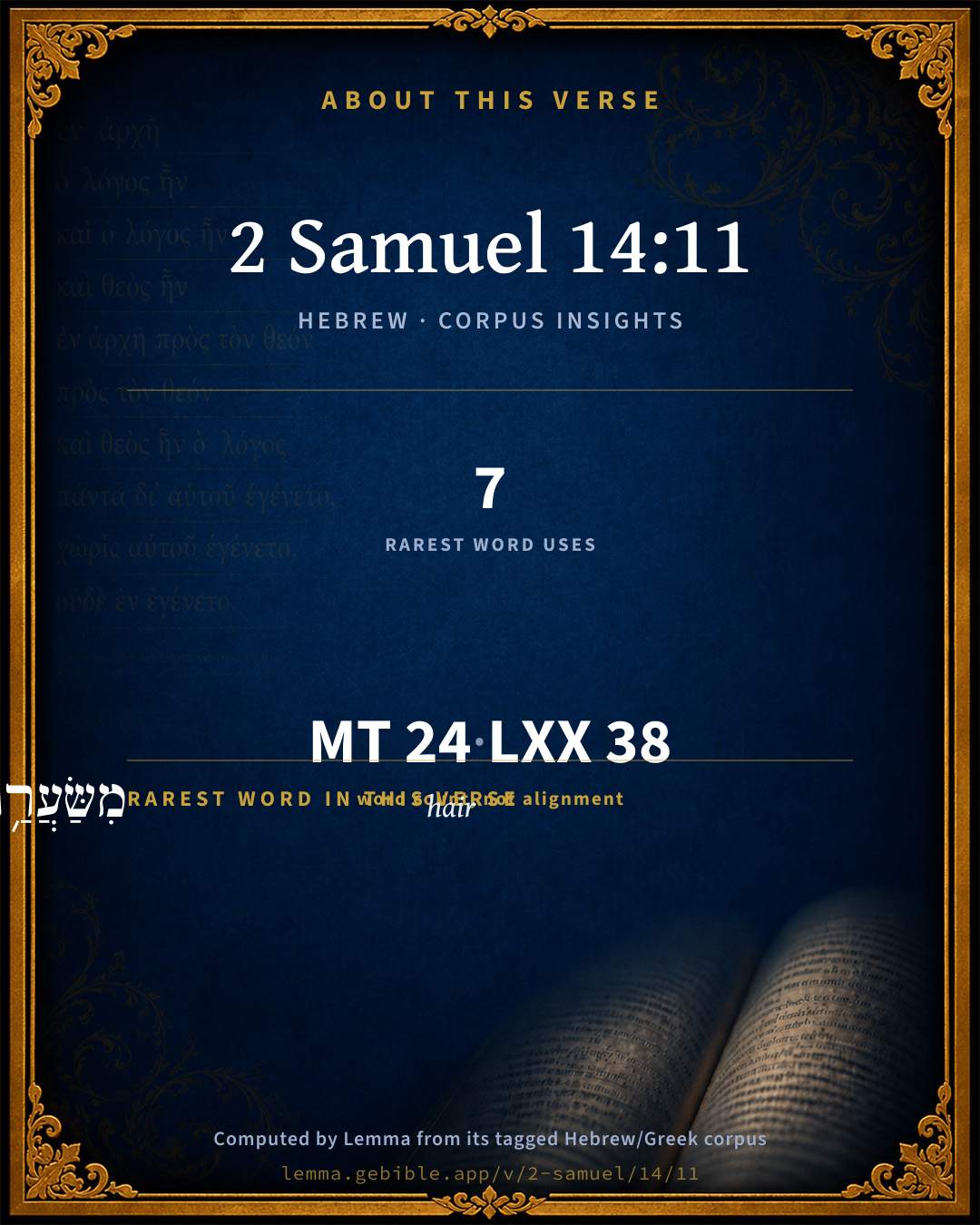
The rarest word here is מִשַּׂעֲרַ֥ת hair H8185 — appearing just 7 times in the whole Hebrew Bible.

Shared distinctive vocabulary

מִשַּׂעֲרַ֥ת hair H8185 occurs in 7 verses of the Hebrew Bible. Also found in:

Grammatical profile

  • 9 verbs
  • 9 nouns
  • 1 adjective
  • 1 conjunction
  • 4 particles

Verb forms

  • וַתֹּאמֶר֩ Qal · Sequential Imperfect
  • יִזְכָּר Qal · Jussive
  • מהרבית Hiphil · Infinitive Construct
  • מֵהַרְבַּ֞ת Hiphil · Infinitive Construct
  • גֹּאֵ֤ל Qal · Participle Active
  • לְשַׁחֵ֔ת Piel · Infinitive Construct
  • יַשְׁמִ֖ידוּ Hiphil · Imperfect
  • וַיֹּ֨אמֶר֙ Qal · Sequential Imperfect
  • יִפֹּ֛ל Qal · Imperfect

Repetition

Words recur within this verse — often emphatic in Hebrew:

  • וַתֹּאמֶר֩ to say H559 ×2
  • יְהוָ֣ה LORD H3068 ×2
  • מהרבית to multiply H7235 ×2
  • בְּנִ֑י son H1121 ×2

Hebrew & Septuagint length

In English translation the verse runs 42 words from the Hebrew and 48 from the Septuagint (LXX English) — closely comparable.

A rough comparison of the two English renderings, which tokenize alike — not a word-level alignment.

Word counts can differ between the Hebrew and the Greek without any difference in meaning — e.g. the Hebrew direct-object marker אֵת has no separate Greek word, and Greek often adds the article ὁ.

In the original languages it is 24 Hebrew tokens and 38 Greek tokens — but the two are counted differently (Hebrew bundles its prefixes and suffixes into one token; the Greek is in lemma form), so that isn’t a like-for-like length.

Cross-references

15

Topical passages linked to 2 Samuel 14:11 in the Treasury of Scripture Knowledge — connected by theme and wording, ordered by reader-vote popularity; previews shown in the World English Bible.

  • 1 Samuel 14:45 The people said to Saul, Shall Jonathan die, who has worked this great salvation in Israel? Far from it: as Yahweh lives, there shall not one hair of his head fall to the ground; for he has worked with God this day. So the people rescued Jonathan, that he didn't die.
  • Numbers 35:19 The avenger of blood shall himself put the murderer to death: when he meets him, he shall put him to death.
  • Matthew 10:30 but the very hairs of your head are all numbered.
  • Numbers 35:21 or in enmity struck him with his hand, so that he died; he who struck him shall surely be put to death; he is a murderer: the avenger of blood shall put the murderer to death, when he meets him.
  • Deuteronomy 19:4–10 This is the case of the manslayer, that shall flee there and live: whoever kills his neighbor unawares, and didn't hate him in time past;
  • 1 Kings 1:52 Solomon said, If he shall show himself a worthy man, there shall not a hair of him fall to the earth; but if wickedness be found in him, he shall die.
  • Acts 27:34 Therefore I beg you to take some food, for this is for your safety; for not a hair will perish from any of your heads."
  • Genesis 14:22 Abram said to the king of Sodom, "I have lifted up my hand to Yahweh, God Most High, possessor of heaven and earth,
  • Genesis 24:2–3 Abraham said to his servant, the elder of his house, who ruled over all that he had, "Please put your hand under my thigh.
  • Genesis 31:50 If you will afflict my daughters, and if you will take wives besides my daughters, no man is with us; behold, God is witness between me and you."
  • Numbers 35:27 and the avenger of blood find him outside of the border of his city of refuge, and the avenger of blood kill the manslayer; he shall not be guilty of blood,
  • Joshua 20:3–6 that the manslayer who kills any person unwittingly [and] unawares may flee there: and they shall be to you for a refuge from the avenger of blood.
  • 1 Samuel 20:42 Jonathan said to David, Go in peace, because we have sworn both of us in the name of Yahweh, saying, Yahweh shall be between me and you, and between my seed and your seed, forever. He arose and departed: and Jonathan went into the city.
  • 1 Samuel 28:10 Saul swore to her by Yahweh, saying, As Yahweh lives, there shall no punishment happen to you for this thing.
  • Jeremiah 4:2 and you shall swear, As Yahweh lives, in truth, in justice, and in righteousness; and the nations shall bless themselves in him, and in him shall they glory.

Cross-references courtesy of OpenBible.info (CC BY 4.0).

Hebrew and Greek witnesses Masoretic Hebrew ↔ Greek Septuagint

The same verse in the two great witnesses to the Old Testament, shown verse-for-verse.

These are two independent witnesses, not word-aligned to each other, and the Septuagint is shown in lemma (dictionary) form.

Hebrew 2 Samuel 14:11 Masoretic · Westminster Leningrad Codex

וַתֹּאמֶר֩ יִזְכָּר נָ֨א הַמֶּ֜לֶךְ אֶת יְהוָ֣ה אֱלֹהֶ֗יךָ מהרבית מֵהַרְבַּ֞ת גֹּאֵ֤ל הַדָּם֙ לְשַׁחֵ֔ת וְלֹ֥א יַשְׁמִ֖ידוּ אֶת בְּנִ֑י וַיֹּ֨אמֶר֙ חַי יְהוָ֔ה אִם יִפֹּ֛ל מִשַּׂעֲרַ֥ת בְּנֵ֖ךְ אָֽרְצָה

Then said she, Please let the king remember Yahweh your God, that the avenger of blood destroy not any more, lest they destroy my son. He said, As Yahweh lives, there shall not one hair of your son fall to the earth.

World English Bible · Public Domain

Greek LXX 2 Samuel 14:11 Septuagint · lemma form

καί εἶπον μνημονεύω δή ὁ βασιλεύς ὁ κύριος θεός αὐτός πληθύνω ἀγχιστεύς ὁ αἷμα ὁ διαφθείρω καί οὐ μή ἐκαἴρω ὁ υἱός ἐγώ καί εἶπον ζάω κύριος εἰ πίπτω ἀπό ὁ θρίξ ὁ υἱός σύ ἐπί ὁ γῆ

And she said, Let now the king remember concerning his Lord God in that the avenger of blood is multiplied to destroy, and let them not take away my son. And he said, As the lord lives, not a hair of your son shall fall to the ground.

LXX2012 (modern English Septuagint) · Public Domain

Hebrew: Westminster Leningrad Codex (CC BY 4.0). Greek: Septuagint (public domain); English from LXX2012 (modern English Septuagint) (Public Domain). How the Septuagint differs from the Hebrew →

Targum (Aramaic paraphrase)

1

The Targum is the ancient Jewish Aramaic paraphrase of the Hebrew Scriptures — an interpretive translation, not the Hebrew text itself. Onkelos (literal) and Pseudo-Jonathan (expansive) render the Torah, and Jonathan the Prophets. Coverage is partial: where no permissively-licensed English translation exists for a verse, only the Aramaic is shown. This is verse-level text, not a word-by-word alignment to the Hebrew.

  1. Targum Jonathan Prophets (Joshua–Malachi)
    וַאֲמַרַת יִדְכַּר כְּעַן מַלְכָּא מַה דִכְתִיב בִּסְפַר אוֹרַיְתָא דַייָ אֱלָהָךְ בְּדִיל לְאַסְגָאָה אוֹרְחָא קֳדָם גָאֵל דְמָא לְחַבָּלָא וְלָא יְשֵׁיצוֹן יַת בְּרִי וַאֲמַר קַיָם הוּא יְיָ אִם יִפּוֹל מִסְעַר רֵישׁ בְּרִיךְ לְאַרְעָא:

    (no public-domain English translation for this verse)

    Targum Jonathan — Aramaic: “Mikraot Gedolot” (public domain). English: “Sefaria Community Translation” (CC0 1.0 (public-domain dedication)); “London "Chaldee Paraphrase," 1871” (public domain). Text via Sefaria.

Commentary

Notes on 2 Samuel 14:11 from classic Christian and Jewish commentators (each source and its license shown beneath its notes). The classic Christian expositions comment on the surrounding passage and are grouped to its opening verse, so a note may address several verses; the Jewish commentaries on the Tanakh (Rashi and others) are per-verse, so they appear only where the commentator wrote on this verse.

Lemma curates 59 commentaries, every one of them public domain or Creative Commons licensed, each selected and text-cleaned for this edition rather than reprinted as found. About our sources →

Trapp's Complete Commentary

John Trapp

2Sa 14:11 Then said she, I pray thee, let the king remember the LORD thy God, that thou wouldest not suffer the revengers of blood to destroy any more, lest they destroy my son. And he said, [As] the LORD liveth, there shall not one hair of thy son fall to the earth.

Ver. 11. Let the king remember the Lord thy God.] Whose viceregent thou art to do me right: which that thou wilt not fail to do, be pleased to swear to me: this she covertly desired, and he granted.

And he said, As the Lord liveth.] This oath was not taken "in truth, in righteousness, and in judgment," as Jer 4:2, for this manslayer ought to have died according to Num 35:16-17; Num 35:21. But it was now David’s own case in respect of Absalom: and thence he was so favourable to this petitioner, and so ready to relieve her.

John Trapp, A Commentary or Exposition upon All the Books of the Old and New Testament (1647–1656) — public domain. Text from a community e-Sword module.

Joseph Benson's Commentary

2Sa 14:11. Let the king remember the Lord thy God — In whose presence thou hast made me this promise, to stay the avenger of blood from causing any further destruction in my family. She intended to draw him thus distantly and insensibly into the obligation of an oath: and her address had the desired effect; for the king, to convince her of the integrity of his intentions, immediately answered, As the Lord liveth, there shall not one hair of thy son fall to the ground.

Joseph Benson's Commentary on the Old and New Testaments (1811–1818) — public domain. Text from a community e-Sword module.

Tyndale Open Study Notes

Tyndale Open Resources

14:11 As surely as the Lord lives: When the woman pressed David for a greater commitment of protection, David responded with this solemn oath (cp. 4:9; 12:5; 15:21; 1 Sam 20:3; 28:10; 29:6).

Tyndale Open Study Notes — © Tyndale Open Resources, licensed CC BY-SA 4.0. Text via the HelloAO Bible API.

Geneva Bible (1599)

Geneva Bible translators

Swear that they shall not revenge the blood, which are many in number.

Geneva Bible (1599) marginal notes — public domain. Text via Bolls.life.

Adam Clarke's Commentary

Verse 11. Let the king remember the Lord thy God] Consider that when God is earnestly requested to show mercy, he does it in the promptest manner; he does not wait till the case is hopeless: the danger to which my son is exposed is imminent; if the king do not decide the business instantly, it may be too late.

And he said, As the Lord liveth] Thus he binds himself by a most solemn promise and oath; and this is what the woman wanted to extort.

Adam Clarke's Commentary on the Bible (1810–1826) — public domain. Text from a community e-Sword/MySword module.

Ellicott's Commentary for English Readers

(11) Let the king remember the Lord.—Having thus far succeeded, the crafty woman still further leads on the king to bind himself with the solemnity of an oath.

A Bible Commentary for English Readers, edited by Charles John Ellicott (1878–1897) — public domain. Text from a community e-Sword module.

The Cambridge Bible for Schools and Colleges

gen. ed. J. J. S. Perowne

11. let the king remember the Lord thy God] She presses for the further assurance of an oath in the name of God.

there shall not one hair, &c.] Cp. 1Sa_14:45; 1Ki_1:52; Mat_10:30; Luk_21:18; Act_27:34.

The Cambridge Bible for Schools and Colleges (gen. ed. J. J. S. Perowne; Cambridge University Press, 1878–1918) — public domain. Text from a community e-Sword module.

John Gill's Exposition

Then said she, I pray thee, let the king remember the Lord thy God,.... Who is a God gracious and merciful, and imitate him in showing mercy to the distressed; pitying their case, having compassion upon them, and relieving them, as she hoped he would commiserate her case, and provide for the safety of her son. Some think she desires not only to give his word, but his oath, for her son's safety: "remember the Lord thy God"; i.e. make mention of him, as men do when they swear by him; swear to me by the Lord thy God:

that thou wouldest not suffer the revengers of blood to destroy any more, lest they destroy my son, or, "from multiplying the avenger of blood" (o); that there might not rise one after another to destroy her son: her meaning is, that the king would swear to her, and give out a general prohibition, an universal edict, that no one should slay her son; otherwise if only the avenger of blood that was next of kin was forbidden, others would rise up one after another, so that he would never be in safety:

and he said, as the Lord liveth; if she desired an oath, he granted her request, and swore by the living God:

there shall not one hair of thy son fall to the earth; so far shall his life be from being touched, or taken away, that the least hurt shall not be done him, as this proverbial expression signifies.

(o) "a multiplicando redemptorem sanguinis", Montanus; so the Tigurine version.

John Gill's Exposition of the Whole Bible (1746–1763) — public domain (CC PDM 1.0). Text via the HelloAO Bible API.

Haydock's Catholic Bible Commentary

Multiplied, or overwhelm me with their numbers. (Calmet)

George Leo Haydock (1774–1849), Haydock's Catholic Family Bible and Commentary, 1859 edition — public domain. Excludes Psalms (Douay-Rheims chapter numbering differs from Protestant) and Deuterocanonical books (Catholic canon only).

Matthew Poole's English Annotations

Let the king remember the Lord thy God: the sense is, either, first, Make mention (as this Hebrew verb is oft rendered) of the name of the Lord thy God, to wit, in an oath, i.e. swear to me by God, that thou wilt protect me and my son against the revenger of blood; for so David did in compliance with this desire of hers. Only she was forced to express her mind in more general and ambiguous terms, because it had been presumption and rudeness for her in plain terms to desire the king’s oath, as if she durst not trust his word; yet withal she insinuates her meaning so plainly that the king understood it; and yet so handsomely and elegantly, that the king was much pleased with her wisdom, and thereby inclined to grant her request. Or, secondly, this, Remember the gracious nature of thy God, who is not too severe and rigorous to mark at all that is amiss, nor doth cut off every man-slayer, as appears from Num 35, and from the example of Cain, and from thyself, O king; though this she expresseth not, but only useth such words which she knew would give so wise and good a king occasion to reflect upon himself, and upon the goodness of God in sparing him, though a wilful murderer, that thereby he might be obliged to imitate God, in sparing the person whom she designed. Or, thirdly, this, Remember the Lord in whose presence thou hast made me this promise, and who will be a witness against thee, if thou breakest it.

That thou wouldest not suffer the revengers of blood to destroy any more, Heb. lest the avenger of blood multiply to destroy, i. e. lest they cause one destruction to another, and add my surviving son to him who is slain already. Or, lest thou dost multiply avengers of blood to destroy, i. e. lest by thy connivance at their cruel and malicious proceedings against my son, thou dost encourage avengers of blood to the like furious practices, and thereby increase the number of that sort of men, and upon that pretence occasion multitudes of murders.

Lest they destroy my son; or, and let them not destroy my son; the future tense being put for the imperative mood, as is frequent.

There shall not one hair of thy son fall to the earth, i. e. he shall not suffer the least damage. We have the same phrase used 1Sa 14:45; 1Ki 1:52; Act 27:34; compare Mat 10:30.

Matthew Poole's English Annotations on the Holy Bible (1683–1685) — public domain. Text from a community e-Sword/MySword module.

Whedon's Commentary on the Bible

Daniel D. Whedon

11. Let the king remember the Lord thy God — She wishes to bind him by a solemn oath, and by this language indicates that desire.

Daniel D. Whedon (gen. ed.), Commentary on the Old and New Testaments (1874–1909) — public domain. Text from a community e-Sword module.

The Pulpit Commentary

I pray thee, let the king remember, etc. Thenius says that the woman plays well the part of a talkative gossip, but really she was using the skill for which Joab employed her in bringing the king to give her son a free pardon. Nothing short of this would serve Absalom, who already was so far forgiven as to be in no fear of actual punishment. It is remarkable that David does not hesitate finally to grant this without making further inquiry, though he must have known that a mother"s pleas were not likely to be very impartial. Moreover, while in ver. 9 she had acknowledged that there might be a breach of the law in pardoning a murderer, she now appeals to the mercy of Jehovah, who had himself provided limits to the anger of the avenger of blood. (see Nu 35) He had thus shown himself to be a God of equity, in whom mercy triumphed over the rigid enactments of law. The words which follow more exactly mean, "That the avenger of blood do not multiply destruction, and that they destroy not my son." Moved by this entreaty, the king grants her son full pardon, under the solemn guaranty of an oath.

HOMILIES BY G. WOOD Ver. 11.

Remembrance of God.

the king remember the Lord thy God." This passage occurs in a singular bit of history, which illustrates, inter alia, the carefulness which even the most favoured and powerful of the subjects of an Eastern monarch must at times exercise in seeking to influence him; and, on the other hand, the accessibility of such a monarch to the meanest subject desirous of his interposition. Perhaps, however, this "wise woman" may have belonged to a class which, like prophets, could (or would) take special liberties with royal and other great persons. (comp. 2Sa_20:16-22, the only other passage in which the phrase, "wise woman," occurs in the same sense) This woman showed herself "wise" in her management of the case which Joab had entrusted to her. It was after she had succeeded in making a favourable impression upon David, that, desirous of a more solemn and specific assurance, she addressed him in the words of the text. This appeal had the desired effect: the king declared with an oath that no harm should be done to her son, whom she had represented as in danger of death from having killed his brother. The exhortation is over suitable and seasonable.

I THE REMEMBRANCE OF GOD WHICH SHOULD BE PRACTISED. It includes mindfulness of:

1. His existence and perfections.

2. His relation to the universe and to ourselves Creator, Sustainer, Ruler, Redeemer, Father of spirits, etc.

3. His revelations and commands.

4. His goodness to us. What he has done, is doing, and has promised to do.

II WHEN WE SHOULD REMEMBER HIM. When should we not? The remembrance should be:

1. Habitual. "I have set the Lord always before me"; (Psa_16:8) "Be ye mindful always of his covenant". (1Ch_16:15)

2. At stated times. Without special remembrances the habitual will not bemaintained. Hence the value of the hours of devotion, private and public.

3. At times of special need. When duty is hard, temptation urgent, troublepressing.

III WHO ARE REQUIRED TO REMEMBER HIM. All kings as well as subjects. The higher men are raised above their fellow men, the more they need to keep in mind him who is higher than they, and who will call them to account. The greater the trust God has committed to any, and the more they are independent of others in discharging it, the more they need to look to God for help in discerning and practising what is right. In an unlimited, or only. partially limited, monarchy, the king has peculiar reason to keep the King of kings in mind, that he may be preserved from injustice, partiality, and oppression. But people of all classes are bound to remember God, and live as in his sight.

IV WHY WE SHOULD CHERISH SUCH REMEMBRANCES.

1. It is our duty. From our relation to God, and from his commandments. And it is no less absurd than impious to forget him "with whom we have to (Heb_4:13) more than with any and all others.

2. It is greatly for our profit. It will be productive of:

(1) Piety and holiness. These spring from the knowledge of God, but only as it is kept in mind. To have God in our creed, but not in our memory, is much the same as to have no God at all. It is thought which stirs emotion and nourishes moral principle.

(2) Strength and safety under temptation.

(3) Happiness. In ordinary life, and in times of trial and suffering. Remembrance of God will sanctify all things, heighten all innocent pleasures, turn duties into delights, afford consolation and support when all else fails.

3. It will save from the pangs of too late remembrances on earth or in hell. (Pro_5:11-14; Luk_16:25, "Son, remember. Mindfulness of God is universal in the eternal world, for joy or sorrow.

V THE NEED THERE IS TO REMIND MEN OF THIS DUTY. "Let the king remember," etc. Men are apt to forget God, even when the memory of him is most desirable and incumbent. Such forgetfulness may spring from:

1. Negligence.

2. The pressure of other thoughts. The worldly. The anxious and troubled.It is often a great kindness to remind troubled Christians of their God.

3. Dislike of God. Unwillingness that he should interfere with life andaction.

4. Love of sin. The pleasure of sin, if not sin itself, would be impossible ifGod were thought of.

5. Pride and self satisfaction. (Deu_8:10-19)

Finally:

1. Remembrance of God, spontaneously and lovingly cherished, is a good evidence of sincere piety.

2. The compatibility or incompatibility of it with any act or habit furnishesa safe guide when distinct precepts are wanting. G.W.

The Pulpit Commentary (1880–1919), ed. H.D.M. Spence-Jones & Joseph S. Exell — public domain. Text from a community e-Sword module.

John Wesley's Explanatory Notes

Remember - Remember the Lord, in whose presence thou hast made me this promise, and who will be a witness against thee, if thou breakest it.

John Wesley, Explanatory Notes Upon the Whole Bible (1754–1765) — public domain. Text via the GEBible commentary corpus.

Scofield Reference Notes

C. I. Scofield

revengers Heb. goel, Redemp. (Kinsman type). (See Scofield "Isa 59:20").

The Scofield Reference Bible (1917 edition), notes by C. I. Scofield — public domain. Text from a community e-Sword module.

Rashi

Rabbi Shlomo Yitzchaki (Rashi)

Please remember Adonoy. God was stringent concerning the distance [necessary] to save lives as it is said, "He will overtake him because the way was long". This is [her reference with], "To avoid giving more [time] for the avenger to destroy," and you are pushing me [away].

Rashi on the Tanakh — English translations: “The Judaica Press complete Tanach with Rashi, translated by A. J. Rosenberg” (CC BY 4.0); “Pentateuch with Rashi's commentary by M. Rosenbaum and A.M. Silbermann, 1929-1934” (public domain); “The Metsudah Tanach series, Lakewood, N.J” (CC BY 4.0); and “The Book of Joshua, Metsudah Publications, 1997” (CC BY 4.0). Text via Sefaria.

Lesson kit

Teaching starters — assembled from the data on this page, not authored interpretation. Every prompt links to the verse data it draws on. Edit before teaching.

2 Samuel, in the Historical, opens this verse with 24 words (19 distinct Hebrew lemmas). Its most distinctive word is saʻărâh (“hair”). A historical commentator’s framing appears above. Read the whole chapter for the surrounding context.

Discussion questions

  1. The word saʻărâh carries the sense “hair.” How does it shape the verse?
  2. Judges 20:16 shares the word «hair» with this verse. How do the two illuminate each other?
  3. “to say” occurs 2× in this one verse. What is the effect of the repetition?
  4. The translations on this page render this verse differently — a whole-verse word diff, not a word-by-word alignment. What might account for the different wordings?
  5. The verb «וַתֹּאמֶר֩» is Qal Sequential Imperfect. How does its form color the action?
  6. Reading how Trapp's Complete Commentary and Joseph Benson's Commentary read this verse, where do the two commentators agree and where do they part?

Things to notice

Reading settings

Reading text

Shown beneath each verse's original-language words.

Old Testament
Old Testament edition

Read the OT as the Masoretic Hebrew (MT) or the Greek Septuagint (LXX).

English shown for the Greek Septuagint (in the Hebrew ↔ Greek comparison).

Comparing translations? Open the Compare panel on any verse page to stack up to four side by side.