
2 Kings 3:25

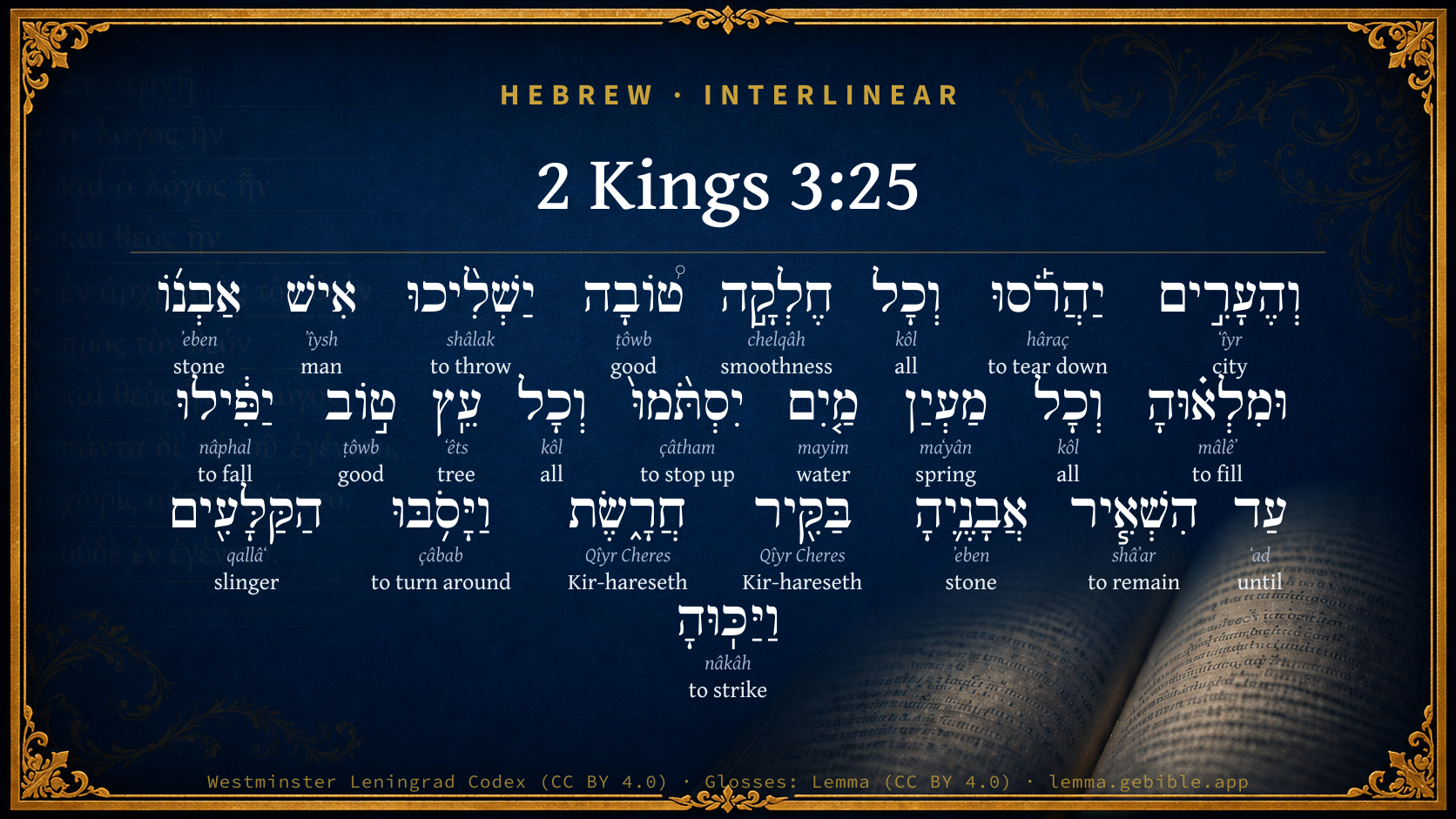
Hebrew (Westminster Leningrad Codex) 2 Kings 3:25 appears in the Hebrew Old Testament. The text above is from the Westminster Leningrad Codex. Each word links to its Strong’s number, a concise gloss, and parsing drawn from the Open Scriptures Hebrew Bible morphology. Click any word for its full Brown-Driver-Briggs (BDB) entry.
Download image
Cite this verse

2 Kings 3:25 (World English Bible). Public Domain. Lemma interlinear Bible study tool, https://lemma.gebible.app/v/2-kings/3/25.

Show BibTeX & RIS
BibTeX
RIS
English Translation
They beat down the cities; and on every good piece of land they cast every man his stone, and filled it; and they stopped all the springs of water, and felled all the good trees, until in Kir Hareseth [only] they left the stones of it; however the men armed with slings went about it, and struck it.
World English Bible · Public Domain
Highlights
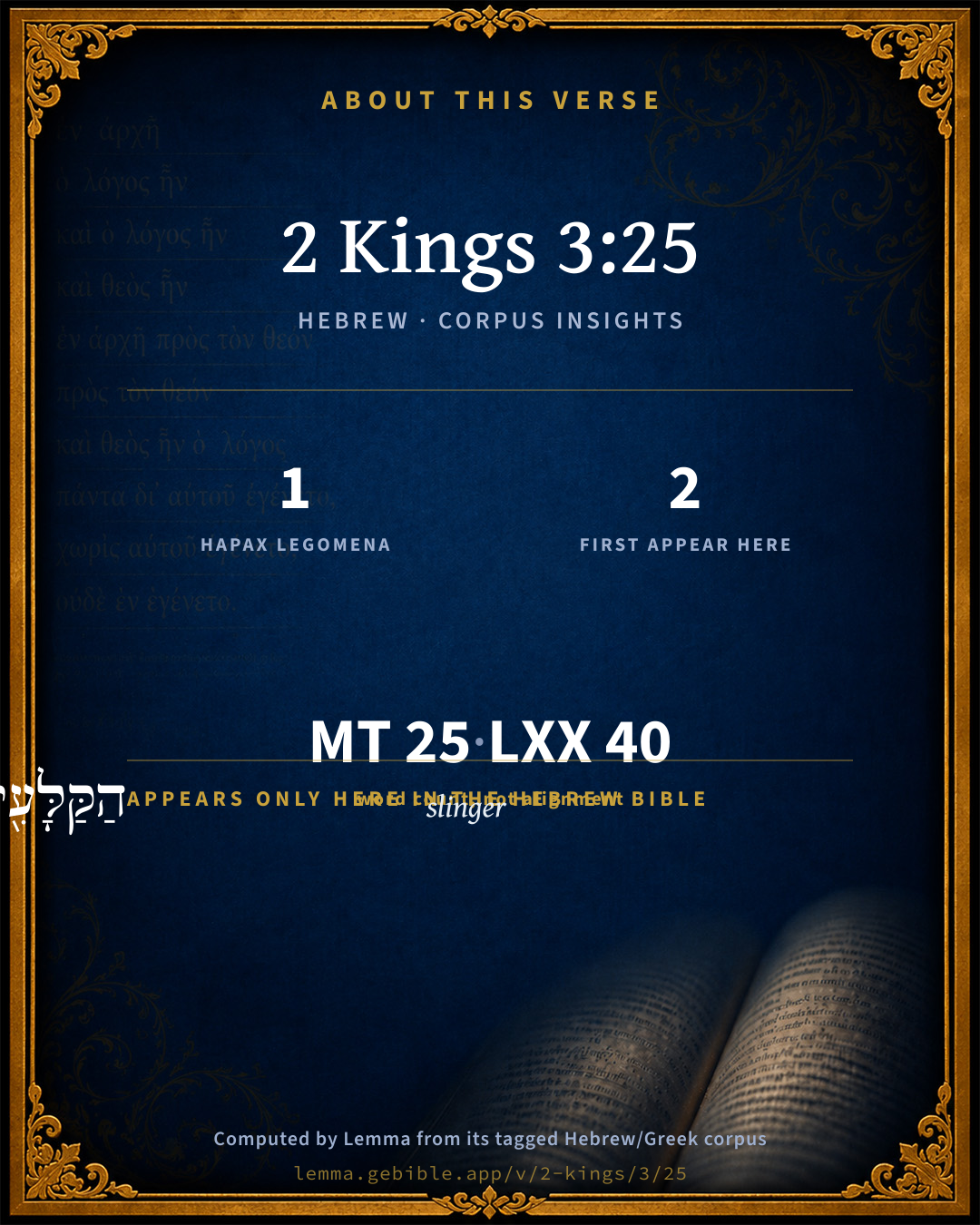
  • 1 hapax legomenon — only here in the Hebrew Bible
  • 2 first appearances in the Hebrew Bible
Full analysis ↓
Download a study sheet

One document with this verse’s original text, its word-by-word gloss line, the meaning frame, cross-references with their text, attributed commentary, and full source and license credits — printable, and it pastes into notes with its structure intact.

This verse Autodidact and up

Study sheet (.html) Plain text (.txt)

A passage Seminary Student

Up to 50 verses in one chapter. A passage sheet keeps up to 6 commentary sources and 12 cross-references per verse, in the order this page ranks them, and says so on the sheet whenever that leaves anything out. Ask for a single verse and you get the Autodidact verse sheet above.

Everything on this page stays free to read, with no account — the sheet is a download of what is already on screen, not access to it.

Want to remove ads? Support Godless Engineer
Compare translations 3

The same verse in 3 English versions, stacked beneath the original-language interlinear above. Click any original word for its lexicon entry.

Each is an independent rendering of the whole verse — the interlinear is not word-aligned to these translations.

Highlighted words mark where these versions differ — a whole-verse word diff, not a word-by-word alignment.

  • World English Bible Public Domain
    They beat down the cities; and on every good piece of land they cast every man his stone, and filled it; and they stopped all the springs of water, and felled all the good trees, until in Kir Hareseth [only] they left the stones of it; however the men armed with slings went about it, and struck it.
  • King James Version Public Domain
    And they beat down the cities, and on every good piece of land cast every man his stone, and filled it; and they stopped all the wells of water, and felled all the good trees: only in Kirharaseth left they the stones thereof; howbeit the slingers went about it, and smote it.
  • unfoldingWord Literal Text CC BY-SA 4.0
    And they tore down the cities, and they threw, a man his stone, every good portion and filled it. And they stopped up every spring of water, and they felled every good tree, until one left its stones in Kir Hareseth. And the slingers went around, and they struck it.

unfoldingWord Literal Text — © unfoldingWord, licensed CC BY-SA 4.0. Word-aligned USFM3 via Door43 (git.door43.org/unfoldingWord/en_ult).

Versions to compare (up to 4)

3 of 4 selected

Show all 18 translations

Every available English version of this verse, each an independent rendering of the whole verse.

  • World English Bible Public Domain
    They beat down the cities; and on every good piece of land they cast every man his stone, and filled it; and they stopped all the springs of water, and felled all the good trees, until in Kir Hareseth [only] they left the stones of it; however the men armed with slings went about it, and struck it.
  • Berean Standard Bible Public Domain
    They destroyed the cities, and each man threw stones on every good field until it was covered. They stopped up every spring and cut down every good tree. Only Kir-haraseth was left with stones in place, but men with slings surrounded it and attacked it as well.
  • Majority Standard Bible Public Domain
    They destroyed the cities, and each man threw stones on every good field until it was covered. They stopped up every spring and cut down every good tree. Only Kir-haraseth was left with stones in place, but men with slings surrounded it and attacked it as well.
  • King James Version Public Domain
    And they beat down the cities, and on every good piece of land cast every man his stone, and filled it; and they stopped all the wells of water, and felled all the good trees: only in Kirharaseth left they the stones thereof; howbeit the slingers went about it, and smote it.
  • American Standard Version (1901) Public Domain
    And they beat down the cities; and on every good piece of land they cast every man his stone, and filled it; and they stopped all the fountains of water, and felled all the good trees, until in Kir-hareseth `only' they left the stones thereof; howbeit the slingers went about it, and smote it.
  • Revised Version (1885) Public Domain
    And they beat down the cities; and on every good piece of land they cast every man his stone, and filled it; and they stopped all the fountains of water, and felled all the good trees: until in Kir-hareseth only they left the stones thereof; howbeit the slingers went about it, and smote it.
  • Geneva Bible (1599) Public Domain
    And they destroyed the cities: and on all the good field euery man cast his stone, and filled them and they stopt all the fountaines of water, and felled all the good trees: onely in Kirharaseth left they the stones thereof: howebeit they went about it with slings, and smote it.
  • Douay-Rheims (1899) Public Domain
    And they destroyed the cities: and they filled every goodly field, every man casting his stone: and they stopt up all the springs of waters: and cut down all the trees that bore fruit, so that brick walls only remained: and the city was beset by the slingers, and a great part thereof destroyed.
  • Young's Literal Translation Public Domain
    and the cities they break down, and `on' every good portion they cast each his stone, and have filled it, and every fountain of water they stop, and every good tree they cause to fall -- till one had left its stones in Kir-Haraseth, and the slingers go round and smite it.
  • Literal Standard Version CC BY-SA 4.0
    and they break down the cities, and they each cast his stone [on] every good portion, and have filled it, and they stop every fountain of water, and they cause every good tree to fall—until one had left its stones in Kir-Haraseth, and the slingers go around and strike it.
  • Unlocked Literal Bible CC BY-SA 4.0
    They destroyed the cities, and on every good piece of land every man threw a rock until it was covered up. They stopped up every spring of water and chopped down all the good trees. Only Kir Hareseth was left with its rocks in place. But the soldiers armed with slings surrounded and attacked it.
  • unfoldingWord Literal Text CC BY-SA 4.0
    And they tore down the cities, and they threw, a man his stone, every good portion and filled it. And they stopped up every spring of water, and they felled every good tree, until one left its stones in Kir Hareseth. And the slingers went around, and they struck it.
  • Darby Bible Public Domain
    And they beat down the cities, and on every good piece of land cast every man his stone and filled it, and they stopped every well of water, and felled every good tree, until they left [only] the stones at Kirhareseth; and the slingers went about it, and smote it.
  • World Messianic Bible Public Domain
    They beat down the cities; and on every good piece of land each man cast his stone, and filled it. They also stopped all the springs of water and cut down all the good trees, until in Kir Hareseth all they left was its stones; however the men armed with slings went around it and attacked it.
  • Webster's Bible Public Domain
    And they beat down the cities, and on every good piece of land cast every man his stone, and filled it; and they stopped all the wells of water, and felled all the good trees: only in Kirhara-seth they left the stones of it; but the slingers went about it, and smote it.
  • Free Bible Version CC BY-SA 4.0
    They destroyed the towns, and each soldier threw stones on every good field until it was covered. They blocked up every spring and chopped down every good tree. Only Kir-haraseth still had its walls, but soldiers using slingshots surrounded it and attacked it as well.
  • Bible in Basic English Public Domain
    Pulling down the towns, covering every good field with stones, stopping up all the water-springs, and cutting down all the good trees; they went on driving Moab before them till only in Kir-hareseth were there any Moabites; and the fighting-men went round the town raining stones on it.
  • JPS Tanakh (1917) Public Domain
    And they beat down the cities; and on every good piece of land they cast every man his stone, and filled it; and they stopped all the fountains of water, and felled all the good trees; until there was left only Kir-hareseth with the stones of the wall thereof; so the slingers encompassed it, and smote it.

Literal Standard Version (2020), Covenant Press — licensed CC BY-SA 4.0. Text via the HelloAO Bible API (eBible.org). Unlocked Literal Bible (unfoldingWord) — licensed CC BY-SA 4.0. Text via the HelloAO Bible API (eBible.org). unfoldingWord Literal Text — © unfoldingWord, licensed CC BY-SA 4.0. Word-aligned USFM3 via Door43 (git.door43.org/unfoldingWord/en_ult). Free Bible Version, Dr. Jonathan Gallagher — licensed CC BY-SA 4.0. Text via the HelloAO Bible API (eBible.org).

Word by word

More ways to search: Search by grammar → Find every occurrence → Compare this word →

Practice this passage: Drill this verse → Learn its vocabulary →

הַקַּלָּעִ֖ים
qallâʻ
H7051
“the · slingers”
Particle, Definite Article + Noun, Common, Masculine, Plural, Absolute
Part of Speech
Particle + Noun
Type
Common
Gender
Masculine
Number
Plural
State
Absolute
Full BDB Definition

Origin: intensive from H7049

TWOT: 2030b

slinger
  1. וְהֶעָרִ֣ים ʻîyr H5892 “and · the · cities” Conjunction + Particle, Definite Article + Noun, Common, Feminine, Plural, Absolute
  2. יַהֲרֹ֡סוּ hâraç H2040 “to tear down” Verb, Qal, Imperfect, 3rd Person, Masculine, Plural
  3. וְכָל kôl H3605 “and · all of” Conjunction + Noun, Common, Masculine, Singular, Construct
  4. חֶלְקָ֣ה chelqâh H2513 “smoothness” Noun, Common, Feminine, Singular, Absolute
  5. ט֠וֹבָה ṭôwb H2896 “good” Adjective, Adjective, Feminine, Singular, Absolute
  6. יַשְׁלִ֨יכוּ shâlak H7993 “to throw” Verb, Hiphil, Imperfect, 3rd Person, Masculine, Plural
  7. אִישׁ ʼîysh H376 “man” Noun, Common, Masculine, Singular, Absolute
  8. אַבְנ֜וֹ ʼeben H68 “stone · his” Noun, Common, Feminine, Singular, Construct + Suffix, Personal, 3rd Person, Masculine, Singular
  9. וּמִלְא֗וּהָ mâlêʼ H4390 “and · to fill · her” Conjunction + Verb, Piel, Sequential Perfect, 3rd Person, Common, Plural + Suffix, Personal, 3rd Person, Feminine, Singular
  10. וְכָל kôl H3605 “and · all of” Conjunction + Noun, Common, Masculine, Singular, Construct
  11. מַעְיַן maʻyân H4599 “spring of” Noun, Common, Masculine, Singular, Construct
  12. מַ֤יִם mayim H4325 “water(s)” Noun, Common, Masculine, Plural, Absolute
  13. יִסְתֹּ֨מוּ֙ çâtham H5640 “to stop up” Verb, Qal, Imperfect, 3rd Person, Masculine, Plural
  14. וְכָל kôl H3605 “and · all of” Conjunction + Noun, Common, Masculine, Singular, Construct
  15. עֵֽץ ʻêts H6086 “tree” Noun, Common, Masculine, Singular, Absolute
  16. ט֣וֹב ṭôwb H2896 “good” Adjective, Adjective, Masculine, Singular, Absolute
  17. יַפִּ֔ילוּ nâphal H5307 “to fall” Verb, Hiphil, Imperfect, 3rd Person, Masculine, Plural
  18. עַד ʻad H5704 “until” Preposition
  19. הִשְׁאִ֧יר shâʼar H7604 “to remain” Verb, Hiphil, Perfect, 3rd Person, Masculine, Singular
  20. אֲבָנֶ֛יהָ ʼeben H68 “stones · her” Noun, Common, Feminine, Plural, Construct + Suffix, Personal, 3rd Person, Feminine, Singular
  21. בַּקִּ֖יר Qîyr Cheres H7025 “in/at the · Kir-hareseth” Preposition, Determined + Noun, Proper
  22. חֲרָ֑שֶׂת Qîyr Cheres H7025 “Kir-hareseth” Noun, Proper
  23. וַיָּסֹ֥בּוּ çâbab H5437 “and · to turn around” Conjunction + Verb, Qal, Sequential Imperfect, 3rd Person, Masculine, Plural
  24. וַיַּכּֽוּהָ nâkâh H5221 “and · to strike · her” Conjunction + Verb, Hiphil, Sequential Imperfect, 3rd Person, Masculine, Plural + Suffix, Personal, 3rd Person, Feminine, Singular

About this verse

These counts appear in no published source. They are computed here, from the morphology-tagged text and Lemma’s own curated glosses. What Lemma adds →

25
words
20
distinct lemmas
Historical
section

Notable vocabulary

1 hapax legomenon — a word that appears only here in the entire Hebrew Bible:

  • הַקַּלָּעִ֖ים slinger H7051

First appearance in Scripture

These words make their first canonical appearance in the Hebrew Bible here:

  • בַּקִּ֖יר Kir-hareseth H7025
  • הַקַּלָּעִ֖ים slinger H7051

Shared distinctive vocabulary

בַּקִּ֖יר Kir-hareseth H7025 occurs in 5 verses of the Hebrew Bible. Also found in:

Grammatical profile

  • 8 verbs
  • 14 nouns
  • 2 adjectives
  • 1 preposition

Verb forms

  • יַהֲרֹ֡סוּ Qal · Imperfect
  • יַשְׁלִ֨יכוּ Hiphil · Imperfect
  • וּמִלְא֗וּהָ Piel · Sequential Perfect
  • יִסְתֹּ֨מוּ֙ Qal · Imperfect
  • יַפִּ֔ילוּ Hiphil · Imperfect
  • הִשְׁאִ֧יר Hiphil · Perfect
  • וַיָּסֹ֥בּוּ Qal · Sequential Imperfect
  • וַיַּכּֽוּהָ Hiphil · Sequential Imperfect

Repetition

Words recur within this verse — often emphatic in Hebrew:

  • וְכָל all H3605 ×3
  • ט֠וֹבָה good H2896 ×2
  • אַבְנ֜וֹ stone H68 ×2
  • בַּקִּ֖יר Kir-hareseth H7025 ×2

Hebrew & Septuagint length

In English translation the verse runs 58 words from the Hebrew and 51 from the Septuagint (LXX English) — closely comparable.

A rough comparison of the two English renderings, which tokenize alike — not a word-level alignment.

Word counts can differ between the Hebrew and the Greek without any difference in meaning — e.g. the Hebrew direct-object marker אֵת has no separate Greek word, and Greek often adds the article ὁ.

In the original languages it is 25 Hebrew tokens and 40 Greek tokens — but the two are counted differently (Hebrew bundles its prefixes and suffixes into one token; the Greek is in lemma form), so that isn’t a like-for-like length.

Cross-references

14

Topical passages linked to 2 Kings 3:25 in the Treasury of Scripture Knowledge — connected by theme and wording, ordered by reader-vote popularity; previews shown in the World English Bible.

  • 2 Kings 3:19 You shall strike every fortified city, and every choice city, and shall fell every good tree, and stop all springs of water, and mar every good piece of land with stones.
  • Isaiah 16:7 Therefore shall Moab wail for Moab, everyone shall wail: for the raisin-cakes of Kir Hareseth shall you mourn, utterly stricken.
  • Jeremiah 48:31 Therefore will I wail for Moab; yes, I will cry out for all Moab: for the men of Kir Heres shall they mourn.
  • Jeremiah 48:36 Therefore my heart sounds for Moab like pipes, and my heart sounds like pipes for the men of Kir Heres: therefore the abundance that he has gotten is perished.
  • Isaiah 16:11 Why my heart sounds like a harp for Moab, and my inward parts for Kir Heres.
  • Genesis 26:15 Now all the wells which his father's servants had dug in the days of Abraham his father, the Philistines had stopped, and filled with earth.
  • Genesis 26:18 Isaac dug again the wells of water, which they had dug in the days of Abraham his father. For the Philistines had stopped them after the death of Abraham. He called their names after the names by which his father had called them.
  • Deuteronomy 2:9 Yahweh said to me, Don't bother Moab, neither contend with them in battle; for I will not give you of his land for a possession; because I have given Ar to the children of Lot for a possession.
  • Deuteronomy 20:19–20 When you shall besiege a city a long time, in making war against it to take it, you shall not destroy the trees of it by wielding an axe against them; for you may eat of them, and you shall not cut them down; for is the tree of the field man, that it should be besieged of you?
  • Judges 9:45 Abimelech fought against the city all that day; and he took the city, and killed the people who were therein: and he beat down the city, and sowed it with salt.
  • 2 Samuel 8:2 He struck Moab, and measured them with the line, making them to lie down on the ground; and he measured two lines to put to death, and one full line to keep alive. The Moabites became servants to David, and brought tribute.
  • 2 Chronicles 32:4 So there was gathered much people together, and they stopped all the springs, and the brook that flowed through the midst of the land, saying, Why should the kings of Assyria come, and find much water?
  • Isaiah 15:1 The burden of Moab. For in a night Ar of Moab is laid waste, [and] brought to nothing; for in a night Kir of Moab is laid waste, [and] brought to nothing.
  • Isaiah 37:26–27 Have you not heard how I have done it long ago, and formed it of ancient times? now have I brought it to pass, that it should be your to lay waste fortified cities into ruinous heaps.

Cross-references courtesy of OpenBible.info (CC BY 4.0).

Hebrew and Greek witnesses Masoretic Hebrew ↔ Greek Septuagint

The same verse in the two great witnesses to the Old Testament, shown verse-for-verse.

These are two independent witnesses, not word-aligned to each other, and the Septuagint is shown in lemma (dictionary) form.

Hebrew 2 Kings 3:25 Masoretic · Westminster Leningrad Codex

וְהֶעָרִ֣ים יַהֲרֹ֡סוּ וְכָל חֶלְקָ֣ה ט֠וֹבָה יַשְׁלִ֨יכוּ אִישׁ אַבְנ֜וֹ וּמִלְא֗וּהָ וְכָל מַעְיַן מַ֤יִם יִסְתֹּ֨מוּ֙ וְכָל עֵֽץ ט֣וֹב יַפִּ֔ילוּ עַד הִשְׁאִ֧יר אֲבָנֶ֛יהָ בַּקִּ֖יר חֲרָ֑שֶׂת וַיָּסֹ֥בּוּ הַקַּלָּעִ֖ים וַיַּכּֽוּהָ

They beat down the cities; and on every good piece of land they cast every man his stone, and filled it; and they stopped all the springs of water, and felled all the good trees, until in Kir Hareseth [only] they left the stones of it; however the men armed with slings went about it, and struck it.

World English Bible · Public Domain

Greek LXX 2 Kings 3:25 Septuagint · lemma form

καί ὁ πόλις κατααἱρέω καί πᾶς μερίς ἀγαθός ῥίπτω ἀνήρ ὁ λίθος καί ἐνπίμπλημι αὐτός καί πᾶς πηγή ὕδωρ ἐνφράσσω καί πᾶς ξύλον ἀγαθός καταβάλλω ἕως ὁ καταλείπω ὁ λίθος ὁ τοῖχος κατααἱρέω καί κυκλεύω ὁ σφενδονήτης καί πατάσσω αὐτός

And they razed the cities, and cast every man his stone on every good piece of land and filled it; and they stopped every well, and cut down every good tree, until they left only the stones of the wall cast down; and the slingers compassed the land, and struck it.

LXX2012 (modern English Septuagint) · Public Domain

On this verse, The Pulpit Commentary discusses the Septuagint’s reading. Read the note in Commentary ↓

Hebrew: Westminster Leningrad Codex (CC BY 4.0). Greek: Septuagint (public domain); English from LXX2012 (modern English Septuagint) (Public Domain). How the Septuagint differs from the Hebrew →

Targum (Aramaic paraphrase)

1

The Targum is the ancient Jewish Aramaic paraphrase of the Hebrew Scriptures — an interpretive translation, not the Hebrew text itself. Onkelos (literal) and Pseudo-Jonathan (expansive) render the Torah, and Jonathan the Prophets. Coverage is partial: where no permissively-licensed English translation exists for a verse, only the Aramaic is shown. This is verse-level text, not a word-by-word alignment to the Hebrew.

  1. Targum Jonathan Prophets (Joshua–Malachi)
    וְקִרְוַיָא פַּגָרוּ וְכָל אַחֲסַנְתָּא שַׁפִּירָא רְמוֹ גְבַר אַבְנֵיהּ וּמַלְאוּהָא וְכָל מַבּוּעֵי מַיָא סְתָמוּ וְכָל אִילָן דְיָאֵי עֲקָרוּ עַד דְלָא אִשְׁתַּאֲרַת אַבְנָא בְּקַרְתָּא דְלָא פַּגְרוּהָא וְאִסְתַּחֲרוּ קְלָעַיָא וּמְחוּהָא:

    (no public-domain English translation for this verse)

    Targum Jonathan — Aramaic: “Mikraot Gedolot” (public domain). English: “Sefaria Community Translation” (CC0 1.0 (public-domain dedication)); “London "Chaldee Paraphrase," 1871” (public domain). Text via Sefaria.

Commentary

Notes on 2 Kings 3:25 from classic Christian and Jewish commentators (each source and its license shown beneath its notes). The classic Christian expositions comment on the surrounding passage and are grouped to its opening verse, so a note may address several verses; the Jewish commentaries on the Tanakh (Rashi and others) are per-verse, so they appear only where the commentator wrote on this verse.

Lemma curates 59 commentaries, every one of them public domain or Creative Commons licensed, each selected and text-cleaned for this edition rather than reprinted as found. About our sources →

Trapp's Complete Commentary

John Trapp

2Ki 3:25 And they beat down the cities, and on every good piece of land cast every man his stone, and filled it; and they stopped all the wells of water, and felled all the good trees: only in Kirharaseth left they the stones thereof; howbeit the slingers went about [it], and smote it.

Ver. 25. Only in Kirhareseth.] The strongest city in Moab. See Isa 16:11.

Left they the stones thereof,] i.e., The stone walls, which, being very strong, and, in addition, well manned and defended by the king of Moab, who was fled there with his forces, were not rased and harassed as the rest.

John Trapp, A Commentary or Exposition upon All the Books of the Old and New Testament (1647–1656) — public domain. Text from a community e-Sword module.

Joseph Benson's Commentary

2Ki 3:25. They stopped all the wells of water, &c. — These, in all probability, are hyperbolical expressions, signifying the great devastation which they made. Only in Kir-haraseth left they the stones thereof — This was the royal city of Moab, into which the remnant of the Moabites were gathered, and where also their king was with them. The wall and buildings of this city only were left; their whole country being destroyed. Howbeit the slingers went about it, and smote it — By slinging stones, they drove those from the wall who defended it, and by raising batteries against it, made great breaches therein, by which they might enter the city and take it.

Joseph Benson's Commentary on the Old and New Testaments (1811–1818) — public domain. Text from a community e-Sword module.

Geneva Bible (1599)

Geneva Bible translators

Which was one of the principle cities of the Moabites, wherein they left nothing but the walls.

Geneva Bible (1599) marginal notes — public domain. Text via Bolls.life.

Jamieson, Fausset & Brown

Robert Jamieson, A. R. Fausset & David Brown

Kir-haraseth--(now Kerak)--Castle of Moab--then, probably, the only fortress in the land.

Jamieson, Fausset & Brown — Commentary Critical and Explanatory on the Whole Bible (1871) — public domain (CC PDM 1.0). Text via the HelloAO Bible API.

Adam Clarke's Commentary

Verse 25. On every good piece of land] On all cultivated ground, and especially fields that were sown.

Only in Kir-haraseth] This was the royal city of the Moabites, and, as we learn from Scripture, exceedingly strong; (see Isa 16:7; Isa 16:11); so that it is probable the confederate armies could not easily reduce it. The slingers, we are informed, went about the wall, and smote all the men that appeared on it, while no doubt the besieging army was employed in sapping the foundations.

Adam Clarke's Commentary on the Bible (1810–1826) — public domain. Text from a community e-Sword/MySword module.

Ellicott's Commentary for English Readers

(25) And they beat down the cities.—Rather, And the cities they would overthrow, describing what happened again and again.

On every . . . filled it.—Literally, And every good plot, they would cast each man his stone, and fill it; and every fountain of water they would stop, and every good tree they would fell. All this as Elisha foretold, 2Ki_3:19.

Only in Kir-haraseth left they the stones thereof.—Literally, as margin, until one left her stones in Kir-harèseth. This clause connects itself with the opening statement, “And the cities they would overthrow (or, kept overthrowing) until her stones were left in Kir-harèseth,” i.e., the work of destruction stopped before the walls of this, the principal strong-hold of the country. In the other cities the invaders had not left one stone upon another.

Kir-haraseth.—Called “Kir-moab,” Isa_15:1, and “Kir-hères,” Isa_16:11. The Targum on Isaiah 15 calls it “Kerak (castle) of Moab,” and it still bears that name. It stands upon a steep cliff of chalk.

Howbeit the slingers went about it.—And the slingers went round, surrounded it.

And smote it—i.e., shot at the men on the walls with deadly effect.

A Bible Commentary for English Readers, edited by Charles John Ellicott (1878–1897) — public domain. Text from a community e-Sword module.

The Cambridge Bible for Schools and Colleges

gen. ed. J. J. S. Perowne

25. cast every man his stone] Thus ensuring that the ground should be made, for a long time to come, useless for the pasturage of flocks.

only in Kirharaseth left they the stones thereof] R.V. until in Kirhareseth only they left the stones thereof. It will be seen from the margin of A.V. that the R.V. approaches more nearly to the literal sense of the Hebrew. What is meant to be expressed is that the only town of which the stone walls were allowed to remain was this capital city of Moab. Probably it was the only city with any solidity of walls. A pastoral people, such as the Moabites were, have very little need for fenced towns. Kirhareseth (for so the name is pointed) is the same which in Isa_15:1 is called Kir of Moab, and in Jer_48:31; Jer_48:36 Kir-heres. As Kir signifies ‘wall’ or ‘fortress’, there appears much probability that this was the only very great stronghold in the land, though Ar of Moab is mentioned as a fortified town (Num_21:28; Isa_15:1). The other village-like settlements were easily dismantled, and their stones served to strew and ruin the pastures. All that was attempted on the stronger place was to clear its walls of their defenders by means of slingers.

The Cambridge Bible for Schools and Colleges (gen. ed. J. J. S. Perowne; Cambridge University Press, 1878–1918) — public domain. Text from a community e-Sword module.

Albert Barnes' Notes on the Bible

Kir-Haraseth, also Kir-Hareseth, is identified almost certainly with the modern Kerak, a strong city on the highland immediately east of the southern part of the Dead Sea. It was the great fortress of Moab, though not the capital, which was Rabbath or Rabbah. It was an important strong-hold at the time of the Crusades, and is still a place of great strength. Kir seems to have meant “fortress.” It is found in Cir-cesium, Car-chemish, etc.

Kir-Haraseth resisted all the attempts to dismantle it; but the slingers found places on the hills which surrounded it, from where they could throw their stones into it and harass the garrison, though they could not take the town.

Albert Barnes' Notes on the Bible (1834–1885) — public domain. Text from a community e-Sword/MySword module.

Haydock's Catholic Bible Commentary

CHAPTER III.

Brick walls. It was the proper name of the city of the Moabites. In Hebrew, Kir-Charaseth. (Challoner) --- Isaias xv., and xvi. 7. It was also called Ar, or Arcopolis. --- Remained. Hebrew adds, "with the stones unmolested." They laid siege to it. (Haydock) --- Slingers. Grotius would understand those who attended the machines designed to throw stones, &c. But the slingers kept off the enemy, while others undermined the walls. (Calmet)

George Leo Haydock (1774–1849), Haydock's Catholic Family Bible and Commentary, 1859 edition — public domain. Excludes Psalms (Douay-Rheims chapter numbering differs from Protestant) and Deuterocanonical books (Catholic canon only).

Matthew Poole's English Annotations

Cast every man his stone: the stones which haply had been with great care and pains picked out of the land, and laid in heaps after the manner, they dispersed again, and slew the people, who should have cleansed them again.

Kir-haraseth was the royal and strongest city of the Moabites, Isa 16:7,11, into which the remnant of the Moabites were gathered, where also their king was with them.

The stones thereof: the walls and buildings of this city only were left; other cities, and in a manner their whole country, being utterly destroyed.

The slingers; either, first, such as slung small stones against those that stood upon the wall to defend it; or rather, secondly, Such as slung great stones against the walls to break them down, according to the manner of those times.

Smote it, i.e. made breaches in the walls, by which they might enter into the city, and take it.

Matthew Poole's English Annotations on the Holy Bible (1683–1685) — public domain. Text from a community e-Sword/MySword module.

Whedon's Commentary on the Bible

Daniel D. Whedon

25. Cast every man his stone — A vast host could in this way quickly even bury a field with stones. Compare note on 2Ki_3:19.

Stopped all the wells — “Wells, dug at great expense, were regarded as very valuable possessions. Isaac was a great well-digger, prompted thereto by the necessity of his vast flocks. To stop up wells was the most pernicious and destructive species of vengeance, the surest way to convert a flourishing country into a frightful wilderness.” — Thomson.

Kir-haraseth — Called also Kir-haresh, (Isa_16:11,) Kir-heres, (Jer_48:31,) and Kir of Moab, (Isa_15:1.) Its modern name is Kerak. The spot has been visited and described by several travellers. It was the chief city of the Moabites, and is situated on a plateau of high land ten miles east of the southern end of the Dead Sea, and some three thousand feet above the level of its waters. It occupies the top of a steep hill, and is surrounded on all sides by deep and narrow valleys, beyond which tower up lofty hills, cutting off all prospect in the distance except towards the northwest, where the deep Wady Kerak opens a prospect to the Dead Sea, and, in a clear day, even to Bethlehem and Jerusalem. The city is still enclosed by a partially ruined wall, flanked by seven massive towers.

Slingers went about it, and smote it — From the surrounding hills, which overlook the city, they could hurl stones so as to smite many of the inhabitants.

Daniel D. Whedon (gen. ed.), Commentary on the Old and New Testaments (1874–1909) — public domain. Text from a community e-Sword module.

The Pulpit Commentary

And they beat down the citiesi.e. destroyed them leveled them with the groundand on every good piece of land cast every man his stone (see ver. 19 and the comment ad loc.), and filled it with stones. And they stopped all the wells of water, and felled all the good treesi.e. the fruit trees, dendra hmera (Josephus)only in Kir-haraseth left they the stones thereof; literally, until in Kir-haraseth i.e. , in Kir-haraseth only left he the stones thereof. He (i.e. the commander, or the army) went on destroying and leveling the cities, until he came to Kir-haraseth, which proved too strong for him. There he was obliged to leave the stones untouched. Kir-haraseth, which is not mentioned among the early Moabite towns, nor even upon the Moabite Stone, and which is therefore thought to have been a newly constructed fortress (Ewald), was, in the later times, one of the most important of the strongholds of Moab (see Isa_15:1 Isa_16:7, Isa_16:11; Jer_48:36) It was sometimes called Kir-Moab, "the fortress of Moab." At what time it got the name of Kerak is uncertain; but we find it spoken of as Kerak-Moab by Ptolemy (about A.D. 150), and by Stephen of Byzantium (about A.D. 530). It was a place of much importance in the time of the Crusades.The situation is one of great strength. The fortress is built upon the top of a steep hill, surrounded on all sides by a deep arid narrow valley, which again is completely enclosed by mountains, rising higher than the fort itself. It is undoubtedly one of the strongest positions within the territory anciently possessed by the Moabites. Howbeit the slingers went about it, and smote it. Ewald thinks that by slingers" are meant, not mere ordinary slingers, but persons who worked more elaborate engines, as catapults and the like ("History of Israel," vol. 4. p. 89, note, Eng. trans.). He is undoubtedly correct in saying that "all sorts of elaborate modes of attacking fortifications were very early known in Asia;" but it is very questionable whether the Hebrew word used ( can mean anything but "slingers" in the usual sense. The LXX translate by sfendonhtai. The situation is one which would allow of "slingers," in the ordinary sense, sending their missiles into the place, and grievously harassing it.

The Pulpit Commentary (1880–1919), ed. H.D.M. Spence-Jones & Joseph S. Exell — public domain. Text from a community e-Sword module.

John Wesley's Explanatory Notes

Kir-haraseth - This was the royal city of the Moabites, into which the remnant of the Moabites were gathered, where also their king was with them. The stones - The walls and buildings of this city only were left; their whole country being destroyed. The slingers - Such as slung great stones against the walls to break them down, according to the manner of those times. Made breaches in the walls, by which they might enter the city, and take it.

John Wesley, Explanatory Notes Upon the Whole Bible (1754–1765) — public domain. Text via the GEBible commentary corpus.

Rashi

Rabbi Shlomo Yitzchaki (Rashi)

They demolished the cities. They would destroy the cities.

Each man threw his stone. For they would take stones from the walls until they left all the stones of the walls in the wall, with only their clay, [i.e.,] their mortar; i.e., there were no more stones in the wall. Afterwards, “and the catapulters surrounded it,” and destroyed that which remained in the fields where the wall was not broken, and tore it down.

Rashi on the Tanakh — English translations: “The Judaica Press complete Tanach with Rashi, translated by A. J. Rosenberg” (CC BY 4.0); “Pentateuch with Rashi's commentary by M. Rosenbaum and A.M. Silbermann, 1929-1934” (public domain); “The Metsudah Tanach series, Lakewood, N.J” (CC BY 4.0); and “The Book of Joshua, Metsudah Publications, 1997” (CC BY 4.0). Text via Sefaria.

Lesson kit

Teaching starters — assembled from the data on this page, not authored interpretation. Every prompt links to the verse data it draws on. Edit before teaching.

2 Kings, in the Historical, opens this verse with 25 words (20 distinct Hebrew lemmas). Its most distinctive word is qallâʻ (“slinger”). A historical commentator’s framing appears above. Read the whole chapter for the surrounding context.

Discussion questions

  1. How does “slinger” (qallâʻ) shape what this verse is saying?
  2. This verse holds 1 word here found nowhere else in the Hebrew Bible. What might the rare word draw attention to?
  3. 2 words here appear for the first time in Scripture. What is being introduced at this debut?
  4. Isaiah 16:7 shares the word «Kir-hareseth» with this verse. How do the two illuminate each other?
  5. “all” occurs 3× in this one verse. What is the effect of the repetition?
  6. These translations render this verse differently. What is at stake in choosing one wording over another?
  7. The verb «יַהֲרֹ֡סוּ» is Qal Imperfect. How does its form color the action?
  8. Reading how Trapp's Complete Commentary and Joseph Benson's Commentary read this verse, where do the two commentators agree and where do they part?

Things to notice

  • 1 word in this verse appears nowhere else in the Hebrew Bible.
  • 2 words make their first canonical appearance in Scripture here.
  • This verse counts 25 Hebrew ↔ 40 Greek words.
  • These translations choose different wording for 31 words in this verse.
  • “all” occurs 3× in this single verse.

Reading settings

Reading text

Shown beneath each verse's original-language words.

Old Testament
Old Testament edition

Read the OT as the Masoretic Hebrew (MT) or the Greek Septuagint (LXX).

English shown for the Greek Septuagint (in the Hebrew ↔ Greek comparison).

Comparing translations? Open the Compare panel on any verse page to stack up to four side by side.